If you’ve spent any time in L&D, you’ve heard the terms pedagogy and andragogy thrown around — often interchangeably, sometimes incorrectly, and occasionally as a way to make a training deck sound more academic than it needs to be. But the distinction is worth understanding properly, because it changes real decisions: how you frame objectives, how much control you hand learners, how you structure activities, and how you assess whether learning actually happened.
Put simply, andragogy vs pedagogy describe two different sets of assumptions about learners — how much they already know, why they’re in the room, and how much direction they need. Adult learners in a workplace setting usually show up with prior experience, competing priorities, and a specific reason for being there, and ignoring that changes how they engage. This article works through both concepts, where they overlap, where they genuinely differ, and how to decide which fits a given training situation.
What Is Pedagogy?
Pedagogy is the theory and practice of teaching, traditionally associated with the education of children and young learners but used far more broadly across education today. The term comes from the Greek paidagogos — literally, one who leads children.
In its classical form, pedagogy assumes a fairly linear relationship: the instructor decides what will be learned, in what sequence, and how it will be evaluated, while the learner’s role is largely to absorb and demonstrate mastery of content chosen on their behalf.
That said, it’s a mistake to reduce pedagogy to “teacher talks, student listens.” In contemporary use, the term covers the general theory and practice of teaching and instructional design, regardless of learner age. Structured curricula, scaffolded skill-building, and direct instruction are pedagogical tools that are entirely appropriate for adults too, particularly when they’re encountering a subject for the first time.
In a training context, a pedagogical approach typically looks like:
- Content and sequencing determined primarily by the instructor or instructional designer
- Learners assumed to have little relevant prior knowledge of the specific topic
- Emphasis on foundational knowledge before independent application
- External standards driving what “success” looks like — a certification body, a regulation, a safety protocol
This isn’t a deficient version of andragogy. It’s simply the right toolkit for certain learning situations, which we’ll get into shortly.
What Is Andragogy?
Andragogy refers to a particular framework for thinking about how adults learn. The term itself predates its modern popularity — it was coined by German educator Alexander Kapp in 1833 to describe aspects of Plato’s educational theory, and later resurfaced among European adult educators in the early twentieth century.
Its widespread use in English-language adult education, however, is due to American educator Malcolm Knowles, who introduced and developed the concept through a series of works beginning in 1970, most notably The Modern Practice of Adult Education and The Adult Learner.
It’s worth being precise here: Knowles did not invent adult learning, and he didn’t coin the term andragogy. What he did was popularize and systematize it for an American, and later global, audience — framing it as a set of assumptions that tend to distinguish how adults approach learning, in contrast to a pedagogical model built around children.
Knowles proposed that adults tend to:
- Want to know why they’re learning something before investing effort in it
- See themselves as capable of directing their own learning, rather than being dependent learners
- Bring a body of experience that is itself a resource for learning
- Become ready to learn when something connects to a real-life task or problem they’re facing
- Orient toward solving problems rather than acquiring subject matter for its own sake
- Respond more to internal motivators — job satisfaction, self-esteem, career growth — than to external rewards alone, though external motivators still matter
These are best read as assumptions and design principles rather than universal laws — a point Knowles himself came to make explicitly, as the next section explains.
How Did Andragogy Become a Distinct Approach to Adult Learning?
The pedagogy/andragogy split that most training articles describe today wasn’t Knowles’ final position — it was closer to his starting one. His 1970 book, The Modern Practice of Adult Education, carried the subtitle Andragogy versus Pedagogy, presenting the two as opposing models.
By the 1980 revised edition, he’d changed the subtitle to From Pedagogy to Andragogy, and in a 1979 follow-up piece titled “Andragogy Revisited Part II,” he said framing the two as a strict “versus” had been a mistake — his assumptions were better understood as a continuum than a dichotomy, with both approaches appropriate for children and adults depending on the situation rather than age alone.
That revision matters for how the theory should be used today. Andragogy isn’t a separate system that replaces pedagogy once a learner turns 18 — it’s one end of a spectrum of instructional approaches, and where a given training situation sits on that spectrum depends on the learner’s experience, the subject matter, and the stakes involved, not a birthday.
Andragogy vs Adult Learning Theory: Are They the Same?
Not quite, and the distinction is worth making. Adult learning theory is the broader field of research into how adults acquire knowledge and skills — it includes andragogy alongside other frameworks, such as transformative learning and self-directed learning research that developed alongside and after Knowles’ work.
Andragogy is one influential framework within that field: a specific set of assumptions and design principles, not the entirety of adult learning research. Treating “andragogy” and “adult learning” as perfect synonyms glosses over decades of subsequent work that has both built on and challenged Knowles’ original assumptions.
Andragogy vs Pedagogy: Key Differences

The table below reflects traditional assumptions associated with each model — tendencies that inform instructional design, not fixed rules about how any individual learner behaves.
| Dimension | Traditional pedagogical assumptions | Andragogical assumptions |
| Learner’s role | Greater dependence on the instructor to direct learning | Greater capacity for self-direction |
| Instructor’s role | Teacher and director of the learning process | Facilitator who guides and supports learner-driven exploration |
| Learning orientation | Often subject- or content-centered | Often problem- or task-centered |
| Prior experience | May be limited or less central to instruction | Treated as a significant resource to build on |
| Motivation | External motivators (grades, compliance, requirements) may play a strong role | Internal motivation is emphasized, though external drivers still matter |
| Readiness to learn | Often linked to curriculum stage or developmental sequencing | Often linked to an immediate role, task, or need |
| Relevance | May be determined primarily by the curriculum or instructor | Explicitly connected to the learner’s own needs and goals |
| Learning environment | More formal, instructor-controlled | More collaborative, responsive to learner input |
| Assessment/feedback | Often standardized and instructor-set | Often includes self-assessment, practical application, and peer feedback |
A few caveats matter more than the table itself. An adult learning a completely unfamiliar technical skill may need a fairly pedagogical structure at first; a highly motivated learner of any age can display strongly andragogical behavior. The table is a starting frame, not a sorting mechanism.
What Are Knowles’ 6 Principles of Andragogy?
Knowles’ framework is commonly summarized as six core principles.
1. Need to know. Adults are generally more likely to engage when they understand why a topic matters before they invest effort in it. In practice: open a compliance module by explaining the actual risk it addresses, not just the policy reference number.
2. Self-concept. Adults generally see themselves as responsible for their own decisions, including learning decisions, and can resist being treated as passive recipients. In practice: offer choices in how learners approach a case study rather than dictating a single path.
3. Prior experience. Adults bring experience that shapes how they interpret new information — experience that can be leveraged, not just accommodated. In practice: in a leadership program, ask participants to relate a concept like delegation to a situation they’ve actually managed.
4. Readiness to learn. Adults often become more ready to learn something when it connects to a role transition or a task they’re currently facing. In practice: introduce a new CRM feature at the point where salespeople actually need it, not months in advance during a generic system overview.
5. Orientation to learning. Adults tend to lean problem-centered rather than subject-centered — oriented toward solving something rather than simply absorbing content. In practice: structure a workshop around a real workplace scenario the team is currently navigating.
6. Motivation. Internal motivators — recognition, confidence, career advancement — often carry meaningful weight, though external motivators such as mandatory certification remain legitimate too. In practice: tie a skills course explicitly to a career pathway or promotion criteria the learner cares about.
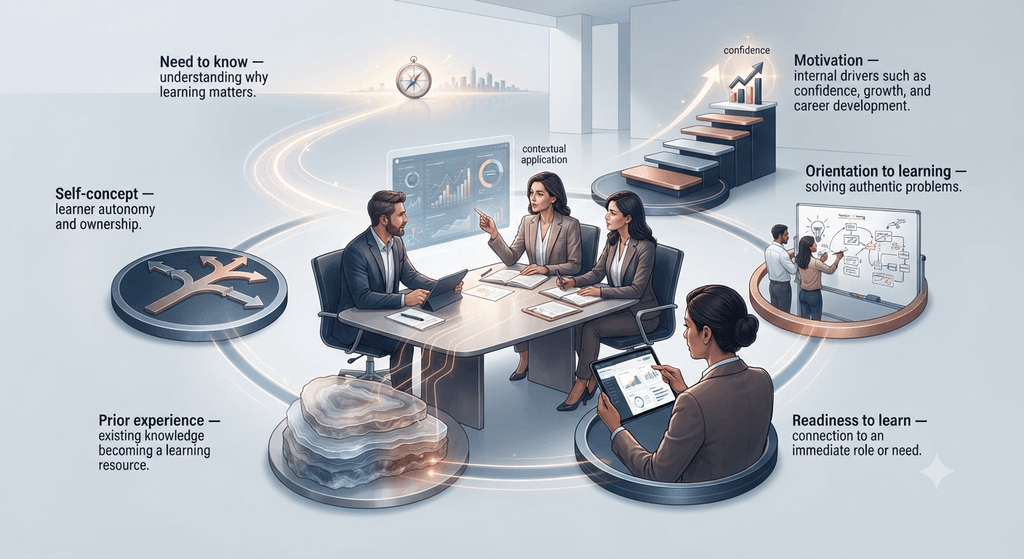
Each principle is a lens for making training decisions, not a checklist to satisfy mechanically — and, as the next sections cover, none of them describe every adult learner equally.
Andragogy vs Pedagogy in Training Design
Learning objectives. A pedagogical objective might read “learners will be able to list the five steps of the process.” An andragogically-informed objective might instead read “learners will be able to apply the process to resolve a customer escalation,” connecting the skill directly to a task the learner recognizes. Frameworks like Bloom’s Taxonomy are useful for writing objectives at the right cognitive level regardless of which approach you’re leaning on.
Content design. Andragogical content design front-loads relevance — why this matters, when they’ll use it — rather than opening with definitions and background theory. Pedagogical content design can still build foundational knowledge in a structured sequence when learners genuinely have no prior exposure.
Activities. Case studies drawn from the organization’s own situations, scenario-based decision exercises, and structured reflection all draw on learners’ experience and autonomy — the kind of experiential approach behind models like Kolb’s experiential learning cycle. Demonstrations, guided practice, and drills remain useful when learners are building an entirely new skill from scratch.
Facilitation. The trainer’s role shifts from presenter of content toward facilitator of application — asking questions, surfacing participant experience, and managing discussion rather than only lecturing. This is a genuinely different skill set, and one worth building deliberately (see our guide to facilitation skills for corporate trainers).
Assessment. Practical application, self-assessment, and structured peer feedback complement — rather than replace — traditional knowledge checks, especially where compliance or certification requires documented proof of competency. If you’re measuring whether any of this actually changes behavior on the job, the Kirkpatrick model is the standard reference point.
Andragogy in Corporate Training: Practical Examples
Leadership development. Less effective: a 45-minute lecture on leadership styles. More andragogical: managers bring a real employee-performance problem and apply the framework directly to it.
Sales training. Less effective: a generic scripted objection-handling module. More andragogical: reviewing real (or recorded) calls the team is currently handling and workshopping actual objections they’re hearing.
Software training. Less effective: an exhaustive feature-by-feature tour of the interface. More andragogical: sequencing training around the actual workflows employees perform, introducing features at the point of need.
Compliance training. Even where content and structure are necessarily pedagogical — dictated by regulation rather than learner preference — connecting each requirement to a real consequence or scenario can make the training feel more meaningful and easier to apply.
Onboarding. Pair structured, sequenced orientation content (systems, policies, terminology) with early opportunities for new hires to apply what they’ve learned to actual, low-stakes tasks. A solid training needs analysis upfront helps calibrate how much structure a given cohort actually needs.
Manager training. Less effective: an abstract framework delivered as a standalone workshop. More andragogical: building sessions around the specific team challenges managers are currently facing.

When Should Trainers Use Andragogy?
Andragogical principles tend to work particularly well when:
- Learners already have relevant experience they can connect new material to
- The goal is applying a skill to a real workplace problem rather than acquiring entirely new foundational knowledge
- Learners have some latitude to make decisions about how they approach the material
- The training supports professional development or career growth rather than compliance alone
- The objective is behavior change or performance improvement, not just information transfer

When Is a More Structured Approach Better?
Adults don’t automatically become fully self-directed experts simply because they’re adults, and andragogy shouldn’t be applied as a rigid formula regardless of context. A more structured, instructor-directed approach — closer to classic ADDIE-style sequencing — tends to make sense when:
- Learners are genuine beginners with little to no relevant prior knowledge
- The subject is highly technical and requires precise, sequential instruction
- The training covers safety-critical procedures where errors carry serious consequences
- Regulatory or legal requirements mandate specific content, sequencing, or assessment methods
- Learners need foundational knowledge before they can meaningfully direct their own application of it
Often, the most effective corporate training doesn’t choose one model exclusively — it opens with structured, pedagogically-sequenced foundations and shifts toward andragogical, application-focused work as learners build competence and confidence.
Should Trainers Use Andragogy or Pedagogy?
In most real-world training environments, the answer is neither exclusively. The right approach depends on the learner’s prior knowledge, the nature of the subject matter, the level of risk involved, regulatory constraints, and how much autonomy the learning objective actually calls for.
A simple framework for choosing an approach
Ask five questions about the group you’re designing for:
- How much does the learner already know about this specific topic?
- How much relevant prior experience can they bring to it?
- How much autonomy does the situation realistically allow?
- How risky is it if learners make mistakes while learning?
- Is the goal knowledge acquisition, skill development, or solving a real, current problem?
If the learner is largely a beginner, the risk of error is high, and sequencing matters — lean toward a more structured, instructor-led approach. If the learner has relevant experience, the problem is authentic, and some autonomy is possible — lean toward a stronger andragogical approach. Most training sits somewhere in between, which is exactly where blending both models earns its keep.
Is Andragogy Still Relevant?
Yes, with an important caveat: it’s a useful lens, not a settled, universally validated theory. Its emphasis on experience, relevance, and some measure of learner autonomy remains highly influential in adult and workplace education.
But the framework has real limitations worth knowing. Adult-education researchers, including Daniel Pratt in his reassessment of andragogy, have argued that treating “the adult learner” as a fairly homogeneous category overlooks how much adults actually vary in how much structure or independence they want, shaped by prior education, confidence, and background rather than age alone.
Others, including Stephen Brookfield in his own review of the pedagogy/andragogy distinction, have specifically raised concerns that the framework’s emphasis on autonomy and self-direction reflects assumptions that don’t translate equally across cultures where more instructor-guided, collaborative learning is the norm. And the original “versus” framing — even after Knowles revised it — can still make the pedagogy/andragogy distinction look more rigid in practice than most contemporary trainers would treat it.
None of that makes the framework useless. It means treating it as one well-established lens among several, applied with judgment about the specific people in the room, rather than as a formula that guarantees better outcomes simply by being followed.
Common Misconceptions About Andragogy and Pedagogy
“Andragogy is only for corporate training.” It applies broadly across adult education — higher education, community education, professional certification, and workplace learning alike.
“Adults should always learn independently.” Andragogy emphasizes autonomy where appropriate, not the removal of instructor guidance altogether.
“Pedagogy is only for children.” Pedagogy, in its broader modern sense, refers to teaching methodology generally and is used with learners of all ages, particularly for foundational or highly structured instruction.
“Andragogy means the trainer shouldn’t teach.” Facilitation still involves guiding, structuring, and sometimes directly instructing — the difference is in how much the learner’s experience and autonomy shape that process.
“All adults prefer self-directed learning.” Preferences vary considerably by individual, prior experience, confidence, and subject familiarity.
“Andragogy and pedagogy are completely opposite systems.” They sit on a continuum of assumptions about learners rather than functioning as mutually exclusive systems; most effective training blends elements of both.
Frequently Asked Questions
What is the main difference between andragogy and pedagogy?
Pedagogy is traditionally organized around instructor-directed, subject-centered learning, while andragogy is built around learner-directed, problem-centered learning that draws on adult learners’ experience and motivation.
Is andragogy only for adults?
Andragogy was developed specifically around adult learners, but elements of it — relevance, experience-based learning, learner autonomy — can benefit learners of other ages too, depending on context.
Who developed the theory of andragogy?
The term originated with German educator Alexander Kapp in 1833. Malcolm Knowles later popularized and developed the modern concept for adult education, beginning in 1970.
What are Knowles’ six principles of andragogy?
Need to know, self-concept, prior experience, readiness to learn, orientation to learning, and motivation.
Is andragogy better than pedagogy?
Neither is universally better. The appropriate approach depends on the learners, subject matter, and context — many effective programs combine both.
Can pedagogy be used with adult learners?
Yes. Structured, instructor-directed pedagogy is often appropriate for adults who are complete beginners in a subject, or where safety, regulatory, or foundational requirements demand precise sequencing.
Conclusion

Pedagogy and andragogy describe different assumptions about who the learner is and what they need — not two competing brands of “good training.” Knowles’ own revisions show that even he saw them as a continuum rather than a hard split, and most adult workplace training benefits from borrowing from both ends of it. The useful question for trainers isn’t “which theory wins,” but “what does this group, with this background, need to actually apply what they learn?”
Further Readings
- Adult Learning Theory (Andragogy)
- Kolb’s Learning Cycle: Using Experiential Learning in the Workplace
- The Complete Guide to Facilitation Skills for Corporate Trainers
- Bloom’s Taxonomy: How to Write Learning Objectives That Actually Work
- How to Apply the ADDIE Model Step by Step
References
- Knowles, M. S. (1970). The Modern Practice of Adult Education: Andragogy versus Pedagogy. New York: Association Press.
- Knowles, M. S. (1980). The Modern Practice of Adult Education: From Pedagogy to Andragogy (Rev. and updated ed.). Chicago: Follett Publishing Company / Association Press.
- Knowles, M. S. (1979). “Andragogy revisited part II.” Adult Education, 30(1), 52–53.
- Knowles, M. S., Holton, E. F., & Swanson, R. A. (2005). The Adult Learner: The Definitive Classic in Adult Education and Human Resource Development (6th ed.). Burlington, MA: Elsevier.
- Pratt, D. D. (1993). “Andragogy after twenty-five years.” New Directions for Adult and Continuing Education, 1993(57), 15–23.
- Brookfield, S. D. (2003). “Pedagogy and andragogy.” In A. DiStefano, K. Rudestam, R. Silverman, & S. Taira (Eds.), Encyclopedia of Distributed Learning. Thousand Oaks, CA: Sage.
Author Details

Sumit is a writer, facilitator and a workspace learning enthusiast who explores the intersections of human behaviour, performance, and professional growth. With extensive experience in corporate environments, he brings a grounded, real-world perspective to the challenges professionals face every day. You can reach out to him at sumit@trainercentric.in