A sales team misses quota. Customer complaints rise. Error rates increase.
The first response is almost always the same: “We need training.”
But here is the uncomfortable truth that experienced L&D professionals know and rarely say out loud: training is the wrong solution more often than most managers realise. Research suggests that only around 20% of training investments result in meaningful on-the-job performance improvement. A widely cited analysis of workplace learning found that just 10% of training outcomes actually transfer into changed behaviour at work.
Before your organisation invests a single rupee in learning design, delivery, or licences, you need to answer one question clearly: what is actually causing the performance gap?
That is what a Training Needs Analysis template is for. Not to rubber-stamp a training request. To diagnose whether training is the right answer — and if so, what kind, for whom, and why.
In this guide you will find:
- The TrainerCentric TNA Framework™ — a six-stage diagnostic process you can use immediately
- A free Training Needs Analysis template with every section explained
- A real-world completed example showing the template in action
- Ready-to-use TNA questionnaires for managers, employees, and senior stakeholders
- The three types of Training Needs Analysis and when to use each
- Common scenarios where a TNA template applies
- What experienced L&D consultants look for — and what most teams miss
The Real Cost of Skipping a Proper Training Needs Analysis
Organisations collectively spend over $100 billion on corporate training each year. Yet the numbers on effectiveness are sobering:
| 1. Ineffective training costs organisations an estimated $13.5 million per 1,000 employees annually. (Source: TeamStage, 2024) 2. Only 22% of organisations measure whether training actually produces business impact. (Source: LEADx Leadership Development Benchmark Report, 2024) 3. 40% of employees who receive inadequate training leave their roles within the first year. (Source: Shift eLearning) 4. A quarter of all training fails to yield significant performance improvement. (Source: KnowledgePool three-year study, 10,000+ learners — HR Magazine) 5. 68% of employees find workplace training disengaging — often because it was not targeted to their actual gaps. (Source: The Training Associates, 2025) |
These are not arguments against training. They are arguments against training without analysis. The difference between a training investment that moves business results and one that disappears without a trace is almost always the quality of the needs analysis that preceded it.
A structured Training Needs Analysis template is how you ensure you are solving the right problem before you start designing the solution.
Training Needs Analysis Toolkit
| Used by L&D professionals to identify true training priorities and make evidence-based recommendations. What’s included: ✅ Training Needs Analysis Template (Excel) — six-section template with dropdowns and guidance notes ✅ Skills Gap Matrix (Excel) — competency mapping with auto-calculated gaps ✅ Stakeholder Interview Guide (Word/PDF) — facilitator guide for TNA conversations ✅ TNA Questionnaire (Word/PDF) — 25+ manager, employee, and stakeholder questions ✅ Root Cause Analysis Worksheet (Excel) — six-category diagnostic model |
What Is a Training Needs Analysis Template?
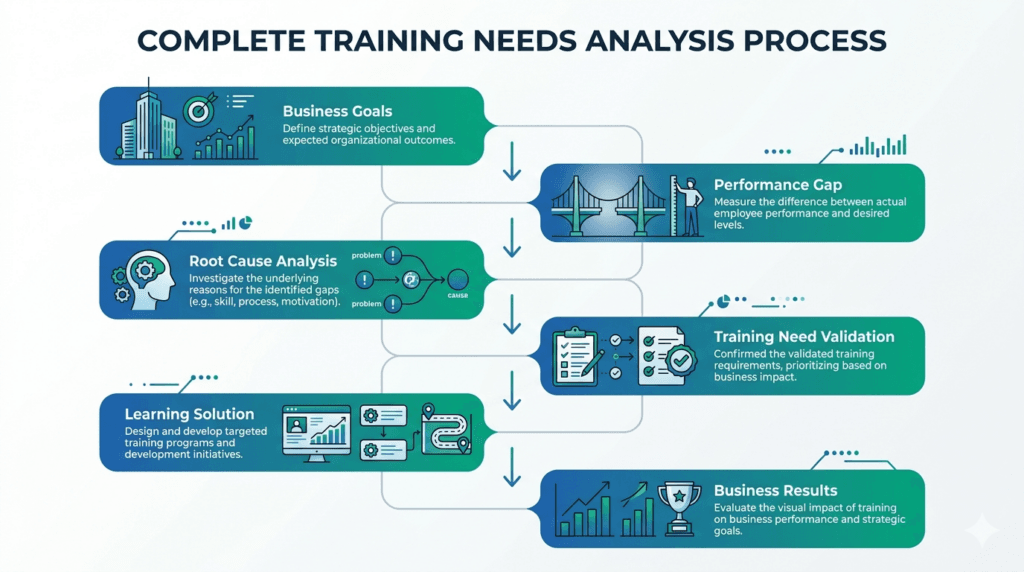
A Training Needs Analysis (TNA) is a structured process for diagnosing the gap between where performance currently stands and where it needs to be — and then determining what, if anything, training can do about it.
A TNA template — sometimes called a Training Needs Assessment template, Learning Needs Analysis template, or TNA form — is a standardised document that guides you through this process step by step. Rather than starting from scratch each time a training request lands on your desk, you work through a consistent set of questions that surface the right information in the right order.
The terms Training Needs Analysis and Training Needs Assessment are often used interchangeably. Strictly speaking, a needs analysis is the broader diagnostic process; a needs assessment is the data-gathering activity within it. In practice, most L&D professionals use them to mean the same thing, and both serve the same function: understanding the problem before designing a solution.
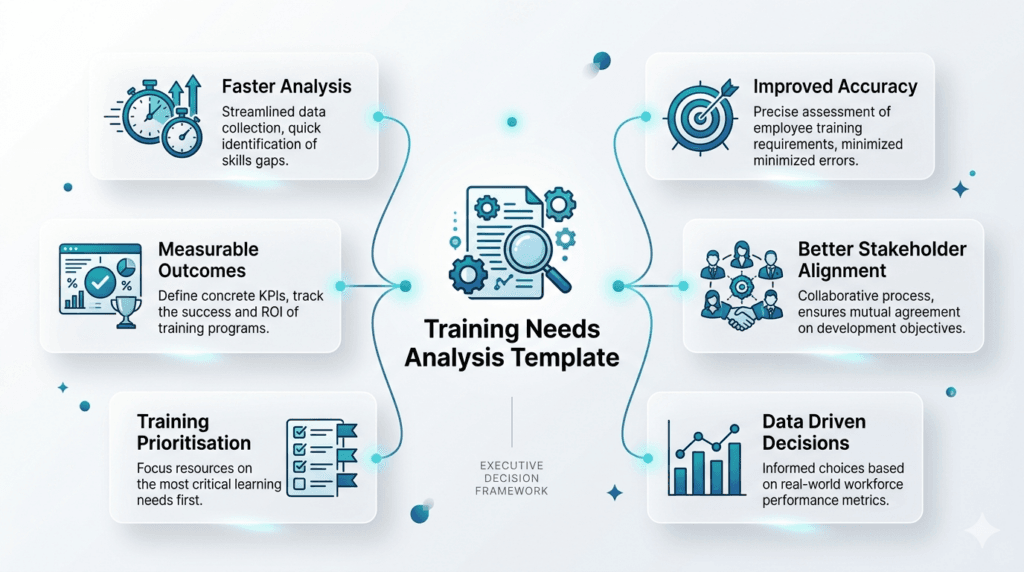
What a good TNA template does
It structures your thinking. Without a template, even experienced analysts tend to jump to solutions before fully understanding the problem. A template forces you to slow down, define the business context, examine evidence, and only then recommend a course of action.
It standardises your data collection. When every analyst on your team approaches a TNA differently, the outputs are incomparable. An employee training needs assessment template creates a common language across the function.
It repositions L&D as a consulting function. Walking into a manager meeting with a structured TNA form changes the dynamic. You are not collecting a training order. You are conducting a professional diagnosis.
Benefits of standardising your TNA process
| Benefit | What it means in practice |
| Consistency | Every TNA follows the same logic regardless of who runs it |
| Data quality | Structured questions produce comparable, actionable data |
| Stakeholder alignment | Managers understand what you need and why |
| Decision-making speed | Clear outputs lead to faster, more confident recommendations |
| Auditability | You can review past TNAs, spot patterns, and learn from them |
| Credibility | Documented analysis is easier to defend to senior leaders |
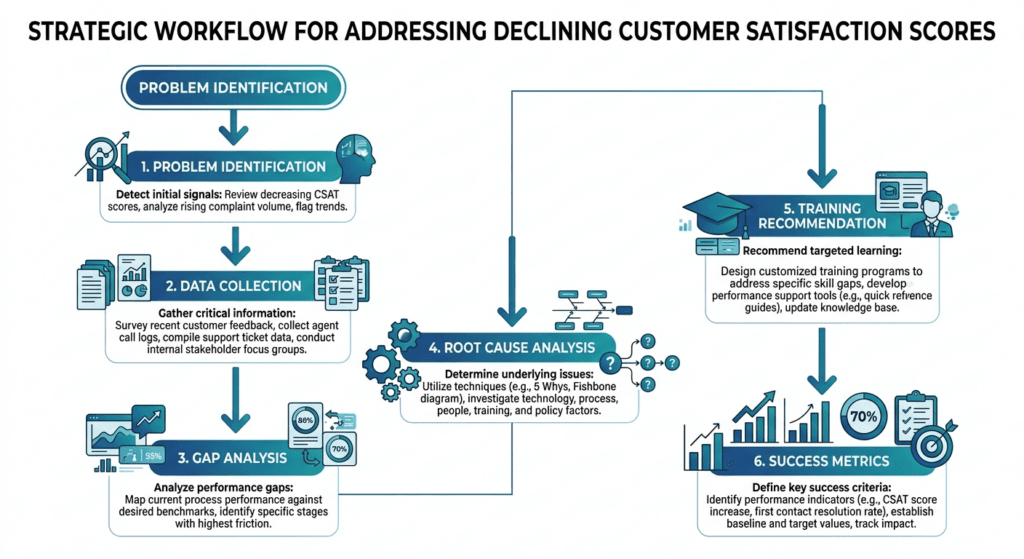
The TrainerCentric TNA Framework™
Most Training Needs Analysis processes described online follow the same basic pattern: assess, design, deliver, evaluate. That is not a diagnostic framework. It is a project management sequence.
The TrainerCentric TNA Framework™ is built differently. It separates the diagnostic phase from the solution phase, and includes an explicit Step 4 that most TNA templates skip entirely: verifying whether training is actually the right intervention before recommending it.
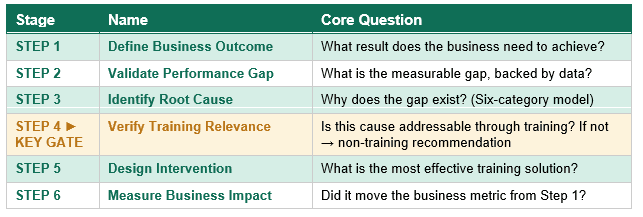
It starts with the business outcome, not the training request. Most TNA processes in practice begin with a training request and work backwards. Starting from the business outcome keeps the entire analysis grounded in what actually matters.
It has an explicit gate at Step 4. Before any learning solution is proposed, the framework requires you to verify that the root cause is actually addressable through training. If the cause is a broken process, a misaligned incentive, or a management issue, the template directs you to a non-training recommendation instead.
It closes the loop with business-level measurement. Not learner satisfaction scores. Not completion rates. Business metrics — the same ones you started with in Step 1.
The Three Types of Training Needs Analysis
Understanding the level at which you are conducting a TNA is as important as understanding the process. There are three levels, and each requires a different focus, different data sources, and a different version of the TNA worksheet.
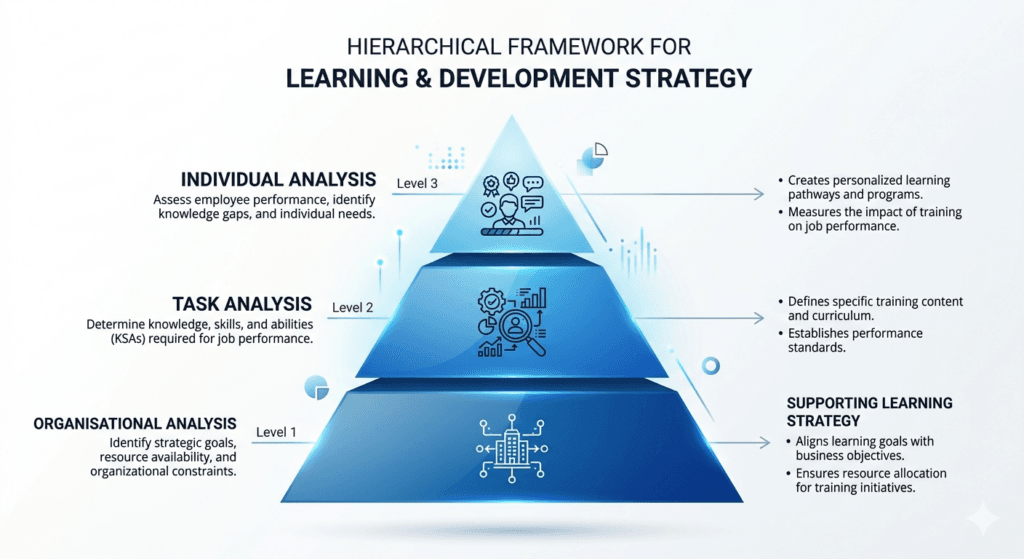
1. Organisational Analysis
Scope: The entire organisation or a major business unit.
When to use: Annual learning strategy planning; post-merger capability mapping; responding to significant strategic change such as digital transformation or market expansion.
Output: A prioritised list of organisation-wide capability needs that feeds into the annual L&D plan.
2. Task Analysis (Occupational / Role Level)
When to use: When redesigning a role or job family; when onboarding standards need updating; when a new job function has been created.
Output: A role competency profile and gap analysis by population. Often referred to as a Training Gap Analysis template at this level.
3. Individual Analysis
When to use: Performance improvement plans; targeted development programmes; post-assessment gap identification.
Output: An individual development plan or targeted training recommendation for a named employee or small group.
| Level | Focus | Trigger | Primary Data Source |
| Organisational | Strategic capability | Annual planning, major change | Business data, strategy |
| Task / Role | Role requirements | Role redesign, new function | Job analysis, SME interviews |
| Individual | Person-level gaps | Performance issue, development need | Performance data, assessments |
Components of an Effective Training Needs Analysis Template
Every section of a TNA template should earn its place by generating information you will actually use. Here is what belongs in a well-designed training needs assessment template and why.
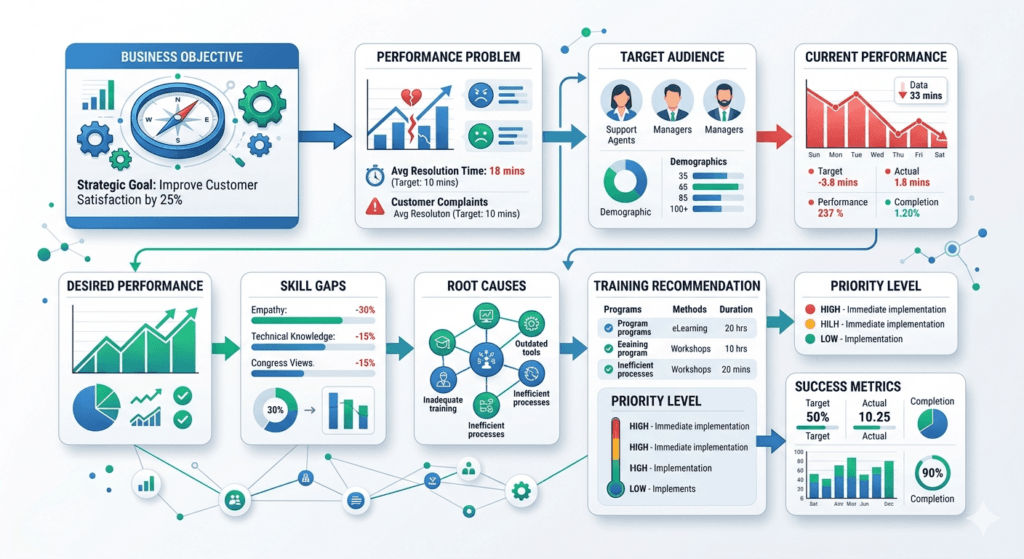
| Section | Purpose | Example |
| Business Objective | Anchors the TNA to an organisational goal, not a training wish | “Increase first-call resolution from 62% to 80% by Q4” |
| Performance Problem | Describes the observable gap between current and required performance | “Agents escalating calls that should be resolved at first contact” |
| Target Audience | Defines who the analysis covers, segmented by relevant factors | “CS agents in Mumbai and Chennai, tenured under 12 months” |
| Current Performance | Establishes the baseline with data, not opinion | “First-call resolution: 62%. Industry benchmark: 75%” |
| Desired Performance | States the specific, measurable standard required | “First-call resolution of 80% within 90 days of training” |
| Skill Gaps | Lists specific knowledge or skill deficits confirmed by evidence | “Agents lack Tier 2 product knowledge; cannot navigate CRM escalation tree” |
| Root Causes | Identifies why the gap exists, not just that it exists | “Onboarding covers Tier 1 only; CRM updated without retraining” |
| Training Recommendation | Proposes training solutions only where training addresses the root cause | “Blended programme: self-paced modules + CRM simulation” |
| Non-Training Recommendation | Proposes fixes for causes that training cannot address | “Revise CRM change process; implement manager calibration” |
| Priority Rating | Rates urgency and business impact to guide investment decisions | High / Medium / Low with documented rationale |
| Success Measures | Defines how you will know the intervention worked, at the business level | “First-call resolution via CRM; target 80% within 90 days” |
When Should You Use a Training Needs Analysis Template?
A TNA is not only for when something has gone wrong. Here are the most common scenarios where an employee training needs assessment template should be your first step.
New Software or System Implementation
When an organisation rolls out new technology — an ERP, a CRM, a new operating system — different user groups have wildly different needs. A TNA at the role level maps exactly which functions each group needs, identifies capability gaps, and prevents a one-size-fits-all programme that satisfies nobody.
Customer Service Performance Problems
A drop in CSAT scores, an increase in complaints, or a rise in escalation rates could be caused by a knowledge gap — or by understaffing, a broken process, unclear expectations, or a management issue. Only a proper TNA reveals which.
Sales Performance Decline
When a sales team misses quota, the instinct is to book a sales skills workshop. But the root cause is equally likely to be territory misalignment, a product issue, or a change in buyer behaviour — none of which training can fix. A TNA prevents L&D from absorbing accountability for a commercial problem.
Leadership Development Programmes
Before investing in a cohort of leaders, a TNA at the individual level tells you which leadership behaviours are actually missing, preventing the common mistake of running a generic programme that addresses the wrong competencies.
Compliance Training
Compliance training is often commissioned as a legal requirement, but a TNA still adds value: understanding which employee groups carry the highest compliance risk, what the knowledge gaps actually are, and whether previous training has transferred.
Organisational Change
Mergers, restructures, new strategies, and market expansions all create capability gaps. An organisational-level TNA maps what the business will need its people to do in 12–24 months that they cannot do today.
What Experienced L&D Consultants Look For During a TNA
There is a difference between conducting a Training Needs Analysis and conducting a good one. Here is what separates the two.
Observable Behaviour, Not Vague Complaints
The first thing a skilled consultant does when they hear “the team needs training” is ask: what are you seeing them do or not do? They push for specific, observable behaviours. “They don’t understand the product” is not observable. “When a customer asks about Tier 2 pricing, agents put the call on hold” is observable. That specificity changes everything about what you design.
Business Metrics First, Training Metrics Second
Experienced consultants will not accept a training request that cannot be linked to a business metric. Training completion rates and satisfaction scores are not outcomes. Revenue per sales rep, first-call resolution rate, error rate, and time-to-productivity are outcomes.
Root Causes Before Recommendations
A good L&D consultant treats every training request as a hypothesis: this performance gap is caused by a knowledge or skill deficit. Their job is to test that hypothesis. A consultant who returns a root cause analysis that says “training alone will not fix this” is doing their job correctly.
Manager Accountability in the Analysis
One of the most consistent findings in learning transfer research is that manager behaviour after training predicts whether that training sticks. KnowledgePool found that when learners receive line manager support, 94% go on to apply what they learned. Experienced consultants make manager expectations a formal output of the TNA.
Non-Training Causes Get Non-Training Solutions
If the TNA reveals that the performance gap is caused by a broken process, an outdated job aid, unclear expectations, or misaligned incentives, an experienced consultant will say so — even if it means declining to design a course. This is what separates an L&D consultant from an L&D order-taker.
Free Training Needs Analysis Template (Full Walkthrough)
Below is the complete template structure with guidance notes and practical examples for every field. The downloadable Excel version mirrors this structure exactly.
Section 1: Business Information
This section anchors your TNA to the organisation’s strategic context. Without it, you risk producing training solutions that are technically correct but strategically irrelevant.
| Field | Guidance | Example |
| Organisation / Business Unit | The team or unit the TNA covers | Customer Experience Division |
| Date of Analysis | When the TNA was conducted | 15 June 2025 |
| Analyst Name | Who conducted the TNA | Priya Sharma, L&D Manager |
| Sponsor / Requestor | Who commissioned the analysis | VP Customer Experience |
| TNA Level | Organisational / Task / Individual | Task (role-level) |
| Business Objective | The strategic goal this analysis relates to | Improve CSAT from 3.6 to 4.2 by December 2025 |
| Business Impact of Problem | What happens if the gap is not addressed | Customer churn risk; NPS decline; reputational damage |
| Deadline / Urgency | When a solution is needed | Before Q3 peak volume (October) |
| Expert tip: L&D teams that skip the business context section produce training that addresses a symptom while the underlying business problem continues. Tying your TNA to a specific, measurable business objective makes your eventual recommendation significantly easier to get funded — and significantly easier to evaluate. |
Section 2: Performance Gap Analysis
This is the diagnostic core of the TNA form. You are defining the gap between current and required performance, with evidence.
| Field | Guidance | Example |
| Performance Problem Statement | A concise description of the observable performance issue | Agents failing to resolve Tier 2 queries at first contact |
| Current Performance Level | What the data shows | First-call resolution: 62% (CRM data, May 2025) |
| Required Performance Level | The standard that needs to be met | First-call resolution: 80% (internal target; benchmark: 75%) |
| Performance Gap | The difference, expressed as a number | 18 percentage points |
| Evidence / Data Sources | Where you got your data | CRM reports, quality monitoring scores, customer complaint logs |
| Affected Population | Who is performing below standard | 47 agents hired in the last 12 months, across two sites |
Section 3: Root Cause Analysis
This is where most training gap analysis templates fall short. You are not asking what the gap is. You are asking why it exists. Root causes fall into one of six categories. Work through each before concluding that training is the answer.
| Root Cause Category | Diagnostic Question | Is Training the Answer? |
| Knowledge / Skill | Do employees know how to do this? Have they been shown? | Yes — if the cause is confirmed knowledge or skill |
| Motivation | Do employees want to perform? Are incentives aligned? | No — training will not fix motivation |
| Process / System | Is the process clear? Do employees have the tools? | No — fix the process or tool |
| Management | Do managers set clear expectations and give feedback? | No — coaching or system change needed |
| Environment | Are there physical or structural barriers to performance? | No — environmental fix needed |
| Capacity | Do employees have enough time and resource to perform? | No — workload or resourcing issue |
| Field | Guidance | Example |
| Identified Root Causes | One entry per category investigated | Knowledge: not trained on Tier 2. Process: CRM updated without retraining. |
| Primary Root Cause | The most significant cause | Incomplete initial training — Tier 2 absent from onboarding |
| Training Addressable Causes | Subset where training is appropriate | Product knowledge; CRM navigation; escalation decision-making |
| Non-Training Causes | Causes requiring a different solution | CRM change management process; manager calibration |
Section 4: Skills Gap Assessment
With root causes confirmed, drill into the specific knowledge, skills, and behaviours that training needs to address. This is the section most closely resembling a traditional learning needs analysis template or skills gap assessment sheet.
| Skill / Knowledge Area | Current Level (1-5) | Required Level (1-5) | Gap | Priority |
| Tier 2 product knowledge | 2 | 4 | High | High |
| CRM navigation — escalation tree | 1 | 4 | Critical | High |
| Customer de-escalation techniques | 3 | 4 | Medium | Medium |
| Active listening and query diagnosis | 3 | 4 | Medium | Low |
Guidance for rating: Use a consistent 1–5 scale where 1 = no capability and 5 = fully proficient. Ratings should be grounded in observable evidence — assessments, quality monitoring, structured observation — rather than self-report alone.
Section 5: Recommended Solution
Translate your analysis into a clear, actionable recommendation. This section has two parts: training and non-training. Both matter.
| Field | Guidance | Example |
| Training Recommendation | The training solution(s) recommended | Blended programme: self-paced e-learning (3 product modules) + facilitated CRM simulation (half-day) |
| Rationale | Why this solution addresses the root causes identified | E-learning addresses knowledge gap at scale; simulation builds application confidence |
| Non-Training Recommendation | Actions required outside of training | Update CRM change process; establish manager expectation-setting cadence |
| Estimated Effort / Cost | Resource required to design and deliver | 6 weeks design; 2 delivery days per cohort; est. ₹3.5L for external SME |
| Recommended Timeline | When to run the solution | Pilot: August 2025; Full rollout: September 2025 |
| Priority Rating | Overall urgency and business impact | High — direct link to Q4 CSAT target; peak season deadline |
| Dependencies | What needs to happen before training can succeed | Manager briefing; updated CRM for simulation; SME availability |
Section 6: Success Metrics
This section is consistently the most neglected part of any training needs analysis worksheet. Define your measures of success before the solution is designed, not after. If you cannot define success now, you will not be able to prove it later.
| Kirkpatrick Level | Metric | Method | Target | Measured When |
| Level 1 — Reaction | Learner satisfaction | Post-training survey | ≥4.0 / 5.0 | Immediately post-training |
| Level 2 — Learning | Knowledge assessment score | Online assessment | ≥80% pass | End of e-learning modules |
| Level 3 — Behaviour | CRM escalation accuracy | Quality monitoring | ≥85% correct | 30 days post-training |
| Level 4 — Results | First-call resolution rate | CRM reporting | 80% | 90 days post-training |
Internal Resource: Read our detailed guide on Kirkpatrick Model: How to Measure Training Effectiveness
Training Needs Analysis Template Example
Here is a fully completed example to show the template working in practice.
| Organisation: Horizon Telecom — Consumer Customer Service Date: 3 May 2025 Analyst: Anand Krishnamurthy, Learning Consultant Sponsor: Head of Customer Experience TNA Level: Task (role-level) + Individual (targeted cohort) |
Business Context
Customer satisfaction scores for the Consumer division declined from 4.1 to 3.6 over two consecutive quarters. Post-call survey verbatims identified “issue not resolved on first call” as the primary complaint driver. Leadership has set a Q4 target of 4.2 CSAT, with first-call resolution identified as the primary lever.
Performance Gap Analysis
| Field | Detail |
| Performance Problem | Agents escalating calls that should be resolvable at first contact |
| Current Performance | First-call resolution: 62% (CRM data, Q1 2025) |
| Required Performance | 80% first-call resolution by Q4 2025 |
| Performance Gap | 18 percentage points |
| Affected Population | 54 agents tenured under 18 months; Chennai and Hyderabad sites |
| Data Sources | CRM escalation reports, post-call surveys, quality monitoring, exit interview themes |
Root Cause Analysis
Through structured interviews with 8 managers, focus groups with 20 agents, and a review of quality monitoring data:
| Root Cause Category | Finding | Training Addressable? | Owner |
| Knowledge / Skill | Onboarding covers Tier 1 only; Tier 2 product range never formally trained | Yes | L&D |
| Process / System | CRM escalation tree updated March 2025; no retraining event followed | Partially (CRM navigation) | Operations + L&D |
| Management | Inconsistent manager guidance on escalation thresholds | No | Manager Effectiveness / HR |
| Motivation | No issues identified | N/A | N/A |
Skills Gap Assessment
| Skill Area | Current | Required | Gap | Priority |
| Tier 2 product knowledge (mobile plans) | 1/5 | 4/5 | Critical | High |
| Tier 2 product knowledge (broadband) | 2/5 | 4/5 | High | High |
| CRM escalation tree navigation | 1/5 | 4/5 | Critical | High |
| Query diagnosis and triage | 3/5 | 4/5 | Medium | Medium |
| Customer communication during resolution | 3/5 | 4/5 | Medium | Medium |
Recommended Solutions
Training recommendations:
- Self-paced e-learning: Tier 2 Products (Mobile + Broadband) — 2 modules, 45 minutes each
- Facilitated simulation workshop: CRM escalation practice — 4-hour session, cohorts of 12
- Job aids: Quick reference cards for escalation decisions, available at agent desks and in the CRM interface
Non-training recommendations:
- Revise CRM change management process to require L&D sign-off before any system go-live
- Manager calibration sessions to align escalation expectations across all sites
Priority: High. Solution must deploy before Q3 peak volume begins.
Success Metrics
| Metric | Target | When Measured |
| Post-training knowledge assessment | ≥80% | End of each e-learning module |
| CRM simulation accuracy | ≥85% correct decisions | End of simulation workshop |
| First-call resolution rate | 80% | 90 days post-training (CRM data) |
| CSAT score | 4.2 | Q4 2025 (post-call survey) |
Training Needs Analysis Questionnaire Template
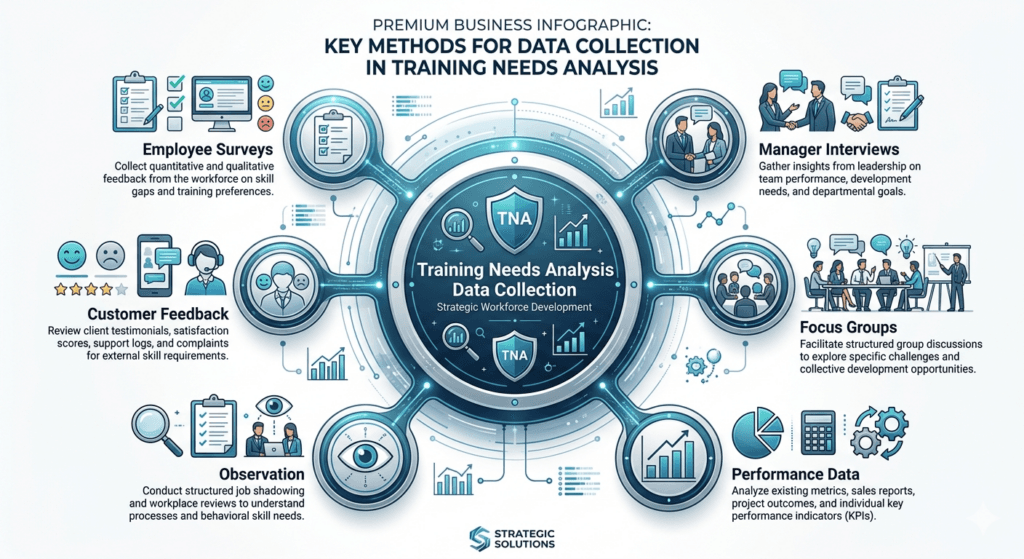
Data collection is only as good as the questions you ask. Here is a ready-to-use questionnaire you can adapt for stakeholder conversations. Each question maps to the TrainerCentric TNA Framework step it serves.
Manager Questions
| # | Question | Framework Step |
| 1 | What specific behaviours or outputs are you seeing that fall short of expectations? | Step 2: Validate Gap |
| 2 | How long has this been an issue? Is it getting better or worse? | Step 2: Validate Gap |
| 3 | Which team members are affected — all of them, or specific individuals? | Step 2: Validate Gap |
| 4 | What does ‘good’ look like? Describe the expected performance specifically. | Step 2: Validate Gap |
| 5 | Have these employees ever performed at the required level? What changed? | Step 3: Root Cause |
| 6 | What data do you have about current performance levels? | Step 2: Validate Gap |
| 7 | What do you think is causing the gap? | Step 3: Root Cause |
| 8 | What solutions have already been tried? What happened? | Step 3: Root Cause |
| 9 | What would success look like six months from now? | Step 6: Measure Impact |
| 10 | Is there anything outside this team’s control affecting their performance? | Step 3: Root Cause |
Employee Questions
Create psychological safety before these conversations. Make clear this is about understanding the system, not judging individuals.
| # | Question | Framework Step |
| 1 | Can you walk me through how you handle [specific task]? | Step 2: Validate Gap |
| 2 | Where do you feel most confident in your role? Where least confident? | Step 4: Skills Gap |
| 3 | When you hit a problem in [specific area], what do you do? | Step 3: Root Cause |
| 4 | What information or tools do you wish you had to do this better? | Step 3: Root Cause |
| 5 | How were you trained on [process or skill]? What was missing? | Step 3: Root Cause |
| 6 | If you could change one thing about how [process] works, what would it be? | Step 3: Root Cause |
| 7 | What would help you perform better in [specific area]? | Step 5: Intervention |
| 8 | How does your manager support you when you are struggling? | Step 3: Root Cause |
Senior Stakeholder Questions
| # | Question | Framework Step |
| 1 | What business outcome are we trying to improve, and by how much? | Step 1: Business Outcome |
| 2 | What is the cost of this performance gap to the business right now? | Step 1: Business Outcome |
| 3 | Who are the key people who need to be involved in any solution? | Step 5: Intervention |
| 4 | What constraints exist — budget, timeline, headcount? | Step 5: Intervention |
| 5 | How will you measure whether the solution has worked? | Step 6: Measure Impact |
| 6 | What has already been tried? What happened? | Step 3: Root Cause |
| 7 | What level of priority is this relative to other business needs? | Step 1 + Step 5 |
Training Needs Analysis Template vs Skills Gap Analysis Template
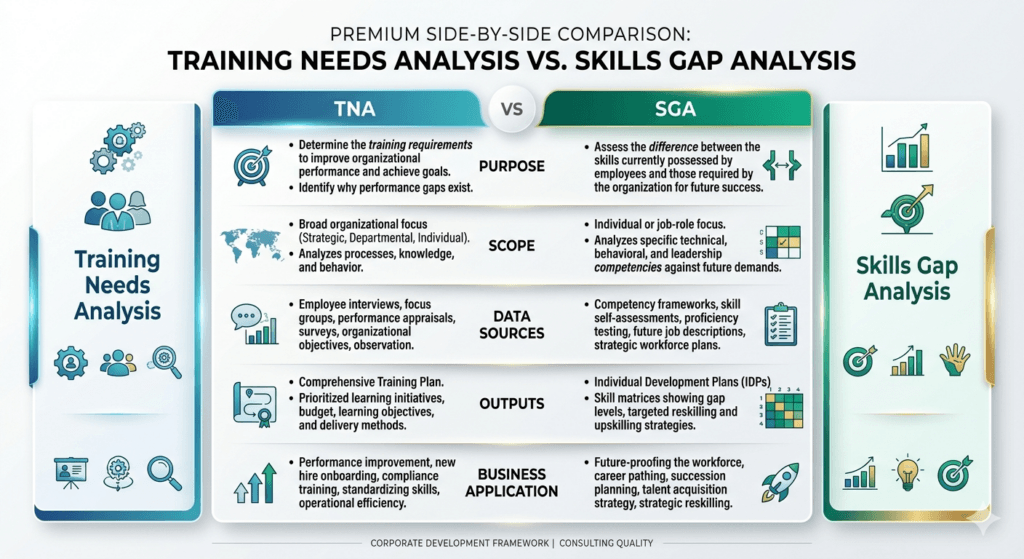
These two terms are often used interchangeably, but they describe different tools with different purposes.
| Dimension | Training Needs Analysis (TNA) | Skills Gap Analysis |
| Primary question | What is causing the performance problem and what should we do? | What skills does this role require and which are missing? |
| Scope | Triggered by a specific performance problem or business change | Often conducted proactively across a role family |
| Root cause focus | Yes — central to the process | No — assumes the gap is the issue |
| Output | A recommendation: training, non-training, or both | A skills inventory showing current vs required capability |
| Business linkage | Strong — starts with a business outcome | Variable |
| Typical trigger | Performance complaint, business change, new initiative | Workforce planning, talent mapping, role redesign |
| Template type | TNA form / TNA worksheet | Skills matrix / competency assessment |
Use a Training Needs Analysis template when there is a specific performance problem to diagnose. Use a Skills Gap Analysis template when planning ahead — mapping capability requirements for a new role, assessing a team ahead of a strategic change, or building a talent development roadmap.
Common Mistakes When Using TNA Templates
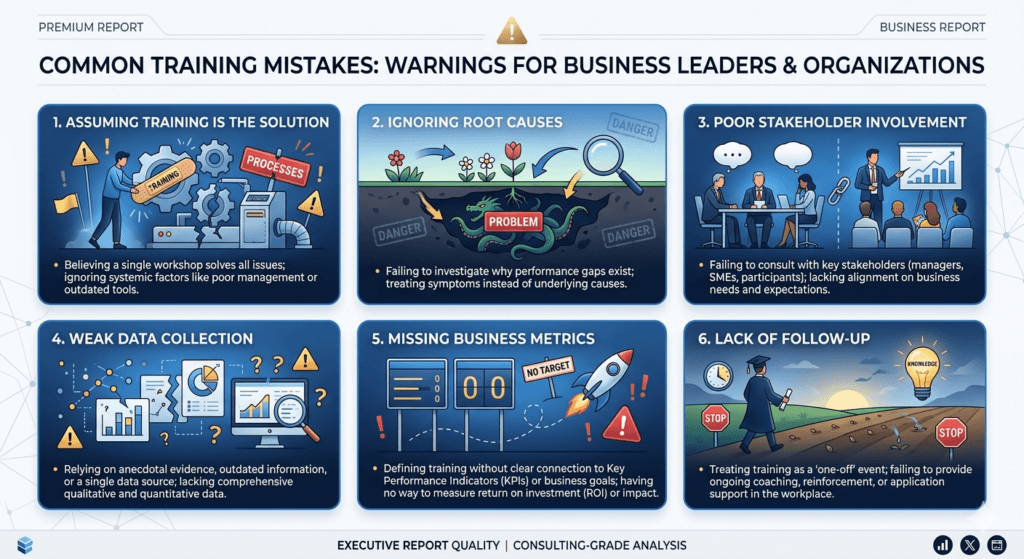
Jumping Straight to Training
A template does not automatically prevent this. Some analysts treat the TNA form as a box-ticking exercise and write “training” in the recommendation field before completing the root cause analysis. If you are filling in the training recommendation before finishing the root cause section, stop.
Treating Root Cause Analysis as Optional
“Agents need more training” is not a root cause. It is a restatement of the symptom. Ask why they lack the knowledge or skill. Was it never covered in onboarding? Did a process change happen without a retraining event? The answer changes the solution.
Collecting Too Much Data
A TNA should be scoped to confirm or refute a hypothesis about root cause — not to conduct an ethnographic study. Use your template to stay focused. The data you need is the data that answers the six root cause categories, nothing more.
Asking Leading Questions
“Would training help you do this better?” is a leading question. “Walk me through exactly what happens when a customer asks you about [specific scenario]” is a behaviour-based question that surfaces real information.
Not Involving Managers
A TNA conducted without talking to managers is missing half the picture. Managers hold the performance expectation context and are the people who will either reinforce or undermine the eventual training solution.
Defining Success in Training Terms Only
Completion rates and learner satisfaction scores are proxies, not outcomes. The business metric that motivated the TNA in the first place is the measure that matters.
How to Use the Template in Five Steps
Step 1: Define Business Goals
Before talking to anyone, be clear on the business context. What is the organisation trying to achieve? What metric or outcome is under pressure? Complete Section 1 of the template before any data collection begins. Common trap: starting with “what training do people want?” rather than “what business problem are we trying to solve?”
Step 2: Collect Performance Data
Gather evidence about the current performance gap using quantitative data (CRM reports, quality scores, error rates) alongside qualitative data (manager interviews, employee focus groups, observation). Aim to talk to the business sponsor, a representative sample of managers, and a cross-section of affected employees.
Step 3: Identify Gaps
With data collected, define the gap precisely. What is the current performance level? What is required? Who exactly is affected — and is the gap systemic (affecting everyone) or individual (affecting specific cohorts)?
Step 4: Determine Root Causes
Work through the six root cause categories systematically. For each performance gap, ask: is this a knowledge or skill deficit? Or is it caused by something in the environment, the process, the management structure, or the motivation system? Only after confirming root causes can you make a credible recommendation.
Step 5: Recommend Solutions
Make a clear, evidence-based recommendation. Include the specific training solution(s) with rationale, any non-training actions required, a priority rating, success metrics tied to business outcomes, and a realistic timeline and resource estimate.
Training Needs Analysis Template (Excel) — Free Download
The most practical format for a Training Needs Analysis template is Excel. A TNA template Excel file allows you to use dropdown menus for standard entries, conditional formatting to highlight critical gaps, and simple formulas to average skill ratings across a cohort.
Teams running multiple TNAs simultaneously can use the Excel template as a consistent record across projects. It integrates cleanly with SharePoint and Google Drive for teams that need to share TNAs across stakeholders.
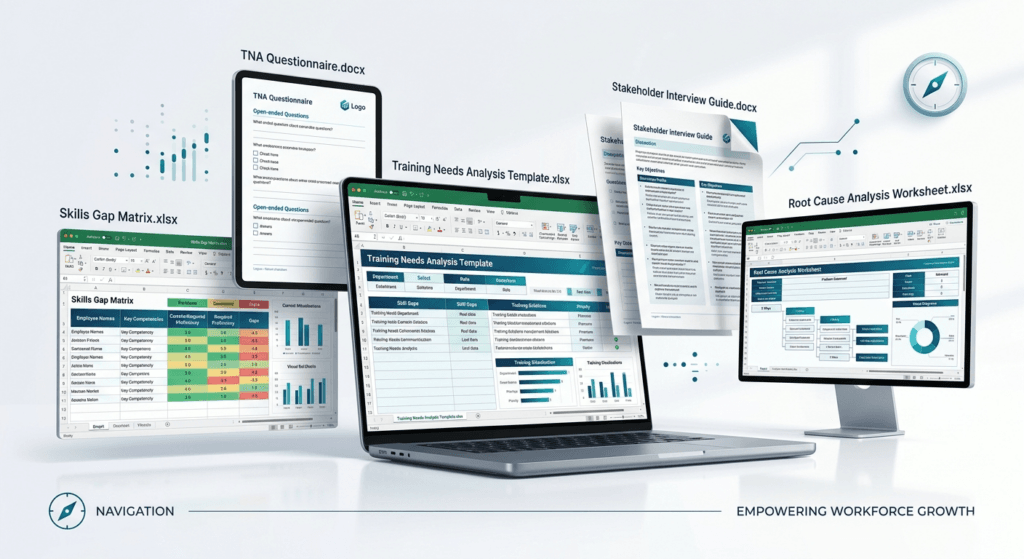
The TNA template in Excel included in the free toolkit below contains all six template sections, built-in priority scoring, and guidance notes in every field. It is the same structure described throughout this guide, formatted for immediate use.
People also search for a training needs assessment Excel template and a training gap analysis template — the free toolkit includes both as separate files, so you can use whichever fits your context.
Training Needs Analysis Toolkit Download
Everything described in this guide is available as a free download. The toolkit contains five documents built around the TrainerCentric TNA Framework™, designed to work together — but each also works as a standalone tool.
| Training Needs Analysis Toolkit Used by L&D professionals to identify true training priorities and make evidence-based recommendations. What’s included: ✅ Training Needs Analysis Template (Excel) — six-section template with dropdowns and guidance notes ✅ Skills Gap Matrix (Excel) — competency mapping with auto-calculated gaps ✅ Stakeholder Interview Guide (Word/PDF) — facilitator guide for TNA conversations ✅ TNA Questionnaire (Word/PDF) — 25+ manager, employee, and stakeholder questions ✅ Root Cause Analysis Worksheet (Excel) — six-category diagnostic model |
Conclusion
A Training Needs Analysis is not a form you fill in before booking a course. It is the professional discipline that separates L&D teams that move business results from those that produce training calendars.
The right TNA process stops you designing solutions before you understand the problem. It surfaces the real causes of performance gaps — including the ones that have nothing to do with training. It gives you the evidence to defend a learning investment, the credibility to decline a training request when training is not the answer, and the metrics to prove that what you built actually worked.
Templates make this process consistent, efficient, and scalable. When every TNA in your team follows the same structure — the TrainerCentric TNA Framework™ — you can compare findings across the function, spot recurring capability patterns, and build a genuine evidence base for where to focus the learning budget.
If you are running TNAs without a structured template, you are doing more work for less reliable output. Download the free toolkit below and run your next TNA with the rigour it deserves.
Frequently Asked Questions
What is a training needs analysis template?
A training needs analysis template is a structured document that guides L&D professionals through the process of identifying performance gaps, diagnosing their root causes, and recommending appropriate solutions. It typically includes sections for business context, performance gap definition, root cause analysis, skills assessment, solution recommendation, and success metrics. A good TNA template ensures consistency across analyses and moves L&D teams from vague training requests to evidence-based recommendations.
What should be included in a TNA template?
An effective TNA template includes: a business information section linking the analysis to a measurable organisational goal; a performance gap analysis defining current vs required performance with evidence; a root cause analysis identifying why the gap exists across six categories; a skills gap assessment mapping specific knowledge and skill deficits; a recommended solution section covering both training and non-training interventions; and a success metrics section defining business-level impact measures. Templates that omit root cause analysis or success metrics are incomplete.
How do you conduct a training needs analysis?
A Training Needs Analysis follows five stages: (1) define the business objective; (2) collect performance data to establish the gap; (3) identify which skills and knowledge are missing; (4) determine the root causes; (5) recommend solutions that address confirmed root causes, including non-training solutions where relevant. The TrainerCentric TNA Framework™ adds an explicit verification step at Stage 4 to ensure training is the right intervention before any solution is proposed.
What questions should be asked during a training needs analysis?
The most important TNA questions focus on observable behaviour. For managers: “What specific behaviours are you seeing that fall short?” and “Have these employees ever performed at the required level?” For employees: “Walk me through how you handle [specific task]” and “What information or tools do you wish you had?” For senior stakeholders: “What business metric are we trying to move, and by how much?”
What is a TNA questionnaire?
A TNA questionnaire is a structured set of questions used to collect data from managers, employees, and stakeholders as part of a Training Needs Analysis. Unlike a general employee survey, a TNA questionnaire is diagnostic — it is designed to reveal the nature and root causes of a performance gap, not to measure satisfaction or engagement. A good TNA questionnaire uses behavioural questions, avoids leading language, and maps each question to a specific stage of the TNA process.
Can I use Excel for training needs analysis?
Yes — Excel is one of the most practical formats for a TNA template, particularly for the skills gap assessment section where you need to rate multiple competencies across groups of people. Excel allows dropdown menus, conditional formatting to highlight priority gaps, and simple averaging formulas to summarise ratings across a cohort. The free toolkit on this page includes an Excel version of the full TNA template and skills gap matrix.
What is the difference between TNA and skills gap analysis?
A Training Needs Analysis diagnoses a specific performance problem, identifies its root causes, and recommends training or non-training solutions accordingly. A Skills Gap Analysis maps the difference between what a role requires and what an individual or team currently has — it is a capability inventory, not a performance diagnosis. The two tools complement each other: a Skills Gap Analysis identifies that a gap exists; a TNA determines what is causing it and what to do about it.
What is the first step in a training needs analysis?
The first step is defining the business objective — the specific, measurable outcome the organisation is trying to achieve. Many TNAs begin with a training request (“we need a customer service course”) rather than a business problem (“our first-call resolution rate has dropped 18 points”). Starting with the business objective ensures the entire analysis stays connected to what actually matters.
Who is responsible for conducting a training needs analysis?
In most organisations, the Training Needs Analysis is conducted by an L&D Manager, Learning Consultant, or Instructional Designer — sometimes in partnership with an HR Business Partner. The business sponsor commissions the TNA and provides data access. Senior leaders provide the strategic context. The TNA itself is an L&D responsibility — and its quality is a direct reflection of L&D’s consulting capability.
What tools are used for training needs analysis?
The primary tools for a TNA are: a structured TNA template or TNA form, a stakeholder interview guide, an employee questionnaire, and a skills gap matrix. For data collection, L&D teams commonly use qualitative methods (structured interviews, focus groups, observation) alongside quantitative data (performance reports, quality monitoring data, assessment results).
How often should training needs analysis be conducted?
At minimum, a TNA should be conducted whenever a specific performance problem is identified, a significant business change is planned, or a new learning programme is being commissioned. Beyond reactive triggers, high-performing L&D functions conduct an annual organisational-level TNA aligned to the business planning cycle.
References
- Training Magazine (2025). 2025 Training Industry Report. trainingmag.com
- TeamStage (2024). Employee Training Statistics: Cost of Progress in 2024. teamstage.io
- LEADx (2024). 2024 Leadership Development Benchmark Report. leadx.org
- KnowledgePool / HR Magazine. Quarter of all training fails to deliver significant performance improvement. hrmagazine.co.uk
- Shift eLearning. Mind-blowing Statistics Prove the Value of Employee Training. shiftelearning.com
- Skillademia (2025). 10 Employee Training Statistics to Improve Your Team’s Performance. skillademia.com
- The Training Associates (2025). Why Training Programs Fail. thetrainingassociates.com
Further Reading
- How to Conduct a Training Needs Analysis in Five Steps
- The 3 Levels of Training Needs Analysis
- Skills Gap Analysis vs Training Needs Analysis
- Job Task Analysis: How to Break Down Any Role for Training Design
- Performance Consulting: When Training Is Not the Answer
- Focus Groups and Interviews for Training Needs Assessment: A Practical Field Guide
- Kirkpatrick Model: How to Measure Training Effectiveness
- Training Needs Analysis Checklist: A Practical Step-by-Step Guide
- Rapid eLearning Development: The Complete Process, Framework, Tools, and Templates
- Corporate eLearning Playbook: The Complete Guide to Designing, Delivering, and Scaling Digital Learning
Author Details

Ankita Roy is an accomplished HR leader with over 9 years of experience driving people strategy across the telecom, logistics, and retail sectors. As Head of Human Resources at AGWANI FASHIONS, she specializes in talent management, organizational development, performance management, employee engagement, and HR transformation. Ankita has successfully led workforce planning, career framework design, succession planning, and culture-building initiatives for high-growth organizations. You can reach out to her via her linkedin Profile: https://www.linkedin.com/in/ankita-roy-398708105/