A regional operations director calls an L&D manager and says, “Our customer service scores are slipping. We need training.”
It sounds simple enough. Book a room, find a facilitator, put together some slides on “communication skills,” run a workshop, tick the box.
Six weeks later, the scores haven’t moved. The facilitator got good feedback — “engaging,” “fun,” “would recommend” — but nothing on the shop floor has actually changed. The same complaints are coming in. The same escalations are happening. Somewhere, a senior leader is quietly wondering whether training even works.
This scenario plays out in businesses every week, and it’s rarely because the trainer did a bad job in the room. It’s because nobody designed a learning programme — they designed an event. There’s a world of difference between the two, and that difference is what separates L&D functions that get taken seriously from those that get treated as a compliance cost.
In short: designing a learning programme means starting from a business problem (not a training request), running a proper needs analysis, writing objectives at the right cognitive level, choosing a design model deliberately, building a spaced journey of activities and reinforcement rather than a single event, and closing the loop with real evaluation. The rest of this guide walks through each part in detail, with templates, a full worked example, and a printable checklist.
This guide is a complete, practitioner-level walkthrough of how to design a learning programme — from the first phone call about a “training problem” through to proving the business impact months later. Whether you’re an independent trainer building your first client engagement, an instructional designer joining a new organisation, or an L&D manager trying to bring more rigour to your training programme framework, this is the resource to keep coming back to.
We’ll cover what makes something a genuine learning programme rather than a course, when a new corporate learning programme is the right response, a complete ten-step instructional design process, a full worked example, the mistakes that quietly sink even well-funded programmes, a practical checklist, and how AI tools fit into modern training curriculum design — without letting them replace sound judgement.
What is a Learning Programme?
A learning programme is a structured, end-to-end journey designed to close a specific performance or capability gap, built around clear objectives, sequenced learning experiences, practice opportunities, and a plan for measuring whether it actually worked.
That’s quite a mouthful, so let’s unpack it with a direct comparison.
| Training Course | Learning Programme | |
| Structure | One event | Multiple, sequenced interventions over time |
| Target | Knowledge transfer | Behaviour change |
| Setting | Classroom or screen | Classroom + workplace + coaching |
| Success measure | Satisfaction (“smile sheet”) | Business results (Kirkpatrick Level 3–4) |
| Reinforcement | Rare or none | Built into the design from day one |
| Owner | Facilitator | L&D + line manager, jointly |
How a learning programme differs from adjacent terms
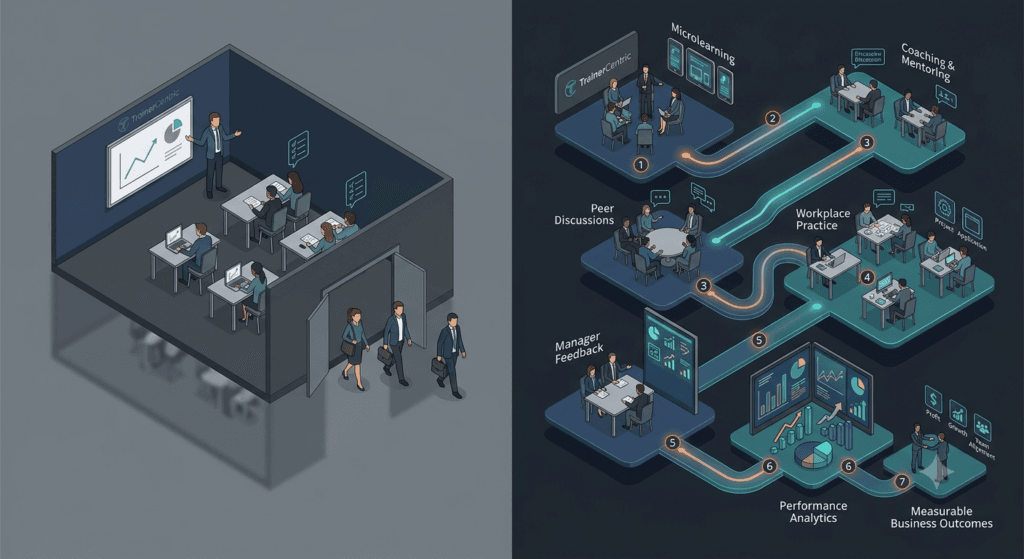
People in L&D use several overlapping terms, and mixing them up muddies both stakeholder conversations and search intent. Here’s how they actually differ:
| Term | What it really means |
| Learning Programme | A designed journey (sessions, coaching, practice, evaluation) built to close a specific performance gap |
| Training Course | A single learning event, usually a few hours or days long |
| Training Plan | The logistical schedule — who attends what, when, and where |
| Curriculum | The full body of content and topics covered across a subject area, often spanning multiple programmes |
| Learning Path | A recommended sequence of resources (often self-directed, digital-first) a learner works through at their own pace |
| Capability Framework | The organisation-wide map of skills and proficiency levels a role requires, which programmes are then designed against |
A capability framework tells you what good looks like. A curriculum organises the topics. A learning programme is the designed experience that gets someone from where they are to where the framework says they need to be. A training plan is just the diary version of that programme.
Characteristics of a genuine learning programme
- It starts with a business problem, not a training request. The brief is “reduce customer complaints by 20%,” not “run a workshop.”
- It has explicit, measurable learning objectives tied to on-the-job performance, not just “raise awareness.”
- It’s sequenced over time. Learning is spaced out to allow for practice, reflection, and reinforcement — a single exposure to new information rarely produces lasting behaviour change.
- It blends delivery methods. Formal sessions, informal social learning, coaching, and self-directed resources all play a role.
- It includes assessment and feedback loops, not just a “did you enjoy this session” survey.
- It’s evaluated against outcomes that matter to the business, using something more rigorous than a smile sheet.
| TrainerCentric Insight: the fastest way to tell a course from a programme in a stakeholder conversation is to ask one question — “what happens to reinforce this after the session ends?” If the honest answer is “nothing,” you’re looking at an event, whatever it’s currently being called. |
| Worth knowing: classic research by Baldwin and Ford (1988) estimated that only around 10% of training content was actually transferred back to job performance; more recent studies put the figure higher, but rarely above 40% for typical corporate training that lacks reinforcement. That gap between “delivered” and “applied” is precisely what a well-designed learning programme, rather than a one-off course, is built to close. |
Is this a knowledge gap, a skill gap, or a behaviour gap?
One reason programmes get designed at the wrong level is that “gap” gets treated as one thing when it’s really three, and each needs a different response:
| Gap Type | What’s missing | Typical fix | Wrong fix |
| Knowledge gap | People don’t know something (a policy, a fact, a process step) | Information delivery — eLearning, a briefing, a job aid | Running a full workshop when a one-page job aid would do |
| Skill gap | People know what to do but haven’t practised doing it | Practice, feedback, coaching, role play, simulation | A knowledge check or quiz, which only confirms recall, not capability |
| Behaviour gap | People can do it but don’t, consistently, under real conditions | Reinforcement, manager coaching, incentive alignment, habit design | Any one-off session at all — behaviour gaps need sustained support, not a single intervention |
Most requests that land on an L&D desk as “we need training” are actually behaviour gaps wearing a knowledge-gap costume. Diagnosing which of the three you’re actually facing, before you design anything, changes the entire shape of the programme.
| TrainerCentric Tip: In our experience, stakeholders often request training before agreeing on measurable business outcomes. Spending an extra meeting up front clarifying which of the three gaps you’re actually looking at — and what success will look like — usually saves weeks of redesign later. |
A quick example
Imagine two companies both dealing with poor onboarding retention.
Company A runs a two-day “Welcome Induction” course covering company history, systems training, and HR policies. New starters attend, get a folder of handouts, and are left to sink or swim.
Company B designs a 90-day onboarding programme: a pre-start welcome kit, a structured first week combining shadowing and short workshops, a buddy system, weekly check-ins with a manager using a structured framework, microlearning modules released at relevant milestones, and a 90-day review against agreed competencies.
Both organisations technically “did onboarding training.” Only one of them designed a learning programme — and it’s not hard to guess which one sees better retention twelve months later.
When Should You Design a New Learning Programme?
Not every performance problem needs a new employee training programme, and part of being a credible L&D professional is knowing when training is — and isn’t — the right lever. That said, there are recurring situations where a properly designed programme genuinely earns its keep.
- Onboarding. New hires who go through a structured onboarding programme reach full productivity faster and are more likely to stay than those given a single induction day.
- Leadership development. Building management capability is a long game — practice, feedback, and real projects, not a single “Leading High-Performing Teams” workshop.
- Compliance and regulatory training. Compliance training designed to actually change behaviour needs objectives tied to real risk scenarios and reinforcement over time, not an annual click-through module nobody remembers by month three.
- Digital transformation. A new system, process, or way of working needs a change-and-capability journey addressing both skills and mindset, not a single “how to use the new CRM” session.
- Sales enablement. New product launches, changed selling methodologies, or underperforming targets usually call for a programme combining product knowledge, skills practice, manager coaching, and ongoing reinforcement.
- Behavioural change initiatives. Safety culture, customer service standards, and ethical conduct all require sustained reinforcement — one-off awareness sessions are notoriously poor at shifting entrenched habits.
- Performance improvement. When a specific team is underperforming against a measurable KPI, and a proper needs analysis confirms a genuine skills gap, a targeted programme is the right response.
The common thread: whenever the desired outcome is sustained behaviour change rather than a one-time knowledge transfer, you need a programme, not a course.
When You Shouldn’t Design a Learning Programme
Many organizations quietly assume training is always the answer; mature performance consulting means being willing to say it isn’t. A learning programme is the wrong response when:
- The problem is caused by poor processes. If the CRM takes eleven clicks to log a call, no amount of “communication skills training” fixes that — fix the process.
- Employees lack tools, not knowledge. If people know exactly what to do but don’t have the equipment, access, or system to do it, training just teaches them to want something they still can’t have.
- Incentives are misaligned. If people are rewarded for speed over quality, training them to prioritise quality will not survive contact with the bonus structure.
- Managers aren’t reinforcing behaviours. If line managers won’t release people’s time or follow up afterwards, even a beautifully designed programme will fail on contact with reality — no amount of design quality compensates for zero reinforcement.
- Success hasn’t been defined. If nobody can say what “success” looks like in business terms before design starts, you’re building an event, not a programme, and it will be judged — fairly — as a cost rather than an investment.
In our experience, the single most common reason a programme fails isn’t poor instructional design — it’s skipping this filter and building a programme to solve a problem training was never going to solve. CIPD’s own evaluation research reflects the same pattern from the other end: one large CIPD annual survey found that a meaningful share of organisations don’t evaluate the majority of their L&D activity at all, and of those that do, the biggest single group stop at learner satisfaction rather than checking whether anything transferred to the workplace — often because nobody agreed what “worked” would mean before the training was delivered.
The TrainerCentric Programme Readiness Scorecard

Before committing to a full design project, score the request against these five questions from 0 (not at all) to 2 (fully in place). It takes ten minutes and it will save you weeks.
| Readiness Factor | 0 | 1 | 2 |
| Management support | No manager buy-in | Manager aware, not committed | Manager actively sponsoring and will reinforce |
| Root cause is skill/knowledge | Clearly process, tools, or incentives | Mixed — some of each | Confirmed genuine capability gap |
| Success is defined | No metric identified | A metric exists but no baseline | Metric and baseline agreed with sponsor |
| Incentives are aligned | Incentives reward the opposite behaviour | Neutral | Incentives support the desired behaviour |
| Tools/process support the change | Current tools/process block it | Workable but clunky | Tools and process fully support it |
9–10: Proceed with full programme design. 5–8: Proceed, but flag the weak factors to the sponsor and build mitigations into the plan. Below 5: Stop and address the underlying issue first — a learning programme built on this foundation is very unlikely to move the business metric, however well it’s designed.
| TrainerCentric Insight: if a stakeholder asks for a two-day workshop before you’ve agreed on how success will be measured, it’s worth pausing that conversation rather than moving straight to scheduling. Clarifying the business outcome first, even if it adds one extra meeting, almost always prevents a much more costly redesign three or four weeks into the project. |
The Complete 10-Step Learning Programme Design Framework
This is the heart of the guide: a practical, sequential training design process for building a learning programme from the first conversation through to proven business impact. It draws on established instructional design theory but applies it the way an experienced practitioner actually would, including the messiness of real organisational life.
The TrainerCentric 5D Learning Programme Framework
The ten steps below are detailed and sequential, but it helps to hold them in your head as five broader phases first. We call this the 5D Framework — it doesn’t replace ADDIE, SAM, or any other named model; it’s simply how we group the ten steps into a shape that’s easy to remember and easy to explain to a stakeholder in one sentence.
| Phase | Covers | Question it answers |
| Discover | Step 1 (Business Problem) + Step 2 (TNA) | What’s actually wrong, and is training the right fix? |
| Define | Step 3 (Objectives) + Step 4 (Design Model) | What should learners be able to do, and how will we build this? |
| Design | Step 5 (Journey) + Step 6 (Activities) | What’s the shape of the experience, session by session? |
| Develop | Step 7 (Assessment) + Step 8 (Materials) + Step 9 (Pilot) | Is it built, tested, and ready to trust with a real audience? |
| Determine | Step 10 (Evaluate) | Did it actually work, in the business’s own terms? |
Five words, one for each phase, in the order they happen: Discover, Define, Design, Develop, Determine. It’s a deliberately simple frame — the detail still lives in the ten steps that follow — but it’s proven useful as a one-slide summary when a sponsor asks “so what does ‘designing a learning programme’ actually involve?”
Before the detail, here’s roughly how long each stage tends to take for a moderately complex programme — useful for anyone scoping a project plan or setting stakeholder expectations up front.
| Phase | Typical Duration |
| Discovery (understand the business problem) | 1–2 weeks |
| Training Needs Analysis | 1–3 weeks |
| Define learning objectives | 2–4 days |
| Choose instructional design model | 1–2 days |
| Design the learning journey | 1–2 weeks |
| Design activities | 1–2 weeks |
| Create assessments | 3–5 days |
| Develop learning materials | 2–5 weeks |
| Pilot and improve | 1–2 weeks |
| Evaluate success | Ongoing (baseline set before launch, results reviewed at 30/60/90 days) |
These are guide figures, not commitments — a compliance refresher and a twelve-month leadership programme will scale very differently — but they’re a realistic starting point for a project timeline conversation with a sponsor.
Step 1: Understand the Business Problem
Every good learning programme starts before “training” is even mentioned — with a real business problem.
This is where performance consulting comes in: a discipline that treats the trainer less like an order-taker and more like a diagnostic partner. When a stakeholder says “we need training,” the job isn’t to start designing a course. It’s to ask better questions:
- What is actually happening that shouldn’t be, or not happening that should?
- How do we know? What data supports this?
- What would success look like, in business terms, six or twelve months from now?
- What’s already been tried?
- Is this a skills and knowledge gap, or a systems, process, incentive, or resourcing issue?
That last question matters enormously, because training cannot fix a broken process, an unworkable system, or a poorly designed incentive structure.
A financial services client I once worked with came to us wanting “negotiation skills training” for their relationship managers, whose deal conversion rates had dropped. Two stakeholder interviews in, it became clear the real issue wasn’t negotiation skill at all — it was a newly introduced approval workflow that meant relationship managers couldn’t confirm pricing on the call, so customers lost momentum and shopped around. We recommended fixing the approval workflow first and running a much smaller coaching intervention alongside it, rather than the full programme they’d originally asked for. It was a smaller engagement for us, and the right one.
In our experience, this step is where the discipline of L&D is proven or disproven. Skipping it and going straight to “let’s design the workshop” is the single fastest way to build something polished that nonetheless fails to move the metric anyone actually cared about.
The TrainerCentric Programme Design Canvas
We use a single one-page canvas to capture the answers to Step 1 before any design work starts. It’s deliberately small — if it doesn’t fit on one page, the problem probably isn’t defined tightly enough yet.
- BUSINESS PROBLEM What’s happening that shouldn’t be (or vice versa)?
- ROOT CAUSE Skill / knowledge / process / tools / incentive / manager gap?
- TARGET AUDIENCE Who, how many, what’s their starting point?
- SUCCESS METRIC The Level 4 number that has to move, and its baseline
- SPONSOR Who owns this outcome, and who signs off design?
- READINESS SCORE From the Programme Readiness Scorecard above
- DESIGN MODEL ADDIE / SAM / blended, and why
- GO-LIVE Target date, working back from the stage-duration table
Filling this in with the sponsor in the same room — rather than writing it up afterwards and sending it for approval — is what usually surfaces disagreements early, while they’re still cheap to resolve.
| TrainerCentric Tip: it’s tempting to skip the canvas for “quick” requests. In our experience, quick requests are exactly the ones most likely to quietly turn into a full programme three weeks in, once someone realises the underlying problem was bigger than described. Ten minutes on the canvas costs almost nothing; retrofitting it after the brief has expanded costs a great deal more. |
Common mistakes at this stage:
- Accepting “we need training” at face value without probing the root cause.
- Designing objectives around activities (“deliver a workshop”) instead of business outcomes (“reduce first-call resolution time by 15%”).
- Skipping stakeholder alignment, so the programme gets built and then rejected by leadership who wanted something different.
- Failing to define what “done” and “successful” look like before design begins.
Step 2: Conduct a Training Needs Analysis

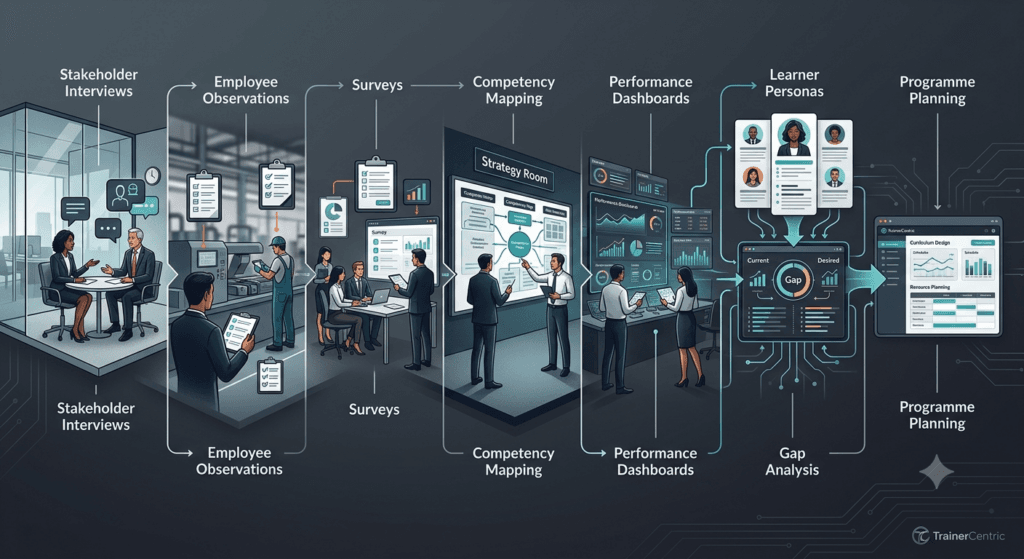
Once the business problem is understood at a high level, the next step is a proper Training Needs Analysis (TNA) — the systematic process of identifying the gap between current and required performance, and confirming that training is genuinely the right intervention.
A thorough needs assessment typically draws on several sources:
- Stakeholder interviews with sponsors, managers, and subject matter experts (SMEs) to understand context, constraints, and expectations.
- Surveys of the target population to capture self-reported confidence and perceived barriers.
- Observations of people actually doing the job, which often reveal gaps nobody mentioned in interviews because they’ve become invisible through familiarity.
- Performance data — complaint logs, error rates, sales figures, quality audits, safety incidents — which grounds the exercise in evidence rather than opinion.
- Competency mapping, comparing the skills, knowledge, and behaviours a role requires against what the current population actually demonstrates.
SME interviews deserve a special mention because they’re both invaluable and a common source of scope creep — subject matter experts often know far more than can realistically fit into a programme, and part of the designer’s job is respectfully extracting what’s essential rather than everything they know.
If your organisation doesn’t yet have a structured process for this stage, our dedicated guides walk through it in more depth: How to Conduct a Training Needs Analysis in Five Steps, the Training Needs Analysis Questionnaire, the Training Needs Analysis Template, the 3 Levels of Training Needs Analysis, Job Task Analysis, Focus Groups and Interviews for TNA, Skills Gap Analysis vs Training Needs Analysis, and Performance Consulting: When Training Is NOT the Answer.
| TrainerCentric Tip: don’t let the needs analysis become a formality that confirms what the sponsor already believed. In our experience, the most useful TNA findings are usually the ones that mildly contradict the original brief — a different root cause, a smaller target audience, a confidence gap nobody mentioned. If your TNA always agrees with the initial brief, it’s worth asking whether it was a genuine analysis or a box-ticking exercise. |
The output of this step should be a clear, evidence-based statement of the gap: who needs to do what differently, under what conditions, and how well — which feeds directly into objectives.
Step 3: Define Learning Objectives
With the gap identified, translate it into learning objectives — clear statements of what learners will be able to do differently as a result of the programme.
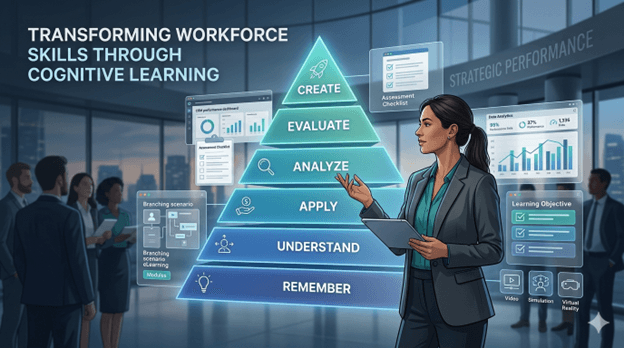
Good objectives are SMART: Specific, Measurable, Achievable, Relevant, and Time-bound. But SMART alone isn’t enough for instructional design; objectives also need to sit at the right cognitive level, which is where Bloom’s Taxonomy earns its keep.
Research summary: Bloom’s Taxonomy, first published in 1956 and revised by Anderson and Krathwohl in 2001, describes a hierarchy of cognitive skill running from remembering and understanding, through applying and analysing, up to evaluating and creating. The revision matters in practice: it reframed the categories as verbs (things learners do), which is exactly why it’s so useful for writing behavioural objectives rather than vague awareness statements.
A common design mistake is writing objectives at the “remembering” level — “learners will know the five steps of the complaints process” — when the actual business need requires application: “learners will be able to de-escalate an angry customer call using the five-step framework, within agreed time limits.”
Examples of well-written objectives:
- Weak: “Understand the principles of active listening.”
- Strong: “By the end of the workshop, participants will be able to demonstrate active listening techniques in a live role-play scenario, correctly applying at least three of the four core techniques.”
- Weak: “Learn about performance feedback.”
- Strong: “Following the programme, managers will be able to conduct a structured feedback conversation using the SBI model, as observed and rated by their line manager within 30 days.”
| TrainerCentric Insight: if you can’t picture what “meeting this objective” would actually look like in a room or on a call, the objective isn’t finished yet — it’s still a topic wearing an objective’s grammar. Rewriting it as a short scene (“advisor stays calm, uses the framework, resolves within four minutes”) almost always reveals whether it’s genuinely ready. |
Step 4: Choose an Instructional Design Model
This is where many first-time designers get stuck — there’s no shortage of instructional design models, each with its own vocabulary and advocates. In practice, a handful matter most for corporate learning design.
| Model | Best For | Speed | Complexity |
| ADDIE | Stable, well-understood content (compliance, established technical skills) | Slow | Low–Medium |
| SAM | Ambiguous requirements, fast-moving environments, early stakeholder buy-in | Fast | Medium |
| Dick and Carey | High-stakes programmes needing tight alignment between objectives, assessment, and strategy | Medium | High |
| Gagné’s Nine Events | Structuring a single session or module reliably | Fast (session-level) | Low |
| Merrill’s First Principles | Quality-checking whether an activity is genuinely problem-centred | N/A (a design lens, not a process) | Medium |
ADDIE (Analyse, Design, Develop, Implement, Evaluate) is the classic, linear model. It’s thorough and well-documented, and works well for stable content, but strict ADDIE can be slow — a lot of work goes into design and development before anything gets tested with real learners. Full detail: ADDIE Model Explained Step by Step.
SAM (Successive Approximation Model) is ADDIE’s more agile cousin: rapid prototyping cycles instead of one long linear sequence. It suits ambiguous requirements or situations where stakeholder buy-in benefits from seeing something tangible early. See SAM Model: How to Build Training Faster and our direct comparison, ADDIE vs SAM.
Dick and Carey offers a systems view, emphasising the interrelationship between learners, context, content, and instructional strategies rather than treating them as separate steps. Particularly strong when you need rigorous, evidence-based alignment between objectives, assessments, and strategy. See Dick and Carey Model: When to Use It and When to Avoid It.
Merrill’s First Principles of Instruction argues that learning is most effective when it’s problem-centred and moves learners through activation of prior knowledge, demonstration, application, and integration into real-world practice. It’s less a process and more a quality lens for the activities you design at Step 6. See Merrill’s Principles of Instruction.
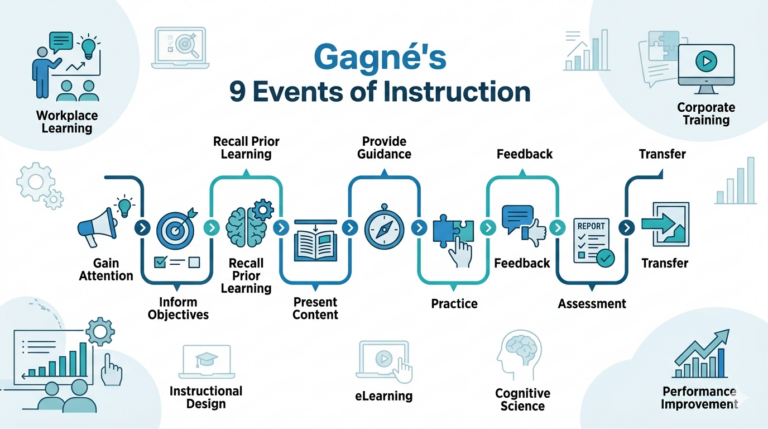
Gagné’s Nine Events of Instruction is a granular, session-level sequence — gaining attention, informing objectives, stimulating recall, presenting content, providing guidance, eliciting performance, providing feedback, assessing performance, and enhancing retention and transfer. It’s less a full programme model and more a reliable blueprint for individual sessions. See Gagné’s Nine Events of Instruction.

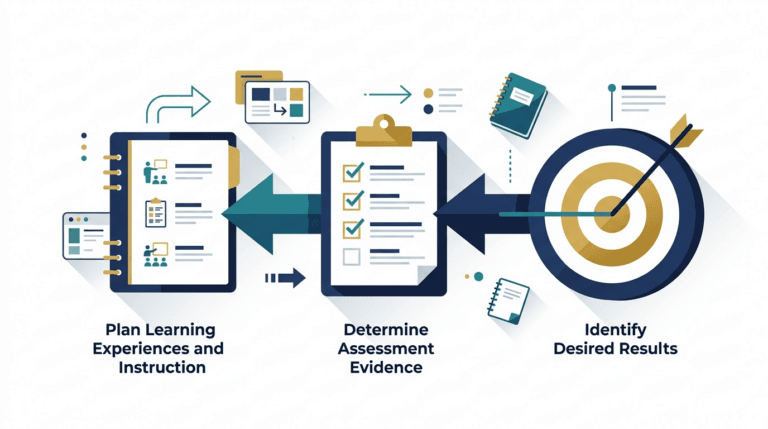
Two further reference points worth knowing at this stage: Adult Learning Theory (Andragogy), which explains why relevance and autonomy matter so much to adult learners, and Cognitive Load Theory, which explains why cramming too much into a single session backfires regardless of which process model you use. If you want a more experiential lens on activity design, Kolb’s Learning Cycle and, for building motivation into materials, Keller’s ARCS Model are both worth a read. If you’re designing backwards from assessment, Backward Design (UbD) is a useful complementary approach.
Which one should you choose? In our experience, most experienced designers don’t rigidly follow a single model; they blend them. A pragmatic default:
- Use ADDIE or Dick and Carey as the overall project backbone for larger, higher-stakes programmes, where rework is expensive and requirements are genuinely stable.
- Use SAM’s iterative prototyping when requirements are unclear or stakeholders need to see something before committing — it reduces rework and earns buy-in earlier than a big-reveal approach ever will.
- Use Gagné’s Nine Events to structure each individual session or module, regardless of which overall model you’ve chosen.
- Use Merrill’s First Principles as a quality check on your activities: is this genuinely problem-centred, or information delivery dressed up as an activity?
Because “Agile” gets used loosely in L&D conversations — sometimes meaning SAM, sometimes meaning a genuine Scrum-style sprint process borrowed from software teams — it’s worth being precise about how the three actually compare:
| ADDIE | SAM | Agile (Scrum-style) | |
| Structure | Linear, sequential phases | Iterative prototyping loops | Fixed-length sprints with a backlog |
| When requirements are locked in | Ideal | Works, but overkill | Works, but process overhead may not pay off |
| When requirements are still forming | Struggles — rework is expensive | Ideal | Ideal, if the team already runs sprints elsewhere |
| Stakeholder involvement | Mostly at the start and end | Continuous, via prototype reviews | Continuous, via sprint reviews |
| Best fit | Compliance, stable technical content | Most corporate L&D projects | Larger digital learning teams already using Agile for other work |
| TrainerCentric Tip: in our experience, teams new to SAM often try to run it exactly like ADDIE with extra meetings, which defeats the point. The value of SAM comes from showing something rough and unfinished early, not from a polished first prototype — resist the urge to make the first version presentable. |
Step 5: Design the Learning Journey
This is where a course becomes a programme. Rather than designing one event, you’re designing a sequence of experiences over time, deliberately blending delivery methods to match the objectives, audience, and constraints.
Options to draw on include:
- Instructor-led training (ILT) — face-to-face, ideal for complex interpersonal skills and activities that benefit from real-time facilitation.
- Virtual instructor-led training (VILT) — the same principle delivered remotely, useful for distributed teams but needing more deliberate design to sustain engagement.
- eLearning — self-paced digital modules, well suited to consistent knowledge delivery at scale.
- Blended learning — combining formats so each does the job it’s best at, rather than making one format do everything. See [Internal Link: Blended Learning Design — How to Combine Online and In-Person Training].
- Microlearning — short, focused bursts of content well suited to reinforcement and just-in-time support. See Microlearning — What It Is, When to Use It, and How to Design It.
- Social learning — peer discussion groups and communities of practice, tapping into how much workplace learning happens informally, from colleagues.
- Coaching — one-to-one or small-group support from managers, crucial for turning “I understood it in the workshop” into “I can actually do this on the job.”
- Practice and reinforcement — structured opportunities to apply new skills repeatedly over time rather than crammed into one session.
Many organisations frame this blend using the 70:20:10 rule of thumb — roughly 70% of development happening through on-the-job experience, 20% through others (coaching, feedback, social learning), and 10% through formal training. It’s a directional guide rather than a strict formula, but it’s a useful sense-check against a journey that’s 90% classroom and 10% everything else.
Choosing between formats is often framed as a single either/or decision when it’s really three different questions — reach, depth, and cost — answered differently by each option:
| ILT (Classroom) | VILT (Virtual) | Blended | |
| Best for | Complex interpersonal skills, sensitive topics, high group-dynamics value | Distributed teams, shorter focused sessions | Most programmes with more than one objective type |
| Reach | Limited by room and travel | High — no travel needed | High |
| Depth of practice | Strong (real-time role play, coaching) | Moderate — needs deliberate design to avoid passivity | Strongest — each format does what it’s best at |
| Cost per learner | Highest (venue, travel, facilitator time) | Lower | Depends on mix |
| Risk if poorly designed | Wasted travel budget on weak content | “Zoom fatigue,” disengagement | Complexity — more moving parts to manage well |
The TrainerCentric Learning Journey Pyramid
We use a simple pyramid to sense-check a journey before it goes into full production. Reading bottom to top, each layer should be smaller than the one below it — if a programme is top-heavy (lots of one-off events, thin reinforcement), that’s usually visible at a glance before a single session is built..

A journey that’s mostly “core experience” with a thin sliver of reinforcement on top is, in effect, still a course wearing a programme’s paperwork. Widening the reinforcement layer is usually the single highest-leverage change available at this stage.
Example learning journey — a customer service programme:
| Week | Activity |
| 0 | Pre-work: short diagnostic self-assessment + sponsor welcome video |
| 1 | Half-day instructor-led workshop, core framework + role-play practice |
| 2–4 | Weekly microlearning nudges (2–3 minutes), reinforcing specific techniques |
| 3 | Manager-led coaching conversation, reviewing a real customer interaction |
| 5 | Peer learning circle — small groups share real examples and outcomes |
| 8 | Follow-up virtual session addressing common challenges from rollout |
| 12 | Formal review against agreed behaviours, tied to the evaluation plan |
One manufacturing organisation I worked with initially wanted the entire safety behaviour programme delivered as a single all-day classroom session, purely because that was how it had “always been done.” We proposed spreading the same content across a shorter session plus five weeks of supervisor-led toolbox talks and a single follow-up audit. Attendance and completion looked identical on paper either way — the difference only showed up three months later, when incident reports in the spaced-out cohort had dropped and the single-session cohort’s hadn’t moved.
Spacing isn’t decoration — it reflects well-established adult learning theory and the understanding that spaced practice dramatically outperforms a single, intense exposure for lasting skill acquisition.
Step 6: Design Activities
With the overall journey mapped, it’s time to design what actually happens inside each session or module. This is where Merrill’s First Principles become genuinely practical: good activities are problem-centred, not information dumps.
Strong activity design draws on:
- Discussions that surface real experiences and challenge assumptions, rather than closed questions with a single “correct” answer.
- Simulations that recreate realistic workplace conditions in a safe environment.
- Scenario-based learning, where learners work through a realistic, branching situation and see the consequences of their choices — one of the most effective ways to build judgement rather than just knowledge. See Scenario-Based Learning: How to Write Branching Scenarios for a full build process.
- Role plays, especially valuable for interpersonal skills, though they need careful facilitation to avoid feeling contrived.
- Games and gamified elements, used purposefully rather than as novelty.
- Reflection, structured moments where learners connect content to their own experience and commit to specific actions.
- Practice, ideally practice that closely resembles the real task, with feedback built in.
A useful test for any activity: if you removed the “learning” framing, would this still resemble something a competent professional actually does in the real job? If not, you may be building an activity that entertains rather than transfers.
| TrainerCentric Insight: the activities that generate the best in-session energy — games, icebreakers, big-group discussions — are not always the ones that produce the strongest transfer back to the job. It’s worth deliberately protecting time for the quieter, less flashy activities (individual practice, structured reflection) that tend to do more of the actual work. |
Step 7: Create Assessments
Assessment isn’t an afterthought bolted on at the end — it should be designed alongside the objectives, because a well-written objective already implies how it will be measured.
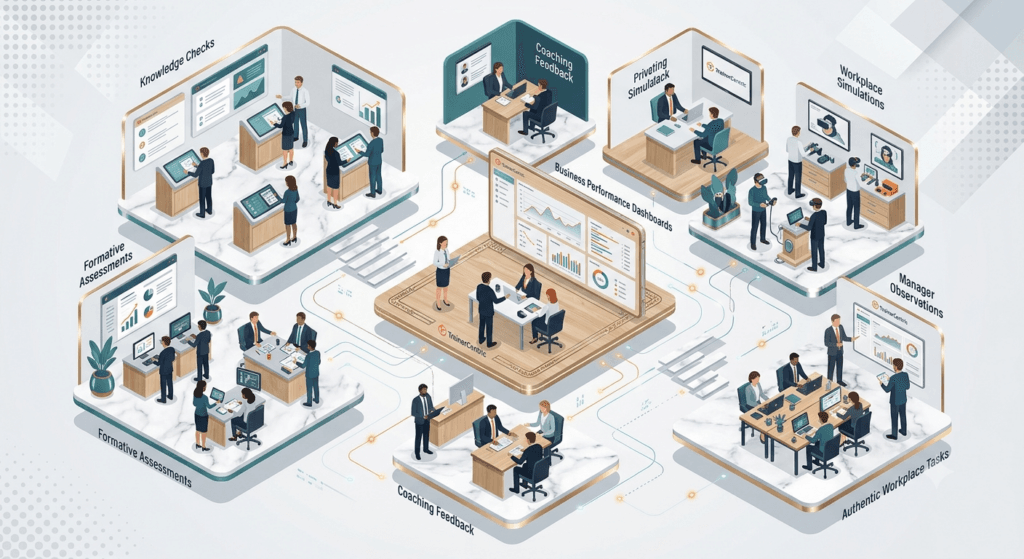
Key assessment types:
- Formative assessment — ongoing checks during learning (quizzes, discussion prompts, practice attempts) that let both learner and facilitator adjust before it’s too late.
- Summative assessment — a final check confirming whether objectives were met.
- Authentic assessment — tasks that closely mirror real workplace conditions, such as a simulated difficult customer call rather than a multiple-choice quiz about theory.
- Knowledge checks — quick, low-stakes recall checks, useful but insufficient alone beyond the lowest levels of Bloom’s Taxonomy.
- Workplace assignments — tasks completed on the job, ideally reviewed by a manager, testing genuine transfer rather than classroom performance.
The strongest programmes triangulate: a knowledge check confirms understanding, an authentic assessment confirms application, and a workplace assignment confirms transfer. Relying solely on an end-of-module quiz tells you almost nothing about whether real-world behaviour will change.
Step 8: Develop Learning Materials
With the design locked down, build the materials learners and facilitators will actually use. A well-designed programme typically includes:
- A facilitator guide — detailed enough that a different facilitator could deliver the session consistently, with timings, key messages, and guidance for common questions or difficult dynamics.
- A learner workbook — a companion resource used during and after the session.
- Slides — a visual aid, not a script. If the slides could be removed and the session would still work, they’re doing their job.
- Participant handouts and job aids — reference material and quick-in-the-moment tools.
- Videos — useful for demonstrating behaviours or delivering consistent content at scale.
- Digital assets — eLearning modules and microlearning content. See [Internal Link: How to Choose eLearning Authoring Tools: A Framework for L&D Teams].
A useful habit at this stage is attaching a completed copy of the Programme Design Canvas from Step 1 to the front of the facilitator guide. It costs nothing to include and means any facilitator picking up the materials cold can see, in ten seconds, what the programme is actually for.
A quality check worth applying: could someone unfamiliar with the programme pick up the facilitator guide and deliver a reasonably consistent session? If not, too much of the programme is living in your head rather than in the materials — a real problem the moment you need to scale delivery to other facilitators.
| TrainerCentric Tip: the facilitator guide is usually the first thing to get shortened under deadline pressure, and it’s almost always the wrong place to cut. In our experience, a thin facilitator guide is the single biggest reason a programme’s quality degrades the moment someone other than the original designer delivers it. |
Step 9: Pilot and Improve
No matter how much analysis and design goes into a programme, it should never go straight from development to full rollout. A pilot is non-negotiable for any programme of meaningful scale or cost.
A good pilot process includes:
- Testing the full programme (or a representative slice) with a small, real group — not a friendly internal team who’ll be politely uncritical.
- Facilitator feedback, gathered immediately after delivery while the experience is fresh.
- Learner feedback, ideally combining immediate reaction with a follow-up a few weeks later asking whether they’ve actually used what they learned.
- Revisions, made systematically — not every piece of feedback should trigger a change, but patterns across multiple pilot participants usually should.
Mistakes that specifically show up around SMEs and stakeholders at this stage:
- SMEs want to teach everything they know, not what the objective actually requires.
- Stakeholders keep changing scope mid-build, because the business problem was never pinned down tightly enough at Step 1.
- Managers agree to reinforcement in principle but skip it in practice once the programme launches.
- Learners are given content but never given protected time to actually practise it.
Skipping the pilot is one of the more expensive mistakes in programme design: problems that would take an afternoon to fix in a small pilot group can take weeks to fix — and cost real credibility — once they’ve surfaced during a full-scale rollout to hundreds of people.
| TrainerCentric Tip: ask your pilot group one extra question the design team can’t answer for itself: “what would make you not bother doing this once you’re back at your desk?” It surfaces friction — time pressure, awkward timing, an unsupportive manager — that no amount of content polishing will fix, and it’s far cheaper to hear at pilot stage than to infer from disappointing Level 3 evaluation data three months later. |
Step 10: Evaluate Success
The final step closes the loop back to Step 1’s business problem. This is where learning evaluation proves — or disproves — whether the programme actually worked.
The Kirkpatrick Model remains the most widely used framework, structured across four levels:
- Level 1 – Reaction: Did learners find it useful, relevant, and engaging?
- Level 2 – Learning: Did learners actually gain the intended knowledge, skills, or confidence?
- Level 3 – Behaviour: Are learners applying what they learned back in the workplace?
- Level 4 – Results: Did the business metric from Step 1 actually move?
Worth knowing: an ASTD/i4cp study on the value of training evaluation found that 92% of organisations evaluate at Level 1, but only around 18% ever reach Level 5 (ROI). A separate academic review citing Rossett’s research found a similar pattern — roughly 94% of evaluation activity happens at Level 1, dropping to just 3% at Level 4.
A CIPD annual L&D survey found much the same shape from a UK perspective: a meaningful share of organisations don’t evaluate most of their L&D activity at all, and among those that do, the largest single group stop at learner satisfaction rather than checking workplace transfer. That gap is precisely why so much L&D work gets dismissed as a cost centre: almost nobody can point to Level 3 or 4 evidence, even though that’s the evidence that actually protects budgets.
For higher-stakes programmes, the Phillips ROI methodology extends Kirkpatrick with a fifth level, converting Level 4 results into a monetary value and comparing it against programme cost. See our detailed guides on the Kirkpatrick Model and How to Calculate Training ROI.
| TrainerCentric Tip: agree the Level 3 and 4 measures with your sponsor in the same meeting where you agree the budget, not afterwards. In our experience, evaluation plans that get built after launch almost always end up measuring what was easy to measure rather than what the business actually cared about — and by then, there’s rarely a clean baseline left to compare against. |
Reinforcement matters here too. Classic forgetting-curve research by Hermann Ebbinghaus — since replicated in a widely cited 2015 study by Murre and Dros — shows that without reinforcement, learners forget the majority of new material within days of a session.
Separately, a meta-analysis by Cepeda et al. (2006) covering over 300 experiments found that spaced practice consistently outperforms massed, single-session practice. In practical terms: if Step 5’s journey doesn’t include spacing and reinforcement, Step 10’s evaluation is likely to disappoint, no matter how good the original session was.
The practical takeaway: build your evaluation plan at Step 1 or 2, not as an afterthought. Decide which business metrics you’ll track, get a baseline before launch, and agree with stakeholders in advance what “success” looks like at each level.
How AI Can Speed Up Learning Programme Design (Without Replacing Good Instructional Design)

It’s 2026, and AI tools are now a genuine part of most designers’ workflow — but they’re an accelerant for the process above, not a substitute for it. Used well, they compress the mechanical parts of design so more time goes into the judgement calls that actually determine whether a programme works.
Where AI tools currently add real value:
- Drafting objectives. Feed in the TNA findings and a target Bloom’s level, and get a first pass at objective wording to edit rather than write from scratch.
- Storyboarding. Quickly generate a rough session or eLearning storyboard structure to react to and refine, rather than staring at a blank page.
- Scenario generation. Draft branching scenario options and dialogue variations for scenario-based learning, which a designer then edits for realism and accuracy.
- Persona creation. Build quick learner personas from TNA data to keep audience needs visible throughout design.
- Quiz generation. Generate draft knowledge-check questions from source content, which still need human review for accuracy and difficulty level.
- SME interview summaries. Summarise long interview transcripts into themes and quotes, cutting hours out of the analysis stage of Step 2.
The limit worth being explicit about: none of this replaces the judgement calls in Steps 1, 4, 6, and 10 — deciding whether training is even the right intervention, choosing the right design model for the context, deciding whether an activity is genuinely problem-centred, and interpreting what evaluation data actually means for the business.
AI-generated content also needs the same SME and facilitator review as anything else — arguably more, given how confidently it can present plausible-sounding but incorrect detail. Treat it as a fast first draft, never as the final word.
Real Corporate Example: Designing a Customer Service Learning Programme
To bring the framework together, here’s how these ten steps played out for a mid-sized retail business dealing with declining customer satisfaction scores.
| Step | What happened |
| 1. Business problem | Complaint-related dissatisfaction had risen; goal set as a 20% reduction plus fewer escalations within two quarters |
| 2. TNA | Interviews and call listening showed low advisor confidence in de-escalation and unclear discretion limits |
| 3. Objectives | Advisors to de-escalate using a structured framework and apply discretion limits correctly, assessed via observed calls |
| 4. Design model | SAM chosen, given a tight two-month timeline and evolving understanding of the problem |
| 5. Learning journey | Half-day workshop + weekly microlearning + manager call reviews + peer forum |
| 6. Activities | Scenario-based learning with branching customer scenarios, plus role-play with feedback |
| 7. Assessment | Observed live/recorded calls scored against the framework, plus a short knowledge check on discretion limits |
| 8. Materials | Facilitator guide, laminated desk job aid, short demonstration videos |
| 9. Pilot | Delivered to one team of twelve; six-step framework condensed to four steps before full rollout |
| 10. Evaluation | Complaint-related dissatisfaction and escalations both fell within three months of full rollout, against a pre-set baseline |
The Head of Customer Operations had originally asked for “some training on customer service.” What actually got delivered was a targeted, evidence-based intervention that gave the business a credible, numbers-backed story — exactly the kind of evidence that protects L&D budgets in future planning conversations.
Common Mistakes in Learning Programme Design
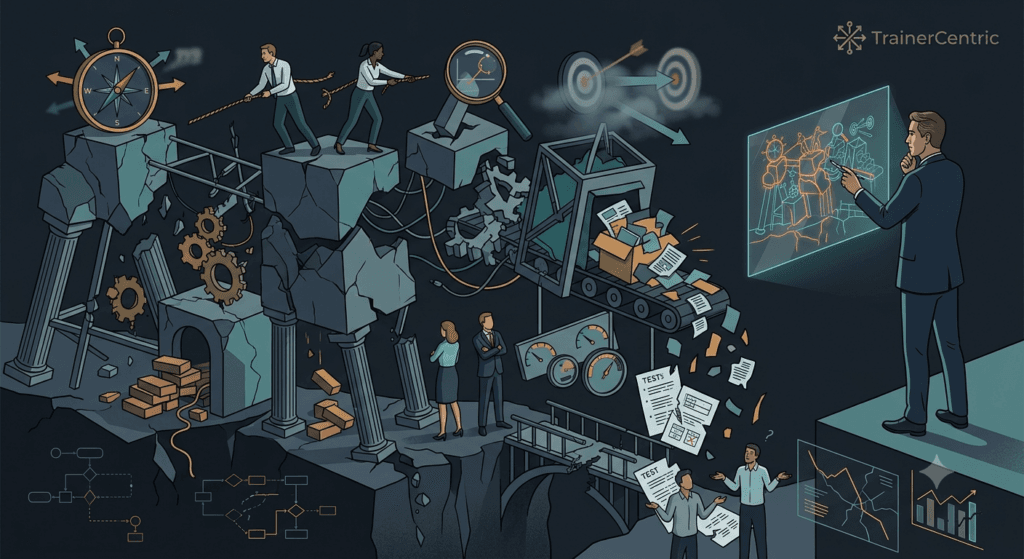
Even well-resourced programmes go wrong in predictable ways. Eighteen of the most common:
- 1. Starting with a solution instead of a problem — designing “a workshop on X” before confirming training is the right intervention.
- 2. Skipping the Training Needs Analysis under time pressure, then discovering mid-programme the wrong gap was targeted.
- 3. Writing objectives at the wrong cognitive level — settling for “understand” when the business needs applied skill.
- 4. Confusing activity with objective — measuring success by “we delivered four workshops” rather than any behavioural or business outcome.
- 5. Overloading content because SMEs contributed more than learners can realistically absorb and apply.
- 6. Designing a single event instead of a journey, ignoring the need for spacing, reinforcement, and practice.
- 7. Ignoring adult learning principles — relevance, autonomy, and connecting new content to prior experience.
- 8. Death by PowerPoint — slides that function as a script rather than a visual aid.
- 9. Skipping the pilot and discovering fundamental design flaws only after full-scale rollout.
- 10. No manager involvement, leaving learners unsupported when they try to apply new skills.
- 11. Evaluating only at Level 1 and never establishing whether behaviour or business results changed.
- 12. No baseline data, making it impossible to credibly demonstrate impact afterwards.
- 13. Treating assessment as an afterthought rather than designing it alongside the objectives.
- 14. Assuming one size fits all, delivering identical content to audiences with very different starting points or contexts.
- 15. Under-investing in facilitator preparation, assuming a good guide alone guarantees consistent delivery.
- 16. Letting SMEs design the curriculum by default — deep expertise in a topic isn’t the same as knowing what a learner actually needs first.
- 17. Allowing scope to drift after sign-off, usually because the business problem in Step 1 was never pinned down tightly enough to say no to additions.
- 18. Treating the pilot as a formality rather than genuinely being willing to rework the programme based on what it reveals.
Frequently Asked Questions
1. What’s the difference between a learning programme and a training course?
A training course is typically a single event — a half-day workshop or a standalone eLearning module — with a clear start and end and no built-in mechanism for reinforcement afterwards. A learning programme is a structured journey made up of multiple experiences spread over time: perhaps a diagnostic, an initial session, several weeks of microlearning, manager coaching, and a formal review. The practical difference shows up in outcomes. A course can raise awareness or transfer knowledge reasonably well in a single sitting; a programme is what’s actually required if the goal is sustained behaviour change, because behaviour change relies on spaced practice, feedback, and reinforcement that a single event simply cannot provide. If your stakeholder is asking for “training” to solve a recurring performance problem, it’s worth explicitly reframing the conversation around a programme rather than an event before design work begins. It’s also worth checking which of the three gap types (knowledge, skill, or behaviour — see the comparison earlier in this guide) you’re actually dealing with, since a genuine behaviour gap essentially can’t be closed by a single course at all, however well it’s delivered.
2. What’s the difference between a knowledge gap, a skill gap, and a behaviour gap?
A knowledge gap means someone doesn’t know something — a policy detail, a process step, a fact — and it’s usually the cheapest gap to close, often with a job aid or a short briefing rather than a full workshop. A skill gap means someone knows what to do in theory but hasn’t practised doing it, so the fix is deliberate practice with feedback: role play, simulation, coaching, or supervised repetition, not another explanation of the theory. A behaviour gap is the hardest of the three: someone can genuinely do the thing, under the right conditions, but doesn’t do it consistently in real workplace conditions, usually because of habit, environment, incentives, or lack of reinforcement. Most requests that arrive on an L&D desk as “we need training” are behaviour gaps described using knowledge-gap language, which is exactly why a proper needs analysis at Step 2 matters — misdiagnosing the gap type is one of the fastest ways to build an expensive, well-produced programme that still doesn’t move the metric anyone cared about.
3. How long does it take to design a learning programme from scratch?
It varies considerably with scope, but a moderately complex programme typically takes six to twelve weeks from the first business-problem conversation to a pilot-ready version. Roughly, expect one to two weeks for business analysis, one to three weeks for the Training Needs Analysis, a few days each for objectives and model selection, one to two weeks each for journey and activity design, three to five days for assessment design, two to five weeks for materials development (the single biggest time sink, especially for video or eLearning assets), and one to two weeks for piloting. Evaluation then continues well beyond launch. Compliance refreshers or single-topic programmes can move faster; multi-month leadership development programmes or large-scale digital transformation rollouts will naturally take longer, particularly where multiple stakeholder groups need sign-off at each stage.
4. Which instructional design model should I use — ADDIE or SAM?
Use ADDIE when the content and requirements are stable and well understood — think established compliance topics or well-documented technical skills — because its linear structure rewards thoroughness where nothing is likely to change mid-project. Use SAM when requirements are ambiguous, timelines are tight, or stakeholders need to see something tangible early to give useful feedback and buy in to the direction; its rapid-prototyping cycles reduce the risk of building a large, polished programme around the wrong assumptions. In practice, many experienced designers don’t pick one exclusively — they’ll run SAM-style prototyping for the parts of a programme where requirements are genuinely uncertain, while managing the overall project timeline more like ADDIE once the direction is confirmed. The choice matters less than making it deliberately and documenting why, so the rest of the team understands the trade-offs being made.
5. Do I always need a full Training Needs Analysis?
For anything beyond a very small, low-stakes request — a single short session for a handful of people, say — yes, a proper TNA is worth the time. Skipping it is one of the most common reasons programmes fail to deliver results even when delivery quality in the room is excellent, because the programme ends up solving a problem nobody actually confirmed exists. A full needs analysis doesn’t have to be slow: stakeholder interviews, a short survey, a look at existing performance data, and a handful of observations can often be done inside one to two weeks. What matters is triangulating more than one data source rather than relying solely on what a single senior stakeholder believes the problem to be, since that’s frequently only part of the picture.
6. How do I write good learning objectives?
Start from the gap identified in your Training Needs Analysis and describe the specific behaviour you want to see afterwards, not the topic you plan to cover. Use Bloom’s Taxonomy to check you’re pitching the objective at the right cognitive level — most corporate training genuinely needs “apply” or higher, not “remember” or “understand,” even though those lower levels are far easier to write and assess. A strong objective specifies three things: the observable behaviour, the condition under which it happens (on a live call, in a simulation, back on the job), and, where possible, a standard of performance. Writing the assessment method alongside the objective is a useful discipline, because if you can’t describe how you’d observe or measure it, the objective probably isn’t specific enough yet.
7. What’s the best way to structure a blended learning programme?
Match each delivery method to what it does best rather than defaulting to whatever’s easiest to schedule. Instructor-led sessions suit complex interpersonal skills and anything that benefits from real-time facilitation and group dynamics; microlearning suits reinforcement and just-in-time support after the main event; coaching suits turning classroom understanding into workplace application; eLearning suits consistent knowledge delivery at scale where interaction matters less than reach. The 70:20:10 framework is a useful directional check — most development happens through on-the-job experience and social learning, with formal training playing a smaller (though still important) supporting role. If your journey is entirely formal sessions with no coaching or workplace practice built in, that’s usually a sign the blend needs rebalancing.
8. How much should I involve line managers in a learning programme?
As much as realistically possible. Manager involvement — through coaching conversations, reinforcement, and follow-up on real examples — is consistently one of the strongest predictors of whether new skills actually transfer back to the workplace, a pattern that’s shown up repeatedly across multiple years of LinkedIn’s Workplace Learning Report research. In practice this means building specific manager touchpoints into the journey design at Step 5 (not leaving involvement implicit or optional), giving managers a simple structure or guide for those conversations rather than assuming they’ll know what to ask, and being honest with sponsors up front that a programme without manager reinforcement will underperform regardless of how good the content is.
9. What’s the difference between formative and summative assessment?
Formative assessment happens during the learning process — quizzes, discussion prompts, practice attempts — and its purpose is to inform adjustments along the way, for both the learner (am I getting this?) and the facilitator (is this landing?). Summative assessment happens at the end of a module or programme and its purpose is to confirm whether the stated objectives were actually met, often feeding into a certification or sign-off decision. Neither is inherently better; they answer different questions. A well-designed assessment strategy typically uses formative checks throughout to catch problems early, plus a summative and, ideally, an authentic assessment (one that mirrors real workplace conditions) at the end to confirm genuine capability rather than just short-term recall.
10. How do I measure the ROI of a learning programme?
Start with the Kirkpatrick Model through to Level 4, which measures whether the actual business result identified back in Step 1 moved — complaint rates, sales figures, safety incidents, retention, whatever the original metric was. Where a financial comparison is specifically required, the Phillips ROI methodology extends this with a fifth level, converting Level 4 results into a monetary value and comparing that against the full cost of designing and delivering the programme. The practical prerequisite for either approach is capturing a clean baseline before the programme launches; without it, any post-programme number is impossible to attribute credibly. It’s also worth isolating training’s contribution honestly — other factors (seasonality, a system change, a new manager) often move the same metrics, and overclaiming credit for training alone tends to damage L&D’s credibility more than modest, defensible claims.
Conclusion
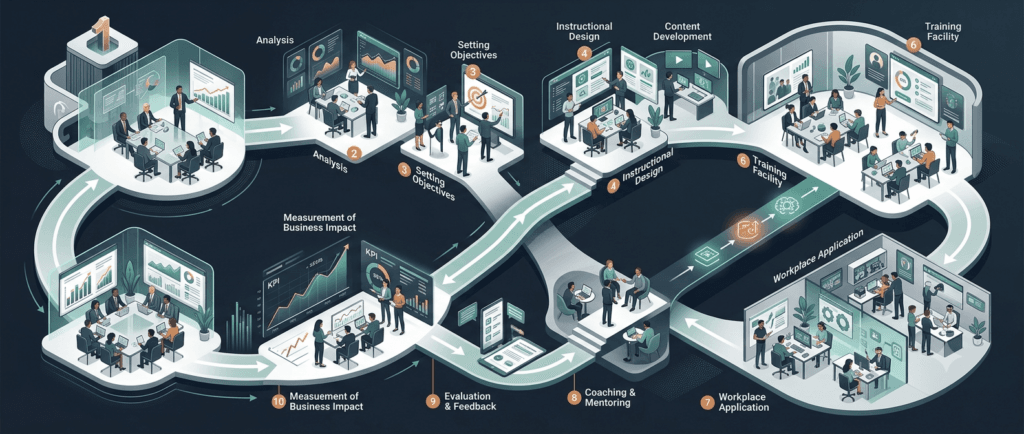
Designing a genuine learning programme is a fundamentally different discipline from putting together a good workshop. It starts before a single slide is built, with a real business problem and a proper needs analysis. It’s shaped by clear, well-pitched objectives and a deliberately chosen instructional design approach. It unfolds as a learning journey over time rather than a single event, with activities that mirror real work, assessments that measure genuine application, and a pilot phase that catches problems while they’re still cheap to fix. And crucially, it closes the loop with evaluation that proves — in language the business actually cares about — whether the investment paid off.
The ten-step corporate training framework in this guide — from understanding the business problem through to evaluating success — is designed to be a working reference for workplace learning design, not something read once and forgotten. Bookmark it, come back to it at each stage of your next training programme planning project, and use the checklist to keep yourself honest when time pressure tempts you to skip a step.
If you’re building out your own learning program development process, TrainerCentric has a growing library of free, practitioner-written resources across instructional design models, needs analysis, facilitation, and evaluation — all worth exploring as you put this framework into practice.
| TrainerCentric Insight: if you only take one thing from this guide, let it be the Discover phase of the 5D Framework above. In our experience, almost every programme that underdelivers can be traced back to a business problem that was assumed rather than confirmed — everything downstream, however well executed, inherits that original uncertainty. |
Save Time With the TrainerCentric Toolkit Library
Everything in this guide can be built from scratch using the templates previewed throughout — but if you’d rather not start with a blank page, TrainerCentric also maintains a set of free, ready-to-use toolkits that map directly onto the framework above. They’re offered as optional time-savers, not as a sales pitch — pick whichever matches the stage you’re at:
- Learning Programme Design Toolkit — the full Blueprint described below, covering the entire ten-step process end to end.
- Training Needs Analysis Toolkit — stakeholder interview guides, survey templates, and a competency-mapping worksheet for Step 2.
- Scenario Design Toolkit — branching-scenario planning sheets and dialogue templates to support Step 6.
- Facilitation Toolkit — facilitator guide templates, session-opening scripts, and techniques for handling difficult group dynamics, for Step 8.
- Learning Measurement Toolkit — Kirkpatrick-aligned evaluation planners and a simple ROI calculator for Step 10.
Download: The Learning Programme Design Blueprint
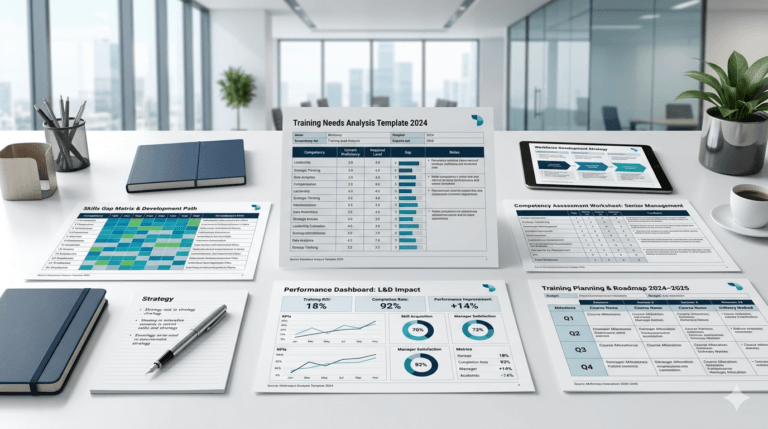
To help you apply this framework immediately, TrainerCentric offers a free downloadable toolkit: The Learning Programme Design Blueprint. Previews of several of these templates appear throughout the steps above.
It includes:
- Programme Planning Workbook
- Stakeholder Interview Guide
- Learning Journey Planner
- Objective Writing Template
- Delivery Planning Worksheet
- Assessment Blueprint
- Evaluation Planner
- Design Checklist
- Project Timeline
- Programme Review Checklist
Further Readings
- How to Write a Learning and Development Strategy That Actually Gets Approved [2026]
- Bloom’s Taxonomy
- Instruction Designing Models
- ADDIE Model of Instructional Designing
- Successive Approximation Model (SAM): Complete Guide + 8 Free Templates
- Kolb’s Learning Cycle: Using Experiential Learning in the Workplace
- ADDIE vs SAM: Which Instructional Design Model Should You Use in 2026?
- Adult Learning Theory (Andragogy): Knowles’ 6 Principles Explained with Workplace Examples
- Kirkpatrick Model: How to Measure Training Effectiveness
- Facilitation Skills for Corporate Trainers: The Complete Guide
- Training Needs Analysis: The Complete Guide for L&D Professionals
- How to Write a Learning and Development Strategy That Actually Gets Approved
References
- The Systematic Design of Instruction || 9th Edition || Walter Dick, Lou Carey & James O. Carey || Pearson || 2014
- Evaluating Training Programs: The Four Levels || 3rd Edition || Donald L. Kirkpatrick & James D. Kirkpatrick || Berrett-Koehler Publishers || 2016
- Design for How People Learn || 2nd Edition || Julie Dirksen || New Riders || 2015
- The Adult Learner: The Definitive Classic in Adult Education and Human Resource Development || 9th Edition || Malcolm S. Knowles, Elwood F. Holton III & Richard A. Swanson || Routledge || 2020
- First Principles of Instruction: Identifying and Designing Effective, Efficient, and Engaging Instruction || 1st Edition || M. David Merrill || Pfeiffer || 2012
- Telling Ain’t Training || 2nd Edition || Harold D. Stolovitch & Erica J. Keeps || Association for Talent Development (ATD) Press || 2011
- Evidence-Informed Learning Design: Creating Training to Improve Performance || 1st Edition || Mirjam Neelen & Paul A. Kirschner || Kogan Page || 2020
Author Details

Arindam is a learning and development entrepreneur. He has designed and delivered learning solutions across leadership development, sales enablement, customer experience and digital learning initiatives over the past 15 years. Reach out to him at arindam@trainercentric.in or via his Linkedin Profile: Linkedin