Introduction – Why the Dick and Carey Model Still Matters
The Dick and Carey Model is a systematic instructional design framework that breaks the creation of instruction into ten interdependent, sequenced components – from identifying an instructional goal to conducting summative evaluation. Developed by Walter Dick and Lou Carey in 1978, it is one of the most widely referenced models in professional instructional design, particularly in compliance, defence, healthcare, and higher education.
| What is the Dick and Carey Model? |
| The Dick and Carey Model (also called the Systems Approach Model) is a prescriptive instructional design methodology in which all ten components – from instructional goal to summative evaluation – are treated as a single, interdependent system. A change to any one component triggers a review of all others. Created by Walter Dick and Lou Carey (1978) and regularly updated through subsequent editions co-authored with James O. Carey, the model is best suited to high-stakes, curriculum-level training where systematic design and audit-ready documentation are required. |
The problem is that most articles about Dick and Carey stop at describing the model. They tell you what it is. Very few tell you when to pick it over ADDIE, SAM, or Agile – or when to walk away from it entirely. As part of our Instructional Design Model Playbook, this article provides exactly that: a decision framework, a realistic corporate case study, and an honest comparison matrix.
Why the Dick and Carey Model Matters (Even If You’ve Never Heard of It)
If you’re an L&D manager, trainer, HR professional, or someone who just landed a big training project – and someone mentioned “Dick and Carey” in a meeting – here is the short version of why it matters.
Most training gets built the same way: someone writes slides, records a video, maybe adds a quiz at the end, and calls it a course. It looks like training. It might even feel like training. But if learners cannot actually do the job better afterwards, it was just content delivery.
The Dick and Carey Model exists to close that gap. It forces you to answer three questions before you build anything:
- What exactly do learners need to be able to do? (Not just “understand,” but actually perform.)
- How will you know if they can do it? (Assessment first, content second.)
- What do learners already know, and what conditions will they be working in?
These questions sound obvious. In practice, most training projects skip them in the rush to produce materials. Dick and Carey makes skipping them structurally impossible.
That rigor has a cost: the model takes longer and costs more upfront than simpler approaches. But for high-stakes training – where a mistake means a regulatory breach, a safety incident, or a failed audit – that upfront investment pays for itself many times over.
Bottom line: Dick and Carey is not for every project. It is the right tool for projects where getting training wrong has serious consequences, and where you have the time and audience access to do it properly.
Dick and Carey Model Explained in 60 Seconds
| At a Glance | |
| Definition | A systems-based instructional design framework treating all ten design components as interdependent. |
| Purpose | To produce instruction that reliably closes a measurable performance gap. |
| Creators | Walter Dick and Lou Carey; later updated with James O. Carey. |
| Year | 1978 (first edition); most recent major update: 8th edition, 2015. |
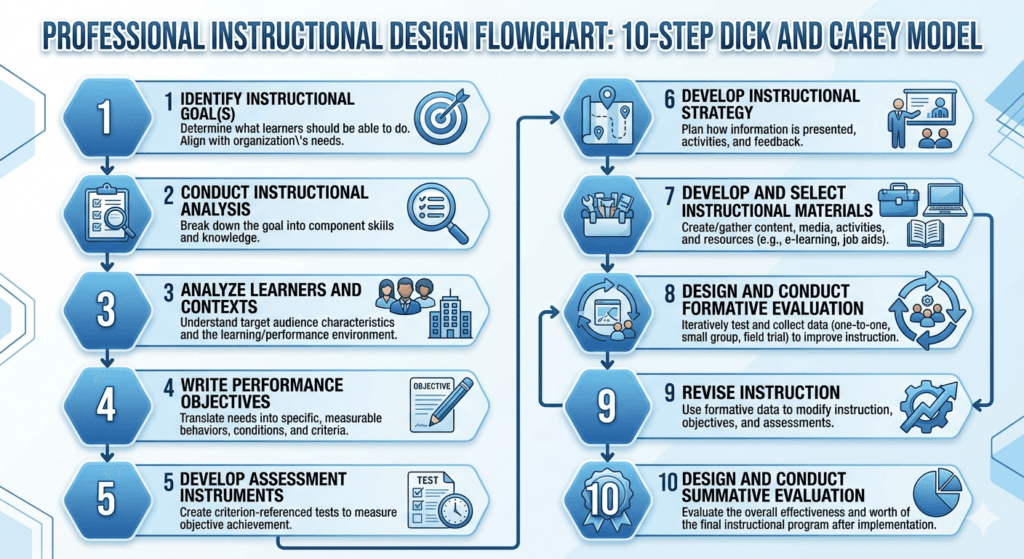
| 10 Components | (1) Identify instructional goal → (2) Conduct instructional analysis → (3) Analyse learners and contexts → (4) Write performance objectives → (5) Develop assessments → (6) Develop instructional strategy → (7) Develop and select materials → (8) Design formative evaluation → (9) Revise instruction → (10) Design summative evaluation. |
| Best use cases | Compliance training, safety-critical curricula, regulated industries, curriculum-level design with a 12-month+ content lifespan. |
A Quick Refresher – The 10 Components of the Dick and Carey Model
The model is deliberately prescriptive. Here is each component in one to two sentences – enough context before we move into the decision framework.
- Identify the Instructional Goal. Define what learners will be able to do after instruction. This single statement drives every downstream decision.
- Conduct Instructional Analysis. Decompose the goal into subordinate skills and map the learning hierarchy learners must master to reach it.
- Analyse Learners and Contexts. Profile your audience (prior knowledge, motivation, entry skills) and analyse both the learning context and the performance context. This is where writing learning objectives with Bloom’s Taxonomy connects directly – your learner analysis informs the cognitive level your objectives must target.
- Write Performance Objectives. Convert subordinate skills into measurable, observable objectives with explicit conditions and criteria.
- Develop Assessment Instruments. Design criterion-referenced tests that map directly to objectives – not to generic difficulty or content coverage.
- Develop Instructional Strategy. Determine pre-instructional activities, content sequencing, practice opportunities, and feedback for each objective.
- Develop and Select Instructional Materials. Produce or source the actual content – eLearning modules, job aids, instructor guides, videos.
- Design and Conduct Formative Evaluation. Test instruction with real learners in three phases: one-to-one review, small-group trial, and field trial. Revise before full rollout.
- Revise Instruction. Use formative evaluation data to fix gaps systematically before declaring the course complete.
- Design and Conduct Summative Evaluation. After deployment, measure whether the instruction actually closes the performance gap it was designed to address.
The systems point is critical: if you rush step 2 (instructional analysis), your objectives in step 4 will be incomplete, your assessments in step 5 will test the wrong things, and your formative evaluation in step 8 will generate misleading data. Every component depends on the quality of the one before it.
When Should You Use the Dick and Carey Model?
The model earns its place in four specific scenarios. Knowing these precisely will save you from both under-using a powerful framework and forcing it where it does not belong.
Ideal Scenario #1 – High-Stakes, Compliance-Driven Training
If the cost of a learning failure is measured in injuries, fines, or regulatory action, Dick and Carey is purpose-built for you. Think pharmaceutical GMP training, aviation maintenance certification, financial AML compliance, nuclear plant operations, or surgical procedure training. A learner who misunderstands a step in these environments does not merely fail a quiz – they trigger an adverse event, a regulatory breach, or a multi-million-dollar liability.
The model reduces that risk through relentless front-end rigour. Because step 3 forces you to document learner characteristics before writing a single objective, you will catch dangerous assumptions during analysis rather than during the field rollout.
The criterion-referenced assessment design in step 5 also creates a defensible audit trail: you can show a regulator exactly which objective maps to which assessment item, and which assessment item maps to which job task. That level of documentation is rarely produced by default under looser frameworks.
Ideal Scenario #2 – Curriculum-Level Design (Not Just a Single Course)
Dick and Carey was designed for large, complex instructional programmes, not stand-alone workshops. A 6-month leadership development programme with eight modules, a university certificate curriculum, an onboarding sequence covering 12 role-specific tracks – these are the contexts where the model’s formative evaluation loop justifies its overhead.
When you have enough scope to pilot instruction with a representative sample, collect data, and revise before full rollout, Dick and Carey’s three-stage formative evaluation produces measurably better outcomes. A typical Dick and Carey analysis phase for a 40-hour curriculum takes 3–6 weeks. That investment makes sense only when the curriculum will be used for 2+ years with hundreds of learners.
Ideal Scenario #3 – When Stakeholders Demand Research-Backed Rigour
Some learning environments – regulated industries, higher education, large government agencies, defence contractors – require that design decisions be traceable to established theory. Dick and Carey is grounded in systems theory, Gagné’s conditions of learning, and cognitive load principles. Its pedigree is peer-reviewed and well-documented.
When a compliance officer or contracting officer asks “what methodology did you use and why?” Dick and Carey gives you a defensible, named answer backed by decades of academic and practitioner validation.
Ideal Scenario #4 – Novice Instructional Design Teams
Counter-intuitively, Dick and Carey’s prescriptiveness is a feature for teams without senior instructional designers. Because the model specifies exactly what to do and in what sequence, it significantly reduces decision ambiguity. A team of mid-level IDs working together for the first time can produce consistent, quality work by following the steps faithfully.
Compare this to SAM or Agile approaches, which require experienced facilitators to know when to prototype, when to iterate, and when to ship. Prescriptive models protect novice teams from skipping steps they do not yet know are important.
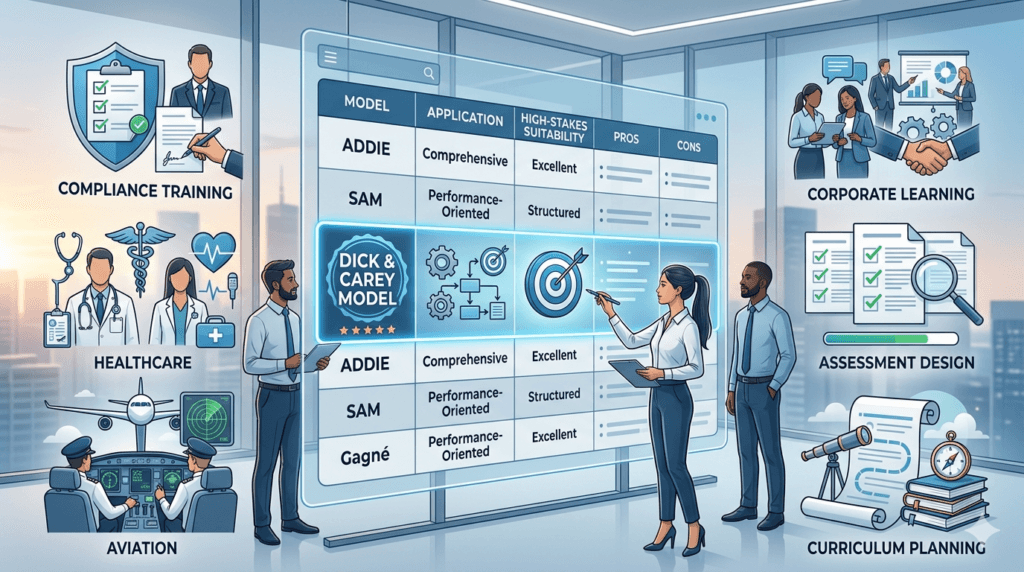
The Other Side – When to Avoid Dick and Carey (And What to Use Instead)
The model’s strengths are precisely the conditions under which it becomes a liability. Understanding the avoid conditions is as important as understanding the ideal scenarios.
Avoid When #1 – The Content Changes Faster Than You Can Document It
If your training content is a moving target – software releases every four weeks, regulatory guidance every quarter, product line changes monthly – Dick and Carey’s sequential, documentation-heavy process will leave you perpetually behind. By the time you complete a thorough instructional analysis for v3.2 of your platform, v4.0 has shipped and half your objectives are obsolete.
The better alternative is the Successive Approximation Model (SAM), which treats change as a design principle rather than an obstacle. SAM’s rapid prototyping cycle gets a workable course live in weeks; Dick and Carey is still in its analysis phase. For volatile content, good-enough-and-current beats perfect-and-late.
Avoid When #2 – Your Budget or Timeline Is Extremely Tight
Dick and Carey’s front-end analysis is not cheap. Steps 1–3 alone – goal identification, instructional analysis, and learner/context analysis – can consume 20–40% of a project’s total budget. If your stakeholder has given you three weeks to launch a 2-hour onboarding module, you do not have the time to conduct proper learner profiling, map a full learning hierarchy, or run three-stage formative evaluation.
In this scenario, a structured application of Gagné’s Nine Events of Instruction gives you a sound pedagogical framework without the analytical overhead. Reserve Dick and Carey for projects with realistic budgets and timelines.
Avoid When #3 – You Have No Control Over the Learning Environment
Dick and Carey explicitly requires analysis of the performance context (where learners will apply learning) and the learning context (where instruction will occur), and then assumes you have authority to shape instruction, media, and assessment accordingly. If you are contributing one module to a vendor-managed curriculum, producing content for a public MOOC platform, or designing a one-off webinar with fixed platform constraints, you cannot fulfil this assumption. The full process would be overkill for a 45-minute lunch-and-learn.
Avoid When #4 – The Learner Characteristics Step Cannot Be Fulfilled
Step 3 is not optional. If you cannot profile your learners – their prior knowledge, attitudes, entry-level skills, and workplace context – you cannot complete a Dick and Carey design with integrity. You will be forced to fabricate learner characteristics, which undermines every downstream decision.
Public-facing tutorials, open-access reference guides, and freely distributed job aids are examples where audience heterogeneity is too wide for step 3 to be meaningful. For universally targeted content, consider Merrill’s Principles of Instruction, which focuses on the structure of effective teaching rather than the characteristics of a specific, known audience.
Dick and Carey vs ADDIE – A Head-to-Head Decision Guide
The most common confusion in the Dick and Carey Model vs ADDIE debate is treating them as competing alternatives when they operate at different levels of abstraction. ADDIE is a project management framework – a high-level process map. Dick and Carey is a specific operational methodology that prescribes exactly how to execute ADDIE’s Design and Development phases.
| Dimension | ADDIE | Dick and Carey |
| Philosophy | Phase model; method-agnostic | Systems theory; all components interdependent |
| Flexibility | High – each phase adopts different methods | Low – prescriptive sequence, all steps required |
| Best for | Managing any ID project | High-stakes, curriculum-level, stable content |
| Worst for | Teams needing step-by-step prescription | Volatile content, short timelines, unknown audience |
| Formative evaluation | Optional; varies by practitioner | Mandatory 3-stage: one-to-one, small group, field trial |
| Documentation depth | Varies; often light | Extensive; every decision traceable |
Verdict: Use ADDIE as your project management backbone for any instructional design initiative. Use Dick and Carey when your team needs detailed prescription within that project. The two are not competitors – Dick and Carey can operate inside ADDIE’s Design phase.
Read our comprehensive article on how to use ADDIE step by step with downloadable templates.
Dick and Carey vs SAM – When Rigour Beats Speed
SAM (Successive Approximation Model) and Dick and Carey are both full instructional design methodologies, not just frameworks. Their fundamental difference is their relationship to change. SAM’s SAVVY Start collapses discovery and prototyping into a single rapid session; its Iterative Design phase runs in short cycles: design, prototype, review, revise, repeat. SAM is built for environments where you cannot fully specify requirements upfront.
Dick and Carey makes the opposite bet: invest heavily at the front end so that by the time you develop materials, you have near-certainty about what you are building. It tolerates change poorly but produces highly defensible, precisely targeted instruction that withstands regulatory scrutiny.
| Decision Rule: Dick and Carey vs SAM |
| Choose Dick and Carey if: Stakeholder sign-off is required at each phase (defence, healthcare, finance). Content is stable for 2+ years. Regulatory documentation is required. Controlled pilots for formative evaluation are feasible. |
| Choose SAM if: You can co-design with learners early. Content will evolve. Time-to-launch outweighs exhaustive analysis. Your team has enough experience to manage iterative cycles without a prescriptive roadmap. |
Read our comprehensive article on SAM model with step by step guide and 8 premium templates that you can download for free.
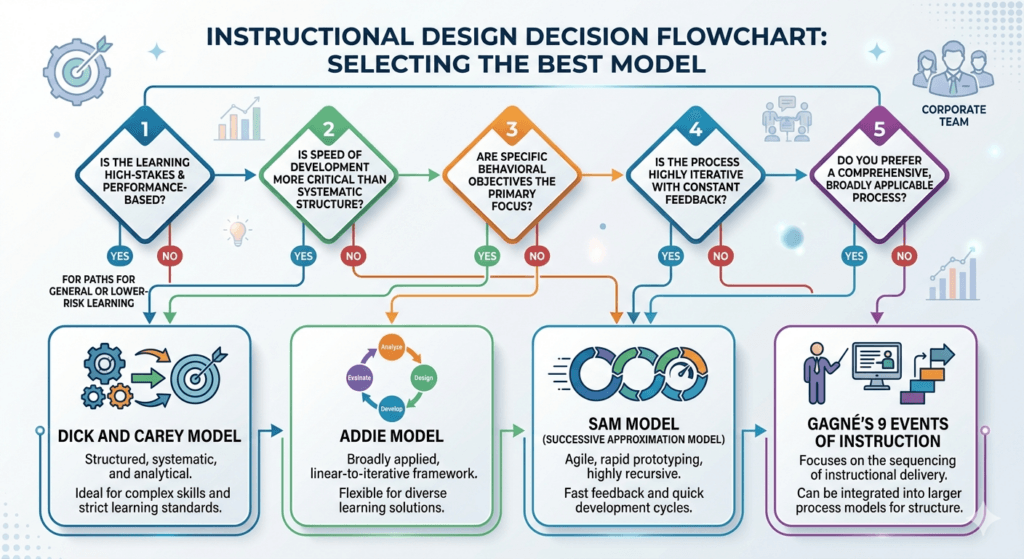
Quick Decision Flowchart
Five yes/no questions to reach a model recommendation:
| Question | YES → | NO → |
| Q1: Is the training high-stakes (compliance, safety, regulated)? | → Go to Q2 | → Go to Q3 |
| Q2: Will this content remain stable for 12+ months? | Strong candidate: Dick & Carey | Consider SAM or rapid ADDIE |
| Q3: Do you need regulatory documentation / audit trails? | Dick & Carey or ADDIE | → Go to Q4 |
| Q4: Is your timeline under 6 weeks for a substantial curriculum? | SAM or lean design | Dick & Carey (if also high-stakes) |
| Q5: Can you profile your learners before design begins? | Dick & Carey conditions met | Avoid Dick & Carey; use Gagné or SAM |
Real-World Corporate Example – Applying the Decision Framework
Nothing clarifies a framework like watching it work in practice. The following case study is fictional but built from composite patterns drawn from real L&D projects. It contrasts two organisations with related training needs that arrive at opposite model choices – and then walks through one complete Dick and Carey implementation in detail.
The Two Organisations
FinCorp Global is a mid-sized investment bank operating in 14 countries. Following two regulatory breaches related to Anti-Money Laundering (AML) procedures, its Chief Compliance Officer commissioned a full overhaul of AML training for 200 branch managers across Southeast Asia. The training must be ready in four months, fully documented, and capable of withstanding a regulatory audit. Content is governed by FATF guidelines, which update infrequently. The L&D team has four instructional designers and a dedicated compliance SME.
TechStart SG is a Series B SaaS company whose product ships new features every three to four weeks. It needs onboarding training for new customer success managers covering the product interface and its evolving feature set. The team is two people – one L&D generalist and a product manager with four hours per week to spare – and the target launch is five weeks away.
The Decision
FinCorp chooses Dick and Carey for five clear reasons:
- High stakes: AML failures carry regulatory fines, licence revocation, and reputational damage.
- Stable content: FATF guidelines change slowly; the curriculum will remain valid for 2–3 years.
- Audit trail required: The regulator will want objective-to-task mapping documentation.
- Known audience: 200 branch managers, profiled via HR records and a targeted survey.
- Adequate timeline: Four months is sufficient for a 12-hour Dick and Carey curriculum.
TechStart avoids Dick and Carey for equally clear reasons:
- Volatile content: A feature released this month may be revised in eight weeks.
- Tight timeline: Five weeks cannot accommodate proper instructional analysis.
- Lean team: Two part-time contributors cannot sustain the documentation overhead.
TechStart adopts SAM: a SAVVY Start with five customer success managers, rapid prototyping of a core task-based module, and a “living eLearning” architecture where modules are updated in 90-minute sprints as the product evolves.
FinCorp: A Complete Dick and Carey Implementation
Step 1 – Identify the Instructional Goal
Goal statement: “Branch managers will correctly complete AML transaction monitoring procedures in accordance with FATF Recommendation 10, reducing AML compliance errors by 40% within six months of training completion.”
This is written at terminal performance level – it describes what managers will do in the workplace, not what they will know after a course. The 40% reduction is measurable against the bank’s documented error rate of 11.2%, giving the summative evaluation a concrete baseline.
Step 2 – Conduct Instructional Analysis
The ID team maps the goal to a learning hierarchy:
- Terminal skill: Execute full AML transaction monitoring procedure.
- Enabling skills: Identify reportable transaction thresholds; interpret customer risk profiles; draft Suspicious Activity Reports (SARs) accurately; escalate edge cases to the compliance team.
- Entry-level skills (assumed): Basic reading comprehension; familiarity with the bank’s core banking system.
The analysis reveals that SAR documentation is actually two distinct skills (drafting and submitting) with different error patterns. Without this step, both would have been combined into a single objective, producing training that improved drafting while leaving submission errors unaddressed.
Step 3 – Analyse Learners and Contexts
The team runs a 12-question survey (n=200) and conducts 8 structured interviews across three country offices. Key findings:
- Prior knowledge: 67% of managers have received AML training before, but 61% rate their current knowledge as “insufficient.”
- Language: 14% are more comfortable in Bahasa Indonesia; module language must be simplified to B2 English or bilingual.
- Performance context: Branches have unreliable internet; offline capability is essential.
- Learning context: Managers can access training only in 20-minute windows; segments must not exceed 18 minutes.
Without step 3, the team would have produced a 60-minute desktop eLearning course in advanced English with no offline mode. The learner analysis alone saves an estimated two weeks of rework during the formative evaluation phase.
Steps 4–7 – Objectives, Assessments, Strategy, and Materials (Summarised)
The team writes 23 performance objectives at Bloom’s Apply and Analyse levels, each with explicit conditions and criteria. Assessments are scenario-based, presenting learners with realistic transaction records requiring classification and documentation decisions. The pass threshold is set at 85%, aligned to compliance breach data showing that error rates below 15% do not correlate with regulatory action.
The instructional strategy specifies: a pre-test to route learners around foundational content they already know; worked examples before practice; delayed feedback on SAR drafting tasks; and a job aid embedded in the bank’s intranet for post-training performance support.
Materials produced: 6 microlearning eLearning modules (average 16 minutes, offline-capable), 1 PDF job aid, 1 instructor-led scenario workshop for the 22% of managers identified as highest-risk, and a manager briefing guide.
Step 8 – Design and Conduct Formative Evaluation
One-to-one phase: Three managers review Module 1 with a screen-share session. Two report confusion over “beneficial owner” – defined in a later module but referenced in Module 1. The team resequences the curriculum.
Small-group phase: Ten managers complete all six modules in self-directed mode. Pre/post test results show an average gain of 34 percentage points. However, the SAR submission module shows only 18 points – well below target. Exit interviews reveal the simulation behaves differently from the live banking system. The simulation is rebuilt using live-system screen recordings.
Field trial: Forty managers across four countries complete the revised curriculum. Average pre/post gain: 43 percentage points. Pass rate: 91%. The training is approved for full rollout.
Steps 9–10 – Revise and Evaluate Summatively
Based on the field trial, the offline job aid is updated to reflect the corrected SAR submission workflow, and the scenario workshop is extended by 30 minutes. Six months post-deployment, the compliance team reports a 44% reduction in AML errors – exceeding the original goal. The L&D team submits this data against the step-1 goal statement, producing the audit documentation the regulator requires.
This is Dick and Carey working exactly as designed: front-loaded investment, systematic formative revision, and a measurable, defensible outcome.
Dick and Carey Model Pros and Cons at a Glance (The Honest Take)
Strengths (Pros)
- Systematic and complete: Every step is required, so no critical component is accidentally skipped. Teams using Dick and Carey rarely discover a missed audience segment or an untested objective after development begins.
- Built for high-risk content: The front-end analysis reduces the probability of catastrophic misalignment between training and job performance – exactly what compliance, safety, and regulated industries need.
- Built-in formative evaluation: The three-stage process (one-to-one, small group, field trial) catches problems at manageable cost before full deployment.
- Research-supported: Grounded in Gagné’s conditions of learning, systems theory, and decades of peer-reviewed instructional design research. Provides a defensible methodology for regulated and academic environments.
- Scalable documentation: Naturally generates the artefacts (learner profiles, learning hierarchies, objective maps, test blueprints) that quality management systems require.
Weaknesses (Cons)
- Time-consuming: A thorough analysis phase for a 40-hour curriculum takes 3–6 weeks before a single piece of content is developed. For compressed timelines, this front-loading is unsustainable.
- Assumes stable content: The model was designed for content that will remain valid long enough to justify the investment. Rapid-change environments outpace the process before it completes.
- Requires skilled analysis: Conducting learner profiling, building a learning hierarchy, and writing criterion-referenced objectives well requires expertise. Shallow front-end work undermines the entire model.
- Over-engineering for simple tasks: Applying Dick and Carey to a 15-minute awareness module is disproportionate. The overhead dwarfs the value for small, low-stakes deliverables.
- Perceived linearity: The sequential framing leads many practitioners to treat it as waterfall. The model allows iteration back from formative evaluation, but teams must consciously design for that loop.
The Instructional Design Decision Matrix – A One-Page Cheat Sheet
This 2×2 matrix maps content stability against learning stakes to give you a rapid model recommendation. It is the core of the instructional design decision matrix for selecting among Dick and Carey, ADDIE, SAM, and Gagné.
| High Stakes | Low Stakes | |
| Stable Content | ✅ Dick & Carey Compliance, safety, regulated curricula. Front-end investment pays for itself. | ➡ Gagné’s Nine Events Product knowledge, skills refreshers. Sound pedagogy without full ISD overhead. |
| Volatile Content | ⚠ ADDIE + Rapid Update Cycles Healthcare protocols, defence procedures updated regularly. | 🔄 SAM or Agile ID SaaS onboarding, marketing enablement. Iteration beats analysis. |
- Quadrant 1 – High Stakes + Stable: Use Dick and Carey. Example: AML compliance training. A procedural error costs millions; content changes annually at most.
- Quadrant 2 – High Stakes + Volatile: Use ADDIE with rapid update cycles. Maintain disciplined phase structure but build content refresh workflows that run in 2-week sprints.
- Quadrant 3 – Low Stakes + Stable: Use Gagné’s Nine Events. A quarterly product knowledge refresher needs sound pedagogy, not a full ISD apparatus.
- Quadrant 4 – Low Stakes + Volatile: Use SAM or Agile. Stakeholders want the training live before the next customer call. SAM’s prototype cycle gets you there.
Common Mistakes When Using (or Misusing) Dick and Carey
Mistake #1 – Skipping the Learner Characteristics Step
“We know our audience” almost always means “we know our average learner” – not the full range of prior knowledge, language proficiency, motivation, and workplace constraints that actually define the population. The FinCorp case demonstrates exactly why this matters: 14% of the audience needed bilingual content that assumptions would have missed, and the offline-capability requirement would never have emerged without context analysis.
The fix: conduct a minimum 10-question survey and two to three structured interviews before writing a single objective. Budget two to four working days – not two hours.
Mistake #2 – Treating It as a Waterfall Model
Dick and Carey requires you to loop back from formative evaluation (steps 8–9) to strategy and materials (steps 6–7) – and sometimes to objectives and assessments (steps 4–5). Practitioners who treat each step as a sealed phase that cannot be revisited are misusing the model and will produce training that passes internal review but fails the field trial.
The fix: build revision cycles into your project plan after each formative evaluation phase. Treat the timeline as a spiral, not a waterfall.
Mistake #3 – Using It for Microlearning or Single Modules
Applying the full 10-step process to a single 15-minute awareness module is a misallocation of resources. The analysis overhead alone (2–4 weeks for proper learner profiling and instructional analysis) dwarfs the development time for the module itself. Teams that do this burn out, skip steps to compensate, and end up with neither a thorough analysis nor a quality module.
The fix: reserve Dick and Carey for curriculum-level projects with a minimum of 8–10 hours of instruction. For stand-alone microlearning, use Gagné’s nine events or a simple backward design approach.
Mistake #4 – Confusing Context Analysis With a Delivery Constraints List
Many teams interpret step 3’s context analysis as “we need a browser-compatible LMS and 16:9 slides.” That is a delivery constraints list, not a context analysis. Genuine context analysis asks: Where physically will learners apply this training? What tools and colleagues will they have at the moment of performance? What environmental pressures – time, interruptions, supervision – will they face? Answering these questions changes what you design, not just how you deliver it.
How This Article Fits Into Your Instructional Design Toolkit
Decision-making in instructional design is only as good as the range of models you understand. Here is how this article sits within a broader resource cluster:
- Instructional Design Model Playbook – Hub article: which model to use when, and how they relate.
- How to Apply the ADDIE Model Step by Step – ADDIE as a project management framework, with a worked example.
- Successive Approximation Model (SAM) – When speed and iteration matter more than front-end rigour.
- Writing Learning Objectives with Bloom’s Taxonomy – How to target the right cognitive level for each objective.
- Kolb’s Learning Cycle for Workplace Training – Experiential design principles that complement Dick and Carey’s systems approach.
- Merrill’s Principles of Instruction– Skill-based design for task-centred instruction.
- ADDIE vs SAM Comparison – The three-way decision guide completing the model selection toolkit.
- Adult Learning Theory (Andragogy)
- Cognitive Load Theory Explained: A Practical Guide for Trainers & Instructional Designers
Conclusion – Your Decision, Simplified
The question of when to use the Dick and Carey Model has a clean answer once you know what to look for. Here are the three decisions that matter:
| Three Takeaways |
| 1. Use Dick and Carey for high-stakes, stable, curriculum-level projects. If training failure carries regulatory, operational, or reputational consequences – and your content will remain valid for two or more years – the front-end investment pays for itself in error prevention and audit documentation. |
| 2. Avoid it when speed, volatility, or unknown learners are the norm. Volatile content, timelines under six weeks for substantial curricula, and audiences you cannot profile are each sufficient reasons to choose SAM, Gagné, or a leaner framework instead. |
| 3. Always check the decision matrix before committing. Plot your project on the 2×2 grid (stakes vs. content stability) and run the five-question flowchart. This takes five minutes and can save five weeks of rework. |
Here is the reality that most instructional design articles will not tell you: no model is universally right. Dick and Carey is not better than SAM. SAM is not better than Gagné. Each is purpose-built for a specific type of problem. The designers who consistently produce the best training are not the ones who know one model deeply – they are the ones who can read a project brief and know immediately which tool to reach for.
Dick and Carey is the right tool when the stakes are high, the content is stable, and the audience is knowable. In those conditions, its systematic rigour does not slow you down. It protects you from the six-figure rework that happens when you discover a training gap after deployment rather than before it.
Use the model when it fits. Walk away from it when it does not. And when you’re not sure – use the matrix.
| Summary Signal Card |
| ✅ USE Dick and Carey when: (1) Training is compliance, safety, or regulated. (2) Content is stable for 12+ months. (3) You need a defensible audit trail of design decisions. |
| 🚫 AVOID Dick and Carey when: (1) Content changes faster than your analysis cycle. (2) Timeline is under six weeks for a substantial curriculum. (3) You cannot profile your learners before design begins. |
Frequently Asked Questions about Dick and Carey Model of Instructional Designing
Is the Dick and Carey Model Still Relevant in 2026?
Yes – with an important caveat. The model’s underlying logic (systematic front-end analysis, criterion-referenced assessment, iterative formative evaluation) remains as sound as it was in 1978. What has changed is the proportion of projects that meet its ideal conditions. As content has grown more volatile and timelines have compressed, Dick and Carey’s sweet spot has narrowed. But for compliance, safety-critical, and curriculum-level projects in regulated industries, it remains the gold standard. The 8th edition of The Systematic Design of Instruction (Dick, Carey, and Carey, 2015) is the authoritative reference for practitioners who want the complete model.
What Is the Difference Between Dick and Carey and Backward Design (Wiggins and McTighe)?
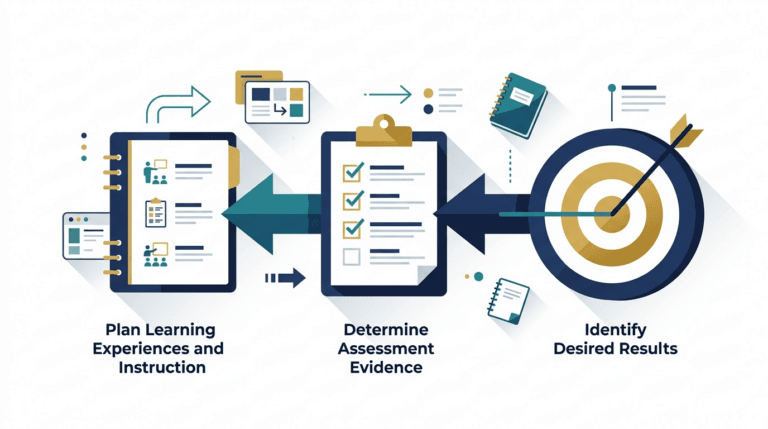
Both models start from desired outcomes and work backward, but they diverge significantly in scope. Backward Design (Understanding by Design) asks three questions: what are the desired results, what is acceptable evidence, and what learning experiences will achieve the results. It is conceptually simple and widely used in K-12 and higher education.
Dick and Carey operationalises this same logic at far greater detail: it prescribes exactly how to conduct the learner analysis, build a learning hierarchy, design criterion-referenced assessments, and run formative evaluation. Use Backward Design for individual course or unit planning. Use Dick and Carey for large, high-stakes instructional systems requiring full documentation.
Can Dick and Carey Work for eLearning Development?
Absolutely. The model predates eLearning as a delivery medium, but its design logic translates directly. Steps 1–7 produce the analysis and design artefacts (learning hierarchy, objectives, assessment blueprints, instructional strategy) that feed directly into development in Articulate Storyline, Rise 360, or Adobe Captivate. eLearning development benefits from Dick and Carey’s rigour more than face-to-face instruction does, because eLearning errors are expensive to fix post-publication and impossible to correct in real time during delivery.
How Is Dick and Carey Different from ADDIE If Both Have an Analysis Phase?
ADDIE’s analysis phase is deliberately broad – it identifies the performance gap, the learning need, and relevant constraints, but does not specify how to conduct that analysis. Dick and Carey’s steps 1–3 prescribe a specific analytical process: instructional goal-setting, followed by a full instructional analysis, followed by a distinct learner-and-context analysis. This prescription produces a richer, more defensible output that directly drives the design phase. ADDIE analysis outputs vary widely by practitioner; Dick and Carey analysis outputs are largely standardised.
References
The following sources underpin the theoretical claims and practical guidance in this article:
- Dick, W., Carey, L., & Carey, J. O. (2015). The Systematic Design of Instruction (8th ed.). Pearson. – The primary source for the Dick and Carey Model; essential reading for practitioners applying the model in professional contexts.
- Gagné, R. M., Wager, W. W., Golas, K. C., & Keller, J. M. (2005). Principles of Instructional Design (5th ed.). Thomson/Wadsworth. – The theoretical backbone for conditions-of-learning concepts referenced in this article.
- Allen, M., & Sites, R. (2012). Leaving ADDIE for SAM: An Agile Model for Developing the Best Learning Experiences. ASTD Press. – The authoritative source for SAM methodology used in comparisons throughout this article.
- Branch, R. M. (2009). Instructional Design: The ADDIE Approach. Springer. – A rigorous treatment of the ADDIE framework referenced in the Dick and Carey vs ADDIE section.
- Merrill, M. D. (2002). First principles of instruction. Educational Technology Research and Development, 50(3), 43–59. – The theoretical foundation for Merrill’s Principles of Instruction referenced in Avoid Scenario #4.
Further Reads
- Bloom’s Taxonomy
- Instruction Designing Models
- ADDIE Model of Instructional Designing
- Successive Approximation Model (SAM): Complete Guide + 8 Free Templates
- Kolb’s Learning Cycle: Using Experiential Learning in the Workplace
- Gagné’s 9 Events of Instruction: A Practical Guide for Trainers with Real Examples
- ADDIE vs SAM: Which Instructional Design Model Should You Use in 2026?
- ARCS Model of Motivation — The Complete Guide for Corporate Trainers [2026]
- Adult Learning Theory (Andragogy): Knowles’ 6 Principles Explained with Workplace Examples
- Kirkpatrick Model: How to Measure Training Effectiveness
- Action Mapping: A Step-by-Step Guide with Examples
- Story-Based Learning Design: A Practical 5-Step Framework
- Andragogy vs Pedagogy: What’s the Difference and When Should Trainers Use Each
Author Details

Soumyadeep Sen is a Learning & Development professional with over 14 years of experience across training, coaching, quality, and performance improvement. Currently serving as Assistant Manager – Training at 24/7.ai, he specializes in designing practical learning solutions that drive employee performance and support business objectives. When he’s not designing learning programs, Soumyadeep enjoys exploring emerging trends in workplace learning, talent development, and instructional design. Reach out to him via Linkedin: https://www.linkedin.com/in/soumyadeep-sen-37515046/