| Quick Answer: Use ADDIE for compliance, regulatory, healthcare, or large-scale programmes where documentation and audit trails are mandatory. Use SAM for soft skills, technology training, or tight deadlines where speed and iteration matter. Use the Hybrid ADDIE-SAM Approach for leadership development, onboarding, and digital transformation where strategic objectives are fixed but the best delivery method needs to be discovered through iteration. |
You have three months to launch a compliance training programme. Do you choose ADDIE or SAM? It is one of the most common questions in instructional design — and one that still trips up experienced L&D professionals.
The short answer: ADDIE wins for compliance, SAM wins for speed, and the hybrid wins for everything else. But the details matter, and the wrong choice can cost you weeks of rework.
In this evidence-based ADDIE vs SAM comparison, you will get a decision framework grounded in real practitioner experience, a full comparison table, industry research evidence, and a hybrid approach that most articles miss entirely.
In this guide, you will learn:
- The exact strengths and weaknesses of ADDIE and SAM — including ROI measurement
- A scenario-based model selection matrix you can use immediately
- The TrainerCentric Model Selection Scorecard: an original practitioner framework
- The Hybrid ADDIE-SAM Approach that most articles never mention
- Research evidence from STEM education and industry sources
- A side-by-side comparison table across 10 key dimensions
- A practitioner section: How We Choose Between ADDIE and SAM
What Is the ADDIE Model?
The ADDIE model is one of the most widely used instructional design frameworks in the world. It was developed at Florida State University in 1975 for the U.S. military to standardise the design and delivery of large-scale training programmes. Although originally created for the armed forces, ADDIE was quickly adopted across corporate, academic, and government training environments worldwide.
ADDIE is an acronym for its five sequential phases.
1. Analysis
Identify the learning gap, the target audience, existing knowledge levels, performance objectives, and project constraints such as budget and timeline. A thorough analysis phase is what separates a training programme that changes behaviour from one that simply fills a seat.
2. Design
Map out the learning strategy: write measurable learning objectives, select instructional methods, sequence content logically, choose assessment approaches, and create storyboards or design documents for stakeholder approval.
3. Development
Build the actual course content — eLearning modules, videos, workbooks, facilitator guides, and assessments — following the approved design blueprint closely.
4. Implementation
Roll out the training to learners via an LMS, instructor-led sessions, or a blended learning programme. This phase also covers facilitator preparation, scheduling, and technical configuration.
5. Evaluation
Measure effectiveness using Kirkpatrick’s four levels or a similar framework. Did learners acquire knowledge? Did behaviour change on the job? What was the return on investment?
| ADDIE in Action: You are designing customer service training for a 500-person call centre. You start with Analysis (surveying agents, reviewing complaint data), move to Design (creating a modular curriculum), develop scenario-based eLearning modules, implement via an LMS, and evaluate using post-training assessment scores and customer satisfaction metrics. That is ADDIE working exactly as intended. |
Strengths and Weaknesses of ADDIE
ADDIE Model Advantages
- Systematic and structured: every decision has a documented rationale that survives staff turnover and audits
- High-quality output: thorough upfront planning significantly reduces errors in the final product
- Compliance-ready: built-in sign-off gates and documentation make it the default in regulated industries
- Predictable timelines and costs: front-loaded planning reduces scope creep and budget surprises
- Easy to measure ROI: because objectives are fixed in the Analysis phase, you can measure directly against them at Evaluation using Kirkpatrick Level 3 or 4 metrics
ADDIE Model Disadvantages
- Slow and inflexible: moving linearly through phases can take months before learners see anything
- Late feedback loops: stakeholders often do not see real content until the Development phase — by which point changes are expensive
- Not suited for fast-changing content: by the time you launch, the subject matter may have evolved
- High cost of late errors: reworking content after the Development phase multiplies costs compared to catching issues earlier
Further Reading: How to Apply the ADDIE Model Step by Step + 5 Free Templates
What Is the SAM Model (Successive Approximation Model)?
The SAM model — or Successive Approximation Model — was developed by Dr. Michael Allen of Allen Interactions in 2012 as a deliberate response to ADDIE’s rigidity. Drawing on agile software development principles, SAM’s core idea is that you get better through repeated cycles of building and testing — rather than trying to get everything right before you start.
There are two versions: SAM1 for smaller projects and SAM2 for larger, more complex efforts. Most practitioners refer to SAM2 when discussing the full iterative process.
SAM operates in three interconnected phases:
Phase 1: Preparation — The Savvy Start
The Savvy Start is SAM’s most distinctive and misunderstood phase. Rather than spending weeks in analysis before anyone sees a prototype, the Savvy Start is a structured collaborative workshop — typically one to three days — where instructional designers, subject-matter experts (SMEs), and stakeholders gather to share background information, sketch rough ideas, and produce a first draft prototype on the very first day. This early tangibility is transformative: stakeholders react to something real, not an abstract plan, which surfaces misalignments before they become expensive mistakes.
Phase 2: Iterative Design
Based on the Savvy Start output, the team enters rapid design cycles. Each cycle produces a slightly more refined prototype — reviewed, critiqued, and improved. These are not polished modules; they are working drafts good enough to test assumptions and surface problems before full development begins.
Phase 3: Iterative Development
As the design stabilises, development begins — but still in loops. Small chunks of content are built, tested with real learners or stakeholders, and refined before the next chunk is produced. Alpha, Beta, and Gold release stages mark progress toward the final product.
| SAM in Action: You need a leadership communication training programme for 200 mid-level managers, with a 6-week deadline. Using SAM, your team runs a Savvy Start on Day 1 and has a rough prototype by end of day. By Week 2 you have a testable design. By Week 4 a Beta version is in managers’ hands. You refine based on feedback and launch by Week 6. That speed-to-feedback loop is SAM’s superpower. |
Further Reading: Successive Approximation Model (SAM): Complete Guide + 8 Free Templates
Strengths and Weaknesses of SAM
SAM Model Advantages
- Fast: rapid prototyping and short cycles compress timelines from months to weeks
- Flexible: the design can pivot at any iteration based on new stakeholder input
- Highly collaborative: SMEs and stakeholders are engaged throughout, not just at sign-off gates
- Ideal for soft skills training: where the best approach is often discovered through iteration, not prescribed upfront
- Reduces costly late-stage rework: problems are caught in early prototypes, not after full development
SAM Model Disadvantages
- Less predictable: scope and cost can expand as new insights emerge during iterative loops
- Requires constant stakeholder involvement: time-poor SMEs may find weekly iterative reviews burdensome
- Harder to measure ROI: when objectives evolve during iterations, establishing a clean baseline for measurement becomes complex
- Not ideal for compliance: regulatory environments require fixed, formally approved, and auditable processes that SAM’s fluid structure does not support
- Requires experienced facilitation: the Savvy Start demands strong facilitation skills to prevent scope drift on Day 1
Key Differences in the ADDIE vs SAM Debate
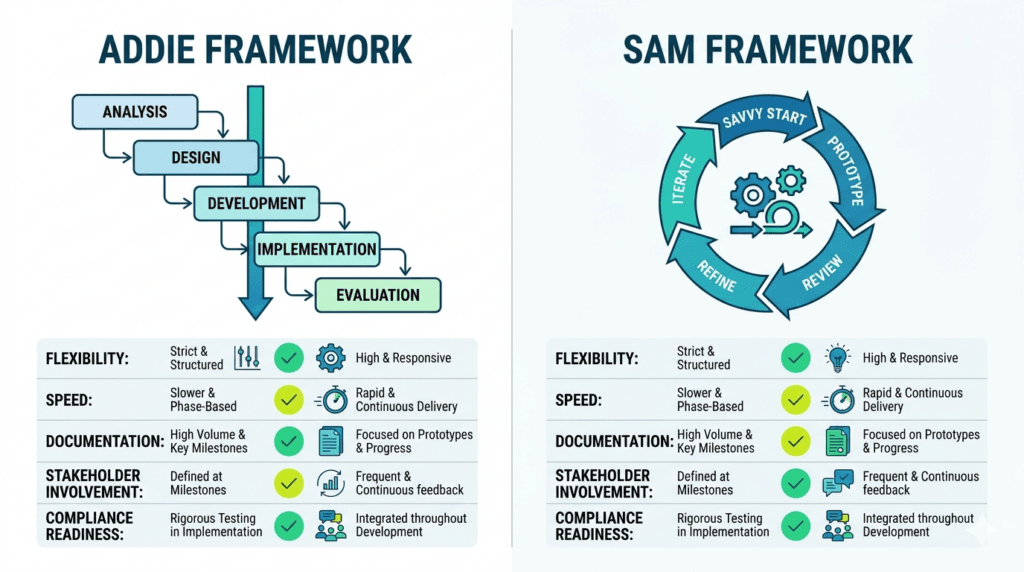
| At a Glance: ADDIE is a waterfall — complete one phase before the next begins. SAM is agile — build, test, and improve in continuous loops. Choosing between them is not about which is ‘better’ but which workflow fits your project’s constraints, timeline, and stakeholder availability. |
| Feature | ADDIE | SAM |
| Approach | Linear / Waterfall — complete each phase before the next | Iterative / Agile — build, test, improve in cycles |
| Flexibility | Low — changes late in the process are expensive | High — the design can pivot at any iteration |
| Collaboration | Moderate — stakeholder sign-offs at phase gates | High — continuous involvement throughout |
| Timeline | Longer — weeks to months of upfront planning | Shorter — working prototype from Day 1 |
| Best For | Compliance, regulatory, government, healthcare | Soft skills, fast-changing topics, tight deadlines |
| Feedback Loop | End-of-phase reviews only | Built into every iteration cycle |
| Documentation | Extensive and formally approved | Lighter — evolves with the project |
| Prototyping | Late — during the Development phase | Early — from the Savvy Start onward |
| Cost Predictability | High — front-loaded planning reduces surprises | Moderate — scope can evolve with new insights |
| ROI Measurement | Easier — objectives fixed upfront, measurable at Evaluation | Harder — shifting objectives complicate baseline tracking |
ADDIE vs SAM: Which Is Better?
This is the question most practitioners arrive with — and the honest answer is: it depends on your context. But that is not a cop-out. Here is how we actually think about it:
| If you need… | The better model is… |
| Training that survives a regulatory audit | ADDIE — its phase-gate structure and documentation trail are the professional standard in regulated environments |
| A working prototype next week | SAM — its Savvy Start produces tangible output from Day 1 that no linear model can match on speed |
| Speed for soft skills or rapidly evolving topics | SAM — iteration surfaces the right approach faster than upfront analysis alone |
| Fixed strategic goals but uncertain delivery methods | Hybrid ADDIE-SAM — ADDIE’s analysis rigour + SAM’s iterative loops give you the best of both |
| Most corporate eLearning projects | Hybrid ADDIE-SAM — most organisations have mixed compliance and speed requirements that neither pure model handles alone |
ADDIE is not obsolete and SAM is not always faster in the ways that matter. The critical distinction is this: ADDIE minimises the risk of building the wrong thing thoroughly. SAM minimises the risk of discovering too late that you built the wrong thing. Choose based on which risk costs more in your context.
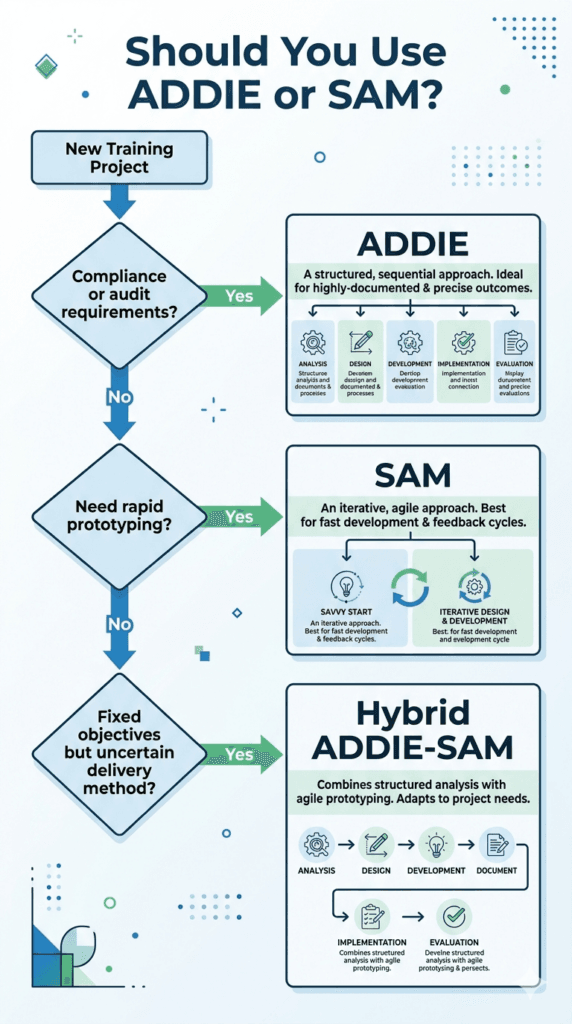
ADDIE vs SAM: When to Use Which Model
Use ADDIE When…
- Compliance or regulatory training: documentation and audit trails are legally or contractually mandatory
- Government, defence, or healthcare: strict stakeholder sign-off requirements demand a phase-gate model
- Stable content: subject matter is unlikely to change significantly for 12–24 months
- Large-scale projects: 500+ learners where consistent delivery matters more than iteration
- Limited stakeholder availability: ADDIE’s phase-gate model requires fewer — but more structured — touchpoints
Use SAM When…
- Soft skills training: leadership, communication, coaching, emotional intelligence — where the best approach emerges through testing
- Fast-changing topics: AI, technology, regulatory interpretation — where speed to market matters
- Tight deadlines: you need a working prototype quickly to validate strategic direction
- Collaborative teams: engaged stakeholders who can commit to iterative review sessions
- Exploratory projects: you need to test assumptions before investing in full-scale development
Model Selection Matrix: Which Model for Which Scenario?
The table below targets the most common practitioner question: which model do I actually use for this type of training? Use it as your first reference point at project kickoff.
| Training Scenario | Recommended Model | Key Reason |
| Compliance / Regulatory Training | ADDIE | Audit trails and formal sign-offs are mandatory |
| Healthcare / Pharmaceutical Training | ADDIE | Regulated content requires fixed, approved processes |
| Government / Defence Training | ADDIE | Strict documentation and phase-gate approvals required |
| Leadership Development | Hybrid ADDIE-SAM | Fixed strategic goals, best approach discovered through iteration |
| Onboarding Programmes | Hybrid ADDIE-SAM | Stable objectives but content benefits from iterative refinement |
| Sales Enablement | Hybrid ADDIE-SAM | Fast-moving topic with measurable business outcomes |
| Soft Skills Training | SAM | Best approach emerges through testing, not upfront prescription |
| AI / Technology Training | SAM | Content evolves rapidly; speed to market is critical |
| STEM / Higher Education | SAM | Peer-reviewed research supports iterative design for STEM outcomes |
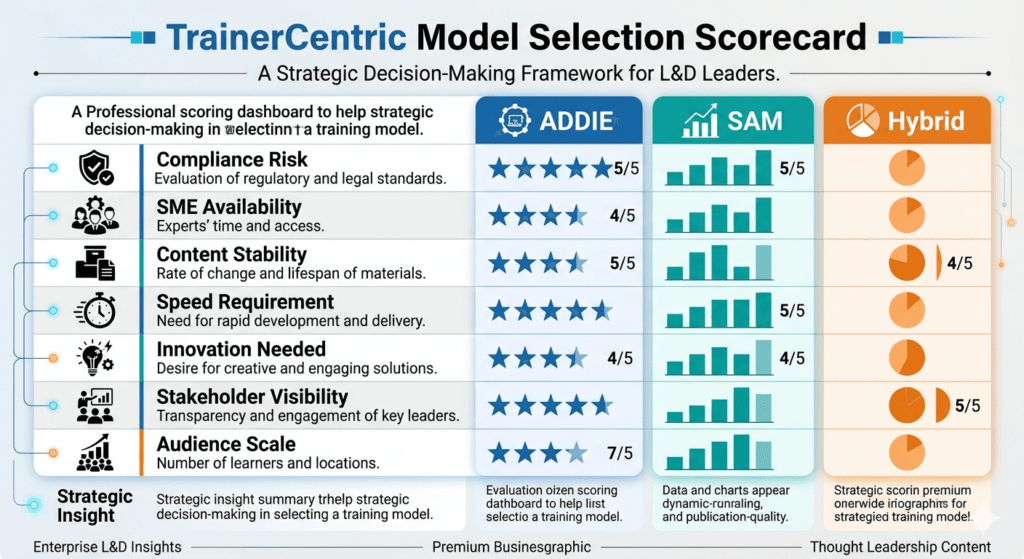
The TrainerCentric Model Selection Scorecard
| Original Practitioner Framework |
| This is an original TrainerCentric framework. Use it at the start of any project to generate an objective score that removes gut-feel from the model selection decision. |
Most model selection happens on instinct. This scorecard replaces instinct with a structured, repeatable process. Rate each factor based on your project, total the columns, and let the score guide your selection.
| Project Factor | ADDIE Score | SAM Score | Hybrid Score |
| Compliance Risk (High = +3) | +3 | 0 | +1 |
| SME Availability (High = +3) | +1 | +3 | +2 |
| Content Stability (Stable = +3) | +3 | 0 | +1 |
| Speed Requirement (Urgent = +3) | 0 | +3 | +2 |
| Innovation Needed (High = +3) | 0 | +3 | +2 |
| Stakeholder Visibility (High = +3) | +1 | +3 | +2 |
| Audience Scale (500+ learners = +3) | +3 | +1 | +2 |
| Total (higher = better fit) | 11 | 13 | 12 |
How to use the scorecard: Score each factor for your specific project (0–3 based on degree), not the fixed values shown above — those represent a typical baseline. The model with the highest total score for your project is the recommended starting point. Scores within 2 points of each other suggest the Hybrid approach is worth considering.
The Hybrid Approach: Using ADDIE and SAM Together
| Most articles treat ADDIE and SAM as opposing choices. In practice, experienced instructional designers blend them — and the result often outperforms either model used alone. |
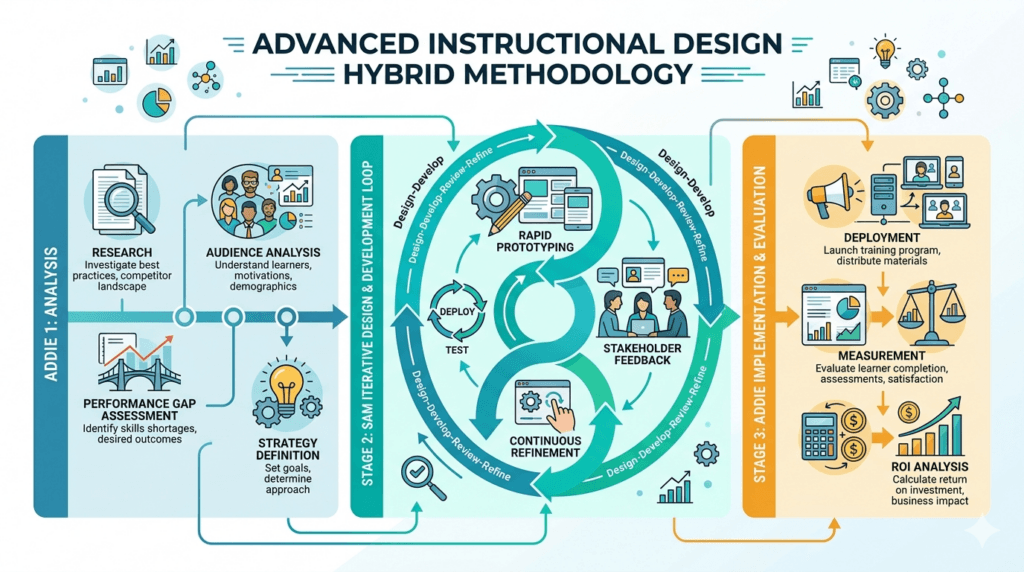
The Hybrid ADDIE-SAM Approach — sometimes called the waterfall-agile hybrid — combines ADDIE’s analytical rigour with SAM’s iterative speed. Here is how it works in three layers:
- Layer 1 — Use ADDIE’s Analysis Phase fully. Invest in upfront analysis: identify the performance gap, audience needs, success metrics, and constraints. This solid foundation prevents iterative loops from spinning in the wrong direction.
- Layer 2 — Apply SAM’s Iterative Design and Development Loops. Once the analysis is complete, replace ADDIE’s sequential Design and Development phases with SAM’s rapid iteration cycles. Run a Savvy Start to generate a first prototype, then iterate with stakeholders through rapid prototyping loops until the content is refined, tested, and approved.
- Layer 3 — Return to ADDIE’s Implementation and Evaluation Phases. Deploy using ADDIE’s structured implementation process — LMS configuration, facilitator preparation, rollout scheduling. Then measure outcomes using ADDIE’s Evaluation framework aligned to Kirkpatrick, since your success criteria were defined in Layer 1.
When to use the hybrid: This approach works best for medium-to-large projects where strategic objectives are fixed (justifying ADDIE’s Analysis) but the best way to achieve them is genuinely uncertain (justifying SAM’s iteration). Leadership development, onboarding redesigns, and digital transformation training all fit this profile.
How We Choose Between ADDIE and SAM: A Practitioner Perspective
| From Our Practice |
| TrainerCentric Perspective In our experience, the deciding factor is rarely timeline alone. Compliance risk and stakeholder availability typically drive the model selection decision more than any other variable. Organisations often arrive with a deadline as their primary constraint — but once we map compliance risk and SME availability, the right model becomes clear regardless of the schedule. |
A Real-World Example: When the Right Model Wasn’t the Obvious One
A manufacturing client recently approached us to redesign their annual safety induction programme. They had 1,400 employees across four sites, a hard launch date in 14 weeks, and a legacy ADDIE-built course that was overlong, text-heavy, and consistently achieving below-target assessment pass rates.
Their initial instinct was to rebuild it in ADDIE again — same structure, fresher content. After running the Model Selection Scorecard, the picture changed. The content was stable (favouring ADDIE), but SME availability was high (three site safety managers available weekly), the legacy course was already failing its learning objectives, and the client needed a demonstrable improvement in pass rates before their next external audit in six months.
We recommended the Hybrid approach: full ADDIE Analysis to define the performance gap and success metrics, SAM’s iterative loops for the design and development phases (which let us test scenario-based assessment questions with real employees before committing to final development), then ADDIE Implementation with formal LMS tracking for the audit trail.
The result: a course that launched on schedule, reduced average completion time by approximately 35%, and improved first-attempt assessment pass rates from 71% to 88% — well inside the audit threshold. The hybrid wasn’t a compromise. It was a deliberate choice driven by the data the scorecard surfaced.
Common Mistakes When Choosing ADDIE or SAM
The decision between ADDIE and SAM is frequently made on instinct or habit rather than project analysis. These are the five most common errors, and how to avoid them.
| Mistake | What Happens | What to Do Instead |
| Choosing ADDIE because ‘that’s how we’ve always done it’ | Projects with high stakeholder availability and low compliance risk end up over-engineered. Timelines stretch unnecessarily. | Ask one question first: ‘Would a regulatory auditor ever review this training record?’ If no, evaluate SAM or the hybrid before defaulting to ADDIE. |
| Using SAM when SMEs cannot attend iterative reviews | Without regular SME input, iterative loops stall or produce content that misses the mark — defeating SAM’s core advantage. | If SMEs can commit to only two or three touchpoints, ADDIE’s phase-gate model fits their availability better. |
| Using SAM for compliance training | Iterative, evolving design documents do not satisfy audit requirements. Regulators expect fixed, formally approved content. | For any training where regulatory non-conformance carries financial or legal risk, ADDIE’s structured sign-off gates are the professional standard. |
| Skipping the Analysis phase to ‘save time’ | Whether using ADDIE or SAM, bypassing analysis means iterating toward the wrong goal. The Savvy Start is not a substitute for understanding the performance gap. | Even in SAM, invest at least a focused half-day in pre-work analysis before the Savvy Start. |
| Treating the hybrid as a compromise rather than a deliberate choice | Teams that ‘mix a bit of both’ without a clear rationale often get the worst of each model: ADDIE’s slowness without its rigour. | Use the hybrid intentionally: ADDIE Analysis + SAM Design/Development + ADDIE Evaluation. Apply only when strategic objectives are fixed but the delivery approach is genuinely uncertain. |
ADDIE vs SAM: Research and Industry Evidence
Study 1: SAM in STEM Teacher Education
Research comparing ADDIE and SAM in STEM education provides one of the few direct experimental comparisons of the two models in an academic setting.
In a Ghana-based experimental study involving 30 mathematics and science student-teachers at the University of Education, Winneba, researchers compared the two models directly. Both improved learners’ conceptual understanding of STEM subjects, but participants showed a stronger preference for SAM, and the SAM group achieved higher post-intervention learning gains overall. The researchers concluded that SAM’s iterative cycles of prototyping, feedback, and revision may be better suited to STEM instruction, where continuous refinement and learner interaction are critical.
While the study’s sample size was relatively small (n=30), its findings provide empirical support for iterative instructional design approaches when rapid adaptation and ongoing improvement are priorities — a pattern consistent with what practitioners see in corporate soft skills contexts.
Source: Ali, C. A., Acquah, S., & Esia-Donkoh, K. (2021). African Educational Research Journal, 9(4), 852-859. DOI: 10.30918/AERJ.94.21.125
Study 2: ADDIE in Regulated Clinical Training Environments
In regulated industries, the case for ADDIE is grounded in operational and legal necessity as much as pedagogical preference. Clinical research training provider Trial Interactive describes the model as particularly well suited to environments where training compliance is tracked and audited — including GCP training for study teams and SOP onboarding for global staff.
Their analysis notes that ADDIE’s structured phases ensure consistency, compliance, and measurability in contexts where the ability to demonstrate both knowledge transfer and documented completion is non-negotiable. In pharmaceutical and healthcare settings, where training records may be reviewed by regulators such as the FDA or CDSCO, ADDIE’s sign-off gates function as both a quality control mechanism and a legal safeguard.
This institutional evidence aligns with broader industry practice: ADDIE’s dominance in compliance-heavy sectors is not a matter of habit. It reflects the model’s structural alignment with the documentation requirements of regulated environments.
Source: Trial Interactive (2025). Applying the ADDIE Model in Training & eLearning: A Practical Perspective. trialinteractive.com
Industry Context: The Scale of L&D Investment
The stakes behind model selection decisions are significant. According to ATD’s 2025 State of the Industry report, organisations in the United States spent an average of $1,254 per employee on workplace learning in 2024. With the average formal learning allocation at 13.7 hours per employee, the cost of a misaligned instructional design approach — one that produces content requiring late-stage rework or fails to change behaviour — is not marginal. Getting the model right at the start of a project is a commercial decision as much as a design one.
Source: ATD State of the Industry Report, 2025 (data from 2024).
ADDIE vs SAM vs Agile: Are They the Same Thing?
A common point of confusion in instructional design discussions is whether SAM and agile are the same methodology. They are not — but they share the same philosophical DNA.
Agile is a software development philosophy built on iterative delivery, continuous feedback, and adaptive planning. It is not a single model but a family of frameworks — Scrum, Kanban, and Lean being the most well-known. Agile prioritises working product over comprehensive documentation and responds to change over following a fixed plan.
SAM is an instructional design model explicitly built on agile principles, adapted for the L&D context. Dr. Michael Allen designed SAM to bring agile’s iterative speed to course development — replacing ADDIE’s waterfall with rapid prototyping cycles. SAM is agile instructional design in the same way that Scrum is agile software development: a specific, structured application of the broader philosophy.
ADDIE is a waterfall model. Like traditional waterfall software development, it moves sequentially through defined phases with formal sign-offs at each gate. It predates agile by decades and was designed for environments — military, government, regulated industries — where predictability and documentation take priority over speed.
For practitioners, the practical implication is this: if your organisation already uses agile project management, SAM or the Hybrid ADDIE-SAM Approach will integrate more naturally with your existing workflows than a pure ADDIE process. If your organisation operates in a waterfall or phase-gate environment — common in compliance-heavy industries — ADDIE aligns better with how projects are managed and approved.
Conclusion
There is no universal winner in the ADDIE vs SAM debate. ADDIE is not obsolete — it remains the gold standard for compliance, regulated industries, and large-scale projects where documentation and predictability are non-negotiable. SAM is not a replacement — it is a different tool, optimised for speed, collaboration, and iterative discovery.
The real skill in instructional design is knowing which tool to reach for, and when. Use the TrainerCentric Model Selection Scorecard to remove instinct from the decision and replace it with a structured, evidence-based process.
| Your Decision Framework |
| Quick Recommendation → If your training must survive an audit — use ADDIE. → If you need a working prototype next week — use SAM. → If objectives are fixed but methods are uncertain — use the Hybrid. → If you’re unsure — run the Scorecard. Let the data decide. Which model will you use for your next project? Share your thoughts in the comments below — we would love to hear how your team navigates this decision. |
Frequently Asked Questions
Can you use ADDIE and SAM together?
Yes — the Hybrid ADDIE-SAM Approach is widely used in practice and often delivers the best outcomes for medium-to-large projects.
Is SAM better than ADDIE?
Not necessarily. They are different tools for different jobs. SAM is faster; ADDIE is more thorough. The right choice depends on your project constraints. See the TrainerCentric Model Selection Scorecard to make an objective decision.
Which model is best for corporate training?
The Hybrid ADDIE-SAM Approach suits most corporate training programmes. Pure ADDIE for compliance-heavy content; pure SAM for soft skills or fast-moving technical topics. The hybrid handles mixed requirements that neither model handles alone.
ADDIE vs SAM for eLearning development?
For compliance eLearning with fixed content: ADDIE. For performance-based eLearning where the best approach needs to be discovered: SAM. For most corporate eLearning with mixed requirements: the Hybrid ADDIE-SAM Approach.
ADDIE vs SAM for compliance training?
ADDIE. Compliance training requires fixed, formally approved, and auditable content. SAM’s iterative, evolving design documents do not satisfy regulatory audit requirements. This is not a preference — it is the professional standard in regulated environments.
Is SAM replacing ADDIE?
No. SAM has expanded the options available to instructional designers and performs better in certain contexts, but it has not replaced ADDIE. Compliance-heavy industries still default to ADDIE, and ADDIE remains the dominant model for large-scale, formally audited training.
Why do some instructional designers dislike ADDIE?
The most common criticisms are its slow pace, late feedback loops, and the high cost of errors discovered after the Development phase. For projects with engaged stakeholders and fast-changing content, ADDIE feels unnecessarily rigid. That is precisely the context where SAM or the hybrid is a better fit.
Can SAM work in regulated industries?
With significant adaptation, yes — but this is rare in practice. The iterative nature of SAM creates challenges for the fixed, formally approved documentation that regulators expect. Most experienced practitioners in regulated sectors use ADDIE or a hybrid that preserves ADDIE’s sign-off structure.
Which model is faster- ADDIE or SAM?
SAM. Rapid prototyping and iterative cycles significantly reduce time-to-launch compared to ADDIE’s sequential phases.
Which model is more thorough?
ADDIE. Its structured phases, extensive documentation, and formal sign-off process make it more rigorous and audit-ready.
Is ADDIE outdated?
No. ADDIE remains the gold standard for compliance, regulatory, and large-scale projects where documentation and predictability are non-negotiable.
What does SAM stand for?
Successive Approximation Model — reflecting its core philosophy of building, testing, and refining in successive iterative cycles.
Is ADDIE a waterfall model?
Yes — ADDIE follows a waterfall structure where each phase must be completed before the next begins. This makes it highly structured and auditable, but less flexible than iterative approaches like SAM.
Is SAM an agile instructional design model?
Yes — SAM is explicitly built on agile principles. Its iterative cycles of prototyping, testing, and refinement directly parallel agile software development practices, making it the leading agile alternative to ADDIE’s waterfall structure.
Further Reads
- Instruction Designing Models
- ADDIE Model of Instructional Designing
- Successive Approximation Model (SAM)
- Merrill’s Principles of Instruction: Designing Skill-Based Training
- Kolb’s Learning Cycle: Using Experiential Learning in the Workplace
- Gagné’s 9 Events of Instruction: A Practical Guide for Trainers with Real Examples
- Bloom’s Taxonomy
- ARCS Model of Motivation — The Complete Guide for Corporate Trainers [2026]
- Adult Learning Theory (Andragogy): Knowles’ 6 Principles Explained with Workplace Examples
- Cognitive Load Theory Explained: A Practical Guide for Trainers & Instructional Designers
- Kirkpatrick Model: How to Measure Training Effectiveness
- Action Mapping: A Step-by-Step Guide with Examples
References
- Ali, C. A., Acquah, S., & Esia-Donkoh, K. (2021). Comparing ADDIE and SAM instructional design models in STEM education. African Educational Research Journal, 9(4), 852-859.
- ATD Research. (2025). State of the Industry Report (2024 data). Association for Talent Development.
- Trial Interactive. (2025). Applying the ADDIE Model in Training & eLearning: A Practical Perspective.
- Training Industry. (2026). ADDIE Model.
- Leaving Addie for SAM: An Agile Model for Developing the Best Learning Experiences by Michael Allen (Author), Richard Sites (Contributor)
Author Details

Soumyadeep Sen is a Learning & Development professional with over 14 years of experience across training, coaching, quality, and performance improvement. Currently serving as Assistant Manager – Training at 24/7.ai, he specializes in designing practical learning solutions that drive employee performance and support business objectives. When he’s not designing learning programs, Soumyadeep enjoys exploring emerging trends in workplace learning, talent development, and instructional design. Reach out to him via Linkedin.