You’ve just wrapped up a six-week sales training program. The facilitator feedback was strong. Attendance was near 100%. The post-training survey scores looked great.
Then someone from finance asks the only question that actually matters:
“What did we get for the money we spent?”
Silence. This is the moment most L&D professionals dread — not because the training didn’t work, but because they can’t prove it did. Reaction scores and attendance numbers don’t answer a CFO’s question. “Trust me, it helped” is not a business case.
In this guide, you’ll learn exactly how to calculate the ROI of a training program — including a real example where a ₹7.6 lakh sales training program actually produced a negative ROI, and why that result matters more than a polished success story.

How to Calculate Training ROI (Quick Answer)
If you need the short version before the deep dive, here it is:
- Calculate total training cost — direct costs + participant time + delivery costs
- Measure the business improvement — compare a pre-training baseline to post-training performance
- Convert the improvement into monetary value — revenue, savings, or productivity gains
- Apply the ROI formula (see below)
That’s the whole method. The rest of this guide walks through each step in detail, with a real training ROI formula example.
Training ROI Formula
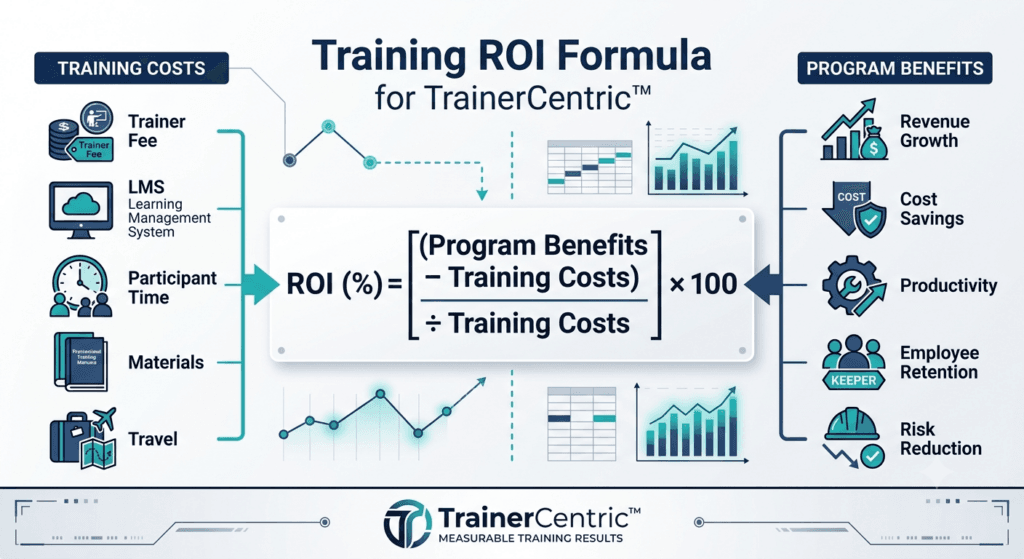
| Training ROI Formula ROI (%) = [(Program Benefits – Training Costs) / Training Costs] × 100 |
In plain English: subtract what the training cost from the monetary value it created, divide by the cost, multiply by 100. A positive number means the training paid for itself. A negative number means it didn’t — yet.
See this training ROI example applied to a real ₹7.6 lakh program below.
What Is Training ROI in Learning and Development?
Training ROI (Return on Investment) measures the financial value created by a training program compared to its cost, expressed as a percentage.
Strip away the jargon and training ROI answers one question: For every rupee you spent on training, how much value did the organisation get back?
It’s the same logic a business leader uses to evaluate any investment — a new hire, new equipment, a marketing campaign. Training is no different.
A quick example:
- Spend ₹5,00,000 on a customer service program
- It saves ₹7,50,000 in refunds, escalations, and lost renewals
- That’s a positive ROI
If the same program only prevented ₹2,00,000 in losses, it didn’t pay for itself. Same effort. Same intentions. Very different business outcome.
Training ROI puts a number on that difference — and it’s quickly becoming one of the core metrics learning and development teams are expected to report on, alongside completion rates and engagement scores.
Why Most Organisations Fail to Measure Training ROI
If the formula is this simple, why do so few L&D teams calculate it? Three reasons show up again and again.
1. No clarity on “success” before training starts : Most programs are measured after the fact, using whatever data happens to be lying around.
2. Metrics don’t connect to money: Satisfaction scores and quiz results are useful — but they don’t answer the CFO’s question. They measure the training, not the business result.
3. Teams assume ROI needs “perfect proof” :Nobody expects lab-level certainty from marketing or sales ROI either. Training ROI only needs to be reasonable and defensible — not perfect.
Once you understand the process below, none of these are hard problems to fix.
Training ROI Formula Breakdown: Cost vs. Benefit
Two components decide everything: cost and benefit.
What Counts as “Training Cost”
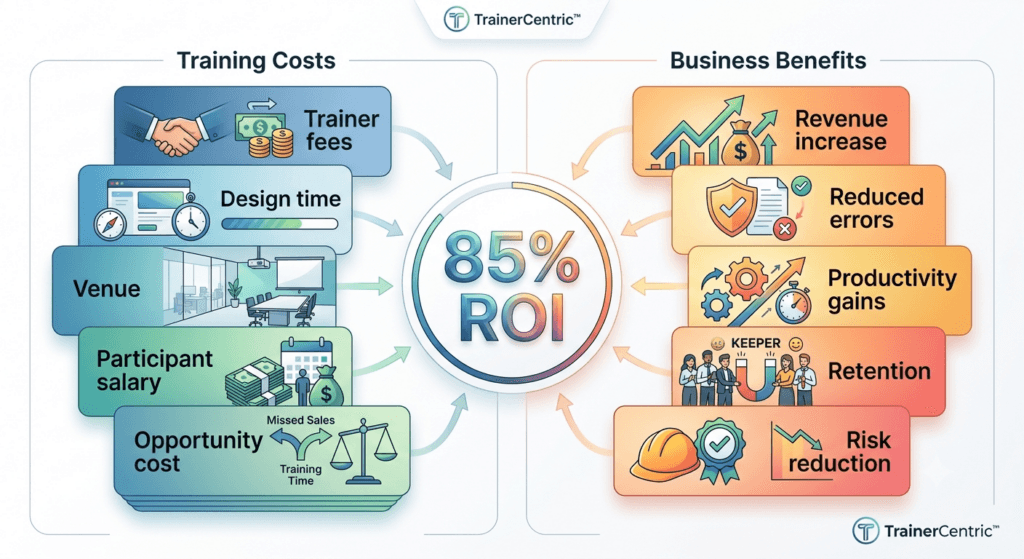
Training cost is more than the vendor invoice. Include:
- Direct costs — trainer fees, content licensing, venue, technology/LMS
- Design and development time — building or customising the program
- Delivery costs — travel, materials, catering
- Participant time cost — hours in training × average salary cost (the most commonly skipped item)
- Opportunity cost — lost productivity while employees are training instead of working
| Skipping participant time is the #1 reason ROI numbers get inflated. If ten managers spend two days in a workshop, that’s real payroll cost — even with no invoice attached. |
What Counts as “Training Benefit”
Benefits are the monetary value created because the training happened:
- Increased revenue — higher conversion, larger deals, faster sales cycles
- Cost savings — fewer errors, less rework, fewer compliance violations
- Productivity gains — faster task completion, shorter ramp-up time
- Retention savings — lower turnover, lower recruitment cost
- Risk reduction — fewer safety incidents, fewer escalations
Think of it the way marketing thinks about a campaign — nobody accepts “the ad was well-received” as proof of value. They ask what it generated. Training deserves the same standard.
The real discipline is converting behaviour change into money. That’s the step most teams skip — and the one we’ll walk through next.
Step-by-Step Process to Calculate Training ROI
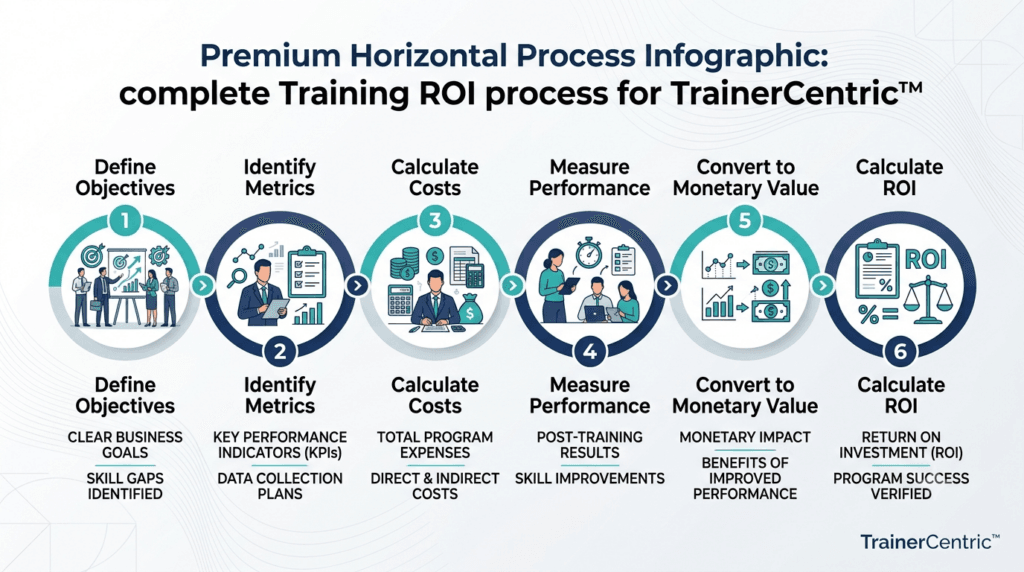
Here’s the full process at a glance:
| Step | What You Do |
| 1 | Define the business-aligned objective |
| 2 | Identify measurable outcomes |
| 3 | Calculate total training cost |
| 4 | Measure performance improvement |
| 5 | Convert the improvement into monetary value |
| 6 | Apply the ROI formula |
Now let’s go through each step in detail.
Step 1: Define Business-Aligned Objectives Before Training Begins
Get explicit agreement — ideally in writing — on the business metric this training should move. Not “improve communication,” but “reduce average call handling time.”
In many cases, poor business performance isn’t caused by a skills gap at all. Before investing in training, it’s worth determining whether training is actually the right solution.
If you can’t name the business metric before training starts, you won’t be able to measure it credibly afterward. This is the same discipline behind a well-run training needs analysis — objectives set before delivery, not guessed at after.
Many organisations begin by using a structured Training Needs Analysis Questionnaire to gather evidence from managers and employees before defining success metrics.
Practical tip: Ask the business sponsor: “If this training works, what number changes, and by how much?” Their answer is your success metric.
Step 2: Identify Measurable Outcomes
Translate the objective into something trackable — sales numbers, error rates, CSAT, time-to-competency, attrition rate. Use metrics the business already tracks wherever possible, so nobody questions the data source later.
Practical tip: Pull 3–6 months of this metric before training so you have a real baseline, not a guess. If your team hasn’t formalised this step yet, conducting a proper training needs analysis is the fastest way to surface a clean baseline.
“If you’re unsure whether poor performance reflects a capability issue or another business problem, start with a skills gap analysis before designing training.”
Step 3: Calculate Total Training Cost
Build a simple cost sheet using the categories above. Use actual figures, not estimates, wherever you can.
Practical tip: Add this one line item and watch the whole conversation change: (average hourly cost per participant) × (training hours) × (number of participants)
Step 4: Measure Performance Improvement
After 60–90 days (behaviour-dependent), compare the metric to your baseline.
- Did the metric move more for the trained group than an untrained comparison group?
- If there’s no control group, compare the change to the organisation’s general trend over the same period
This protects you from crediting training for a shift that was happening anyway.
Step 5: Convert Outcomes into Monetary Value
This is where most ROI calculations succeed or collapse. Apply a monetary value to each improved metric:
- 5% increase in conversion → × average deal value × deal volume
- 10% drop in handling time → × hourly cost × call volume
- 2% drop in attrition → × cost-per-hire × roles retained
Where exact figures aren’t available, use conservative, defensible estimates — and say so explicitly. A modest number that survives scrutiny beats an impressive number that collapses under one follow-up question.
Practical tip: Get finance or ops to validate your assumptions before presenting. Their sign-off makes the number far harder to challenge — the same way presenting findings to senior stakeholders works better with pre-aligned data than with a surprise number.
Step 6: Apply the ROI Formula
Plug total benefit and total cost into the formula. Present the percentage alongside your assumptions — a number without its logic invites doubt; a number with its logic invites trust.
Training ROI Example: Calculating ROI for a Sales Training Program
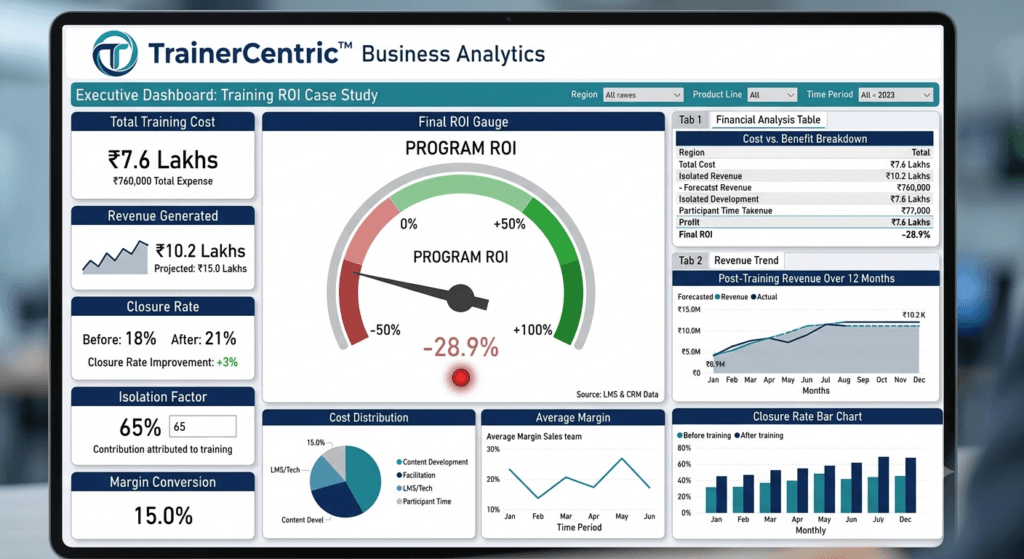
Scenario: A 50-person sales team completes a 2-day negotiation and closing skills workshop.
Cost Breakdown
| Item | Cost |
| External trainer fee (2 days) | ₹1,80,000 |
| Materials and content licensing | ₹40,000 |
| Venue and logistics | ₹60,000 |
| Participant time (50 × 16 hrs × ₹600/hr) | ₹4,80,000 |
| Total Training Cost | ₹7,60,000 |
Performance Change (90 Days Post-Training)
- Closure rate improved from 18% to 23% (+5 points)
- Average deal size: ₹1,50,000
- Qualified opportunities per rep per quarter: 12
- Team size: 50 reps
Converting to Monetary Value
- 12 opportunities × 5% improvement = 0.6 additional deals per rep
- 0.6 × 50 reps = 30 additional deals
- 30 × ₹1,50,000 = ₹45,00,000 additional revenue
To stay conservative:
- Apply a 60% isolation factor (agreed with the sales VP, accounting for market conditions and manager coaching): ₹45,00,000 × 60% = ₹27,00,000
- Apply a 20% margin conversion (revenue ≠ profit): ₹27,00,000 × 20% = ₹5,40,000 attributable benefit
Applying the Formula
| Now here’s where most L&D teams get surprised. |
| Result ROI = [(₹5,40,000 – ₹7,60,000) / ₹7,60,000] × 100 = –28.9% |
Even with a real, measurable closure-rate improvement, this program shows a negative ROI once participant time and a conservative isolation factor are applied.
That’s not a failed exercise — it’s exactly what ROI measurement is supposed to surface. It might mean the program needs a longer measurement window, a lower delivery cost, or a design change. That’s a far more useful leadership conversation than “the feedback was great.”
Contrast: A Positive ROI Example
A customer service training program, measured the same way:
- Total training cost: ₹3,00,000
- Attributable benefit (reduced escalations, after isolation factor): ₹4,80,000
- ROI = 60%
Same formula. Same rigor. Very different business story — which is exactly why calculating ROI honestly matters more than calculating it favourably.
Common Mistakes in Training ROI Calculation
- Measuring too early — behaviour change and business impact both take time to surface
- Ignoring baseline data — without a “before” number, the “after” number means nothing
- Overestimating benefits — crediting training for 100% of a change, with no isolation factor
- Skipping business alignment — ROI calculated after the fact is weaker than ROI planned before delivery
- Skipping participant time cost — leaving it out doesn’t remove the cost, it just hides it
Practical Tips to Simplify Training ROI Measurement
- Start small — pick 1–2 high-visibility, high-cost programs first, not your whole portfolio
- Get stakeholder buy-in before training, not after — when the sponsor agrees to the success metric in advance, your final number is harder to dispute
- Use conservative estimates, and say so — “a conservative estimate agreed with finance” builds more trust than an unverified impressive figure
- Build a repeatable template — one solid worksheet (cost categories, benefit categories, isolation factor, formula) speeds up every future calculation
- Don’t chase ROI for every program — onboarding, compliance, and safety training are business requirements, not investment decisions. Reserve full ROI analysis for discretionary, high-cost programs
This is the exact framework consulting-grade L&D teams use to evaluate multi-lakh training investments before renewal decisions.
A Note on Formal ROI Models
Two frameworks are worth knowing if you want to go deeper:
- Kirkpatrick’s Level 4 (Results) — the highest level of the well-known four-level evaluation model, focused on business outcomes rather than reaction or learning
- The Phillips ROI Methodology — builds on Kirkpatrick with a fifth level specifically for ROI, including a formal isolation process
You don’t need to adopt either model fully to calculate ROI well — but both are worth studying as your measurement practice matures.
Frequently Asked Questions on Training ROI Calculation
What is a good training ROI?
It depends on context, but as a general rule, any ROI above 0% means the value created exceeded the cost. Many organisations look for a meaningfully positive ROI (well above break-even) before calling a program a clear business win, since conservative estimation already discounts the benefit side.
How long does it take to measure training ROI?
Most teams measure 60–90 days after training, depending on how quickly the targeted behaviour is expected to show up in business metrics. Sales or negotiation skills may take longer to show impact than a process change or compliance behaviour.
Is training ROI always measurable?
No. Onboarding, compliance, and safety training are usually business requirements rather than discretionary investments, so they’re typically evaluated against completion and risk-reduction criteria rather than a full ROI calculation.
How do you prove ROI of a training program to leadership?
Present the cost breakdown, the benefit calculation, and the isolation factor together — not just the final percentage. A number backed by visible assumptions is far more persuasive than a number alone.
What’s the difference between training ROI and Kirkpatrick’s Level 4?
Kirkpatrick’s Level 4 asks whether training produced a business result. Training ROI goes one step further and converts that result into a monetary percentage return.
Bringing It All Together
Training ROI isn’t about proving L&D deserves to exist. It’s about using the same language business leaders already use for every other investment decision.
Once you can walk into a budget conversation with a clear cost breakdown, a defensible benefit calculation, and an honest ROI percentage — negative or positive — you stop defending a cost centre and start managing an investment.
Start with one program:
- Build the cost sheet
- Agree on the success metric with your business sponsor
- Convert the outcome into money, conservatively
- Run the formula
- Bring the number to the table — whatever it is
A well-reasoned negative ROI builds more credibility with leadership than an unsupported positive one ever will.
| This is what separates L&D teams that get budget cuts from those that get budget increases. |
Download Your Free Training ROI Calculator
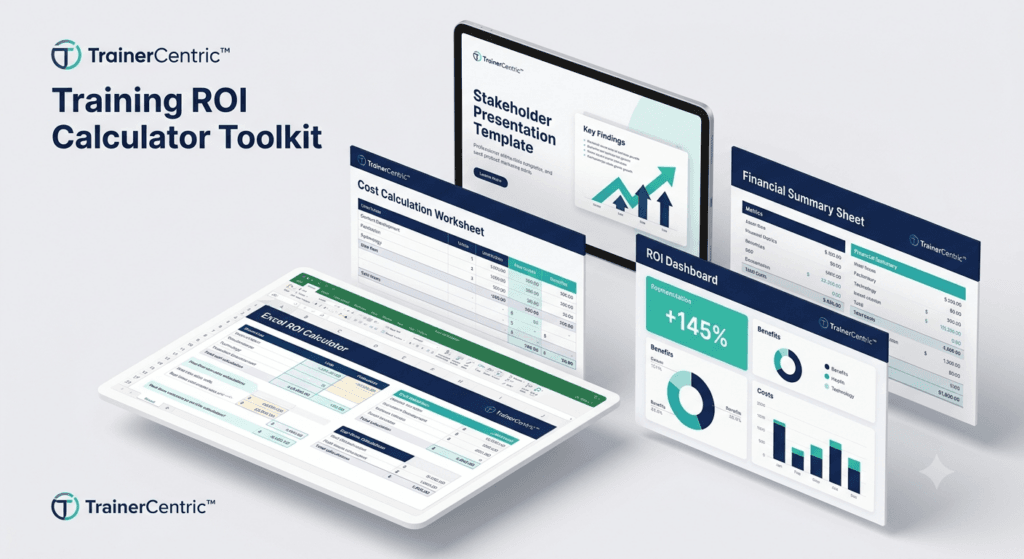
- Pre-built cost calculator (direct, delivery, and participant time cost)
- Built-in ROI formula — no manual math
- Isolation factor and margin conversion included
- Ready to present to stakeholders as-is
Built for L&D teams who need a defensible ROI number without building a spreadsheet from scratch — part of TrainerCentric’s broader Training Needs Analysis toolkit.
References
- Return on Investment in Training and Performance Improvement Programs || Author: Jack J. Phillips || Publication: Routledge
- Handbook of Training Evaluation and Measurement Methods || Author: Donald L. Kirkpatrick || Publication: Berrett-Koehler Publishers
- The Six Disciplines of Breakthrough Learning || Authors: Calhoun W. Wick, Roy V. H. Pollock & Andrew C. Jefferson || Publication: John Wiley & Sons
- Evidence-Informed Learning Design || Authors: Mirjam Neelen & Paul A. Kirschner || Publication: Kogan Page
- Measuring the Success of Learning Through Technology || Authors: Ruth Colvin Clark & Richard E. Mayer || Publication: Pfeiffer
- The Business Case for Learning || Authors: Patricia Pulliam Phillips & Jack J. Phillips || Publication: Berrett-Koehler Publishers
Further Reading
- Ultimate Guide to Training Needs Analysis
- How to Conduct a Training Needs Analysis
- Skills Gap Analysis vs Training Needs Analysis
- Job Task Analysis
- How to Present TNA Results to Senior Stakeholders
- The 3 Levels of Training Needs Analysis: Organisation, Task & Person Analysis
- ADDIE Model Explained
- Learning Objectives Guide
- Training Needs Analysis Template
- Focus Groups and Interviews
- Kirkpatrick Model: How to Measure Training Effectiveness
- Phillips ROI Model Explained: With Examples
- 12 Facilitation Skills for Corporate Trainers: The Complete Guide
- Training Needs Analysis Questionnaire: Complete Guide (75 Questions & Free Template)
- Questioning Techniques in Training: A Practical Guide for Trainers
Author Details

Tulip Ghosh is a Learning and Development professional who designs impactful, learner-centric experiences rooted in behavioral insight and real-world application. She is passionate about improving learner engagement and translating complex ideas into practical training solutions. A thoughtful writer at heart and with experience of a decade in Learning and Development domain, she brings a simple, grounded perspective to the evolving world of workplace learning. Reach out to her on her Linkedin Profile from here.