Introduction
“Does everyone understand?”
Twenty heads nod. Nobody says a word. The trainer moves on, relieved.
Three weeks later, the manager who ran that session asks why nothing from the training has shown up in the team’s actual work. The honest answer is uncomfortable: the room never really understood. It just nodded.
That single moment – the nod, the silence, the trainer’s relief – is the difference between a session that feels like it went well and a session that actually changes behaviour. Weak questions produce compliant faces. Strong questions produce thinking, talking, occasionally uncomfortable learners – and those are the ones who remember what they learned on Monday morning.
This guide walks through the questioning techniques in training that separate forgettable sessions from the ones people still quote a year later: the question types every trainer should have in their back pocket, a funnel framework for structuring any discussion, Socratic questioning adapted for the workplace, what to do with silence, how it all changes in a virtual room, and more than 50 ready-to-use questions organised by situation. By the end, you’ll have a practical system for planning questions instead of improvising them.
Why Questions Matter More Than Answers

Most new trainers over-prepare answers and under-prepare questions. That’s backwards. The answer is the thing a participant forgets by Friday. The question is the thing that makes them think – and thinking is what sticks.
Active engagement beats passive listening. When someone answers a question, they’re retrieving information, connecting it to what they already know, and often hearing themselves say it out loud – three things that never happen when they’re just listening to a slide.
Retrieval practice is one of the best-supported findings in learning science. Cognitive psychologists have shown repeatedly that the act of recalling information strengthens memory far more than re-reading or re-hearing it. A well-placed question – “before I explain this, what do you think happens when…?” – forces retrieval before the trainer gives anything away. That small effort is what makes the concept stick.
Questions respect adult learners. Adults walk into a room with experience, opinions, and a low tolerance for being lectured at. A good question says “your experience matters here” instead of “sit down and absorb this.” That single shift changes the entire energy of a session. For more on why this matters, see Adult Learning Theory (Andragogy).
Questions build psychological safety – if they’re asked well. A question asked with genuine curiosity (“what’s actually made this hard for your team?”) invites honesty. The same question asked with an edge (“so why hasn’t this worked for you?”) shuts people down. The words can be nearly identical; the intent behind them is what participants respond to.
Questions manage cognitive load. Dumping a full explanation on a group taxes working memory. Breaking the same content into a sequence of questions lets people build understanding in smaller, more manageable steps. This connects closely to Cognitive Load Theory – if you design activities with load in mind, you’ll already have an instinct for how to pace questions too.
The trainers who get remembered aren’t the ones with the smoothest slides. They’re the ones whose questions made a room think differently about its own work.
What Makes a Powerful Question?
Not every question earns its place in a session. A weak question wastes airtime and makes a group feel like they’re being tested rather than developed. A powerful one does real work. Here’s what separates the two.
Clear. Participants shouldn’t have to decode what you’re actually asking. “What’s one thing you’d change about how your team handles handoffs?” beats “So, thoughts?”
Purposeful. Every question should exist to do something – surface an assumption, check understanding, spark debate, or move the group toward a decision. If you can’t say what a question is for, cut it.
Relevant. Tie the question to the room’s actual work. A sales team doesn’t need a hypothetical about manufacturing defects; they need a hypothetical about a customer who won’t return calls.
Challenging, not threatening. The best questions stretch people slightly past their current thinking without making them feel exposed in front of peers.
Open enough to invite thought. “Did that make sense?” invites a lie (“yes”). “What’s one part of this you’d want to try first?” invites a real answer.
Connected to the learning objective. A clever question that has nothing to do with what the session is meant to achieve is just entertainment. Anchor every question back to what participants need to walk away able to do.
Vague questions fail for a predictable reason: they ask the brain to do too much guessing about what’s actually wanted, so it defaults to the safest, laziest answer. Precision in the question produces precision in the response.
Types of Questions Every Trainer Should Master
Different situations call for different question types. Below is a working reference for the ten types that show up most often in a training room.
Comparison Table: Question Types

| Type | Purpose | Example | When to Use | Common Mistake |
| Open | Encourage elaboration and personal thinking | “What’s been your experience managing this kind of conflict?” | Opening discussion, surfacing perspectives | Following it immediately with a closed question that kills the openness |
| Closed | Confirm a fact or decision quickly | “Have you used this template before?” | Quick checks, decisions, moving things along | Overusing them and turning a discussion into an interrogation |
| Probing | Go deeper into an initial answer | “What made that approach work?” | When a first answer is surface-level | Probing so hard it feels like cross-examination |
| Reflective | Prompt self-awareness and connection to experience | “What does this remind you of from your own team?” | Debriefs, after activities, action planning | Asking it before there’s been any real experience to reflect on |
| Hypothetical | Test judgment in a scenario with no real risk | “What would you do if the client pushed back on price mid-call?” | Skill practice, decision-making practice | Making the scenario so unrealistic nobody can relate to it |
| Diagnostic | Identify the root of a problem or gap | “Where exactly does the process break down?” | Needs analysis, troubleshooting discussions | Jumping to solutions before the diagnosis is finished |
| Funnel | Move from broad to specific in a structured sequence | “What’s the general challenge? … Now, where specifically does it show up?” | Structuring longer discussions | Rushing the funnel and skipping the broad stage entirely |
| Clarifying | Make sure everyone shares the same understanding | “When you say ‘the client was difficult,’ what did they actually do?” | Whenever language is vague or assumed | Asking it in a way that sounds like you doubt the person |
| Socratic | Challenge assumptions and reasoning through structured follow-ups | “What’s the evidence that this approach usually works?” | Critical thinking, leadership and decision-making sessions | Using it to score points rather than genuinely explore reasoning |
| Appreciative | Build on strengths and what’s already working | “What’s already going right that we could do more of?” | Team sessions with low morale, culture-sensitive topics | Skipping straight to problems and never using this type at all |
Most trainers default to open and closed questions and stop there. The real skill is knowing when a diagnostic question would move a stuck conversation forward, or when an appreciative question would rescue a group that’s turned a debrief into a complaint session.
The Question Funnel Framework
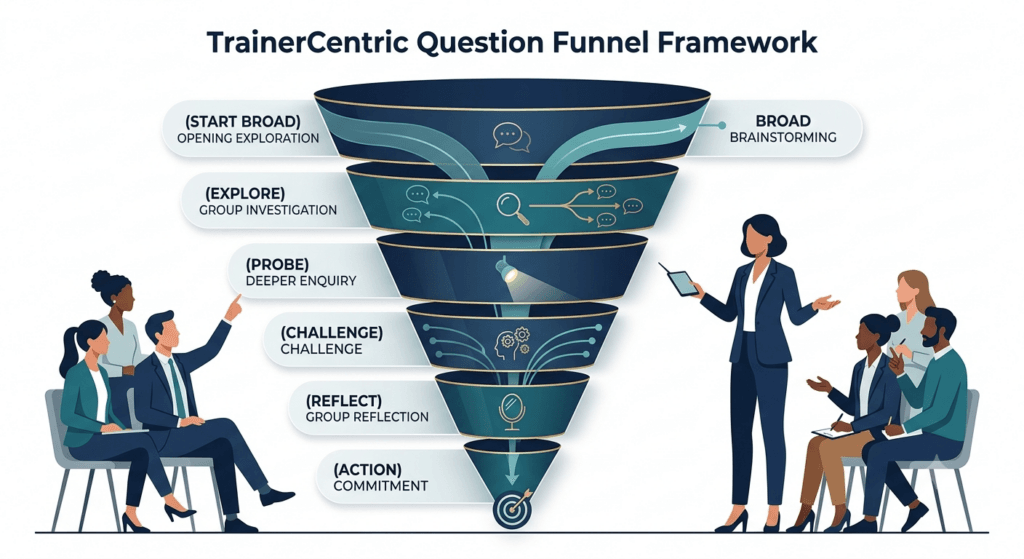
This is one of the most useful structures a trainer can carry into any discussion, debrief, or coaching conversation. TrainerCentric calls it the Question Funnel Framework, and it works because it mirrors how people naturally process a topic – from general to specific to personal.
- Start Broad: Open the topic without narrowing it yet. “What’s your general experience with performance conversations?”
- Explore: Invite more territory before you dig into any one point. “What tends to make them harder – or easier?”
- Probe: Push into a specific example or claim. “Tell me about a time one of those conversations went badly. What happened?”
- Challenge: Test the thinking behind the example. “What do you think the other person walked away believing?”
- Reflect: Bring it back to the individual’s own practice. “What would you do differently if you had that conversation again?”
- Commit to Action: Convert insight into a concrete next step. “What’s one thing you’ll change in your next performance conversation?”
Workplace example – a customer service session:
- Start Broad: “What’s it like handling an angry customer?”
- Explore: “What usually escalates it, and what calms it down?”
- Probe: “Walk me through the last call that got heated.”
- Challenge: “At what point could it have gone differently?”
- Reflect: “What does that tell you about your own instinct in that moment?”
- Commit: “What’s one phrase you’ll try using next time you feel a call escalating?”
The funnel prevents two common failures: jumping straight to “so what will you do differently” before anyone has actually explored the problem, and getting stuck circling the broad stage forever without ever reaching commitment.
Questioning Techniques for Different Stages of Training
Questions do different jobs depending on where you are in a session.
- Before training. Pre-session questions (“what’s the one thing you want to walk away being able to do?”) set expectations and give the trainer a read on the room before it even starts.
- During introductions and icebreakers. Keep these light but purposeful: “What’s one word you’d use to describe how your week’s going?” gives you useful energy data without demanding depth too early.
- Needs assessment moments. Diagnostic and open questions work best here: “Where does this skill actually show up in your day-to-day work?”
- Knowledge checks. Closed and clarifying questions confirm retention without turning into a quiz atmosphere: “In your own words, what’s the first step of the process?”
- Facilitating discussion. Funnel and probing questions keep a conversation moving without the trainer doing all the talking.
- Managing resistance. Appreciative and clarifying questions de-escalate defensiveness better than direct challenge: “What’s making this feel like it won’t work for your team specifically?”
- Reflection. Reflective questions turn an activity into actual learning: “What did this activity show you about your own approach?”
- Action planning. Commitment-focused questions close the loop: “What’s the first thing you’ll try this week?”
- Closing activities. A short, memorable closing question outperforms a long summary: “What’s one sentence you’d text a colleague about today’s session?”
Socratic Questioning for Corporate Learning

Socratic questioning didn’t start in a boardroom, but it maps onto corporate learning almost perfectly. It works by walking someone through their own reasoning rather than handing them a conclusion. Six categories make up the method:
- Clarification – “What exactly do you mean by ‘the process is broken’?”
- Evidence – “What have you actually seen that supports that?”
- Assumptions – “What are we assuming has to be true for this approach to work?”
- Alternatives – “Is there another way to look at this situation?”
- Consequences – “If we go with this approach, what’s likely to happen down the line?”
- Reflection on the reasoning itself – “Why does this question matter in the first place?”
Business example – a leadership session on a stalled project:
A manager says, “The team just isn’t motivated.” Instead of accepting that as fact, a trainer using Socratic questioning might go:
- Clarification: “What are you seeing that makes you say ‘not motivated’?”
- Evidence: “How many of them have said that directly, versus how many you’re inferring it from?”
- Assumptions: “Are we assuming motivation is the problem, or could it be something structural – unclear priorities, competing deadlines?”
- Alternatives: “What’s another explanation for the same behaviour?”
- Consequences: “If you’re wrong about motivation being the cause, what happens if you address it anyway?”
- Reflection: “What would change about your next conversation with the team if the real issue turned out to be priorities, not motivation?”
That sequence does more to shift a manager’s thinking than any slide on “how to motivate your team” ever could.
Questions That Increase Learner Participation
Some questions reliably pull people into a discussion because they invite a personal, low-risk answer rather than a “correct” one.
- “What surprised you about that?”
- “What would happen if you tried the opposite approach?”
- “What would your customer say if they were in this room right now?”
- “What would you do differently tomorrow, based on today?”
- “What’s a moment from your own work that this reminds you of?”
- “If you had to explain this to someone on your team in one sentence, what would you say?”
- “What’s the part of this you’re least convinced by?”
Questions like these work because they don’t have a single right answer trainers are fishing for. Nobody’s afraid of getting it “wrong,” so more people are willing to speak.
Questions for Different Learning Activities
Different activity formats call for different question emphasis.
Scenario discussions. Use diagnostic and hypothetical questions: “What’s really going on beneath the surface of this scenario?” See Scenario-Based Learning for a deeper look at designing these.
Case studies. Probing and evidence-based questions work well: “What in the case actually supports that conclusion?”
Role plays. Reflective questions after the role play matter more than questions during it: “What did you notice about the other person’s reaction to your approach?”
Group work. Funnel questions help groups self-manage: “What’s your group’s current thinking, and what’s still unresolved?”
Breakout rooms. Short, anchoring questions work best since facilitator presence is limited: “What’s one decision your group needs to make before you come back?” More on structuring these in Breakout Room Activities.
Peer coaching. Clarifying and reflective questions model the coaching behaviour you want peers to practice: “What did you hear them actually ask for help with?”
Problem solving. Diagnostic questions before solution questions: “Where exactly does this break down, before we talk about fixing it?”
Action learning. Commitment questions close the loop on real projects: “What’s the next real step your team will take on this, and by when?” This activity style draws heavily on Kolb’s experiential cycle – see Kolb’s Learning Cycle: Using Experiential Learning in the Workplace.
Common Questioning Mistakes Trainers Make
Answering your own question. A trainer asks something, waits two seconds, and fills the silence themselves. It happens because silence feels awkward – but it trains the room to wait you out instead of thinking. Fix: commit to at least five seconds of silence before rephrasing anything.
Leading questions. “Don’t you think we should always confirm requirements first?” isn’t really a question – it’s an instruction in disguise. It happens because trainers want to steer toward a “correct” answer. Fix: strip the opinion out and ask neutrally – “What should happen first, and why?”
Double-barrelled questions. “What went well, and what would you change, and how did the client react?” asks three things at once and usually gets none of them answered properly. It happens under time pressure. Fix: ask one question, get an answer, then ask the next.
Rapid-fire questioning. Firing several questions back-to-back overwhelms rather than engages. It happens when a trainer is nervous about silence. Fix: one question, then stop talking.
Calling on the same participants. The confident voices answer every time; everyone else learns they don’t need to. It happens because it’s the path of least resistance. Fix: use structured turn-taking or written responses before opening the floor.
Only asking volunteers. Volunteers are often the people who already understand the content. It happens because cold-calling feels uncomfortable. Fix: use low-stakes methods like think-pair-share before asking for names.
Not allowing thinking time. Expecting an instant answer to a genuinely hard question produces shallow answers. It happens because trainers underestimate how long real thinking takes. Fix: say the question, then explicitly announce a short thinking pause before anyone answers.
Ignoring silence. Treating silence as a sign the question failed, rather than a sign people are thinking. It happens because trainers read silence as disengagement. Fix: hold the pause; often the best answers come after the uncomfortable gap.
Turning questions into lectures. Asking a question, getting a partial answer, then talking for three minutes to “complete” it. It happens because trainers want to make sure the point lands. Fix: build on what the participant said instead of restating the whole explanation yourself.
Techniques for Handling Silence After Asking Questions
Silence is not failure. It’s usually the sound of people thinking about something that actually requires thought. A few techniques make it easier to sit with:
Wait time. Aim for at least five to seven seconds before speaking again. It feels much longer to the trainer than it does to the room.
Think-Pair-Share. Give people a moment to think alone, then discuss with a partner, before opening to the full group. This removes the pressure of being the first voice heard.
Writing before sharing. Ask people to jot a quick answer before anyone speaks aloud. It gives quieter processors a chance to form a real answer instead of reacting on the spot.
Small groups. Breaking a large silent room into groups of three or four almost always produces conversation that a full-group question wouldn’t.
Polling. A quick poll gives everyone a way to respond without speaking, and often warms up the room for a verbal follow-up.
Anonymous responses. Sticky notes, anonymous chat, or digital tools let people contribute honestly without the social risk of being wrong in front of colleagues.
For a deeper look at this specific challenge, see How to Handle Silent Participants During Training.
Adapting Questions for Virtual Training
Virtual rooms strip away most of the non-verbal cues trainers rely on, so questioning has to work harder.
Chat. Written questions in chat let multiple people answer at once instead of waiting for one voice at a time.
Polls. Quick multiple-choice or scaled questions keep energy up between longer discussion questions.
Breakout rooms. Smaller virtual rooms recreate some of the safety of small in-person groups – but need a clear, single question to stay focused.
Digital whiteboards. Visual, asynchronous questions (“add one word describing your biggest challenge with this”) work well when cameras are off and voices are hesitant.
Reaction icons. A quick thumbs-up/thumbs-down question keeps engagement visible without requiring anyone to unmute.
AI tools. Used well, AI can generate scenario variations or follow-up questions on the fly during a live virtual session – covered more in the section below.
Micro-reflections. A single typed sentence in the chat (“one thing you’ll try this week”) closes a virtual session with more commitment than a verbal “any questions?”
Using AI to Generate Better Training Questions
AI tools like ChatGPT can meaningfully speed up question design when used with judgment rather than blind trust.
Using AI responsibly. Treat AI output as a first draft, not a final answer. It’s good at generating volume and variety; it’s not good at knowing your specific room, culture, or sensitivities.
Creating scenarios. Ask AI to generate several realistic workplace scenarios in your industry, then edit for accuracy and relevance before using them live.
Bloom’s-aligned questioning. AI can generate questions across levels of Bloom’s Taxonomy – from recall through to evaluation – which is useful for building a full question set for one topic. See Bloom’s Taxonomy: How to Write Learning Objectives That Actually Work [internal link] for the underlying framework.
Reflection prompts. AI is genuinely useful here – generating a bank of reflective questions to rotate through debriefs so you’re not reusing the same three prompts every session.
Critical thinking prompts. AI can draft Socratic-style follow-up questions, which is a fast way to build a bank you then trim down to the sharpest three or four.
Ethical considerations. Never let AI-generated content go live unreviewed, especially anything touching sensitive workplace topics like conflict, discrimination, or performance issues. The trainer’s judgment is the actual safeguard, not the tool. For a broader look at where AI fits into the profession, see AI in Learning and Development.
Real Corporate Example
A compliance team at a mid-sized financial services company had a familiar problem: an annual compliance refresher that everyone dreaded. The session was 90 minutes of slides, delivered lecture-style, with a “any questions?” moment every twenty minutes that nobody ever used. Post-training surveys were fine. Actual behaviour change was close to zero – incident reports kept showing the same recurring errors year after year.
The trainer redesigned the session around structured questioning instead of content delivery. The compliance content itself barely changed. What changed was the format:
- The session opened with a diagnostic question instead of a policy overview: “What’s the compliance rule you’re least confident you’re following correctly?” Answers were collected anonymously and used to shape which topics got the most airtime.
- Each policy section opened with a hypothetical scenario question before any rule was explained: “A client asks you to backdate a document. What do you do in that exact moment?” Only after discussion did the trainer introduce the actual policy.
- The Question Funnel Framework structured each case discussion – broad, explore, probe, challenge, reflect, commit – rather than the trainer explaining the “right” answer.
- Closing action-planning questions replaced the final summary slide: “What’s one specific situation in your role where this policy will actually come up in the next month?”
The measurable results, tracked over the following two quarters:
- Participation, measured by number of unique voices contributing per session, roughly tripled compared to the previous year’s lecture format.
- Post-session knowledge checks showed higher accuracy on scenario-based questions specifically, not just recall questions.
- Manager-reported “real-world application” – staff referencing the training unprompted in actual client situations – increased noticeably, based on manager check-ins over the following quarter.
- The recurring compliance errors that had shown up in incident reports for three straight years dropped in the following review cycle.
Nothing about the underlying policy content changed. The delivery mechanism – lecture versus structured questioning – was the entire difference.
Quick Reference Cheat Sheet
| Situation | Best Question Type | Example | Purpose |
| Opening a session | Open | “What’s your experience with this topic so far?” | Surface existing knowledge and set tone |
| Checking understanding | Closed / Clarifying | “In one sentence, what’s the key idea here?” | Confirm retention without a formal test |
| Group has gone quiet | Reflective / Think-Pair-Share prompt | “What’s one thought you’d share with a partner first?” | Lower the risk of speaking first |
| Discussion feels surface-level | Probing | “What specifically made that difficult?” | Move past the first, easy answer |
| Someone makes a sweeping claim | Socratic / Evidence | “What have you seen that supports that?” | Test and strengthen reasoning |
| Resistance to new idea | Appreciative / Clarifying | “What’s already working that we should keep?” | Reduce defensiveness, invite honesty |
| Debrief after an activity | Reflective | “What did this show you about your own approach?” | Convert experience into insight |
| Closing a session | Commitment | “What’s the first thing you’ll try this week?” | Turn insight into action |
| Virtual session, cameras off | Poll / Chat-based | “Type one word for how confident you feel right now.” | Get participation without needing voice |
| Managing a dominant talker | Redirecting / Open to group | “What do others think about that point?” | Rebalance airtime across the room |
Download the TrainerCentric Questioning Toolkit
Reading about questioning techniques is one thing. Having them ready to use in your next session is another.
The TrainerCentric Questioning Toolkit puts everything in this guide into practical, editable tools you can bring straight into your next design or delivery:
- 100 Ready-to-Use Trainer Questions, organised by category and situation
- Socratic Questioning Guide, with business-ready scripts for each of the six question types
- Facilitation Question Planner, to map your questions to session objectives in advance
- Reflection Prompt Library, so debriefs never rely on the same three tired questions
- Question Funnel Template, ready to drop straight into your session design
- Question Design Checklist, to pressure-test every question before you use it live
- Discussion Planning Worksheet, for structuring longer group conversations
- Coaching Question Cards, for 1:1 and peer coaching conversations
- Virtual Facilitation Question Bank, built specifically for chat, polls, and breakout formats
- Trainer Observation Checklist, to evaluate questioning skill in yourself or others
Great trainers aren’t improvising their questions in the moment – they’ve already done the thinking beforehand. This toolkit is that thinking, done for you, ready to adapt to your own sessions.
Conclusion
Participants rarely remember the answers a trainer gave them. They remember the questions that made them think differently about their own work. That’s the real measure of a strong facilitator – not how much they explained, but how much thinking they provoked.
Purposeful questioning turns a passive audience into an active one. It improves retention because it forces retrieval instead of re-exposure. It surfaces resistance early instead of letting it fester quietly. And it’s the single fastest way to find out whether a session is actually landing, rather than just appearing to.
The trainers who get this right don’t rely on instinct alone. They plan their questions with the same care they plan their content – choosing the type, the sequence, and the moment deliberately, before they ever walk into the room. That’s the shift worth making: stop treating questions as filler between slides, and start treating them as the main event.
Frequently Asked Questions
Why are questioning techniques important in training?
They shift participants from passively listening to actively thinking, which is what actually drives retention and real-world application of the content.
What are the best questioning techniques for corporate trainers?
A mix of open, probing, funnel, and Socratic questions covers most situations – open to start discussion, probing to deepen it, funnel to structure it, and Socratic to challenge assumptions.
What is Socratic questioning?
It’s a structured method of asking questions – covering clarification, evidence, assumptions, alternatives, consequences, and reflection – that walks someone through examining their own reasoning rather than being told an answer.
How long should trainers wait after asking a question?
At least five to seven seconds. It feels longer to the trainer than it actually is, and cutting that pause short is one of the most common questioning mistakes.
What are open-ended questions?
Questions that can’t be answered with a single word like “yes” or “no,” and instead invite explanation, opinion, or elaboration – for example, “what’s been your experience with this?”
How do you encourage quiet participants to answer questions?
Use lower-risk formats first, like writing an answer down or discussing with a partner, before asking anyone to share with the full group.
What questioning techniques work in virtual training?
Chat-based questions, polls, digital whiteboards, and short written micro-reflections all work better in virtual sessions than expecting people to unmute and answer verbally.
What mistakes should trainers avoid when asking questions?
Common ones include answering your own question, asking leading or double-barrelled questions, rapid-fire questioning, and only calling on the same confident volunteers each time.
How can questioning improve learning retention?
Answering a question is an act of retrieval practice, which strengthens memory far more effectively than passively re-hearing the same information.
How does Bloom’s Taxonomy help trainers ask better questions?
It gives trainers a structure for moving questions from simple recall through to analysis and evaluation, ensuring a session isn’t stuck asking only surface-level questions.
References
- The Skilled Facilitator: A Comprehensive Resource for Consultants, Facilitators, Managers, Trainers, and Coaches || 3rd Edition || Roger Schwarz || Jossey-Bass || 2016
- Training from the Back of the Room!: 65 Ways to Step Aside and Let Them Learn || 2nd Edition || Sharon L. Bowman || Pfeiffer || 2014
- Design for How People Learn || 2nd Edition || Julie Dirksen || New Riders || 2015
- Telling Ain’t Training || 2nd Edition || Harold D. Stolovitch & Erica J. Keeps || Association for Talent Development (ATD) Press || 2011
- The Adult Learner: The Definitive Classic in Adult Education and Human Resource Development || 9th Edition || Malcolm S. Knowles, Elwood F. Holton III & Richard A. Swanson || Routledge || 2020
- The Art and Science of Training || 1st Edition || Elaine Biech || Association for Talent Development (ATD) Press || 2015
Further Readings
- Training Needs Analysis
- Job Task Analysis
- The ADDIE Model
- Writing Learning Objectives
- The Kirkpatrick Model
- Adult Learning Theory
- When Training Is NOT the Answer
- How to Handle Difficult Participants in Training
- 8 Icebreakers That Actually Work in Corporate Training
- 12 Facilitation Skills for Corporate Trainers: The Complete Guide + Free Template
- How to Facilitate Training Without Being An Expert [2026]
Author Details

Sumit is a writer, facilitator and a workspace learning enthusiast who explores the intersections of human behaviour, performance, and professional growth. With extensive experience in corporate environments, he brings a grounded, real-world perspective to the challenges professionals face every day. You can reach out to him at sumit@trainercentric.in