A new manager sits through a two-hour module on “Effective Feedback.” She passes the quiz. Three weeks later, an underperforming team member misses another deadline, and she says nothing — because the course never actually asked her to handle that conversation. It told her about it.
This is the quiet failure mode of most workplace training. It transfers information, not capability. People can recite a model in a multiple-choice question and still freeze the moment they need it in a real meeting.
Scenario Based Learning closes that gap. Instead of telling learners what good judgement looks like, it puts them inside a situation where they have to exercise it — and then shows them what happens next.
It’s also no longer a niche tactic. In ATD’s 2025 State of the Industry report, 69% of organisations said they now use simulations or scenario based learning as part of their talent development programmes — and ATD’s research into why found the top driver wasn’t novelty, it was results: better engagement (60% of organisations) and better knowledge retention and application after training (57%).
This guide is written for instructional designers, trainers, and L&D leaders who want to move past information-dump training and start designing experiences that actually shift behaviour on the job. You’ll get the theory, two original TrainerCentric frameworks for designing and auditing scenarios, the step-by-step design process, real workplace examples across ten industries, fifteen common mistakes to avoid, and a framework for measuring whether it’s working.
“Experience is not what happens to you; it’s what you do with what happens to you.” — Aldous Huxley
That line is the entire case for Scenario Based Learning in one sentence. Two learners can sit through the identical workshop and walk away with completely different capability, because capability isn’t built by exposure — it’s built by what they’re asked to do with what they’ve just learned.
What is Scenario Based Learning?
Scenario Based Learning (SBL) is an instructional approach where learners are placed inside a realistic, job-relevant situation and asked to make decisions the way they would on the job. Each decision leads to a consequence, and the consequence teaches the lesson — not a slide of bullet points sitting above it.
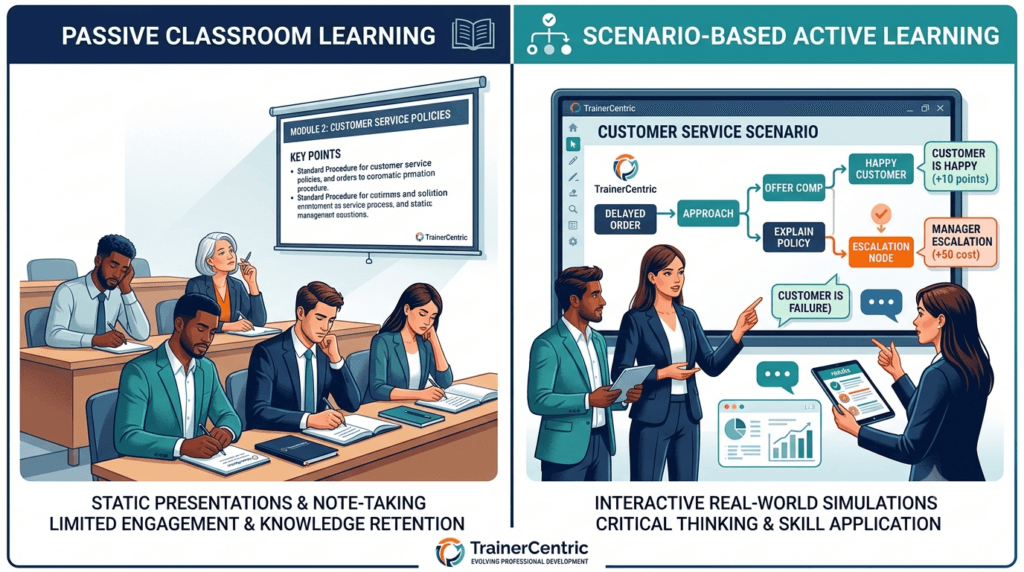
At its core, SBL is built on one principle: people learn judgement by practising judgement, not by reading about it.
A well-designed scenario usually contains four ingredients:
- A realistic context the learner recognises from their own role
- A decision point with genuinely plausible options (not one obviously “right” answer and two jokes)
- A consequence that plays out — socially, operationally, or emotionally
- Feedback that explains why the consequence happened, tied back to a principle the learner can reuse
It’s worth being precise about what SBL is, because the term gets used loosely and often gets confused with related formats.
Scenario Based Learning vs. Knowledge-Based Learning
Knowledge-based learning asks: Can you recall this information? Scenario based learning asks: Can you apply this information under realistic conditions, with incomplete information and some pressure? Knowledge-based formats are appropriate for facts, definitions, and policies. Scenario based formats are appropriate for judgement, conversation, and decision-making.
Scenario Based Learning vs. Case Studies
A case study is usually a static narrative the learner analyses and discusses afterward — useful for building shared understanding of a complex situation. A scenario puts the learner inside the narrative as the decision-maker, in real time, with consequences attached to their own choices rather than someone else’s.
Scenario Based Learning vs. Role Plays
Role plays are live, facilitator-led, and depend heavily on the skill of whoever is in the room. Scenarios can deliver a similar decision-making experience asynchronously, consistently, and at scale — though the two aren’t mutually exclusive; many strong programmes use scenarios to build the skill first, then role play to pressure-test it live.
Scenario Based Learning vs. Simulations
Simulations typically model a system (a piece of equipment, a financial model, a clinical environment) where the learner manipulates variables and observes systemic results. Scenarios are narrower and more narrative — focused on a specific decision or conversation rather than an entire operating environment. Simulations often contain scenarios as their decision points.
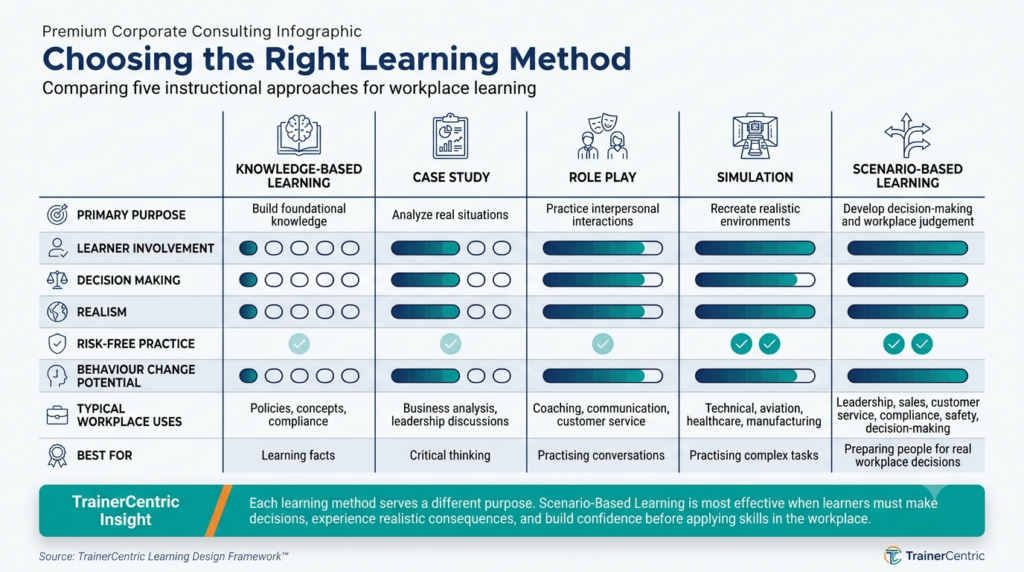
| Format | Learner role | Best for | Limitation |
| Knowledge-based learning | Receiver of information | Facts, policy, compliance content | Doesn’t build applied judgement |
| Case study | Analyst, discussing after the fact | Building shared understanding of complexity | No personal consequence attached |
| Role play | Live performer | Practising conversation under real-time pressure | Inconsistent, facilitator-dependent, hard to scale |
| Simulation | Operator of a system | Technical, procedural, or systemic skills | Expensive to build and maintain |
| Scenario based learning | Decision-maker inside a story | Judgement, soft skills, decision-making | Needs strong writing and SME input to feel real |
The TrainerCentric Perspective: After auditing hundreds of client scenarios over the years, the single most common fault line we see isn’t bad writing — it’s a scenario built around the wrong question. Teams ask “what do we want learners to know?” and then dress that fact up as a story. The question that actually produces a good scenario is “where do our people freeze, hesitate, or get it wrong on the job?” Start there, and the rest of the design gets much easier.
The TrainerCentric REAL Framework
Most scenario design advice tells you to “make it realistic” without telling you what that actually requires. We built the REAL Framework to give teams a repeatable structure — something to check every scenario against before it ships, rather than relying on gut feel.
R — Realistic Context The setting, characters, and pressures need to be ones your learner already recognises from their own role. If it could be set in any company, in any industry, it’s not specific enough yet.
E — Essential Decision Every scenario should centre on one decision that actually matters — not three minor ones diluted together. If you can’t name the single decision the scenario exists to test, the scenario doesn’t have a clear purpose yet.
A — Authentic Consequence The outcome of the decision has to be proportionate and believable, and it should vary in type — emotional, operational, or reputational — rather than defaulting to the same “you fail” ending every time.
L — Learning Feedback The debrief explains the underlying principle behind the consequence, not just whether the choice was “correct,” so the lesson transfers to situations that look different on the surface.
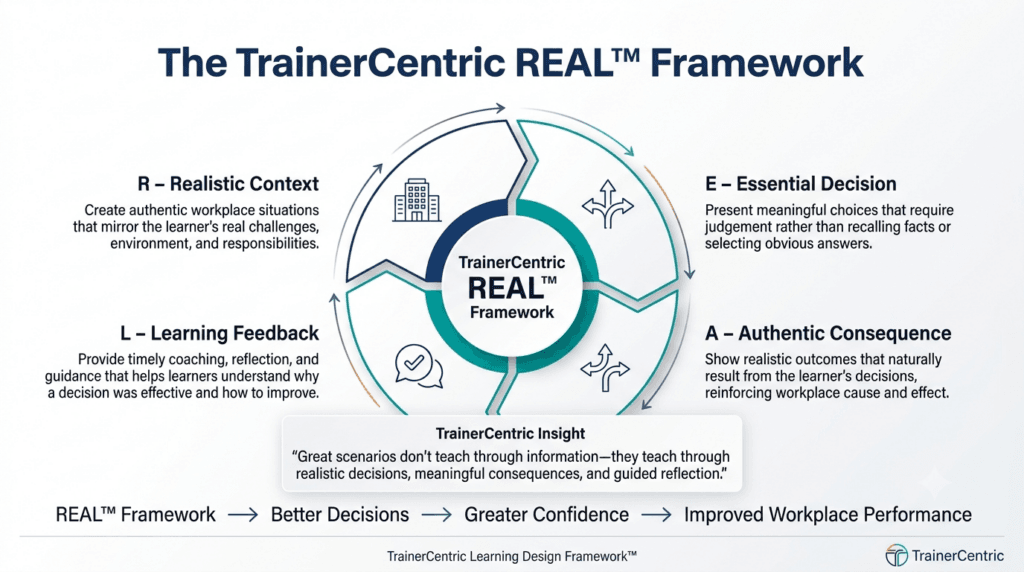
Run any scenario through these four checkpoints before it goes to pilot, and most of the common mistakes covered later in this guide get caught before they ever reach a learner.
Why Scenario Based Learning Works
SBL isn’t a trend — it’s grounded in decades of learning science. Here’s the research that explains why it outperforms passive instruction for skill and judgement development.
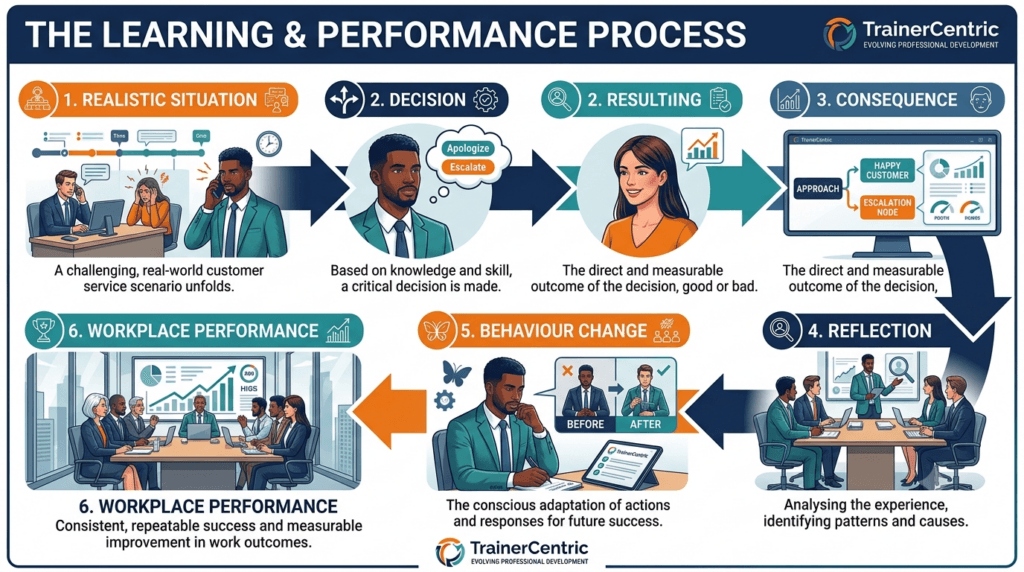
Kolb’s Experiential Learning Cycle. David Kolb’s model describes learning as a four-stage loop: concrete experience, reflective observation, abstract conceptualisation, and active experimentation. Most corporate training stops at “abstract conceptualisation” — explaining the model and stopping there. A scenario gives learners the concrete experience and the active experimentation in one structure, then feedback drives the reflection.
Knowles’ Andragogy. Malcolm Knowles argued that adults learn best when content is problem-centred rather than subject-centred, and when it connects to their existing experience. Scenarios are inherently problem-centred — the learner isn’t studying a topic, they’re solving a recognisable work problem.
Cognitive Load Theory. Sweller’s research shows working memory is limited, and instruction that adds unnecessary processing (irrelevant detail, poor sequencing, decorative complexity) crowds out actual learning. Good scenario design respects this by stripping out anything that doesn’t serve the decision point — every line of dialogue, every detail, earns its place.
Situated Learning and Constructivism. Lave and Wenger’s situated learning theory holds that knowledge is best learned in the context where it will be used. Constructivist theory (building on Piaget and Vygotsky) holds that learners build understanding by actively engaging with problems, not by absorbing transmitted facts. Scenarios situate the learning inside the actual context of use, and force active construction of meaning at each decision point.
Retrieval Practice. Research from cognitive psychology (Roediger and Karpicke, among others) consistently shows that retrieving information strengthens memory far more than re-reading it. Every decision point in a scenario is a retrieval event — the learner has to pull the relevant knowledge from memory and apply it, rather than recognise it on a page.
Transfer of Learning. The closer training conditions resemble the conditions of actual performance, the more likely a skill transfers to the job. This is sometimes called the “identical elements” theory of transfer. Scenarios close the gap between the training environment and the real environment by replicating the pressure, ambiguity, and stakes of an actual workplace decision.
Expert perspective: Julie Dirksen, author of Design for How People Learn, makes a related point worth holding onto: realistic practice with feedback matters more to skill-building than how polished or complete the surrounding content is. A scenario with slightly rough dialogue but a genuinely realistic decision point will out-teach a beautifully produced course that never asks the learner to do anything. That’s a useful gut-check when a scenario project is tempted to spend its budget on production polish instead of decision quality.
The underlying thread across all of this: retention and transfer come from decision-making, not exposure. A learner who makes ten realistic decisions and sees the consequences will out-perform a learner who reads ten pages of theory on the same topic, almost every time it’s been tested.
| Learning theory | Core idea | What it means for scenario design |
| Kolb’s Experiential Learning | Learning is a cycle of experience, reflection, and experimentation | Build the experience and the experimentation into the scenario; let feedback drive the reflection |
| Knowles’ Andragogy | Adults learn through problem-centred, experience-linked content | Centre the scenario on a recognisable work problem, not an abstract topic |
| Cognitive Load Theory | Working memory is limited | Cut anything that doesn’t serve the decision point — no decorative detail |
| Situated Learning | Knowledge is best learned in its context of use | Set the scenario in the learner’s actual role and environment |
| Retrieval Practice | Retrieving information strengthens memory more than re-reading it | Make every decision point a genuine retrieval event, not a recognition task |
| Transfer of Learning | Skills transfer best when practice conditions resemble real conditions | Replicate the pressure, ambiguity, and stakes of the real decision |
“Tell me and I forget, teach me and I may remember, involve me and I learn.” — often attributed to Benjamin Franklin
The forgetting curve research popularised by Hermann Ebbinghaus is the uncomfortable backdrop to all of this: people forget a large share of new information within days of learning it unless that information is reinforced through use. Scenarios are a form of reinforcement by design — the learner isn’t just told the principle once, they’re forced to retrieve and apply it at every decision point, which is precisely the mechanism retrieval-practice research credits with stronger long-term retention.
It’s also worth being honest about where most programmes lose the thread. CIPD’s Learning at Work research has found that only a small minority of L&D teams — around 8% in their most recent survey — actually prioritise learning transfer to the workplace as a measured outcome, and only half have any process in place to assess whether learning sticks at all. Scenario Based Learning doesn’t fix that measurement gap on its own, but because it’s built around observable decisions rather than completion, it gives you something concrete to measure transfer against — more on that in the Measuring Success section.
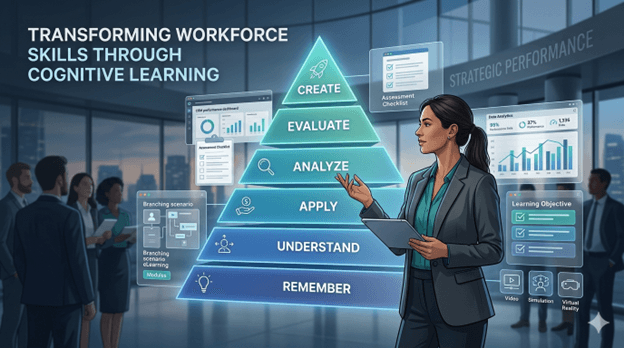
This is also where it’s useful to connect SBL to your existing instructional design process — it slots naturally into the Design and Development phases of the ADDIE Model, and strong scenarios are built from clearly defined Learning Objectives mapped against Bloom’s Taxonomy, particularly at the Apply, Analyse, and Evaluate levels.
Benefits of Scenario Based Learning
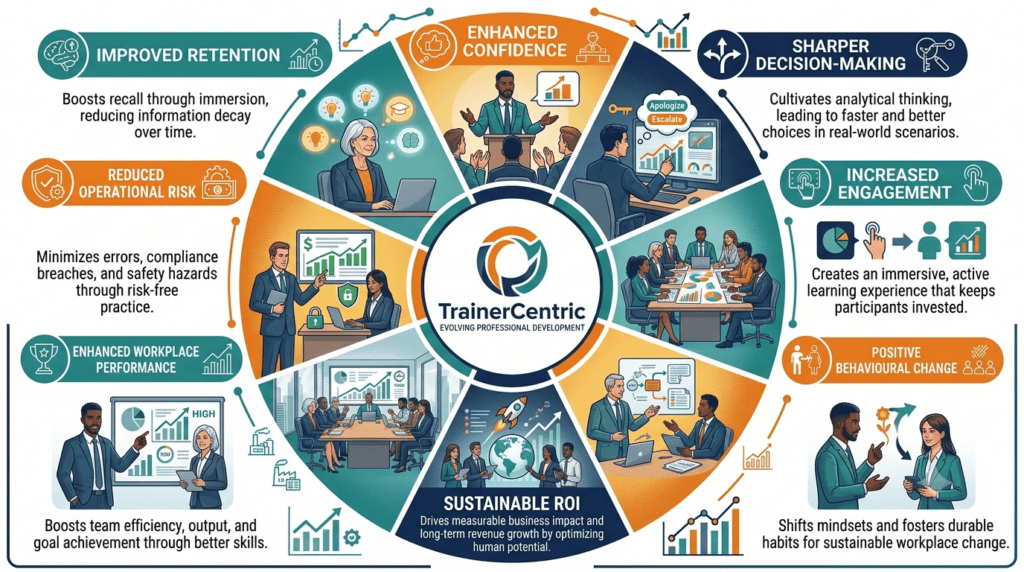
When designed well, SBL delivers measurable advantages over passive formats. ATD’s research into why organisations adopt scenario based learning found engagement and applied retention sitting at the top of the list, ahead of cost or novelty — which lines up with what the benefits below describe in practice:
- Improves retention — decision-making is a retrieval event, and retrieval strengthens memory more effectively than re-reading or re-watching content.
- Increases engagement — learners stay invested in a story with stakes far longer than they stay invested in a slide deck.
- Encourages critical thinking — learners have to weigh trade-offs rather than recognise a “correct” fact.
- Develops decision-making — repeated practice under realistic ambiguity builds the muscle for fast, sound judgement.
- Builds confidence — learners who’ve already “failed safely” in a scenario are less anxious facing the real version of that situation.
- Creates behavioural change — because the learning is tied to action, not just understanding, it’s more likely to show up in actual workplace behaviour.
- Supports knowledge transfer — the closer the practice environment is to the real one, the more reliably the skill transfers.
- Reduces learning decay — emotionally engaging, decision-based content is recalled longer than fact-based content (the testing effect amplifies this further).
- Improves workplace performance — ultimately, this is the metric that matters, and it’s the one SBL is built to influence directly, because it rehearses the actual behaviour being measured.
When Should You Use Scenario Based Learning?
SBL earns its cost when the skill being trained involves judgement under ambiguity — not recall of fixed information. Some of the strongest applications:
Leadership. Difficult conversations, delegation, performance management, navigating conflicting priorities between stakeholders.
Sales. Objection handling, qualifying a prospect, negotiating price, reading buying signals.
Customer Service. De-escalating an angry customer, deciding when to break policy for goodwill, handling ambiguous complaints.
Compliance. Recognising a conflict of interest, deciding whether a situation needs escalation, applying a policy to a grey-area case (note: the policy itself is knowledge-based — the application of it is where scenarios add value).
Healthcare. Triage decisions, communicating bad news, recognising early warning signs, escalation protocols.
Safety. Recognising hazards in context, deciding whether to stop work, responding to a near-miss.
Technical Training. Diagnosing a fault from symptoms, choosing between competing technical solutions under time pressure.
Management. Coaching conversations, managing underperformance, handling team conflict, giving upward feedback.
Coaching. Asking the right question at the right moment, recognising when to challenge versus support.
Soft Skills. Communication, empathy, persuasion, active listening — all skills that only become real in the moment of use.
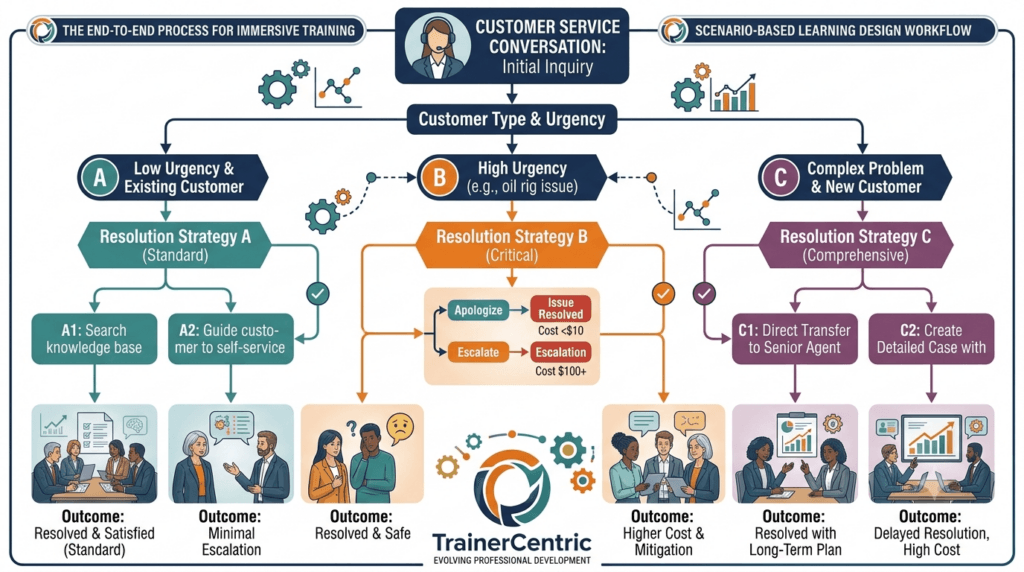
| Training goal | Recommended scenario type |
| Build a single conversational skill | Micro scenario |
| Practise a multi-step difficult conversation | Branching scenario |
| Teach hazard recognition in a physical environment | VR or video scenario |
| Reinforce a skill at the point of need | Micro scenario, delivered just-in-time |
| Practise open-ended negotiation or coaching dialogue | AI-powered conversational scenario |
| Build judgement across a varied, mixed-experience audience | Adaptive scenario |
| Drive voluntary engagement with optional practice | Gamified scenario |
| Audience | Ideal scenario format |
| New hires / onboarding | Linear or micro scenarios — lower ambiguity, clearer right-of-way decisions |
| Experienced frontline staff | Branching scenarios with realistic grey areas |
| Leaders and managers | Branching or AI-powered conversational scenarios — open-ended, high-ambiguity |
| Highly distributed or deskless teams | Mobile-first micro scenarios |
| Safety-critical or physical roles | VR or video-based scenarios |
When NOT to Use Scenario Based Learning
SBL is expensive to build well, and not every topic needs it. Avoid it for:
- Basic knowledge — definitions, terminology, product facts. A scenario built around “what does this acronym stand for” wastes the format.
- Policies — the policy itself is reference material. (You can scenario-test the application of a policy, but not the policy text itself.)
- Simple procedures — step-by-step processes with one correct sequence are better served by job aids or checklists.
- Reference training — content learners will look up rather than recall (system navigation, where to find a form).
- Mandatory information — content driven by regulatory requirement to “confirm exposure” rather than build judgement (though even here, a single scenario can sometimes make the requirement land better than a wall of text).
A useful test: if you can write a single correct answer to the question being trained, it’s probably knowledge-based. If the “correct” answer depends on context, stakeholders, and trade-offs, it’s a scenario candidate.
Types of Scenario Based Learning
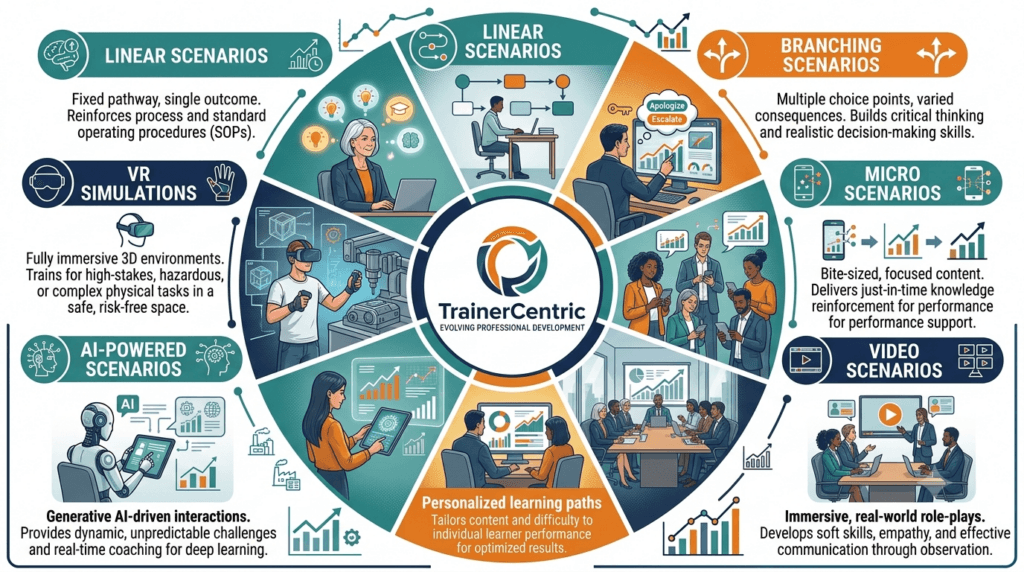
| Type | Description | Best for |
| Linear scenarios | One path, sequential decisions, single ending | Simple judgement checks, shorter build time |
| Branching scenarios | Multiple paths and endings based on choices | Complex conversations, leadership and sales skills |
| Adaptive scenarios | Difficulty or path adjusts based on learner performance | Mixed-skill audiences, personalised remediation |
| Micro scenarios | Single decision point, 2–5 minutes | Reinforcement, performance support, just-in-time learning |
| Video scenarios | Filmed actors deliver the situation and choices | High emotional realism, leadership and customer-facing skills |
| VR scenarios | Immersive 3D environment, often with spatial interaction | High-risk physical environments (safety, healthcare, manufacturing) |
| AI-powered scenarios | Learner converses with an AI character with dynamic responses | Open-ended conversation practice (coaching, negotiation, difficult conversations) |
| Gamified scenarios | Points, badges, or competitive elements layered onto decisions | Engagement-driven audiences, voluntary learning |
Branching Scenarios Deep Dive
Branching scenarios deserve special attention because they’re the most requested — and most frequently over-engineered — format in SBL.
A branching scenario is a decision tree: each choice the learner makes opens a different next step, and different choices can lead to different endings. Done well, this creates a genuine sense of consequence. Done badly, it becomes an exponential content-production nightmare with thirty endings nobody will ever review.
The fix is to branch with intention. Most effective branching scenarios use a “branch and converge” structure — learners get a meaningfully different experience based on their choice (different dialogue, different difficulty), but paths funnel back toward a smaller number of core endings (often two to four: best outcome, workable outcome, and one or two cautionary outcomes). This keeps production manageable while preserving the feeling of consequence.
Scenario Based Learning in eLearning vs. Instructor-Led Training
The decision-and-consequence structure behind SBL isn’t tied to one delivery format — it shows up differently depending on where it’s deployed.
In eLearning, scenarios are typically built in an authoring tool, delivered asynchronously, and tracked through the LMS. The advantage is consistency and scale — every learner gets the same quality of experience, and you get clean data on which choices people make. The trade-off is that the “character” reacting to the learner is scripted, not adaptive, unless you’re using AI-powered scenario tools (covered below).
In instructor-led training (ILT), scenarios usually take the form of live case discussions, structured role plays, or facilitator-guided decision points built into a workshop. The advantage is real-time adaptability — a skilled facilitator can push back, improvise, and respond to exactly what the learner says. The trade-off is consistency: the quality of the experience depends heavily on who’s facilitating, and it doesn’t scale the same way.
The strongest programmes typically use both in sequence: an eLearning scenario builds foundational judgement asynchronously and at scale, and a live ILT session — role play, group case discussion, or coaching practice — pressure-tests that judgement under real conversational pressure. Facilitation Skills become the multiplier here: a well-designed scenario still depends on a facilitator who knows how to debrief it well in the room.
Scenario Based Learning vs. Problem-Based and Case-Based Learning
These three formats get confused constantly because they all involve a “problem” of some kind. The difference is in structure and ownership of the outcome.
| Format | Structure | Learner’s role | Typical setting |
| Scenario Based Learning | A specific decision point, often branching, with a built-in consequence | Decision-maker, in the moment | Workplace skills training (digital or live) |
| Problem-Based Learning (PBL) | An open-ended, often multi-week problem with no single defined path | Investigator, researching and proposing a solution | Academic and professional education, often team-based |
| Case-Based Learning (CBL) | A detailed real or realistic case, analysed after the fact | Analyst, discussing what should have been done | Academic settings, professional development, peer discussion |
In practice, PBL asks “how would you solve this complex, open problem over time,” CBL asks “what do you think happened here and why,” and SBL asks “what do you do right now, in this specific moment.” Workplace L&D leans toward SBL precisely because most job-relevant judgement happens in moments, not multi-week investigations — but PBL and CBL remain valuable for building broader analytical and strategic thinking, particularly in leadership development.
How to Design Scenario Based Learning
Here’s the process we use end-to-end, step by step — what we call the Decision-First Design Model: instead of starting with content and looking for a story to wrap around it, you start with the decision learners struggle with, and build everything else outward from there.
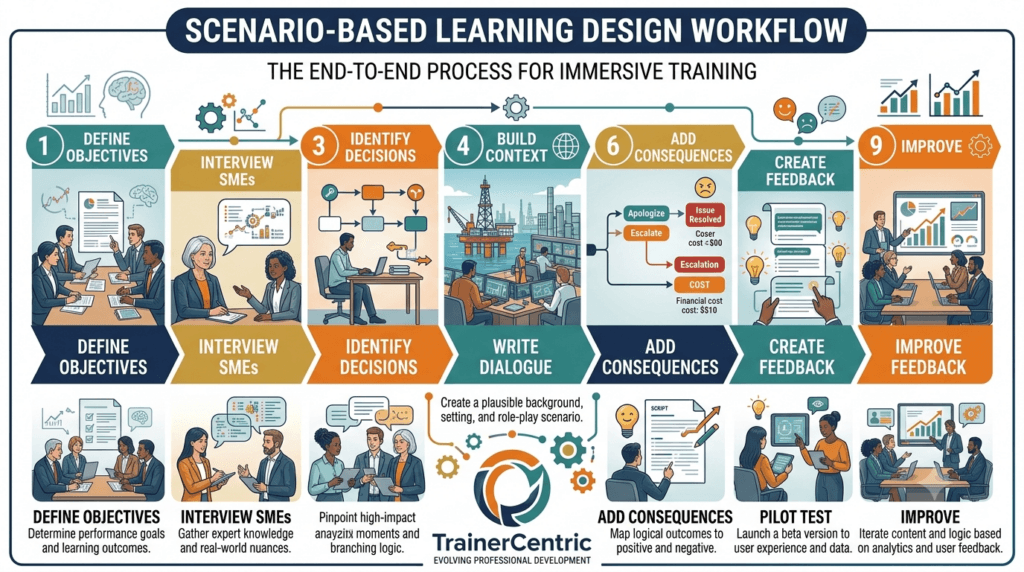
Step 1: Identify Learning Objectives
Start with what the learner needs to be able to do, not what they need to know. Write objectives at the Apply, Analyse, or Evaluate levels of Bloom’s Taxonomy — “recognise the signs of disengagement and respond appropriately,” not “list the signs of disengagement.”
Tip: if your objective starts with “understand” or “know,” rewrite it as an observable action before you build anything.
Step 2: Identify the Decisions Learners Actually Make
List the real moments of judgement in the role — not the whole job, just the friction points. Where do people hesitate, get it wrong, or avoid the conversation entirely? That’s your scenario material.
Tip: ask managers “what’s the conversation people dread having” — that question surfaces better scenario content than any objective-writing workshop.
Expert perspective: This is essentially what instructional designer Cathy Moore built her action mapping approach around — designing training around the specific decisions people need to practise on the job, not the information they’re assumed to be missing. Her core argument is that most training fails because it’s organised around content topics rather than real, measurable behaviours, which is exactly the trap Step 1 and Step 2 above are designed to help you avoid.
Step 3: Interview Subject Matter Experts
Talk to people who do this well and people who’ve watched it go wrong. The best scenario dialogue almost always comes from a real anecdote someone tells you in passing, not from a competency framework.
Tip: ask SMEs for a specific story, not a general opinion — “tell me about a time this went badly” beats “what should someone do in this situation.”
Step 4: Collect Real Stories
Real workplace incidents (anonymised) make the strongest scenario foundations because they already contain the ambiguity and stakes that fictional scenarios often lack.
Tip: keep a running “scenario swipe file” of anecdotes from stakeholder conversations — you’ll draw on it for years.
Step 5: Build Learner Personas
Know who’s on the other side of the decision — the customer, the team member, the colleague. Give them a name, a motivation, and a reason their position is reasonable, even if the learner disagrees with it.
Tip: avoid making the “antagonist” character a caricature — the most useful scenarios are the ones where both sides have a point.
Step 6: Write Realistic Dialogue
Write the way people actually talk at work: interruptions, hedging, incomplete sentences, mild frustration. Polished, grammatically perfect dialogue is the single fastest way to break immersion.
Tip: read your dialogue out loud — if it sounds like a script, rewrite it.
Step 7: Add Consequences
Every choice needs a consequence that’s proportionate and believable — not a cartoonish “you’re fired” for a minor misstep, and not a non-consequence dressed up as one.
Tip: vary the type* of consequence — emotional (the other person shuts down), operational (the deadline slips), reputational (the team loses trust) — rather than relying on the same kind every time.*
Step 8: Design Feedback
Feedback should explain the why behind the consequence and connect it to a transferable principle, not just say “correct” or “incorrect.”
Tip: write feedback as if a respected mentor is debriefing the learner immediately afterward — direct, specific, non-judgemental.
Step 9: Review with SMEs
Have your SMEs check the scenario for realism and accuracy before it goes anywhere near learners. They’ll catch implausible details you won’t.
Tip: ask them one question specifically: “would this actually happen this way?” — it surfaces more useful feedback than a general review.
Step 10: Pilot Test
Run it with a small group from the actual target audience and watch where they hesitate, get confused, or disengage.
Tip: watch them complete it rather than just collecting survey feedback afterward — hesitation tells you more than a satisfaction score.
Step 11: Improve
Revise based on pilot data, then re-test if you made substantial changes. Treat the first version as a draft, not a deliverable.
Tip: track which choice options learners pick most often — if 95% choose one option, either it’s too obviously correct or the others aren’t plausible.
AI-Generated Scenarios and Authoring Tools
AI-generated scenarios. Generative AI has changed two parts of the workflow above. First, it’s a strong drafting partner for Steps 6 and 7 — generating dialogue variations and branch options for an SME to review and correct, rather than writing from a blank page. Second, it enables genuinely conversational scenarios at delivery time, where the learner types or speaks a response and an AI character reacts dynamically, rather than choosing from three fixed options. This is particularly strong for open-ended skills like negotiation and coaching, where real conversations don’t follow a fixed branch structure.
Using AI to Design Scenario Based Learning Responsibly
By 2026, AI has become a normal part of most instructional designers’ workflow — but it works best as a drafting and ideation partner, not as the final word on a scenario that’s going in front of real learners. Here’s where it earns its place in the process, and where human judgement still has to lead.
Brainstorming ideas. AI is genuinely useful for generating a wide first pass of possible scenario situations from a learning objective, especially when you’re short on SME time early in a project. Treat the output as raw material to react to, not a shortlist to pick from directly.
Drafting dialogue. AI can produce multiple dialogue variations for a given decision point quickly, which is useful for exploring tone and pacing. Left unprompted, it tends toward dialogue that’s too polished and too agreeable — the opposite of the realistic, slightly messy conversation real scenarios need (see Step 6).
Creating personas. AI can help flesh out a character’s background, motivation, and likely reactions once you’ve defined the basics, which speeds up Step 5. The risk is generic, stereotyped characters if you don’t give it specific, real details to work from — anchor every persona in something an SME actually told you.
Identifying decision points. AI can help break a broad situation down into a sequence of smaller decisions, which is a useful structural aid when mapping a branch-and-converge tree. It’s not a substitute for the SME conversation that tells you which of those decisions people actually get wrong on the job.
Reviewing for bias. AI-generated characters, names, and consequences can default to narrow or stereotyped patterns — the “difficult customer” always written the same way, for instance. Run a dedicated bias check on AI-assisted content: read it specifically looking for unintentional stereotyping in names, roles, and behaviour patterns, not just for accuracy.
Human validation. Every AI-assisted draft still needs the same SME review and pilot testing (Steps 9 and 10) as a fully human-written one — arguably more, since AI-generated realism can look convincing on the surface while missing details only someone who’s lived the situation would catch. The REAL Framework and Scenario Quality Score are useful here precisely because they give you a structured check that doesn’t depend on the draft “feeling” right.
Common authoring software. Most teams build scenarios in either a dedicated branching-scenario tool (purpose-built for decision trees and variables), a general-purpose eLearning authoring tool with branching capability layered on top, or — for simpler linear scenarios — a presentation tool with hyperlinked slides. The right choice depends on complexity: a three-decision linear scenario rarely justifies a specialised tool, while a deeply branching, variable-tracking scenario usually does.
xAPI tracking. Traditional SCORM tracking tells you whether someone completed a course. xAPI (Experience API) lets you capture individual statements — “learner chose X at decision point 2,” “learner spent 40 seconds before deciding” — which is exactly the kind of choice-path data scenario based learning is built to generate. If you’re investing in branching scenarios at scale, xAPI tracking (via an LRS, or Learning Record Store) is what turns “did they finish it” into “what does their decision-making pattern actually look like.”
Adaptive learning. Adaptive scenarios use that same data in real time — adjusting the next decision point’s difficulty or path based on how the learner has performed so far, rather than showing every learner an identical sequence. This is most valuable with mixed-experience audiences, where a fixed-difficulty scenario either bores your strongest performers or overwhelms your newest ones.
Microlearning scenarios. Not every scenario needs to be a 20-minute branching experience. A single, well-built decision point — two to five minutes, one choice, one consequence — works well as performance support delivered close to the moment of need (just before a difficult call, for example, rather than only during onboarding). Microlearning scenarios trade narrative depth for relevance and timing, and they’re a strong complement to longer-form scenarios rather than a replacement for them.
Scenario Based Learning Examples
Each example below shows the situation, the choices on offer, the consequence of one path, and the underlying learning point.
| Industry | Recommended complexity | Why |
| Customer service / Retail | Low to medium | High-frequency, time-pressured decisions; short scenarios fit existing workflows |
| Sales | Medium to high | Multi-turn conversations with several plausible paths and stakeholder dynamics |
| Healthcare | High | High-stakes, ambiguous decisions where escalation protocols and consequence accuracy matter |
| Manufacturing / Safety | Medium to high | Often benefits from visual or VR formats given the physical environment |
| Compliance | Medium | Application of policy to grey-area cases, not the policy text itself |
| Leadership / Management | High | Long-arc conversations with emotional nuance and several reasonable approaches |
| Cybersecurity | Low to medium | Usually a small number of high-impact recognition decisions, well suited to micro scenarios |
| Project Management | Medium | Trade-off decisions involving multiple stakeholders and competing priorities |
Customer Service
Situation: A customer calls furious about a delayed order, raising their voice within the first ten seconds. Choices: (a) Apologise immediately and offer a refund, (b) Acknowledge the frustration and ask what would help before offering anything, (c) Explain the delay reason first. Consequence (choice c): The customer interrupts, feeling unheard, and escalates to “let me speak to your manager.” Learning point: Acknowledgement before explanation — people need to feel heard before they can process information.
Leadership
Situation: A high-performing team member has started missing deadlines for the third time this month. Choices: (a) Send a reminder email about the deadline policy, (b) Have a private conversation asking what’s going on before addressing the pattern, (c) Address it publicly in the team meeting as a reminder to everyone. Consequence (choice a): The underlying issue — the employee is quietly overloaded — goes unaddressed, and performance continues to decline. Learning point: Patterns of behaviour change usually signal a cause worth investigating before a consequence is applied.
Sales
Situation: A prospect says, “Your price is 20% higher than your competitor’s.” Choices: (a) Immediately offer a discount, (b) Ask what they’re comparing the price against, (c) Defend the price by listing features. Consequence (choice b): The conversation reveals the competitor’s offer doesn’t include implementation support — the real comparison shifts in your favour without a discount. Learning point: Price objections are often value questions in disguise; clarifying before reacting protects margin.
Healthcare
Situation: A patient’s vitals are borderline, but they insist they feel fine and want to go home. Choices: (a) Discharge them, respecting their wishes, (b) Escalate to the senior clinician before deciding, (c) Keep them for observation without explaining why. Consequence (choice c): The patient becomes anxious and distrustful, and future compliance with care instructions drops. Learning point: Escalation protocols exist precisely for ambiguous borderline cases, and transparency protects trust even when the answer is “no.”
Manufacturing
Situation: A machine is making an unusual sound, but the production line is already behind schedule. Choices: (a) Keep running to hit the deadline, (b) Stop the line and report it, (c) Make a quick visual check and decide based on that. Consequence (choice a): The machine fails completely an hour later, causing a longer stoppage than the original check would have. Learning point: Near-miss signals are cheaper to investigate early than to ignore under schedule pressure.
Compliance
Situation: A colleague asks you to approve an invoice from a vendor that is also their spouse’s company. Choices: (a) Approve it since it’s within your authority, (b) Decline and explain why, (c) Approve it but mention you’ll flag it later. Consequence (choice c): The conflict of interest is recorded after the fact, by which point trust in the process — and in you — has already eroded. Learning point: Conflicts of interest need disclosure before action, not after.
Cybersecurity
Situation: An urgent email from “the CEO” asks you to purchase gift cards immediately and send the codes. Choices: (a) Comply quickly given the seniority of the sender, (b) Verify through a separate channel before acting, (c) Ignore the email entirely. Consequence (choice a): The funds are lost — this was a phishing attempt exploiting urgency and authority. Learning point: Urgency combined with an unusual request is the clearest signal of social engineering, regardless of apparent seniority.
Hospitality
Situation: A guest complains about noise from a renovation the hotel forgot to mention at check-in. Choices: (a) Offer a room change immediately, (b) Apologise, explain the oversight, and offer options, (c) Explain that the renovation was unavoidable. Consequence (choice b): The guest, having been given both an explanation and a choice, leaves a positive review despite the inconvenience. Learning point: Ownership plus choice repairs trust faster than either alone.
Retail
Situation: A customer wants to return an item without a receipt, past the stated return window. Choices: (a) Refuse per policy, (b) Use judgement based on the situation and offer a store credit, (c) Refund in full to avoid conflict. Consequence (choice b): The customer leaves satisfied, and the cost to the business is minimal compared to the loyalty gained. Learning point: Policy gives a default, not a rule that overrides every context — frontline judgement has a defined space to operate in.
Project Management
Situation: A key stakeholder requests a scope addition two weeks before launch, without acknowledging it will delay the date. Choices: (a) Accept the addition to keep the relationship smooth, (b) Push back and explain the trade-off clearly, (c) Quietly absorb the work into the existing timeline. Consequence (choice c): The team works unsustainable hours, the quality of the original scope suffers, and the root cause — unmanaged scope creep — repeats on the next project. Learning point: Trade-offs need to be named explicitly; absorbing scope silently doesn’t make the cost disappear, it just hides it.
The TrainerCentric Perspective: Notice that in almost every example above, the “tempting” choice isn’t lazy or careless — it’s the choice a reasonably competent person would make under pressure. That’s deliberate. We’ve reviewed enough failed scenarios to know that if the wrong answer is obviously wrong, learners stop treating the exercise as a real decision and start treating it as a guessing game.
The Scenario Quality Score™
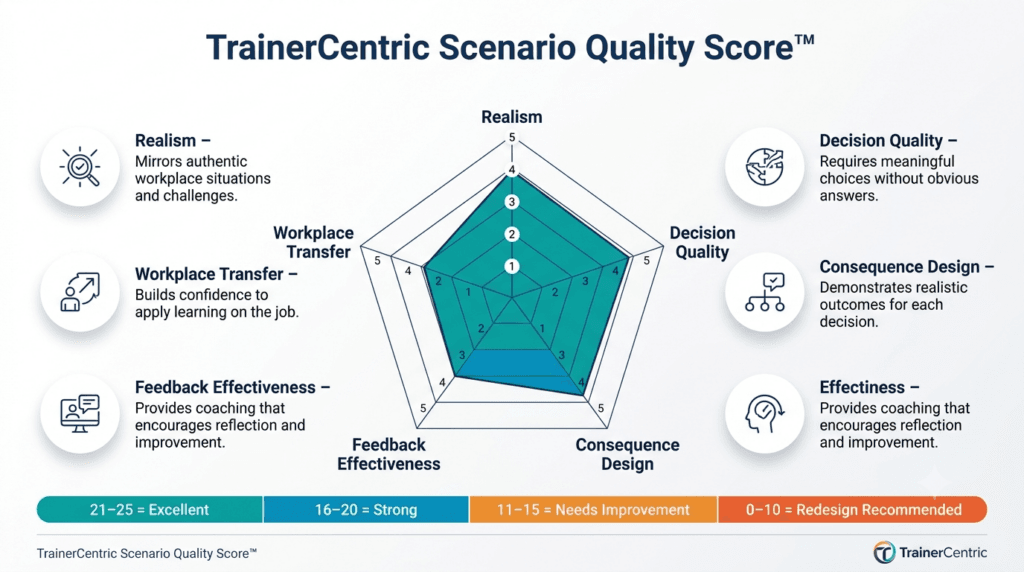
Before any scenario in this guide’s examples would go to pilot, we’d run it through our Scenario Quality Score — a quick way to rate a draft scenario across the five dimensions that determine whether it actually works, rather than relying on a single “does this feel okay” read-through.
Score each dimension from 1 (weak) to 5 (strong):
| Dimension | What you’re scoring | 1–5 |
| Realism | Would someone in this role recognise this exact situation? | |
| Decision Quality | Are all the choices genuinely plausible, with no obvious “joke” option? | |
| Consequence | Is the outcome proportionate, believable, and varied in type? | |
| Feedback | Does the debrief explain the underlying principle, not just the verdict? | |
| Transferability | Will the lesson apply to situations that look different on the surface? |
Add the five scores together for a total out of 25. As a rough benchmark: anything below 15 needs a structural rewrite before it goes anywhere near a learner; 15–19 is pilot-ready with revisions flagged by your SME review; 20 and above is ready to ship. Run it again after pilot testing — scores often shift once you see how real learners actually respond to the choices.
If You’re Designing Your First Scenario
If this is your first scenario project, the process in this guide can feel like a lot at once. Here’s how to sequence it realistically across four weeks, assuming a single standard branching scenario (3–6 decision points) as the target.
Week 1 — Define and Discover Confirm the learning objective using the Decision-First Design Model: identify the specific moment of hesitation you’re designing for. Schedule and run your SME interviews (Step 3). Start a swipe file of real anecdotes and incidents (Step 4). By the end of the week, you should be able to describe the core decision in one sentence.
Week 2 — Plan and Draft Build learner personas for every character in the scenario (Step 5). Map the branch structure using a branch-and-converge approach — sketch it on paper or in a storyboard tool before writing a word of dialogue. Write a full first draft of the dialogue and choices (Step 6), and draft the consequences for each path (Step 7).
Week 3 — Feedback and Review Write the feedback for every decision point, making sure each one explains the underlying principle (Step 8). Send the full draft to your SMEs for review (Step 9) and run it through the REAL Framework and Scenario Quality Score before it leaves your desk. Revise based on what comes back.
Week 4 — Pilot and Refine Pilot test with five to ten people from the actual target audience (Step 10). Watch them complete it rather than relying only on a survey afterward. Capture choice-path data if your tool supports it. Make final revisions (Step 11) and prepare your measurement plan — confidence survey, manager check-in timing, and the operational metric you’ll track — before launch.
This timeline assumes one designer working part-time on the project alongside other work, with reasonably responsive SMEs. Complex branching scenarios with many paths, custom illustration, or video production will extend this — but the sequence stays the same regardless of scale.
Best Practices Checklist
- Tie every scenario to a single, clearly defined learning objective
- Base scenarios on real workplace situations, not invented ones
- Make every choice plausible — no “obviously wrong” decoy options
- Write dialogue the way people actually speak
- Vary consequence types (emotional, operational, reputational)
- Keep branching focused — branch with intention, converge deliberately
- Review every scenario with a subject matter expert before launch
- Pilot test with real members of the target audience
- Keep feedback specific, principle-based, and non-judgemental
- Match scenario length to complexity — don’t pad for the sake of it
- Design for mobile completion where relevant to the audience
- Track choice data, not just completion data
Common Mistakes
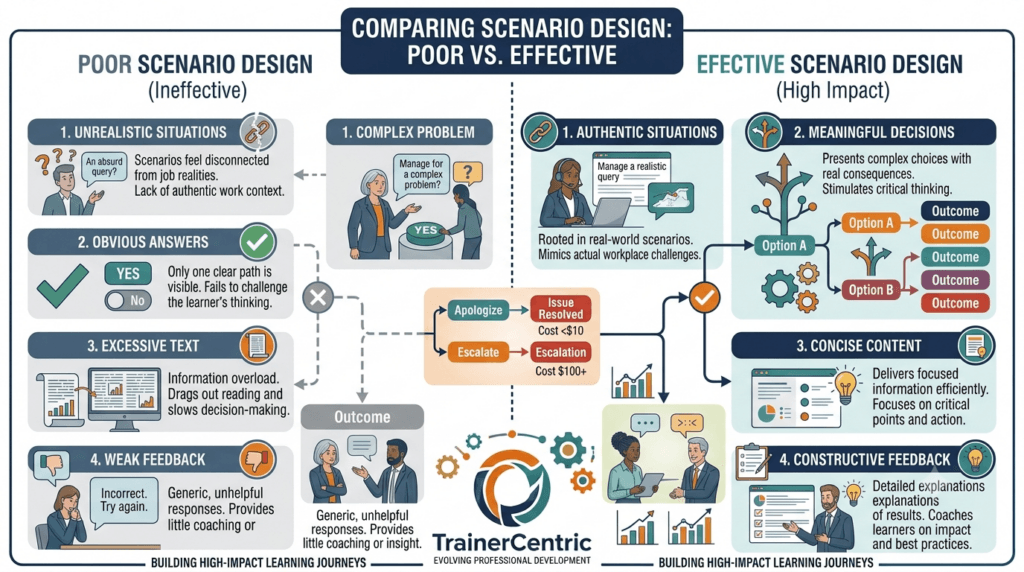
- 1. Making the “wrong” answer obviously wrong. Why it happens: Designers want to make sure learners “get it right,” so they write decoy options as jokes. Fix: Every option should be something a reasonable person could plausibly choose.
- 2. Writing scenarios that test compliance, not judgement. Why it happens: It’s easier to validate a single correct answer than to design for nuance. Fix: If there’s only one defensible choice, it’s not a scenario — it’s a knowledge check in disguise.
- 3. Over-branching. Why it happens: Enthusiasm for realism leads to exponential path growth that’s impossible to maintain. Fix: Use a branch-and-converge structure with a manageable number of core endings.
- 4. Under-branching. Why it happens: Budget or time pressure flattens what should be a branching scenario into a linear one. Fix: Reserve branching for the decisions where the consequence genuinely diverges.
- 5. Dialogue that sounds like a training manual. Why it happens: SMEs and writers default to formal language because that’s how policy documents are written. Fix: Read dialogue aloud; rewrite anything that doesn’t sound like a real conversation.
- 6. Feedback that just says “correct” or “incorrect.” Why it happens: Time pressure during development; feedback gets treated as an afterthought. Fix: Always explain the underlying principle, not just the verdict.
- 7. No real consequence for poor choices. Why it happens: Designers don’t want to feel “punitive” toward learners. Fix: A consequence isn’t punishment — it’s the mechanism that makes the lesson memorable.
- 8. Scenarios that are too long. Why it happens: Trying to cover too many objectives in a single scenario. Fix: One scenario, one core decision focus; use a series of micro scenarios instead of one sprawling one.
- 9. Ignoring SME review. Why it happens: Time pressure to launch. Fix: Build SME review into the project timeline as a non-negotiable milestone.
- 10. Skipping pilot testing. Why it happens: Same as above — deadline pressure. Fix: Even a five-person pilot surfaces problems a full QA pass will miss.
- 11. Characters with no believable motivation. Why it happens: Characters are written purely to deliver plot points, not as people. Fix: Give every character a reason their position makes sense to them.
- 12. Using scenarios for basic knowledge transfer. Why it happens: SBL is in fashion, so teams default to it for everything. Fix: Reserve scenarios for judgement-based skills; use simpler formats for facts.
- 13. Inconsistent difficulty across decision points. Why it happens: Different writers or SMEs contribute different sections without calibration. Fix: Map difficulty deliberately across the scenario arc, generally increasing toward the end.
- 14. No connection back to the job. Why it happens: Generic, template-driven scenarios disconnected from the actual role. Fix: Base scenarios on real incidents and use role-specific terminology and context.
- 15. Treating the toolkit as a one-time build. Why it happens: Scenarios get launched and then never revisited. Fix: Review and refresh scenarios annually, especially the choice data and outcomes, to keep them current and effective.
Scenario Writing Tips
Writing realistic conversations. Listen to how people actually talk in your organisation — record (with permission) or transcribe real meetings if you can. Real speech includes hedging (“I guess,” “kind of”), interruptions, and incomplete thoughts. Avoid dialogue that sounds like it’s reading from a policy.
Creating believable conflict. The best conflict isn’t villain versus hero — it’s two reasonable positions in tension. Give the “opposing” character a defensible reason for their stance, even if the learner ultimately needs to push back on it.
Creating meaningful choices. A meaningful choice changes what happens next in a way the learner can feel. If every option leads to roughly the same outcome, the choice isn’t meaningful — it’s decorative.
How many choices to include. Three options is usually the sweet spot: enough to represent real nuance without overwhelming the learner or diluting the decoy quality. Two can feel binary and artificial; five or more usually means some options are filler.
How long scenarios should be. Micro scenarios: one decision point, 2–5 minutes. Standard branching scenarios: 3–6 decision points, 10–20 minutes. Beyond 20 minutes, split into a series rather than building one long scenario — attention and decision quality both degrade.
Expert perspective: Learning experience designer Connie Malamed, whose work focuses heavily on visual and cognitive design for eLearning, often makes the point that the “decoy” choices in a scenario do as much instructional work as the right one — a poorly written wrong answer teaches the learner nothing about why it’s wrong. Treat every option, not just the correct one, as something worth writing carefully.
| Scenario length | Decision points | Best use |
| Micro scenario | 1 | Performance support, reinforcement, just-in-time practice |
| Short scenario | 2–3 | Single-skill practice within a broader module |
| Standard branching scenario | 3–6 | Core skill-building for a defined competency |
| Extended scenario series | 6+ (split across episodes) | Complex, multi-stage skills like negotiation or case management |
Measuring Success
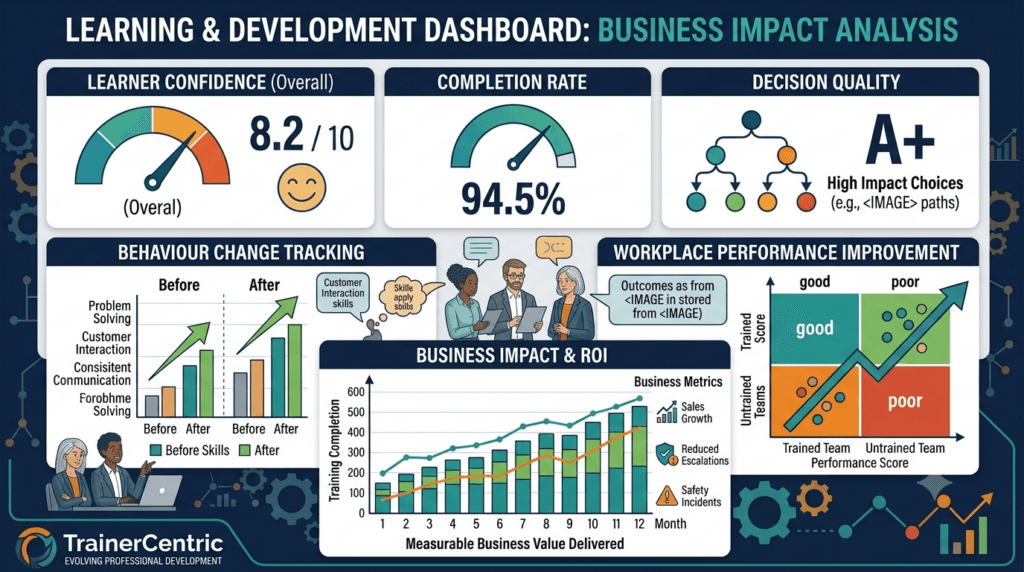
| Metric category | What to measure | How to capture it |
| Learning analytics | Choice paths, time on decision points, hesitation patterns | xAPI/SCORM data from your LMS or authoring tool |
| Completion | Completion rate, drop-off points | LMS reporting |
| Confidence | Self-reported confidence before/after | Pre/post survey |
| Behaviour change | Observed behaviour on the job | Manager observation, 30/60/90-day check-ins |
| Performance metrics | Role-specific KPIs (e.g. resolution time, conversion rate, error rate) | Operational/business systems |
| Business impact | ROI, cost of error reduction, retention | Business reporting, linked back to the Kirkpatrick Model levels 3–4 |
The most common measurement mistake is stopping at completion and satisfaction (Kirkpatrick Levels 1–2). The real value of SBL shows up at Levels 3 and 4 — behaviour change and business results — which is why pairing your scenario data with manager observation and operational metrics matters more than the survey score at the end of the module.
This isn’t a hypothetical risk: CIPD’s Learning at Work research found that only around 8% of L&D teams treat learning transfer as a measured priority, and only half have any formal process to assess whether learning actually translates into changed behaviour. Scenario based programmes are well positioned to close that gap, but only if the measurement plan is built in from the start rather than added afterward.
Free Branching Scenario Design Workbook
A complete field manual for designing realistic branching scenarios. Includes proprietary TrainerCentric methodologies such as:
- Branch-and-Converge Method™
- Decision Tree Planning
- Branch Mapping
- Complexity Calculator
- Choice Design Worksheets
- Consequence Mapping
- Variable Tracking
- Navigation Planning
- QA Checklist
Design branching experiences that are engaging for learners and practical to build.
Premium Scenario Design Toolkit
For teams building scenarios regularly, our Premium Scenario Design Toolkit brings together the templates we use on every project, so you’re not rebuilding structure from scratch each time.
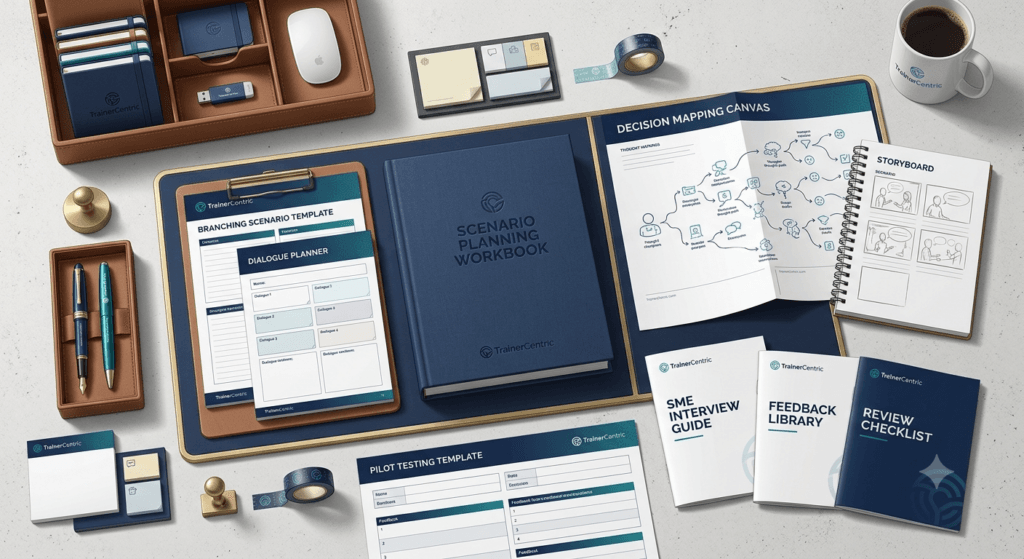
Here is what it includes:
- Scenario Planning Workbook — map objectives, decisions, and audience before you write a single line
- Branching Scenario Template — pre-built branch-and-converge structure, ready to populate
- Dialogue Planner — a structured way to draft realistic, role-specific conversation
- Scenario Storyboard — visualise the full flow before development begins
- SME Interview Guide — the exact questions that surface usable scenario material
- Decision Mapping Canvas — plan choices and consequences side by side
- Feedback Library — reusable feedback structures organised by principle, not just by answer
- Scenario Evaluation Checklist — a pre-launch quality pass
- Pilot Testing Template — structured observation notes for your test group
- Scenario Review Checklist — what to check before every refresh cycle
It’s built to save the planning and structuring time that usually eats into the actual writing — so more of your project hours go into the part that matters: getting the scenario to feel real.
Conclusion
Every learner remembers the decision they had to make — not the slide they had to read.
That’s the gap most workplace training never closes. It’s easy to build a course that explains good judgement. It’s much harder, and far more valuable, to build one that demands it — and then shows the learner exactly what happens when they get it right, or wrong.
If you take one thing from this guide, let it be the Decision-First Design Model in practice: start with the moment your learners hesitate on the job, not the content you already have. Build the scenario around that decision. Run it through the REAL Framework and the Scenario Quality Score before it ships. Let the consequence do the teaching the slide never could.
If you’re ready to put this into practice, download the free Branching Scenario Workbook to structure your next project, or explore the Premium Scenario Design Toolkit for the full set of templates we use to take a scenario from rough idea to pilot-tested course.
Frequently Asked Questions
What is Scenario Based Learning in simple terms?
It’s a training method where learners make decisions inside a realistic work situation and see the consequences of those decisions, rather than reading or watching content passively.
How is Scenario Based Learning different from eLearning in general?
Scenario Based Learning is one approach within eLearning — many eLearning courses are knowledge-based (slides, quizzes); scenario based eLearning specifically structures the course around decisions and consequences.
What’s the difference between linear and branching scenarios?
Linear scenarios follow one fixed path regardless of choices made along the way; branching scenarios change the path and sometimes the ending based on the learner’s decisions.
How long does it take to build a branching scenario?
It varies with complexity, but a standard branching scenario with three to six decision points typically takes several weeks from SME interviews through pilot testing, factoring in review cycles.
Do scenarios need to be built in specialised authoring software?
Not necessarily — simple scenarios can be built in PowerPoint with hyperlinked slides; complex branching or adaptive scenarios usually benefit from dedicated authoring tools that handle variables and branching logic more cleanly.
Can Scenario Based Learning be used for compliance training?
Yes, but selectively — it works well for applying compliance principles to ambiguous situations, but the underlying policy facts are still better delivered as straightforward reference content.
How many decision points should a scenario have?
Most effective standard scenarios use three to six meaningful decision points; more than that tends to dilute focus and increase production cost without adding proportional learning value.
What makes a scenario feel realistic?
Dialogue that sounds like real speech, characters with believable motivations, and choices that are all genuinely plausible rather than one obvious right answer surrounded by jokes.
Is Scenario Based Learning the same as gamification?
No — gamification adds game mechanics like points and badges, which can be layered onto a scenario but aren’t required for it to work.
How do you measure if a scenario is working?
Look beyond completion rates to choice-path data, confidence shifts, and ultimately observed behaviour change and performance metrics on the job.
Can AI be used to build scenario based learning?
Yes — AI can support both the authoring process (drafting dialogue variations, generating branch options for SME review) and the delivery (AI-powered conversational scenarios where a learner converses with a dynamic character), though human review for accuracy and realism remains essential.
What industries benefit most from scenario based training?
Any role involving judgement under ambiguity benefits — leadership, sales, customer service, healthcare, safety, and compliance are the most common high-value applications.
What is the Scenario Quality Score?
It’s a five-dimension scoring framework — Realism, Decision Quality, Consequence, Feedback, and Transferability, each rated 1–5 for a total out of 25 — used to evaluate whether a draft scenario is ready to pilot or needs a structural rewrite.
References
- Association for Talent Development (ATD). (2025). State of the Industry: Talent Development Benchmarks and Trends. ATD Press.
- Association for Talent Development (ATD). Research: Use of Simulations, Scenario Based Learning Is Rising. td.org.
- Chartered Institute of Personnel and Development (CIPD). (2023). Learning at Work 2023. CIPD.
- Dirksen, J. (2015). Design for How People Learn (2nd ed.). New Riders.
- The eLearning Guild. Research reports on eLearning design, branching scenarios, and emerging learning technology. learningguild.com
- Knowles, M. S., Holton, E. F., & Swanson, R. A. (2015). The Adult Learner: The Definitive Classic in Adult Education and Human Resource Development (8th ed.). Routledge.
- Kolb, D. A. (2014). Experiential Learning: Experience as the Source of Learning and Development (2nd ed.). Pearson FT Press.
- Lave, J., & Wenger, E. (1991). Situated Learning: Legitimate Peripheral Participation. Cambridge University Press.
Further Reading in Trainercentric
- Bloom’s Taxonomy
- Instruction Designing Models
- ADDIE Model of Instructional Designing
- Successive Approximation Model (SAM): Complete Guide + 8 Free Templates
- Kolb’s Learning Cycle: Using Experiential Learning in the Workplace
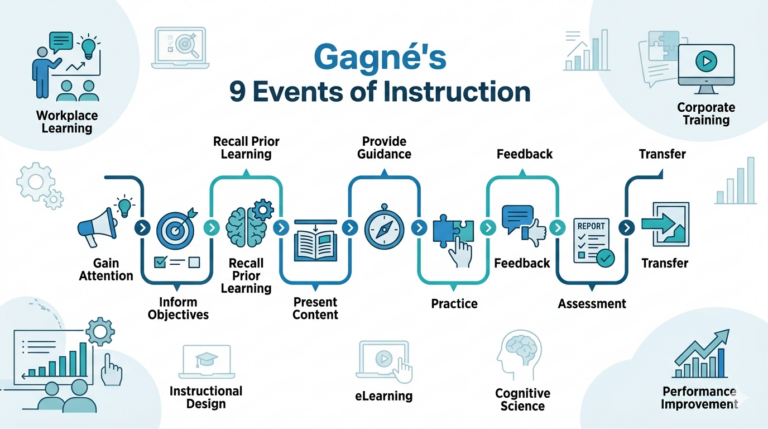
- Gagné’s 9 Events of Instruction: A Practical Guide for Trainers with Real Examples
- ADDIE vs SAM: Which Instructional Design Model Should You Use in 2026?
- ARCS Model of Motivation — The Complete Guide for Corporate Trainers [2026]
- Adult Learning Theory (Andragogy): Knowles’ 6 Principles Explained with Workplace Examples
- Cognitive Load Theory Explained: A Practical Guide for Trainers & Instructional Designers
- Kirkpatrick Model: How to Measure Training Effectiveness
- 12 Facilitation Skills for Corporate Trainers: The Complete Guide
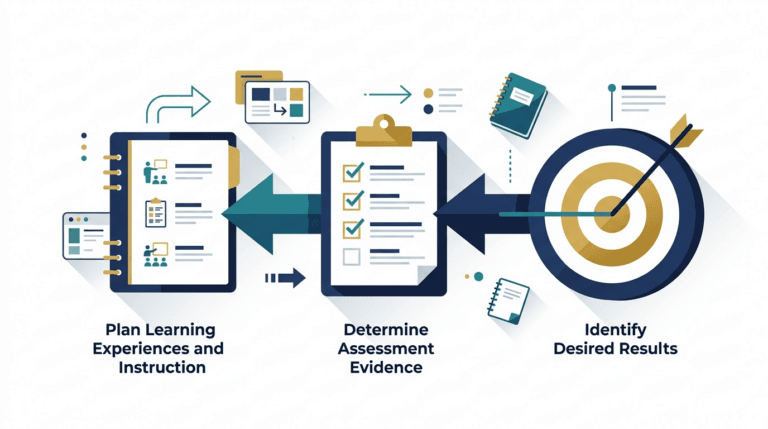
- Backward Design – The Complete Framework for Planning Learning
- Rapid eLearning Development: The Complete Process, Framework, Tools, and Templates
Author Details

Pankaj Nandi is a Technical Writer and Learning Content Specialist with experience creating complex technical and instructional content across software, technology, and enterprise environments. Having worked with organizations including Cisco, Rakuten India, and Newgen Software, he specializes in transforming complex concepts into clear, practical, and learner-friendly content. You can reach out to him at pankaj@trainercentric.in