Introduction
Walk into almost any L&D planning meeting and you’ll hear the same two phrases thrown around like they mean the same thing: “Let’s do a competency mapping exercise” and “We need a skills gap analysis.” Ask five HR professionals to define the difference and you’ll usually get five different answers — and at least two of them will be wrong.
This isn’t a minor semantic issue, and it isn’t just an academic debate either. According to the World Economic Forum’s Future of Jobs Report 2025, based on a survey of over 1,000 employers worldwide, skill gaps are now seen as the single biggest barrier to business transformation. When a business can’t tell the difference between a long-term capability standard and a short-term skill deficit, it ends up running the wrong diagnostic, collecting the wrong data, and funding training that solves the wrong problem — at a moment when, per the same report, roughly 59 out of every 100 workers globally will need reskilling or upskilling by 2030.
Here’s the honest answer: competency mapping and skills gap analysis are related but fundamentally different tools, built for different questions, at different points in the talent lifecycle. Competency mapping asks, “What does great performance look like in this role, and how do people compare to that standard?” Skills gap analysis asks a narrower, more tactical question: “What specific skill is missing, and how big is that gap right now?”
Confuse them, and you either over-engineer a simple training need into a six-month competency framework project, or you under-diagnose a systemic capability issue as a one-off skills course.
This guide Competency Mapping vs Skills Gap Analysis, is written for people who have to make that call in real organizations — L&D managers building a business case, HRBPs supporting a restructuring, instructional designers scoping a project, and training managers who need a defensible answer when a CHRO asks “why are we doing this instead of that?” Along the way, we’ll introduce the framework we use at TrainerCentric to help clients sequence both tools correctly, instead of treating them as competing options.
What You’ll Learn
- What competency mapping actually is (and what it isn’t)
- What skills gap analysis actually is (and where it commonly gets misapplied)
- Two comparison tables — one structural, one practical (cost, time, ownership, budget)
- Our proprietary Capability Stack framework for sequencing both tools correctly
- When NOT to use each approach — and why misapplication is more common than you’d think
- A decision flowchart and checklist you can use in your next planning meeting
- A step-by-step corporate implementation process, from business goals to evaluation
- Real workplace examples, including a manufacturing case scenario
- The most common mistakes organizations make with each approach, and why competency projects fail structurally
Why Organizations Confuse These Two Concepts
Before getting into definitions, it’s worth understanding why this confusion is so persistent. Three reasons show up again and again in consulting work:
- Both tools produce a “gap.” Competency mapping identifies gaps against a competency standard; skills gap analysis identifies gaps against a specific skill requirement. Because both outputs contain the word “gap,” people assume the underlying process is interchangeable.
- Vendors and templates blur the line. Many off-the-shelf templates label a basic skills checklist as a “competency framework” because it sounds more strategic. This inflates simple skills audits into something they’re not, and dilutes the term “competency” until it stops meaning anything specific.
- Both feed training design. Since both eventually inform a training needs analysis, people conflate the diagnostic stage with the output stage.
A pattern we see repeatedly in consulting engagements: the confusion isn’t really about definitions — it’s about ownership. Whoever raised the training request (a line manager wanting a quick fix, or an HR leader wanting a long-term framework) tends to label whatever tool they already have in mind as “the right one,” regardless of which the situation actually calls for.
Getting this distinction right is the difference between a training strategy the business genuinely trusts and one that gets quietly ignored after the first pilot.
What Is Competency Mapping?
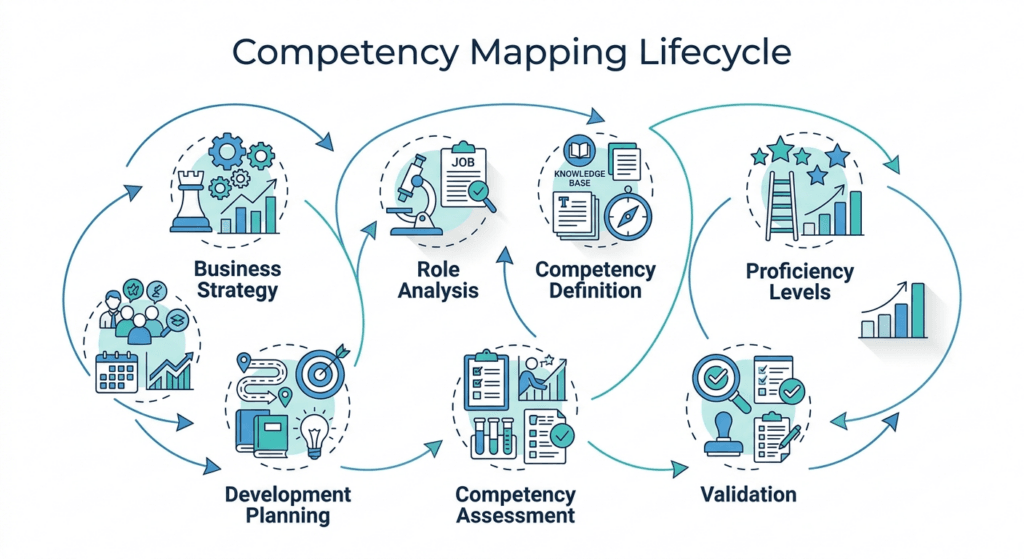
Competency mapping is the process of identifying, defining, and assessing the specific combination of knowledge, skills, abilities, and behaviours (“competencies”) required for a person to perform successfully in a particular role, and then measuring individuals against that standard.
It is fundamentally a role-design and workforce-standards exercise, closely tied to job analysis and role analysis, and it forms the backbone of what many organizations call their job architecture — the overall structure of role families, levels, and career paths. It doesn’t start with “what training do we need to run” — it starts with “what does success actually look like in this job, at this level, in this organization.” The end product is often formalised into a competency dictionary — a master reference of every competency used across the organization, with consistent definitions and proficiency levels — so that “stakeholder influence” means the same thing whether it’s being assessed in Sales or in Finance.
Professional bodies build exactly this kind of framework at scale. SHRM’s own Competency Model, now formalised as the SHRM Body of Applied Skills and Knowledge (BASK), defines the behavioural and technical competencies expected of HR professionals at every career stage, and is used to guide both certification and individual development plans — a useful reference point for what a mature, well-governed competency framework actually looks like in practice.
A competency typically includes:
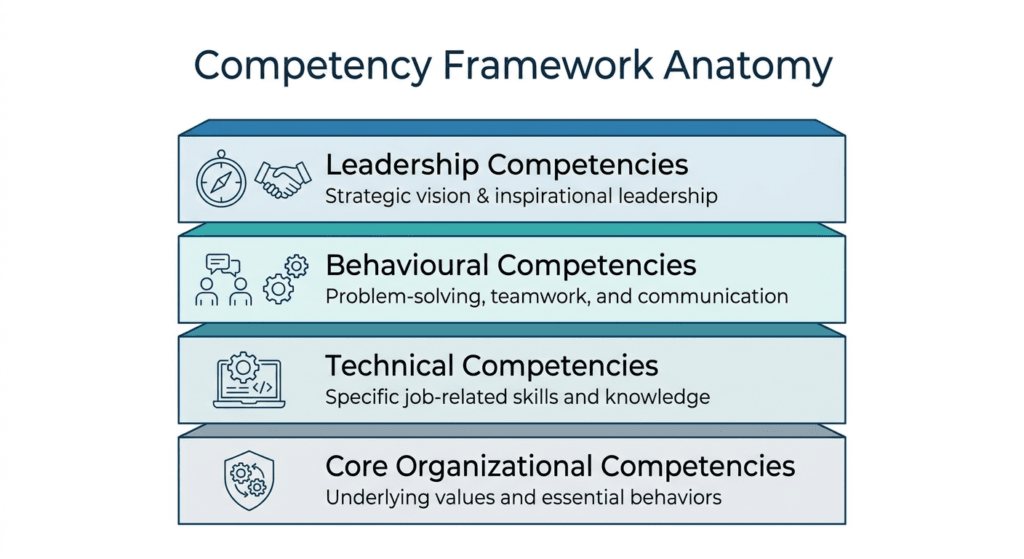
- Technical/functional competencies — role-specific expertise (e.g., financial modelling, C++ proficiency, clinical assessment)
- Behavioural competencies — how the work gets done (e.g., stakeholder influence, decision-making under ambiguity, coaching others)
- Core/organizational competencies — expectations that apply across all roles (e.g., customer centricity, adaptability, integrity)
- Leadership competencies — for people-manager and executive roles (e.g., strategic thinking, talent development, change leadership)
Purpose of Competency Mapping
- Define what “good” and “great” performance look like for every role or role family
- Create a consistent standard for hiring, promotion, performance management, and succession planning
- Give employees a transparent development pathway and support career pathing
- Align individual capability with long-term workforce planning and organizational strategy, not just this quarter’s tasks
Benefits
- Creates a shared vocabulary across HR functions — recruitment, performance management, talent management, and L&D all reference the same framework
- Supports succession planning and succession management by defining readiness criteria for future roles
- Improves the objectivity of performance and promotion decisions
- Provides a durable capability framework that doesn’t need to be rebuilt every time a new training need arises
The Competency Mapping Process (High-Level)
- Clarify the business strategy and the capabilities it demands
- Identify role families and critical roles through job analysis
- Define competencies for each role family (technical, behavioural, core, leadership)
- Set proficiency levels for each competency (e.g., Foundational, Practitioner, Expert, Master)
- Validate the framework with role incumbents and senior stakeholders — and, in regulated industries, against relevant occupational standards
- Assess individuals against the framework using multiple data sources
- Build competency profiles and identify development priorities
- Integrate the framework into hiring, appraisal, succession, and workforce planning processes
Competency Mapping Example
Role: Mid-Level Sales Manager
| Competency Category | Competency | Proficiency Level Required |
| Technical | Sales pipeline management | Practitioner |
| Technical | Pricing and negotiation | Practitioner |
| Behavioural | Stakeholder influence | Expert |
| Behavioural | Coaching and feedback | Practitioner |
| Core | Customer centricity | Practitioner |
| Leadership | Performance management | Foundational |
An individual is then assessed against each line using 360 feedback, manager review, and structured interviews, producing a competency profile that shows exactly where they sit relative to the required standard.
Advantages of Competency Mapping
- Strategic, long-term, and role-defining rather than task-specific
- Reusable across multiple HR processes (recruitment, appraisal, succession, workforce planning, L&D)
- Supports career pathing and internal mobility
- Creates a consistent competency model and language for capability across the organization
Limitations of Competency Mapping
- Resource-intensive to build and validate properly
- Frameworks can become outdated quickly if not reviewed regularly — a real risk given how fast core skill requirements are moving; LinkedIn’s 2025 Workplace Learning Report analysis found that the skill sets required for jobs have shifted by roughly 25% since 2015
- Risk of being overly generic if not tailored to actual role context
- Doesn’t, by itself, tell you which specific training intervention is needed right now — it identifies the gap in capability, not the tactical fix
Consulting insight: one mistake we repeatedly see is organizations building a beautifully detailed competency framework and then never connecting it back to recruitment or performance management systems. A framework that only lives in an L&D folder isn’t a capability framework — it’s a document.
What Is Skills Gap Analysis?
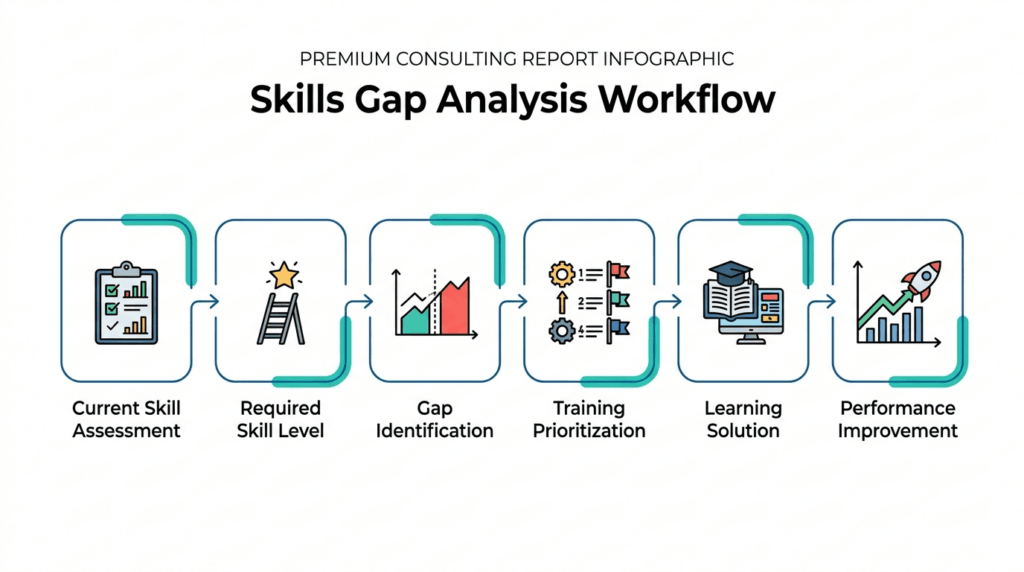
Skills gap analysis is a more focused, tactical diagnostic that compares the skills employees currently have — often documented in a skills inventory — against the skills required to meet a specific, often near-term, business or performance objective.
Where competency mapping asks “what should this role look like,” skills gap analysis asks “what specific, measurable skill is missing right now, for this task, this team, or this transition.” It’s closely related to, but narrower than, a full skills taxonomy — the broader classification system some organizations use to catalogue every skill across the workforce.
This isn’t just a training question. CIPD research in the UK has found that a significant share of employees feel their skills are under-utilised in their current roles — a mismatch that damages both engagement and productivity. CIPD’s guidance on workforce planning frames the fix as comparing workforce supply against future demand, then building an action plan to close the gap — the same logic that underlies a well-run skills gap analysis at team level.
Definition
A skills gap is the measurable difference between the skill level an employee (or team) currently demonstrates and the skill level required to meet a defined performance standard, usually tied to a specific tool, process, product, or deliverable. This is sometimes called a capability gap when applied at team or department level rather than to an individual.
Objectives
- Pinpoint specific, addressable skill deficits (e.g., “40% of the finance team cannot build a pivot table in Excel”)
- Support urgent or project-specific training decisions (system rollouts, new product launches, compliance changes)
- Prioritise training investment where it will have the most immediate performance impact
- Provide a quantifiable baseline to measure training ROI against
Business Value
Skills gap analysis is where L&D earns its credibility with finance and operations leaders, because the output is concrete and countable: “X% of the team lacks Y skill, which is costing Z in errors/rework/delays.” This matters more than ever — LinkedIn’s 2025 Workplace Learning Report found that nearly half of talent development professionals say their executives are worried employees lack the skills needed to execute the business strategy. That’s exactly the conversation a well-run skills gap analysis is designed to resolve with data instead of anecdote.
Benefits
- Fast to conduct — often days or weeks, not months
- Directly actionable — the output maps almost one-to-one to a training solution
- Easy to quantify, which supports ROI conversations and performance gap analysis
- Useful for validating whether a specific training programme actually closed the gap
Limitations
- Narrow scope — doesn’t capture behavioural or leadership capability
- Reactive by nature — tends to respond to a known, already-visible problem rather than anticipate future capability needs
- Without a competency framework or skills taxonomy behind it, skills gap analysis can turn into an endless cycle of ad hoc “skill of the month” training that never builds toward a coherent capability strategy
- Risk of over-training on visible technical gaps while ignoring underlying behavioural or systemic issues
Consulting insight: after running skills gap analyses across very different industries, one pattern becomes obvious — the gap that gets reported first (usually a technical, easy-to-test skill) is rarely the gap that’s actually limiting performance. The real constraint is often a behavioural one sitting one layer beneath it, which a narrow skills audit simply isn’t designed to catch.
Skills Gap Analysis Example
Team: Customer Service Representatives — New CRM Rollout
| Required Skill | Current Proficiency (Avg.) | Required Proficiency | Gap |
| CRM data entry | 2/5 | 4/5 | 2 |
| Ticket escalation workflow | 3/5 | 4/5 | 1 |
| Live chat tools | 1/5 | 4/5 | 3 |
| Product knowledge (new SKUs) | 2/5 | 5/5 | 3 |
This table gives a training team an immediate, defensible answer: live chat tools and product knowledge on new SKUs are the priority gaps, and the training design should focus there first.
Competency Mapping vs Skills Gap Analysis
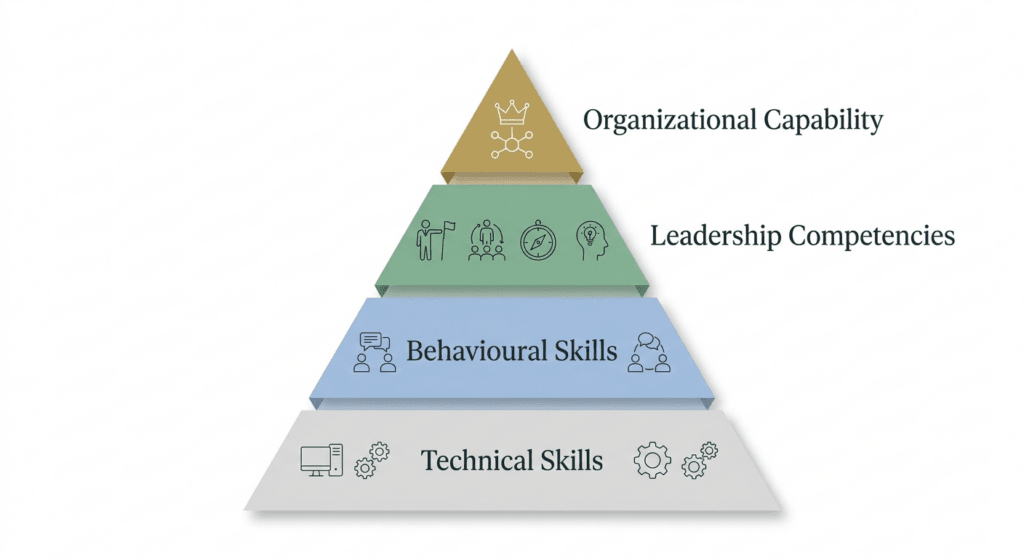
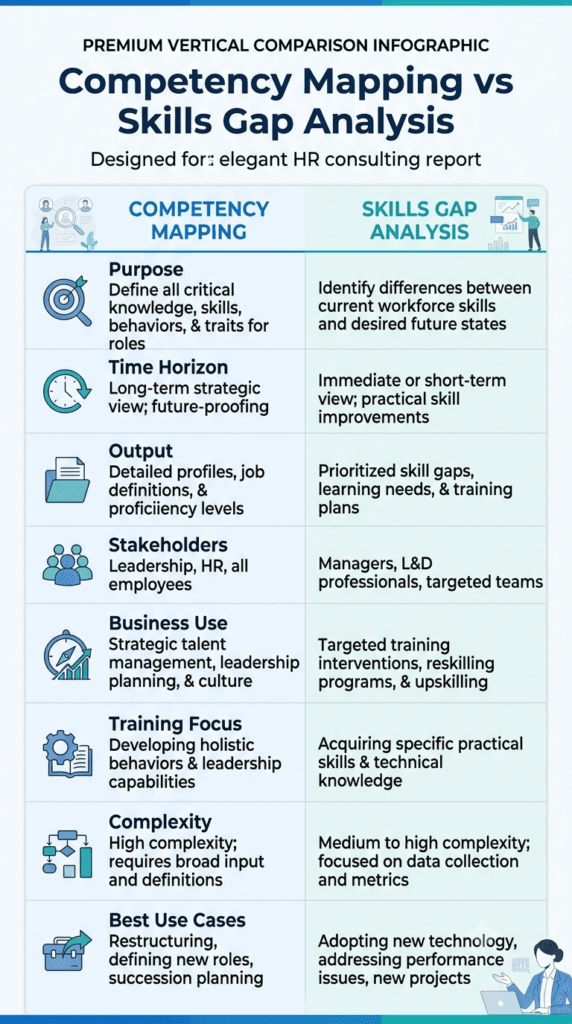
Structural Comparison
| Dimension | Competency Mapping | Skills Gap Analysis |
| Purpose | Define the full capability standard for a role | Identify a specific, measurable skill deficit |
| Focus | Knowledge, skills, behaviours, attributes | Specific technical or functional skills |
| Output | Competency framework and individual competency profiles | Ranked list of skill gaps with severity |
| Time Horizon | Long-term, strategic (reviewed annually or every 2–3 years) | Short-term, tactical (project or event-driven) |
| Business Use | Recruitment, succession planning, career pathing, appraisal | Urgent training prioritisation, project readiness, compliance |
| Training Application | Informs broad capability-building strategy | Directly informs specific course or intervention design |
| Data Required | 360 feedback, structured interviews, role analysis, performance data | Skills assessments, tests, manager ratings, task audits |
| Stakeholders | HR leadership, senior management, OD, talent management | Line managers, project leads, L&D delivery teams |
| Deliverables | Competency framework, competency matrix, development pathways | Skills matrix, prioritised gap list, training needs summary |
| Complexity | High — cross-functional, multi-stage project | Low to medium — focused, fast-turnaround exercise |
| Ideal Use Cases | Role design, succession planning, leadership development, career frameworks | New system rollouts, compliance deadlines, performance issues, onboarding |
Practical Comparison: The Questions People Actually Ask about Competency Mapping vs Skills Gap Analysis
| Question | Competency Mapping | Skills Gap Analysis |
| Typical cost | Higher — often needs external facilitation, workshops, and validation cycles | Lower — can often be run internally with existing tools |
| Time required | 2–6 months for a full framework build | Days to a few weeks per exercise |
| Who typically leads it | HR/OD, sometimes with an external consultant | L&D team, project lead, or line manager |
| Typical budget owner | Central HR/L&D budget | Project or business-unit budget |
| Best fit for SMEs | Scaled-down version, focused on 2–3 critical role families only | Excellent fit — fast, low-cost, immediately useful |
| Best fit for large enterprises | Strong fit — supports succession and mobility at scale | Still valuable, but usually run inside a larger framework |
| Can AI assist? | Yes, for drafting definitions and analysing data — human validation still essential | Yes, AI-assisted skills inventories are increasingly common — still need manager sign-off |
| Common failure point | Framework gets built but never wired into hiring or appraisal systems | Gap identified but training delivered to everyone, not just the affected group |
| Immediate training outcome | Development pathway and prioritised learning needs by role | A specific, scoped training intervention |
| Business outcome | Stronger succession bench, more consistent hiring and promotion decisions | Faster time-to-competency on a specific tool, process, or product |
When NOT to Use Each Approach
Almost every guide to these two tools explains when to use them. Just as important — and far more rarely covered — is when not to. Misapplying either tool doesn’t just waste time; it produces a deliverable the business quietly stops trusting.
Don’t use Competency Mapping when:
- You need an answer within two weeks — a validated framework takes months, not days
- Only one process or tool has changed, not the whole role
- The requirement is a temporary compliance need with a fixed end date
Don’t use Skills Gap Analysis when:
- You’re redesigning an entire job family or role structure
- You’re building a succession pipeline or leadership bench
- You need a reusable, enterprise-wide framework that other HR processes will reference for years
Key Differences Explained
- Strategic vs Tactical. Competency mapping is an infrastructure investment — built once and maintained, feeding multiple HR processes for years. Skills gap analysis is a diagnostic snapshot tied to a specific business event: a system change, a new market entry, a compliance deadline.
- Scope of what’s measured. Competency mapping deliberately includes behavioural and leadership dimensions — how someone operates, not just what they can technically do. Skills gap analysis, in most implementations, sticks to observable, testable skills because that’s what makes it fast and defensible.
- Who owns the outcome. Competency frameworks are usually owned centrally by HR/OD, feeding into talent management and workforce planning, with L&D as one of several downstream users. Skills gap analysis is often owned directly by L&D or a specific business unit running a specific initiative.
- Reusability. A validated competency framework becomes a reusable asset across hiring, performance, and development. A skills gap analysis is largely single-use — it answers today’s question and typically needs to be re-run for tomorrow’s.
- Data collection burden. Competency mapping requires structured, often expensive data collection: job analysis interviews, validation workshops, multi-rater assessments. Skills gap analysis can often be done with a simple self-assessment plus manager sign-off.
- Risk of misuse. Using competency mapping when you need a fast answer leads to analysis paralysis — the business needed a training decision this month, and you’re still validating a framework in month four. Using skills gap analysis when you need a competency framework leads to a pile of disconnected micro-fixes with no coherent capability strategy behind them.
Our Framework: The Capability Stack – Competency Mapping vs Skills Gap Analysis
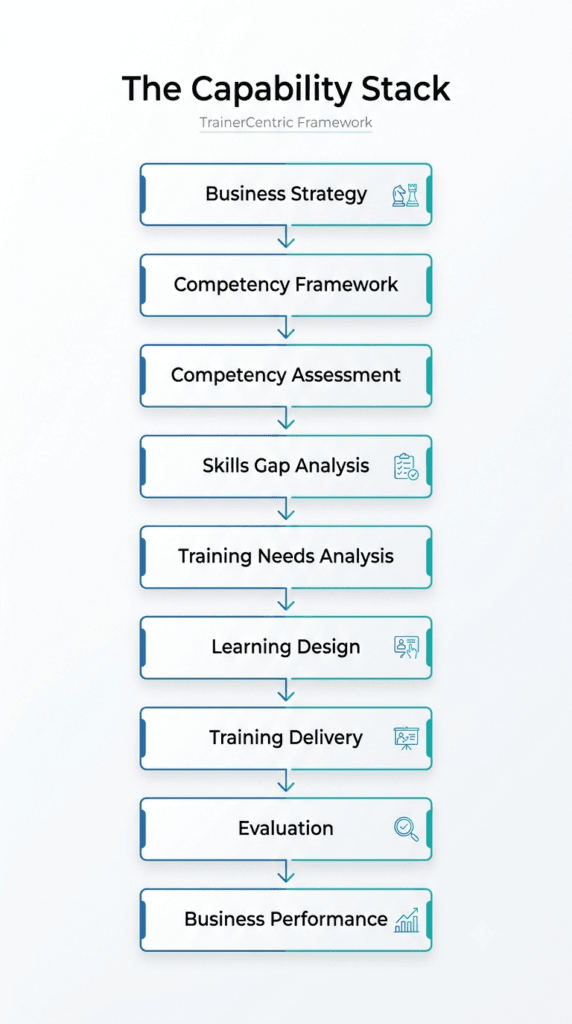
Most articles on this topic stop at “here’s a comparison table, now go figure out the sequencing yourself.” At TrainerCentric, we use a simple model with clients to show exactly how competency mapping and skills gap analysis fit together inside a single capability pipeline. We call it the Capability Stack.
This distinction isn’t just semantic — ATD, the largest professional association for talent development, made a similar shift at an industry level, retiring its long-standing Competency Model in favour of a Talent Development Capability Model. Their reasoning: competence describes a person’s current state, while capability describes the capacity to adapt as requirements change. The Capability Stack applies that same logic to how competency mapping and skills gap analysis fit together across an organization.
Each layer answers a distinct question:
- Business Strategy — where is the organization actually heading, and what capability does that require?
- Competency Framework — what does “great” look like for each critical role, across technical, behavioural, core, and leadership dimensions?
- Competency Assessment — where do people currently sit against that standard?
- Skills Gap Analysis — within the priority competency gaps (or independently, for a tactical need), what specific skill is missing?
- Training Needs Analysis — consolidating both competency-level and skill-level gaps into one prioritised register
- Learning Design — translating needs into learning objectives and course structure
- Training Delivery — the actual intervention, blended or otherwise
- Evaluation — did it work, and by how much?
- Business Performance — the outcome all of the above exists to influence
Think of the Capability Stack as the full pipeline; competency mapping and skills gap analysis are two specific layers inside it, not two competing ways of doing the same job. Most of the “which one should I use” confusion disappears once a team can see where each tool actually sits in this stack.
Expert Tip: if your organization has never built a competency framework, don’t wait to run skills gap analyses in the meantime — they’ll keep the business moving. But flag internally that without layers 2 and 3 of the Capability Stack in place, you’re solving symptoms one at a time rather than building capability strategically.
Can They Be Used Together?
Yes — and This Is Where Most Value Is Created. In mature L&D functions, competency mapping and skills gap analysis aren’t competitors — they’re sequential layers in the Capability Stack described above.
The typical workflow:
- Competency Mapping defines what “success” looks like for each role, at each level, against business strategy.
- Competency Assessment measures individuals or teams against that standard, surfacing broad capability gaps (e.g., “our mid-level managers are weak in coaching and change leadership”).
- Skills Gap Analysis drills into the specific, tactical skill deficits that sit underneath those broader competency gaps (e.g., “specifically, managers can’t run a structured feedback conversation using our performance framework”).
- Learning Needs Analysis converts prioritised gaps — both competency-level and skill-level — into defined learning objectives.
- Training Design (see our Training Needs Analysis and ADDIE Model guides) builds the actual intervention.
Think of competency mapping as the map of the territory, and skills gap analysis as the route to the next specific destination on that map. You need the map to know where you’re generally headed; you need the route to know what to do this week.
Step-by-Step Corporate Process: From Business Goals to Continuous Improvement
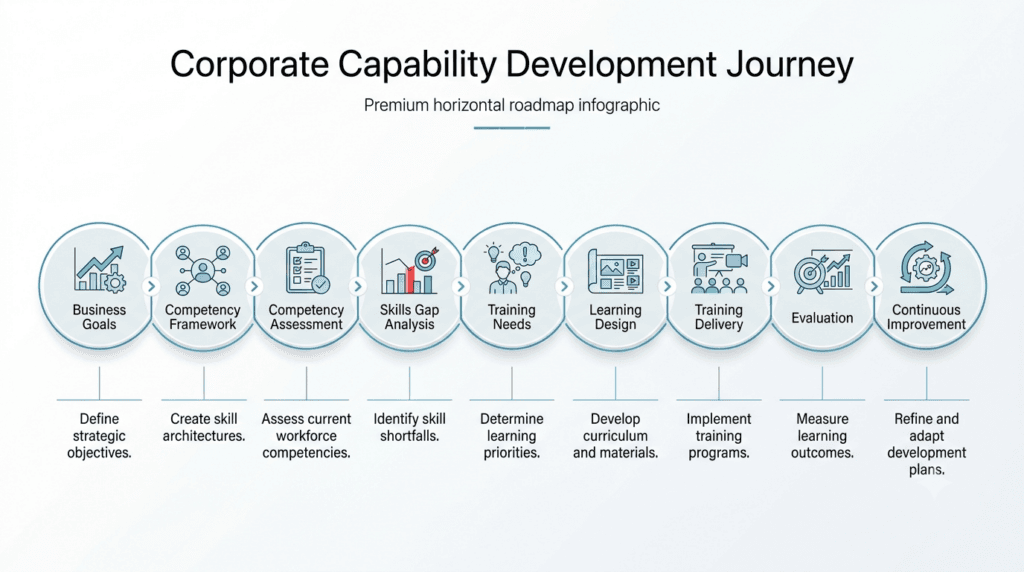
This is the end-to-end sequence a well-run L&D function follows, mapped directly onto the Capability Stack.
- 1. Clarify Business Goals — Start with the actual business strategy: growth targets, market shifts, digital transformation, cost pressure. Capability work that isn’t anchored to a business goal rarely survives budget season.
- 2. Build/Update the Competency Framework — Define role families and the technical, behavioural, core, and leadership competencies each requires, ideally consolidated into a shared competency dictionary.
- 3. Run Competency Assessment — Assess current employees against the framework using multi-source data (manager review, self-assessment, 360 feedback, performance records).
- 4. Run Targeted Skills Gap Analysis — For the priority gaps identified in step 3, or for specific operational needs, drill down into concrete skill deficits using a skills inventory or skills matrix.
- 5. Consolidate into Training Needs — Combine competency-level and skill-level gaps into a single, prioritised training needs register.
- 6. Design Learning Solutions — Translate needs into learning objectives and structure the intervention using the ADDIE Model.
- 7. Deliver Training — Roll out via the appropriate blended, digital, or classroom format.
- 8. Evaluate Impact — Measure against the Kirkpatrick Model and, where a financial case is needed, the Phillips ROI Model.
- 9. Continuous Improvement — Feed evaluation data back into the competency framework and future skills gap analyses, so workforce planning gets sharper each cycle.
Real Workplace Examples
- Sales Team. A B2B sales organization uses competency mapping to define what “consultative selling” looks like at each level (Associate, Senior, Principal). A subsequent skills gap analysis reveals that even experienced reps, who score well on the broader competency, specifically struggle with objection-handling on a newly launched product line — a narrow, fixable skill gap sitting inside a broader competency.
- Customer Service. Competency mapping defines “customer resolution ownership” as a core behavioural competency. A skills gap analysis, triggered by a new ticketing system rollout, identifies that agents lack proficiency in the new tool itself — a short-term technical gap, unrelated to the underlying behavioural competency, which is still strong.
- Manufacturing. A plant’s competency framework includes “process safety compliance” as a non-negotiable technical competency for all floor operators, benchmarked against relevant occupational standards. A skills gap analysis after a machinery upgrade identifies which specific operators haven’t yet been certified on the new equipment — a compliance-driven, time-bound gap.
- Leadership Development. A competency framework for first-time people managers includes “coaching and feedback” and “performance conversations” as core behavioural competencies. Skills gap analysis, run via manager self-assessment, shows the specific mechanical gap: managers don’t know how to structure a documented performance improvement conversation — a concrete, trainable micro-skill.
- Digital Transformation. As a company migrates to cloud-based tools, competency mapping updates the “digital fluency” competency across all corporate roles. Skills gap analysis then identifies exactly which teams need training on which specific platforms, avoiding a blanket “everyone attends digital skills training” approach that wastes time for already-proficient teams.
- Graduate Programme. Competency mapping defines the full capability profile expected of a graduate by the end of an 18-month rotational programme. Skills gap analysis is run quarterly to check specific technical proficiencies against that longer-term target, allowing rotation-by-rotation course correction.
- Healthcare. Clinical competency frameworks define required competencies by role and seniority, validated against regulatory and accreditation standards. Skills gap analysis is used tactically — for example, identifying which nursing staff need a refresher on a specific new equipment protocol ahead of an audit.
- Finance. A finance function’s competency framework defines “business partnering” as a core competency for finance business partners. Skills gap analysis, run ahead of a new ERP rollout, identifies the specific system and reporting skills that need urgent training — separate from, but complementary to, the broader business-partnering competency work.
Illustrative Scenario: A Manufacturing Automation Rollout
The following is an illustrative scenario, not a specific client engagement.
A manufacturing company planned to retrain around 400 machine operators after introducing new automation on its production line. The initial instinct was a broad, one-size-fits-all retraining programme for the entire operator workforce.
Instead, the L&D team ran a targeted skills gap analysis first. It found that only a subset of operators — those working directly on the automated stations — actually needed technical retraining on the new equipment; the rest needed little more than a short briefing.
At the same time, a parallel competency assessment surfaced a different, less visible gap: supervisors lacked the coaching capability needed to help their teams adapt to the new way of working, which was quietly undermining adoption regardless of how well the operators were trained.
The result was a much more targeted learning strategy: focused technical training for the operators who actually needed it, and a short coaching-skills intervention for supervisors — instead of a blanket programme that would have retrained hundreds of people who didn’t need it, while missing the real constraint on the automation rollout.
Common Mistakes
- Confusing competencies with skills. Treating “leadership” as if it were a single trainable skill, rather than a competency made up of multiple behaviours and sub-skills, leads to vague, unmeasurable training objectives.
- Ignoring business objectives. Building a competency framework or running a skills gap analysis disconnected from where the business is actually heading produces a technically sound but strategically irrelevant deliverable.
- Using outdated competency frameworks. Frameworks built years ago, before major role or technology changes, quietly stop reflecting what “good” actually looks like — and nobody notices until an assessment against them produces obviously wrong results.
- Poor assessment methods. Relying solely on self-assessment (for either competencies or skills) inflates scores and undermines the credibility of the whole exercise. Triangulate with manager input and, where possible, observed performance data.
- Training everyone. Running a generic training programme for an entire department because a skills gap analysis found an average gap, without checking who specifically needs it, wastes time for proficient employees and doesn’t concentrate resources where the real deficit sits.
- Ignoring behavioural competencies. Focusing skills gap analysis exclusively on technical, easily-tested skills while ignoring behavioural and leadership gaps — which are often the real driver of performance issues — produces training that fixes the wrong problem.
- Failing to measure impact. Running either exercise without a follow-up evaluation plan means the organization can never prove the training worked, which erodes L&D’s credibility over time.
- A mistake specific to the current moment: treating AI-assisted skills matching tools as a replacement for human validation. AI can speed up drafting competency definitions or scanning a skills inventory for gaps, but it cannot sit in the room and validate whether a competency actually reflects how the role is performed today — that still needs a human conversation with role incumbents and managers.
Why Competency Mapping Projects Fail
Common Mistakes covers the errors that show up inside a single exercise. But most failed competency mapping initiatives don’t fail because of a bad workshop — they fail structurally, months after launch:
- Executive sponsorship disappears once the framework is built, and nobody drives adoption into hiring or appraisal.
- Competencies become generic — defined so broadly (“leadership,” “communication”) that they can’t actually be assessed or coached against.
- The framework isn’t integrated into HR processes — it lives in a slide deck, not in the performance review template or the hiring scorecard.
- No ownership after launch — so it’s never refreshed and slowly drifts out of step with the roles it describes.
These are structural failures, not delivery failures — which is exactly why they’re harder to spot in the room and easier to prevent with the right ownership model from day one.
Best Practices
- Build the competency framework once, and reuse it everywhere — recruitment, appraisal, succession, and L&D should all reference the same document, not four separate versions.
- Reserve skills gap analysis for tactical, time-bound needs — new systems, compliance deadlines, product launches — rather than as a substitute for long-term capability planning.
- Always triangulate assessment data — combine self-assessment, manager review, and where possible, observed performance or output data.
- Review competency frameworks on a fixed cycle, not only when something breaks. Annually for fast-changing environments; every two to three years for more stable ones.
- Prioritise ruthlessly — not every gap deserves a training intervention. Some gaps are better solved by job redesign, coaching, or process fixes.
- Tie every training recommendation back to a business outcome — this is what protects the L&D budget in a downturn.
- Treat evaluation as part of the design, not an afterthought — decide how you’ll measure success before you build the course.
Did You Know?
Many “competency frameworks” circulating as free templates online are actually generic skills checklists with the word “competency” added to the title. A genuine competency framework is built from actual role analysis and validated with incumbents and senior stakeholders — not copied from a template and relabelled. It’s a bigger deal than it sounds: the World Economic Forum’s 2025 Future of Jobs Report found that nearly 40% of workers’ core skills are expected to change by 2030, which means a framework that isn’t reviewed on a fixed cycle is quietly going stale faster than most HR teams assume.
Common Myths
- Myth: Competency mapping and skills gap analysis are the same thing. They measure different things, at different time horizons, for different purposes.
- Myth: You need a competency framework before you can do any training needs analysis. Not true — skills gap analysis can and should run independently for urgent, specific needs. A framework strengthens long-term strategy but isn’t a prerequisite for every training decision.
- Myth: Skills gap analysis is only for technical roles. It applies equally to soft skills, provided the skill is defined narrowly and observably enough to assess (e.g., “structuring a difficult conversation” rather than “communication” in the abstract).
- Myth: Once a competency framework is built, it’s done. Frameworks that aren’t reviewed against changing business strategy and role requirements become inaccurate within a few years.
- Myth: AI can now do competency mapping end-to-end. AI tools can accelerate drafting and pattern-spotting, but validating a competency framework still requires structured input from the people actually doing the job — a step that hasn’t been automated away.
Decision Checklist: Which One Do You Need?
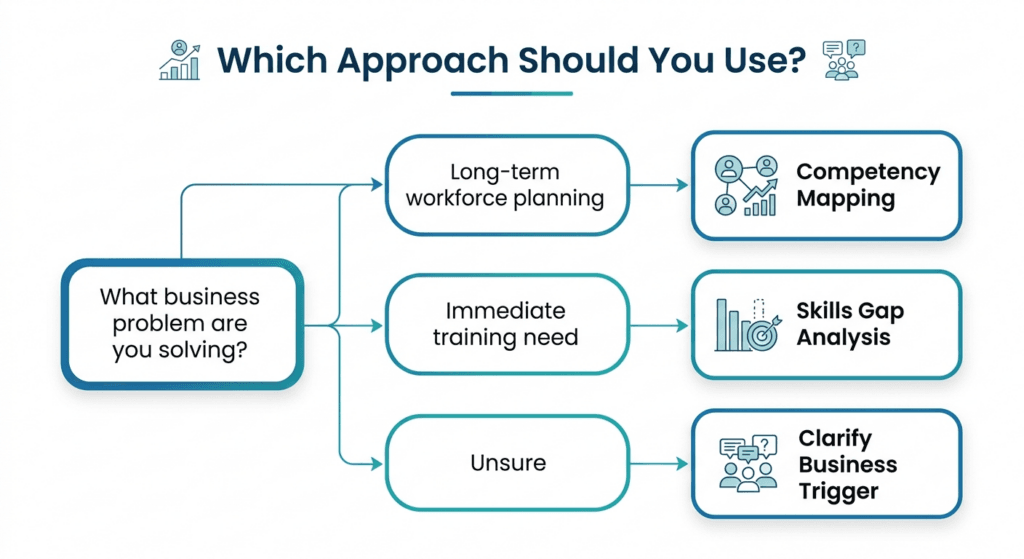
Use this quick decision framework in your next planning conversation:
| If your situation is… | Use this approach |
| Designing or redesigning roles across the organization | Competency Mapping |
| Building succession plans or leadership pipelines | Competency Mapping |
| Responding to a new system, tool, or product rollout | Skills Gap Analysis |
| Facing a compliance deadline for a specific certification | Skills Gap Analysis |
| Setting career development pathways | Competency Mapping |
| Diagnosing a sudden, specific performance dip in one team | Skills Gap Analysis |
| Building a long-term capability strategy tied to business goals | Both — Competency Mapping first, then Skills Gap Analysis (see the Capability Stack) |
| Needing a fast, defensible business case for a training budget | Skills Gap Analysis |
Quick Preview: Questions to Ask Before Choosing Competency Mapping
A full 20-question version of this checklist is available as a downloadable resource (see below); here’s a preview to get you started:
- Is this decision about a role, or about a single task?
- Do we need this to inform succession planning or career pathing?
- Will the output need to be reused across hiring, appraisal, and development?
- Do we have 2–6 months before a decision is needed?
- Is behavioural or leadership capability part of the concern?
- Do we already have a competency dictionary we can build from?
- Is there executive sponsorship for a longer capability project?
- Would a narrower skills gap analysis actually answer the immediate question faster?
If most of your answers point to “role,” “long-term,” and “behavioural,” you’re looking at competency mapping. If they point to “task,” “urgent,” and “technical,” start with skills gap analysis instead.
Frequently Asked Questions
What is the main difference between competency mapping and skills gap analysis?
Competency mapping defines the full capability standard for a role — including behaviours and attributes — and measures people against it long-term. Skills gap analysis identifies a specific, measurable skill deficit tied to a shorter-term business need.
Which comes first, competency mapping or skills gap analysis?
Ideally, competency mapping comes first, since it defines the standard. Skills gap analysis then drills into specific gaps within or alongside that standard — this is exactly how the Capability Stack sequences the two. In practice, many organizations run skills gap analysis first out of urgency, before a formal competency framework exists.
Competency Mapping vs Job Analysis — are they the same?
No. Job analysis is the underlying research process — studying tasks, responsibilities, and context for a role. Competency mapping uses job analysis as an input, then goes further to define the knowledge, skills, and behaviours needed for success in that role.
Competency Mapping vs Skills Matrix — what’s the difference?
A skills matrix is usually a simpler, task-level tracker of specific technical proficiencies across a team. A competency matrix (the output of competency mapping) is broader — covering technical, behavioural, core, and leadership dimensions against defined proficiency levels.
Competency Mapping vs Training Needs Analysis — how do they relate?
Training needs analysis is a downstream step. It consolidates the gaps identified through competency mapping and/or skills gap analysis into specific, prioritised learning requirements.
Can AI perform competency mapping?
AI can assist with drafting competency definitions, analysing assessment data, and spotting patterns across large datasets, but validating a competency framework still requires structured input from role incumbents and senior stakeholders — a step that remains human-led.
Can ChatGPT or similar tools replace skills gap analysis?
They can help structure a skills inventory or draft assessment questions faster, but the actual assessment — rating real employees against real requirements — still needs manager input and, ideally, observed performance data.
Can a small business do competency mapping without a full HR team?
Yes, on a scaled-down basis — focusing on business-critical roles first rather than mapping every position in the organization at once.
Is a skills matrix the same as a competency matrix?
No. A skills matrix tracks specific, usually technical, skill proficiencies. A competency matrix tracks broader competencies — technical, behavioural, and leadership — against defined proficiency levels.
How often should a competency framework be updated?
Most organizations review core frameworks every one to three years, or sooner if there’s a major strategic shift, restructuring, or technology change affecting the role.
Quick Summary
- The Capability Stack shows how the strongest capability strategies use both, sequentially: competency framework first, then targeted skills gap analysis, feeding into a unified training needs process.
- Competency mapping defines the full capability standard for a role — technical, behavioural, core, and leadership — and is a long-term, strategic exercise.
- Skills gap analysis identifies specific, measurable skill deficits tied to a shorter-term business need, and is fast, tactical, and highly actionable.
- Use competency mapping for role design, succession planning, and career pathways.
- Use skills gap analysis for system rollouts, compliance deadlines, and targeted performance issues.
Conclusion
Competency mapping and skills gap analysis aren’t rival methodologies — they’re different layers of the same pipeline, trained on the same underlying question: where is the gap between what our people can do and what the business needs them to do?
Competency mapping gives you the long-range map: what good looks like, for every role, at every level, tied to where the organization is heading. Skills gap analysis gives you the tactical route: exactly which skill is missing, for whom, and how urgently it needs fixing. With the World Economic Forum reporting that skills gaps are now the leading barrier to business transformation globally, getting this sequencing right isn’t a nice-to-have — it’s increasingly a competitive one.
Organizations that treat these as competing choices tend to either over-build (a competency framework nobody uses tactically) or under-build (an endless stream of disconnected skills fixes with no strategic backbone). Organizations that use both — competency mapping to set the standard, skills gap analysis to solve what’s urgent, sequenced through something like the Capability Stack — end up with training strategies that are both strategically sound and operationally responsive.
Before you build your next training programme, challenge your team with one question: are you trying to define long-term capability, or solve an immediate performance gap? The answer determines whether you should begin with competency mapping, skills gap analysis, or both.
Further Readings
- Training Needs Analysis Guide
- Training Needs Analysis Checklist
- Training Needs Analysis Questionnaire
- Job Task Analysis Guide
- Performance Management Guide
- The 3 Levels of Training Needs Analysis
- Skills Gap Analysis vs Training Needs Analysis:Understanding the Difference
References
- Competence at Work: Models for Superior Performance || 1st Edition || Lyle M. Spencer Jr. & Signe M. Spencer || John Wiley & Sons || 1993
- The Talent Management Handbook: Creating a Sustainable Competitive Advantage by Selecting, Developing, and Promoting the Best People || 3rd Edition || Lance A. Berger & Dorothy R. Berger || McGraw-Hill Education || 2017
- The Handbook of Competency Mapping: Understanding, Designing and Implementing Competency Models in Organizations || 3rd Edition || Seema Sanghi || SAGE Publications India || 2017
- Competency-Based Human Resource Management || 1st Edition || David D. Dubois & William J. Rothwell || Nicholas Brealey Publishing || 2004
- Effective Training: Systems, Strategies, and Practices || 6th Edition || P. Nick Blanchard & James W. Thacker || Pearson || 2023
- Strategic Human Resource Management: A Guide to Action || 8th Edition || Michael Armstrong || Kogan Page || 2020
Author Details

Sumit is a writer, facilitator and a workspace learning enthusiast who explores the intersections of human behaviour, performance, and professional growth. With extensive experience in corporate environments, he brings a grounded, real-world perspective to the challenges professionals face every day. You can reach out to him at sumit@trainercentric.in