Evidence-Based Learning & Performance Improvement : A practical guide for L&D Managers, Training Managers, HR Business Partners, Instructional Designers, and Talent Development Professionals
Skill Gap Analysis vs Training Needs Analysis
| A manager walks into a meeting and says: “My team isn’t performing well. We need training.” Within minutes, the L&D team is discussing learning objectives, course formats, and delivery timelines. Budgets are earmarked. A training programme is on the horizon. But two critical questions have not been asked: 1. What skills are actually missing? 2. Is training even the right solution? |
This scenario plays out in organisations every day — and it leads to wasted investment, ineffective programmes, and frustrated managers who eventually stop believing in L&D altogether. At the heart of the problem is a failure to distinguish between two distinct diagnostic processes: Skills Gap Analysis vs Training Needs Analysis.
These two questions belong to two different but related diagnostic processes:
- Skills Gap Analysis (also called a skills gap assessment) — a systematic process for identifying capability gaps
- Training Needs Analysis — a systematic process for determining the right solution
A Skills Gap Analysis identifies the gap. A Training Needs Analysis determines the solution.
This guide explains both processes in depth, examines when to use each one, and shows how they work together as part of a complete performance improvement approach.
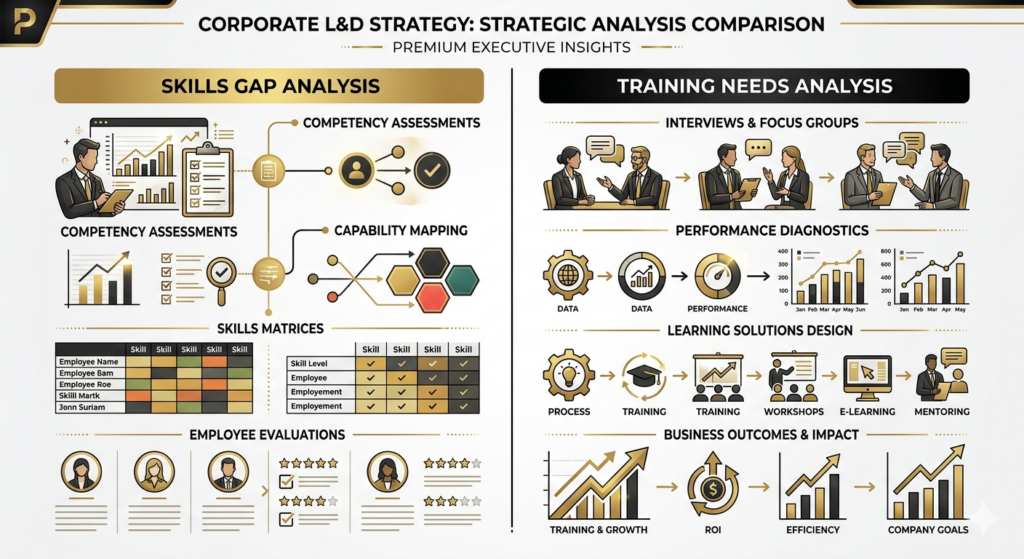
Quick Answer: Skills Gap Analysis vs Training Needs Analysis
If you need the short version before diving into the detail:
| Skills Gap Analysis | Training Needs Analysis | |
| Identifies missing capabilities | Identifies required interventions | |
| Answers: What is missing? | Answers: What should we do? | |
| Focuses on gaps | Focuses on causes and solutions | |
| Produces gap reports | Produces action plans | |
| Often comes first | Often follows Skills Gap Analysis | |
| Typical User: HR / Workforce Planning | Typical User: L&D / Line Managers |
The sections below provide the full explanation, a practical framework, real workplace examples, and a step-by-step guide for conducting both processes together.
In simple terms: a Skills Gap Analysis identifies what employees are missing, while a Training Needs Analysis determines whether training is the correct response and what form that response should take.
The TrainerCentric Capability Alignment Model™
Before examining each process individually, it helps to understand how they fit together. The TrainerCentric Capability Alignment Model™ provides a structured pathway from business need to measurable performance improvement.
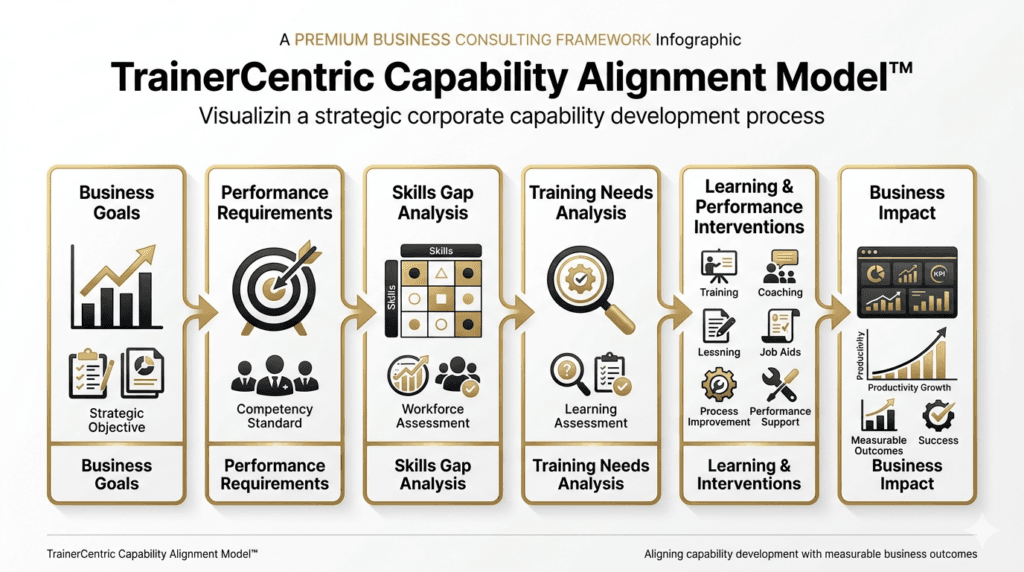
Stage 1: Business Goal — Every L&D initiative must connect to a business objective. Increase revenue. Improve customer satisfaction. Reduce compliance incidents. Accelerate leadership succession. Without this anchor, training becomes activity without purpose.
Stage 2: Performance Requirement — What must people do differently to achieve the business goal? This is a performance question, not a training question. Defining the required behaviour or output is the bridge between business strategy and people development.
Stage 3: Skills Gap Analysis — Now we assess capability. What competencies, knowledge, and skills are required to perform at the required standard? Where does the current workforce fall short? The gap analysis provides the evidence base.
Stage 4: Training Needs Analysis — With the gap identified, we investigate the performance context. Is the gap caused by lack of knowledge, skill, or something else? What interventions will address the root causes? Who needs support?
Stage 5: Learning Intervention — Only at this point is a solution designed. It may be a structured training programme, coaching, mentoring, revised job aids, process improvement, or a combination.
Stage 6: Business Impact — Has the business goal been achieved? Measured against the original business requirement, the intervention should produce a demonstrable change in performance and a measurable improvement in the outcome that prompted the diagnostic work in the first place.
Should You Use Skills Gap Analysis or Training Needs Analysis?
Use this decision framework to determine which process — or combination of processes — your situation requires.
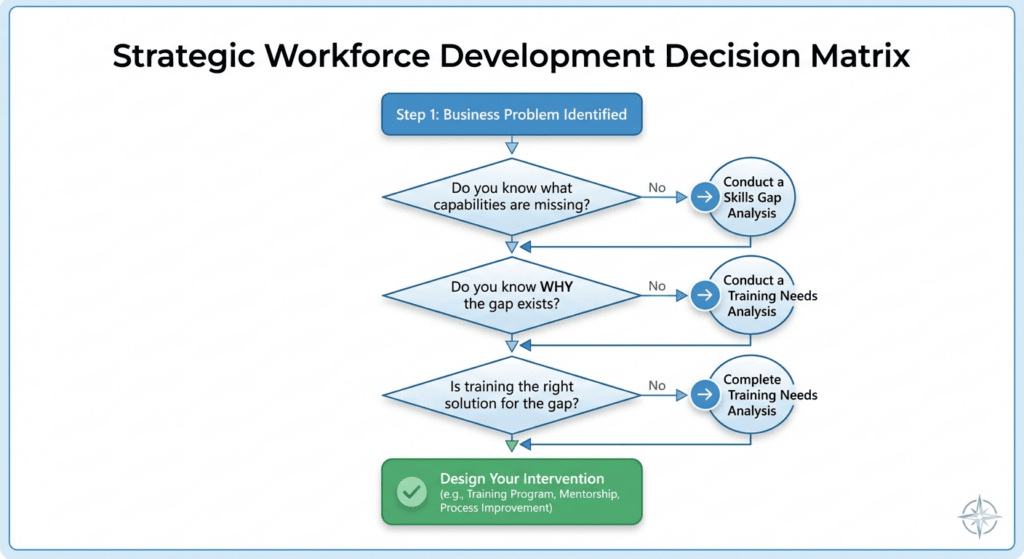
In practice, most strategic L&D initiatives require both processes. The decision tree is most useful when resources are limited and practitioners need to prioritise which diagnostic to run first.
What Is a Skills Gap Analysis?
A Skills Gap Analysis — also referred to as a skills gap assessment — is a systematic process used to compare current employee capability against the capability required to meet business objectives. It identifies where a shortfall exists — not why it exists or what should be done about it.
The process typically moves through three stages:
Current State Assessment
What skills, knowledge, and behaviours do employees currently demonstrate? This is measured through observation, assessments, manager evaluations, or structured competency reviews.
Desired State Definition
What skills, knowledge, and behaviours are required for effective performance? This is defined through role profiles, competency frameworks, job task analysis, or strategic workforce planning documents. See our guide on
For a practical approach to defining required performance, see our guide on Job Task Analysis: How to Break Down Any Role for Training Design.
Gap Identification
Where does a measurable difference exist between current and desired capability? This is the gap — the delta between where people are and where they need to be.
Practical Examples Across Functions
Sales Teams: A skills gap analysis might reveal that a sales team demonstrates strong relationship-building skills but lacks the consultative questioning techniques needed for a new solution-selling approach. The gap is clear, measurable, and tied to a business requirement.
Leadership Development: A leadership pipeline review might surface that high-potential managers rate well on technical expertise but score below the required standard on strategic thinking and commercial acumen — capabilities the organisation will need in its next wave of senior leaders.
Customer Service: A competency assessment might show that frontline agents handle routine enquiries effectively but lack the empathy and de-escalation skills required for complex complaint management.
Technical Roles: A digital transformation initiative might reveal that a significant proportion of the workforce lacks proficiency in a new enterprise platform — a gap that poses a direct risk to implementation timelines.
Common Outputs of a Skills Gap Analysis
- Skills inventory — a comprehensive record of current capability levels across the workforce
- Competency ratings — individual or team scores against defined competency standards
- Gap reports — structured summaries showing where shortfalls exist and by how much
- Capability heat maps — visual tools that show gap severity across teams, roles, or departments
A well-conducted Skills Gap Analysis tells you what is missing. It does not tell you why it is missing or what to do about it. That is where Training Needs Analysis begins.
What Is a Training Needs Analysis?
A Training Needs Analysis (TNA) is a systematic process used to determine whether training is required, who needs it, what should be taught, and how it should be delivered.
Training Needs Analysis goes considerably further than identifying skill deficits. It investigates the full performance context — examining knowledge gaps, skill gaps, environmental factors, motivational issues, and business requirements — before recommending a solution.
According to the ATD (Association for Talent Development), an effective TNA examines performance at three levels: the organisation, the job or role, and the individual. This multi-level approach, also described by Dana Robinson and James Robinson in their foundational work on performance consulting, prevents L&D teams from jumping to training solutions before understanding the true cause of a performance problem.
For a comprehensive walkthrough of the process, see our [INTERNAL LINK: Ultimate Guide to Training Needs Analysis] and How to Conduct a Training Needs Analysis in Five Steps
A Training Needs Analysis typically addresses the following questions:
- Is there a genuine performance problem, or is this a perception issue?
- Is the gap caused by a lack of knowledge or skill — or by something else (environment, motivation, resources, process)?
- Who specifically needs support, and at what level?
- What content or capability development is required?
- What delivery method is most appropriate given the audience, context, and constraints?
- What does success look like, and how will it be measured?
Training Needs Analysis: Beyond Skills
Consider a scenario where complaint handling scores are declining. A skills gap analysis might confirm that agents lack certain complaint management skills. But a training needs analysis would go deeper:
- Are agents aware of the expected standard? (Knowledge)
- Do they have the skills to meet it? (Capability)
- Do the job aids and scripts support them? (Environment)
- Do managers model and reinforce the right behaviours? (Culture)
- Are there system or process barriers preventing effective complaint resolution? (Resources)
Training may address the knowledge and capability elements. But without resolving the environmental and managerial factors, even excellent training will underperform.
For a detailed breakdown of what each level investigates, see The 3 Levels of Training Needs Analysis
Skills Gap Analysis vs Training Needs Analysis — The Key Differences
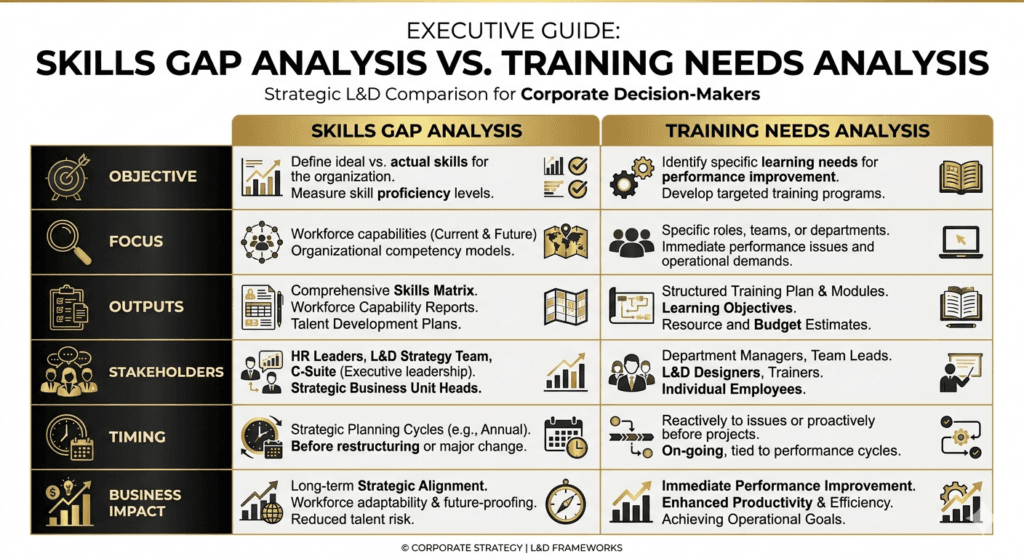
The table below summarises the core distinctions between the two processes. Three additional rows have been added to address the most common follow-up questions.
| Dimension | Skills Gap Analysis | Training Needs Analysis |
| Primary Objective | Identify capability shortfalls | Determine appropriate interventions |
| Main Question | What skills are missing? | What should be done about it? |
| Focus | Current vs required capability | Performance context and root causes |
| Scope | Workforce, team, or role level | Individual, role, or organisational level |
| Outputs | Skills inventory, gap reports, heat maps | Training recommendations, learning design briefs |
| Timing | Before strategic decisions or investment | Before designing or commissioning training |
| Stakeholders | HR, workforce planners, senior leadership | L&D, line managers, subject matter experts |
| Business Impact | Informs workforce strategy | Informs learning and performance strategy |
| Data Sources | Competency assessments, role profiles, performance data | Performance data, interviews, observations, job analysis |
| Decision Supported | Where to invest in capability development | What type of intervention to design and deliver |
| Typical Trigger | Future capability needs or strategic change | Current performance issues or specific learning event |
| Can It Stand Alone? | Yes — useful for workforce planning without a training programme | Yes — useful for compliance or reactive performance needs |
| Primary Output User | HR / Workforce Planning teams | L&D professionals and line managers |
The key insight: Skills Gap Analysis is primarily a diagnostic tool operating at the capability level. Training Needs Analysis is primarily an analytical tool operating at the performance level.
When to Use a Skills Gap Analysis
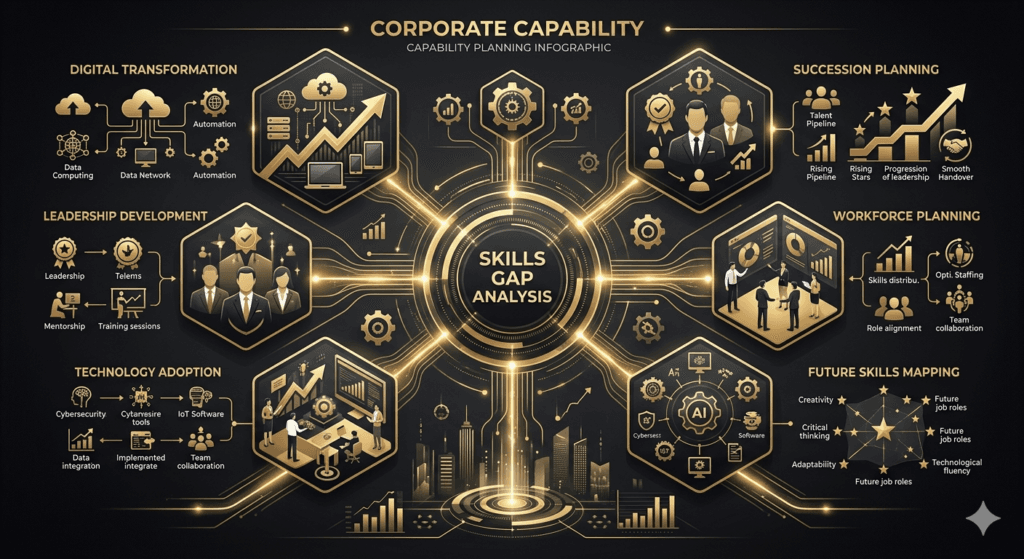
A Skills Gap Analysis is most valuable when an organisation needs to understand the state of its capability relative to a future requirement. It is inherently forward-looking and strategic.
Digital Transformation: As organisations invest in new technologies and operating models, understanding which capabilities are present and which are absent is essential before making investment decisions. A skills gap analysis maps the capability landscape and informs both hiring and development priorities.
Leadership Pipeline Development: Identifying which future leaders have the competencies required for senior roles — and where the shortfalls lie — enables targeted succession planning and development investment. Without this diagnostic step, high-potential programmes risk developing the wrong things.
Succession Planning: When critical roles need to be filled internally, a skills gap analysis identifies whether internal candidates are ready now, nearly ready, or significantly underprepared — enabling the organisation to plan development timelines and contingency options.
Technology Adoption: Deploying new enterprise systems, platforms, or tools requires understanding the baseline proficiency of the affected workforce. A skills gap analysis prevents costly assumptions about readiness.
Future Workforce Planning: Strategic workforce planning requires organisations to anticipate future capability requirements and assess current capability against them. Skills gap analysis provides the diagnostic foundation for long-term workforce investment decisions.
Organisations often begin with a Skills Gap Analysis or skills gap assessment because it produces data that is immediately useful for multiple stakeholders: HR business partners, workforce planners, senior leaders, and L&D teams alike. It answers a question that exists independently of any specific training initiative.
When to Use a Training Needs Analysis
A Training Needs Analysis is most valuable when a specific performance problem or organisational change requires a deliberate learning and development response.
New Product Launch: When a sales or customer-facing team needs to build knowledge and confidence around a new product or service, a TNA determines what they need to know, what they can already do, and what format of support will work best in context.
Compliance Training: Before designing mandatory compliance programmes, a TNA establishes the current state of understanding, identifies where risk is highest, and ensures the programme targets genuine knowledge gaps rather than delivering content people already know.
Role Transition: When employees move into new roles — through promotion, restructuring, or lateral moves — a TNA identifies what they need to learn, what they can already apply from previous experience, and what support they need during the transition period.
Performance Problems: When an individual or team is underperforming, a TNA investigates whether the cause is a knowledge or skill deficit (suggesting a training solution), or something else — such as unclear expectations, inadequate resources, or process failures — suggesting a non-training solution.
For a thorough discussion of when non-training solutions are the right answer, see our article When Training Is Not the Answer.
Process Changes: When business processes change significantly, a TNA determines which roles are affected, what knowledge and procedural understanding needs to be built, and how quickly people need to be performing to the new standard.
Training Needs Analysis is fundamentally solution-focused. It takes a defined problem or change requirement and asks: what is the most effective way to develop the knowledge, skills, or capability needed to address it?
Can You Have One Without the Other?
This is one of the most practical questions L&D practitioners face. The answer depends entirely on the context.
Scenario A: Skills Gap Analysis Without Training Needs Analysis
A strategic workforce planning exercise may require a comprehensive skills gap analysis to inform talent acquisition, restructuring, and L&D investment priorities — without any specific training programme being the immediate output. In this case, Skills Gap Analysis operates legitimately as a standalone tool.
Scenario B: Training Needs Analysis Without a Formal Skills Gap Analysis
A regulatory body announces a mandatory compliance requirement. The organisation must ensure all relevant employees have the required knowledge and understanding by a defined date. There is no skills gap to analyse — the content is defined by the regulation and the requirement applies universally. Here, TNA operates independently to determine delivery approach and verify understanding.
Scenario C: Both Together
For most strategic L&D initiatives — developing a new sales capability, building a leadership pipeline, supporting a culture change, or responding to a significant performance trend — both processes are required and complement each other directly.
| The Skills Gap Analysis answers: What capability is missing and by how much? The Training Needs Analysis answers: Why is it missing, who is most affected, and what should we do about it? Together, they provide the diagnostic rigour that separates evidence-based L&D from assumption-based training. |
A Real Workplace Example
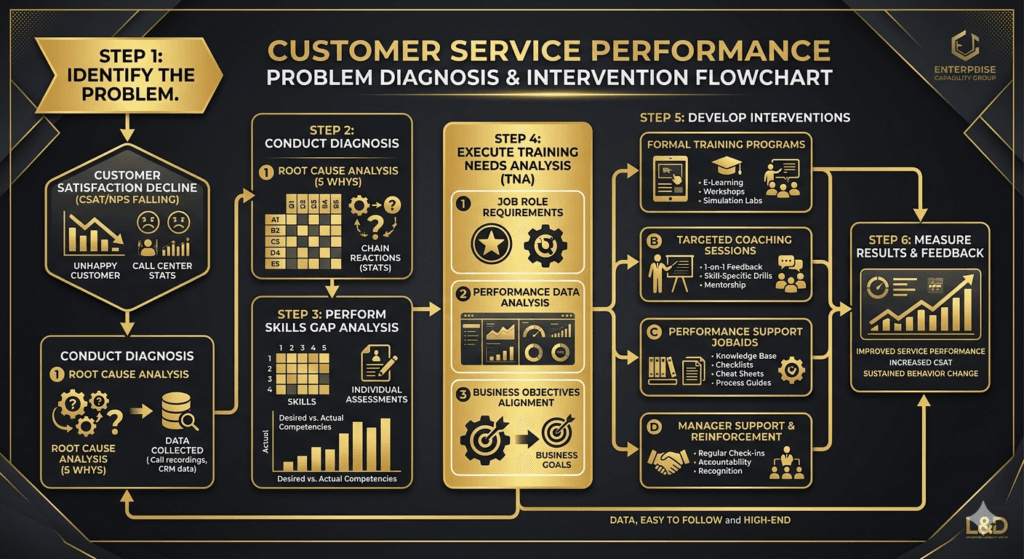
The Scenario
A retail financial services organisation notices a sustained decline in customer satisfaction scores over a six-month period, specifically in relation to complaint handling. The Contact Centre Manager raises the issue with the L&D team and requests complaint handling training.
Step 1: Skills Gap Analysis
The L&D team resists the temptation to immediately design a training programme and instead conducts a Skills Gap Analysis. They assess current performance against two key competency areas:
- Product Knowledge — the ability to accurately explain products, terms, and resolution options
- Complaint Handling — the ability to acknowledge, de-escalate, resolve, and follow up complaints effectively
The assessment (conducted through a combination of call monitoring, manager ratings, and a short structured knowledge check) reveals: 60% of agents fall below the required standard on product knowledge; 45% fall below the required standard on complaint handling; performance varies significantly by team and tenure, with newer agents showing the largest gaps.
The gap is confirmed and quantified. But the Skills Gap Analysis does not explain why these gaps exist or what the best response is.
Step 2: Training Needs Analysis
The L&D team now conducts a Training Needs Analysis, investigating the performance context behind the gaps. Through stakeholder interviews, a focus group with agents, and a review of quality monitoring data, they uncover:
- Knowledge gap — product information is spread across multiple internal systems, and agents cannot locate accurate information quickly enough during live calls
- Outdated job aids — the complaint handling quick-reference guide was last updated 18 months ago and does not reflect current policy or resolution options
- Inconsistent manager coaching — some team leaders provide structured complaint handling coaching; others do not, creating significant variation in agent practice
- Training gap — new agents receive product induction but no structured complaint handling module as part of their onboarding
The Solution
Based on the combined outputs of the Skills Gap Analysis and Training Needs Analysis, the L&D team recommends a multi-component intervention:
- A structured complaint handling module for all agents, with additional onboarding content for new starters
- Revised and updated job aids, consolidating product information into a single, searchable resource
- A team leader coaching toolkit with a structured observation and feedback framework
- Monthly quality calibration sessions to ensure consistent standards across teams
Training alone — the original request — would have addressed part of the problem. The combined diagnostic approach produced a solution that addressed all of the root causes.
If you are designing a similar intervention, our guide on How to Conduct a Training Needs Analysis in Five Steps covers each diagnostic step in detail.
Common Mistakes Organisations Make
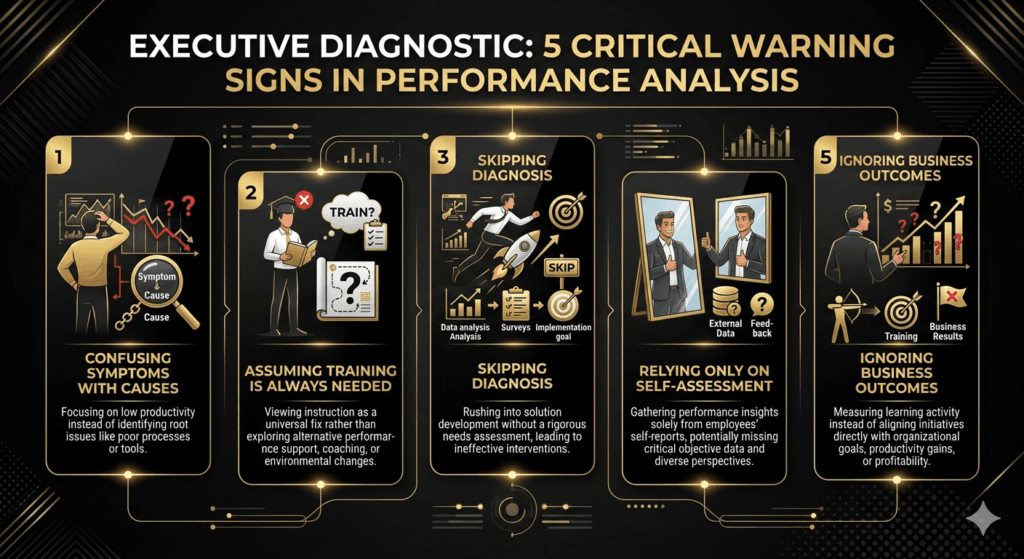
Confusing symptoms with skill gaps: Declining performance metrics are symptoms, not diagnoses. Customer satisfaction scores, sales conversion rates, or error frequencies tell you that something is wrong. They do not tell you what is wrong at the capability level. Treating symptoms as gaps leads to mis-targeted interventions.
Assuming every gap requires training: Training is one possible intervention — not the default solution. Treating every performance problem as a training problem wastes budgets and weakens L&D credibility. Research in Human Performance Improvement consistently shows that a significant proportion of performance problems are caused by environmental factors, not capability deficits.
Skipping diagnosis entirely:
| One of the most damaging habits in L&D is accepting a request for training without diagnosis. It turns L&D into an order-taking function rather than a performance consulting partner. Without knowing what is missing and why, even a well-designed training programme is a guess — and organisations that guess consistently erode the credibility of their L&D function. |
Using self-assessment alone: Self-reported competency ratings are useful as one data point but are rarely sufficient on their own. People consistently overestimate their capability in areas where they lack awareness of what good looks like. Triangulating self-assessment with observed performance, manager ratings, and objective measures produces a more accurate picture.
Ignoring business outcomes: Skills Gap Analysis and Training Needs Analysis should always connect back to a business goal. Capability development for its own sake produces activity, not performance improvement. The question is never “what training can we deliver?” — it is always “what business outcome are we trying to achieve?”
Treating competency ratings as evidence: A manager rating an employee as “3 out of 5” on a competency is an opinion, not a measurement. Competency ratings can be useful starting points, but they require validation through behavioural observation, work output analysis, or structured assessment before being used as the basis for significant investment decisions.
How to Conduct Both Together
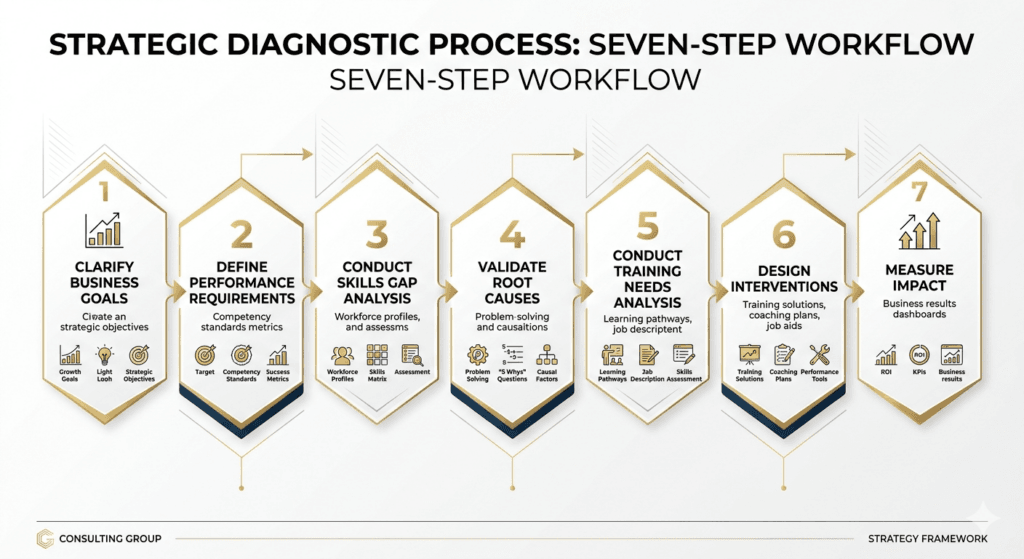
The following step-by-step process integrates Skills Gap Analysis and Training Needs Analysis into a single diagnostic workflow.
- Clarify business goals — Begin with the strategic or operational outcome the organisation is trying to achieve. Be specific: not “improve performance” but “increase first-contact resolution by 15% within six months.”
- Define performance requirements — Identify what employees need to do to achieve the business goal. Describe required behaviours, outputs, and standards in observable terms.
- Conduct Skills Gap Analysis — Assess current capability against defined performance requirements using a combination of data sources: competency assessments, manager ratings, call monitoring, work output review, and structured observations. For guidance on building the right role profile, see our Job Task Analysis: How to Break Down Any Role for Training Design.
- Validate root causes — Do not assume the gap is caused by a lack of training. Interview stakeholders, observe performance in context. Ask: is this a can’t do problem (training may help) or a won’t do or doesn’t have the tools to do problem (training will not help)?
- Conduct Training Needs Analysis — If training is indicated, establish what content is required, who needs it, at what level, in what format, and within what timeframe. Our detailed guide on How to Conduct a Training Needs Analysis in Five Steps walks through each stage.
- Design interventions — Design the solution based on the combined diagnostic findings. The solution may be a formal training programme, performance support tools, coaching, process changes, or a blend of approaches.
- Measure impact — Define success measures before the intervention is delivered. Measure at the behaviour level (are people performing differently?) and the business outcome level (has performance improved against the original goal?).
For guidance on presenting your findings to the business before and after the intervention, see How to Present TNA Results to Senior Stakeholders.
Conclusion
Skills Gap Analysis vs Training Needs Analysis: they are not the same process. They serve different purposes, ask different questions, and produce different outputs. Treating them as interchangeable is one of the most common — and most costly — mistakes in workplace learning and development.
| A Skills Gap Analysis identifies what is missing. It compares current capability against required capability and produces a clear, evidence-based picture of where shortfalls exist. A Training Needs Analysis determines what should be done about it. It investigates the root causes of performance gaps, considers the full performance context, and recommends the most appropriate interventions — which may or may not include training. |
The most effective L&D teams use both processes together rather than treating them as interchangeable or, worse, skipping both and jumping straight to a solution.
The TrainerCentric Capability Alignment Model™ provides a structured way to integrate both processes into a single diagnostic workflow — one that connects capability development directly to business outcomes and ensures that every intervention is grounded in evidence rather than assumption.
One of the fastest ways to waste a training budget is to confuse a capability gap with a training need. The first tells you what is missing. The second tells you whether training is actually the right response. High-performing L&D teams understand the difference — and use both the skills gap assessment and the Training Needs Analysis together as part of a disciplined, evidence-based approach to performance improvement.
Before you approve a training solution, make sure you understand both the capability gap behind it and the performance context that surrounds it.
Frequently Asked Questions
What is the difference between skills gap analysis and training needs analysis?
A Skills Gap Analysis (or skills gap assessment) identifies the difference between current and required capability. A Training Needs Analysis investigates the causes of a performance gap and determines the most appropriate intervention. Skills Gap Analysis tells you what is missing; Training Needs Analysis tells you what to do about it.
Can skills gap analysis identify training needs?
It can indicate that training may be needed, but it cannot confirm this on its own. A skills gap is not the same as a training need. Training is appropriate when the gap is caused by a genuine lack of knowledge or skill. When the gap has other causes — environmental, motivational, or structural — training will not close it. A Training Needs Analysis is required to make this determination.
Which comes first: skills gap analysis or training needs analysis?
In most strategic L&D initiatives, Skills Gap Analysis comes first. It identifies and quantifies the capability gap, which then informs and focuses the Training Needs Analysis. However, in some contexts — such as a compliance requirement or reactive performance problem — a TNA may begin without a formal Skills Gap Analysis.
Do all skills gaps require training?
No. A skills gap confirms that a capability shortfall exists. It does not explain why. If the gap is caused by a lack of knowledge or practice opportunity, training may help. If it is caused by poor job design, lack of resources, unclear expectations, or inadequate feedback, training will not resolve it.
Who should conduct a skills gap analysis?
Skills Gap Analysis is most effectively conducted as a collaboration between L&D professionals, HR business partners, line managers, and subject matter experts. L&D brings the diagnostic methodology; managers bring contextual knowledge; subject matter experts define the required capability standard.
How often should organisations perform skills gap analysis?
Most organisations benefit from conducting a formal skills gap analysis or skills gap assessment when significant strategic or operational changes are planned — digital transformation, market expansion, leadership succession, or major process changes. A lighter-touch capability review may be conducted annually as part of the performance and talent management cycle.
References
- Telling Ain’t Training — Harold D. Stolovitch and Erica J. Keeps
- Design for How People Learn — Julie Dirksen
- Performance Consulting — Dana Robinson and James Robinson
- ATD Handbook for Talent Development and Training
- The Six Disciplines of Breakthrough Learning — Roy Pollock, Andrew Jefferson, and Calhoun Wick
Further Readings
- Ultimate Guide to Training Needs Analysis
- How to Conduct a Training Needs Analysis
- Performance Consulting Explained: When Training Is NOT the Answer
- Job Task Analysis
- How to Present TNA Results to Senior Stakeholders
- The 3 Levels of Training Needs Analysis: Organisation, Task & Person Analysis
- ADDIE Model Explained
- Learning Objectives Guide
- Training Needs Analysis Template: 1 Free Download for L&D Teams
- Focus Groups and Interviews for Training Needs Assessment: A Practical Field Guide
- 12 Facilitation Skills for Corporate Trainers: The Complete Guide
- Training Needs Analysis Questionnaire: Complete Guide (75 Questions & Free Template)
- Training Needs Analysis Checklist: A Practical Step-by-Step Guide

Tulip Ghosh is a Learning and Development professional who designs impactful, learner-centric experiences rooted in behavioral insight and real-world application. She is passionate about improving learner engagement and translating complex ideas into practical training solutions. A thoughtful writer at heart and with experience of a decade in Learning and Development domain, she brings a simple, grounded perspective to the evolving world of workplace learning. Reach out to her on her Linkedin Profile from here.