How to run qualitative TNA that uncovers the real reasons performance is falling short — with question banks, a moderator script, a proprietary framework, and a worked case study.
Introduction
Focus groups and interviews are the qualitative backbone of a credible training needs assessment (TNA). They don’t replace surveys, performance data, or task analysis — they explain them. A survey tells you 62% of supervisors rate their team’s delegation skills as weak. An interview tells you it’s because supervisors were promoted from individual-contributor roles eighteen months ago and have never been taught how to let go of tasks they used to own personally. That second sentence is what actually gets you a training design brief that works.
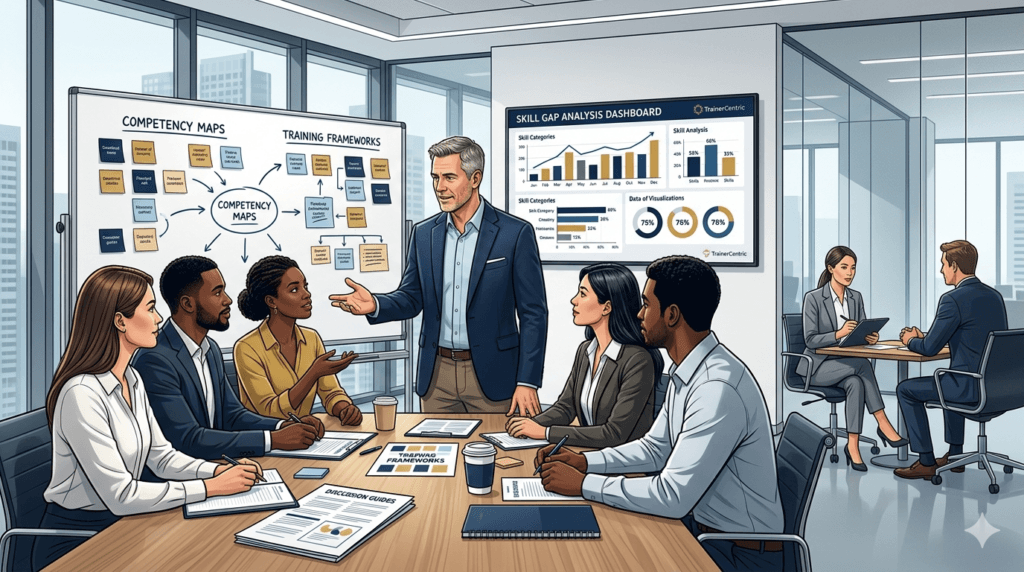
Here is an example.
Six months ago, a mid-sized BPO rolled out a new “customer empathy” training module across its entire frontline team. Attendance was good. Feedback forms were positive. Trainers delivered exactly what the curriculum called for. Three months later, customer satisfaction scores hadn’t moved, and escalation volumes were actually up.
When the L&D head finally sat down with team leaders and a sample of agents, the real story came out in about forty minutes. Agents weren’t struggling with empathy. They were struggling with a billing system that took eleven clicks to process a simple refund, and a script that forced them to apologise for delays they had no power to fix. The training had targeted a skill gap that didn’t exist, while the actual problem — a process and tooling issue — went untouched.
This is the single most common failure pattern in corporate L&D: building training on assumptions instead of evidence. A survey would have told this organisation what employees thought about the new module. It would never have told them why customer satisfaction wasn’t improving. Only a conversation could do that.
This guide is written for L&D professionals, training managers, HR business partners, OD consultants, instructional designers, and freelance facilitators who need to run focus groups and interviews that produce usable, defensible findings — not just a stack of sticky notes. By the end, you’ll have:
- Guidance specific to running these sessions in Indian workplace cultures
- A clear framework — including the TrainerCentric QUAL-TNA™ Framework — for choosing and sequencing qualitative TNA methods
- A six-step process for planning and running a TNA focus group
- A complete stakeholder interview process, from mapping to analysis
- 45 ready-to-use questions across both methods, organised by audience and category
- A reusable focus group moderator script you can adapt for your next session
- A practical method for turning raw transcripts into training recommendations
- A mixed-methods comparison table covering surveys, focus groups, interviews, and observation
What Research Says About Qualitative TNA
One of the most persistent criticisms of focus groups and interviews as TNA methods is that they are “just opinions.” The evidence base suggests otherwise. Decades of HR and L&D research consistently shows that qualitative inquiry, when properly structured, produces more actionable diagnoses than quantitative data alone — particularly when the performance problem is rooted in context, culture, or process rather than simple knowledge deficits.
| Source | Key Finding | TNA Implication |
| CIPD Learning & Development Surveys (multiple waves) | L&D professionals who combine qualitative stakeholder conversations with quantitative data are significantly more likely to report that training interventions produce measurable performance improvement. | Stakeholder interviews and focus groups are not supplementary — they are the mechanism that validates whether quantitative signals point to a training solution or something else. |
| ATD State of the Industry Reports | Organisations with mature TNA practices — defined partly by systematic stakeholder engagement — consistently show higher rates of learning transfer and post-training performance change. | Structured qualitative inquiry is a marker of TNA maturity, not a luxury for well-resourced L&D teams. |
| SHRM Research on Performance Improvement | The majority of performance gaps that initially appear to be training problems are partly or wholly attributable to environmental, process, or motivational factors — findings that surface in conversation but not in skills assessments. | Qualitative methods are the primary tool for distinguishing a genuine skill gap from a process, resources, or incentive gap — the distinction that determines whether training will produce ROI. |
| Brinkerhoff’s Success Case Method (2003) | Post-training interviews with extreme performers (top and bottom) reveal the environmental and managerial factors that determine whether training transfers — factors invisible to pre-training TNA surveys. | Interview-based qualitative inquiry remains essential after training, not only before it, to close the design feedback loop. |
| Creswell & Plano Clark — Mixed Methods Research (2017) | In applied organisational settings, qualitative methods consistently outperform quantitative-only approaches at identifying root causes of performance variance. | The TNA context is a prototypical applied setting: qualitative methods are not second-best to surveys — they answer a different and often more critical set of questions. |
What the research consistently shows is that the question is not whether qualitative methods are valid — it’s whether the organisation’s L&D practice is sophisticated enough to use them well. This guide is designed to close that gap.
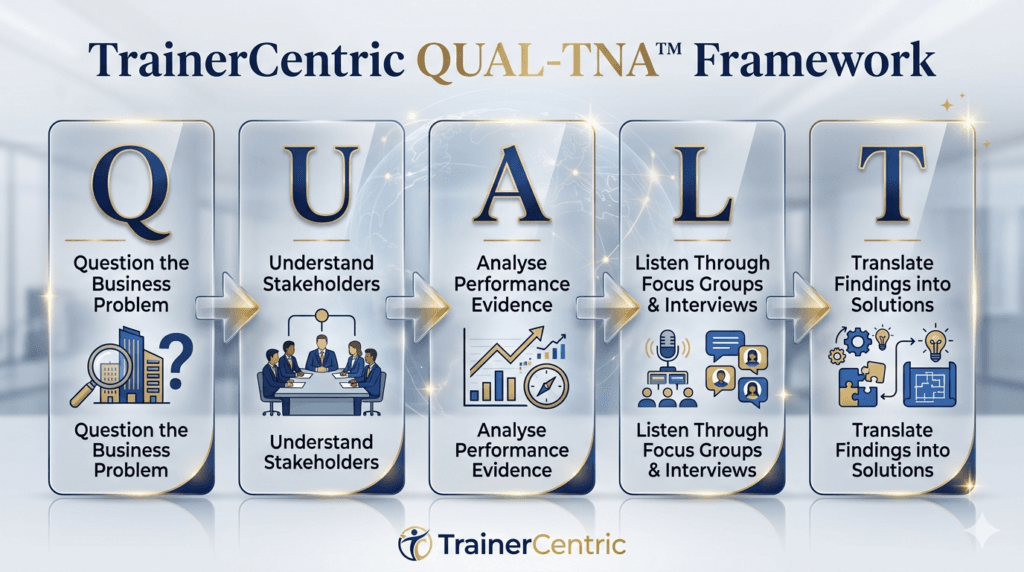
TrainerCentric QUAL-TNA™ Framework
| Stage | Name | What You Do |
| Q | Question the Business Problem | Before designing a single question, interrogate the presenting problem. What metric is off-target? What’s the cost of inaction? Is this definitely a capability issue, or could it be a process, motivation, or resource issue? Define the objective in one sentence that names a population, a symptom, and an open question about cause — never an assumed answer. |
| U | Understand Stakeholders | Map who holds insight (frontline employees, managers, SMEs) and who holds influence (executives, business sponsors). Each group gets a different conversation format — focus groups for peer-level shared experience, semi-structured interviews for depth, authority, or sensitivity. Build your stakeholder map before scheduling a single session. |
| A | Analyse Performance Evidence | Gather existing data before you run a single conversation — error logs, performance metrics, LMS completion records, customer satisfaction data, turnover rates. Use this evidence to build your discussion guide and to validate or challenge what you hear. Qualitative inquiry without a quantitative anchor produces rich anecdotes with no way to assess their representativeness. |
| L | Listen Through Structured Sessions | Run focus groups and interviews using the structured approach in this guide. Start with 2-3 senior stakeholder interviews to scope the problem, then 2-4 peer-level focus groups to find shared patterns at scale, then follow-up interviews to resolve contradictions or chase sensitive threads. Code and theme as you go — don’t save all analysis for the end. |
| T | Translate Findings into Recommendations | Convert validated themes into explicit intervention recommendations that name the type — training, coaching, job aid, process fix, tooling change. A theme about an outdated job aid is not a training recommendation. A theme about managers not reinforcing skills is not a learning design problem — it’s a change management problem. Be explicit about what training can and cannot fix. |
The QUAL-TNA™ Framework integrates directly with TrainerCentric’s broader DVPD Framework™ (Diagnose → Validate → Prioritise → Design): the QUAL-TNA stages map primarily to the Diagnose and Validate phases, ensuring that focus groups and interviews feed into — rather than substitute for — a full TNA methodology.
What Are Focus Groups in Training Needs Assessment?
A focus group is a facilitated discussion with a small, deliberately selected group of employees, designed to surface shared experiences, disagreements, and patterns around a specific performance or capability question. In a TNA context, the goal isn’t consensus — it’s range. You want to hear where people agree, where they don’t, and what assumptions surface when employees hear each other’s answers.
The value of a focus group over a one-on-one interview is interaction effect: one participant’s comment about a broken handoff process often triggers three more examples from people who’d never have volunteered the story unprompted. That dynamic is also the method’s biggest risk, which we’ll cover in the challenges section.
Typical Focus Group Element
| Focus Group Element | Typical Practice |
| Group size | 6–8 participants is the sweet spot. Below 5, the discussion thins out. Above 10, quieter voices disappear and the session is hard to manage in 60–90 minutes. |
| Duration | 60–90 minutes. Anything shorter rushes the warm-up; anything longer fatigues participants and degrades data quality. |
| Composition | Same level, mixed function — e.g., all frontline agents across three product lines — to avoid hierarchy suppressing honesty. |
| Facilitator | A neutral moderator who is not the participants’ manager and ideally not from the participants’ own department. |
| Setting | A private room or breakout call with recording (with consent), away from open-plan seating where managers can overhear. |
| Number of groups | Run 2–4 groups per stakeholder segment until you start hearing the same themes repeat — that’s your signal of saturation. |
Use focus groups when you need to understand shared experience across a role or team — how a process actually works on the ground, where a skill gap shows up in daily tasks, or how a recent change has landed with the people living it. They’re a poor fit for sensitive, individually risky topics and a poor fit when you need depth from a single highly specialised role, where one-on-one interviews do better.
What Are Interviews in Training Needs Assessment?
An interview is a one-on-one (occasionally one-on-two) conversation designed to go deep with a single perspective — usually because that perspective carries authority, sensitivity, or specialised knowledge that a group setting would suppress or dilute.
Structured, Semi-Structured, and Unstructured Interviews
Structured interviews use a fixed question set, asked in the same order, with little or no deviation. They’re useful when you’re interviewing many people in the same role and need comparable, codable data. The trade-off is depth: you get consistency, not discovery.
Semi-structured interviews use a core set of questions with built-in room to probe. This is the default mode for most TNA interviews. You arrive with 8–10 anchor questions but follow interesting threads wherever the conversation leads. Most of what’s in this article assumes semi-structured interviewing.
Unstructured interviews start from a topic, not a question list, and let the conversation find its own shape. These work well in exploratory, early-stage TNA before you’ve even scoped the assessment — but they produce data that’s hard to compare across interviews, so they’re rarely your main data-collection method.
Interviewing Different Stakeholder Groups
Employee interviews focus on day-to-day task reality: what’s hard, what takes longer than it should, where the employee feels under-equipped.
Manager interviews focus on team-level patterns: where the manager sees performance variance across their team, what they’ve already tried, and what they believe is the cause.
Executive interviews focus on the business case: what metric is moving in the wrong direction, what the cost of inaction looks like, and what “success” means to the person signing off the budget. These conversations are short (20–30 minutes), strategic, and rarely involve task-level detail.
SME (subject matter expert) interviews focus on technical accuracy: what “good” actually looks like in a task, what the common failure modes are, and what a credible assessment or simulation should test for. SMEs are also your best source for spotting a fake skill gap — a problem that looks like a training issue but is actually a tooling, staffing, or policy issue.
Focus Groups vs Interviews: Which Should You Use?
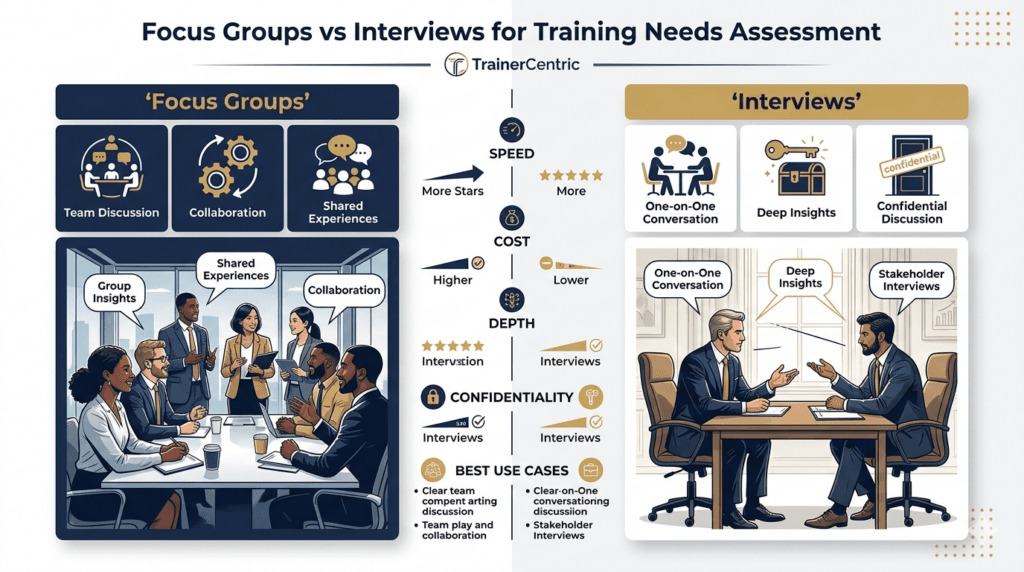
Both methods are qualitative, both rely on skilled facilitation, and both can be badly run. But they’re not interchangeable. Here’s how they compare on the dimensions that actually drive your method choice.
| Dimension | Focus Groups | Interviews |
| Depth per person | Lower — airtime shared across 6–8 | Higher — full session belongs to one |
| Breadth per hour | Higher — multiple viewpoints at once | Lower — one perspective at a time |
| Speed | Faster — one session covers 6–8 | Slower — same coverage needs 6–8 sessions |
| Confidentiality | Limited — peers hear each other | High — disclosures stay private |
| Best for | Shared task/process experience across peers | Sensitive topics, senior stakeholders, SME depth |
Use focus groups only when investigating shared process or task experience across a peer group, the topic isn’t personally sensitive, and you need breadth quickly. Use interviews only when talking to executives, when topics involve performance concerns about named individuals, or when hierarchy makes a mixed-level session unsafe. Use both together — the standard, and strongest, approach for any mid-to-large TNA.
Combining Surveys, Focus Groups, and Interviews in Training Needs Assessment
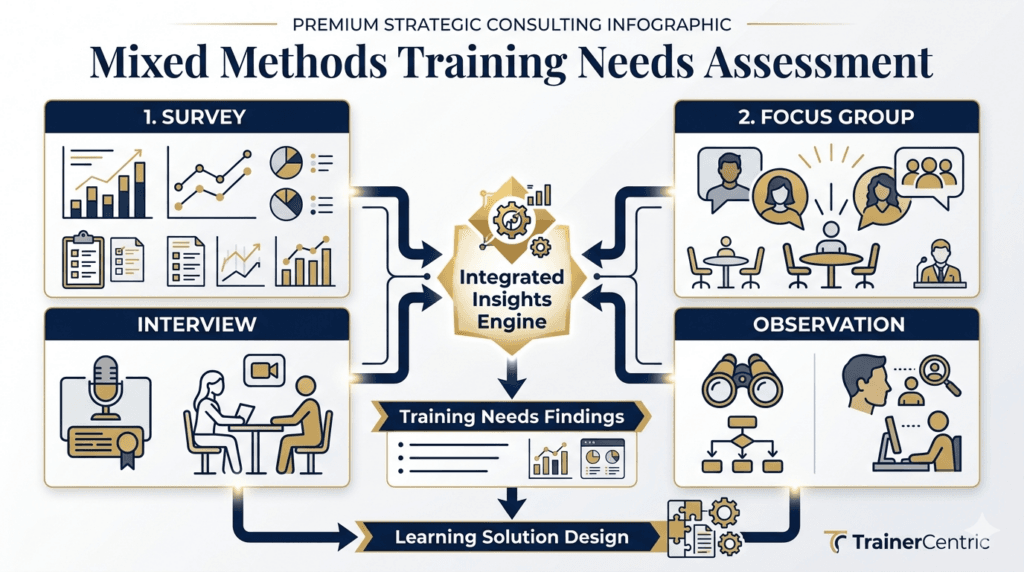
Qualitative methods don’t exist in isolation — they sit inside a broader TNA data-collection ecosystem alongside surveys, observation, and performance data. Understanding where each method earns its place is what separates a well-designed TNA from one that either drowns in data or runs out of depth.
The table below maps the four primary TNA data-collection methods to their optimal use cases, keywords they help capture, and their key limitations.
| Method | Best For | What It Captures That Others Miss | Key Limitation |
| Survey / Questionnaire | Large-scale data across a whole population; prioritising training needs by volume | Quantified patterns, statistical significance, benchmarking — the “how many” and “how often” questions | Tells you what, not why. Low response rates can skew findings. Pre-supposes what to ask. |
| Focus Group | Shared experience across a peer group; surface-level root causes; early-stage hypothesis testing | Group-generated insight — the trigger effect where one story opens up three others. Peer validation of themes. | Groupthink risk. Low confidentiality. Dominant voices can distort data. |
| Interview | Deep insight from a single perspective; sensitive topics; senior or specialist stakeholders | The why behind the what — root cause attribution, motivation factors, environmental barriers invisible to surveys | Time-intensive. Single-perspective bias. Interviewer skill heavily determines data quality. |
| Observation / Job Shadow | Real behaviour on the job; gap between stated practice and actual practice; task-level accuracy | The doing, not just the saying — what actually happens on-task versus what employees report in interviews | Observer effect alters behaviour. Time and access-intensive. Hard to scale. |
The strongest TNA designs use a mixed-methods sequence: survey first to quantify patterns and prioritise where to dig; focus groups next to understand the shared experience behind the survey data; targeted interviews to chase outliers, sensitive topics, or stakeholder-specific depth; and observation where the presenting problem is task-level and self-report is unreliable.
Qualitative vs quantitative TNA is a false choice. The question is not which method is “better” — it’s which method answers the question currently in front of you. The TrainerCentric QUAL-TNA™ Framework is designed to sequence these methods deliberately rather than defaulting to whichever feels most familiar.
Internal Resource: Read our complete guide to Training Needs Analysis Methods
Why Qualitative Methods Matter in TNA
Surveys are efficient at scale, but they’re built to answer what — what percentage of people rate a skill as weak, what percentage feel under-trained. Focus groups and interviews answer why, and why is what determines whether your intervention is training, coaching, a process fix, a tooling fix, or a policy change.
Consider how the same survey finding splits into five completely different root causes once you ask why:
| Survey Finding | Possible Root Cause Surfaced in Interview/Focus Group |
| “68% rate their negotiation skills as below average” | Skill gap — never received negotiation training (true training need) |
| “Sales cycle time has increased 20% this quarter” | Process issue — new approval workflow adds three extra sign-offs |
| “Team reports low confidence using the new CRM” | Resource constraint — no job aid exists; the one training session was six months before go-live |
| “Engagement scores dropped after the reorg” | Motivation issue — unclear new reporting lines, not a capability gap at all |
| “Quality defects rose on the new production line” | Process/equipment issue — machine calibration drift, not an operator skill gap |
A short case example: a manufacturing client came to TrainerCentric believing they needed a refresher on Standard Operating Procedures after a spike in quality defects. Two focus groups with line operators told a different story — operators knew the SOP cold and could recite it accurately. The actual issue, confirmed by an SME interview with the maintenance lead, was that a newly installed sensor was miscalibrated and triggering false-pass readings. No training intervention would have touched that defect rate. The qualitative data didn’t just refine the training — it prevented an entirely wasted training spend.
Step-by-Step TNA Focus Group Process
Here’s the practical, repeatable process TrainerCentric uses when running TNA focus groups for clients — six steps from objective to analysis-ready data.
Step 1: Define the Objective
Every focus group needs a single, specific objective written down before you recruit a single participant. Examples of well-formed objectives:
- Understand why first-call resolution has declined among agents hired in the last six months
- Identify the specific tasks within the new claims process that supervisors find hardest to coach
- Surface the gap between what the onboarding programme teaches and what new hires say they actually need in their first 30 days
- Determine whether the drop in safety audit scores reflects a knowledge gap, a compliance attitude issue, or a workload/time pressure issue
Notice each objective names a specific population, a specific symptom, and an open question about cause — not an assumed answer.
Step 2: Select Participants
Aim for cross-functional and tenure representation within the same peer level. Sample size guidance:
- Small population (under 50 in role): run 2 groups of 6–7, ideally covering different shifts or sub-teams
- Medium population (50–200): run 3–4 groups, stratified by tenure (new hires vs. experienced) or location
- Large population (200+): run 4–6 groups; stop adding groups once two consecutive sessions produce no new themes — that’s thematic saturation
Step 3: Develop the Discussion Guide
Sequence questions from broad and low-risk to specific and higher-stakes:
- Warm-up (5 min): low-stakes, easy-to-answer opener that gets everyone talking
- Context-setting (10 min): general questions about the task or process under review
- Core exploration (40–50 min): the questions that map directly to your objective
- Probing and contradiction-checking (10–15 min): follow-up on anything inconsistent or vague
- Closing (5–10 min): “what haven’t we asked that we should have?” and a forward-looking wrap-up
Step 4: Conduct the Session
Open with ground rules (confidentiality, no right answers, disagreement is welcome, this isn’t a performance conversation). Facilitation technique matters more than question wording: nod and pause rather than jumping in after every answer, deliberately invite quieter participants by name, and resist the urge to fill silence — three to five seconds of quiet usually produces a better answer than the one offered to break the silence.
Step 5: Capture Data
Use at least two capture methods so you’re never relying on memory alone:
- Audio or video recording, with explicit consent stated and logged before the session starts
- Live notes from a dedicated note-taker who is not also facilitating
- An observation sheet tracking who spoke, how often, and any visible group dynamics
Step 6: Analyze Findings
Transcribe or summarise each session within 24–48 hours, while context is still fresh. Code responses into recurring themes, then triangulate against your other TNA data sources. A theme that shows up in focus groups but contradicts your survey data isn’t a problem to discard; it’s usually the most important finding in the whole assessment.
How to Conduct Interviews for Training Needs Assessment
Interviews need a different rhythm than focus groups — slower, more adaptive, and more dependent on the interviewer’s individual skill since there’s no group dynamic to generate momentum.
Planning and Stakeholder Mapping
Before scheduling anything, map your stakeholders against two axes: how much influence they have over whether training actually gets adopted, and how much first-hand insight they have into the performance gap. This map tells you who needs a 20-minute strategic conversation versus a 45-minute task-level one.
Scheduling and Preparation
Send a short pre-read (2–3 sentences on the purpose, expected duration, and a note that responses will be kept confidential and reported only in aggregate or anonymised form). Prepare your question guide in advance but treat it as a map, not a script — your job in the room is to listen for what’s underneath the literal answer.
Question Design and Probing Technique
Lead with open, descriptive questions before moving to evaluative ones. When an answer is vague, probe with neutral follow-ups: “can you give me a specific example,” “what happened right before that,” “how often does that come up.” Avoid compound questions and avoid questions that contain your own hypothesis — that’s a leading question, and it will get you agreement, not truth.
Documentation and Analysis
Take notes during the conversation but write a fuller summary immediately afterward — memory degrades fast. Tag each interview against the same theme codes you’re using for focus groups, so the two data sets can be analysed together rather than as separate, disconnected reports.
Interview Process Checklist:
- Stakeholder map completed and prioritised by influence and insight
- Interview objective and 8–10 anchor questions drafted and reviewed
- Pre-read sent with purpose, duration, and confidentiality note
- Quiet, private space or call booked — no open-plan seating
- Recording consent obtained and logged (if recording)
- Notes written up within 24 hours of the conversation
- Responses coded against shared theme framework
- Key quotes flagged (with permission) for the findings report
25 Focus Group Questions for Training Needs Analysis
Use these as a starting bank, not a rigid script — adapt the language to your organisation’s vocabulary and trim to the 10–12 questions your session time actually allows.
Current Performance
- Walk me through what a typical day looks like in your role right now.
- What part of your job takes longer than it feels like it should?
- Where do you most often see mistakes happen on this team — yours or others’?
- What’s something you do well now that you didn’t feel confident about a year ago — what changed?
Skill Gaps
- What’s a task you’re regularly asked to do that you’ve never been formally trained on?
- If you could get one hour of expert coaching on anything in your role, what would it be on?
- Tell me about a time you had to figure something out on your own that you wish someone had taught you.
- What do your most experienced colleagues do differently from everyone else, and could that be taught?
Process Challenges
- What’s a step in your workflow that feels unnecessarily complicated?
- Where do handoffs between teams or shifts tend to break down?
- What tools or systems slow you down more than they help?
- If you could change one policy or procedure tomorrow, what would it be and why?
Learning Preferences
- Think of a time you learned something useful fast — what made it stick?
- What’s the worst training experience you’ve had here, and what made it bad?
- Would you rather learn something new from a formal course, a job aid, or a colleague showing you — and why?
- How much time can you realistically give to training without it disrupting your actual workload?
Organisational Barriers
- What gets in the way of applying what you learn in training once you’re back at your desk?
- Does your manager follow up on training afterward, or does it stop at the certificate?
- Is there anything about how this team is measured or rewarded that discourages trying new approaches?
- If you raised a concern about not being equipped for something, what would happen?
Future Skills
- What’s changing about this role in the next year that you don’t feel ready for?
- If this team doubled in size tomorrow, what would break first?
- What skill do you think will matter most for this role in two years that doesn’t matter much today?
- What’s a capability you see in other teams or companies that you wish this one had?
- If you were designing the training for someone starting in this role tomorrow, what’s the one thing you’d make sure they learned in week one?
20 Training Needs Assessment Interview Questions
Five anchor questions for each major stakeholder group, with a short note on why each one earns its place in the guide.
Employees
- Walk me through the last time this task was harder than it should have been.
- Anchors the answer to a specific, recent event instead of a general impression.
- What do you wish someone had told you in your first month here?
- Surfaces onboarding gaps that current employees have normalised and stopped mentioning.
- When you get stuck, who or what do you turn to — and does that actually solve the problem?
- Reveals whether informal support is filling a real training gap or just papering over one.
- What feedback have you gotten from your manager that you didn’t know how to act on?
- Distinguishes a motivation problem from a genuine capability gap.
- If training could fix one thing about your day-to-day work, what should it fix?
- A direct, low-jargon closer that often produces the most quotable finding in the report.
Managers
- Where do you see the biggest performance variance across your team, and what do you think explains it?
- What have you already tried to fix this, and what happened?
- What do you coach your team on informally that isn’t covered in any formal training?
- How confident are you in your own ability to reinforce training once your team completes it?
- If you could only fix one root cause behind your team’s biggest performance gap, what would you target?
Senior Leaders
- What metric, if it doesn’t move in the next two quarters, would make this initiative a failure in your eyes?
- What’s the cost of not addressing this gap — in time, money, attrition, or risk?
- What have previous training investments in this area failed to deliver, and why do you think that happened?
- Who else in the business needs to be aligned for this training to actually stick?
- What constraints — budget, time, headcount — should shape the design from day one?
Subject Matter Experts
- Walk me through what separates a top performer in this task from an average one.
- What’s the most common mistake you see, even among people who’ve done this task for years?
- Is there a tool, policy, or process issue that looks like a skill gap but actually isn’t one?
- What would a realistic, fair assessment of competence in this task actually need to test?
- What’s changed about how this task is done in the last two years that training hasn’t caught up with?
Internal Resource: When SME interviews surface detailed task-level findings, use our Job Task Analysis Guide to structure them into a usable task inventory.
Interview Questions to Identify Training Gaps
The 20 questions in the section above are organised by stakeholder. This section reframes the same bank through a different lens: what type of training gap are you trying to surface, and which questions are most likely to expose it?
Knowing your stakeholder is necessary but not sufficient. You also need to know what kind of gap you’re looking for before you walk into the room — because a knowledge gap, a skill gap, a confidence gap, and a motivation gap all produce the same surface-level symptom (poor performance) but require entirely different interventions. The wrong diagnosis produces the wrong training, which produces no performance change.
Here’s how to use interview questions strategically to identify each gap type:
Questions That Surface Knowledge Gaps
A knowledge gap is the simplest diagnosis — the person genuinely doesn’t know something they need to know. But it’s also the most over-diagnosed. Use these questions to test whether a knowledge gap is actually present, rather than assumed:
- “Walk me through how you’d handle [specific task] from start to finish.” — If they can’t walk you through it, that’s direct evidence of a knowledge gap. If they can, you’re probably looking at something else.
- “What do you do when you’re unsure how to proceed on [task]?” — Employees with knowledge gaps will reference guessing, asking colleagues, or avoiding the task. Employees with motivation or process issues will know what to do but describe why they don’t do it.
- “What would you want to know before you felt confident handling this?” — This question converts the employee into a co-designer of the training they actually need.
Questions That Surface Skill Gaps
A skill gap is different from a knowledge gap: the person understands the concept but can’t execute reliably. Skill gaps reveal themselves when employees describe knowing what to do but struggling to do it well, quickly, or consistently:
- “Tell me about a time you did this task and it didn’t go as well as it should have — what happened?” — Performance stories surface skill gaps far more reliably than hypothetical questions.
- “What do the most experienced people on your team do differently from everyone else?” — The gap between what experts do and what others do is often a skill gap waiting to be taught.
- “What’s the hardest part of getting this right consistently, even for people who’ve done it many times?” — Consistency issues almost always indicate a skill gap rather than a knowledge deficit.
Questions That Surface Confidence and Mindset Gaps
Confidence gaps are frequently misread as skill gaps, particularly in complex or high-stakes roles. An employee can have the knowledge and the skill but still underperform because they don’t trust their own judgment under pressure. Confidence gaps need coaching, not training:
- “How do you feel when you’re handling this task — is it something you feel sure about or something you second-guess?”
- “Have you ever known what to do but held back — what stopped you?”
- “If you made the wrong call on this, what do you think would happen?” — Fear of consequences is one of the most common drivers of confidence gaps, and it almost never surfaces without a direct question.
Questions That Rule Out Non-Training Causes
The most valuable interview questions in TNA are often the ones that eliminate training as the answer. Use these to test for process, tooling, motivation, or management causes before recommending any learning intervention:
- “Is there anything that makes it harder to do this correctly even when you know how?” — This is the process and tooling diagnostic.
- “If you did this perfectly tomorrow, would anyone notice or reward that?” — This is the motivation and incentive diagnostic. If the answer is no, training won’t fix the performance gap.
- “What would need to change for this to be easier to get right?” — Open-ended enough to surface causes the interviewer hasn’t anticipated.
The pattern that experienced TNA practitioners develop over time is this: if the interviewee’s answer to most of these questions points to knowledge, skill, or confidence — you have a training case. If it points to tools, processes, time, policy, or recognition — you don’t, and building training anyway is a wasted intervention.
Internal Resource: For a deeper look at how training gaps differ from skills gaps at the organisational level, see our guide to Skills Gap Analysis vs Training Needs Analysis.
Focus Group Moderator Guide for TNA
This is a reusable template. Copy it, adapt the bracketed language to your context, and keep it in front of you during the session.
Opening Script
“Thank you all for making time for this. I’m [name], and I’m not your manager and I don’t report results back with names attached — what we discuss here gets summarised as themes, not quotes tied to individuals. We’re here because [organisation] wants to understand [topic] from the people who deal with it every day, not from what leadership assumes is happening. There are no right or wrong answers — if you disagree with something someone else says, that disagreement is exactly the kind of thing we want to hear. This will take about [X] minutes.”
Ground Rules
- Everything shared stays in the room; only themes, not names, go into the report
- One person speaks at a time — feel free to build on or disagree with what someone else said
- There’s no need to wait to be called on, but please make space for quieter voices too
- This isn’t a performance review — we’re here to understand the situation, not to judge anyone’s performance
Transition Statements
“That’s really helpful context. I want to shift now to something more specific — [introduce next topic].”
“A few of you have mentioned [theme] — I’d like to dig into that a bit more before we move on.”
“We’ve got about 20 minutes left, so I want to make sure we cover [remaining topic] before we close.”
Probing Questions
- “Can you give me a specific example of that?”
- “What happened right before that?”
- “Does everyone here see it that way, or is it different for some of you?”
- “You said [paraphrase] — did I get that right?”
- “How often does that come up — is this a regular thing or a one-off?”
Closing Script
“Before we wrap up — is there anything important about [topic] that we haven’t talked about yet?”
“If you had one piece of advice for whoever designs the training that comes out of this, what would it be?”
“This has been genuinely useful — thank you for being candid. Here’s what happens next: I’ll combine what came up today with other conversations we’re having, and the themes will shape what gets built. If anything comes to mind after you leave this room, [contact details] is the best way to reach me. Thanks again for your time.”Focus Group Moderator Guide for TNA
This is a reusable template. Copy it, adapt the bracketed language to your context, and keep it in front of you during the session.
Opening Script
“Thank you all for making time for this. I’m [name], and I’m not your manager and I don’t report results back with names attached — what we discuss here gets summarised as themes, not quotes tied to individuals. We’re here because [organisation] wants to understand [topic] from the people who deal with it every day, not from what leadership assumes is happening. There are no right or wrong answers — if you disagree with something someone else says, that disagreement is exactly the kind of thing we want to hear. This will take about [X] minutes.”
Ground Rules
- Everything shared stays in the room; only themes, not names, go into the report
- One person speaks at a time — feel free to build on or disagree with what someone else said
- There’s no need to wait to be called on, but please make space for quieter voices too
- This isn’t a performance review — we’re here to understand the situation, not to judge anyone’s performance
Transition Statements
- “That’s really helpful context. I want to shift now to something more specific — [introduce next topic].”
- “A few of you have mentioned [theme] — I’d like to dig into that a bit more before we move on.”
- “We’ve got about 20 minutes left, so I want to make sure we cover [remaining topic] before we close.”
Probing Questions
- “Can you give me a specific example of that?”
- “What happened right before that?”
- “Does everyone here see it that way, or is it different for some of you?”
- “You said [paraphrase] — did I get that right?”
- “How often does that come up — is this a regular thing or a one-off?”
Closing Script
- “Before we wrap up — is there anything important about [topic] that we haven’t talked about yet?”
- “If you had one piece of advice for whoever designs the training that comes out of this, what would it be?”
“This has been genuinely useful — thank you for being candid. Here’s what happens next: I’ll combine what came up today with other conversations we’re having, and the themes will shape what gets built. If anything comes to mind after you leave this room, [contact details] is the best way to reach me. Thanks again for your time.”
Interview Techniques That Generate Better Data
Question wording matters less than most new interviewers assume. What actually separates a thin interview from a rich one is technique.
Active Listening
Active listening means visibly tracking what’s said — a nod, a brief verbal acknowledgement, a follow-up that references something they said three minutes earlier. Participants who feel heard go deeper.
Laddering
Laddering means repeatedly asking “why does that matter to you” or “what happens as a result of that” to move from a surface-level statement to the underlying value or consequence. The third or fourth answer is almost always the real insight.
Probing
A probe is a short, neutral follow-up that asks for more without changing the subject. Probes should never supply your own theory — “was it because of X” is a leading question disguised as a probe.
Strategic Silence
After someone finishes an answer, count to three or four before speaking. The best follow-up detail often comes in the extra seconds people take to decide whether to add something.
Reflective Questioning
Paraphrase what you heard and ask if you got it right. This corrects misunderstandings on the spot and often prompts the participant to refine or add nuance to their own answer.
Common Challenges and How to Overcome Them
| Challenge | Practical Solution |
| Dominant participant takes over | Use direct, polite redirection: “thanks — I want to make sure we hear from a few others on this too,” then name a quieter participant. |
| Silent or disengaged participants | Use round-robin prompts: “let’s go around — what’s one word for how this process feels to you?” |
| Groupthink / false consensus | Explicitly invite dissent: “does everyone agree with that, or is anyone seeing it differently?” Normalise disagreement in the ground rules up front. |
| Manager influence on honesty | Never mix employees with their direct manager in the same session; if a manager insists on attending, hold a separate manager-only session instead. |
| Fear of speaking honestly | Reiterate anonymity at the start and again before sensitive questions; report findings as themes, never as attributable quotes without explicit permission. |
| Interviewer or moderator bias | Use a written guide to stay neutral, avoid leading phrasing, and where possible have a second person review a sample of notes. |
How to Analyze Focus Group and Interview Data
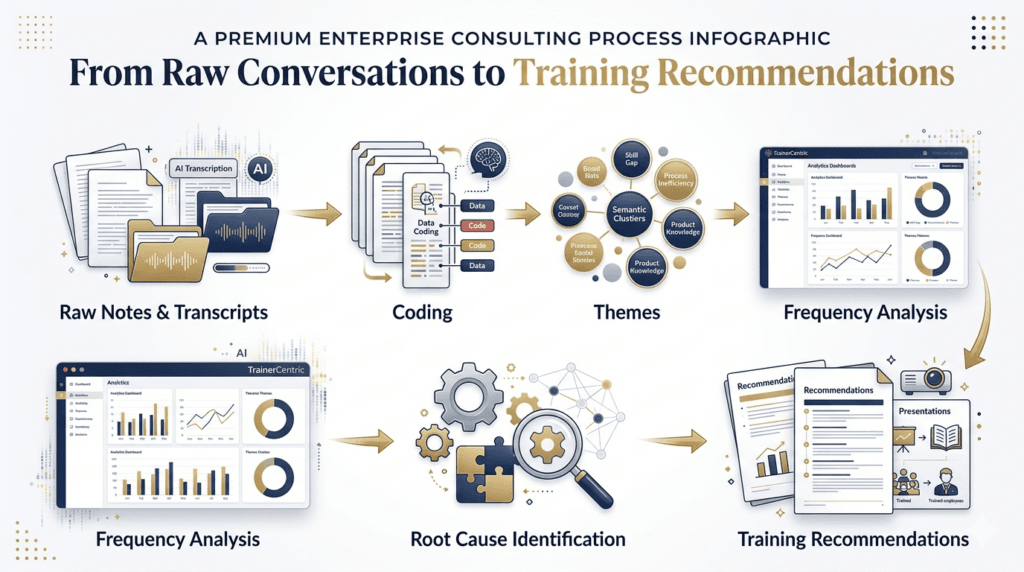
Qualitative data is only as useful as your analysis process. Here’s the five-step method TrainerCentric uses to move from raw transcripts to defensible training recommendations.
Step 1: Organize Data
Gather every transcript, note set, and observation sheet into one place, labelled consistently. Strip identifying details if you promised anonymity, and keep a separate, secured key linking codes to names only if you need to follow up later.
Step 2: Code Responses
Read through 2–3 transcripts first and build an initial code list — short labels for recurring ideas. Apply that code list across the rest of the data, adding new codes only when something genuinely doesn’t fit an existing one. Resist the urge to create a new code for every slightly different phrasing.
Step 3: Identify Themes
Group related codes into broader themes. A theme should be specific enough to act on, not so broad it could apply to almost any organisation.
Step 4: Quantify Patterns
Even qualitative data benefits from a frequency count: how many of your sessions mentioned this theme, spontaneously or in response to probing. A theme raised by 1 of 20 participants is a flag to watch, not a finding to act on.
Step 5: Convert Findings into Training Recommendations
For each validated theme, write a one-line recommendation that names the intervention type — training, job aid, coaching, process fix, or tooling fix. Being explicit about non-training fixes is what separates a credible TNA report from a sales pitch for a training programme.
Worked Example
| Theme (from coding) | Frequency | Recommendation |
| New supervisors haven’t been taught to delegate after promotion from IC roles | 9 of 11 interviews | Design a focused delegation module for newly promoted supervisors, delivered within 60 days of promotion |
| Job aid for refund processing references a retired system | 5 of 6 focus groups | Not a training fix — update the job aid and retire the outdated reference (content maintenance, not new training) |
| Agents don’t know escalation criteria and over-escalate to be safe | 4 of 6 focus groups | Build a short decision-aid checklist plus a 90-minute workshop using real, anonymised case examples |
Advantages and Limitations of Focus Groups in TNA
| Advantages | Limitations |
| Rich, contextual insight that surveys can’t capture | Vulnerable to groupthink and false consensus |
| Faster per-participant coverage than one-on-one interviews | Moderator skill heavily influences data quality |
| Group discussion surfaces shared patterns participants might not raise alone | Lower confidentiality — peers hear each other’s answers |
| Builds early buy-in — participants feel heard before the programme is even designed | Scheduling 6–8 people simultaneously is operationally harder than 1:1s |
| Cost-efficient relative to running the same number of individual interviews | Not suitable for sensitive, individually risky, or hierarchy-loaded topics |
Practical Example: Training Needs Assessment for a Customer Service Team
Business problem: A 140-person customer service team at a financial services company was missing its first-call resolution (FCR) target by 14 percentage points, despite agents completing a refreshed product-knowledge course three months earlier.
Focus group findings: Three focus groups revealed agents knew the product details well — the course had landed. The recurring theme instead was navigation: agents needed an average of four screen switches across two systems to resolve a single billing query. Two of three groups independently raised the same example: a refund request that should take “two minutes” routinely took eight to ten.
Interview findings: Five manager interviews confirmed the same pattern and added a second layer — managers had stopped coaching on the systems issue because they’d raised it with IT eighteen months earlier and nothing had changed. An SME interview revealed a workaround existed — a lesser-known query path that cut the four-screen process to one — but had never been documented or taught.
Recommended learning interventions: A 45-minute workshop teaching the documented workaround, paired with a one-page job aid pinned to each agent’s desktop; a parallel, non-training recommendation to IT leadership to formally evaluate the two-system navigation issue. FCR improved 9 percentage points within six weeks of the workshop — without a single hour spent on additional product training.
Focus Groups and Interviews in the Indian Workplace Context
Running TNA focus groups and interviews in Indian organisations comes with cultural dynamics that shape both recruitment and facilitation technique — and getting these wrong is one of the most common reasons qualitative TNA data in India ends up shallow or unreliable.
Hierarchical Cultures
Many Indian workplaces carry strong deference to seniority and authority. Run employee and manager sessions completely separately, and be explicit — more explicit than may feel necessary — that findings won’t be traced back to individuals.
Employee Hesitation
It’s common for the first 10–15 minutes of an Indian focus group to produce safe, generic answers before participants test whether candour is actually welcome. Build in a longer warm-up phase, and consider opening with a low-stakes disagreement question to signal early that criticism is genuinely wanted.
Language Diversity
Conduct sessions in the language participants are most fluent in for expressing nuance. A facilitator translating in real time loses nuance; where possible, use a moderator who is a native or fluent speaker of the group’s working language.
Hybrid Work Environments
For hybrid and remote teams, use a co-facilitator dedicated to monitoring the chat and remote participants. Deliberately call on remote participants by name to prevent in-room voices from dominating.
Manufacturing Organisations
Shift patterns mean you’ll rarely get a full cross-section together outside working hours without pay or time-off implications — plan sessions during shift overlap windows or paid time.
IT and Services Sector
In IT services and BPO/ITES environments, attrition pressure and appraisal-cycle timing affect candour. Where possible, schedule outside the weeks immediately before appraisal ratings are finalised.
Best Practices Checklist
Planning
- Objective is specific, names a population, and avoids assuming the root cause
- Method choice (focus group, interview, or both) matches the topic’s sensitivity and audience
- Sample size and segmentation planned for thematic saturation, not just convenience
Facilitation
- Neutral moderator — not the participants’ manager
- Ground rules stated clearly at the start, including anonymity terms
- Time allocated deliberately across warm-up, core exploration, and closing
Interviewing
- Stakeholder map completed before scheduling begins
- Questions sequenced from descriptive to evaluative, open-ended throughout
- Probes stay neutral and never embed the interviewer’s own hypothesis
Analysis
- Data organised and anonymised before coding begins
- Code list kept tight — new codes added only when nothing existing fits
- Themes quantified by frequency across sessions before being called “findings”
Reporting
- Each finding paired with a named intervention type, not just “needs training”
- Non-training root causes (process, tooling, policy) flagged explicitly, not buried
- Findings traceable to evidence — quotes anonymised, frequencies cited
Key Takeaways
- Surveys tell you what is happening; focus groups and interviews tell you why — and why is what determines whether the fix is training, coaching, process, or tooling
- The TrainerCentric QUAL-TNA™ Framework — Question, Understand, Analyse, Listen, Translate — gives qualitative TNA a systematic, repeatable structure
- Use focus groups for shared peer-level experience at speed; use interviews for sensitive topics, senior stakeholders, and specialised SME depth — use both together for any TNA of real consequence
- A good discussion guide moves from broad and low-risk to specific and high-stakes, never the reverse
- Dominant voices, groupthink, and hierarchy suppression are the three biggest threats to focus group data quality — all three are manageable with deliberate facilitation technique
- Code tightly, quantify themes by frequency, and resist calling something a “finding” until it’s shown up across multiple independent conversations
- Always name the intervention type explicitly — not every theme your qualitative data surfaces is a training problem, and saying so is what builds credibility with leadership
- In Indian workplace contexts, separate hierarchy levels rigorously, build in extra time for candour to emerge, and facilitate in the language participants think in
Frequently Asked Questions
1. What is a focus group in training needs assessment?
A focus group in TNA is a facilitated discussion with 6–8 peer-level employees used to identify performance challenges, skill gaps, and training priorities. It provides qualitative insights that surveys cannot — by surfacing the shared experiences and disagreements behind the numbers.
2. How many participants should be in a TNA focus group?
Six to eight participants. This range is large enough to generate varied perspectives and discussion, small enough that every participant gets meaningful airtime within a 60–90 minute session.
3. What questions should I ask during a TNA focus group?
Sequence questions from broad and low-stakes (current performance, learning preferences) to specific and high-stakes (organisational barriers, future skills), keeping every question open-ended. See the 25-question bank above for ready-to-use examples by category.
4. How do interviews help identify training gaps?
TNA interviews go deep with a single perspective — particularly useful for senior stakeholders, sensitive topics, and SME input. They are often what reveals whether a performance gap is actually a skill gap, or a process, motivation, or resource issue wearing a training disguise.
5. What is the difference between interviews and focus groups in TNA?
Focus groups trade depth for breadth and speed — one session covers 6–8 people. Interviews trade speed for depth, confidentiality, and suitability for sensitive or hierarchy-sensitive topics. Most credible TNAs use both.
6. Can focus groups replace surveys in training needs analysis?
No. Surveys quantify patterns across large populations; focus groups explain the reasons behind those patterns in a smaller, representative sample. The two methods answer different questions and work best together.
7. How do I analyze focus group data for training needs?
Organise and anonymise transcripts, code recurring ideas into a tight framework, group codes into themes, quantify how often each theme appears across sessions, then convert validated themes into named intervention types — training, coaching, process, or tooling.
8. Should managers be included in focus groups?
Not in the same session as their direct reports — their presence suppresses candour. Run separate manager-only sessions instead, which also produces valuable team-level pattern data that employee sessions alone won’t surface.
9. What are the biggest mistakes in TNA interviews?
The most common mistakes are asking leading questions that embed the interviewer’s own theory, rushing past silence instead of letting it produce a fuller answer, and failing to write up notes promptly enough to preserve nuance.
10. Which method is better: interviews or focus groups?
Neither is universally better. The right choice depends on topic sensitivity, stakeholder level, and how much breadth versus depth the assessment needs. Most well-designed TNAs combine both rather than choosing one over the other.
Continue Building Your TNA Toolkit
This article is part of TrainerCentric’s Training Needs Analysis content cluster. Each resource below takes you deeper into a specific layer of the TNA process.
- Training Needs Assessment Process : The end-to-end TNA lifecycle — where focus groups and interviews fit within the broader Diagnose → Validate → Prioritise → Design sequence.
- Training Needs Analysis Methods: A comparison of all TNA data-collection approaches — qualitative and quantitative — with guidance on when to use each.
- Organizational Analysis for TNA: The macro layer — how to determine whether the performance problem sits at the individual, team, or organisational level before you design a single session.
- Task Analysis for TNA :How to structure the task-level detail that SME interviews uncover into a usable task inventory for training design.
- Training Needs Analysis Template : A ready-to-use planning document that covers scope, method selection, stakeholder mapping, and findings reporting in one structured template.
- Training Needs Analysis Checklist: A Practical Step-by-Step Guide Free Download for L&D Professionals [2026]
- Competency Mapping vs Skills Gap Analysis
Download: The Focus Groups & Interviews for TNA Toolkit
Running a credible qualitative TNA takes more than good questions — it takes the right structure around them. This toolkit gives you everything from this guide in ready-to-edit form, so your next focus group or interview round starts from a finished template, not a blank page.
Inside the Toolkit
- Focus Group Discussion Guide — pre-sequenced, ready to adapt to your topic
- Moderator Script — the full opening, transitions, probes, and closing from this article, in editable form
- Interview Question Bank — all 20 questions, organised by stakeholder, with rationale notes
- Stakeholder Interview Template — covering planning, scheduling, and documentation in one sheet
- Data Analysis Worksheet — structured for coding, theming, and frequency counts
- Thematic Coding Template — a starter code list you can adapt instead of building one from scratch
- TNA Findings Report Template — built to convert themes directly into intervention recommendations
- Focus Group Planning Checklist — covering sample size, segmentation, and saturation tracking
References:
- Focus Groups: A Practical Guide for Applied Research || Richard A. Krueger & Mary Anne Casey
- Interviewing as Qualitative Research || Irving Seidman
- Qualitative Inquiry and Research Design || John W. Creswell & Cheryl N. Poth
- Telling Training’s Story || Robert O. Brinkerhoff
- Performance Consulting || Dana Gaines Robinson & James C. Robinson
- The Performance Consultant’s Fieldbook || Judith Hale
Author Details

Soumyadeep Sen is a Learning & Development professional with over 14 years of experience across training, coaching, quality, and performance improvement. Currently serving as Assistant Manager – Training at 24/7.ai, he specializes in designing practical learning solutions that drive employee performance and support business objectives. Reach out to him via Linkedin.