How to identify the right training, for the right people, at the right time — with a step-by-step process, real-world example, and a free template.
What is a Training Needs Analysis?
Before investing in training, organisations need to know whether training is actually the solution. A Training Needs Analysis (TNA) — also called a training needs assessment or learning needs assessment — is a systematic process for identifying performance gaps, determining their root causes, and defining exactly who needs development, and why. It ensures every training programme has a clear business rationale behind it.
Done well, TNA turns L&D from a programme factory into a strategic partner. Done badly — or skipped entirely — it is the single biggest driver of wasted training investment.
| Free resource: The TrainerCentric TNA Toolkit — interview guide, gap analysis matrix, and results template. Download link after the worked example. |

Why TNA Matters: The Cost of Skipping It
Most organisations design training before diagnosing the problem. Research on learning transfer explains the result.
| “Only 12% of employees apply new skills learned in training back on the job.” Saks, A.M. (2002). So what is a good transfer of training estimate? The Industrial-Organizational Psychologist, 39(3), 29–30. |
The most common cause of poor transfer is not bad facilitation or poor course design. It is that the training did not address the actual performance gap — because no proper diagnosis was done first. That is the problem TNA solves.
Training Needs Analysis at a glance
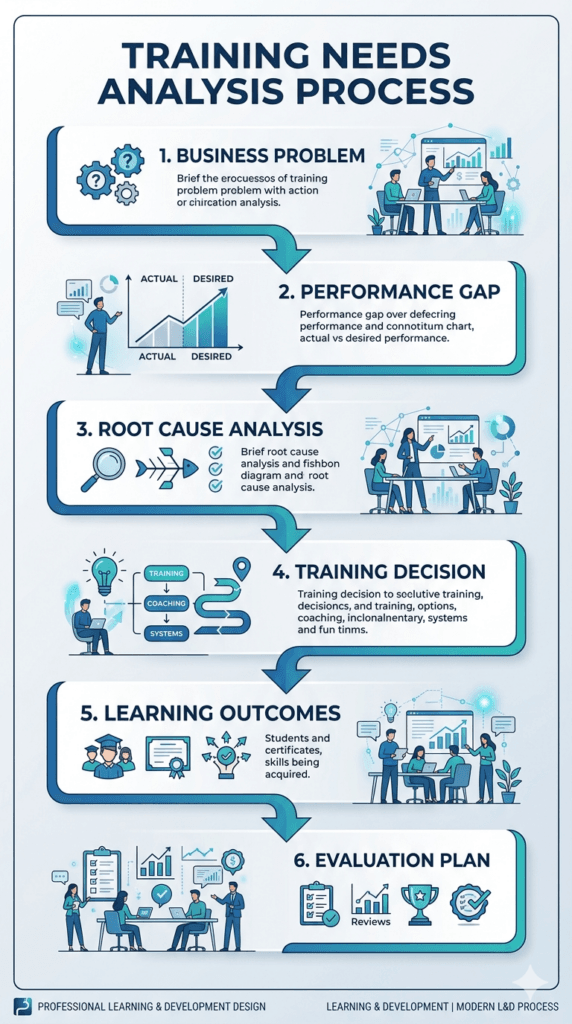
Before going deeper, here is the complete picture of what a TNA involves.
| What it is | A structured process for diagnosing whether training is needed, and if so, exactly what and for whom |
| Other names | Training needs assessment, learning needs analysis (LNA), learning needs assessment, skills needs analysis |
| When to use it | Before designing any significant programme; when performance problems appear; when roles or strategy change |
| Who runs it | L&D business partner, instructional designer, or learning consultant — with line managers and HR |
| Typical duration | 2–5 days for a targeted TNA; 4–12 weeks for an organisational learning needs assessment |
| Key output | A learning needs specification: who needs what, to what standard, by when — and an evaluation plan |
| Main frameworks | Three-level model (Boydell 1976); Gilbert’s Behaviour Engineering Model (1978); Rossett’s TNA framework (1987) |
The Three Levels of TNA
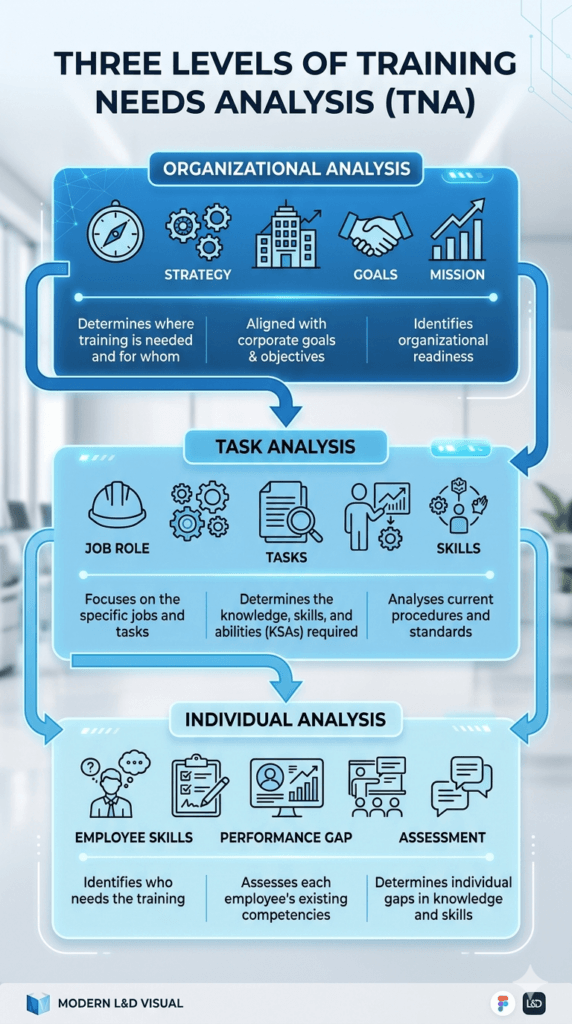
Most TNAs operate at three levels: organisational, task (occupational), and individual. All three are needed. Each one answers a different question.
Level 1: Organisational analysis
Ask: what must the organisation achieve, and what capability does it currently lack to get there? This level connects training to business strategy and flags where a competency gap analysis is needed at scale.
Sources: business strategy documents, HR workforce data, succession plans, customer metrics, performance management data, and compliance requirements.
Level 2: Task / occupational analysis
Ask: for roles where gaps exist, what does good performance actually look like? This is the most commonly skipped level — and the most costly to omit.
Methods: job profile review, competency framework analysis, job task analysis, observation of high performers, critical incident interviews.
Level 3: Individual analysis
Ask: which specific people have gaps relative to the occupational standard? This is what makes a skills assessment precise enough to actually inform design decisions.
Sources: line manager assessments, 360-degree feedback, self-assessments, observation, and performance data.
| Why all three levels matter: A TNA at only one level gives you a partial picture. Individual-only analysis tells you what people cannot do, not why or whether it matters strategically. Organisational-only gives you direction but no precision. You need all three — the depth at each level scales with the scope and stakes of the programme. |
📌 Internal Resource: Read more on each The 3 Levels of Training Needs Analysis: Organisation, Task & Person Analysis on Trainercentric.in
How to conduct a Training Needs Analysis (the TrainerCentric DVPD Framework™)
There are several TNA models in the literature — Rossett (1987), Kaufman’s Organisational Elements Model, Mager and Pipe’s performance analysis flowchart. In practice, experienced L&D professionals adapt these into a working process rather than following any one model rigidly.
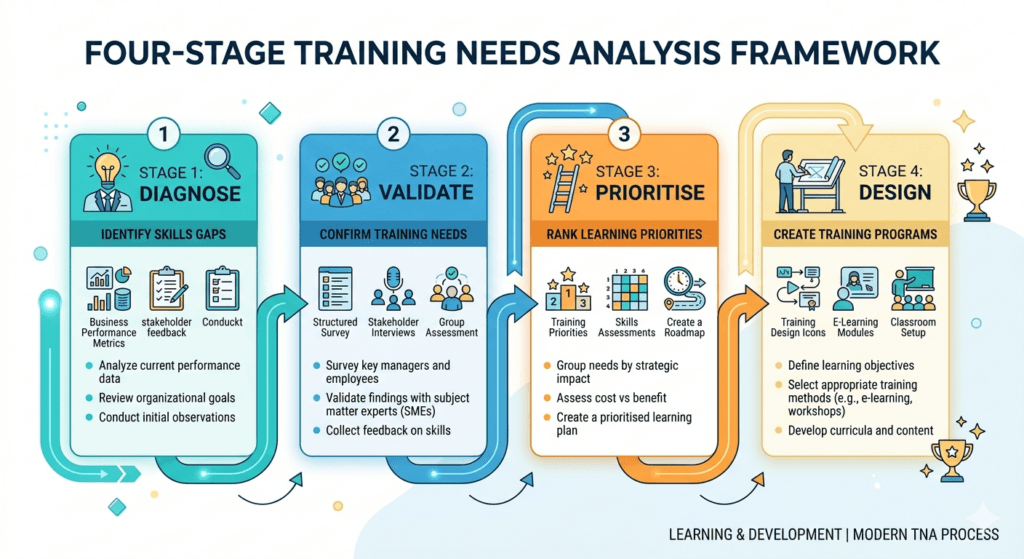
The TrainerCentric DVPD Framework™ organises that process into four stages: Diagnose → Validate → Prioritise → Design. Each stage answers one clear question and produces one concrete output. Together they take you from a vague training request to a precise, evidence-backed learning brief.
| The TrainerCentric DVPD Framework™ A four-stage process for conducting a Training Needs Analysis | |||
| D Diagnose | V Validate | P Prioritise | D Design |
| Key question What gap exists between current and required performance? | Key question Why does the gap exist — is training the right solution? | Key question Who needs what, to what standard, in what order of urgency? | Key question What gets built, for whom, and how will success be measured? |
| Methods Sponsor interviews, performance data, org strategy docs | Methods Focus groups, observation, performance data, root cause analysis | Methods Skills assessments, 360 feedback, surveys, stakeholder review | Methods Stakeholder sign-off, evaluation plan design, programme brief |
| Output Clear problem statement with business impact defined | Output Root cause map + go / no-go decision on training | Output Learning needs specification with priority ranking | Output Prioritised training plan + evaluation approach |
| © TrainerCentric | trainercentric.in | |||
Stage 1: Diagnose — define the performance gap
Move from a vague request to a specific, measurable description of the gap between current and required performance.
A manager requesting ‘leadership training’ is not a problem statement — it is a solution looking for a problem. Your job is to translate the request back into the performance gap it is trying to close.
Key questions to work through:
- What specific behaviour or outcome is below standard?
- What does ‘good’ look like — and how do you know?
- How significant is the gap, and what is the business impact of leaving it?
- Who is affected — which roles, teams, or individuals?
Start with a sponsor conversation. Ask them to describe, as concretely as possible, what they see happening that they do not want — and what they want to see instead.
| Watch out for: Requests framed as solutions (‘we need a course on X’) rather than problems (‘people are not doing Y’). Resist the urge to start designing until you can answer: what specific performance gap is this meant to close? |
Stage 2: Validate — investigate the causes
Once you have defined the gap, ask why it exists. This is where you determine whether training is actually the right answer.
Gilbert’s Behaviour Engineering Model (1978) identifies six performance drivers. Only two — knowledge and skill — are addressable through training. The decision framework below summarises the logic.
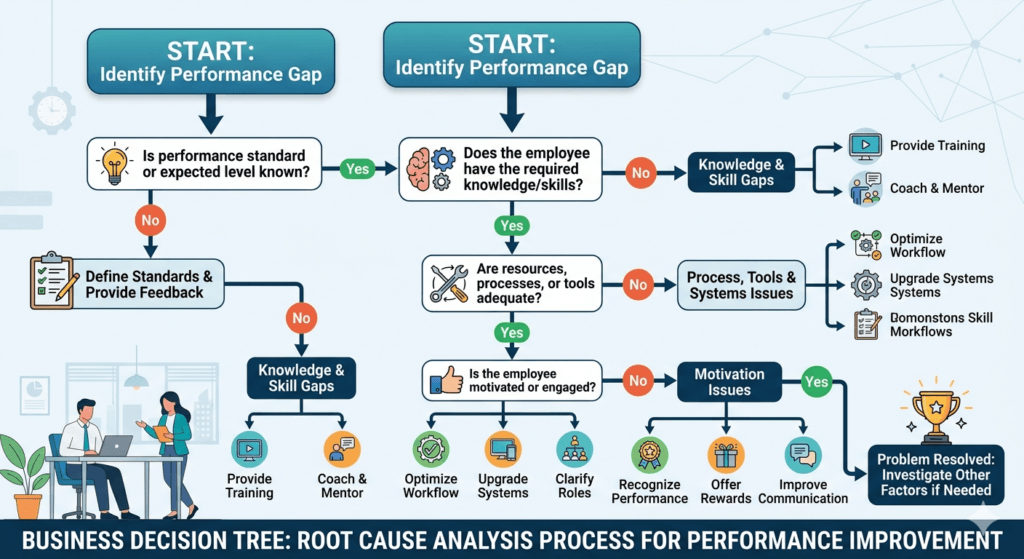
| Is training the answer? A decision framework |
| Is the gap caused by a lack of knowledge or skill? YES → Training can help • People don’t know what to do • People know but haven’t practised enough • People lack confidence from inexperience Intervention: training, coaching, job aids, e-learning NO → Training won’t fix it • Tools or systems are broken • Processes prevent good performance • No motivation or incentive to perform Intervention: process redesign, management, HR fix |
Practitioner note: Some of the most valuable TNA work is telling a stakeholder that training will not solve their problem — and pointing them toward what will. This is what separates a performance consulting mindset from simple order-taking.
Read the full guide: When Training Is NOT the Answer — a practical guide to performance consulting and non-training interventions
Stage 3: Prioritise — define the learning need
Once training is confirmed as the right answer, Stage 3 specifies exactly what the training must achieve.
Express outcomes as observable behaviours, not topic descriptions. ‘Understand leadership’ is not a learning outcome. ‘Hold a structured performance conversation using the SBI feedback model’ is.
Capture: who needs training, what they must be able to do, the current vs required standard, and how much the need varies across the target population.
Stage 4: Design — plan and evaluate
A skills needs analysis almost always surfaces more needs than can be addressed at once. Work with stakeholders to prioritise based on: business impact, risk exposure, feasibility, reach, and speed to value.
Plan evaluation from the start. Kirkpatrick Level 3 (behaviour change) requires a performance baseline collected before training begins — capture it now, while you have access.
How TNA connects to the wider L&D ecosystem
A Training Needs Analysis does not sit in isolation. It feeds into — and draws from — several other frameworks and disciplines that L&D professionals use every day.
| Framework / concept | How it connects to TNA | Where to learn more |
|---|---|---|
| ADDIE Model | TNA feeds directly into the Analysis phase of ADDIE. A completed TNA is the brief that drives instructional design decisions. | See: Instructional Design Model Playbook |
| Kirkpatrick Model | Evaluation approach and baseline data are set during Stage 4 of TNA. Level 3 measurement requires pre-training data you can only collect now. | See: The Kirkpatrick Model Explained |
| Competency frameworks | Competency frameworks provide the occupational standard used in Level 2 (task analysis). Without them, you are designing training without a performance blueprint. | Part of the task analysis process in Stage 1 |
| Performance consulting | TNA is a performance consulting discipline. Gilbert’s Behaviour Engineering Model (used in Stage 2) comes directly from performance consulting practice. | See: When Training Is NOT the Answer |
| Workforce planning | Workforce planning identifies future capability requirements at the organisational level — a key input to Level 1 TNA. Future skill gaps drive the most strategic training investments. | Often owned by HR; L&D should request access to workforce planning outputs |
| SPIN selling (example) | In the worked example below, SPIN is the performance standard used at Level 2 (task analysis) for the sales role. Occupational standards come from job-specific frameworks like this. | Used in the Meridian Manufacturing worked example |
Building semantic connections between these frameworks is what distinguishes an L&D generalist from a strategic practitioner. TNA is the diagnostic engine that makes all of them work in practice.
Training Needs Analysis in practice: a worked example
Here is how the DVPD Framework plays out in a realistic corporate scenario. The company and details are illustrative.

| Scenario: Meridian Manufacturing Ltd | 850 employees, three UK sites, undergoing a shift from transactional to consultative selling |
Stage 1 — Diagnose: define the performance gap
The Sales Director contacts L&D: ‘Our reps are losing deals at the proposal stage. We need a sales training programme.’
L&D does not immediately commission a programme. Instead, they arrange a 30-minute sponsor conversation. Three questions surface the real picture:
| Question asked | What they discovered |
| What are reps doing that they shouldn’t — or not doing that they should? | Reps are presenting product features before understanding customer problems. Win rates have dropped 18% in 9 months. |
| What does ‘good’ look like in this role? | The top 3 performers consistently run a structured discovery process before pitching. Bottom performers skip it. |
| Who is affected? | 14 field sales reps across two sites. 4 are already performing to standard. 10 have the gap. |
Problem statement: ‘10 of 14 field sales reps are not conducting structured discovery conversations before presenting solutions. This is contributing to an 18% decline in win rates over 9 months.’
Stage 2 — Validate: investigate the causes
L&D runs three focus groups with the 10 affected reps and conducts call observation sessions. They also speak with three line managers and review CRM data.
Findings:
- Reps know discovery conversations are expected — the competency framework mentions them. (Not an information gap.)
- Reps cannot consistently execute a SPIN-style discovery conversation under pressure. When calls become difficult, they revert to pitching. (This is a skills gap — insufficient deliberate practice.)
- CRM does not prompt for discovery stage completion. Good discovery is invisible to managers and unrewarded. (Process and incentive gap — not a training fix.)
Decision: Training will address the skills gap. L&D also flags the CRM and incentive issues to the Sales Director and HR as separate actions requiring a non-training intervention.
| Result: Training is confirmed as the right intervention for the skills gap. Two non-training root causes are escalated to the correct owners. |
Stage 3 — Prioritise: define the learning need
| Element | Specification |
| Who | 10 field sales reps (Sites 1 and 2). The 4 already performing to standard are excluded from the mandatory programme. |
| Learning outcome | Run a full SPIN discovery conversation — capturing client problem, impact, and desired outcome — before any product demonstration. |
| Current standard | 3 of 10 reps execute SPIN discovery consistently. 7 of 10 begin pitching within the first 5 minutes. |
| Required standard | All 10 reps execute a full SPIN discovery on 90%+ of calls within 60 days of training. |
| Constraints | Reps cannot be off-territory for more than one day. Mixed technology access across sites. |
| Priority | High. Revenue impact is active and accelerating. |
Stage 4 — Design: plan and evaluate
L&D proposes a blended programme: a half-day skills workshop per site (live practice with role plays), followed by four weeks of structured coaching from line managers using recorded calls.
Evaluation plan: CRM data collected for all 10 reps for the 30 days before training (baseline). Re-measured at 60 days post-training. Manager observation scores at 30 days.
The four high-performing reps are offered an optional advanced negotiation session as a development opportunity — a separate, smaller programme.
What this example shows: A proper TNA took 6 days of effort. It changed the programme design (from a generic sales course to a targeted skills practice intervention), changed the audience (from all 14 reps to 10), and surfaced two non-training issues that would have undermined any programme regardless of quality.
Includes: stakeholder interview guide, gap analysis matrix, learning needs specification template, data collection planner, and a results presentation template for senior stakeholders.
Training Needs Analysis template

Use this table to document any training need at any scale. The full version with guidance notes and pre-filled examples is in the TNA Toolkit above.
| Element | Question to answer |
| Performance gap | What is currently happening that should not be — or not happening that should? Be specific and measurable. |
| Desired state | What does good performance look like? What would you see happening that is not happening now? |
| Root cause | Why does the gap exist? Is it knowledge, skill, motivation, tools, process, or environment? |
| Is training the answer? | Is the root cause addressable through learning, or does it require a non-training intervention? |
| Learning need | What specifically must learners be able to do after training that they cannot do now? |
| Target population | Who needs training — which roles, how many people, and are there subgroups with different needs? |
| Current capability | Where is the target population starting from? Is the gap consistent, or varied across individuals? |
| Required standard | What observable behaviour confirms the gap has been closed? |
| Constraints | Budget, timing, geography, technology access, prior learning history, language. |
| Priority | How urgent is this? What happens if training is delayed or cancelled? |
| Evaluation approach | How will you measure whether training has closed the gap? What baseline data do you need now? |
How to use this template: Complete one row at a time during your TNA investigation. If you cannot answer a row, that is a signal to gather more data. If you reach ‘Is training the answer?’ and the honest answer is no — stop, and redirect to the right intervention.
Training Needs Analysis vs Skills Gap Analysis
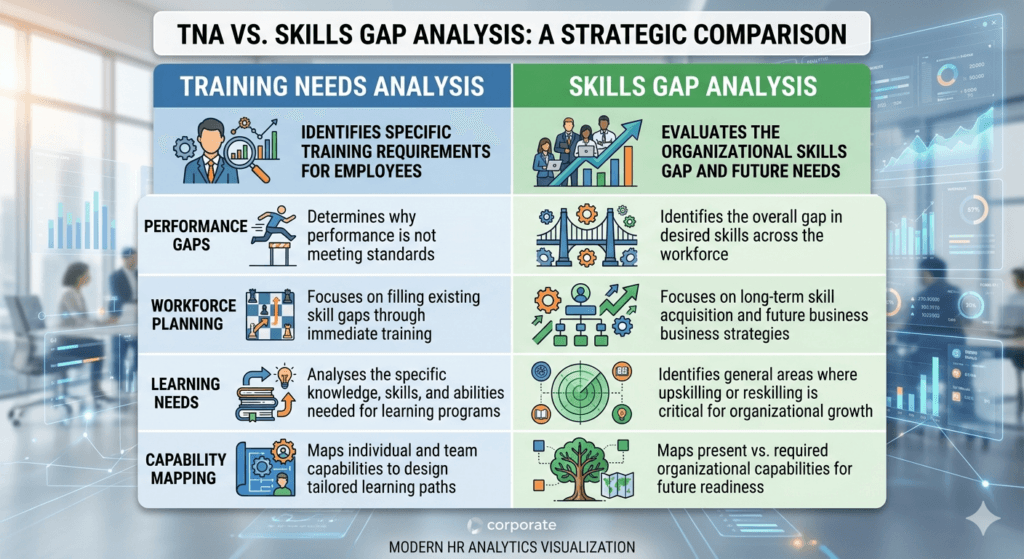
These two terms are often used interchangeably. They are related but distinct.
| Dimension | Training Needs Analysis | Skills Gap Analysis |
| Starting point | A business problem or performance gap | A skills inventory compared to a required skills framework |
| What it asks | Why is performance below standard — and is training the fix? | What skills do we have vs what skills do we need? |
| Output | Learning needs specification; training plan | Skills gap map; capability heat map |
| Scope | Usually triggered by a specific performance issue or programme need | Usually conducted at workforce or team level as part of strategic planning |
| Relationship | A skills gap analysis often feeds into a TNA as an input at Stage 1 | A TNA provides the diagnosis that a skills gap analysis alone cannot |
Read the full guide: Skills Gap Analysis vs Training Needs Analysis — a full comparison with a step-by-step decision guide for L&D teams
Organisational TNA vs Individual TNA
Not all TNAs operate at the same level. An organisational TNA asks: what capability does our workforce need at scale to deliver our strategy? An individual TNA asks: what does this specific person need to perform their role to the required standard?
| Dimension | Organisational TNA | Individual TNA |
| Scope | Workforce-wide or department-wide | Single employee or small cohort |
| Typical trigger | Strategic planning cycle, restructure, new strategy | Performance review, role change, development request |
| Primary methods | Surveys, HR data, workforce analytics, focus groups | Manager conversation, self-assessment, 360 feedback |
| Output | Annual L&D plan, capability framework priorities | Personal development plan (PDP), training recommendation |
Read the full guide: Organisational TNA vs Individual TNA — a full comparison of methods, outputs, and when to use each approach
TNA data collection methods
The quality of your learning needs assessment depends on the quality of your data. The most robust approach combines two or three methods.
| Method | Best for | Strengths | Watch out for |
| Stakeholder interviews | Stages 1 and 2; context and priority | Rich qualitative data; builds relationships | Interviewees often advocate for solutions, not problems |
| Focus groups | Stage 2; employee perspective on gaps | Efficient; surfaces shared themes quickly | Group dynamics can suppress dissenting views |
| Surveys | Stage 3; quantifying need across large populations | Reach; good for prioritisation | Self-reported data has reliability limits |
| Observation | Stage 2; what actually happens on the job | High validity; reveals gaps interviews miss | Time-intensive; Hawthorne effect |
| Performance data review | All stages; objective baseline | Hard to dispute; reveals patterns | May not map cleanly to learning gaps |
| Document review | Stage 1; role requirements and standards | Efficient; good pre-interview preparation | Documents may be aspirational, not descriptive |
| 360 / assessment tools | Stage 3; individual-level gap data | Multi-source data increases reliability | Requires existing frameworks to be in place |
Common mistakes in Training Needs Analysis

1. Running only one level of analysis
Individual-only analysis tells you what people cannot do, not why or whether it matters strategically. Organisational-only gives you direction but no precision. You need all three levels, proportionate to the scope.
2. Accepting the first solution you are given
A manager saying ‘we need communication training’ is a hypothesis, not a diagnosis. Test it before commissioning a programme. Accepting a training request at face value is the most common — and most costly — TNA mistake.
3. Skipping task analysis
Task analysis — mapping what good performance actually looks like in the role — is the most frequently omitted step. Without it, you are designing training without a performance blueprint.
4. Treating all gaps as training problems
Most performance gaps have multiple causes. Inadequate tools, broken processes, absent feedback, and misaligned incentives are common contributors. Training will not fix any of them. Surface all causes, not just the ones L&D can address.
5. Not collecting baseline data
Kirkpatrick Level 3 evaluation requires a before-and-after comparison. If you do not collect performance baseline data as part of TNA, you will be unable to demonstrate training impact later. Collect it now.
6. Producing findings nobody acts on
A TNA report filed in a shared drive is not a TNA. Plan stakeholder communication from the start: who gets what output, in what format, and with what follow-up. A structured findings presentation drives more action than a written report alone.
Read the full guide: How to Present TNA Results to Senior Stakeholders — turning findings into a business conversation that gets programmes approved
Training Needs Analysis checklist
Use this checklist to quality-check any TNA before moving into programme design.
| ✓ | Checklist item |
| □ | I have a clear problem statement — a specific gap between current and required performance (not just a training topic). |
| □ | I have conducted analysis at all three levels: organisational, task, and individual. |
| □ | I have investigated root causes and confirmed that training is the right (or part of the right) intervention. |
| □ | I have identified any non-training root causes and escalated them to the appropriate owner. |
| □ | I know exactly who needs training — specific roles or individuals, not a broad population assumed to need it. |
| □ | I have defined learning outcomes as observable behaviours, not topic descriptions. |
| □ | I have documented the current capability baseline for the target population. |
| □ | I have captured all constraints: budget, timeline, geography, technology access, prior learning. |
| □ | I have agreed a prioritisation with stakeholders for needs that cannot all be addressed at once. |
| □ | I have planned an evaluation approach and collected any baseline data needed for Kirkpatrick Levels 3 and 4. |
| □ | I have a written learning needs specification to hand off to design — not just notes in my head. |
| □ | I have a plan to communicate findings to the stakeholders who commissioned this TNA. |
Download the full checklist: The TNA Toolkit includes a printable, fillable version of this checklist.
Read the full guide: The 3 Levels of Training Needs Analysis: Organisation, Task & Person Analysis
Frequently asked questions
How long does a Training Needs Analysis take?
A targeted TNA for a single team or role: 2–5 days of effort. A full organisational learning needs assessment covering multiple business units: 4–12 weeks. The depth of analysis should match the scale and strategic importance of the training decision.
What is the difference between a TNA and a learning needs analysis?
In most practical usage, they mean the same thing. Strictly speaking, a learning needs analysis (LNA) is broader — it includes informal and experiential learning, not just formal training. A TNA is a subset of LNA. The terms are used interchangeably by most L&D practitioners.
Who should conduct a Training Needs Analysis?
Usually an L&D business partner, instructional designer, or learning consultant — in partnership with line managers and HR. For high-stakes or politically sensitive TNAs, an external consultant adds credibility and removes perceived bias.
Should every training request go through a formal TNA?
No. A regulatory compliance refresh, a standard induction, or a short skills update may need only a light-touch diagnosis. Reserve your most rigorous workforce skills assessment process for high-investment, high-stakes, or strategically important programmes.
What happens after the TNA?
The learning needs specification becomes the brief for instructional design — informing modality choice, content sequence, assessment approach, and evaluation plan. A well-executed TNA makes everything in the design phase faster and more focused.
Further reading on TrainerCentric:
- How to Conduct a Training Needs Analysis in Five Steps
- Organisational TNA vs Individual TNA
- Skills Gap Analysis vs Training Needs Analysis
- How to Present TNA Results to Senior Stakeholders
- When Training Is NOT the Answer
- Training Needs Analysis Template: Free Download
- The 3 Levels of Training Needs Analysis: Organisation, Task & Person Analysis
- Focus Groups and Interviews for Training Needs Assessment:
- Training Needs Analysis Questionnaire: Complete Guide (75 Questions & Free Template)
- How to Design a Learning Programme From Scratch: A Step-by-Step Guide
- Learning Analytics for L&D Professionals
References
- Boydell, T. H. (1976). A Guide to the Identification of Training Needs. British Association for Commercial and Industrial Education.
- Gilbert, T. F. (1978). Human Competence: Engineering Worthy Performance. McGraw-Hill.
- McGehee, W., & Thayer, P. W. (1961). Training in Business and Industry. Wiley.
- Mager, R. F., & Pipe, P. (1997). Analyzing Performance Problems (3rd ed.). Center for Effective Performance.
- Rossett, A. (1987). Training Needs Assessment. Educational Technology Publications.
- Saks, A. M. (2002). So what is a good transfer of training estimate? The Industrial-Organizational Psychologist, 39(3), 29–30.
Author Introduction

Pankaj Nandi is a Technical Writer and Learning Content Specialist with experience creating complex technical and instructional content across software, technology, and enterprise environments. Having worked with organizations including Cisco, Rakuten India, and Newgen Software, he specializes in transforming complex concepts into clear, practical, and learner-friendly content. You can reach out to him at pankaj@trainercentric.in