I’ve lost count of strategy documents that faithfully reproduce the annual business plan and quietly ignore the conversation the COO had with senior managers two weeks later that changed everything. That gap is where most L&D strategies lose relevance before they’re even approved.
Most organizations don’t fail because they lack training. They fail because their learning strategy is disconnected from the business strategy — which is exactly why generic training gets cut first when budgets tighten, while strategic learning tied to measurable outcomes survives.
Everyone already knows the frameworks: a training needs analysis, a skills gap analysis, some competency mapping. Sequencing them, knowing which shortcuts are safe, and knowing when to say no to a stakeholder is the part templates don’t teach. That’s what this guide covers- a complete step by step guide on how to write a learning and development strategy from scratch. For the fuller grounding in what an L&D strategy is and why it matters, start with our Learning & Development Programme Design overview.
To keep things concrete, one example runs through the entire guide. Meet Acme Manufacturing: 650 employees, three plants, a unionized production workforce, midway through a company-wide SAP rollout, still absorbing friction from a recent acquisition, and two years into ugly maintenance technician turnover. None of this is a clean setup — and that’s the point. Most real L&D strategies get written inside exactly this kind of mess, not a case study with the edges sanded off.
Quick Steps: How to Write an L&D Strategy
Review the business strategy — and verify it in conversation, not just on paper.
Conduct a training needs analysis at the organizational, task, and person level.
Run a skills gap analysis to quantify current vs. required capability.
Review or build a competency framework, only if one doesn’t already exist.
Define and score strategic learning priorities against business impact and urgency.
Set SMART learning objectives tied to measurable business behaviour.
Choose learning solutions matched to the capability, not the budget.
Build a phased learning roadmap with named owners.
Define layered KPIs, from participation through business impact.
Build executive buy-in with a conservative, finance-tested ROI case.
Draft the eleven-section strategy document.
Review and update the strategy every quarter, not just once a year.
Before You Start Writing: The TrainerCentric Strategy Readiness Score
Before you open a template, answer these ten questions. Score one point for every question you can answer with real confidence, not a guess. It’s a five-minute gut check we built after watching too many strategies get drafted before the groundwork was actually done.
- Is your CEO’s top priority growth, efficiency, or transformation this year?
- What business metrics matter most to leadership right now — the two or three numbers they actually get asked about?
- Which roles are hardest to hire or retain, and why?
- What capabilities are becoming obsolete inside the business in the next 12–24 months?
- What learning investments have delivered measurable impact previously — and which ones quietly didn’t?
- Which initiatives already have executive sponsorship, versus which ones you’d need to build sponsorship for?
- What data do you actually have access to (performance data, exit interviews, engagement scores), and what’s missing?
- Does a competency framework already exist, even an informal one — or would you be building one from nothing?
- Is this strategy meant to guide one year or three?
- Who has the authority to say no to this strategy, and have you talked to them yet?
That last question is the one people skip most often. It’s usually the one that determines whether the finished document gets used or filed away.
Your Readiness Score: 8–10 — you’re ready to draft. 5–7 — you have enough to start, but flag the gaps rather than writing around them. Below 5 — you’re still gathering intelligence, and that’s fine, but say so before you open the template.
How to Write an L&D Strategy
Step 1: Review the Business Strategy — But Don’t Treat It as Gospel
Everyone tells you to start here, and that’s correct. What most guides don’t tell you is that the written business strategy is frequently out of date by the time it reaches your inbox.
One mistake I see repeatedly: L&D teams treat the annual strategy document as the source of truth. It rarely is. Spend an hour with a business unit head instead of re-reading the document a third time. You’ll learn which initiatives are actually receiving funding — those are the ones your strategy needs to support.
- Strategic objectives — revenue targets, market expansion, new product lines
- Business challenges — operational bottlenecks, customer complaints, quality issues
- Growth plans — new markets, acquisitions, headcount scaling
- Digital transformation initiatives — new systems, automation, data capability
- Compliance requirements — regulatory changes, industry certifications, audit findings
Acme, Part 1: Acme’s published strategy talked broadly about “operational excellence.” In conversation with the plant director, it turned out the real, funded priority was a 20% reduction in unplanned downtime within 12 months — a specific board commitment. Nothing in the published document mentioned downtime by name. The SAP rollout complicated things further: half the plant’s data systems were mid-migration, which meant some of the “performance data” the L&D team expected to lean on simply didn’t exist yet in a usable form.
What if the business strategy is vague, with no hard numbers attached? Ask directly: “If we only fixed one capability gap this year, which one would move the needle for you?” You’ll usually get a sharper answer than anything written down.
This is exactly the kind of conversation the Learning & Development Strategy Writing Toolkit is built to structure. The Business Alignment Worksheet inside it has one column most templates skip — “What the document says” next to “What the business unit head actually said” — which is what stops a strategy from quietly optimizing for the wrong version of the truth.
Step 2: Conduct a Training Needs Analysis
Three levels, in this order:
- Organizational analysis — where do performance gaps actually sit, by department, function, or location?
- Task analysis — what does the job genuinely require?
- Person analysis — who specifically needs development, as distinct from who has a motivation, tooling, or process problem?
This process is covered step-by-step in our guide to conducting a Training Needs Analysis, including how to distinguish skill gaps from non-training issues — a distinction that trips up more strategies than any other step in this list.
Training Needs Analysis Checklist will guide you if you have completed all the necessary checboxes.
Acme, Part 2: Organizational analysis pointed straight at the plant floor. Task analysis surfaced something the plant director hadn’t mentioned: operators were following a maintenance checklist that predated a recent equipment upgrade. Half the “skills gap” was a documentation problem wearing a training costume. Acme fixed the checklist first, then trained against the corrected version.
A training needs analysis will sometimes shrink your training program, not expand it. If yours never does, be suspicious of how rigorously it was actually conducted.
Step 3: Perform a Skills Gap Analysis
Acme’s Skills Gap Matrix
| Role | Skill | Current Level | Required Level | Gap | Priority |
| Machine Operator | Predictive Maintenance | 1/5 | 3/5 | 2 | High |
| Shift Supervisor | Root Cause Analysis | 2/5 | 4/5 | 2 | High |
| Maintenance Technician | New Equipment Diagnostics | 2/5 | 4/5 | 2 | Medium |
| Plant Manager | Data-Driven Decision Making | 3/5 | 4/5 | 1 | Low |
We explore this in detail in our guide to running a Skills Gap Analysis. The editable matrix inside the toolkit auto-calculates the gap and priority score the moment you enter current and required levels — the same scoring logic behind Acme’s matrix above — so you’re not rebuilding the formula in a blank spreadsheet every cycle.
Most organizations try to close every identified gap in the first year. Don’t. Acme funded two of the four gaps and named the other two as deliberately deferred to year two, not quietly dropped. Leadership respected the second list more than a strategy that pretended to fix everything at once.
Step 4: Review Competency Frameworks — And Know When to Skip Building One
If your organization doesn’t already have a competency framework, building one from scratch as part of this strategy cycle is usually a mistake. It’s a multi-month project on its own, and the version you rush usually needs redoing anyway.
Acme didn’t build an enterprise competency model. It defined four competencies relevant to the downtime initiative and left the broader framework for a future HR-led project — one made more complicated, incidentally, by the acquisition, since the acquired company had its own informal competency language that nobody had reconciled yet.
If you’re unfamiliar with this process, our guide to Competency Mapping covers it for organizations that do have an existing framework.
Do you need one to write an L&D strategy? No. Don’t let its absence stall the timeline.
Step 5: Define Strategic Learning Priorities — Where the Real Strategy Happens
This is the strategic heart of the whole document, and it’s also where most of the politics live. Everything up to this point is analysis. This step is where you start saying no to people, and that’s uncomfortable enough that a lot of strategies quietly avoid doing it properly.
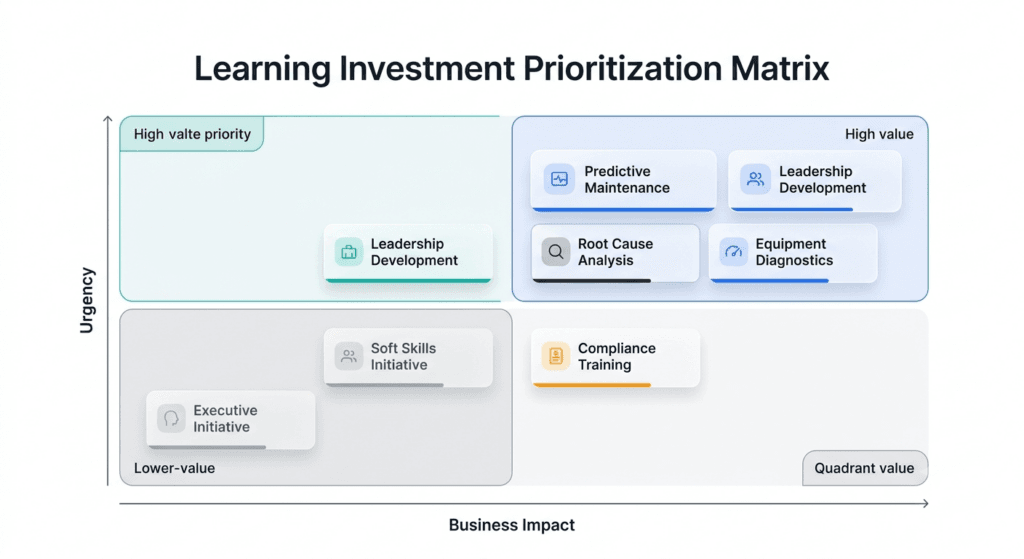
Scoring the priorities. Business impact, urgency, and population size, scored consistently:
Acme’s Learning Priority Matrix
| Priority | Business Impact | Urgency | Population Size | Priority Score |
| Predictive Maintenance | High | High | Medium | 1 |
| Root Cause Analysis | High | High | Small | 2 |
| Equipment Diagnostics | Medium | Medium | Small | 3 |
| Data-Driven Decision Making | Medium | Low | Small | 4 |
Urgent versus important. Predictive maintenance was both urgent and tied to a board number — an easy yes. Data-driven decision making for the plant manager was important, arguably more important long-term, but nobody upstairs was asking for it this quarter. Important-but-not-urgent items belong on the roadmap, honestly labeled, rather than smuggled into year one because they’re intellectually more interesting to build.
How to say no without burning the relationship. The plant’s quality manager wanted a full quality-systems training rollout added to year one. It scored low on the priority matrix — real gap, but not tied to a funded initiative, and the population size was small.
This is a mistake I see teams make constantly: saying no directly (“this isn’t funded and isn’t urgent this year”) landed better than a vague “we’ll look into it,” because it was backed by the same scoring logic applied to every other request. Inconsistent scoring is what turns prioritization into politics. Consistent scoring turns politics into a conversation about criteria, which is a fight you can actually win.
Budget reality. Acme’s initial ask covered three priorities. Finance funded two. Don’t try to deliver three priorities on two priorities’ budget — I’ve watched more than one L&D team fall into that trap. The plant scope for equipment diagnostics was narrowed to the two production lines with the worst diagnostic error rates, instead of all six lines. Smaller scope, delivered well, beats full scope delivered thin.
Stakeholder influence, honestly. Not every voice in the room carries equal weight, and pretending otherwise wastes time. The plant director’s priorities got weighted heavily because the budget answered to him. The quality manager’s request got a real hearing and a real no. HR’s request for a generic leadership program got parked entirely — not because it lacked merit, but because it didn’t trace to a named, funded business priority, and this cycle wasn’t going to be the one where scope crept back in.
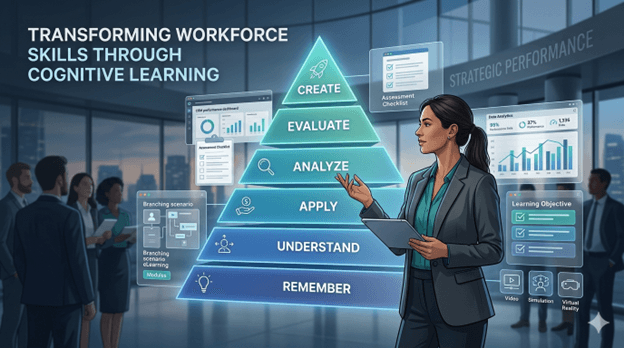
The TrainerCentric Capability Alignment Pyramid
Every strategy in this space eventually needs one mental model that holds the whole thing together when a stakeholder asks “why this, and not that.” This is the one we teach in every TrainerCentric engagement, and it’s worth building into your own document regardless of which template you follow:
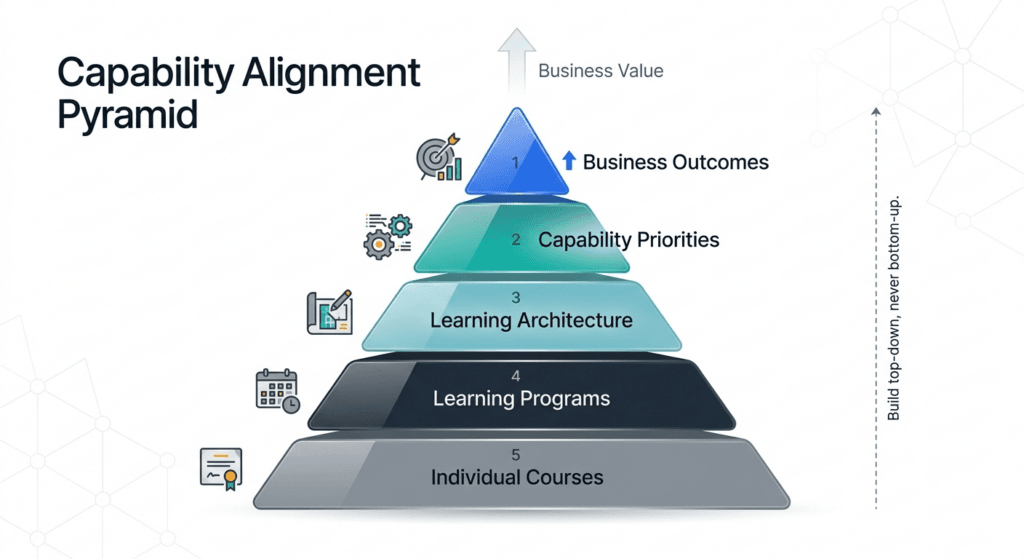
Most organizations build this pyramid upside down. They start at the bottom — a course catalogue, a list of available programs — and try to justify upward toward a business outcome after the fact. It rarely holds together, because the courses were never derived from a capability priority in the first place; they were derived from what a vendor was selling or what was easy to schedule.
Writing an L&D strategy correctly means building the pyramid top-down: start from the business outcome (Acme’s downtime number), derive the capability priority (predictive maintenance), design the learning architecture around it (blended delivery, sequencing, reinforcement), and only then select specific programs and courses. Every layer should be able to answer “why do you exist” by pointing to the layer above it. If a course can’t trace a line all the way to a business outcome, that’s not a reason to keep it out of guilt over the sunk cost — it’s a reason to cut it.
Step 6: Set Learning Objectives
Weak version: “Machine operators will understand predictive maintenance.”
Working version: “Machine operators will be able to identify early failure indicators on assigned equipment using the predictive maintenance checklist, evidenced by a 15% reduction in unplanned stoppages within two quarters.”
SMART objectives and Bloom’s Taxonomy do most of the heavy lifting, but the real skill is resisting vague verbs like “understand” or “be aware of.” This is covered step-by-step in our guide to Writing Learning Objectives.
Run every draft objective through one test: could someone outside your team read it and know exactly what evidence would prove it was met? If the answer requires you to explain it further, rewrite it.
Step 7: Choose Learning Solutions
| Method | Best Suited For | Less Suited For |
| Instructor-Led Training | Complex skills needing discussion, practice, and feedback | Large, dispersed audiences on a tight timeline |
| Virtual Instructor-Led | Distributed teams needing live interaction | Deep hands-on or physical skill practice |
| eLearning | Standardized knowledge at scale, compliance content | Behavior change requiring practice and feedback |
| Blended Learning | Complex capability building combining knowledge and practice | Simple, one-time awareness topics |
| Coaching | Individualized leadership or performance development | Large-scale, standardized skill rollout |
| Mentoring | Long-term career and capability growth | Urgent, time-bound skill gaps |
| Social Learning | Peer knowledge-sharing in mature learning cultures | Organizations without existing collaboration habits |
| Microlearning | Reinforcement, just-in-time performance support | Foundational or highly technical skill-building |
| Performance Support | In-the-moment task guidance at point of need | Deep conceptual understanding |
Delivery method is often the first compromise organizations make when budgets tighten. Ironically, it’s usually the last place they should compromise. If a capability genuinely requires supervised practice, replacing it with self-paced eLearning doesn’t make the program cheaper — it changes the intervention into something fundamentally different.
Acme, Part 3: For predictive maintenance, Acme resisted building a single eLearning module and calling it done — that approach had been tried two years earlier for a different initiative and hadn’t moved the needle. Instead: a half-day instructor-led session, supervisor coaching during the first month, microlearning refreshers at two and four months. The union added a wrinkle nobody had planned for: instructor-led sessions had to be scheduled within contracted hours, which meant the pilot slipped by three weeks while HR worked out the scheduling agreement with union reps. Worth planning for, not worth panicking over.
For any priority scored High on both business impact and urgency, avoid relying on eLearning alone. It’s the cheapest option and the easiest to greenlight, which is exactly why it gets overused on the priorities that can least afford a shallow intervention.
Step 8: Create the Learning Roadmap
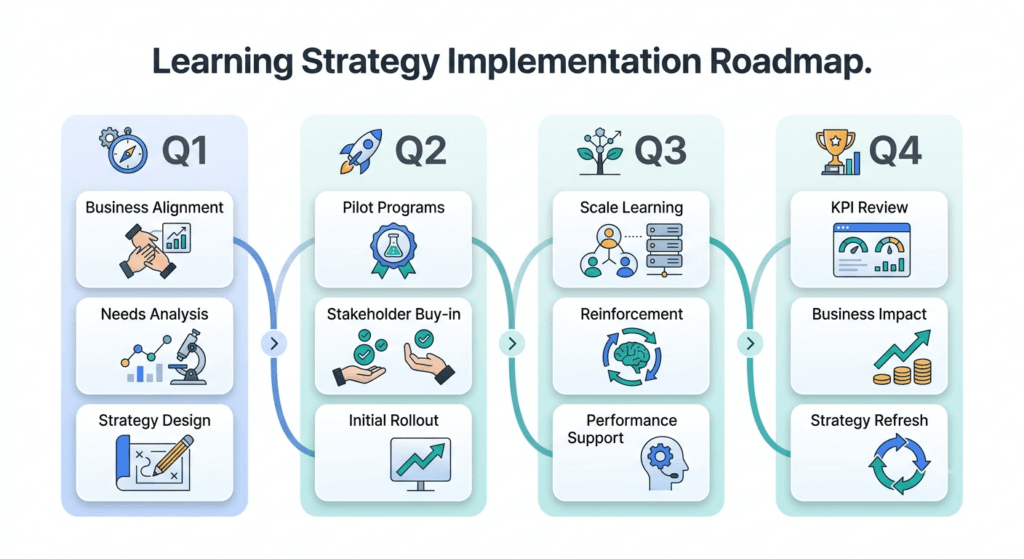
Acme’s Roadmap Extract
| Quarter | Priority | Phase | Owner |
| Q1 | Predictive Maintenance | Design & Pilot | L&D + Operations |
| Q2 | Predictive Maintenance | Full Rollout | L&D |
| Q2 | Root Cause Analysis | Design & Pilot | L&D + Plant Management |
| Q3 | Equipment Diagnostics | Rollout | L&D |
| Q4 | All Programs | Reinforcement & Evaluation | L&D |
Friction, mid-roadmap: Halfway through Q2, falling order volume triggered a hiring freeze across the plant. The original roadmap assumed new maintenance hires would be trained alongside existing staff. With the freeze in place, that population disappeared overnight. Rather than rewriting the entire strategy, Acme’s L&D lead re-sequenced the roadmap around internal mobility instead — cross-training existing operators into maintenance-adjacent tasks rather than waiting for external hires who weren’t coming. The business outcome (reduced downtime) didn’t change. The delivery path to it did. That’s what a roadmap is actually for: a plan you’re allowed to bend without losing the thread back to the business outcome.
Step 9: Define KPIs
| KPI Type | What It Measures | Acme Example |
| Participation | Reach | 95% of machine operators enrolled |
| Completion | Delivery | 90% completion within deadline |
| Knowledge | Learning | 25% improvement in checklist assessment scores |
| Behaviour | Application | Supervisor-observed checklist use within 60 days |
| Business Impact | Outcome | 20% reduction in unplanned downtime |
The Kirkpatrick Model and Phillips ROI Methodology remain the two most widely used frameworks for structuring this evaluation. Our guides to the Kirkpatrick Model and Learning Evaluation cover the full application of each.
Business impact metrics take longest to materialize and are hardest to attribute cleanly to training alone. Report them with appropriate confidence (“downtime decreased 18% in the quarter following rollout, alongside two other operational changes”) rather than overclaiming a single cause.
A Strategy That Failed
Not every story in this space ends like Acme’s. A few years ago, I reviewed a strategy for a services company that, on paper, was a success: 92% completion rate, strong satisfaction scores, a well-run leadership development program. Eighteen months later, the business hadn’t moved the metric it was meant to move — manager-driven attrition on frontline teams.
The postmortem surfaced three separate problems. The KPI framework had stopped at completion and satisfaction and never built in a genuine behaviour or business-impact layer, so nobody noticed the gap until attrition data forced the question. The executive sponsor had championed the program for optics reasons tied to an unrelated initiative, not because they owned the attrition number, so accountability had nowhere real to land.
And the timing was wrong: the program launched during a reorganization that changed half the target managers’ roles within three months of completion, so the skills being reinforced didn’t map to the jobs people actually held by the time reinforcement was supposed to happen. Training succeeded. The business result it was meant to produce didn’t. Wrong KPI depth, wrong sponsor, wrong timing — any one of those alone is survivable. Together, they sank it.
Step 10: Build Executive Buy-In
- Lead with business value, not training activity.
- Use leadership’s own language and metrics.
- Estimate ROI conservatively.
- Ask for staged budget where trust is still being built.
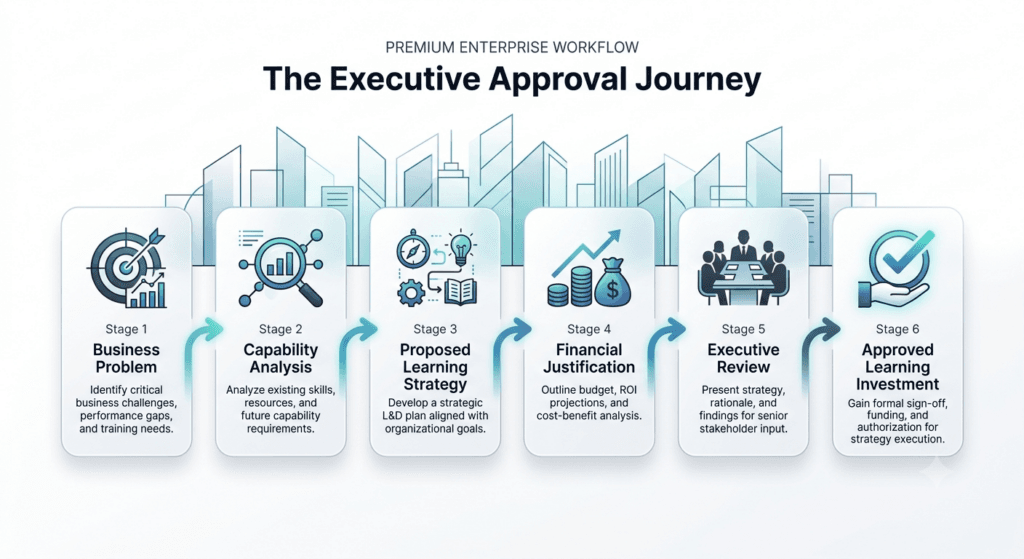
Acme, Part 4: The L&D lead opened the executive meeting with one slide: the cost of current downtime per month, next to the projected cost of the predictive maintenance program. Finance pushed back hard on the projected ROI figure in the first draft, calling it optimistic — and they were right. The original estimate assumed full-speed rollout with no scheduling friction. After the union scheduling issue in Step 7 became known, the revised, more conservative ROI estimate was the one that actually got approved. The pushback made the number more credible, not less.
Executive Presentation Checklist
- ☐ Business problem stated in one sentence
- ☐ Cost of inaction quantified where possible
- ☐ Proposed solution summarized in non-technical language
- ☐ Budget request tied to a specific, time-bound outcome
- ☐ Success measures included upfront, not as an afterthought
The Executive Approval Checklist inside the toolkit expands on this with a one-page executive summary template built specifically for this conversation — the same one-slide, cost-of-inaction structure the Acme L&D lead used to open their meeting above.
Step 11: Draft the Strategy Document
A learning and development strategy template typically follows eleven sections. Here’s what “good” looks like inside each one, with annotated excerpts from Acme’s actual document.
1. Executive Summary
One page. Business problem, strategic response, expected outcome — in that order.
Acme excerpt: “Unplanned downtime cost the plant an estimated 340 production hours in the past 12 months, tied primarily to preventable equipment failures and inconsistent maintenance practice. This strategy proposes a targeted capability program for machine operators and supervisors, projected to reduce unplanned downtime by 15–20% within two quarters of full rollout, at a cost of approximately 4% of the current downtime cost.”
Notice the revised range (15–20%, not a flat 20%) — a direct result of the finance pushback in Step 10. No mention of course names or delivery format here. That comes later.
2. Business Context
Acme excerpt: “This strategy directly supports the plant’s FY26 commitment to reduce unplanned downtime, as set out in the operations strategic plan, and the broader corporate priority on operational excellence following the recent acquisition integration.”
3. Current Capability
The skills gap matrix from Step 3, plus one judgment sentence: “Approximately half of the identified maintenance gap was attributable to an outdated procedural checklist rather than a skills deficit; the checklist has been corrected as a prerequisite to this training.”
4. Strategic Priorities
The scored, prioritized list from Step 5, presented as a ranked table with the deferred items explicitly labeled, not omitted.
5. Learning Objectives
The SMART objectives from Step 6, one per priority.
6. Delivery Strategy
Acme excerpt: “Instructor-led delivery was selected for initial checklist training due to the need for live equipment demonstration; delivery was scheduled in coordination with union representatives to align with contracted working hours.”
7. Implementation Roadmap
The visual, phased roadmap from Step 8, including the re-sequencing note explaining the hiring-freeze adjustment. Showing that a plan changed, and why, builds more governance credibility than presenting a roadmap as if it survived untouched.
8. Budget
Phased, validated with finance, with the revised conservative ROI range from Step 10 rather than the original optimistic figure.
9. Success Measures
The layered KPI framework from Step 9, with a named owner for tracking each layer — and, learning from the failed strategy example above, an explicit line confirming the business-impact layer has an owner distinct from the program facilitator.
10. Governance
A quarterly review group of three roles, named by role rather than by person, which survives staff turnover better.
11. Review Schedule
Annual full review, quarterly monitoring, with a defined trigger for off-cycle revision — the hiring freeze in Step 8 being exactly the kind of trigger this clause exists for.
Strategy Document Section Comparison
| Section | Primary Audience | Typical Length |
| Executive Summary | Senior leadership | 1 page |
| Business Context | Leadership, finance | 1–2 pages |
| Current Capability | HR, L&D team | 1–2 pages |
| Strategic Priorities | All stakeholders | 1 page |
| Delivery Strategy | L&D team, vendors | 1–2 pages |
| Implementation Roadmap | All stakeholders | 1 page (visual) |
| Governance | Leadership, L&D | 1 page |
Stakeholder Responsibilities
| Stakeholder | Responsibility |
| Executive Sponsor | Approves budget, champions strategy at leadership level |
| L&D Manager | Owns the strategy document, coordinates delivery |
| HR Business Partners | Provide workforce data, support change management |
| Line Managers | Identify team needs, reinforce learning on the job |
| Learners | Engage with development, apply new capability |
Strategy Draft Review Checklist
- ☐ Every priority traces back to a named, funded business objective
- ☐ Every objective is measurable, not just observable
- ☐ Roadmap timeline is realistic given resourcing, and names its own trigger for revision
- ☐ Budget figures are validated with finance
- ☐ Governance and review cadence are clearly defined
- ☐ Document has been reviewed by at least one non-L&D stakeholder
If you’d rather adapt a working structure than build these eleven sections from a blank page, the Learning & Development Strategy Writing Toolkit includes a full Strategy Outline Template and Executive Summary Template built around this exact structure, alongside the Annual Learning Roadmap and KPI Planning Worksheet referenced earlier.
Step 12: Review and Update
Treating the strategy as a document you revisit once a year is itself a common mistake, not a neutral choice. Business priorities move faster than annual cycles in most industries now.
Acme, Part 5 (closing the loop): By the Q3 review, root cause analysis training was landing well, but equipment diagnostics had slipped in relevance after a planned equipment replacement was delayed. Rather than running the program as originally scoped, Acme’s L&D lead deferred it and reallocated the budget to extend the predictive maintenance reinforcement cycle, which was already showing measurable downtime improvement. That’s not a failure of planning. That’s the review process doing its job.
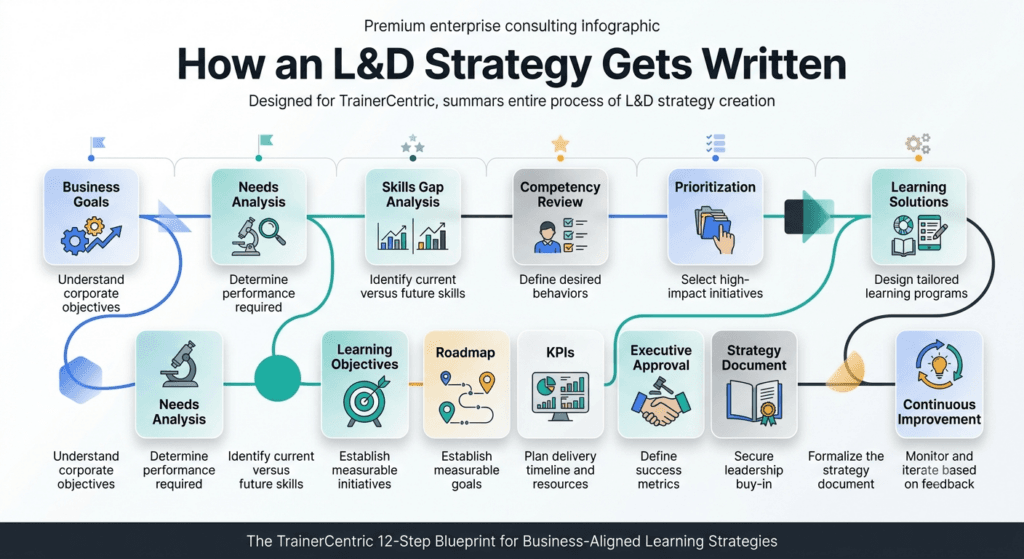
The TrainerCentric 12-Step L&D Strategy Blueprint
A one-page summary worth keeping on hand once you’ve internalized the detail above:
How L&D Strategy Is Changing in 2026
A few shifts worth building into your thinking now:
- AI-assisted capability planning is increasingly used to surface skills gaps from performance and productivity data faster than manual needs analysis alone.
- Skills taxonomies and skills intelligence platforms are giving organizations a more granular, real-time view of workforce capability than annual competency frameworks alone could offer.
- Workforce planning integration means L&D strategies increasingly need to speak the same language as workforce planning, talent mobility, and succession planning, rather than sitting in a separate silo.
- Internal talent marketplaces and capability academies are shifting some development activity away from centrally scheduled training toward employee-driven, marketplace-style skill building — part of a broader shift in employee experience expectations.
- Dynamic strategy reviews are gradually replacing purely annual cycles, particularly under continuous digital transformation.
- Capability maturity measurement is emerging as a complement to individual KPI tracking, alongside growing attention to the health of an organization’s broader learning ecosystem and learning governance structures, not just its learning portfolio of individual programs.
AI will probably write the first draft of most L&D strategy documents within the next few years. That doesn’t mean AI replaces the strategist. It means the competitive advantage shifts from writing documents to making better strategic decisions. AI can summarize interview notes and draft a skills gap matrix from raw data in minutes. It cannot tell you which capability deserves next year’s budget when three business units are competing for the same investment, or whether a stakeholder’s request is worth the political capital it would cost to say no.
Bodies like ATD and CIPD have both published extensively on the shift toward strategically integrated L&D functions, and recent editions of LinkedIn’s Workplace Learning Report and Deloitte’s Human Capital Trends research point in the same direction: organizations that treat learning as a business function, not a support function, consistently report stronger workforce capability outcomes. The World Economic Forum’s ongoing work on reskilling similarly frames capability building as core business infrastructure rather than an HR initiative — which is the same argument this entire guide has been making from the first paragraph, just with better funding behind it.
None of this replaces the twelve-step process above. It changes the inputs and the tooling, not the underlying discipline of connecting learning priorities to business outcomes.
Conclusion
A learning strategy isn’t judged by how polished the document looks. It’s judged by whether leaders keep referring back to it six months later when they’re making decisions about people, capability, and investment. Every step in this guide — the honest conversation in Step 1, the political no in Step 5, the re-sequenced roadmap in Step 8 — exists to earn that kind of relevance. If your strategy becomes a document that shapes those conversations, you’ve written more than a plan. You’ve created a business tool.
If you’d rather work from a structured starting point than a blank page, the Learning & Development Strategy Writing Toolkit brings together every template referenced in this guide — the Business Alignment Worksheet, the Skills Gap Matrix, the Executive Approval Checklist, and the Final Strategy Review Checklist among them. Between them, they catch the mistakes that sink strategies most often: analysis built on the wrong version of the business plan, priorities that were never scored consistently, and an executive pitch built without knowing what finance will push back on.
The document you write this year shouldn’t just survive the approval meeting — it should still be influencing investment decisions a year from now. That’s the standard worth writing for.
Frequently Asked Questions
How long should an L&D strategy be?
Most effective L&D strategy documents run 15–25 pages, including the executive summary, roadmap, and KPI framework. Length matters less than whether each section gives stakeholders what they need to make a decision.
How long does it take to write an L&D strategy?
For a single business unit with existing data, four to six weeks is realistic, most of it spent on needs analysis and stakeholder conversations rather than drafting itself. Enterprise-wide strategies typically take two to three months.
What does a good L&D strategy actually look like?
It reads like a business case with learning as the mechanism, not a training catalogue with a business justification bolted on. Every section traces back to a funded priority.
Who should write an L&D strategy?
Typically the L&D Manager or Head of L&D, working closely with HR Business Partners, line managers, and an executive sponsor.
Who owns an L&D strategy once it’s written?
The document usually sits with L&D, but accountability for outcomes should be shared with the business unit leaders whose priorities it supports — otherwise it becomes an HR artifact rather than a business tool.
What should an L&D strategy include?
Business context, current capability findings, strategic priorities, learning objectives, delivery methods, an implementation roadmap, budget, success measures, and governance.
What data should be collected before writing an L&D strategy?
Performance data by department and role, existing skills or competency assessments, exit interview themes, engagement survey results, and direct input from business unit leaders on funded priorities — the last of which is the most frequently skipped.
Can you write an L&D strategy without a competency framework?
Yes. A strategy tightly anchored to a skills gap analysis and named business priorities can be written and defended without one.
What is the difference between an L&D strategy and a training plan?
A strategy is the multi-year or annual framework connecting learning priorities to business goals. A training plan is the tactical schedule of courses underneath it.
How do you measure the success of an L&D strategy?
A layered KPI framework covering participation, completion, knowledge, behaviour, and business impact, drawing on Kirkpatrick or Phillips ROI for structure.
Can AI help write an L&D strategy?
Yes, and increasingly it will handle more of the drafting than most L&D professionals expect. AI tools can summarize stakeholder interviews, draft a first-pass skills gap matrix from raw performance data, and even generate objective statements that follow the SMART format correctly on the first try. What AI can’t do is sit in the room when the quality manager’s request gets deprioritized and hold that line under pressure, or judge which of three competing business units deserves next year’s capability budget when all three cases are well argued. That judgment depends on organizational context, political capital, and accumulated trust that no model has access to. Treat AI as a drafting accelerator for the analysis-heavy steps in this guide — needs analysis, skills gap matrices, objective-writing — and keep the prioritization and stakeholder-facing decisions firmly human.
What mistakes should be avoided when writing an L&D strategy?
Five show up more often than the rest. Treating the published business strategy as unchanging fact, when the real priorities usually live in conversations that happened after the document was published. Trying to close every skills gap in year one instead of naming deferred priorities honestly. Writing objectives around the training event (“complete the workshop”) rather than the resulting business behaviour. Defaulting to eLearning for high-stakes, high-urgency priorities because it’s the cheapest option to get approved, even when the capability genuinely requires supervised practice. And treating the finished strategy document as a static artifact to file away rather than a living plan that gets revisited every quarter — the strategies that actually shape business decisions a year later are the ones that got adjusted along the way, not the ones that survived untouched.
References
- The Chief Learning Officer: Driving Value Within a Changing Organization Through Learning and Development || 2nd Edition || Tamar Elkeles & Jack J. Phillips || Routledge || 2017
- The Six Disciplines of Breakthrough Learning: How to Turn Training and Development into Business Results || 3rd Edition || Roy V. H. Pollock, Andrew C. Jefferson & Calhoun W. Wick || Wiley || 2015
- The Performance Consultant’s Fieldbook: Tools and Techniques for Improving Organizations and People || 2nd Edition || Judith Hale || Pfeiffer || 2007
- Design for How People Learn || 2nd Edition || Julie Dirksen || New Riders || 2015
- ATD Handbook for Training and Talent Development || 2nd Edition || Elaine Biech || Association for Talent Development (ATD Press) || 2022
- Evidence-Informed Learning Design: Creating Training to Improve Performance || 1st Edition || Mirjam Neelen & Paul A. Kirschner || Kogan Page || 2020
Further Readings
- How to Design a Learning Programme From Scratch: A Step-by-Step Guide [2026]
- Bloom’s Taxonomy
- Instruction Designing Models
- ADDIE Model of Instructional Designing
- Successive Approximation Model (SAM): Complete Guide + 8 Free Templates
- Kolb’s Learning Cycle: Using Experiential Learning in the Workplace
- ADDIE vs SAM: Which Instructional Design Model Should You Use in 2026?
- Adult Learning Theory (Andragogy): Knowles’ 6 Principles Explained with Workplace Examples
- Kirkpatrick Model: How to Measure Training Effectiveness
- How to Choose the Right LMS: A Complete Selection, Evaluation, and Implementation Guide
- Learning Experience Platform (LXP): Features, Benefits, Examples and Whether You Need One
- Curriculum Design vs Instructional Design: 3 Certain Differences
Author Details

Anupama Mitra is a learning experience designer, writer and facilitator with a deep interest in how people learn, adapt and grow at work. With over a decade of experience in corporate learning and development, she specializes in simplifying complex ideas into practical, actionable insights. Her work focuses on leadership development, behavioral changes, making workplace learning more human and engaging. You can reach out to her at anupama@trainercentric.com