A Practitioner’s Playbook for Corporate L&D Professionals
Introduction: The Billion-Dollar Training Problem Nobody Talks About
Every year, organisations worldwide spend over $300 billion on workplace learning. And every year, the majority of that investment produces something closer to a compliance checkbox than a performance outcome.
The training launches. The learners attend. The LMS records a completion rate. And then — nothing. No behaviour change. No performance data. No accountability loop. The same problem resurfaces six months later, and someone commissions another training programme.
This is not a budget problem. It is not a learner problem. It is a design problem — and it is completely solvable.
This playbook is built on 15+ years of designing training across manufacturing, financial services, healthcare, retail, and technology — contexts where the stakes ranged from customer satisfaction scores to regulatory compliance to life-and-death clinical decisions. What works in those environments is not theory. It is disciplined, evidence-based instructional systems design applied under real organisational constraints.
You will find here: the core instructional design models and when to use each, the learning science that separates effective training from expensive content delivery, the execution tools that turn plans into programmes, and — critically — a decision framework that tells you exactly which model fits which situation. That last part is what most guides skip entirely.
| 🔥 The Three Things That Determine Training Effectiveness 1. Diagnose before you design. A Training Needs Analysis is not optional — it is the foundation of every programme worth building. 2. Match your model to your constraints. The right framework for a six-month leadership journey is wrong for a two-week compliance rollout. 3. Measure learning transfer, not completion. Behaviour change on the job is the only metric that matters. |

PART 1: Core Instructional Design Models
| Which instructional design model should I use? It depends on four variables: timeline, stakes, stakeholder availability, and the nature of the performance gap. ADDIE for structured large-scale programmes. SAM for fast-changing content. Dick & Carey for high-stakes compliance. Gagné for individual eLearning modules. See the full decision matrix in Part 4. |
1. The ADDIE Model
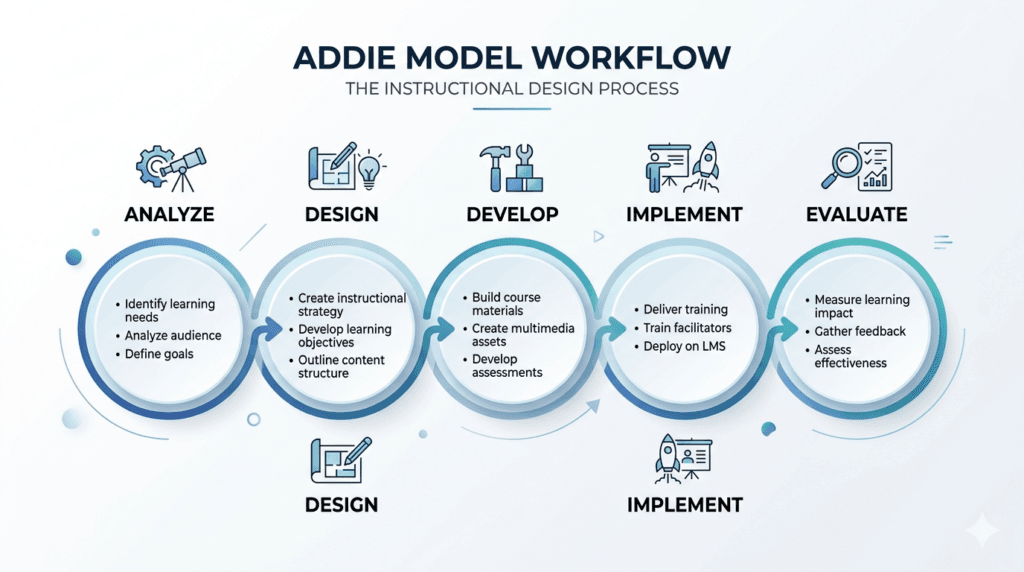
What it is: ADDIE — Analyse, Design, Develop, Implement, Evaluate — is the foundational framework of instructional systems design. Introduced by Florida State University in the 1970s for the U.S. military, it remains the most widely used model in corporate L&D because it imposes discipline on a process that, without structure, drifts into content-dumping disguised as training.
How ADDIE Works in a Corporate Context
Analyse: You are diagnosing a performance gap, not reviewing content. This phase drives stakeholder interviews, job task analysis, learner profile research, and a hard look at whether training is even the right intervention.
Design: Learning objectives, assessment strategy, content sequencing, delivery modality, and curriculum mapping decisions. This is where most teams rush — and where most programmes are fatally compromised.
Develop: Content creation, SME reviews, prototype builds, and authoring tool production. Budget reality hits hardest here. Scope creep is the primary cause of blown timelines.
Implement: Pilot testing with a real learner cohort, facilitator preparation, LMS configuration, and rollout logistics. A 90-minute pilot can surface more design problems than ten rounds of SME review.
Evaluate: The phase most organisations treat as optional. It is not. Without evaluation data, you cannot improve the programme, justify the investment, or demonstrate business impact.
⚠️ What Goes Wrong with ADDIE in Real Organisations
During a financial services onboarding redesign, a team treated ADDIE as a strict waterfall — completing each phase fully before touching the next. By the time they reached development, the business context had shifted and the objectives needed rewriting. Six weeks of content became unusable.
Modern ADDIE is iterative. Phases overlap. You loop back. The framework gives you discipline — not a rigid sequence. The other common failure: the Evaluate phase becomes a post-training survey rated 4.2 out of 5. That is not evaluation. That is comfort-seeking dressed in spreadsheet format.
When to Use ADDIE
- Global or multi-site onboarding design where standardisation across regions is non-negotiable
- Compliance training requiring audit documentation and formal sign-off at each phase
- Leadership development programmes with 6+ month timelines and SME involvement
- Any programme where curriculum mapping and version control matter
When NOT to Use ADDIE
- When the content will change within 60 days — you’ll be redesigning before you launch
- When your window is two weeks and your team is three people
- When stakeholder availability is unpredictable — ADDIE stalls without structured sign-off
If you need to download the templates of each phase of the ADDIE model or learn more step by step on how to Apply the ADDIE model in Corporate Training with example, please read our extensive document on ADDIE Model.
2. The SAM Model (Successive Approximation Model)
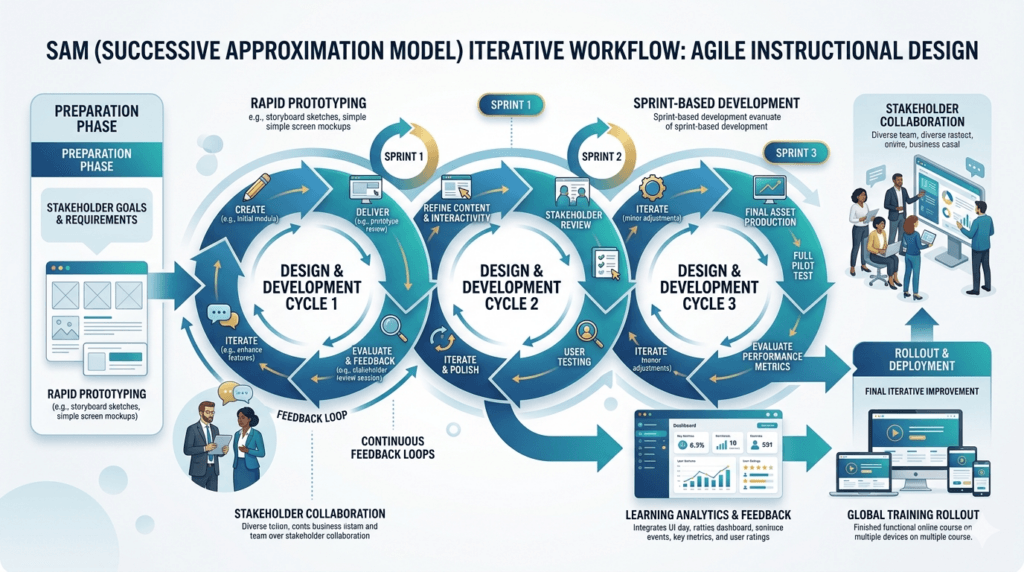
What it is: Developed by Michael Allen, SAM is instructional design’s answer to agile software development. Where ADDIE plans extensively before building, SAM builds something rough, tests it, and improves — rapidly and repeatedly. It operates in two nested cycles: Iterative Design (savvy start → prototype → planning) and Iterative Development (design proof → alpha → beta → gold).
SAM’s core insight is that the best way to find out if a learning design works is to put it in front of real learners as fast as possible, collect feedback, and iterate. This is not a shortcut — it is a different philosophy about where learning happens in the design process.
SAM in Practice: A Sales Enablement Example
A fast-growth SaaS company needed product knowledge training for a sales team of 80. The product was releasing updates weekly. ADDIE would have collapsed under those conditions — by the time a formal programme launched, three modules would have been obsolete.
Using SAM: a rough prototype — a decision-tree scenario and a product overview — went to five salespeople on Day 3. Their feedback reshaped the structure entirely. The final programme launched in Week 4, was immediately relevant, and was updated in sprint cycles alongside the product roadmap. Here is a details guideline on how to use SAM model and free downloadable templates that you can use right away.
| 💡 The Honest Limitation of SAM SAM works brilliantly when stakeholders show up. In most corporate environments, delayed approvals become the bottleneck — not the design process itself. In one manufacturing programme, a SAM project stretched to twelve weeks because a single approver was consistently unavailable for prototype reviews. The speed advantage evaporated. Before committing to SAM, negotiate a rapid-feedback SLA with your stakeholders. Without it, you get waterfall with extra steps and nobody to blame but the process. |
When to Use SAM
- Fast-changing content — product training, sales enablement, market and regulatory updates
- Organisations with agile cultures that already understand iteration and prototyping
- Short-turnaround projects where a workable solution now beats a perfect solution in three months
- Teams with tight stakeholder relationships and agreed rapid-feedback cycles
Read our comprehensive guide on SAM Model: How to Build Training Faster Without Sacrificing Quality.
ADDIE vs SAM: The Comparison That Actually Matters
| Should I use ADDIE or SAM? Use ADDIE when you need documentation, consistency, and structured phase sign-off. Use SAM when speed, iteration, and fast learner feedback are more valuable than comprehensive planning. Many experienced L&D teams combine both: ADDIE for project governance, SAM for content prototyping within the Develop phase. |
| Factor | ADDIE | SAM |
| Timeline | 3–12 months | 2–8 weeks for first iteration |
| Documentation | Extensive — each phase produces formal outputs | Lighter — emphasis on working prototypes |
| Stakeholder involvement | Structured sign-off at phase gates | Continuous, rapid feedback required |
| Best for | Large-scale, standardised, high-documentation programmes | Fast-changing content, agile teams, short timelines |
| Risk if misused | Rigidity — world changes while you’re still designing | Stakeholder bottleneck kills speed advantage |
| Learning transfer design | Built into Evaluate phase — if executed properly | Requires explicit reinforcement design; not built-in |
| Budget intensity | Higher upfront (planning and documentation) | Lower upfront, iterative spend across cycles |
3. The Dick & Carey Model
What it is: Walter Dick and Lou Carey’s systems approach treats instruction as an interconnected whole. Every component — learner analysis, objectives, assessments, content, and delivery — is explicitly aligned to a specific performance goal. Nothing is designed in isolation. This is instructional systems design taken to its most rigorous form.
This is the model for high-stakes training. In pharmaceutical field representative programmes, every claim made during a sales call carries legal and regulatory weight. In healthcare compliance training, a missed learning objective has patient safety implications. Dick & Carey’s systematic alignment between goals, objectives, and assessment criteria is not overhead — it is protection.
The Model’s Core Sequence
- Identify instructional goals from a validated performance gap analysis
- Conduct instructional analysis — decompose the goal into enabling subskills
- Analyse learners and the performance context in detail
- Write performance objectives with measurable, observable criteria
- Develop criterion-referenced assessment instruments (before content)
- Design the instructional strategy — sequence, methods, media
- Develop and select instructional materials
- Design and conduct formative evaluation with real learners
- Revise based on formative data
- Design and conduct summative evaluation against performance objectives
| 🔍 Where Dick & Carey Earns Its Complexity During a compliance rollout for a regulated financial services firm, the Dick & Carey analysis phase uncovered that the original learning objectives didn’t map to the regulator’s competency framework. This was caught in Phase 4 — before a single piece of content was developed. That catch avoided six weeks of rework and a potential audit finding. The model paid for its complexity before development even started. The rigour most L&D teams skip at the start is the rework they pay for at the end. |
When to Use Dick & Carey
- Compliance, regulatory, and competency-based training with audit trail requirements
- Technical skills certification programmes where performance precision is critical
- Large-scale programmes requiring formal human performance improvement documentation
- Any context where training failure has measurable legal, financial, or safety consequences
Read our comprehensive guide on Dick and Carey model of Instructional Designing and when to use it and when not to.
ADDIE vs Dick & Carey: When Systems Thinking Wins
| What is the difference between ADDIE and Dick & Carey? ADDIE is a project management framework for instructional design — it tells you what phases to work through. Dick & Carey is a systems design model — it tells you exactly how to design each component and how they must interrelate. Dick & Carey is significantly more rigorous and is best suited to high-stakes, high-complexity training programmes. |
| Factor | ADDIE | Dick & Carey |
| Nature | Project framework — phase structure | Systems model — component alignment |
| Objective writing | Recommended but not prescribed | Mandated — criterion-referenced and measurable |
| Assessment design | Evaluated after content development | Designed before content — drives everything |
| Learner analysis | One phase in the process | Deep analysis of learners AND context — foundational |
| Complexity | Medium — adaptable to team size | High — requires instructional design expertise |
| Best for | Broad range of corporate programmes | High-stakes compliance, technical certification |
4. Gagné’s Nine Events of Instruction
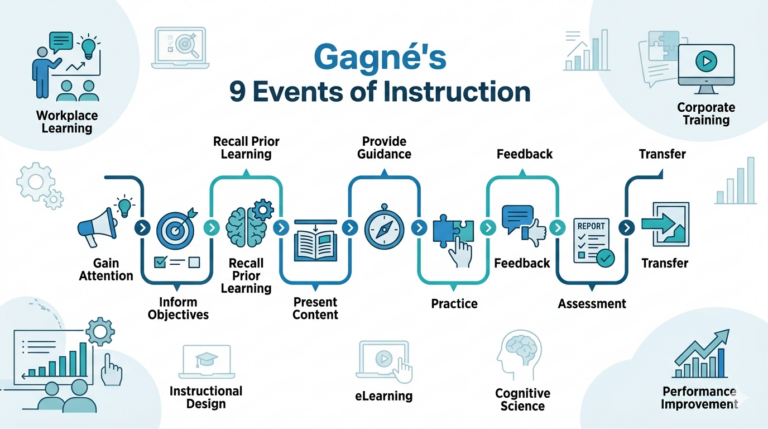
What it is: Robert Gagné’s Nine Events are a psychology-rooted sequence that maps how humans process and retain new information. It is less a project management model and more a lesson-level design framework — the microstructure that sits beneath your macro approach. You might use ADDIE or SAM to manage the project; you use Gagné to design each individual learning unit within it.
| Event | What It Does | Corporate Example |
| 1. Gain attention | Activates learner readiness | A real complaint call recording before customer service training |
| 2. Inform objectives | Sets expectations — builds relevance | “By the end, you’ll handle Tier 2 escalations without supervisor support” |
| 3. Stimulate recall | Activates prior knowledge as a scaffold | “Think about the last escalation that didn’t go well…” |
| 4. Present content | Delivers instruction | Model demonstration with narrated commentary |
| 5. Provide guidance | Supports encoding and schema formation | Worked examples, job aids, annotated walkthroughs |
| 6. Elicit performance | Practice with learner engagement | Roleplay scenario with immediate facilitator observation |
| 7. Provide feedback | Corrects, reinforces, and directs improvement | Specific behavioural feedback — not just “good job” |
| 8. Assess performance | Measures achievement against objectives | Post-training scenario test or observable performance checklist |
| 9. Enhance retention | Supports learning reinforcement and transfer | 30-day spaced practice prompt, manager check-in, job aid |
Practitioner note: Events 8 and 9 are the most commonly dropped in corporate training design. Event 9 in particular — the learning reinforcement and spaced learning activities that drive transfer — is almost always sacrificed to timeline pressure. Plan for both before the project brief is signed.
Read our comprehensive guide on Gagné’s Nine Events of Instruction: A Practical Guide for Trainers.
5. Bloom’s Taxonomy
What it is: Benjamin Bloom’s classification of learning objectives (1956, revised 2001) is not a training model — it is a cognitive framework. Its value in corporate L&D lies in one specific place: writing learning objectives that accurately describe the level of performance required.
Most corporate training objectives are written at the lowest two levels of the taxonomy — Remember and Understand — without designers realising it. “Participants will understand data privacy policy” is not a measurable objective. It cannot be assessed. It cannot drive meaningful content design. It produces slide-based content delivery with a knowledge test that confirms attendance, not competence.
| ✅ Bloom’s in Practice: Writing Objectives That Drive Design Remember → “List the five mandatory disclosures required under GDPR” Understand → “Explain why third-party data sharing triggers separate consent requirements” Apply → “Use the escalation matrix to route a Tier 2 complaint correctly in a scenario” Analyse → “Identify the root cause of a service failure from a recorded call” Evaluate → “Assess a colleague’s coaching conversation against the GROW model rubric” Create → “Design a 30-60-90 day development plan for a new direct report” Each level maps to a different assessment type, different content design approach, and different business outcome. Choose the level that matches the actual performance requirement — not the one that’s easiest to test. |
| What is Bloom’s Taxonomy used for in corporate training? In corporate L&D, Bloom’s Taxonomy is primarily used to write measurable learning objectives and design appropriately levelled assessments. It ensures the training targets the correct cognitive level — whether that is knowledge recall (compliance awareness) or complex application (leadership judgement). It is not a standalone design model; pair it with ADDIE, SAM, or Dick & Carey for project structure. |
Read our comprehensive guide on Bloom’s Taxonomy: How to Write Learning Objectives That Actually Work.
6. Merrill’s Principles of Instruction
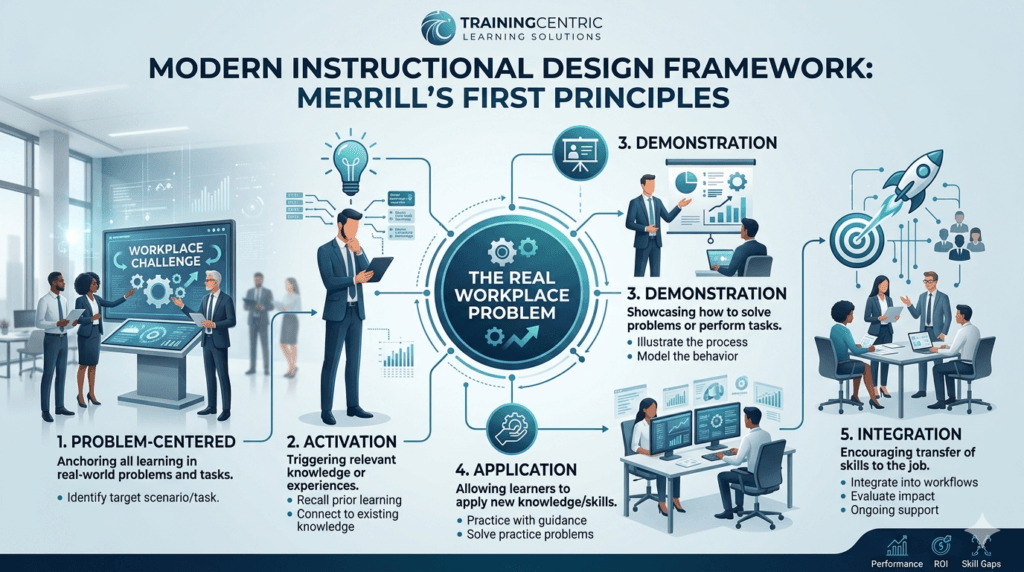
What it is: M. David Merrill’s First Principles of Instruction (2002) synthesised research across dozens of instructional design theories to identify what consistently produces learning that transfers to the job. His central argument: the most effective instruction is centred on real-world problems, not subject matter logic.
The Five Principles
- Problem-centred: Learning is anchored in a real task or problem. The problem is the curriculum, not a vehicle for delivering it.
- Activation: Existing knowledge and experience are activated as a foundation — adults are not blank slates, and effective instructional design builds on what learners already know.
- Demonstration: Learning is shown, not just described. Worked examples, case studies, and expert models make abstract principles concrete.
- Application: Learners practice with coaching and feedback — not passive consumption. Learner engagement through practice is the mechanism of skill acquisition, not content delivery.
- Integration: New skills are integrated into real work — reflected upon, discussed with peers, and applied in the performance context. This is where learning reinforcement happens.
Customer service training built on Merrill’s principles looks radically different from content-forward design. Instead of slides explaining complaint handling, learners work through real recorded calls, diagnose what went wrong, practice alternative approaches in roleplay, and reflect on their own difficult interactions. The content is not the training. The problem is.
Bloom’s vs Merrill’s: Complementary, Not Competing
| What is the difference between Bloom’s Taxonomy and Merrill’s Principles? Bloom’s Taxonomy helps you determine the cognitive level your training should target and write measurable objectives accordingly. Merrill’s Principles tell you how to structure the learning experience itself — through problems, demonstration, practice, and integration. Use Bloom’s to write objectives; use Merrill’s to design the instructional sequence that achieves them. They work best together. |
Read our comprehensive guide on Merrill’s Principles of Instruction: Designing Skill-Based Training.
7. Kolb’s Experiential Learning Cycle
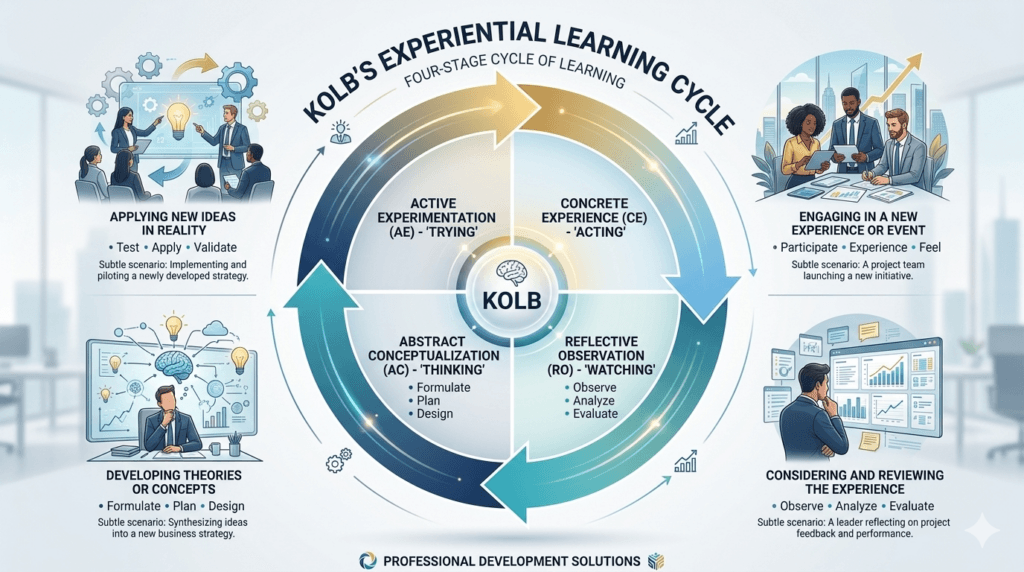
What it is: David Kolb’s 1984 model frames all learning as a continuous cycle: Concrete Experience → Reflective Observation → Abstract Conceptualisation → Active Experimentation. The cycle never truly ends — each experimentation creates new experience, and learning deepens through repetition.
Kolb is most valuable for leadership development, behavioural change, and experiential learning contexts — programmes where the goal is not knowledge transfer but genuine change in how people operate. It is the model I reach for when designing management capability programmes, coaching skills workshops, and culture-shift initiatives.
In a leadership programme for newly promoted managers across a retail chain, the Kolb cycle structured a 6-month journey: real management scenarios (experience) → facilitated peer reflection sessions → conceptual frameworks on feedback and delegation → application experiments back on the floor, reviewed at the next session. Behavioural change — measured through 360-degree feedback at 6 months — was the most significant the client had seen across any previous programme.
Kolb’s limitation is real: it requires time, psychological safety, and structured reflection. A 90-minute compliance module is the wrong home for it. But workflow learning programmes, action learning sets, and long-form development journeys are exactly where it belongs.
Read our comprehensive guide on Kolb’s Learning Cycle: Using Experiential Learning in the Workplace.
8. Learning Styles: VARK and Honey & Mumford — Use With Caution
No instructional design playbook is complete without addressing the learning styles debate directly. VARK (Visual, Auditory, Reading/Writing, Kinesthetic) and Honey & Mumford’s Activist/Reflector/Theorist/Pragmatist model are widely referenced in corporate L&D — and both come with an important evidence caveat.
| ⚠️ The Evidence Problem With Learning Styles Decades of research have failed to support the ‘meshing hypothesis’ — the idea that learners perform better when instruction matches their preferred style. A 2018 meta-analysis in Anatomical Sciences Education found no reliable performance benefit when learners were taught in their preferred modality. This does not mean VARK or Honey & Mumford are useless. It means you should not design separate programme versions for different learner types, and you should not use learning style assessments to stream learners into different content tracks. Use them instead as design variety reminders: build visual, auditory, reflective, and kinesthetic elements into every programme — not because individual learners require one type, but because variety reduces cognitive fatigue and supports broader learner engagement across any cohort. |
Model Comparison: The Full Picture
| Model | Best For | Timeline | Stakeholder Need | Cognitive Level | Budget Intensity |
| ADDIE | Structured, large-scale programmes | High | High | All levels | High |
| SAM | Fast-changing content, agile teams | Low | Very High | Apply–Create | Medium |
| Dick & Carey | Compliance, high-stakes technical | Very High | Medium | Apply–Evaluate | Very High |
| Gagné | Individual eLearning unit design | Medium | Low | All levels | Medium |
| Bloom’s | Objectives and assessment design | Low | Low | All levels | Low |
| Merrill | Skill-based, problem-centred | Medium | Medium | Apply–Create | Medium |
| Kolb | Behavioural and leadership change | Medium | Low | Analyse–Create | Medium |
PART 2: Learning Science Fundamentals
The principles that determine whether training actually produces behaviour change
Adult Learning Principles: Why Corporate Training Fails to Engage
Malcolm Knowles’ theory of andragogy — adult learning — is foundational for corporate L&D, not because it’s a design framework, but because it explains why most classroom-style corporate training fails to engage adults. Adults are not school-age learners. They arrive with prior experience, strong self-concepts, established work habits, and an immediate, legitimate question: “Why do I need to know this?”
Designing without answering that question produces passive learners who click through eLearning to reach the completion certificate and attend face-to-face sessions on their phones.
| Knowles’ Assumption | What It Means for Design |
| Self-directed | Give learners control: choice-based paths, self-paced options, autonomy in practice activities |
| Experience-rich | Use their experience as content: peer discussion, case studies drawn from their own role context |
| Goal-oriented | Lead with outcomes — tell learners what they will be able to do before delivering any content |
| Relevance-driven | Anchor everything to the specific job role: generic examples disengage, specific ones land |
| Problem-centred | Design around real workplace problems — not subject matter logic |
| Internally motivated | Connect learning to career progression, performance reviews, and visible professional impact |
Cognitive Load Theory: The Hidden Reason Training Doesn’t Stick
Picture a new hire opening compliance training on Day 1. The first slide contains 14 bullet points, two embedded videos, three diagrams, a table, and a call to action. By slide five, they are reading nothing. By slide fifteen, they are clicking through to the end. The certification is issued. Nothing was learned.
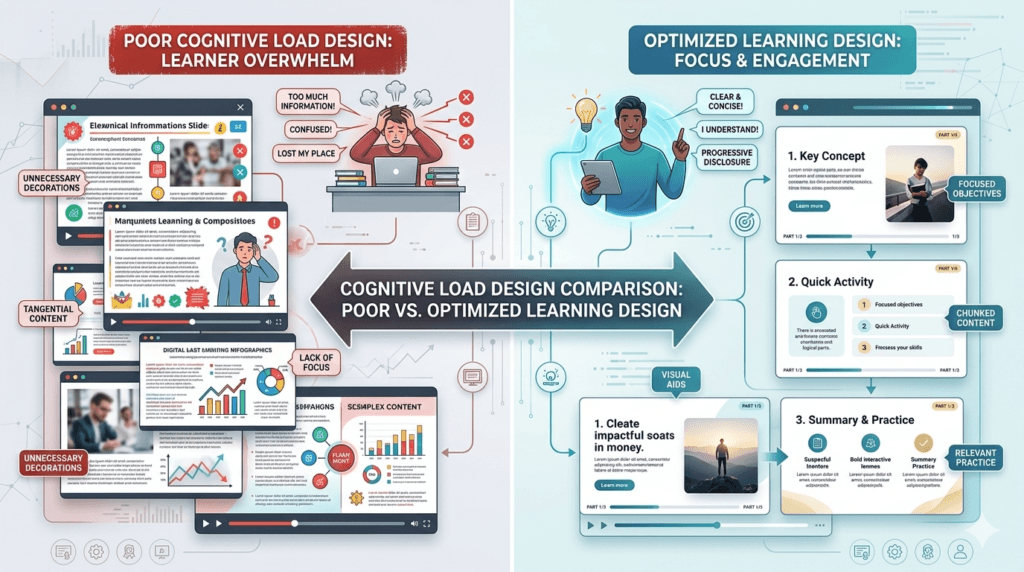
That is not a learner engagement problem. That is cognitive overload — and it is entirely a design failure.
Cognitive Load Theory, developed by John Sweller in the 1980s, explains the mechanism. Working memory — the mental space where active learning occurs — is severely limited. When extraneous demands exceed its capacity, learning stops. Information does not encode. Skills do not form. Transfer does not happen.
The Three Types of Cognitive Load
- Intrinsic load: The inherent complexity of the content. You cannot eliminate it, but you can sequence and chunk it to make it manageable.
- Extraneous load: Load created by poor design — cluttered visuals, inconsistent formatting, redundant narration, irrelevant examples. This load is entirely within your control as a designer.
- Germane load: The productive mental effort of forming schemas and making connections — the actual learning. Your goal is to maximise this by eliminating extraneous load and sequencing intrinsic load intelligently.
| 🎯 7 Design Moves That Reduce Extraneous Load 1. One idea per slide — if you can split it, split it 2. Remove decorative visuals that carry no instructional meaning 3. Use visual hierarchy (size, weight, colour) to guide attention without requiring effort 4. Chunk long content into modules of 10–15 minutes maximum — this is the foundation of microlearning 5. Use consistent design patterns so learners decode content, not layout 6. Eliminate redundant narration — do not read on-screen text aloud verbatim 7. Provide retrieval cues and summaries at the end of every module to consolidate schemas Practitioner test: If your slide looks ‘impressive,’ it is probably overloaded. If a learner’s first reaction is ‘this is a lot,’ you have already lost them to cognitive saturation. |
Read our comprehensive guide on Cognitive Load Theory and get a free template.
The Neuroscience of Learning: What the Evidence Actually Supports
Neuroscience is frequently oversold in L&D circles — brain-based learning, left/right hemisphere theory, learning style neuroscience. Most of it is not supported by rigorous research. What the evidence does consistently support is more practical and more actionable.
Spaced Learning: The Most Under-Used Tool in Corporate L&D
Spaced repetition — reviewing content at increasing intervals rather than in a single session — produces dramatically stronger long-term retention than massed practice. A one-hour training followed by a 10-minute retrieval activity at Day 7 and Day 30 consistently outperforms a 3-hour training block with no reinforcement.
In a call centre onboarding programme, shifting from a 5-day intensive product training block to a 3-day foundation programme with structured spaced learning activities across the following four weeks produced a measurable improvement in first-call resolution rates at 90 days — with no increase in training budget.
Retrieval Practice: Testing as a Learning Tool
The testing effect is one of the most robustly replicated findings in cognitive psychology. Retrieving information from memory — even in low-stakes quiz format — strengthens the memory trace more effectively than re-reading or re-watching content.
Replace “review slides” with “answer questions from memory.” The quiz is not the assessment at the end — it is a learning reinforcement tool throughout.
Interleaving and Elaboration
- Interleaving different types of practice (scenarios, knowledge checks, skill drills) produces better long-term retention than practising one type until mastery before moving to the next
- Elaborative interrogation — asking learners to explain why something is true, not just what it is — significantly deepens encoding and supports learning transfer
Learning Transfer: The Only Metric That Actually Matters
| What is learning transfer and why does it matter? Learning transfer is the learner’s ability to apply knowledge or skills acquired in training to their actual job performance. It is the only measure of training effectiveness that produces business outcomes. Completion rates, post-training survey scores, and even knowledge test results are leading indicators at best — transfer is the result. |
Training success is not completion rate. It is not a 4.3 out of 5 on a reaction survey. It is not even a post-test score measured 90 minutes after instruction.
Training success is behaviour change on the job. And in most corporate learning programmes, nobody measures it.
Why Transfer Fails — And What to Do About It
| Transfer Failure Cause | What It Looks Like | Design Response |
| Training disconnected from context | Generic examples learners cannot apply to their role | Use authentic scenarios from the actual performance environment |
| No post-training reinforcement | Learners forget within 72 hours (Ebbinghaus curve) | Build spaced learning activities at Day 7, Day 14, Day 30 |
| Manager not involved | No accountability for applying learning | Build a manager guide with observable behaviour checklist |
| Assessment doesn’t reflect the job | Multiple-choice tests that measure recall, not performance | Design performance-based assessments that mirror real tasks |
| No evaluation at Level 3 or 4 | Completion data only — no behaviour or outcome tracking | Build evaluation plan before content development begins |
PART 3: Design Execution
From theory to training — tools and frameworks you can use on Monday morning
Training Needs Analysis: The Most Valuable Hour in Any Project
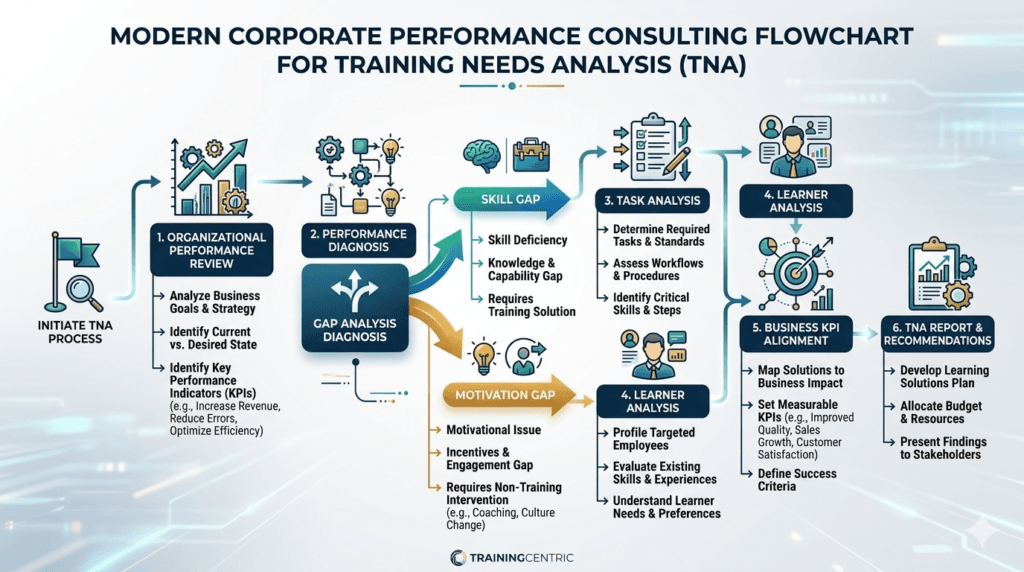
| What is a Training Needs Analysis (TNA)? A Training Needs Analysis (TNA) is a systematic process for identifying the gap between current and required performance, determining whether that gap is addressable through training, and diagnosing the specific knowledge, skill, or competency deficits that a training programme should address. A TNA is the foundation of effective instructional systems design — without it, you are designing solutions to problems you have not yet confirmed. |
The most expensive mistake in corporate L&D is building the wrong training. And the reason organisations build the wrong training is consistently the same: they skip — or compress — the TNA. A stakeholder says “we need a training on X.” A request becomes a brief. A brief becomes a module. And the underlying performance problem remains unsolved.
A TNA turns a hypothesis into a diagnosis. It takes an hour when done rapidly, and it saves weeks of rework when done properly.
The Three Levels of TNA
- Organisational level: What business problem is this connected to? What KPI, OKR, or strategic goal does this training serve? If the training cannot be linked to a measurable business outcome, it will not have a sponsor when the budget conversation comes.
- Task level: What specific tasks or behaviours are underperforming? What does excellent performance look like in this role? This requires job task analysis, performance observation, and sometimes direct comparison between high and low performers.
- Person level: Who is underperforming, and why? Is it a skill gap (can’t do it), a knowledge gap (doesn’t know it), or a motivation or environment gap (won’t do it, or can’t do it under current conditions)? Only the first two are addressable through training.
| 🛑 The Most Important Diagnostic Question in L&D “Could this person do it correctly if their life depended on it?” If the answer is yes — the problem is not a knowledge or skill deficit. It is motivation, environment, process design, management feedback, or consequences. Training will not fix any of those things. During a customer satisfaction improvement project at a retail chain, the initial brief called for a complaint handling training programme. The TNA revealed that frontline staff knew exactly what to do — they simply lacked the authority to resolve complaints without a manager’s approval. The solution was a process change, not a training programme. That question saved a five-figure budget and redirected effort to something that actually worked. |
Rapid TNA Template
| TNA Question | What You’re Diagnosing |
| What is the measurable business problem? | Organisational alignment and investment justification |
| What should performers be doing that they are not? | The specific task or behaviour gap |
| What is the current vs. required performance level? | Gap size, urgency, and programme scope |
| Could they perform correctly if they had to? | Skill/knowledge gap vs. motivation/environment gap |
| What would change if training fixed this? | ROI potential and stakeholder buy-in |
| When does this need to be resolved by? | Timeline constraints and model selection |
Writing Learning Objectives That Drive Design
Vague objectives produce vague training. “Participants will understand data security” is not an objective — it is a topic heading in disguise. It cannot be assessed. It cannot drive content design. And it cannot produce measurable learner behaviour.
A properly written learning objective specifies the observable behaviour, the conditions under which it will be performed, and the standard for acceptable performance. This is the ABCD method — and it is the single most important writing discipline in instructional design.
| Component | Meaning | Example |
| A — Audience | Who is performing? | “Given a live customer complaint call…” |
| B — Behaviour | What observable action? | “…the representative will apply the 4-step resolution framework…” |
| C — Condition | Under what constraints? | “…without reference to the job aid, during a scored roleplay…” |
| D — Degree | To what standard? | “…achieving a facilitator rubric score of 4 out of 5 on each criterion.” |
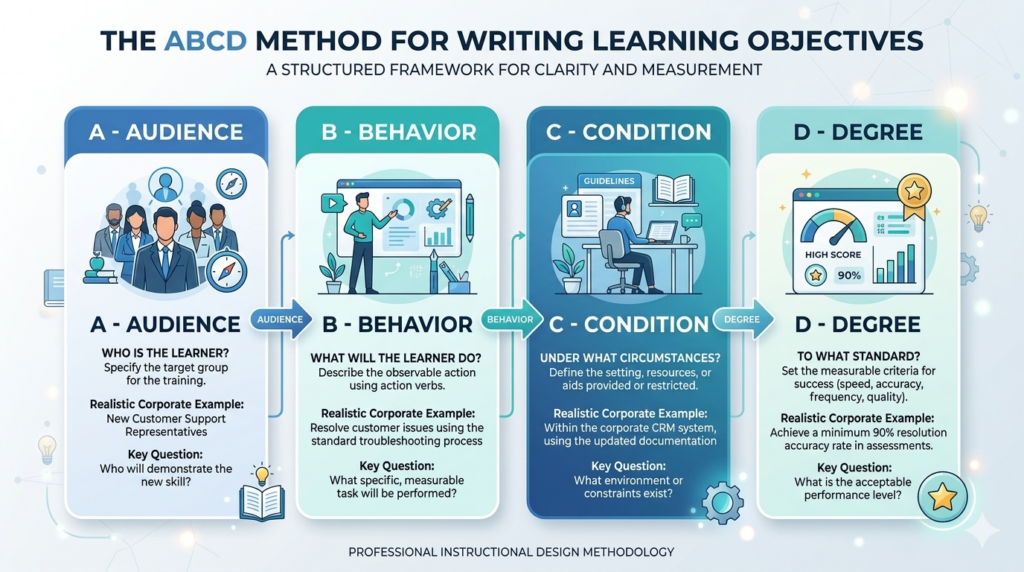
Write objectives before you write a single piece of content. If your content does not directly serve an objective, cut it. Curriculum mapping begins here — every element of your programme should trace back to a measurable objective.
Lesson Plan Design: Structure That Scales
A lesson plan is not a slide outline. It is a session architecture that specifies what will happen, in what sequence, for how long, through what instructional method, and with what assessment. When lesson plans are built properly, facilitator preparation time drops, delivery consistency increases, and learning reinforcement can be planned explicitly.
| Reusable Lesson Plan Template Session Title: Target Audience and Prior Knowledge Level: Duration: Learning Objective (ABCD format): Opening (10%): Gain attention + state objectives + activate prior knowledge through recall question Core Content (40%): Present key concepts with demonstrations, worked examples, and worked models Guided Practice (25%): Structured activity with coaching — not independent practice yet Independent Practice (10%): Scenario application without facilitator support Assessment (10%): Performance check against objective criteria Close (5%): Summary + retrieval cue + spaced learning prompt at Day 7 Materials Required: Transfer Activity (30-day post-session): Manager Observation Criteria: |
Assessment Design: Build This Before You Build Content
| What are the types of assessments in instructional design? There are five main assessment types in instructional design: diagnostic (before training, to identify gaps), formative (during training, to monitor progress), summative (end of training, to certify achievement), ipsative (across a programme, to measure personal growth), and authentic (real-world tasks that mirror job performance). Effective programmes typically combine two or three types rather than relying on a single post-training test. |
Assessment design should follow objective writing — not content development. If you know what ‘good performance’ looks like before you build anything, every design decision points toward it. If you design assessments last, you often discover that your content doesn’t actually develop what the assessment measures.
| Assessment Type | When | Purpose | Corporate Example |
| Diagnostic | Before training | Identify gaps, calibrate starting point, enable competency-based learning paths | Pre-test to skip modules covering already-mastered content |
| Formative | During training | Monitor progress, identify misconceptions, adjust delivery in real time | Polls, scenario checks, pair-share discussions, live Q&A |
| Summative | End of training | Certify achievement, gate advancement, create compliance record | Final scenario exam, observed skills demonstration |
| Ipsative | Across a programme | Measure personal growth over time — supports learner engagement and self-direction | Pre/post self-assessment against leadership competency framework |
| Authentic | Real-world context | Validate ability to perform, not just recall — the gold standard for transfer | Scored roleplay with rubric, simulated customer interaction |
Evaluation: The Phase That Determines Everything — and Gets Cut First
In programme after programme, across manufacturing, financial services, healthcare, and retail, the pattern is identical: training launches, completions are tracked, a summary slide goes to the leadership team — and evaluation ends there.
Six months later, the same performance gap has resurfaced. A new training is commissioned. The cycle repeats.
Kirkpatrick’s Four-Level Model has been the industry standard since 1959 and remains the most practical framework for structuring evaluation. Most organisations collect Level 1 data. Almost none collect Level 3.
| Kirkpatrick Level | What It Measures | Collection Method | Why Most Skip It |
| Level 1 — Reaction | Did learners find it relevant and useful? | Post-training survey | Easy to collect — and tells you the least about impact |
| Level 2 — Learning | Did knowledge or skill actually increase? | Pre/post test, observation checklist | Requires objective-first design discipline to execute properly |
| Level 3 — Behaviour | Did behaviour change on the job? | Manager observation at 30/60 days, performance data | Requires stakeholder partnership outside the L&D function |
| Level 4 — Results | Did the business metric move? | KPI tracking, performance dashboards, ROI analysis | Requires executive sponsorship and longitudinal data access |
| 📊 Building an Evaluation Plan That Actually Gets Implemented Build your evaluation plan during the Design phase — before a single piece of content exists. If you wait until after launch, Level 3 and Level 4 data are impossible to collect cleanly. Minimum viable evaluation when resources are constrained: → Level 1: One targeted question — ‘How confident are you that you can apply this tomorrow?’ (not ‘Did you enjoy the session?’) → Level 2: One pre/post scenario — compare learner responses before and after instruction → Level 3: One structured manager conversation at Day 30 — ‘Have you observed this specific behaviour?’ with a concrete checklist Three data points. That is more than 80% of corporate training programmes ever collect — and it is enough to demonstrate whether your design worked. |
PART 4: The Decision Framework
Which model, when — and why the answer is rarely obvious
How to Choose the Right Instructional Design Model
This is the question every L&D professional faces at the start of a project — and the answer depends on four variables that most model-selection guides never address together: timeline, stakes, stakeholder availability, and the nature of the performance gap.
The matrix below is built from 15+ years of working across industries where these choices had real consequences. It is a starting point for your diagnosis — not a substitute for it.
The TrainerCentric ID Model Selection Matrix
| Your Situation | Recommended Model | Why |
| Fast-changing content, agile team, short timeline | SAM | Built for iteration — get learning in front of learners fast and improve in cycles |
| Compliance, regulatory, or high-stakes technical training | Dick & Carey | Forces alignment between goals, objectives, and assessments — the rigor pays off |
| Leadership or behavioural development (6+ months) | Kolb + Merrill | Behavioural change requires experience, reflection, and integration — not content delivery |
| Large-scale global onboarding (standardised) | ADDIE | Documentation, consistency, and structured phase sign-off are non-negotiable at scale |
| Individual eLearning module design (within any framework) | Gagné | Use as the microstructure for each learning unit — apply across any macro model |
| Skill-based training: sales, service, technical | Merrill + Bloom’s | Problem-centred design with precisely levelled performance objectives |
| Writing objectives or designing assessments | Bloom’s Taxonomy | Use this every time, for every project — pair with any structural model |
When NOT to Use Each Model: The Conversation Most Guides Skip
| Which instructional design model is best for compliance training? Dick & Carey is the strongest model for compliance and regulatory training because its systematic alignment of goals, objectives, assessments, and content directly maps to audit and certification requirements. ADDIE is a viable alternative for large-scale compliance programmes. SAM is generally not recommended for compliance contexts where documentation and formal sign-off at each stage are regulatory requirements. |
| Model | Avoid When… | Risk If You Don’t |
| ADDIE | Content changes frequently, timelines are short, or stakeholder sign-off is unpredictable | You launch outdated content after months of development |
| SAM | Stakeholders are unavailable for rapid feedback, or documentation is a compliance requirement | Speed advantage disappears; you get waterfall with extra complexity |
| Dick & Carey | Timeline is short or team lacks systems design experience | Excessive upfront rigour delays delivery with no proportional benefit |
| Gagné | Designing broad programme strategy rather than individual lesson sequences | You over-engineer lessons without addressing curriculum design |
| Bloom’s as standalone | Using it as a design framework rather than an objective/assessment tool | Content design without structural guidance — produces unsequenced knowledge dumps |
| Kolb | Short programmes, knowledge-transfer goals, or time-pressured environments | Superficial reflection activities without genuine behaviour change |
7 Mistakes Corporate Trainers Make With Instructional Design Models
These are the patterns that surface repeatedly across industries and organisation sizes — regardless of team experience or budget.
- Choosing a model before diagnosing the problem. The model should follow the TNA, not precede it. Defaulting to ADDIE for every project will produce slow, comprehensive training for problems that needed a 30-minute performance support intervention.
- Designing at the wrong cognitive level. Most compliance training targets Bloom’s Level 1 (Remember) when the performance requirement is Level 3 (Apply) or higher. The training fails not because the content is wrong but because the cognitive level is wrong.
- Skipping the pilot. Every programme I have been asked to rescue had one thing in common: no pilot with real learners. A 90-minute pilot session will surface more design problems than ten rounds of SME review.
- Designing for the stakeholder, not the learner. Stakeholders want their content included. Learners want to know what’s in it for them. When the stakeholder’s wish list drives design, learner engagement collapses and transfer fails.
- Treating learning styles as science. Build variety into your design — not because people have fixed styles, but because variety reduces cognitive fatigue and supports broader learner engagement across any cohort.
- Using training to solve non-training problems. If the performance gap is caused by unclear processes, missing tools, absent management feedback, or misaligned incentives — training will not fix it. Human performance improvement begins with correctly diagnosing the root cause.
- Skipping evaluation and never knowing if it worked. Training launches. Completions are tracked. The programme is declared a success. Six months later the same problem resurfaces and a new programme is commissioned. Build your evaluation plan before you build your content. Every time.
Conclusion: Build Training That Changes Behaviour
The models, frameworks, and principles in this guide are not ends in themselves. They are tools. A hammer does not build a house — a skilled builder using the right tool for the right job does.
The practitioners who produce the most impact in corporate L&D share three habits: they diagnose before they design, they match their model to their constraints, and they measure what actually changed — not just what was delivered.
After years of working across contexts — from manufacturing onboarding redesigns to financial compliance programmes to healthcare leadership development — the most consistent differentiator between effective and ineffective training is not the model chosen, the technology used, or the budget available. It is whether anyone measured what happened on the job, 30 days after the training ended.
If you take one thing from this playbook: the most important moment in any instructional design project is not the launch. It is the 30-day conversation with the manager who supervised the learners — asking, with a specific behavioural checklist in hand, whether anything changed. That conversation is where you find out whether your design worked.
Everything else is a draft.
| Your Next Step → Pick one programme you are currently designing or preparing to start. → Run a rapid TNA using the template in Part 3 — before you open any authoring tool. → Match your situation to the decision matrix in Part 4. → Write your evaluation plan (Levels 1–3) before you write a single learning objective. → Write objectives before you write a single slide. That sequence — diagnose, decide, design, evaluate — is the difference between training that satisfies a compliance requirement and training that moves a business metric. |
Instructional Design Models Toolkit
Stop Building Training Nobody Measures
Download the complete Instructional Design Toolkit used to design corporate training that improves real workplace performance — not just completion rates. Includes:
- ADDIE Model templates free download
- SAM Model templates free download
- Bloom’s Taxonomy Templates free download
- Training Needs Analysis frameworks free download
- Merrill’s Principle templates free download
- Kolb’s Experiential Learning Framework templates free download
- Dick and Carey Model: When to Use It and When to Avoid It
- Gagné’s Nine Events of Instruction: A Practical Guide for Trainers
- Leadership Score calculation template free download
- Learning Persona Worksheet template free download
- Training Plan Annual Calendar template free download
All of this for free of cost. For more templates and toolkits, subscribe to our Monthly Magazine from here.
Frequently Asked Questions
Which instructional design model is best for beginners?
Start with ADDIE. It is structured, well-documented, and teaches the fundamental discipline of instructional design — analyse before designing, design before developing, evaluate after implementing. Once comfortable with ADDIE, explore Gagné’s Nine Events to improve individual lesson quality, and SAM for faster-turnaround projects.
Can ADDIE and SAM be used together?
Yes — and this is a common approach in experienced L&D teams. Use ADDIE’s phase structure to manage the overall project governance, and apply SAM’s iterative prototyping within the Develop phase. You get structural rigour and delivery speed without sacrificing either.
What is the difference between instructional design and instructional systems design?
Instructional design (ID) refers broadly to the process of designing learning experiences. Instructional systems design (ISD) refers to a more rigorous, systems-thinking approach in which every component of the training — objectives, content, assessment, delivery, and evaluation — is explicitly aligned as an interconnected system. Dick & Carey is the clearest example of ISD; ADDIE is often associated with both terms depending on how rigorously it is applied.
What is performance consulting and how does it relate to instructional design?
Performance consulting is the practice of diagnosing organisational performance gaps before recommending any intervention — including training. An instructional designer operating as a performance consultant does not accept a training request at face value. They first determine whether the gap is caused by a knowledge or skill deficit (addressable through training) or by process, environment, motivation, or management factors (not addressable through training). TNA is the primary tool of performance consulting in L&D.
How long does a Training Needs Analysis take?
A rapid TNA for a well-scoped project can be completed in one to three days — stakeholder interviews, a review of performance data, and job task observations. A full TNA for a large-scale programme may take two to four weeks. The depth of the TNA should be proportional to the investment being made: do not spend four weeks on a TNA for a two-hour module.
What is competency-based training?
Competency-based training is a design approach that anchors all learning objectives, content, and assessments to a defined competency framework — a structured description of the knowledge, skills, and behaviours required for effective performance in a role. Learners advance based on demonstrated competency, not time spent in training. Dick & Carey and Bloom’s Taxonomy are the models most naturally aligned to competency-based design.
Do learning styles matter in corporate training design?
Not in the way most trainers believe. The research does not support designing separate instructional tracks for different learner styles. What does consistently improve learning outcomes is design variety — visual, auditory, reflective, and practical elements built into every programme. This benefits all learners, reduces cognitive fatigue, and improves learner engagement across any cohort.
Further Reads
- Bloom’s Taxonomy
- Instruction Designing Models
- ADDIE Model of Instructional Designing
- Successive Approximation Model (SAM): Complete Guide + 8 Free Templates
- Kolb’s Learning Cycle: Using Experiential Learning in the Workplace
- Gagné’s 9 Events of Instruction: A Practical Guide for Trainers with Real Examples
- ADDIE vs SAM: Which Instructional Design Model Should You Use in 2026?
- ARCS Model of Motivation — The Complete Guide for Corporate Trainers [2026]
- Adult Learning Theory (Andragogy): Knowles’ 6 Principles Explained with Workplace Examples
- Cognitive Load Theory Explained: A Practical Guide for Trainers & Instructional Designers
- Kirkpatrick Model: How to Measure Training Effectiveness
- 12 Facilitation Skills for Corporate Trainers: The Complete Guide
- Backward Design – The Complete Framework for Planning Learning
- How to Design a Learning Programme From Scratch: A Step-by-Step Guide
Author Introduction

Tulip Ghosh is a Learning and Development professional who designs impactful, learner-centric experiences rooted in behavioral insight and real-world application. She is passionate about improving learner engagement and translating complex ideas into practical training solutions. A thoughtful writer at heart and with experience of a decade in Learning and Development domain, she brings a simple, grounded perspective to the evolving world of workplace learning.
Reach out to her on her Linkedin Profile from here.