Most corporate training fails before the first slide even loads.
Not because the content is wrong. Not because the facilitator is unprepared. It fails because it was designed for children — not for the experienced, autonomous, goal-driven adults sitting in the room.
That is the core insight behind adult learning theory: adults do not learn the same way children do, and treating them as if they do is the single biggest mistake trainers make. Knowles’ framework — andragogy — gives us the vocabulary and the tools to do something about it.
The term andragogy was popularised by American educator Malcolm Knowles in the 1970s. It comes from the Greek aner (adult) and agogos (to guide) and describes a learner-centred approach built specifically around how adults think, what they need, and why they choose to engage with new information.
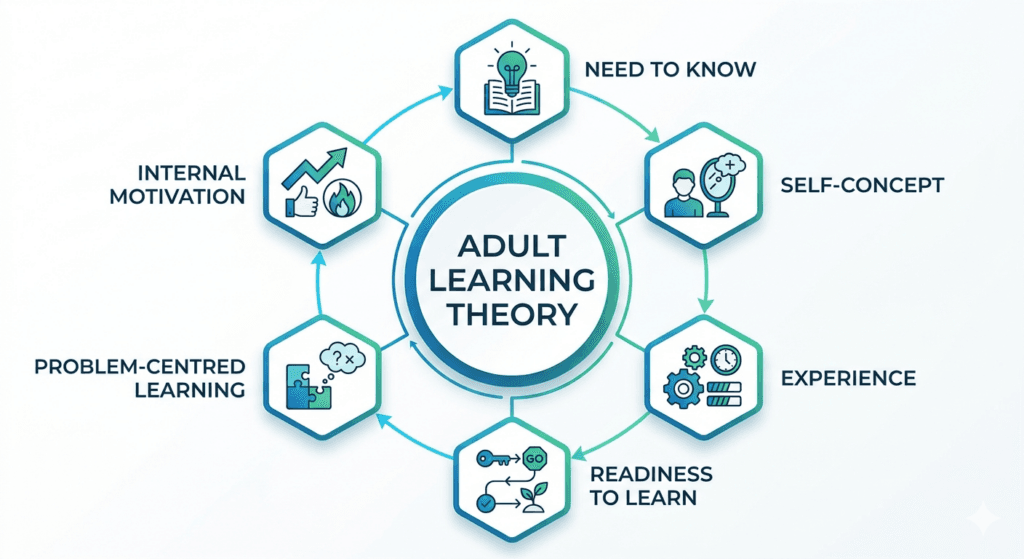
| Adult Learning Theory at a Glance Adult Learning Theory (Andragogy) is Malcolm Knowles’ framework explaining how adults learn differently from children. It is based on six principles: Need to Know, Self-Concept, Role of Experience, Readiness to Learn, Problem-Centred Orientation, and Internal Motivation. Together, these principles guide how corporate training should be designed to maximise engagement and transfer. |
In contrast, pedagogy — from paidos (child) — assumes the teacher is the authority, the learner is a passive receiver, and the curriculum drives everything. That model works in school. It often backfires in a conference room.
In this article, you will learn exactly what Knowles’ 6 principles of andragogy are, see how they apply in real corporate training scenarios, and get a practical framework for building them into your next course. You will also find something most articles on this topic skip: an honest look at where andragogy breaks down — because that is where real expertise lives.
What Is Andragogy in Adult Learning Theory?
Andragogy is the art and science of helping adults learn. Unlike traditional teaching, it does not start with a curriculum — it starts with the learner.
Malcolm Knowles defined andragogy through a set of assumptions about adult learners that fundamentally changed how we think about training design (Knowles, 1980; Knowles, Holton & Swanson, 2015). His model asserts that as people mature:
- Their self-concept shifts from dependency to self-direction
- Their accumulated experience becomes a rich resource for learning
- Their readiness to learn is tied to real-life tasks and challenges
- Their orientation shifts from subject-centred to problem-centred
- Their motivation becomes primarily internal rather than external
These assumptions are not abstract theory. They have direct, practical consequences for every design decision you make — from how you structure activities to how you frame objectives.
The Research Basis: What Does the Evidence Say?
Adult learning theory has accumulated a substantial evidence base since Knowles first proposed andragogy. The core framework has been refined and validated across decades of research:
- Knowles’ original formulation (1968, expanded 1980) introduced the four core assumptions and later extended them to six principles.
- Knowles, Holton & Swanson (2015) updated the model in The Adult Learner, the definitive academic text, adding empirical grounding and addressing critiques of cultural universality.
- Merriam, Caffarella & Baumgartner (2007), in Learning in Adulthood, situate andragogy within the broader landscape of adult learning theory — alongside transformative learning, self-directed learning, and experiential approaches.
- The Association for Talent Development (ATD) regularly produces workforce learning research that validates andragogy’s core principles in practice — particularly the value of problem-centred design and just-in-time delivery.
- CIPD research consistently highlights relevance to job performance and learner ownership as important contributors to successful workplace learning — findings that align closely with what andragogy predicts.
Note on scope: Andragogy is not the only adult learning framework, and it has been critiqued for assuming a Western, individualistic model of the learner. Merriam et al. discuss these cultural limitations thoughtfully. The principles are best understood as tendencies, not universal laws.
What Are the 6 Principles of Andragogy?
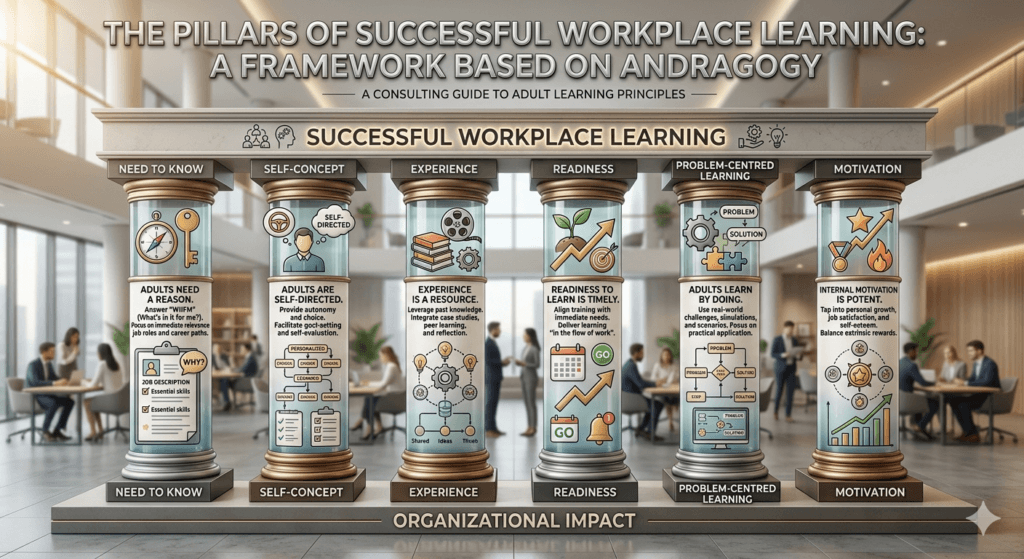
Knowles originally proposed four assumptions in his 1968 paper, later expanding the model to include a fifth and then a sixth principle. Here is the full framework as it stands today.
| Principle 1: The Need to Know Adults need to understand WHY they are learning something before they will invest effort in it. They do not take information on authority the way children might. Corporate Training Example: During compliance training on data privacy, instead of opening with GDPR definitions, open with a real (anonymised) case study of a data breach that cost a comparable company millions — and the employee error that caused it. Now learners understand exactly why this matters to them personally. ID Tip: Start every module with a ‘Why This Matters’ hook — a problem, a scenario, or a business consequence — before introducing any content. Here is an article on ARCS model of instructional design that will guide you further. |
| Principle 2: Self-Concept (Learner Autonomy) Adults see themselves as self-directed. Being told what to do — without choice or control — triggers resistance. The more ownership learners have over their experience, the more engaged they become. Corporate Training Example: In a leadership development programme, instead of a fixed 8-hour curriculum, give managers a learning menu: choose two of five skill workshops based on their team’s current challenges. They own the journey from day one. ID Tip: Build choice into your design — optional deep-dive modules, self-assessment entry points, or learner-set goals at the start of a course. |
| Principle 3: Role of Experience Adults walk into every training room carrying years — sometimes decades — of relevant experience. Designs that ignore this waste an invaluable resource. Worse, they signal to learners that their expertise does not count. Corporate Training Example: In a sales skills workshop, open with a peer-pair activity: ‘Share the best objection you’ve ever handled and how you dealt with it.’ You instantly activate prior knowledge, warm the room, and surface real examples the facilitator can weave into the session. ID Tip: Use experience-activating openers: case discussions, peer-teaching segments, or pre-work reflections. This is also where adult learning principles instructional design professionals often see the fastest engagement gains. If you would like to know more about the experiential learning, here is an article about Kolb’s experiential learning cycle that will guide you further., |
| Principle 4: Readiness to Learn Adults become ready to learn when they face a real-life situation that demands new knowledge or skill. Readiness is not calendar-based — it is task-based. The closer training is to a real need, the more absorbed learners are. Corporate Training Example: In several CRM software implementations I have supported, training delivered within two weeks of go-live consistently resulted in higher adoption than training delivered months beforehand. Pair this with just-in-time job aids and you have a design built for how adults actually learn. ID Tip: Time your interventions strategically. Pre-launch, just-in-time, or milestone-triggered training outperforms scheduled calendar training almost every time. |
| Principle 5: Orientation to Learning (Problem-Centred) Adults are problem-solvers, not subject-collectors. They do not want to learn ‘about communication’ — they want to solve the specific problem of a team member who goes silent in meetings. Frame learning around problems, not topics. Corporate Training Example: A new manager onboarding programme replaces ‘Module 3: Giving Feedback’ with ‘How do I handle the conversation when a team member misses a deadline?’ Same content — radically different frame. Completion rates and application scores both increase. ID Tip: Rewrite your learning objectives as ‘By the end of this module you will be able to solve [specific problem]’ rather than ‘understand [topic].’ Just as we explore in our deep-dive on Bloom’s Taxonomy, the verb matters enormously. |
| Principle 6: Motivation to Learn (Internal Drive) Adults are primarily motivated by internal factors: the desire for a promotion, the need to solve a real problem, professional pride, curiosity, or the wish to contribute more effectively. External pressure — mandatory training — rarely sustains effort. Corporate Training Example: A cybersecurity awareness programme that stops leading with ‘This is required by policy’ and starts leading with ‘Here is how phishing attacks target people at your level — and what you can do that no software can’ typically sees improved completion and stronger recall. The shift from obligation to personal relevance changes everything. ID Tip: Connect every piece of content to a personal benefit — career advancement, reduced stress, team impact. The ARCS Model (Attention, Relevance, Confidence, Satisfaction) is a powerful companion framework for designing motivationally rich experiences. |
Andragogy vs Pedagogy — Why It Matters for Trainers
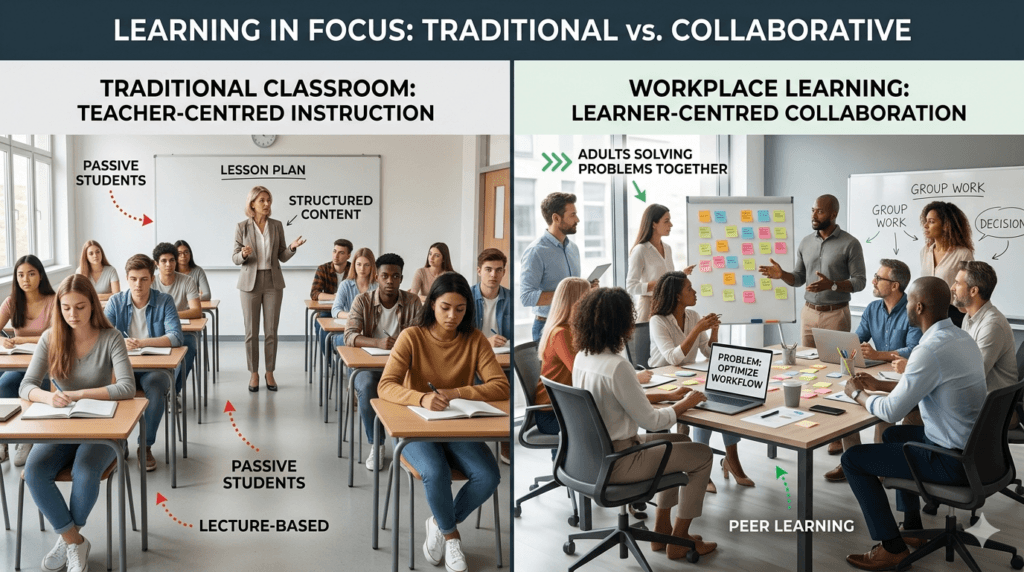
Understanding the andragogy vs pedagogy distinction is not just an academic exercise — it is a diagnostic tool. When a training programme is not working, it is almost always because a pedagogical design has been applied to an adult audience.
Here is how the two approaches compare across key dimensions:
| Pedagogy (Child Learning) | Andragogy (Adult Learning) |
| Dependent; teacher decides | Self-directed; learner takes ownership |
| Limited; teacher is main resource | Rich experience brought into learning |
| External (grades, authority) | Internal (career growth, problem-solving) |
| Age- or curriculum-based | Life/task readiness drives it |
| Subject-centred | Problem- and life-centred |
| Follows curriculum without questioning | Needs to know WHY before learning |
The practical takeaway: if your learners are checking their phones, skipping optional modules, or failing to apply new skills back on the job, audit your design against this table. The culprit is usually one of these six dimensions.
It is also worth noting that andragogy is not a binary switch. Some adult learners — particularly those new to a domain — genuinely benefit from more structured, teacher-directed guidance early on. The best designs are flexible.
Andragogy vs the ARCS Model — What Is the Difference?
Two frameworks come up together most often in corporate training design: Knowles’ andragogy and Keller’s ARCS Model. They are complementary — but they answer different questions.
| Andragogy (Knowles) | ARCS Model (Keller) | |
| Core question | How do adults learn? | What motivates learners? |
| Focus | Learner assumptions and conditions | Motivational design elements |
| Application | Structural design decisions | Content and engagement hooks |
| Output | Adult-centred course architecture | Motivationally rich learning experiences |
Trainercentric Tip: use andragogy to shape how you structure the learning experience (timing, choice, framing), and use ARCS Model to design the motivational texture of the content inside it.
Where Adult Learning Theory Breaks Down — Limitations of Andragogy
Most articles on andragogy only discuss its benefits. Experts also talk about its limits. Here is an honest assessment of four contexts where applying Knowles’ principles uncritically can cause problems.

1. Mandatory Compliance Training
Principle 6 says adults are internally motivated. But mandatory compliance training — data privacy, health and safety, anti-bribery — is externally mandated by law. Learners know it. Pretending otherwise often backfires. The better approach: acknowledge the mandate directly, then make the case for why it personally matters anyway. Respect the adult’s intelligence.
2. New Hires with No Prior Experience
Principle 3 assumes rich prior experience. But a recent graduate in their first corporate role may have almost none in the relevant domain. Designing primarily around experience-activation for this audience leaves a gap. The fix: scaffold more heavily early on, fading structure as experience accumulates. This is not a failure of andragogy — it is recognising that the model describes a spectrum, not a binary.
3. Safety-Critical Environments
In nuclear, aviation, or surgical training, some procedures must be followed precisely as designed — there is no room for learner autonomy or problem-centred deviation. Here, more directive, structured training is appropriate, with compliance being non-negotiable. Andragogy’s emphasis on learner self-direction can be actively counterproductive in high-stakes procedural contexts.
4. Highly Technical Onboarding
When learners need to acquire dense technical knowledge rapidly — think developer onboarding to a complex codebase or a new regulatory framework — pure problem-centred design can overwhelm working memory before learners have enough schema to connect problems to solutions. Some structured, explicit instruction is needed first.
The meta-lesson: andragogy is a powerful default, not a universal prescription. The best instructional designers know when to apply it fully, when to dial it back, and why.
How to Apply Adult Learning Theory in Your Next Course

Knowing the 6 principles is one thing. Building a course that actually embodies them is another. Here is a step-by-step process for applying adult learning principles that instructional design professionals can follow immediately.
Step 1: Start with the ‘Why’, Not the ‘What’
Before you open PowerPoint, write down the real-world problem this training must solve. Not the topic — the problem. This single shift forces you to design for Need to Know (Principle 1) from the very start.
Step 2: Analyse Your Learners’ Experience
Conduct a brief pre-training survey or stakeholder interview. What do learners already know? What have they tried? This data feeds Principle 3 (Role of Experience) and prevents you from wasting time on content your audience has already mastered.
Step 3: Build Choice Into the Structure
Design at least one moment of learner autonomy — a pre-assessment that lets learners skip content they know, a choice of case studies, or an optional advanced module. This activates Principle 2 (Self-Concept).
Step 4: Time the Training Strategically
Work with your stakeholder to identify when learners will actually need this skill. Design the intervention to land close to that moment. If that is not possible, build in follow-up performance support (Principle 4: Readiness).
Step 5: Reframe Objectives as Problems
Take every learning objective and rewrite it as a problem statement. ‘Understand conflict management techniques’ becomes ‘Handle the scenario where two team members refuse to collaborate on a deadline project.’ This operationalises Principle 5.
Step 6: Connect Content to Personal Payoff
For every key concept, add a ‘What’s in it for you?’ line — not just ‘the company will benefit’ but ‘you will benefit.’ Career advancement, reduced workload, greater confidence, better relationships. This brings Principle 6 (Motivation) to life.
This six-step process pairs naturally with a structured development framework. If you are not already using one, our guide to the ADDIE model explains how to apply it across the full design lifecycle — from analysis through evaluation.
The Adult Learning Theory Design Audit — A Practical Checklist
Use this checklist before signing off on any training design. It is organised around Knowles’ 6 principles and takes under five minutes to complete. If you cannot answer ‘Yes’ to at least five of the eight questions, the design has gaps worth addressing before build.
| Principle | Audit Question | Yes / No / Partial |
| Need to Know | Does the module open with a real-world consequence or problem — not a topic title? | ☐ |
| Self-Concept | Do learners have at least one choice in the experience (path, case study, pace)? | ☐ |
| Role of Experience | Is there a structured activity that activates prior knowledge before introducing new content? | ☐ |
| Readiness to Learn | Is the training timed close to the real performance moment? | ☐ |
| Problem-Centred | Are learning objectives framed as problems to solve — not topics to understand? | ☐ |
| Motivation | Does every major concept connect to a personal benefit — career, stress reduction, pride? | ☐ |
| Research Grounding | Does the design reference or align with at least one evidence base (Knowles, Bloom, Gagné, Kolb)? | ☐ |
| Transfer to Job | Does the design include a mechanism for applying learning back on the job (action plan, job aid, manager check-in, or performance task)? | ☐ |
Adult Learning Theory Examples in the Workplace
Theory lands harder when you can see it in action. Here are four adult learning theory examples in the workplace that show the principles working together.

Example 1: Onboarding Redesign at a Financial Services Firm
A large bank replaced its 3-day classroom onboarding with a blended programme: a pre-boarding digital module (self-paced, skippable based on a pre-assessment), a one-day in-person session built around role-specific case studies, and a 30-day on-the-job task list with manager check-ins.
Principles in play: Need to Know (case studies grounded in real roles), Self-Concept (self-paced digital), Experience (pre-assessment respects prior knowledge), Readiness (timed to the role transition), Problem-Centred (task list vs. topic curriculum), Motivation (visible connection to 90-day performance goals).
Example 2: Product Knowledge Training for a Retail Sales Team
Instead of a lecture-style product briefing, a retailer created a 20-minute mobile module with a ‘mystery shopper’ scenario. Learners had to advise a fictional customer using only the product knowledge in the module — and see the consequence of their advice play out. In one implementation of this approach, customer satisfaction scores improved meaningfully in the quarter that followed the redesign.
Example 3: Compliance Training That People Actually Finish
An HR team struggling with low completion rates redesigned their mandatory compliance training using Knowles’ principles: opened with a real industry penalty case (Need to Know), added a self-assessment to skip modules learners already knew (Self-Concept), and replaced policy text with decision-tree scenarios (Problem-Centred). In one implementation of this redesign, completion rates improved substantially in the following cycle — moving from under half to over nine in ten learners completing the course.
Example 4: Leadership Development Using Peer Learning
A technology company replaced its annual leadership classroom programme with quarterly peer-learning circles: small groups of managers meeting monthly to work through a real business challenge using a structured framework. This drew on Gagné’s Nine Events — particularly the activation of prior learning and the application phase — and in practice demonstrated stronger transfer back to the job than the classroom format had achieved.
Example 5: Adult Learning Theory in E-Learning — Personalised Onboarding
A SaaS company redesigned its new-user onboarding flow using andragogy as the design framework. Instead of a fixed 12-module walkthrough, learners completed a two-minute role and goal survey at the start. The platform then served a personalised learning path: finance users saw finance-specific workflows first; operations users saw operations. Each module opened with a real problem statement rather than a feature list (Need to Know), and learners could skip any module they passed a short pre-check on (Self-Concept). Follow-up data showed that users who completed the personalised path were more likely to reach key activation milestones within the first 30 days than those on the previous fixed path.
Common Mistakes When Using Andragogy — And How to Avoid Them
| Mistake 1: Treating Andragogy as an All-or-Nothing Switch Fix: Use andragogy as a spectrum. Some learners or contexts (new hires, highly regulated processes) benefit from more structure. Dial the approach up or down based on the audience and task. |
| Mistake 2: Assuming All Adults Are Self-Directed Fix: Assess your specific audience. A 22-year-old graduate in their first corporate role may not yet have the self-direction of a 45-year-old senior manager. Design scaffolding that fades over time. |
| Mistake 3: Adding ‘Experience Activities’ Without Connecting Them to Content Fix: Debrief every experience-based activity explicitly. Ask: ‘How does what you just shared connect to [concept]?’ Without the bridge, the activity is just warm-up noise. |
| Mistake 4: Delivering Training Too Far in Advance Fix: Work with your sponsor to identify the performance moment. If training must happen early, build in spaced retrieval or just-in-time job aids that trigger at the moment of need. |
| Mistake 5: Forgetting That Motivation Must Be Re-earned Fix: Do not just hook learners in the opening slide — reconnect to the ‘Why’ at every major transition in the programme. Motivation is not a one-time design decision. |
Conclusion: One Principle at a Time
Andragogy is not a checklist — it is a lens. When you design with Malcolm Knowles’ 6 principles in mind, you stop building courses and start building experiences that adults actually want to engage with.
Here is the full set to keep front of mind:
- Principle 1 – Need to Know: Tell adults WHY before you tell them WHAT.
- Principle 2 – Self-Concept: Give learners control wherever possible.
- Principle 3 – Role of Experience: Make their expertise part of the curriculum.
- Principle 4 – Readiness to Learn: Time your training to real need.
- Principle 5 – Problem-Centred: Frame content around problems, not topics.
- Principle 6 – Motivation: Connect every concept to a personal benefit.
But remember the limits. Andragogy is a powerful default — not a universal law. The contexts where it breaks down (mandatory compliance, safety-critical environments, novice learners) are just as instructive as the contexts where it excels. Knowing both is what separates a practitioner from someone who has simply read a framework.
You do not have to overhaul everything at once. Pick one principle — the one that resonates most with a training challenge you are facing right now — and apply it to your next design decision.
Small changes, grounded in how adults actually learn, compound quickly.
| Over to You Which of Knowles’ 6 principles will you apply first? And which training challenge prompted that choice? Comment below — we read every response and often turn the most interesting questions into future articles. |
Frequently Asked Questions About Adult Learning Principles
Q: What is the difference between andragogy and pedagogy?
Pedagogy is the art of teaching children. It assumes a teacher-directed, subject-centred approach where the learner is relatively dependent. Andragogy is the art of helping adults learn. It assumes the learner is self-directed, motivated by internal goals, and brings rich prior experience to the learning context. In corporate training, applying pedagogical principles to adult learners typically results in passive audiences, low engagement, and poor knowledge transfer.
Q: What are the 6 principles of andragogy?
Malcolm Knowles’ 6 principles are: (1) Need to Know — adults need to understand why they are learning something before they engage; (2) Self-Concept — adults are self-directed and need autonomy; (3) Role of Experience — adults bring rich prior experience that should be part of the learning design; (4) Readiness to Learn — adults learn best when training is tied to a real task or challenge; (5) Orientation to Learning — adults are problem-centred, not subject-centred; (6) Motivation to Learn — adults are primarily driven by internal motivators such as career growth and personal relevance.
What is the difference between Knowles’ assumptions and principles?
Knowles originally described these as ‘assumptions’ about adult learners — observable characteristics that differentiate adults from children as learners. Over time, scholars and practitioners began calling them ‘principles’ because they generate actionable design guidance. The terms are often used interchangeably. In practice: the assumptions describe how adults learn; the principles describe how instructional designers should respond to those characteristics.
Is andragogy still relevant today?
Yes — though it continues to be refined. Research over the past four decades has largely validated Knowles’ core assumptions, particularly the value of self-directed learning, problem-centred design, and connecting training to real need. The main critiques (cultural universality, the treatment of self-direction as uniformly positive) have been addressed in later editions of The Adult Learner (Knowles, Holton & Swanson, 2015). For corporate learning practitioners, andragogy remains the most useful starting framework available.
Can andragogy be used in e-learning?
Absolutely — and it translates naturally. Apply andragogy in e-learning by: (1) opening each module with a ‘Why This Matters’ scenario rather than a topic title; (2) using pre-assessments that let learners skip content they already know; (3) incorporating reflection prompts that activate prior experience; (4) building branching scenarios that put learners in the role of problem-solver; (5) including optional advanced modules for self-directed learners; and (6) ending every module with a personal action commitment that connects the content to the learner’s own role.
Q: What are examples of adult learning theory in the workplace?
Common examples include: compliance training redesigned around real-world breach scenarios rather than policy text; CRM rollouts timed to go-live rather than delivered months in advance; leadership programmes that replace fixed curricula with learner-chosen skill workshops; and peer learning circles where managers work through real business challenges together. The common thread: relevance, timing, autonomy, and problem-centred framing.
References
- Knowles, M. S. (1980). The Modern Practice of Adult Education: From Pedagogy to Andragogy (2nd ed.). Cambridge Adult Education.
- Knowles, M. S., Holton, E. F., & Swanson, R. A. (2015). The Adult Learner: The Definitive Classic in Adult Education and Human Resource Development (8th ed.). Routledge.
- Merriam, S. B., Caffarella, R. S., & Baumgartner, L. M. (2007). Learning in Adulthood: A Comprehensive Guide (3rd ed.). Jossey-Bass.
- Association for Talent Development (ATD). Adult Learning Theory Research. https://www.td.org/insights/adult-learning-theories
- CIPD. (Annual). Learning at Work Survey. Chartered Institute of Personnel and Development.
Further Reading
Building on what you’ve learned here? These articles go deeper on the frameworks that work alongside andragogy:
- Instructional Designing Models
- The ADDIE Model Explained: A Step-by-Step Guide for Instructional Designers
- Gagné’s Nine Events of Instruction: What They Are and How to Use Them
- Bloom’s Taxonomy in Corporate Training: Writing Better Learning Objectives
- The ARCS Model: Designing for Motivation in Corporate Learning
- Merrill’s Principles of Instruction: First Principles in Practice
- Kolb’s Experiential Learning Cycle: Using Experience as a Teaching Tool
- Dick and Carey model of Instructional Designing
- Cognitive Load Theory Explained: A Practical Guide for Trainers & Instructional Designers
- Kirkpatrick Model: How to Measure Training Effectiveness
- 12 Facilitation Skills for Corporate Trainers: The Complete Guide
- Backward Design – The Complete Framework for Planning Learning
- Action Mapping: A Step-by-Step Guide with Examples
- Gamification vs Game-Based Learning: What’s the Difference
Meet the Author