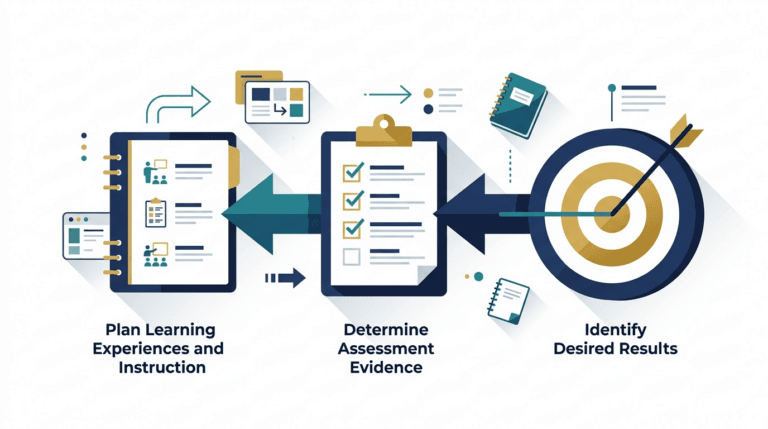
Action Mapping is a performance-focused instructional design approach, developed by Cathy Moore, that starts from a measurable business goal, identifies the observable workplace behaviours needed to reach it, uncovers the real barriers stopping people from doing those behaviours today, and only then designs the training activities that address genuine skill gaps. Its job is to stop a training project before it turns into an information dump.
Despite billions spent on corporate training every year, many organisations still struggle to translate learning into measurable business results. Here’s what that looks like up close: a sales enablement team spends three months building a new onboarding course. It has interviews with top performers, a module on the company’s value proposition, and a 40-question knowledge check. Learners rate it 4.6 out of 5, and completion sits at 98%. Six months later, close rates haven’t moved — reps still fumble the same objections they fumbled before the course existed.
That gap between “learners liked it” and “behaviour changed” is exactly what Action Mapping is built to close, and it’s the throughline of everything in this guide: what the model is, how to run it on a real project, a full worked example, a workshop agenda you can reuse, where it breaks down in large organisations, and how it compares to ADDIE.
This article assumes you already know the basics of instructional design and behaviour change training. If you need that foundation first, our Instructional Design hub guide is the better starting point — this piece goes deep on one model rather than the whole field.
What Is Action Mapping?
Action Mapping is a visual, needs-analysis-first instructional design process created by Cathy Moore in 2008. It’s often described as a mashup of performance consulting and backward design: instead of starting with content, it starts with a business metric and works backward through behaviour and barriers before any learning activity gets designed.
Moore has summarised the model’s intent plainly, describing its goal as helping designers “commit to measurably improving the performance of the business” before anything else gets decided. She later expanded the method into her book, Map It: The Hands-On Guide to Strategic Training Design, which remains the most complete primary source on the model and the natural next read after this article.
Action Mapping didn’t emerge in isolation. It builds on decades of Human Performance Technology (HPT) research — formalised in Thomas Gilbert’s Behavior Engineering Model and carried forward by ISPI — that workplace performance depends on far more than knowledge alone. That lineage explains why Action Mapping starts with a business goal and a barrier diagnosis, not a course outline.
3 Ideas of Action Mapping Model
Three ideas anchor the model itself:
1. Performance consulting comes first. Before anyone opens an authoring tool, the designer’s job is a form of root cause analysis: understand the business problem well enough to know whether training is even the right intervention, or whether the barrier is environmental, motivational, or managerial.
2. Design works backward from the goal. Like other backward-design and gap-analysis approaches, you start with the destination — a measurable outcome — and work back through the behaviours and barriers that separate the current state from it. Content is the last thing designed, not the first.
3. Knowing is not the same as doing. Someone can pass a quiz on a return policy and still handle a refund conversation badly under pressure. Action Mapping treats “completed the training” as meaningless unless it’s paired with “and now performs the action better.”
For the primary-source version of this thinking, Cathy Moore keeps a running explanation of the model on her own site, along with a set of clarifications on common misunderstandings — worth reading once the basics here are settled.
The Four Steps of Action Mapping

Action Mapping has four steps, worked outward from a central business goal: identify the goal, identify the observable actions that reach it, identify the barriers stopping those actions today, and design practice activities only for the barriers training can actually fix.
Picture it literally as a map: the business goal sits in the centre, actions branch off it, barriers branch off each action, and activities branch off each barrier that turns out to be a genuine skill gap.
We’ll follow one running example throughout this article: a mid-size B2B software company whose customer support team has a first-contact resolution (FCR) rate stuck at 54%, against a 75% target. Escalations are expensive and churn among frustrated customers is rising.
Step 1: Identify the Business Goal
Everything starts with a number the organisation already tracks, or is willing to track — not a training objective, a business metric: revenue, retention, error rate, cycle time, safety incidents, first-contact resolution. If stakeholders can’t name one, that’s the first sign a training request may be premature, and a performance analysis conversation needs to happen before an outline does.
For our example: raise first-contact resolution from 54% to 75% within two quarters.
Asking “how will we know this training worked?” at this stage tends to surface quickly whether the requester actually wants training, or wants a symptom gone. If nobody can answer, that’s useful — it means the project needs a performance-consulting conversation, not a storyboard.
Step 2: Identify the Observable Actions
List the specific, observable things people need to do differently to move that number — not what they need to know, what they need to do. A useful test: could a supervisor stand behind a one-way mirror and watch someone do this, or is it invisible (“understand,” “appreciate,” “be aware of”)? If invisible, keep asking “so that they can do what, exactly?” until it isn’t.
For our support team:
- Diagnose the customer’s real issue within the first 90 seconds of the call, rather than the issue they initially describe
- Choose the correct troubleshooting path from three overlapping decision trees without defaulting to escalation
- Push back, professionally, on out-of-policy requests instead of quietly escalating to avoid conflict
These are behaviours a supervisor could watch and score — not “understands troubleshooting procedures.”
| TrainerCentric Tip If stakeholders can’t name a specific, observable behaviour within about ten minutes of trying, stop the workshop. You’re probably still solving the wrong problem, and no amount of Step 3 or Step 4 work will fix that. |
Step 3: Identify the Barriers
This is the step most conventional training design skips, and it’s where Action Mapping earns its reputation as a performance-consulting tool rather than a course-outlining technique. For each action, ask why isn’t this already happening? The answer is rarely “people don’t know how.” More often it’s one of:
- Knowledge/skill gap — they genuinely haven’t practised it
- Environmental barrier — the tool, process, or policy gets in the way, independent of anyone’s skill
- Motivational barrier — doing it correctly is more effortful or less rewarded than the workaround
- Management/incentive barrier — supervisors reward a different metric than the one that actually matters
In our example: interviews with top and bottom performers reveal the diagnosis problem is mostly a skill gap (new reps haven’t practised active-diagnosis conversations), but the escalation-avoidance behaviour is partly motivational — reps are scored on call-handling time, which quietly punishes the “right” behaviour of taking longer to resolve on the first call. That second finding is a barrier no course can fix; it goes back to the business as a metrics issue, run in parallel with any training.
| TrainerCentric Tip If a stakeholder’s answer to “why isn’t this happening?” is “people just need more training,” treat that as the start of the barrier conversation, not the end of it. It’s rarely the real answer on the first try. |
Step 4: Design Only the Practice Learners Actually Need
Only now — after the goal, actions, and barriers are agreed — do you design a learning activity, and only for barriers that are genuine knowledge or skill gaps. Each activity should put the learner inside a realistic decision, not a recall exercise. Moore’s consistent guidance is to design the practice activity first and the supporting content second: decide what decision you want someone to rehearse, then supply only the minimum information needed to make it, at the point they need it.
For the diagnosis skill gap: branching scenario calls where reps practise diagnostic questioning against a simulated customer who initially misdescribes their problem, scored on whether the rep found the real issue in time — not a multiple-choice quiz on “the five diagnostic question types.”
Action Mapping Example: Customer Support Case Study

Here’s the same example as a single visual chain — the way you’d present it to stakeholders in a working session.
- Business Goal Raise first-contact resolution from 54% to 75% in two quarters.
- Critical Behaviours
- 1. Diagnose the real issue within 90 seconds
- 2. Choose the correct troubleshooting path without defaulting to escalation
- 3. Push back professionally on out-of-policy requests
- Barriers
- 1. Skill gap — reps haven’t practised active diagnosis under time pressure
- 2. Environmental — three overlapping, poorly documented decision trees
- 3. Motivational — handling-time metric quietly punishes thorough resolution
- Learning Activities (only for the genuine skill gaps) – Branching scenario practice: diagnostic conversations with a simulated customer, scored on time-to-correct-diagnosis – A single job aid replacing the three decision trees, built by the team that surfaced the barrier — a content-design fix, not a course – Manager coaching guide for the “push back professionally” behaviour, since it’s best practised live, not on a screen
- Results Reps report the branching scenarios feel closer to real calls than the old click-through module. Alongside a revised handling-time metric agreed with operations, FCR is tracked monthly against the 75% target — the course’s own success measure is the business metric, not a smile-sheet score.

Two things are worth naming explicitly, because they’re where most first attempts at Action Mapping go wrong: the job aid and the metric change weren’t “extras” bolted onto a training project — they came directly out of the Step 3 barrier analysis, and no course was designed for the motivational barrier, because a course can’t fix an incentive problem.
Common Barrier → Recommended Intervention
Not every barrier from Step 3 should end in a training activity. Use this as a starting point, not a rule — context can shift any of these:
| Barrier | Training? | More likely fix |
| Skill gap | ✅ Yes | Practice activity / scenario |
| Knowledge gap | ✅ Yes | Practice activity, or a job aid if the information is reference-only |
| Motivation | ❌ No | Incentive or recognition change |
| Incentives/metrics | ❌ No | Revised KPI or scorecard |
| Missing or broken tools | ❌ No | Tooling or process fix |
| Process issue | ❌ No | Process redesign |
| Unclear expectations | ⚠️ Maybe | Job aid or manager communication |
| Needs live feedback | ⚠️ Maybe | Coaching, not a course |
Action Mapping Workshop Agenda

Most teams’ first real exposure to Action Mapping happens in a workshop with a sponsor and one or two SMEs. Here’s a 90-minute agenda covering the first three steps in one session — Step 4 is deliberately left for a follow-up, once the map has been validated.
| Time | Segment | Who’s in the room | Output |
| 0:00–0:10 | Frame the session — explain that the goal is to scope the problem, not the course | Sponsor, SME, facilitator | Shared expectation that no content decisions happen today |
| 0:10–0:30 | Step 1: Business goal — “What are we currently measuring that tells us we have a problem?” | Sponsor | One measurable goal, written on the board |
| 0:30–0:55 | Step 2: Observable actions — “What would we watch someone do differently?” | SME, sponsor | 3–6 observable behaviours, tested against the “one-way mirror” rule |
| 0:55–1:20 | Step 3: Barriers — “Why isn’t this happening already?” for each action | SME, ideally a frontline performer if available | Barriers tagged as skill, environmental, motivational, or management |
| 1:20–1:30 | Wrap-up and next steps — flag which barriers need further investigation (interviews, observation) before Step 4 | Facilitator | Follow-up plan; no content brief written yet |
Stakeholder questions worth having ready: –
- “What are we measuring today that would move if this project worked?”
- “If I watched your best performer do this well, what would I actually see them do?” –
- “What’s stopping everyone else from doing it that way already?”
- “Is there anything about our tools, process, or incentives that makes the wrong behaviour easier than the right one?”
Common deliverable from this session: a single-page filled canvas (goal, actions, barriers, provisional activities) the sponsor signs off before any development time is spent — the artifact the [Action Mapping Canvas] at the end of this article is built to produce.
Action Mapping Templates and Tools
People searching for an Action Mapping template usually want either a structure to fill in or software to run the workshop in. What matters more than either is the conversation the template structures — but here’s what teams actually use:
- Physical sticky notes and a whiteboard — still the most common format for in-person kickoff workshops. Cheap, fast to rearrange, and low-pressure for SMEs who haven’t done this before.
- Miro or FigJam — the default for remote or hybrid teams; both have sticky-note-style boards well suited to a live, goal-in-the-centre map that a distributed group can build together in real time.
- PowerPoint or Google Slides — less interactive, but useful for documenting a finished map afterward as a shareable artifact for stakeholders who weren’t in the room.
- A simple printed canvas — the fastest option for a first attempt, since it removes the “which tool do we use” decision entirely and lets the group focus on the four questions.
Whichever format you use, the template itself should stay simple: four boxes (goal, actions, barriers, activities) and the discipline that nothing enters the fourth box without a barrier behind it. TrainerCentric’s free [Action Mapping Canvas], detailed at the end of this article, is built as a print-and-digital version of exactly this structure.
Why Traditional Training Often Fails — And How Action Mapping Solves It

Most conventional training fails not because of weak instructional writing, but because content gets chosen before anyone agrees what behaviour needs to change. Three patterns show up repeatedly:
Knowledge dumping. A subject matter expert is asked “what should be in the course?” and answers with everything they know, not everything a learner needs to act on. The designer’s job quietly becomes “organise the dump into modules” instead of “decide what belongs.” Action Mapping blocks this structurally: nothing gets added to a course without a barrier, an action, and a goal behind it.
Content overload. Because nothing was filtered against an action, courses grow to cover edge cases and adjacent policies a performer will never need in the moment they need to act. Action Mapping’s barrier step is the filter — content earns its place only by addressing a genuine skill gap standing between a performer and a defined behaviour.
Information-first design. The course transmits facts and the assessment checks whether they were received — a knowledge score, not a performance measure. Action Mapping’s evaluation plan is the business goal itself, not a quiz.
Action Mapping vs ADDIE
Action Mapping isn’t a replacement for ADDIE — the two operate at different altitudes. ADDIE is a project-management framework for the full lifecycle of a course; Action Mapping is a needs-analysis and scoping technique most useful early in ADDIE’s Analysis and Design phases, or as a front end to agile frameworks like SAM.
| Action Mapping | ADDIE | |
| Focus | Behaviour and performance gap | Full instructional development lifecycle |
| Workflow | Visual, four-step, goal-outward | Linear/iterative: Analyse, Design, Develop, Implement, Evaluate |
| Complexity | Low to moderate — one workshop can complete Steps 1–3 | Moderate to high — five formal phases, often with sign-offs between each |
| Ideal team size | Small: facilitator, sponsor, 1–2 SMEs | Larger, cross-functional: SMEs, designers, developers, QA, project management |
| Stakeholder involvement | Heavy upfront, in the scoping workshop itself | Distributed across phases, often heaviest in Analysis and Implementation |
| Documentation | Lightweight — a single-page map is often sufficient | Formal — design documents, storyboards, phase sign-offs |
| Flexibility | Highly flexible; can sit inside ADDIE, SAM, or stand alone | Traditionally linear, though modern practice often loops phases |
| Learning objectives | Derived from observable, on-the-job actions | Often written first, sometimes independent of a verified performance gap |
| Business outcomes | Central from step one; the model hinges on a measurable goal | Present in Analysis, but easy to lose by Development without active protection |
| Design philosophy | Backward design; practice activity designed before content | Can be backward or content-first depending on team discipline |
| Project duration | Scoping phase: days to a few weeks | Full lifecycle: weeks to months, depending on scope |
| Typical output | A validated goal-action-barrier map feeding into design | A fully documented, built, and evaluated course |
| Advantages | Fast, cheap to run, hard to accidentally build the wrong course | Thorough, auditable, good for large teams and compliance trails |
| Disadvantages | Depends on real stakeholder access; not a full build process on its own | Slow if run rigidly; content dumping still possible if Analysis is weak |
| Tool support | Whiteboard, sticky notes, Miro, FigJam, or a simple canvas | Full authoring tool, project management software, LMS integration |
| When to use | Behaviour-change projects with a genuine business metric attached | Larger, multi-stakeholder projects needing a documented lifecycle or hand-offs |
Avoid treating this as a “which one is better” question — it isn’t one. A common pattern: run Action Mapping’s four steps during ADDIE’s Analysis phase to pressure-test whether training is the right intervention, then let ADDIE’s remaining phases manage build, rollout, and evaluation. See our Instructional Design Models comparison for how Action Mapping sits alongside SAM, Kirkpatrick’s evaluation levels, and the 70:20:10 framework.
Where Action Mapping Breaks Down in Practice
Most articles on Action Mapping stop at describing the model. The failure modes below are less about the model itself and more about where organisational reality doesn’t cooperate with it.
It struggles without real stakeholder access. The model assumes a sponsor and an SME are available to answer pointed questions about metrics and barriers. Vendor teams building generic content for unknown clients, or internal teams working through several layers of relayed requirements, often can’t get that access. In those cases, teams end up assuming the goal and barriers, then validating post-launch — a workaround worth labelling as one, so nobody mistakes an assumed map for a validated one.
It scales unevenly in large organisations. A single team with one clear metric maps cleanly. A multi-region rollout with five business units and three levels of management is harder — different regions often have different real barriers behind the same stated gap, and a map built with one region’s stakeholders can quietly misrepresent the others. The fix: run barrier analysis separately per business unit rather than assuming one map generalises.
What Cathy Moore’s Model Doesn’t Emphasize Enough
This isn’t a criticism of the model so much as a note on where practitioners consistently need to supply their own process alongside it.
It doesn’t specify how to run the barrier interview well. The model is clear that you need to find out why an action isn’t happening, but getting an honest answer — especially one that implicates a manager’s incentive structure — is a facilitation skill it assumes rather than teaches. Teams new to Action Mapping often settle for generic answers (“people just need more practice”) because they haven’t built the rapport to get to the real barrier.
It says less about post-launch evaluation mechanics than about scoping. The model is explicit that the business goal is your evaluation plan, but it offers little guidance on the practical measurement work — attribution when several initiatives launch together, or how long to wait before concluding a metric genuinely didn’t move. Teams typically borrow an evaluation framework, such as Kirkpatrick’s Level 4, to close this gap.
It doesn’t address change management for the non-training fixes it surfaces. When Step 3 uncovers an environmental or incentive barrier, the model is silent on how you get a metrics change approved by an operations leader who didn’t ask for one. That conversation is often harder than building the course, and it deserves its own workstream rather than an assumption that the finding will sell itself.
When Should You Use Action Mapping?
Action Mapping earns its keep fastest on projects where a real, trackable behaviour gap already exists and someone in the business can name the metric that would prove it closed.
Strong fits: –
- Sales training — pipeline, close rate, and objection-handling behaviours are usually well-measured already
- Customer service — resolution rates, CSAT, and escalation rates give you a ready-made goal
- Leadership development — behaviours like delegation, feedback delivery, and difficult conversations are observable, even if the metrics (engagement scores, retention) are slower-moving
- Compliance-adjacent behaviour change — not “know the policy” compliance, but compliance depending on judgment under pressure (recognising and reporting a safety hazard, for instance)
- Onboarding for performance-critical roles, where ramp time itself is the metric
Weaker fits, or not suitable at all: –
- Pure regulatory/legal attestation training, where the actual goal is a documented record that someone was exposed to specific content, not a behaviour change
- New-system rollouts with no meaningful behaviour choice — if there’s exactly one correct way to click through a new interface, the “critical behaviours” step collapses to “follow these steps,” and a job aid may outperform a course entirely
- Projects with no access to a stakeholder who can name a business metric — see the stakeholder-access limitation above
This is a genuine limitation worth stating plainly: Action Mapping assumes a level of stakeholder access and organisational measurement maturity that not every project has.
Should You Use Action Mapping? A Quick Decision Tree
Run through these four questions in order. A “no” at any point is a signal to consider a different approach — a job aid, a process fix, or a straightforward information course.
- Is the problem actually behavioural — is someone doing the wrong thing, or not doing the right thing? If no → this may be an information or documentation problem, not a training problem.
- Can the desired behaviour be observed? Could a supervisor watch someone do it and score it? If no → the target isn’t specific enough yet; go back and define it as an action, not a concept.
- Is there a business metric attached to it? Revenue, resolution rate, error rate, retention — anything trackable. If no → get one before scoping further, or treat this as a pilot with a metric added later.
- Do stakeholders have the access needed to answer Steps 1–3 honestly? A sponsor and SME who can name the goal and speak candidly about barriers. If no → either build that access first, or clearly label any resulting map as assumption-based.
All four “yes”? Action Mapping is a strong fit — proceed to the workshop agenda below. Any “no”? Consider a different approach, or address the gap (get the metric, get stakeholder access) before running the full model.
Common Action Mapping Mistakes
- Jumping straight into content. A stakeholder mentions a topic (“we need a module on our new pricing structure”) and the team starts drafting slides before anyone has named the behaviour the pricing knowledge is supposed to change. Discipline: no slide gets built until it’s attached to an action, and the action is attached to a goal.
- Ignoring workplace barriers. Teams run Steps 1 and 2 enthusiastically, then skip to Step 4, treating every gap as a training gap. This is the most common failure mode, and it recreates the “high scores, no behaviour change” problem the model exists to prevent.
- Confusing knowledge with behaviour. “Learners will understand the escalation policy” sneaks back in as an objective because it’s easier to write than a true behaviour. Ask, for every draft objective: “what would I watch someone do to prove this?”
- Poor stakeholder conversations. Action Mapping requires asking pointed questions — “what should we measure to know this worked?” and “what’s actually stopping people from doing this now?” — that can feel confrontational without the relationship for it. Under-trained facilitation here produces a map that looks right on paper but wasn’t validated with anyone who understands the real barriers.
- Creating slides before defining actions. A stakeholder hands over an existing slide deck as “the source material,” and the team treats organising that deck as the design task, rather than treating it as one possible input to Step 2.
Action Mapping Best Practices
- Interview stakeholders and performers, not just managers. The person who can describe a barrier accurately is often the frontline performer, not the person who requested the training. Talk to top performers (what are they doing differently?) and struggling ones (what’s stopping them?).
- Observe performance directly where you can. Listening to real support calls, shadowing a sales rep, or watching a shift on the floor surfaces barriers no interview will mention, because insiders often don’t notice their own workarounds.
- Prototype early and cheaply. Build one rough version of a single practice activity before committing to a full course build. A five-minute paper prototype tested with two frontline performers tells you more about whether the “action” is right than a week of storyboarding will.
- Validate assumptions before scaling. If your barrier analysis is a guess, pilot it on a small group and check whether the practice activity addresses the real obstacle before rolling out broadly.
- Measure behaviour, not just completion. The business goal from Step 1 is also your evaluation plan. If the metric doesn’t move, that’s not proof the training failed — it might mean a barrier was missed. Tracking the actual metric separates Action Mapping from programmes that quietly redefine success as satisfaction scores.
Action Mapping Checklist
Before approving a training project, ask:
- ☐ Do we have a measurable business goal?
- ☐ Have we identified observable behaviours, not just topics?
- ☐ Have we interviewed top performers as well as struggling ones?
- ☐ Have we ruled out environmental and process barriers?
- ☐ Have we validated barriers with real users, not just the sponsor’s assumption?
- ☐ Have we eliminated content that doesn’t map to an action?
- ☐ Is every planned activity linked to a specific behaviour?
- ☐ Do we know how success will be measured, and by when?
If any box is unchecked, that’s the next conversation to have — before development time is spent.
Action Mapping Questions Every L&D Professional Should Ask Themselves
The workshop agenda above covers questions to ask stakeholders. These are different — questions worth asking yourself as the designer, before you commit to a course:
- What evidence suggests this is actually a skill gap, and not something else?
- Could a job aid solve this instead of a course?
- What behaviour will genuinely change if this training succeeds?
- Who are the best performers here, and have I actually talked to them?
- What would success look like six months from now, in the business’s own numbers — not in a completion report?
Action Mapping in One Page
| Step | Question | Deliverable |
| Goal | What business result are we trying to move? | A measurable KPI |
| Actions | What should people do differently to move it? | A short list of observable behaviours |
| Barriers | Why aren’t they doing it already? | Root causes, tagged as skill, environmental, motivational, or management |
| Activities | What practice do people actually need? | Learning activities built only for genuine skill gaps |
Frequently Asked Questions
What is Action Mapping?
Action Mapping is a visual, performance-focused instructional design process created by Cathy Moore. It scopes training around a measurable business goal, the observable actions needed to reach it, the barriers preventing those actions today, and only then, the learning activities needed to close genuine skill gaps.
Who created Action Mapping?
Cathy Moore, an instructional designer, published the first version of Action Mapping in May 2008 and later expanded it into her book, Map It.
What are the four steps of Action Mapping?
Identify the business goal, identify the observable actions that reach it, identify the barriers currently preventing those actions, and design practice activities only for the barriers that are genuine skill gaps.
Is Action Mapping better than ADDIE, or can it replace it?
Neither — they solve different problems, and Action Mapping doesn’t fully replace ADDIE. ADDIE is a full development lifecycle framework; Action Mapping is a needs-analysis and scoping method most often used inside ADDIE’s Analysis and Design phases, or alongside agile frameworks like SAM, to decide what the course should contain before development starts.
Can Action Mapping be used for eLearning?
Yes. Moore originally presented it in an eLearning context, though she has said the model works for any type of business training, not only online courses.
Is Action Mapping an instructional design model?
It’s best described as an instructional design approach or needs-analysis method rather than a full model on the scale of ADDIE, since it focuses specifically on scoping what a course should contain and whether a course is warranted at all.
What are examples of Action Mapping in practice?
Common examples include sales objection-handling training scoped around close-rate goals, customer service diagnostic training scoped around first-contact resolution (as in this article’s case study), and compliance-judgment training scoped around incident-reporting rates.
What tools are used for Action Mapping?
Physical sticky notes and a whiteboard for in-person workshops; Miro or FigJam for remote sessions; PowerPoint or Google Slides for documenting a finished map; or a simple printed canvas for a first attempt.
Is Action Mapping Agile?
It shares Agile’s bias toward fast prototyping and validating assumptions early, and pairs naturally with agile development frameworks like SAM, but it isn’t itself an Agile framework — it’s a scoping method that can feed into either agile or waterfall-style build processes.
Who should facilitate an Action Mapping workshop?
Ideally someone comfortable asking pointed, occasionally uncomfortable questions of a sponsor or SME — an instructional designer, performance consultant, or L&D lead with facilitation experience, not necessarily the most senior person in the room.
Downloadable Resource: The Action Mapping Canvas
What’s included: –
- A one-page, printable/digital canvas laying out the four Action Mapping steps (Goal → Actions → Barriers → Activities) with guided prompt questions at each stage. Check out our prompt library for trainers for more detailed information on useful prompts that can be reused in learning and development.
- A stakeholder interview question bank for Steps 1–3, matching the workshop agenda in this article
- A worked example (the customer support case study from this article) as a filled-in reference canvas
- A barrier-type checklist (knowledge/skill, environmental, motivational, management/incentive) to speed up Step 3
- An editable digital version (Miro/FigJam-ready) for remote workshops, alongside a print-ready PDF for in-person sessions
“Stop scoping courses from memory. Download the free Action Mapping Canvas (Use Code “ACTIONMAPPINGFREE”) and walk your next stakeholder meeting through goal, actions, barriers, and activities — before anyone opens a slide deck.”
Conclusion

Action Mapping doesn’t guarantee good training — poor facilitation, weak stakeholder access, or skipping the barrier analysis can still produce a course that misses the mark, as the sections above on where the model breaks down make clear. But it does something most default approaches don’t: it makes the gap between “learners liked it” and “behaviour changed” visible early enough to fix, instead of discovering it in a quarterly review six months later.
Action Mapping doesn’t ask “what should we teach?” It asks “what should people do differently tomorrow?” That single shift in thinking is why the approach remains one of the most practical tools in modern instructional design.
References
- Map It: The Hands-On Guide to Strategic Training Design || First Edition || Cathy Moore || Association for Talent Development (ATD) Press || 2017
- Design for How People Learn || Second Edition || Julie Dirksen || New Riders || 2015
- Telling Ain’t Training || Second Edition || Harold D. Stolovitch & Erica J. Keeps || Association for Talent Development (ATD) Press || 2011
- Human Competence: Engineering Worthy Performance || Tribute Edition || Thomas F. Gilbert || Pfeiffer || 2007 (Original work published in 1978)
- The Performance Consultant’s Fieldbook: Tools and Techniques for Improving Organizations and People || Second Edition || Judith Hale || Pfeiffer || 2007
- Design for Modern Learning: Beyond ADDIE and SAM || First Edition || Crystal Kadakia & Lisa M.D. Owens || Association for Talent Development (ATD) Press || 2020
Further Readings
- Bloom’s Taxonomy
- Instruction Designing Models
- ADDIE Model of Instructional Designing
- Successive Approximation Model (SAM): Complete Guide + 8 Free Templates
- Kolb’s Learning Cycle: Using Experiential Learning in the Workplace
- Gagné’s 9 Events of Instruction: A Practical Guide for Trainers with Real Examples
- ADDIE vs SAM: Which Instructional Design Model Should You Use in 2026?
- ARCS Model of Motivation — The Complete Guide for Corporate Trainers [2026]
- Adult Learning Theory (Andragogy): Knowles’ 6 Principles Explained with Workplace Examples
- Cognitive Load Theory Explained: A Practical Guide for Trainers & Instructional Designers
- Kirkpatrick Model: How to Measure Training Effectiveness
- 12 Facilitation Skills for Corporate Trainers: The Complete Guide
- Story-Based Learning Design: A Practical 5-Step Framework
Author Details

Soumyadeep Sen is a Learning & Development professional with over 14 years of experience across training, coaching, quality, and performance improvement. Currently serving as Assistant Manager – Training at 24/7.ai, he specializes in designing practical learning solutions that drive employee performance and support business objectives. When he’s not designing learning programs, Soumyadeep enjoys exploring emerging trends in workplace learning, talent development, and instructional design. Reach out to him via Linkedin: https://www.linkedin.com/in/soumyadeep-sen-37515046/