A complete performance consulting framework and process for diagnosing performance problems before recommending learning solutions — and protecting your training budget from being spent on the wrong fix.
Introduction: The Most Expensive Word in L&D Is “Yes”
A regional sales director emails the L&D team with a clear request: “Our account managers need communication training. Customers keep complaining that they don’t feel heard, deals stall in negotiation, and our renewal rate is slipping. Can you put together a two-day workshop?”
It’s a reasonable-sounding request. It comes from a senior stakeholder. It has a budget attached. And in most organisations, the L&D team would say yes, book a venue, find a facilitator, and start designing a communication skills workshop within the week.
Three weeks later, a closer look at the situation tells a different story. The account managers already completed a communication skills programme eighteen months ago, and most of them can demonstrate the techniques perfectly in a roleplay. The real issues are that the CRM was changed six months ago and half the team still logs notes on paper because the new system is clunky and unintuitive; sales targets were increased by 22% without any corresponding change to account workload, so reps are rushing every call; and the most experienced account manager, who used to mentor the rest of the team informally, was promoted into a management role and no longer has time to coach anyone.
None of those problems will be solved by a communication skills workshop. Running one anyway would cost the organisation two days of lost selling time per rep, a facilitator fee, venue costs, and materials — and at the end of it, customers would still feel unheard, deals would still stall, and renewal rates would still slip. Worse, the next time someone proposes a learning intervention, the sales director will remember that “training didn’t work last time”, making it harder to get buy-in for interventions that actually would work.
| The Core Idea Training can only close gaps in knowledge and skill. It cannot fix unclear expectations, broken processes, conflicting incentives, poor management, inadequate tools, or a culture that quietly punishes the behaviours it claims to want. When a performance problem has a cause outside the knowledge-skill space, training will not solve it — no matter how well it is designed, delivered, or evaluated. |
This is not a controversial idea in the academic literature. Human performance improvement (HPI) practitioners, the Association for Talent Development (ATD), and the Chartered Institute of Personnel and Development (CIPD) have all argued for decades that learning interventions should follow a diagnosis, not precede it. Yet in day-to-day practice, most training requests still skip the diagnosis entirely. A manager observes a symptom, assumes a cause, and requests the solution they’re most familiar with — which is almost always training.
The scale of the problem is measurable, not just anecdotal. ATD research has found that only 30% of organisations are good at using learning data to make business decisions — which means the majority of L&D functions have limited visibility into whether the training they deliver is actually changing performance at all, let alone whether it was the right intervention to begin with. Without that visibility, a misdiagnosed training request can run for years without anyone noticing the spend wasn’t producing a return.
This is where performance consulting comes in. Performance consulting is the discipline of diagnosing a performance gap — systematically, before any solution is proposed — to determine whether training, a process fix, a management change, or some combination is the right response. It treats every request for training as a starting hypothesis rather than a finished brief, and it’s the central subject of this article.
This article is written for the people who receive those requests: L&D managers, corporate trainers, instructional designers, HR business partners, learning consultants, and the senior leaders who commission training in the first place. Its purpose is simple — to give you a practical, repeatable performance consulting process for working out whether training is actually the right answer before you commit time, budget, and credibility to building it.
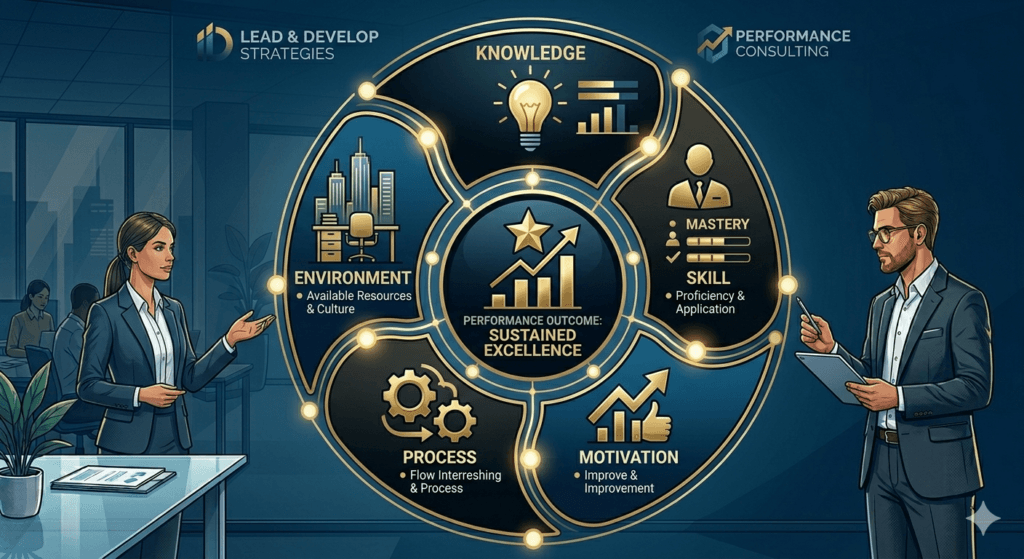
To make that process concrete, this article introduces a performance consulting framework we call the TrainerCentric Performance Diagnostic Lens™. It’s a structured way of looking at any performance problem through five lenses — Knowledge, Skill, Motivation, Process, and Environment — so that the root cause becomes visible before a solution is chosen. We’ll come back to this framework throughout the article, and Section 4 walks through it in full.
The Cost of Misdiagnosing Performance Problems
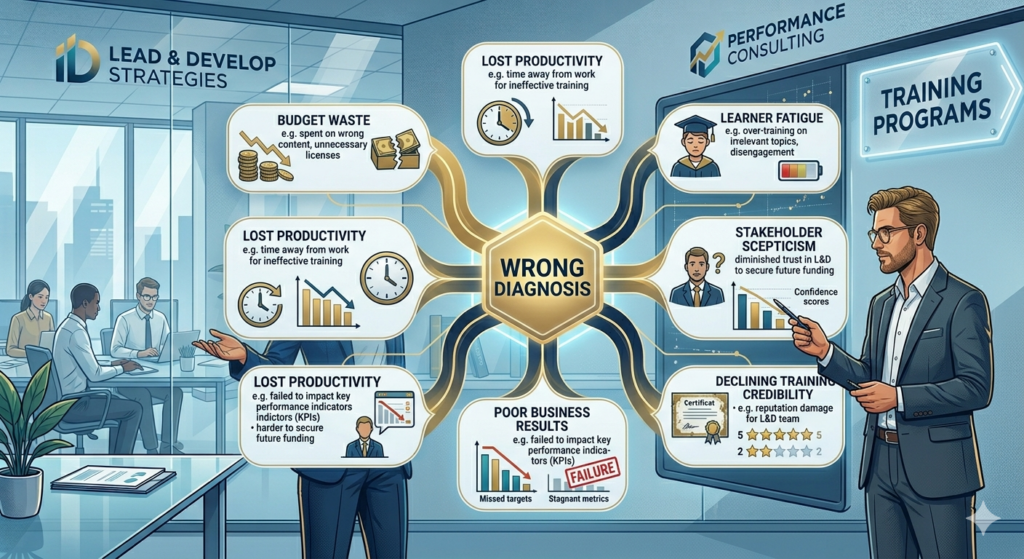
Before getting into how to diagnose performance problems correctly, it’s worth being explicit about what misdiagnosis actually costs. Training built on the wrong cause doesn’t just fail to help — it actively consumes resources that could have gone toward a fix that would have worked. A two-day workshop for a 20-person team isn’t only a facilitator fee; it’s 40 person-days of lost productive time, plus venue, materials, and design costs, spent on a problem that’s still there afterwards.
There’s a compounding cost beyond the immediate spend. Employees who sit through training that doesn’t address what’s actually limiting their performance become harder to engage the next time — a pattern often described as learner fatigue, where future sessions are met with scepticism regardless of their quality. Stakeholders who commissioned the training and saw no change in the metric they cared about become warier of approving the next L&D request, even when that next request is well-diagnosed. And because nothing about the original cause has changed, the performance gap itself persists, continuing to cost the business in the metric that prompted the request in the first place — missed revenue, customer churn, safety incidents, or rework.
None of this is reversible after the fact. The only point at which it can be prevented is before the training is designed — which is exactly where the rest of this article picks up.
Section 1: Why Organisations Jump Straight to Training
If diagnosing performance problems before recommending training is so clearly the better approach, why doesn’t it happen more often? The answer isn’t that managers are lazy or that L&D teams don’t know better. It’s that training has a set of structural advantages over almost every other type of intervention — advantages that have nothing to do with whether it will actually fix the problem.
Training is visible
A workshop, an e-learning module, or a certification programme is something you can point to. It shows up on a calendar, generates attendance records, and produces a completion certificate. Fixing a broken approval process or rewriting a confusing policy document doesn’t generate the same kind of visible artefact, even if it has a much bigger impact on performance. When a senior leader asks “what are we doing about this?”, “we’ve rolled out a training programme” is an easy, satisfying answer — even if the underlying problem is untouched.
Training feels proactive
Commissioning training signals that something is being done. It demonstrates investment in people, looks good in a board report, and can be framed as developmental rather than punitive. Telling a team “we’re going to fix the broken handoff process between sales and operations” can feel like an admission that the process was broken in the first place — and that admission often has to go through several layers of approval and political negotiation. A training request, by contrast, can usually be approved by a single manager with a training budget line.
Managers are familiar with it
Most managers have been on the receiving end of training many times in their careers. It’s a familiar mechanism: identify a gap, send people to a course, expect improvement. Far fewer managers have direct experience with structured root cause analysis, performance consulting, or human performance improvement methodologies. People reach for the tool they know.
Training shifts responsibility
This is the one nobody says out loud, but it’s often the strongest driver. If poor performance is caused by unclear expectations from a manager, or by a process that manager designed, addressing the real cause means the manager has to change something about how they operate. Requesting training, on the other hand, puts the responsibility for improvement onto the employees attending it — and onto L&D for delivering it. If performance doesn’t improve afterwards, the natural follow-up question is “why didn’t the training work?” rather than “why did we ask for training in the first place?”
Training is often easier than fixing systems
Finally, there’s a simple practical reality: designing and delivering a training programme, however much work it takes, is usually a self-contained project with a defined start and end. Fixing a broken process often means renegotiating ownership across departments, changing a system that other teams also rely on, or having a difficult conversation with a manager about their own behaviour. Training is, in a very real sense, the path of least organisational resistance — even when it’s the wrong path.
| Field Observation In our experience working with L&D teams across sectors, the phrase “we need training on…” is most often a description of a symptom the requester has noticed, not a diagnosis of its cause. Treating it as a finished diagnosis — and moving straight to a training brief — is the single most common and most expensive mistake in L&D request management. |
Section 2: What Training Can Actually Fix
None of this means training is a poor intervention in general — quite the opposite. Training is an excellent, often the best, intervention when the root cause of a performance gap genuinely sits in knowledge or skill. The problem isn’t training itself; it’s training applied to the wrong cause.
Training works well when people don’t yet know something they need to know, or can’t yet do something they need to be able to do — and when the environment around them will support the new knowledge or skill once they have it. The clearest cases fall into a small number of categories.
Knowledge gaps
Employees lack information that is genuinely new to them and not available through job aids or reference material — for example, changes to regulatory requirements, updates to product specifications, or new organisational policies that affect how they should do their jobs.
Skill deficiencies
Employees understand conceptually what they need to do but haven’t yet practised the underlying skill enough to perform it competently — for example, a new manager who has never run a difficult conversation, or a customer service representative who has never used a particular de-escalation technique under pressure.
New processes
A genuinely new process has been introduced, and employees need to understand both the mechanics of the new process and the reasoning behind it. This is different from “the existing process is broken and people aren’t following it” — which is a process problem, covered in Section 3.
New systems
A new software platform, piece of equipment, or tool has been introduced, and employees need structured instruction on how to operate it. Even highly intuitive systems benefit from some structured onboarding, particularly for less commonly used features.
Compliance requirements
Regulatory or legal requirements mandate that employees demonstrate awareness of specific policies — health and safety, data protection, anti-harassment, financial conduct, and similar areas. Here, training often has a documentation and audit purpose as well as a learning purpose.
Product launches
A new product or service is being introduced, and customer-facing staff need to understand its features, positioning, pricing, and how it compares to alternatives, so they can represent it accurately to customers.
In each of these cases, the underlying logic is the same: the gap is something people don’t know or can’t yet do, and once they know it or can do it, nothing else in their environment will prevent them from applying it. That second condition matters as much as the first — and it’s where Section 3 picks up.
| Problem | Training Appropriate? | Reason |
| New data protection regulation affects how customer records are handled | Yes | Genuinely new knowledge; legal requirement to demonstrate awareness |
| New CRM platform is being rolled out next month | Yes | New system; structured instruction reduces early errors and frustration |
| Sales reps don’t know the features of a newly launched product | Yes | Knowledge gap; product information didn’t exist before launch |
| New supervisors have never conducted a formal disciplinary conversation | Yes (skill practice) | Skill deficiency; benefits from guided practice and feedback |
| Staff know the correct process but skip steps because the system is too slow | No | Knowledge and skill are present; cause is a process/technology issue |
| Team underperforms because their manager gives contradictory instructions | No | Management/communication issue at the supervisory level, not a team skill gap |
Section 3: What Training Cannot Fix
This is the section that matters most — and the one most often skipped in practice. If Section 2 described the conditions under which training works, this section describes the much longer list of conditions under which it cannot, regardless of how well it is designed or delivered.
The common thread across everything in this section is that the employee already has the knowledge and skill required to perform — but something in their environment, their management, their incentives, or the organisation’s systems prevents that knowledge and skill from translating into the desired performance. Training cannot change any of those things, because training operates on the person, not on the system around them.
Poor Management
If a team’s performance issues stem from a manager who doesn’t set clear goals, doesn’t give feedback, plays favourites, or creates a stressful working environment, training the team will not change any of that. The team members can be the most skilled people in the organisation and still underperform under poor management. The intervention needed here is management coaching, a change in leadership, or structural changes to how the team is supervised — not a workshop for the people being managed.
Lack of Accountability
When there are no consequences — positive or negative — for whether someone follows a process, hits a target, or applies a skill, performance will drift towards whatever requires the least effort, regardless of how well people were trained. A classic example: a company trains its entire sales team on a new consultative selling methodology, but managers continue to evaluate reps purely on call volume. Within weeks, reps revert to high-volume, low-quality calls, because that’s what gets measured and rewarded. The training wasn’t the problem — the absence of any accountability mechanism for the new behaviour was.
Broken Processes
If the process itself is the obstacle — too many approval steps, conflicting handoffs between departments, manual workarounds for systems that don’t talk to each other — then training people to work harder within that process simply makes them more skilled at navigating a bad system. The process needs to be redesigned. No amount of individual skill compensates for a structurally inefficient workflow.
Unclear Expectations
Sometimes employees genuinely don’t know what “good” looks like — not because they lack the skill to do it, but because nobody has defined it. A customer service team might be told to “provide excellent service” without any specific definition of what that means in measurable terms. Training people on service skills they already mostly possess won’t help if the underlying issue is that they’re being judged against a standard nobody has articulated.
Conflicting Incentives
This is one of the most common and most overlooked causes of performance gaps. If two parts of an incentive structure pull in opposite directions — for example, a bonus structure that rewards individual sales numbers while the organisation is simultaneously asking for more collaborative, team-based selling — employees will rationally follow the incentive that pays them, regardless of what training says they should do. Training cannot override a pay structure.
Resource Constraints
If employees don’t have the staffing, time, equipment, or budget required to perform a task to the expected standard, no amount of training changes that underlying scarcity. A warehouse team trained extensively on a new safety procedure will still cut corners if they’re permanently short-staffed and the procedure adds time they don’t have.
Poor Hiring Decisions
Sometimes a performance gap exists because someone was placed in a role that doesn’t match their underlying aptitudes, interests, or working style — not because of a skill they could acquire through training. An introverted analyst placed in a high-volume outbound sales role, for instance, may never reach the same performance level as someone better suited to that kind of work, regardless of how much sales training they receive.
Organisational Culture Problems
If the prevailing culture quietly discourages the behaviour that training is trying to encourage — for example, training people to speak up about safety concerns in a culture where raising concerns has historically led to the person being labelled “difficult” — the training will be undermined by the very environment it’s delivered into.
Technology Failures
If the software, equipment, or tools required to do a job are unreliable, slow, or poorly designed, training people to use them more effectively only goes so far. A point-of-sale system that crashes three times a day will continue to create poor customer experiences no matter how well-trained the staff using it are.
| Why This Section Is the Most Important in the Article Every item on this list describes a situation where, after training, the employee will return to their job with new knowledge or skill — and the same broken management, process, incentive, or system that was there before. Performance won’t improve, because the thing that was actually limiting it hasn’t changed. Worse, the organisation may now conclude that the people are the problem (“we trained them and they still aren’t performing”), when the people were never the issue. |
At a Glance: Training Can Fix vs Training Cannot Fix
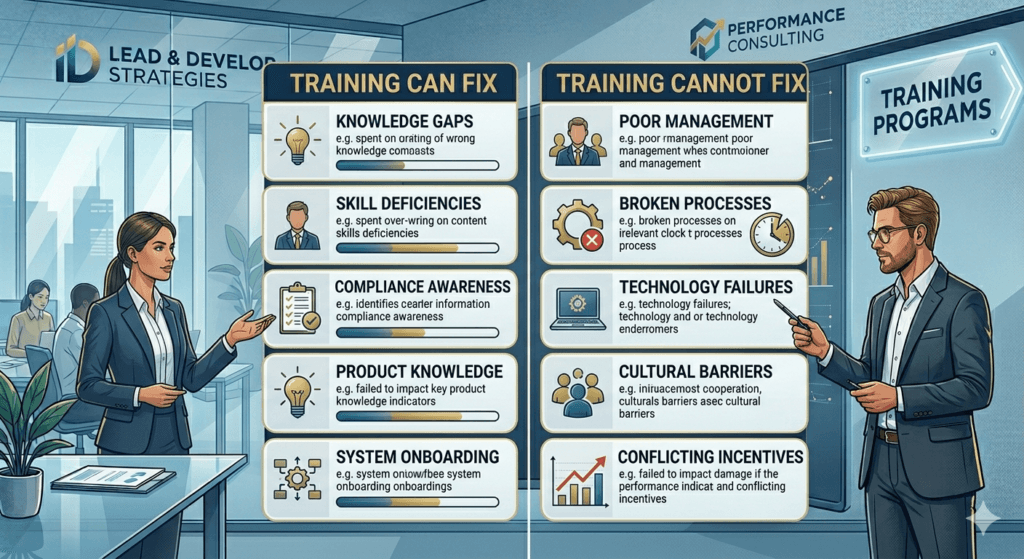
Sections 2 and 3 in full detail boil down to a simple two-column reference. Use it as a quick gut-check before any training request moves forward — if the cause sits on the right, training alone will not close the gap, regardless of how well it’s delivered.
| Training Can Fix | Training Cannot Fix |
| Knowledge gaps | Conflicting incentives |
| Skill deficiencies | Broken processes |
| Procedure awareness | Technology and tooling failures |
| Product or system updates | Poor management |
| Compliance knowledge | Organisational culture problems |
Section 4: The TrainerCentric Performance Diagnostic Lens™
Knowing that training can’t fix everything is useful, but it doesn’t tell you what to do instead. What practitioners need is a structured way to look at a performance problem and work out, systematically, which category it actually belongs to — before any solution, training or otherwise, is proposed.
The TrainerCentric Performance Diagnostic Lens™ is a five-category framework designed for exactly this purpose. It builds on the long tradition of human performance improvement models — most notably the work of Dana and James Robinson on performance consulting, and Gilbert’s Behavior Engineering Model — but reorganises the categories into a sequence that mirrors how performance problems actually present themselves in everyday management conversations.
Thomas Gilbert is one of the foundational figures in this field. In his 1978 book Human Competence: Engineering Worthy Performance, Gilbert argued that most performance problems are caused by deficiencies in the work environment — information, instrumentation, and incentives — rather than deficiencies in the person, and that these environmental factors should be examined before any individual-focused intervention, including training, is considered. His Behavior Engineering Model (BEM) organises these factors into six cells spanning environmental supports and individual repertoire, and remains one of the most cited frameworks in human performance improvement. The Diagnostic Lens introduced below draws directly on this insight — that environmental and systemic causes deserve at least as much scrutiny as knowledge and skill — while reorganising it into five categories more directly aligned with how L&D and HR practitioners typically describe performance gaps.
The five lenses are: Knowledge, Skill, Motivation, Process, and Environment. For any performance gap, working through these five lenses in order — asking the diagnostic questions, watching for the warning signs, and matching the appropriate intervention — will surface the actual root cause far more reliably than asking “what training do we need?”
| How to Use the Lens Work through all five categories for every significant performance request, even if you think you already know the answer. A gap can sit in more than one category at once — for example, a process problem that has also caused a motivation problem, because employees have given up trying to work around a broken system. The Lens is designed to surface all contributing causes, not just the first one you find. |
1. Knowledge — “Do they know what to do?”
This lens asks whether the person has the information required to perform — facts, procedures, policies, or context — regardless of whether they can currently apply it under real conditions.
Diagnostic questions:
- Has this employee ever been told, in a way they would recognise as instruction, what is expected of them in this specific situation?
- If asked to explain the correct process or standard right now, with no preparation, could they describe it accurately?
- Is the information they need documented anywhere they could access it, or does it exist only in someone’s head?
Warning signs:
- Employees give inconsistent answers when asked to describe the same process.
- New starters and tenured staff perform at similar levels because nobody has formally been told the standard.
- “We assumed everyone knew that” is a common phrase when problems are investigated.
Appropriate interventions:
- Targeted information-sharing: briefings, job aids, knowledge bases, updated documentation.
- Short-form training or e-learning where the gap is genuinely informational.
- Communication campaigns for policy or process changes, rather than full workshops.
2. Skill — “Can they do it, even when they know what ‘it’ is?”
This lens asks whether the person can translate knowledge into action under real working conditions — with the right pace, judgement, and consistency.
Diagnostic questions:
- Has this person had the opportunity to practise this specific skill, with feedback, before being expected to perform it live?
- Does performance improve noticeably when someone is watching or coaching them, compared to when they’re unsupervised?
- Is the skill genuinely complex, or is it simple but rarely performed, so it has decayed through lack of use?
Warning signs:
- Performance is fine in roleplay or simulation, but breaks down in live, high-pressure situations — often a sign the gap is elsewhere, not in skill.
- Skill was once present but has degraded because the task is performed infrequently.
- New employees consistently struggle with the same specific task, regardless of who they are.
Appropriate interventions:
- Hands-on practice with feedback: simulations, roleplay, supervised on-the-job application.
- Coaching and mentoring, particularly for skills that develop through repetition over time.
- Refresher practice for skills that are correct but infrequently used.
3. Motivation — “Do they want to do it?”
This lens asks whether the person is willing to apply what they know and can do — and, crucially, whether the incentives and consequences around them support or undermine that willingness.
Diagnostic questions:
- When this person performs the desired behaviour, what happens to them — positively or negatively, immediately or eventually?
- Is there any meaningful difference, in recognition, reward, or consequence, between doing this well and doing it poorly?
- Does the person believe the desired behaviour is actually valued by the organisation, regardless of what is officially stated?
Warning signs:
- “We’ve told them what to do a hundred times and they still don’t do it” — despite clear evidence the person is capable.
- High performers and low performers are treated identically, with no differentiation in outcomes.
- The desired behaviour takes more effort or time than the behaviour it’s meant to replace, with no corresponding benefit to the employee.
Appropriate interventions:
- Realign incentives, recognition, and performance management so they support the desired behaviour.
- Give meaningful feedback that differentiates strong and weak performance.
- Address conflicting messages between what is said and what is actually rewarded.
4. Process — “Is the way work is supposed to flow actually workable?”
This lens asks whether the defined process itself — the sequence of steps, handoffs, and decision points — allows good performance to occur, or whether it actively works against it.
Diagnostic questions:
- If someone followed this process exactly as documented, would it actually produce the outcome we want?
- How many handoffs, approvals, or system transitions does this process require, and what happens at each one?
- Are there informal workarounds that staff use instead of the official process — and if so, why?
Warning signs:
- “No one follows the official process” — and the workarounds people use instead are faster or more reliable.
- The process was designed for a different scale, team size, or system than the one currently in use.
- Errors cluster around specific handoff points between teams or systems, rather than being spread evenly.
Appropriate interventions:
- Process redesign, simplification, or removal of unnecessary steps and approvals.
- Clarify ownership at handoff points between departments or systems.
- Pilot a revised process with a small group before rolling it out more widely.
5. Environment — “Does the physical and technological context support the behaviour?”
This lens asks whether the tools, technology, physical workspace, staffing levels, and information access that surround the person actually allow them to perform as expected.
Diagnostic questions:
- Do the tools and systems this person uses daily work reliably, and are they fit for the task?
- Does the person have enough time, staffing support, and information access to meet the standard expected of them?
- Would a highly skilled, highly motivated person in this exact environment still struggle to perform well?
Warning signs:
- Frequent system outages, slow software, or equipment failures are mentioned repeatedly by frontline staff.
- Staffing levels have not been adjusted despite significant increases in workload or targets.
- Performance is consistently worse on certain shifts, locations, or system configurations — pointing to environmental rather than individual causes.
Appropriate interventions:
- Fix, replace, or reconfigure unreliable tools and systems.
- Adjust staffing levels or workload to match realistic capacity.
- Improve access to information and resources at the point of need.
| Memorable Summary: The Five-Lens Quick Check Knowledge — Do they know what ‘good’ looks like? Skill — Can they actually do it under real conditions? Motivation — Does doing it well actually matter to them? Process — Does the workflow itself allow good performance? Environment — Do their tools and conditions support it? Training only addresses the first two. If the root cause sits in the last three, training will not move the needle — no matter how good it is. |
Section 5: How to Conduct a Root Cause Analysis Before Recommending Training
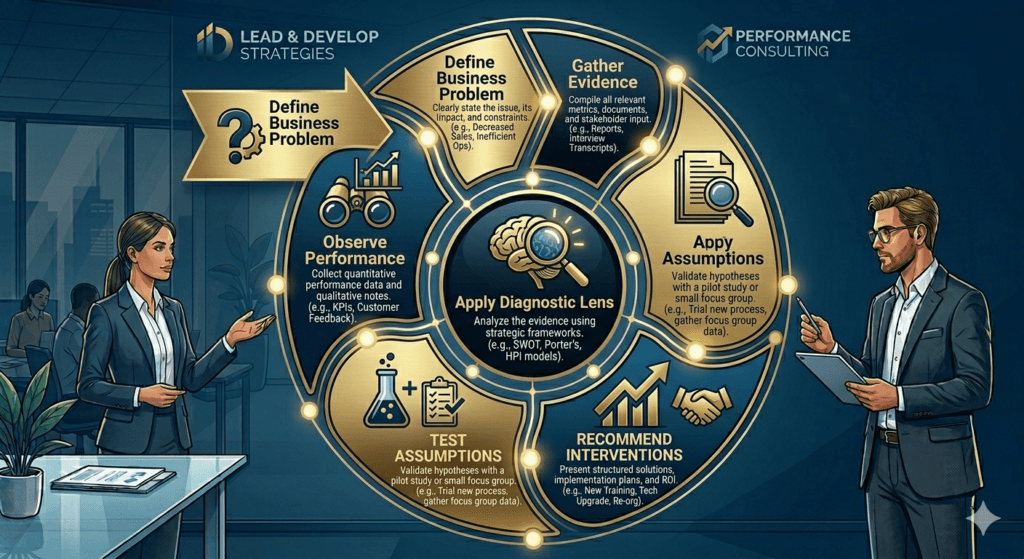
The TrainerCentric Performance Diagnostic Lens™ tells you what to look for. This section describes the process for actually finding it — a six-step root cause analysis sequence that can be run in anywhere from a few days to a few weeks, depending on the scale of the request.
📌 Internal Resource: For a step-by-step walkthrough, see How to Conduct a Training Needs Analysis in 5 Steps on TrainerCentric.in.
Step 1: Define the business problem
Before anything else, restate the request as a business outcome rather than a training request. “We need communication training” becomes “customer satisfaction scores have dropped 15% over two quarters and renewal rates are below target”. This reframing matters because it keeps the conversation anchored to a measurable result, and because it stops the requester’s proposed solution from quietly becoming the definition of the problem.
At this stage, ask for whatever data already exists: performance metrics, customer feedback, error rates, turnover figures, or anything else that quantifies the gap between current and desired performance. If no data exists, that’s useful information too — it tells you the request may be based on perception rather than evidence, which doesn’t make it invalid, but does mean the next steps need to establish a baseline.
Step 2: Observe performance directly
Wherever possible, watch the work happen — not a demonstration or a simulation, but the actual task in its actual context. Sit with the account managers during real calls. Watch the warehouse team during a normal shift, not a specially arranged one. Direct observation consistently reveals things that interviews and surveys miss, because people often don’t consciously notice the workarounds, hesitations, or system frustrations that have become normal to them.
During observation, pay particular attention to the gap between what people say they do and what they actually do — this gap is frequently where the real cause lives.
Step 3: Gather evidence from multiple sources
No single source of evidence is sufficient. A robust diagnosis triangulates across several: performance data (what does the metric actually show, and when did it start changing?), the people doing the work (what do they say is getting in their way?), their managers (what do they believe is happening, and does it match what the frontline says?), and the systems and documentation involved (does the official process match what people actually do?).
Where these sources agree, you can move forward with confidence. Where they disagree — for example, a manager says “they just need more training” while frontline staff say “we know how to do this, the system won’t let us” — that disagreement itself is diagnostic information, and usually points towards a motivation or accountability issue layered on top of whatever else is happening.
Step 4: Identify root causes using the Diagnostic Lens
With evidence gathered, work through each of the five lenses — Knowledge, Skill, Motivation, Process, Environment — systematically. For each one, ask: is there evidence that this category is contributing to the performance gap? Be specific. “Motivation might be part of it” is not a finding; “there is no difference in recognition or consequence between team members who follow the new process and those who don’t” is.
It’s common to find that more than one lens is contributing. A broken process (Process) can lead to staff giving up on trying to follow it correctly (Motivation), which over time can mean that even those who once knew the correct procedure no longer remember the details (Knowledge). Untangling which cause came first, and which is now sustaining the problem, is part of the analysis.
Step 5: Test assumptions before committing to a solution
Before recommending a full-scale intervention, test the hypothesis on a small scale wherever possible. If the analysis suggests the cause is a broken handoff between two teams, pilot a revised handoff process with one team pairing before rolling it out organisation-wide. If the analysis suggests motivation is the issue, test whether a change in how performance is recognised produces a measurable shift before assuming the entire team needs retraining.
This step protects against the same mistake the rest of the article is about — just one level down. It’s entirely possible to correctly identify that the cause is, say, a process issue, and still get the specific fix wrong. Testing at small scale catches that before it becomes an organisation-wide rollout.
Step 6: Recommend interventions matched to root causes
Finally, present recommendations that map directly to the causes identified — not a single intervention, but potentially a combination. A typical output might recommend a process change, a revised performance scorecard, and a short, targeted skills refresher, in that order of priority, with the skills element addressing only the genuine knowledge or skill gap that the analysis uncovered — which is often much smaller than the original request implied.
Crucially, this step should also state explicitly what training will not solve, and why — so that if performance doesn’t improve after the process and incentive changes are made, there’s a documented record of what was already ruled out, rather than a default assumption that “maybe they need more training after all”.
Section 6: A Real Performance Consulting Example
To show how this works in practice, here is a detailed walkthrough of a common scenario — a sales team missing its targets — following the six-step process from Section 5.
The Initial Request
A regional sales director reports that the team has missed its quarterly target for three consecutive quarters, with performance roughly 18% below plan. The request that arrives in L&D’s inbox is for “advanced sales training, ideally covering objection handling and closing techniques, for the whole team.”
Step 1 — Defining the Business Problem
Reframed: revenue is 18% below target for three consecutive quarters, and the trend is flat rather than improving. The team has 14 account managers, all of whom completed a recognised sales methodology programme roughly 18 months ago.
Step 2 — Direct Observation
A consultant sits in on a sample of live sales calls across several reps, both higher and lower performers. The calls themselves are, on the whole, competently handled — reps build rapport, ask reasonable discovery questions, and respond to objections in ways consistent with their earlier training.
However, two things stand out: several reps spend the first few minutes of each call working out from memory what was discussed in the previous interaction, because notes from the last call aren’t easily accessible; and a noticeable number of calls are with prospects who, based on their answers to basic discovery questions, are clearly not a good fit for the product.
Step 3 — Gathering Evidence
- CRM data: Only 40% of customer interactions are being logged in the CRM consistently. Reps report the interface requires too many clicks for routine updates, so many default to personal notes or memory.
- Lead source data: Around 35% of leads assigned to the team come from a marketing campaign that, on closer inspection, is generating high volumes of enquiries from organisations well outside the product’s target customer profile.
- Manager interviews: Sales managers report that one-to-one coaching sessions, which were a core part of how the original sales methodology was meant to be reinforced, have been deprioritised over the last year due to the managers themselves taking on larger spans of control after a restructure.
- Rep interviews: Reps consistently say they remember the training content and believe in the methodology, but feel they ’re “winging it” on calls because they don’t have reliable information about what was discussed previously, and they’re spending significant time on leads that were never going to convert.
Step 4 — Applying the Diagnostic Lens
| Lens | Finding | Contributing? |
| Knowledge | Reps recall the sales methodology accurately when asked directly | No |
| Skill | Observed call quality is broadly consistent with trained techniques; reps can demonstrate the skills | Minor — some reps would benefit from refresher practice on advanced objection handling, but this is not the primary cause |
| Motivation | Coaching that reinforced the methodology has lapsed; reps feel unsupported, which has gradually reduced confidence | Yes — secondary cause |
| Process | CRM logging is inconsistent, meaning reps lack continuity between interactions; this directly affects call quality and follow-up | Yes — primary cause |
| Environment | A significant share of leads come from a poorly targeted campaign, consuming selling time on prospects unlikely to convert | Yes — primary cause |
Step 5 — Testing Assumptions
Before recommending a full programme of change, two small-scale tests were run over a four-week period. First, a subset of five reps was given a simplified CRM logging template requiring only three fields after each call, rather than the standard twelve. Second, the marketing team agreed to apply stricter qualification filters to one lead source for the same period.
Within the test period, the five reps using the simplified template logged 85% of interactions, up from the team average of 40%, and reported needing less time to prepare for follow-up calls. The filtered lead source produced 30% fewer leads overall, but the proportion that matched the target customer profile rose substantially, and early conversion indicators on those leads were notably higher than on the unfiltered source.
Step 6 — Recommendations
- Simplify CRM logging for the whole team to the three-field format validated in the pilot, with a brief (90-minute) walkthrough session — not a training programme — to introduce it.
- Apply the stricter lead qualification filters used in the pilot across all relevant lead sources, in coordination with the marketing team.
- Reinstate structured one-to-one coaching sessions for sales managers, with a lighter-touch coaching framework that fits within their expanded spans of control.
- Deliver a short (half-day) refresher session on advanced objection handling for reps who specifically requested it — the only genuinely training-shaped element of the recommendation, and a small fraction of the overall plan.
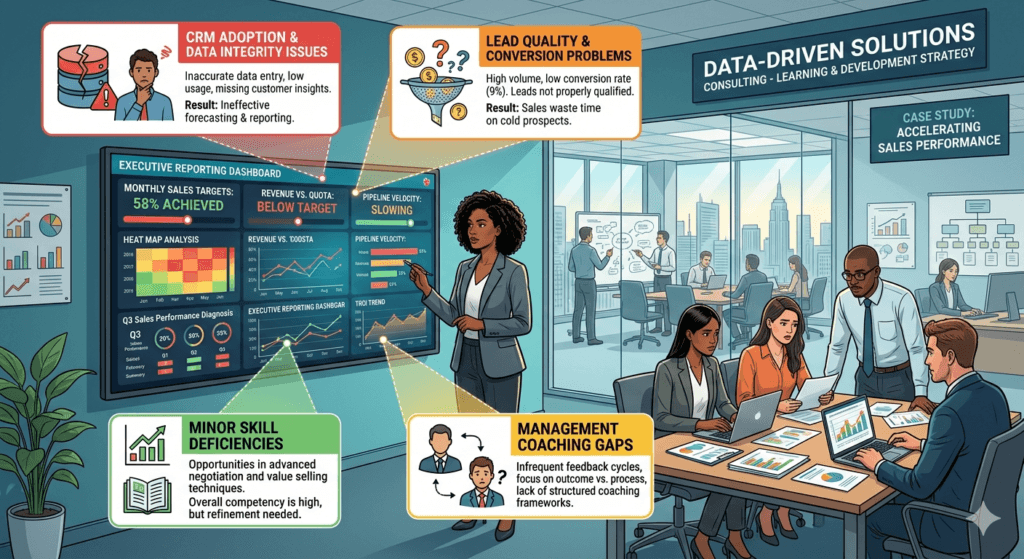
| Outcome The original request was for a multi-day sales training programme for the entire team — a significant investment in facilitator time, lost selling days, and materials. The actual root causes were a CRM workflow issue, a lead quality issue, and a coaching cadence issue, none of which required a training programme to fix. The training element that was ultimately delivered was a half-day refresher for a subset of the team — a fraction of the original scope, time, and cost. |
Section 7: Performance Consulting vs Training Needs Analysis
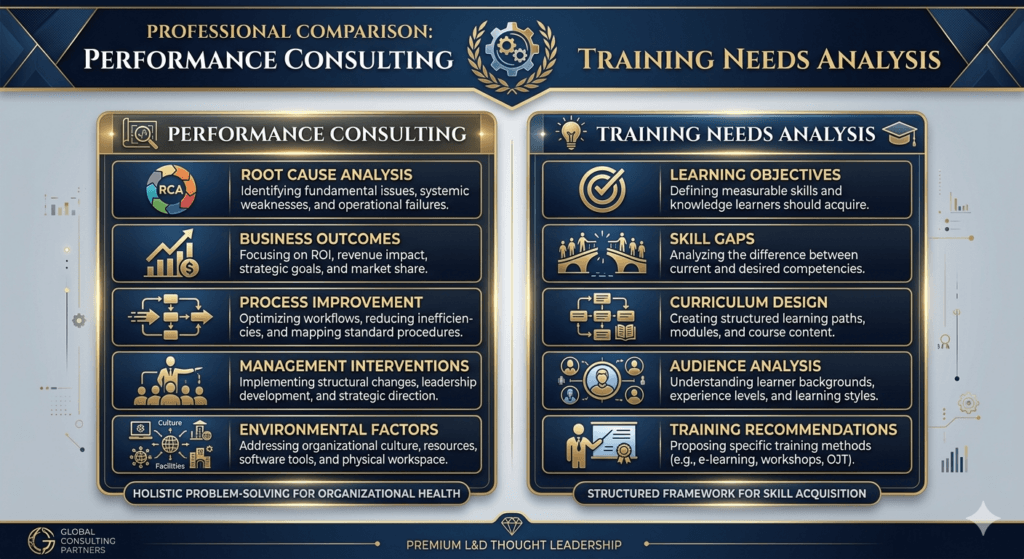
Performance consulting and training needs analysis (TNA) are related but distinct activities, and the difference between them is a frequent source of confusion. Understanding where each fits — and how they complement each other — helps avoid both unnecessary diagnostic work and premature training design.
In short: performance consulting asks whether training is the right intervention at all. Training needs analysis assumes training is the right intervention and asks what, specifically, that training should cover. Performance consulting is the broader, earlier-stage activity; TNA is the narrower, later-stage activity that performance consulting may lead into.
| Dimension | Training Needs Analysis | Performance Consulting |
| Primary objective | Determine the content, scope, and structure of a training intervention | Determine whether a performance gap has a cause that training can address at all |
| Scope | Focused on the knowledge and skill requirements of a specific role or task | Broad — covers knowledge, skill, motivation, process, and environment |
| Starting assumption | Training is needed; the question is what kind | No assumption is made about the solution until causes are identified |
| Typical outputs | Learning objectives, curriculum outline, target audience profile, delivery format recommendations | Root cause analysis, recommendations that may include training, process change, management action, or a combination |
| When to use | After it has been established (through performance consulting or other evidence) that a knowledge or skill gap exists and training is an appropriate response | At the point a performance problem is first raised, before any solution — including training — has been agreed |
In practice, the two activities often run in sequence. Performance consulting establishes that a genuine knowledge or skill gap exists and that training is an appropriate part of the response — as it did, on a small scale, in the case study in Section 6.
At that point, a training needs analysis takes over to define exactly what that training should contain, who it’s for, and how it should be delivered. Skipping straight to TNA without the performance consulting step risks producing a very well-designed training programme for the wrong problem.
If you’re working through a request and have concluded that training is, in fact, part of the right answer, the next step is a structured training needs analysis — covered in detail in our companion guide, How to Conduct a Training Needs Analysis.
Section 8: Red Flags That Training Is Probably Not the Answer
Some signals are reliable enough that they should trigger a pause and a closer look before any training brief is written. None of these prove training is the wrong answer on their own, but each one is common enough, and predictive enough, to warrant a five-minute conversation before a project kicks off.
- “We’ve already delivered training on this.” : If the same or similar training has been delivered before and the problem persists, repeating it is unlikely to produce a different result. Something other than knowledge or skill is sustaining the gap.
- “No one follows the process.” : Widespread non-compliance with a known process points towards the process itself, an accountability gap, or a motivation issue — not a knowledge gap.
- “Managers aren’t reinforcing the behaviours.”: If the people responsible for reinforcing a new skill or behaviour day-to-day aren’t doing so, training will fade quickly regardless of how well it was delivered.
- “Employees know what to do but don’t do it.” : This is, almost by definition, not a knowledge or skill problem. It points towards motivation, accountability, or environmental barriers.
- “The systems make the task difficult.” : If the tools or technology required to do the job well are unreliable or poorly designed, training people to work around them only goes so far.
- “We just need everyone to be more [adjective].” : Vague requests built around an adjective (“more proactive”, “more accountable”, “more engaged”) rather than a specific, observable behaviour are a sign the underlying problem hasn’t yet been defined clearly enough to diagnose.
- The request names the solution before describing the problem. : When a request opens with “we need a workshop on…” rather than “we’re seeing this performance issue…”, the diagnostic step has likely been skipped entirely.
| How to Use This Checklist If two or more of these signals are present in a request, treat that as a strong indicator that a short root cause analysis — even an informal one, run over a day or two — should happen before any training design work begins. |
Section 9: Performance Consulting Best Practices
Beyond the specific process outlined in Section 5, a handful of broader principles separate effective performance consulting from a more superficial version of the same activity.
Evidence before assumptions
Every step of the diagnosis should be grounded in something observable — a metric, a documented process, a direct observation, a pattern across multiple interviews — rather than a single person’s impression of what’s happening. It’s easy to form a hypothesis quickly; the discipline is in testing it against evidence before acting on it.
Business outcomes first
Anchor every diagnostic conversation to a measurable business outcome — revenue, error rate, customer satisfaction, turnover, safety incidents — rather than to a behaviour in isolation. This keeps the focus on whether an intervention actually moves the metric that matters, rather than on whether it looks like a reasonable learning activity.
Multiple data sources
As described in Step 3 of the root cause analysis process, no single source of evidence — manager opinion, employee survey, performance data — should be treated as sufficient on its own. Triangulating across sources is what catches the cases where what people say doesn’t match what the data shows.
Stakeholder involvement
Involve the manager who raised the original request throughout the diagnostic process, not just at the start and end. This builds shared ownership of the eventual findings and makes it far easier to gain agreement for recommendations that may not match the original request — particularly when those recommendations point towards changes the manager themselves needs to make.
Separating symptoms from causes
A symptom is what’s observed (missed targets, customer complaints, high error rates). A cause is why it’s happening. Effective performance consulting keeps this distinction explicit throughout — documenting the symptom that triggered the request separately from each candidate cause identified during the analysis, so that recommendations can be traced clearly back to evidence.

Section 10: Common Mistakes L&D Teams Make
Even L&D teams who are aware of the principles in this article fall into predictable traps when under pressure to deliver quickly. Recognising these patterns is often the first step to avoiding them.
Acting like order takers
Treating every training request as a finished specification to be executed, rather than as a starting hypothesis to be tested, is the single most common mistake. It’s also the most understandable — saying yes quickly feels helpful, and questioning a senior stakeholder’s request can feel risky. But it consistently leads to training being delivered against the wrong cause.
Accepting training requests at face value
Closely related: assuming that because a request is detailed and specific (“two days, covering negotiation and objection handling, for 14 people”), it must also be correctly diagnosed. Specificity in a request says nothing about whether the underlying diagnosis is accurate.
Confusing activity with impact
Measuring success by attendance, completion rates, or satisfaction scores (“92% of participants rated the session 4 or 5 out of 5”) rather than by whether the original business metric actually moved. High satisfaction scores are compatible with a training programme that had zero effect on the underlying performance problem, because they measure the experience of the session, not its impact on the job.
Ignoring management factors
Diagnosing knowledge, skill, process, and environment issues thoroughly, but treating the manager’s own behaviour as out of scope. Management quality is frequently the single largest contributing factor to team performance, and it is also the factor L&D teams are most reluctant to investigate, because it requires a difficult conversation with the person who commissioned the work.
Failing to challenge stakeholders
Even when a diagnosis clearly points away from training, some L&D teams deliver the originally requested training anyway, rather than presenting the evidence and recommending an alternative. This is often driven by a reasonable fear of damaging the relationship with the stakeholder — but in practice, stakeholders who see clear evidence and a credible alternative recommendation are usually more receptive than expected, and the relationship is strengthened, not damaged, by the L&D team demonstrating this level of rigour.
Conclusion
Training is a solution. It is not a diagnosis. That distinction, simple as it sounds, is the difference between an L&D function that consistently delivers measurable business impact and one that produces well-attended events with little lasting effect.
Everything in this article builds towards a single practical habit: before a training brief is written, before a facilitator is booked, before a single slide is designed, take the time to ask which of the five lenses — Knowledge, Skill, Motivation, Process, or Environment — the performance gap actually sits in.
Where the answer is genuinely Knowledge or Skill, training is the right tool, and the companion guide on conducting a training needs analysis will help define exactly what that training should contain. Where the answer lies in Motivation, Process, or Environment, training alone will not move the metric that matters, regardless of how well it is designed or delivered.
The best L&D professionals operate as performance consultants first and training providers second. They treat every request as a hypothesis to be tested rather than a specification to be executed, they’re comfortable presenting evidence that challenges the original request, and they measure their own success by whether the business outcome moved — not by how many people attended or how highly they rated the session.
| Before You Approve Your Next Training Programme Ask whether the request describes a business problem or a pre-chosen solution. Ask what evidence exists beyond a single manager’s observation. And ask, specifically, which of the five lenses the gap sits in — before a single hour of training is designed. |
To make this process easier to run consistently, TrainerCentric is developing a companion Performance Diagnostic Worksheet™ — a structured, fillable tool that walks you through the five lenses, the diagnostic questions, and evidence-gathering steps in this article for any specific performance request. Keep an eye on the toolkit downloads section for its release.
Frequently Asked Questions
What is performance consulting?
Performance consulting is the practice of diagnosing the root cause of a performance gap — across knowledge, skill, motivation, process, and environment — before recommending a solution. Rather than starting from an assumed intervention such as training, it starts from the business problem and works backwards to identify what is actually causing it, then matches the intervention to the cause.
What is the difference between performance consulting and training?
Training is one possible intervention among several; performance consulting is the diagnostic process that determines which intervention, or combination of interventions, is actually appropriate. Training addresses gaps in knowledge and skill specifically. Performance consulting can identify causes — such as broken processes, unclear expectations, or conflicting incentives — that training cannot address at all.
When should training not be used?
Training should not be used when the root cause of a performance gap sits outside knowledge and skill — for example, when the cause is poor management, a broken process, unclear expectations, conflicting incentives, resource constraints, a poor hiring fit, a cultural barrier, or unreliable technology. In these cases, training may still run successfully as an event, but it will not resolve the underlying performance problem.
How to identify root causes of poor performance?
A structured root cause analysis combines direct observation of the work, performance data, and interviews with both the people doing the work and their managers, then examines the evidence against a framework such as the TrainerCentric Performance Diagnostic Lens™ — covering Knowledge, Skill, Motivation, Process, and Environment. The full six-step process is set out in Section 5 of this article.
Can performance consulting reduce training costs?
Yes, often substantially. By identifying when training is not the appropriate intervention — or when only a small, targeted training component is genuinely needed, as in the case study in Section 6 — performance consulting prevents spend on training programmes that would not have addressed the underlying problem, redirecting that budget towards interventions, such as process or incentive changes, that are more likely to produce a measurable result.
What models are used in performance consulting?
Widely referenced models include the performance consulting framework developed by Dana and James Robinson, Thomas Gilbert’s Behavior Engineering Model, and human performance improvement (HPI) approaches associated with the Association for Talent Development (ATD). The TrainerCentric Performance Diagnostic Lens™ introduced in this article draws on this tradition, organising the diagnosis into five practitioner-friendly categories: Knowledge, Skill, Motivation, Process, and Environment.
References
- Performance Consulting || Dana Gaines Robinson and James C. Robinson
- The Six Disciplines of Breakthrough Learning || Calhoun W. Wick, Roy V. H. Pollock, and Andrew McK. Jefferson
- Evaluating Training Programs || Donald L. Kirkpatrick and James D. Kirkpatrick
- Telling Ain’t Training || Harold D. Stolovitch and Erica J. Keeps
- Design for How People Learn || Julie Dirksen
Further Readings
- Ultimate Guide to Training Needs Analysis
- How to Conduct a Training Needs Analysis
- Skills Gap Analysis vs Training Needs Analysis
- Job Task Analysis
- How to Present TNA Results to Senior Stakeholders
- The 3 Levels of Training Needs Analysis: Organisation, Task & Person Analysis
- ADDIE Model Explained
- Learning Objectives Guide
- Training Needs Analysis Template
- Focus Groups and Interviews
- Kirkpatrick Model: How to Measure Training Effectiveness
- 12 Facilitation Skills for Corporate Trainers: The Complete Guide
- Training Needs Analysis Questionnaire: Complete Guide (75 Questions & Free Template)
- Training Needs Analysis Checklist: A Practical Step-by-Step Guide
- Competency Mapping vs Skills Gap Analysis
Author Details

Pankaj Nandi is a Technical Writer and Learning Content Specialist with experience creating complex technical and instructional content across software, technology, and enterprise environments. Having worked with organizations including Cisco, Rakuten India, and Newgen Software, he specializes in transforming complex concepts into clear, practical, and learner-friendly content. You can reach out to him at pankaj@trainercentric.in