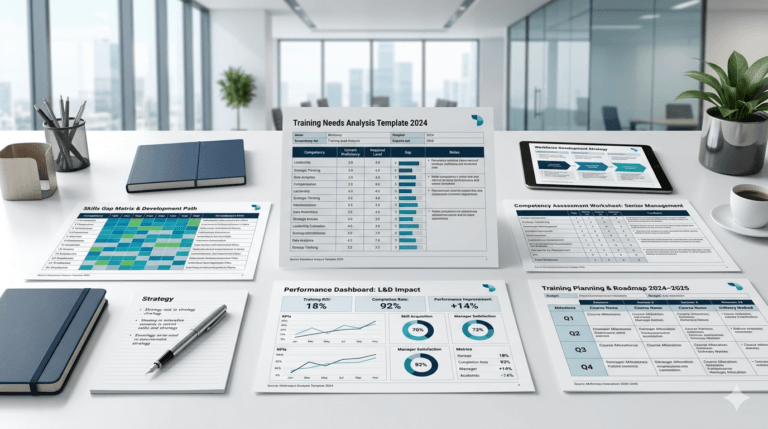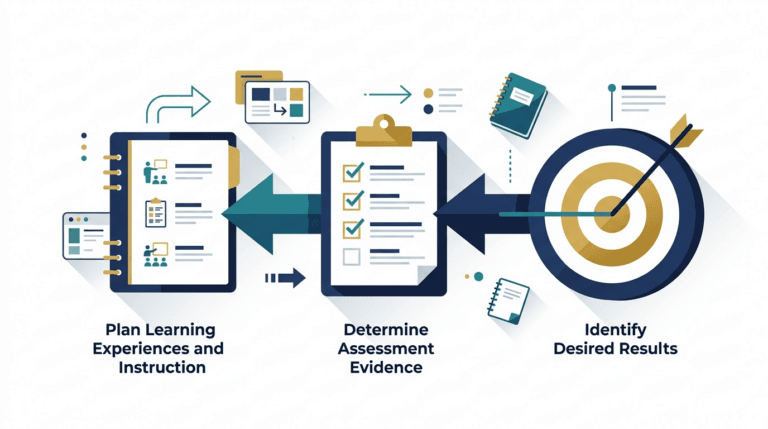
(+75 Questions, Free Template & The Performance Gap Pyramid™)
A mid-sized manufacturing company once spent close to $180,000 rolling out a leadership development program for its plant supervisors. Eighteen months later, frontline turnover hadn’t moved. Safety incidents were flat. Supervisors still couldn’t run a difficult conversation without it escalating.
Nobody had asked the supervisors — or their teams — what they actually struggled with. The training was built on a boardroom assumption, not on evidence.
This is the most expensive mistake in corporate learning: designing training before properly diagnosing the problem. A well-built Training Needs Analysis Questionnaire is the instrument that prevents it. ATD has reported that organizations investing more heavily in employee development consistently outperform those that don’t across multiple business metrics — but only when that investment is targeted correctly. A questionnaire is how you find the target before you spend the money.
In this guide, you’ll get a complete, field-tested system for running a Training Needs Analysis Questionnaire — including our own Performance Gap Pyramid™, 75 ready-to-use questions, software comparisons, validation checklists, an Excel analysis example, and a composite case study built from patterns seen across real TNA engagements. By the end, you’ll be equipped to run this yourself — and you’ll know exactly where a toolkit saves you the implementation time.
(Internal Resource: Training Needs Analysis — The Foundational Guide)
15 Signs You Need a Training Needs Analysis
Before you build any questionnaire, it helps to know whether you actually need one yet. If several of these sound familiar, the answer is yes.
- Training completion rates are high, but performance metrics haven’t moved.
- Different departments are requesting the same training for very different reasons.
- Leadership keeps approving budget for training nobody asked for.
- Employee turnover is rising in roles that recently received training.
- Managers and employees disagree sharply about where the real skill gaps are.
- You’re about to roll out new technology and don’t know who’s ready for it.
- Customer complaints are increasing but nobody can pinpoint the root cause.
- Compliance training is completed on time, yet violations still occur.
- A merger or reorganization has just changed what “good performance” looks like.
- Your last training program was built from a single stakeholder’s opinion.
- You can’t currently say, with data, what your top three skill gaps are.
- New hires take longer than expected to reach full productivity.
- Succession candidates exist on paper but aren’t ready in practice.
- L&D budget requests are based on requests, not evidence.
- Nobody has measured training impact against business KPIs in the last 12 months.
If three or more of these apply, a structured questionnaire — not another generic course — should be your next move.
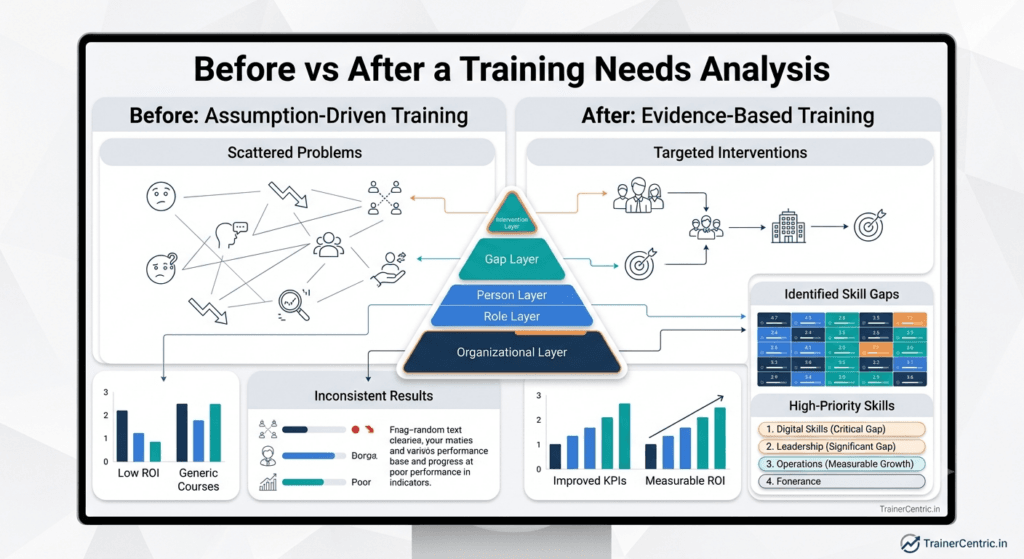
The Performance Gap Pyramid™
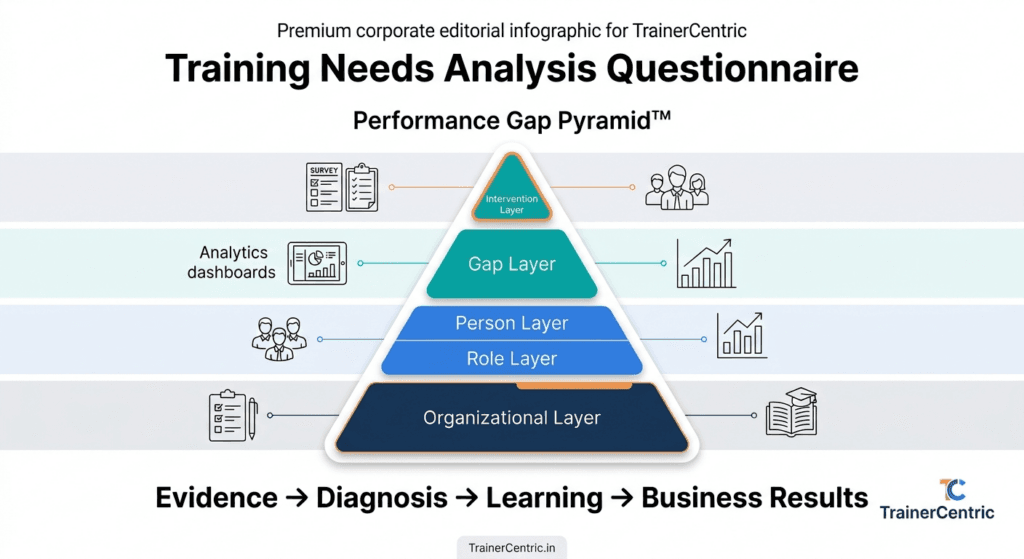
Most guides treat a questionnaire as a standalone form. We treat it as one layer in a diagnostic stack. Here’s the model we use at TrainerCentric when advising on needs analysis design:
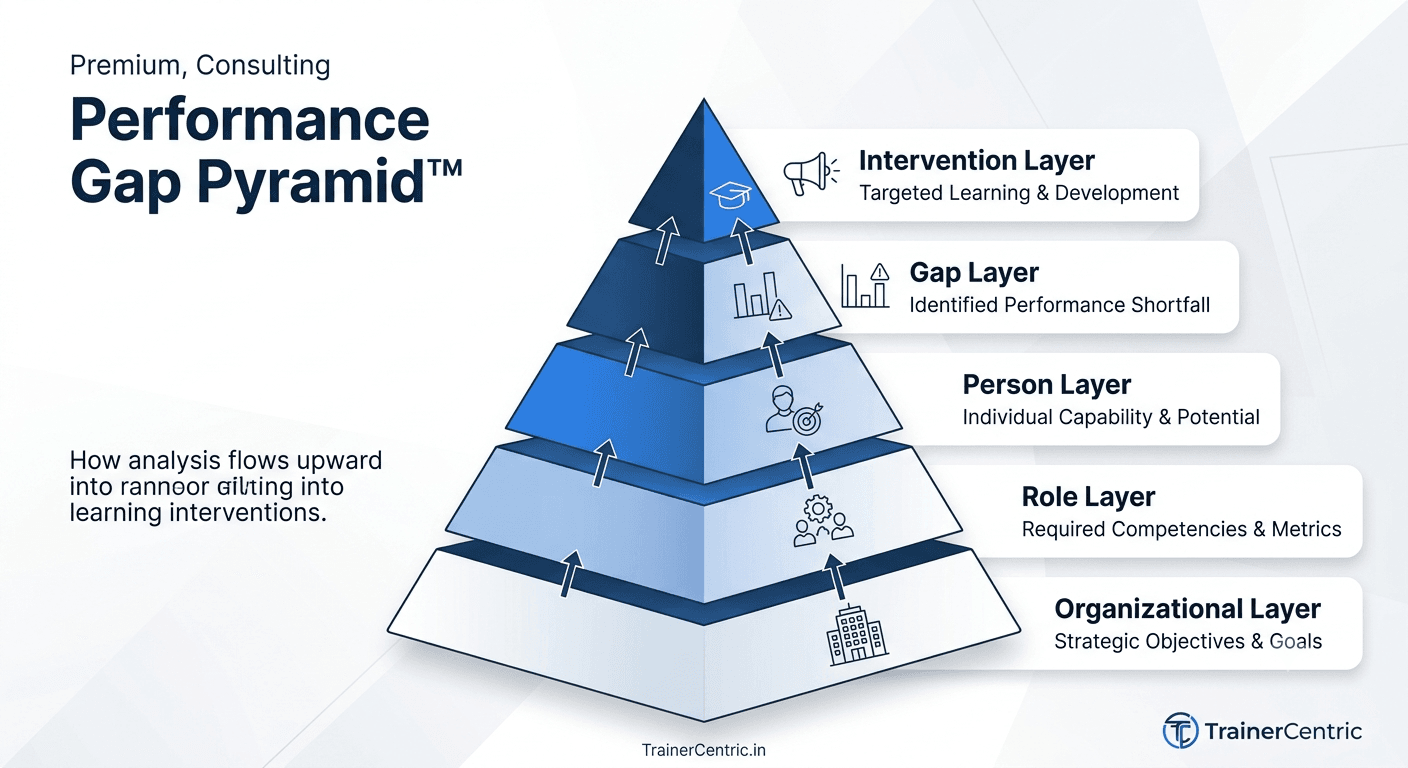
- Organizational Layer — What does the business actually need to achieve? (ties to organizational analysis and workforce planning)
- Role Layer — What does this specific role require to deliver that outcome? (job analysis and task analysis live here)
- Person Layer — What does this specific individual currently bring? (person analysis, self- and manager-rated competency data)
- Gap Layer — Where is the distance between the Role Layer and Person Layer largest, and which gaps matter most to the business?
- Intervention Layer — Is training the right fix, or is this a process, tooling, or management problem? (performance diagnosis happens here, before committing to a training plan)
A questionnaire is the primary data-collection tool for the middle three layers. Build forms without locating them inside a structure like this, and you end up with data and no diagnosis — which is exactly how organizations end up training the wrong thing. LinkedIn’s Workplace Learning Report has repeatedly found that alignment between learning programs and business priorities is one of the strongest predictors of L&D’s perceived value inside an organization — the Pyramid is how you build that alignment deliberately, rather than by accident.
What Is a Training Needs Analysis Questionnaire?
A Training Needs Analysis Questionnaire is a structured data-collection instrument used to identify the gap between current and required performance. It feeds the middle layers of the Pyramid above, and it sits within the wider discipline of needs assessment — a field with roots in instructional design models like ADDIE, where “Analysis” is the very first phase for a reason: nothing downstream works if the diagnosis is wrong.
It’s worth being precise about overlapping terms, because they get used loosely in practice:
- Training Needs Analysis (TNA) — the full diagnostic process.
- Training Needs Assessment — often synonymous, though some practitioners use “assessment” for a narrower, point-in-time check.
- Questionnaire — the instrument: the actual list of questions.
- Survey — the broader activity of distributing the questionnaire and gathering responses.
(Internal Resource: Job Task Analysis: The Complete Guide + 2 Free Templates)
A pattern often seen in TNA projects: teams confuse a generic employee engagement survey with a TNA questionnaire. They’re not the same. An engagement survey measures sentiment and culture. A TNA questionnaire measures capability gaps against specific, defined performance requirements. Confusing the two produces a stack of opinion data with no clear training decision attached to it.
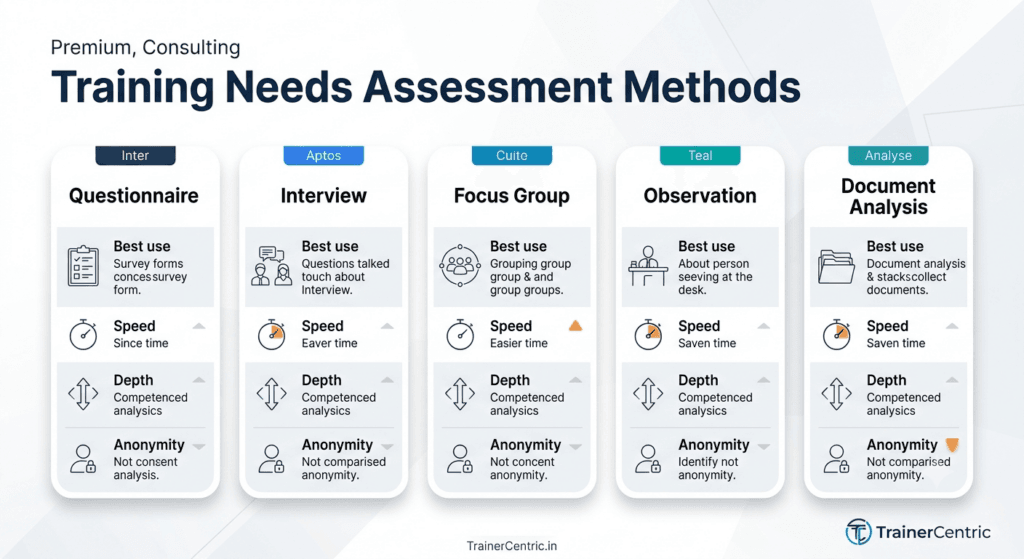
| Method | Best For | Speed | Depth | Anonymity |
| Questionnaire/Survey | Large groups, quantifiable trends | Fast | Moderate | High |
| Interview | Nuanced, individual insight | Slow | High | Low |
| Focus Group | Group dynamics, shared themes | Medium | High | Low |
| Observation | Actual on-the-job behavior | Slow | High | N/A |
| Document Analysis | Performance data, KPIs, incident logs | Fast | Moderate | N/A |
- (Internal Resource: Focus Groups in Training Needs Analysis)
- (Internal Resource: Observation-Based Needs Analysis)
TNA Questionnaire vs Employee Engagement Survey
| TNA Questionnaire | Engagement Survey | |
| Measures | Capability gaps | Sentiment, culture, satisfaction |
| Output | Training plan, learning objectives | Culture initiatives, retention actions |
| Frequency | Ahead of specific initiatives | Often annual/pulse |
| Owner | L&D / Performance Consulting | HR / People Operations |
Why Training Needs Questionnaires Matter
ATD research indicates that companies investing more heavily in employee development consistently see stronger business outcomes than those that don’t — but that correlation only holds when development is aimed correctly. A questionnaire is the aiming mechanism.
- Cost savings. Training built on guesswork tends to get re-run or quietly abandoned, which costs more than the few weeks a proper needs analysis takes.
- Improved training ROI. CIPD’s learning and development research has consistently emphasized that effective L&D requires a clear understanding of business and learner needs before designing interventions. When training maps to a verified gap, demonstrating ROI — a topic we cover in our training ROI guide — becomes far easier.
- Employee engagement. People invest more energy in training they were consulted on.
- Better stakeholder buy-in. A heat map built from a department’s own data is a stronger pitch than an assertion.
- Objective decision-making. Deloitte’s human capital research has repeatedly pointed out that organizations relying on assumption-driven workforce decisions tend to misallocate development budget relative to those using structured diagnostic data.
When Should You Use a Training Needs Questionnaire?
- Before launching new training, to confirm content matches the actual gap
- During annual L&D and workforce planning, to prioritize competing budget requests
- Ahead of digital transformation, where skill gaps are routinely underestimated
- During leadership development and succession planning, especially at promotion points
- Before compliance training cycles, to check understanding, not just completion
- When addressing a specific performance improvement issue
- Following a merger, when two workforces may have different skill baselines
- During broader organizational change or new technology implementation
Advantages and Limitations
| Advantages | Limitations |
| Scales to large or distributed workforces cheaply | Subject to response bias |
| Easy to analyze quantitatively at scale | Poorly worded questions produce unusable data |
| Can be made fully anonymous | Survey fatigue lowers quality over a long form |
| Produces trackable longitudinal data | Low response rates can skew results |
A pattern often seen in organizations running their first TNA: they treat these limitations as reasons to skip the exercise entirely, when in practice each one is solvable through better design — covered next.
Types of Training Needs Questionnaires
- Employee questionnaire — self-perceived skill and knowledge gaps, learning preferences
- Manager questionnaire — team-level gaps as observed by the supervisor
- Leadership questionnaire — strategic, change-readiness, and succession-related gaps
- Department questionnaire — function-specific, enabling cross-department benchmarking
- Technical skills questionnaire — tool and systems proficiency
- Soft skills questionnaire — communication, collaboration, conflict resolution
- Customer service questionnaire — service recovery and de-escalation
- Sales questionnaire — negotiation, objection handling, product knowledge
- Compliance questionnaire — regulatory understanding, not just completion
- New hire questionnaire — baseline within the first 30–60 days
- Remote workforce questionnaire — digital collaboration and self-management
How to Design an Effective Training Needs Questionnaire
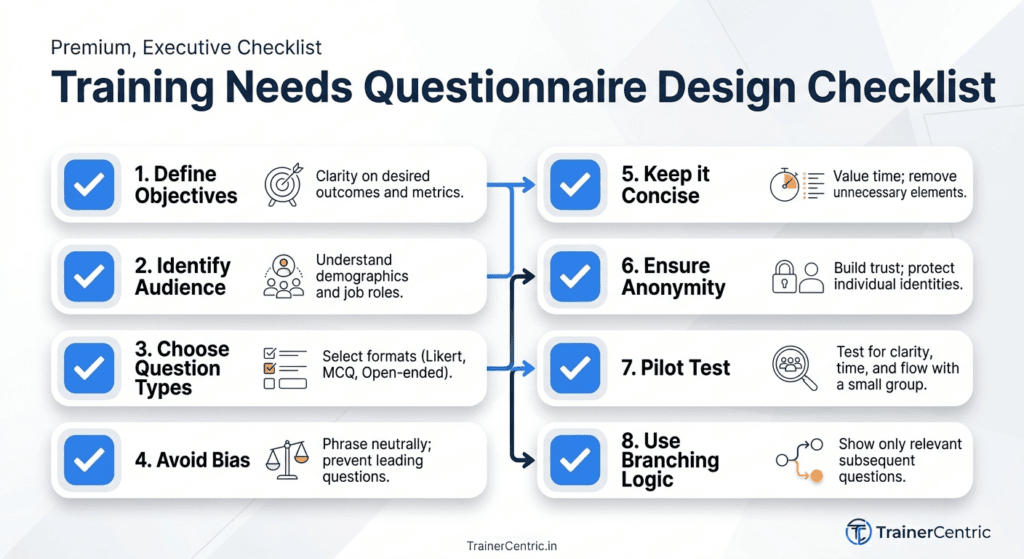
Define objectives first. “Understand training needs” is too vague. “Determine whether reps need de-escalation training before launch” is usable.
Identify your audience precisely. Frontline staff and senior leaders need different tone and depth.
Choose question types deliberately. Mix closed questions for measurable data with open questions for context.
Avoid leading or loaded questions.
Keep it concise — aim for 8–12 minutes of completion time.
Ensure genuine anonymity where honesty matters most.
Pilot test with 5–10 respondents before full rollout.
Use branching logic to skip irrelevant sections.
Example: Weak Question vs Strong Question
| Weak (Leading/Vague) | Strong (Neutral/Specific) |
| “How much has the new CRM frustrated you?” | “How would you rate your comfort using the new CRM?” |
| “Don’t you think managers need better feedback training?” | “How confident are you giving feedback to a team member?” |
| “Rate your skills.” | “Rate your confidence handling an escalated customer complaint.” |
Bad questionnaire pattern: 60 questions, all Likert scale, no branching, no open-ended section, sent with no explanation of purpose. Result: high drop-off, low-quality data.
Strong questionnaire pattern: 20 questions, mixed types, branching logic for tool-specific sections, one open reflection question per category, sent with a short note explaining what will be done with results. Result: higher completion, richer data.
👉 Want this structure pre-built? Our Training Needs Analysis Toolkit includes an editable, branching-logic-ready questionnaire template across employee, manager, and leadership versions
Types of Questions: A Practical Breakdown
| Question Type | Best Use Case | Advantage | Disadvantage |
| Likert Scale | Measuring attitudes/confidence | Easy to quantify | Central-tendency bias |
| Rating Scale | Scoring skill level (1–5/1–10) | Intuitive | Subjective across respondents |
| Multiple Choice | Identifying categories/preferences | Fast to analyze | Can miss nuance |
| Ranking | Prioritizing competing needs | Reveals relative priority | Harder on mobile |
| Yes/No | Quick factual checks | Extremely fast | No nuance |
| Matrix Questions | Rating related items together | Space-efficient | Risk of fatigue |
| Open-ended | Context, suggestions, surprises | Rich qualitative insight | Slow to analyze at scale |
| Scenario-Based | Testing applied judgment | Surfaces real capability | Time-consuming to write |
Likert Scale vs Rating Scale
| Likert Scale | Rating Scale | |
| Measures | Agreement/attitude | Magnitude/level |
| Typical range | 5-point (Strongly Disagree → Strongly Agree) | 1–5 or 1–10 |
| Best for | Confidence, sentiment | Skill proficiency, severity |
Anonymous vs Named Surveys
| Anonymous | Named | |
| Honesty | Higher, especially on sensitive topics | Lower on sensitive topics |
| Follow-up capability | None | Full |
| Best for | Manager evaluation, barriers | Individual development planning |
75 Ready-to-Use Training Needs Analysis Questions
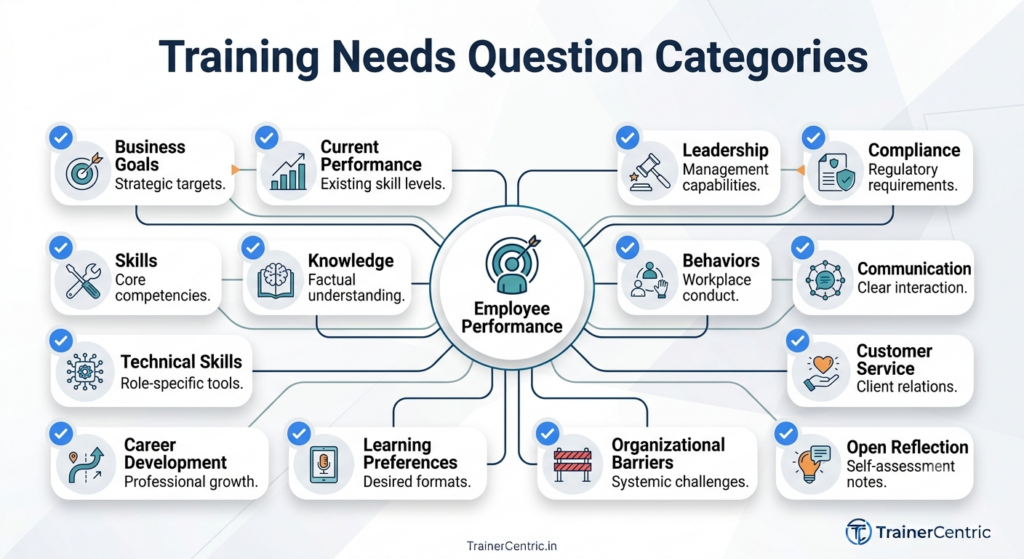
Business Goals
- How well do you understand the organization’s top priorities for this year?
- Which business goal do you feel least equipped to contribute to?
- What would help you connect your daily work more clearly to company objectives?
- How confident are you explaining our strategic priorities to a new colleague?
Current Performance
- Which part of your role takes you longer than it should?
- What task do you most often need help completing?
- How would you rate your overall confidence in your current responsibilities?
- What’s one recurring problem in your role that hasn’t been resolved?
Skills
- Which skill would most improve your performance if strengthened?
- Rate your proficiency in [specific skill relevant to role].
- Is there a skill your role requires that you’ve never been formally trained on?
- Which of your current skills do you feel are underused?
Knowledge
- How would you rate your understanding of company policies relevant to your role?
- Are there processes you follow without fully understanding why?
- What product or service knowledge gap affects your work most?
Behaviors
- How comfortable are you giving feedback to colleagues?
- How do you typically respond to conflict in a team setting?
- What behavior do you wish you could change about how you approach your work?
Leadership
- How confident are you in delegating tasks effectively?
- What leadership skill do you feel least prepared to use?
- How well do you handle underperformance in a team member?
- Rate your confidence in having difficult conversations with direct reports.
Communication
- How effective do you feel your written communication is at work?
- How confident are you presenting ideas to senior stakeholders?
- What communication challenge comes up most often for you?
Technical Skills
- Which software or system do you feel least confident using?
- How often do technical issues slow down your work?
- What technical skill would save you the most time if improved?
Digital Skills
- How confident are you using digital collaboration tools?
- Have you received formal training on the tools you use daily?
- What digital skill gap most affects your productivity?
Customer Service
- How confident are you handling an upset customer?
- What part of customer interactions do you find most challenging?
- How well-equipped do you feel to resolve complaints without escalation?
Sales
- How confident are you handling objections during a sales conversation?
- What part of the sales process do you find hardest to execute well?
- How well do you understand the full product range you’re selling?
Safety
- How confident are you identifying safety risks in your work area?
- Have you received refresher training on safety procedures in the last 12 months?
- What safety-related task do you feel least prepared for?
Compliance
- How well do you understand the compliance requirements relevant to your role?
- Is there a regulation or policy you find confusing or unclear?
- How confident are you applying compliance rules in day-to-day decisions?
Remote Working
- How effective do you feel working independently outside the office?
- What’s the biggest challenge you face collaborating with remote colleagues?
- Do you feel equipped with the tools needed to work remotely effectively?
Career Development
- Do you feel you have a clear path for growth in this organization?
- What skill would you like to develop for your next career step?
- How supported do you feel in pursuing professional development?
Future Skills
- What skill do you think will become more important in your role over the next two years?
- Are there emerging tools or technologies you’d like training on?
- How prepared do you feel for upcoming changes in your industry?
Learning Preferences
- What format of training works best for you (in-person, online, self-paced, blended)?
- How much time can you realistically dedicate to training each month?
- What has made past training effective or ineffective for you?
Organizational Barriers
- What gets in the way of you applying training to your actual work?
- Do you have enough time allocated to complete required training?
- Does your manager support you in applying new skills after training?
Open-Ended Reflection
- What’s one thing that would make your job significantly easier?
- If you could fix one process at work, what would it be?
- What training have you found most valuable in the past, and why?
- Is there a topic you wish leadership understood better about your day-to-day role?
- What would you change about how training is currently delivered here?
- What’s a skill you’ve taught yourself that the organization never formally trained you on?
- What’s one barrier to performance that training alone won’t fix?
- How could your manager better support your development?
- What would make you more likely to apply what you learn in training?
- Is there anything about your role you wish someone had explained earlier?
- What’s a recent situation where you didn’t feel equipped to handle something?
- What training topic do you think your team needs most, and why?
- How do you usually find answers when you’re unsure how to do something at work?
- What would “good training” look like to you, specifically?
- Are there generational or experience-level differences in training needs on your team?
- What’s one thing you’d tell L&D if you knew they were listening?
- Is there anything we haven’t asked about that you think is important for us to know?
👉 Download the editable version of this exact questionnaire — pre-loaded into our Training Needs Analysis Toolkit with branching logic and scoring built in.
Best Software for TNA Questionnaires
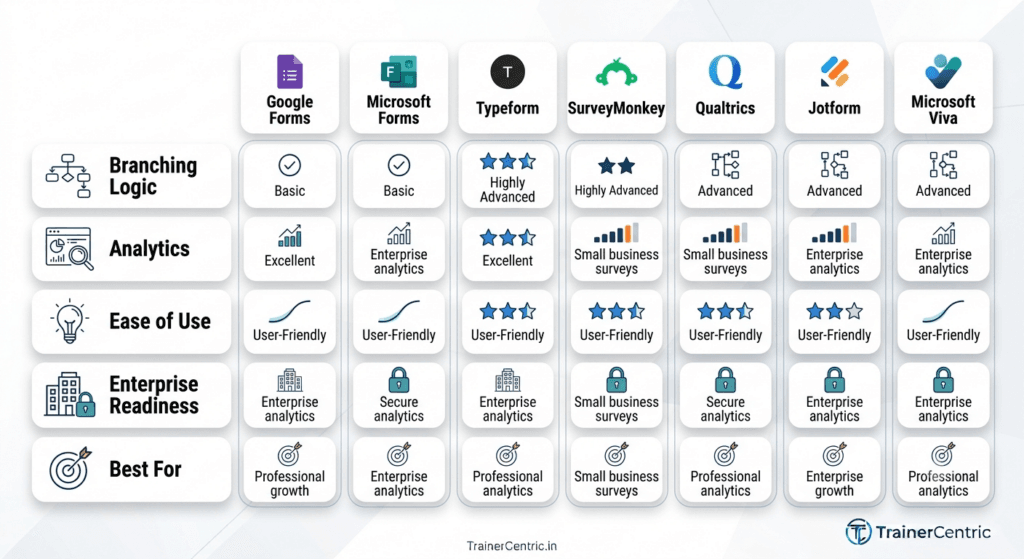
| Tool | Best For | Branching Logic | Analytics Depth |
| Google Forms | Small teams, simple needs | Limited | Basic |
| Microsoft Forms | Microsoft 365 organizations | Limited | Basic |
| Typeform | Engaging, conversational UX | Strong | Moderate |
| SurveyMonkey | Mid-size organizations | Strong | Strong |
| Qualtrics | Enterprise, complex segmentation | Very strong | Very strong |
| Jotform | Custom forms with integrations | Moderate | Moderate |
| Microsoft Viva | Embedded in MS Teams workflows | Moderate | Strong (people analytics) |
Choice generally comes down to organization size, existing tech stack, and how much segmentation and branching the analysis requires. Microsoft and IBM have both published workplace research suggesting that tool adoption friction — not feature depth — is the biggest driver of low completion rates, which is worth weighing as heavily as feature lists when choosing software.
How AI Can Help Create Training Needs Questionnaires
AI tools are increasingly used to speed up two specific parts of this process: drafting question variations (turning one rough idea into multiple neutral, well-worded versions to pilot test) and theme-coding open-ended responses at scale, which used to require manual tagging. AI is not a substitute for the diagnostic thinking in the Pyramid above — it accelerates execution, not judgment. A common pattern in organizations adopting AI here: they use it to draft a first pass of questions, then have a human reviewer check for leading language and relevance before piloting.
How to Analyze Questionnaire Results
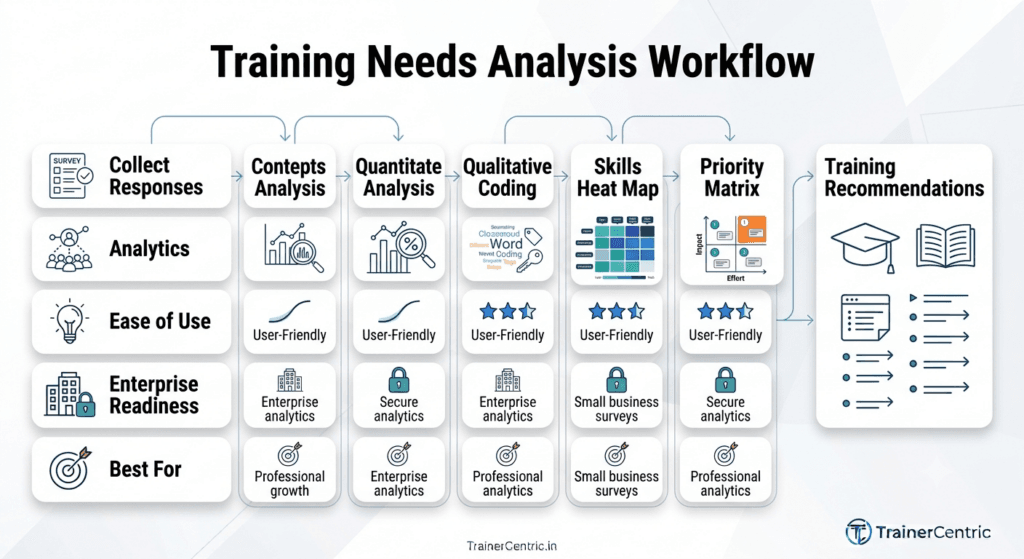
- Step 1: Quantitative analysis. Aggregate closed-question responses into averages and distributions. Segment by department, tenure, and role — overall averages hide where the real gaps sit.
- Step 2: Qualitative analysis. Code open-ended responses into themes.
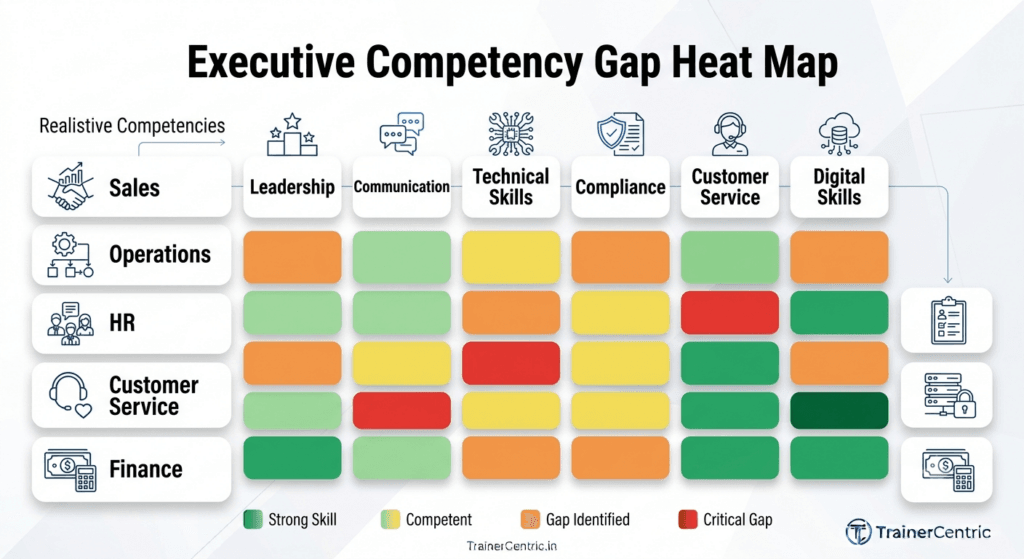
- Step 3: Build a heat map. Plot skill areas against departments, color-coded by severity.
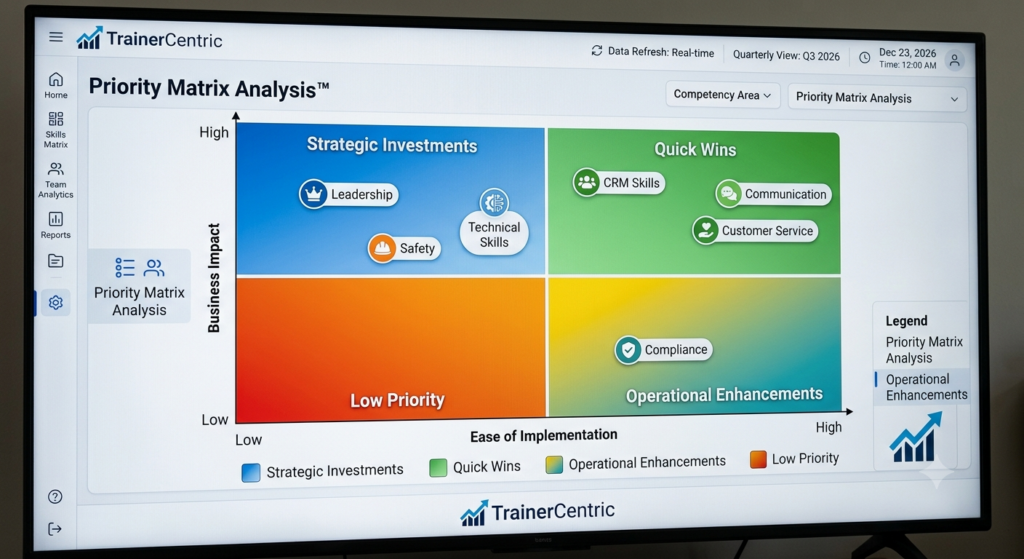
- Step 4: Apply a priority matrix. Plot gaps by business impact versus ease of closing them.
- Step 5: Conduct a formal skills gap analysis comparing required versus demonstrated proficiency by role.
- Step 6: Translate findings into training recommendations and learning objectives, each traceable to a specific data point. McKinsey’s workforce research has noted that organizations which explicitly link diagnostic data to specific learning objectives report higher confidence in training outcomes than those that design curricula first and justify them with data afterward.
Internal Resource: How to Present Training Needs Analysis Results to Senior Stakeholders + 4 Templates Free Download
Excel Analysis Example
A simple, usable structure for a skills-gap matrix in Excel:
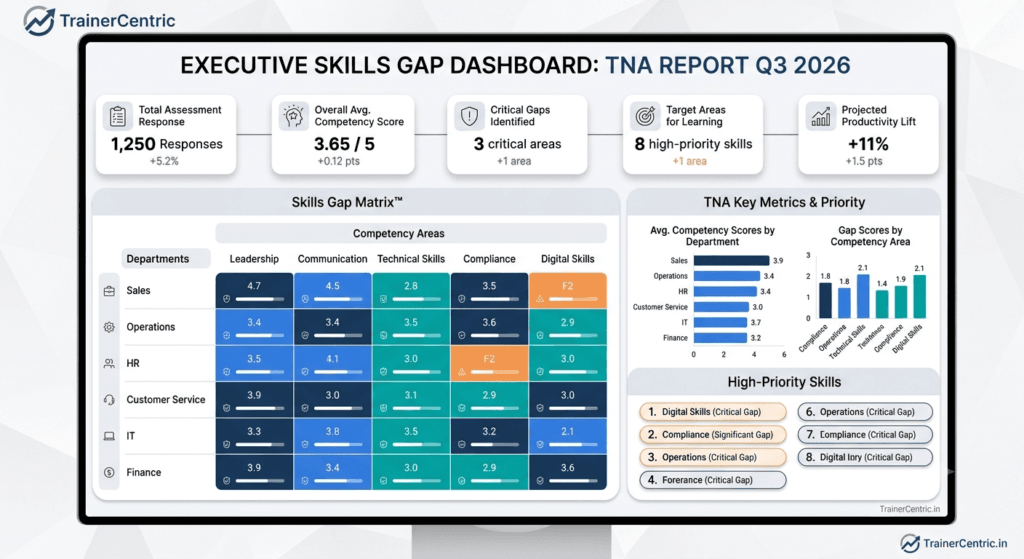
| Role | Skill | Required Level (1–5) | Avg Self-Rating | Avg Manager Rating | Gap Score | Priority |
| Store Associate | Complaint Resolution | 4 | 2.3 | 2.1 | 1.8 | High |
| Store Associate | Product Knowledge | 4 | 3.6 | 3.4 | 0.5 | Low |
| Team Lead | Delegation | 4 | 2.8 | 2.5 | 1.4 | Medium |
Gap Score = Required Level minus the average of self- and manager ratings. Sort descending, then weight by business impact to get your final priority order — this is the mechanical core of the priority matrix described above.
Internal Resource: Skills Gap Analysis vs Training Needs Analysis:Understanding the Difference
👉 Skip the spreadsheet setup — the toolkit includes this matrix pre-built with auto-calculating gap scores and priority flags.
Common Mistakes (and How to Avoid Them)
- Asking leading questions — have a colleague review every question for hidden assumptions.
- Including too many questions — cut anything that doesn’t map to a specific decision.
- Ignoring business objectives — anchor every section to a stated organizational goal.
- Poor segmentation — include role/department questions up front.
- No action after the survey — commit publicly to sharing findings before launch.
- Collecting data without stakeholders — review draft questions with managers before launch.
Mistakes HR Specifically Makes (Different from General Survey Mistakes)
- Treating the TNA questionnaire as an extension of the annual engagement survey, diluting both.
- Sending the same generic form to every department regardless of function.
- Skipping manager input entirely and relying only on self-report, which tends to inflate confidence ratings.
- Failing to align findings with workforce planning and succession data already sitting in HR systems.
- Running the survey, then taking six months to act — by which point trust in future surveys has eroded.
Before You Launch / After Survey Checklist
Before You Launch
- Objectives clearly defined and tied to a business outcome
- Questions reviewed for leading/biased language
- Pilot tested with 5–10 respondents
- Anonymity decisions made and communicated
- Branching logic tested end-to-end
- Distribution timeline avoids peak business periods
- Stakeholders briefed on purpose and next steps
After the Survey
- Response rate reviewed against target
- Quantitative data segmented by role/department/tenure
- Open-ended responses coded into themes
- Heat map and priority matrix built
- Findings shared back with participants
- Recommendations converted into a training plan and learning objectives
- Follow-up review scheduled (typically 3–6 months post-implementation)
👉 Want a printable version of both checklists? Please see Training Needs Analysis Checklist. If you need the complete TNA toolkit, you can download it from here: toolkit.
Composite Example Scenario: A 500-Person Retail Operation
This scenario is a composite, built from patterns commonly observed across multiple retail TNA engagements — not a single client case.
A regional retail company with roughly 500 employees across 40 stores faced rising customer complaints. Leadership initially assumed the answer was a company-wide customer service refresher.
Before committing budget, the team ran a Training Needs Analysis Questionnaire across store staff and managers, layered with the Performance Gap Pyramid: organizational goal (reduce resolution time), role requirement (policy application authority), person data (confidence ratings), and gap analysis.
- Findings: Only 22% of frontline staff reported confidence handling escalated complaints without manager involvement. Open-ended responses pointed to a specific cause: staff understood refund policy but felt they lacked authority to apply it independently — creating delays.
- Analysis: Cross-referencing survey data with complaint logs confirmed resolution time, not service attitude, was the real driver of dissatisfaction.
- Recommendation: A focused module on policy application and decision authority, paired with manager training on delegation — instead of a broad customer service course.
- Illustrative impact range: Organizations addressing this type of decision-authority gap typically report meaningful reductions in resolution time and improved satisfaction scores within one to two quarters, generally at a lower cost than a broad, undifferentiated training rollout.
This is the core argument for a proper needs analysis: the obvious answer and the correct answer are often different, and only the data can tell you which is which.
Best Practices
- Tie the questionnaire to a specific business objective.
- Pilot test before full launch, every time.
- Keep completion time under 12 minutes.
- Use branching logic to skip irrelevant sections.
- Guarantee and communicate anonymity where it matters.
- Mix quantitative and qualitative question types.
- Write for an eighth-grade reading level.
- Segment your sample for analysis by role, tenure, department.
- Involve managers in question design, not just distribution.
- Communicate why the survey is being run.
- Set a realistic response window — typically 7–10 days, one reminder.
- Avoid peak business periods.
- Use consistent scales throughout.
- Include at least one open-ended question per major section.
- Cross-reference survey data with performance metrics.
- Share a findings summary back to participants.
- Translate every finding into an actionable recommendation.
- Avoid over-surveying the same population repeatedly.
- Use demographic questions only where you’ll act on the segmentation.
- Treat the questionnaire as one input among several.
- Use templates to maintain consistency across cycles.
Conclusion
A Training Needs Analysis Questionnaire, used inside a structured framework, is the difference between training that changes performance and training that just looks good in a slide deck. We’ve given you the full methodology here — the Performance Gap Pyramid, 75 questions, the analysis workflow, and the checklists to run it properly.
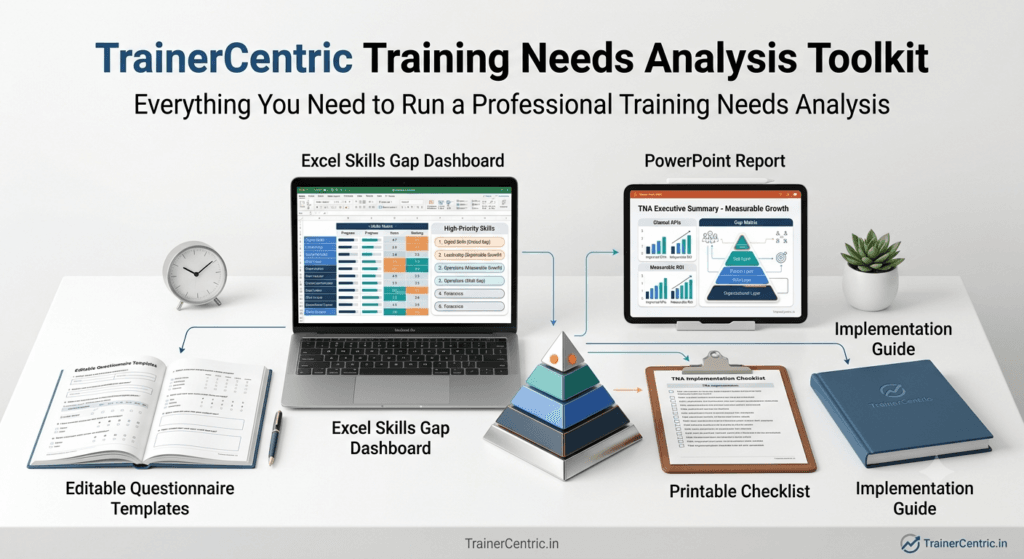
Where most teams lose time isn’t the thinking — it’s the building: formatting a branching questionnaire, setting up the scoring spreadsheet, designing the stakeholder-ready report. That’s exactly what the TrainerCentric Training Needs Analysis Toolkit is built to remove, with ready-made templates, the Excel analysis matrix, and presentation assets — so the methodology above takes days to implement instead of weeks.
Start with one well-designed questionnaire. The data it produces will change how your organization thinks about training.
Frequently Asked Questions
What is the purpose of a training needs questionnaire?
Its purpose is to identify the gap between current and required performance using structured, comparable data — so training decisions are based on evidence rather than assumption.
What questions should be included in a training needs analysis questionnaire?
A strong questionnaire covers business goals, current performance, skills, knowledge, behaviors, and learning preferences, with a mix of closed and open-ended questions. See the 75-question bank above for a ready-to-use set.
How long should a training needs questionnaire be?
Most effective questionnaires fall between 15 and 30 questions — long enough to be useful, short enough to complete in 8–12 minutes.
What is the difference between TNA and skills gap analysis?
A Training Needs Analysis is the broader diagnostic process, including data collection methods like questionnaires and interviews. A skills gap analysis is a specific output of that process — a comparison of required versus actual proficiency levels by role.
What is the difference between a survey and a questionnaire?
A questionnaire is the instrument. A survey is the broader activity of distributing it and analyzing responses.
Who should complete a training needs questionnaire?
Typically employees, their direct managers, and sometimes senior leadership, depending on scope.
Can Google Forms be used for a training needs questionnaire?
Yes, for smaller organizations or simpler needs. Larger projects requiring branching logic or advanced analytics often need dedicated survey or TNA software.
How do you analyze training needs questionnaire results?
Through quantitative analysis (averages, segmentation), qualitative theme analysis, heat maps, and an impact-versus-effort priority matrix.
How long should a training needs analysis take from start to finish?
For a mid-sized organization, four to eight weeks, covering design, pilot, distribution, analysis, and reporting.
Should training needs questionnaires be anonymous?
For sensitive sections — manager effectiveness, organizational barriers — yes.
How often should organizations run a training needs analysis?
Annually at minimum, with additional targeted analyses ahead of major changes.
What’s the difference between a Training Needs Analysis Form and a full Training Needs Assessment?
A form is a single instrument. A full assessment is the broader process, often combining forms, interviews, and document analysis.
Further Reading in Trainercentric
- Training Needs Analysis : Learn the complete process before designing your questionnaire.
- Job Task Analysis : Identify the tasks employees actually perform.
- Skills Gap Analysis : Turn questionnaire results into measurable skill gaps.
- Learning Measurement: Measure whether training solved the identified gap.
- Training ROI : Demonstrate business impact after implementation.
- Training Needs Analysis Template
- Competency Mapping vs Skills Gap Analysis
- Phillips ROI Model Explained: With Examples
- Learning Analytics for L&D Professionals:
References
- Analyzing Performance Problems — Robert F. Mager & Peter Pipe
- Telling Ain’t Training — Harold D. Stolovitch & Erica J. Keeps
- Evaluating Training Programs: The Four Levels — Donald L. Kirkpatrick & James D. Kirkpatrick
- Return on Investment in Training and Performance Improvement Programs — Jack J. Phillips
- Design for How People Learn — Julie Dirksen
- Map It: The Hands-On Guide to Strategic Training Design — Cathy Moore
(Some links may be Amazon affiliate links, which help support TrainerCentric at no additional cost to you.)
Additional Resources (Free Download)
Skills_Gap_Heat_Map
TNA_Scoring_Matrix
TNA_Project_Planner
Author Details

Tulip Ghosh is a Learning and Development professional who designs impactful, learner-centric experiences rooted in behavioral insight and real-world application. She is passionate about improving learner engagement and translating complex ideas into practical training solutions. A thoughtful writer at heart and with experience of a decade in Learning and Development domain, she brings a simple, grounded perspective to the evolving world of workplace learning. Reach out to her on her Linkedin Profile from here.