Introduction: The Real Reason Your Employees Forget Everything by Friday
Imagine this. A new cohort arrives for onboarding. Your trainer delivers a polished, 90-slide presentation. The room looks engaged. Participants take notes. The session ends on time.
One week later, their manager asks three of them to walk through the expense approval process — a topic that occupied an entire 40-minute module. Blank faces. Vague answers.
This is not a motivation problem. It is not an intelligence problem. It is a cognitive overload problem — and it is happening in training rooms and LMS platforms across every industry, every day.
The human brain does not passively absorb information. It processes it through a system with strict biological limits. When those limits are exceeded, content does not transfer to long-term memory — no matter how important it is or how clearly it is delivered.
This is precisely what Cognitive Load Theory explains. And once you understand it, you cannot unsee it in almost every piece of corporate training you have ever built or delivered.
What you will learn: The science behind why training fails. The three cognitive loads that control learning. Real workplace examples. How CLT connects to ADDIE, Bloom’s Taxonomy, and AI. And a practical toolkit you can apply tomorrow — including the TrainerCentric C.L.E.A.R. Audit Framework.
What Is Cognitive Load Theory? (The Plain-English Version)
Cognitive Load Theory is a framework for understanding how mental effort affects learning. In plain terms: your brain has a limited workspace. If you fill it beyond capacity, learning stops.
That is the whole theory. Everything else is detail about how to apply it.
The Academic Version
Cognitive Load Theory was developed by Australian educational psychologist John Sweller, first published in the journal Cognitive Science in 1988. Sweller was studying how students solved mathematics problems and noticed something counterintuitive: some teaching methods that seemed more helpful were actually making it harder for students to develop real understanding.
His insight was that working memory — the mental workspace where all active thinking happens — has a severely limited capacity. When instructional design places too many demands on that workspace simultaneously, the learner cannot process, organise, or retain the information.
Why It Matters More Than Any Other Learning Framework
There are dozens of instructional design models — ADDIE, SAM, Dick and Carey, Gagné’s Nine Events, Bloom’s Taxonomy, Merrill’s First Principles. All of them are valuable. But none of them tells you as directly as CLT why learning fails at the cognitive level, and what to do about it.
Bottom line: Cognitive Load Theory is the most directly actionable framework in learning science. It tells you exactly what is breaking your training and exactly how to fix it.
How Human Memory Works (And Why It Creates Hard Limits for Trainers)
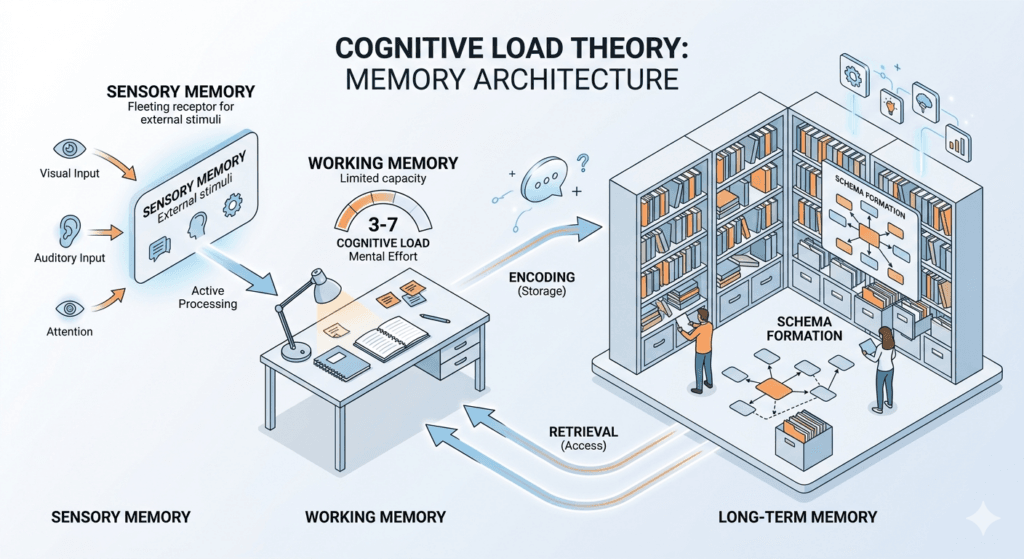
To apply CLT, you need to understand the two-stage model of memory it is built on. This takes three minutes to read and will change how you design training.
Working Memory: The Brain’s Desk
Working memory is where conscious thinking happens. When you follow a new process, hold instructions in your head, or try to understand an unfamiliar concept, you are using working memory.
It has two critical constraints that every trainer must know:
- Capacity limit: Working memory can hold approximately 4–7 discrete pieces of information at any one time (Miller, 1956; Cowan, 2001). More recent research suggests the effective limit may be closer to four.
- Duration limit: Information in working memory fades within 15–30 seconds unless it is actively rehearsed or connected to existing knowledge.
These are not weaknesses. They are features of a highly efficient cognitive system. The problem is that most corporate training is designed as if these limits do not exist.
Long-Term Memory: The Brain’s Library
Long-term memory has virtually unlimited capacity and can retain information for a lifetime. Everything you have genuinely learned — language, procedures, expertise — lives here.
The goal of all learning is to move information from working memory into long-term memory in a form that is retrievable and applicable. That is what good instructional design is fundamentally trying to do.
Schema Theory: How Learning Actually Happens
The bridge between working memory and long-term memory is schemas — mental structures that organise related information into connected, retrievable units.
Here is why schemas matter for training design:
- An experienced nurse hears ‘sepsis’ and immediately activates a rich schema covering symptoms, lab values, and interventions. What would overwhelm a student nurse’s working memory is handled almost automatically.
- A junior analyst stares at a financial model for 20 minutes trying to understand it. A senior analyst reads the same model in two minutes. The difference is not intelligence — it is the depth of their existing schemas.
| Working Memory | Long-Term Memory | |
| Capacity | Very limited (4–7 items) | Essentially unlimited |
| Duration | 15–30 seconds without rehearsal | Potentially lifelong |
| Function | Active processing and thinking | Storage and retrieval |
| Overload risk | High — the primary design constraint | Low |
| Design implication | Limit new elements per unit of instruction | Build through practice, retrieval, and spacing |
Bottom line: Every instructional design decision you make is either adding to or subtracting from your learners’ available working memory. There is no neutral choice.
The Three Types of Cognitive Load (With Workplace Examples)
CLT identifies three distinct types of cognitive load that compete for working memory. Understanding all three is non-negotiable for anyone designing training.
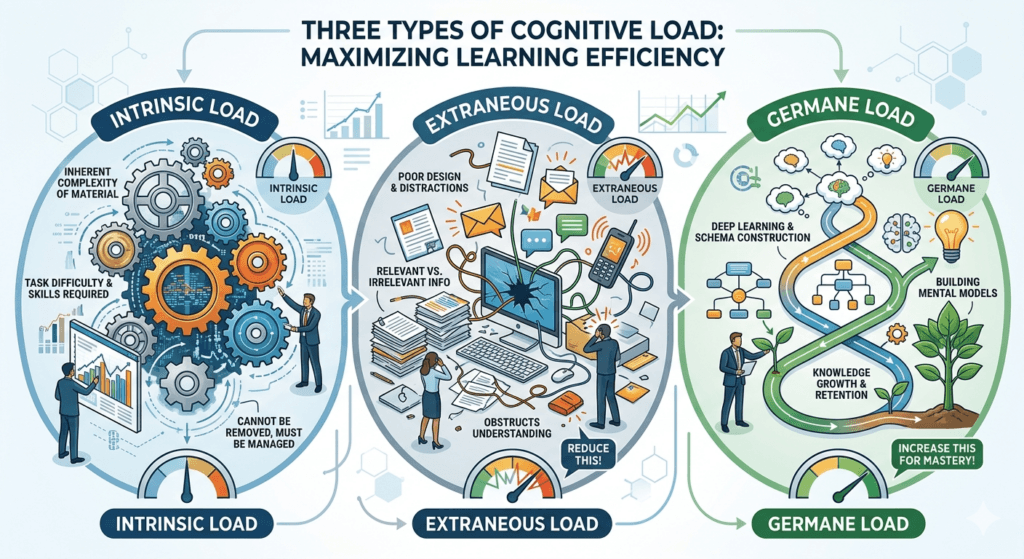
Type 1: Intrinsic Cognitive Load — The Complexity of the Content Itself
Intrinsic load comes from the subject matter. It is determined by the number of interacting elements a learner must process simultaneously to understand a concept.
Some content has low intrinsic load — each element can be learned independently (memorising a list of keyboard shortcuts). Other content has high intrinsic load — elements must be understood in relation to each other to make sense (understanding how GDPR’s consent requirements interact with marketing automation and cross-border data transfers).
You cannot eliminate intrinsic load — it is a property of the content. But you can manage it through sequencing, scaffolding, and progressive complexity.
Intrinsic Load Workplace Examples: Low = one data privacy regulation with three clear rules. High = how GDPR, CCPA, and PECR interact across a multinational marketing operation. Low = logging a lead in a CRM. High = configuring API integrations between enterprise systems.
Type 2: Extraneous Cognitive Load — The Load You’re Causing
Extraneous load is entirely within your control. It is the cognitive effort caused by poor instructional design — effort that consumes working memory without contributing anything to learning.
It does not come from the content. It comes from how you present the content.
Extraneous cognitive load is the single biggest reason corporate training fails. And it is 100% the designer’s responsibility.
Common sources of extraneous load:
- Cluttered slides with more than 40 words, multiple images, animations, and logos competing for attention
- Narration that reads on-screen text word for word (the most common eLearning mistake in existence)
- Irrelevant graphics that add visual noise without adding meaning
- Confusing LMS navigation that forces learners to figure out how to proceed
- Long, unbroken paragraphs in training materials
- Inconsistent terminology — calling the same thing by three different names
Type 3: Germane Cognitive Load — The Good Kind
Germane load is the productive cognitive effort dedicated to building and automating schemas — the mental work that results in actual learning.
Your design goal: reduce intrinsic and extraneous load so that maximum working memory capacity is available for germane load. The more cognitive resources a learner can dedicate to making sense of content and connecting it to what they know, the more they learn.
| TrainerCentric Insight: The practical question to ask about every element in your training is this: does this help learners process and understand, or does it just take up space in their brain? If it is the latter, remove it. |
| Intrinsic Load | Extraneous Load | Germane Load | |
| Source | Complexity of content itself | Poor instructional design | Schema construction effort |
| Controllable? | Partially — manage it | Yes — eliminate it | Yes — maximise it |
| Effect on learning | Neutral when managed well | Always harmful | Always beneficial |
| Designer’s goal | Scaffold and sequence | Simplify and strip out | Add practice and reflection |
| Workplace example | Learning ERP system logic | Cluttered LMS interface | Practising real scenarios |
Bottom line: One type of load is your enemy. One is unavoidable. One is the goal. Your job is to design instruction that eliminates the first, manages the second, and maximises the third.
Cognitive Load Theory in Real Workplace Training Examples
This is where the theory becomes practical. Here are five of the most common corporate training scenarios — and exactly how cognitive load theory explains what is going wrong and how to fix it.
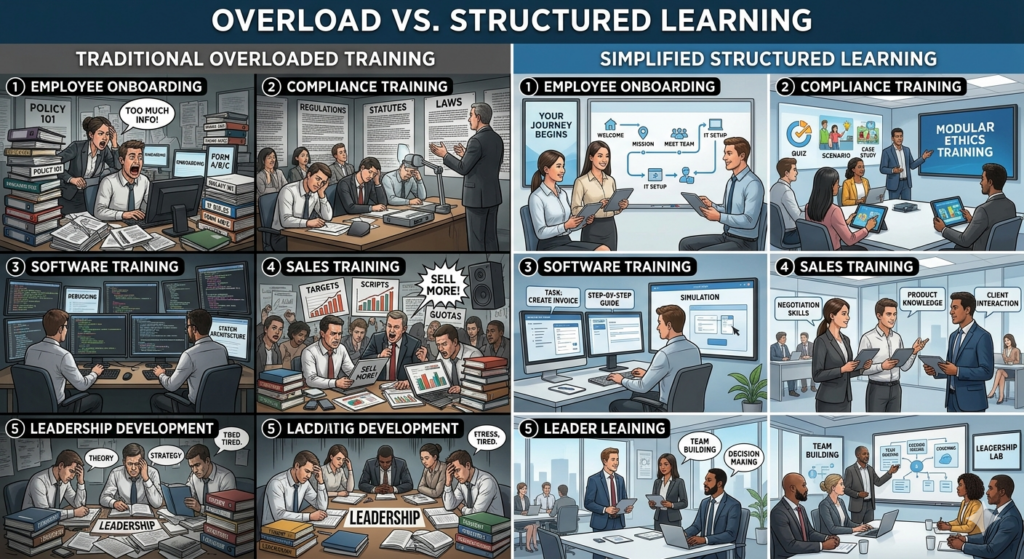
Example 1: Employee Onboarding
The overload problem: A new starter’s first week covers company history, values, HR policies, IT systems, health and safety, benefits, performance processes, and their specific role — all delivered via a combination of presentations, reading packs, and introductions. By 3pm on Day 1, nothing is sticking.
Why it fails: New starters have virtually no existing schemas for the organisation. Every piece of information is genuinely new, creating extremely high intrinsic load. Stack that with dense slides and speaker-switching extraneous load, and you have a working memory catastrophe.
The CLT fix: Redesign using spaced learning across the first 90 days. Deliver only what employees need in the first 48 hours (safety, key contacts, core process). Introduce everything else progressively as schemas develop. Use job aids instead of expecting memorisation.
Example 2: Compliance Training
The overload problem: An annual compliance refresher covers 14 regulatory areas in a 3-hour eLearning module. Each section has lengthy policy text, scenarios, and a quiz. A narrator reads every slide aloud.
Why it fails: The Redundancy Effect (reading on-screen text aloud) creates extraneous load from the first minute. The volume of content across 14 areas overwhelms intrinsic load. There is no scaffolding from simple to complex.
The CLT fix: Break into short microlearning units — one per regulatory area — distributed throughout the year. Use scenarios that contextualise the regulation in realistic workplace situations. Replace narration that duplicates text with audio that elaborates and explains.
Example 3: Software Training
The overload problem: A new CRM is rolling out. Training is a 3-hour instructor-led session covering every feature, followed by a reference manual. Employees are expected to use the live system tomorrow morning.
Why it fails: Software systems have very high element interactivity — meaning dozens of features must be understood in relation to each other. Teaching all of them simultaneously, without established schemas for the system’s underlying logic, is a guaranteed overload.
The CLT fix: Apply progressive complexity. Week 1: teach only the three daily processes (log a lead, update a contact, record a call). Week 2: introduce pipeline management. Week 3: reporting. Provide laminated quick-reference cards for less frequent tasks.
Example 4: Sales Training
The overload problem: A two-day bootcamp covers product knowledge, pricing, objection handling, consultative selling methodology, CRM process, pipeline management, and competitive positioning — with role plays woven throughout.
Why it fails: Each domain has its own high intrinsic load. Asking new salespeople to apply product knowledge AND consultative methodology simultaneously in a role play, before either has been consolidated, is cognitively catastrophic.
The CLT fix: Separate product training from methodology training and sequence carefully. Use worked examples — recorded model conversations — before role play. Build in spaced practice over weeks. Use conversation frameworks as job aids rather than expecting recall under pressure.
Example 5: Leadership Development
The overload problem: A one-day leadership workshop covers emotional intelligence, situational leadership, giving feedback, coaching, and managing performance — all in eight hours.
Why it fails: Leadership content requires both cognitive processing (understanding frameworks) and affective processing (self-reflection and attitude shift). Attempting both simultaneously across five distinct topics in a single day overwhelms working memory before any of it can be consolidated.
The CLT fix: Redesign as a multi-month blended programme. Each capability gets its own focused module with pre-work, a focused workshop, on-the-job practice, and peer reflection. This mirrors Kolb’s Learning Cycle — experience, reflection, conceptualisation, and experimentation cannot be compressed into a single day.
Real-World Case Study — Redesigning an Overloaded Compliance Programme
Theory is convincing. Results are more convincing. Here is a real programme redesign from our client work at TrainerCentric — details anonymised, with metrics drawn from post-training measurement across two assessment cycles.
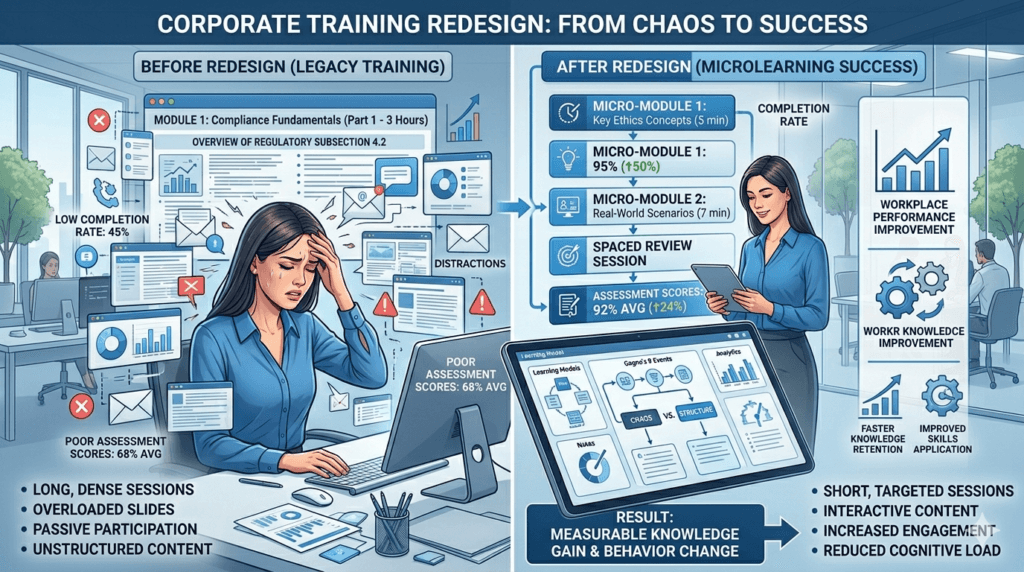
The Original Programme (Before)
- Format: Single 3-hour eLearning module covering 14 compliance areas
- Slide count: 62 slides, averaging roughly 180 words per slide
- Delivery: Full narration reading on-screen text verbatim — a textbook Redundancy Effect
- Assessment: 20-question multiple choice quiz at the end of the module only
- Average assessment score: 58%
- Completion rate: 61% — more than a third abandoned before finishing
- Manager-reported transfer: Low — policy errors continued at similar rates three months post-training
A cognitive load audit of this programme revealed three problems working together:
- Extraneous load: High throughout. The redundancy effect (narration duplicating on-screen text) consumed working memory resources before learners had processed a single concept. Cluttered slide design compounded this.
- Intrinsic load: Unmanaged. All 14 regulatory areas were delivered at a uniform complexity level — no progression from simple to complex, no sequencing that built on prior knowledge.
- Germane load: Minimal. No retrieval practice, no reflection activities, no scenario-based application. Content was presented but never worked with.
The Redesigned Programme (After)
- Format: 14 standalone microlearning modules of 8–12 minutes each, deployed monthly throughout the year
- Design: Each module centred on a single regulation, framed around a realistic workplace scenario relevant to the learner’s role
- Narration: Replaced redundant narration with explanatory audio that elaborated on visuals — not repeated what learners could already read
- Practice: Three retrieval practice questions per module, distributed throughout rather than grouped at the end
- Job aids: Each module concluded with a one-page summary card for that regulation
- Spaced repetition: Brief quarterly review questions revisiting content from earlier in the year
The Measured Results
| Metric | Before | After | Change |
| Average assessment score | 58% | 81% | +23 percentage points |
| Module completion rate | 61% | 94% | +33 percentage points |
| Average time to complete | 187 minutes | 96 minutes total | 49% reduction |
| Manager-reported transfer | Low | Moderate–High | Qualitative improvement |
| Policy error incidents (6 months) | Baseline | Reduced by ~40% | Estimated from incident logs |
| TrainerCentric Insight: The most meaningful outcome was not the assessment score improvement — it was the reduction in actual policy errors. Assessment scores measure learning under test conditions. Behaviour change in the workplace measures whether training actually worked. That gap is where most compliance programmes fail. This redesign closed it. |
Bottom line: Applying CLT principles did not just improve scores. It reduced total training time by nearly half while producing significantly better outcomes. Less time, better results. That is what good instructional design looks like.
Signs of Cognitive Overload in Your Training
One of the most useful skills a trainer can develop is recognising cognitive overload before it becomes a retention problem. These signs are observable during delivery — if you know what to look for.
- Learners ask the same questions repeatedly, even after you have answered them — a clear sign that information is not consolidating into long-term memory
- Participants seem engaged during training but score poorly on post-training assessments or on-the-job tasks
- Learners become visibly confused during exercises that should follow logically from what was just taught
- Participants disengage — checking phones, losing eye contact — midway through content-heavy sections
- Training fatigue is visible: learners make uncharacteristic errors as the session progresses
- Low transfer to the workplace: managers report employees cannot apply trained content despite passing assessments
- Learners describe the training as ‘overwhelming’ or ‘too much information’ — even when the content seems simple to you
- High eLearning dropout rates — learners abandoning modules before completion
- Systematic errors in practice exercises suggesting misunderstanding, not simple mistakes
If you observe three or more of these signs consistently, your training almost certainly has a cognitive load problem. The solution is not to repeat the content more slowly. It is to redesign the instructional approach.
How to Apply Cognitive Load Theory in Instructional Design
Here are the ten most effective CLT-based instructional strategies, with practical workplace examples for each.
1. Chunking
What it is: Grouping related pieces of information into discrete, meaningful units.
Why it works: Reducing the number of discrete elements working memory must hold simultaneously. Well-chunked content supports faster schema construction.Workplace example: Instead of 20 individual steps in a software process, group them into four phases: Preparation, Data Entry, Review, and Submission. Four chunks instead of 20 elements.
2. Sequencing — Simple to Complex
What it is: Ordering content deliberately so that simpler, foundational concepts precede more complex ones.
Why it works: Learners build the schemas they need to process advanced content before they encounter it. Without proper sequencing, they attempt to understand complex material without the cognitive scaffolding to support it.
Workplace example: In financial analysis training, teach P&L structure before ratio interpretation, and ratios before financial modelling. Each layer builds on established schemas.
3. Scaffolding and Fading
What it is: Providing temporary support structures that help learners handle tasks that exceed their current capability — then gradually removing those supports as competence grows.
Workplace example: Give new call centre agents a structured call framework as a reference card during early calls. Remove the card gradually over four weeks as the structure becomes internalised.
4. Worked Examples
What it is: Presenting complete, step-by-step examples of solved problems or demonstrated tasks before asking learners to attempt similar tasks independently.
Why it works: The Worked Example Effect is one of the most robustly replicated findings in CLT research. Studying a worked example allows learners to observe the structure and logic of a solution without the cognitive cost of generating it themselves.
Workplace example: In negotiation training, show a full recorded example of an experienced negotiator handling a price objection before asking trainees to practise the same scenario.
5. Progressive Complexity
What it is: Deliberately increasing task difficulty over time, matched to the learner’s developing schemas.
Workplace example: In project management training, begin with a simple two-phase project, three stakeholders. Progressively introduce multi-phase projects, competing priorities, resource constraints — one complexity layer at a time.
6. Retrieval Practice
What it is: Requiring learners to actively recall information from memory rather than passively reviewing it.
Why it works: The Testing Effect — one of the most reliable findings in cognitive science — shows that the act of retrieval strengthens memory traces more effectively than re-reading or reviewing. Roediger and Karpicke’s 2006 research demonstrated this conclusively.
Workplace example: End every training session with a retrieval exercise — ‘Write down the three most important things you learned today without looking at your notes’ — rather than a summary review.
7. Spaced Learning
What it is: Distributing practice and review across multiple sessions over time, rather than massing it all into a single event.
Why it works: The Spacing Effect — one of the oldest and most reliable findings in memory research — shows that distributed practice produces dramatically better long-term retention than massed practice.
Workplace example: Replace a one-day annual compliance event with monthly 15-minute microlearning modules. Not only does this produce better retention — it is also significantly easier to maintain engagement with shorter, more frequent touchpoints.
8. Microlearning
What it is: Delivering content in short, focused units — typically 3–10 minutes — addressing a single, specific learning objective.
Workplace example: A five-minute video teaching one specific Excel function, with a short practice exercise, is more effective than a two-hour ‘Excel for Business’ workshop covering 30 functions in rapid succession.
9. Job Aids and Performance Support
What it is: External tools — checklists, decision trees, reference cards, embedded help systems — that provide information at the moment of need rather than requiring recall from memory.
Why it works: Job aids offload cognitive demand from working memory to an external system, freeing mental resources for the aspects of a task requiring genuine judgment and expertise.
Workplace example: A medication checklist on a nurse’s trolley. A call guide on a contact centre agent’s screen. A process card on a factory floor. All of these reduce working memory load and reduce errors. They are not a substitute for training — they are an intelligent extension of it.
10. Activating Prior Knowledge
What it is: Beginning every learning module by explicitly connecting new content to existing knowledge and experience.
Why it works: Prior knowledge dramatically reduces intrinsic load by providing cognitive anchors for new information. This is foundational to both Adult Learning Theory (Andragogy) and schema theory.
Workplace example: Before introducing a new change management framework, ask participants: ‘Think of a time you successfully navigated a significant change at work. What made it work?’ This activates existing schemas that new content can connect to.
10 Ways to Reduce Cognitive Load in Employee Training — Right Now
These are immediate, actionable changes. You can apply most of them in your next training design or review session.
- Remove unnecessary content. Audit every module and ask: does this directly support a learning objective that drives performance? If not, delete it.
- Cut the text on every slide. Replace walls of text with a single key statement supported by your verbal commentary or a visual.
- Use signalling. Visually highlight what matters — through bold text, colour, arrows, and headings — so learners do not expend cognitive effort searching for the key point.
- One concept per screen or slide. Resist the urge to group multiple concepts on a single slide. Each new concept should be introduced, illustrated, and explained before the next appears.
- Break long modules into shorter segments. A 90-minute eLearning module should almost always be broken into six 15-minute modules. Cognitive depletion compounds over time.
- Use explanatory visuals, not decorative ones. Diagrams, process flows, and annotated screenshots reduce cognitive load by externalising information.
- Eliminate the redundancy effect. If a narrator is reading exactly what appears on screen — fix it today. Use narration to explain and expand on visuals, not to repeat what learners can read themselves.
- Lead with worked examples before practice. Worked example first, partially completed example second, independent practice third.
- Activate prior knowledge at the start of every session. Ask a question that connects new content to existing experience. This is cognitively essential.
- Provide job aids for infrequent but important information. Identify what learners will need occasionally and give it to them as a tool rather than expecting recall under pressure.
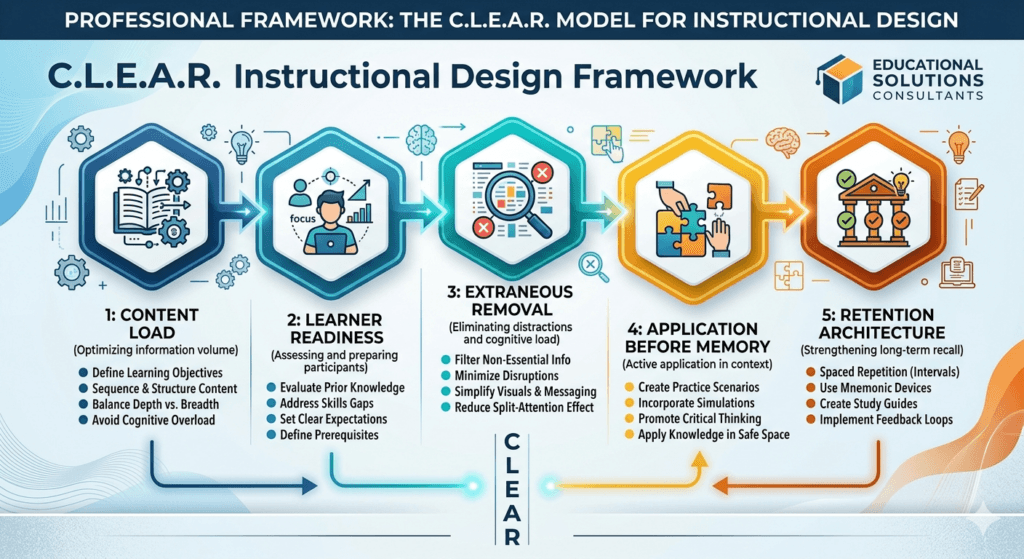
The TrainerCentric C.L.E.A.R. Framework — A Cognitive Load Audit
Before you publish any training programme, run it through the C.L.E.A.R. Audit. This is the TrainerCentric framework for identifying and resolving cognitive load problems before learners encounter them.
C.L.E.A.R. stands for: Content Load, Learner Readiness, Extraneous Removal, Application Before Instruction, Retention Architecture.
| Letter | Stage | Key Questions |
| C | Content Load | Have you assessed the intrinsic complexity? Sequenced from simple to complex? Limited each unit to one primary objective? |
| L | Learner Readiness | Have you identified what schemas learners already have? Differentiated for novice vs experienced learners? Accounted for the Expertise Reversal Effect? |
| E | Extraneous Removal | Have you audited every screen for unnecessary text or images? Eliminated the Redundancy Effect? Checked for split-attention issues? |
| A | Application Before Memory | Have you provided worked examples before practice? Included retrieval practice — not just review? Provided job aids for reference information? |
| R | Retention Architecture | Have you used spaced learning rather than a single event? Built in retrieval practice throughout? Included a follow-up plan beyond the training day? |
| TrainerCentric Insight: We use the C.L.E.A.R. Audit on every training programme before it goes live. The most common audit failure — by a large margin — is the Extraneous Removal step. Instructional designers are trained to create content. Removing content feels counterproductive. But it is often the single most learning-enhancing thing you can do. |
Use the C.L.E.A.R. Framework as a pre-publication checklist, a peer review tool, or a stakeholder communication framework. When a client asks why you are removing content, ‘because the C.L.E.A.R. Audit identified extraneous load’ is a stronger answer than ‘because I think it is too long.’
Cognitive Load Theory and eLearning — Where Most Organisations Get It Wrong
eLearning presents a uniquely high-risk environment for cognitive overload. The combination of screen-based delivery, self-paced navigation, and the temptation to pack maximum content into minimum time creates conditions that violate nearly every CLT principle.
The Six Most Common eLearning Cognitive Load Mistakes
- Narration that reads on-screen text verbatim — the Redundancy Effect in its most common digital form
- Long, text-heavy modules with no chunking or learner-controlled navigation
- Background music competing with narration for auditory working memory
- Decorative animations and transitions that consume visual processing resources
- Complex, inconsistent LMS navigation that forces learners to think about how to proceed
- No retrieval practice — content is presented but never tested in ways requiring active recall
Mayer’s Multimedia Principles and CLT
Richard Mayer’s Cognitive Theory of Multimedia Learning provides specific design principles that align directly with CLT. The most important for eLearning designers:
- Coherence Principle: Exclude extraneous material — words, images, sounds — that does not support the learning objective
- Redundancy Principle: Explain graphics with audio alone, not with both narration and on-screen text simultaneously
- Segmenting Principle: Break lessons into learner-paced segments rather than continuous streams
- Modality Principle: Use audio narration alongside visuals rather than text — the two channels process independently
- Spatial Contiguity Principle: Place labels and related text directly on or next to the graphic they describe
Mobile Learning
Mobile adds additional cognitive load challenges: small screens intensify split-attention effects, and learners are often in distracting environments. For mobile: single-column layouts, audio-led design, one objective per module, and assume distracted learners who may be interrupted at any moment.
The Six Key Cognitive Load Effects Every Trainer Should Know
CLT research has identified a set of specific, reproducible ‘effects’ — findings about how particular design choices affect learning. These are the effects that appear most frequently in workplace training contexts.
1. The Split-Attention Effect
When learners must process two related information sources that cannot be understood independently — a diagram and its separate text key — the need to mentally integrate them creates unnecessary extraneous load. Solution: integrate labels directly on the diagram.
Workplace example: A training manual shows a system architecture diagram on page 12 and the explanatory text on page 13. Integrate the labels directly on the diagram and eliminate the split-attention effect entirely.
2. The Redundancy Effect
Presenting the same information in multiple formats simultaneously creates cognitive interference, not reinforcement. The most common version: a narrator reading every word on screen. Remove either the text or the narration, or redesign so audio adds to rather than repeats the visual.
3. The Modality Effect
Audio narration alongside visuals produces better outcomes than text alongside the same visuals — because audio and visual information are processed by different cognitive channels, allowing simultaneous processing without competition.
Workplace example: When demonstrating a software process, use a screencast with audio commentary rather than a screencast with text captions. Visual channel handles the screen activity; auditory channel handles the explanation.
4. The Worked Example Effect
Novices learn more effectively from studying worked examples than from solving equivalent problems independently. This is one of the most replicated effects in CLT research — demonstrated across mathematics, medicine, law, writing, and professional training.
5. The Expertise Reversal Effect
Instructional approaches that benefit novices can harm experts. Scaffolding and step-by-step guidance reduce load for novices — but become redundant extraneous load for experts who already have the schemas. Differentiate your design based on learner experience level.
6. The Goal-Free Effect
When learners are given specific goals in problem-solving tasks, they use means-end analysis — a strategy that consumes working memory without building transferable schemas. Goal-free problems (‘calculate as many values as possible’) can produce deeper learning than specific-goal problems (‘solve for X’).
Workplace example: Rather than asking trainees to identify the single best course of action in a case study, ask them to list all relevant considerations. This explores the problem space more broadly and builds richer schemas.
| TrainerCentric Insight: The Expertise Reversal Effect is the most frequently ignored CLT finding in corporate training. We regularly see experienced professionals sitting through the same heavily scaffolded training as new joiners — growing increasingly frustrated and disengaged. The solution is not better content. It is differentiated design. |
Cognitive Load Theory vs Other Frameworks
CLT vs Constructivism
Constructivism — from Piaget, Vygotsky, and discovery-learning approaches — proposes that learners construct knowledge through direct experience and exploration. CLT researchers, in a landmark 2006 paper by Kirschner, Sweller, and Clark, argued that minimally guided approaches impose excessive cognitive load on novice learners. Constructivists responded that overly guided instruction produces shallow, inert knowledge.
| Dimension | Cognitive Load Theory | Constructivism |
| View of learner | Cognitive limits must be respected | Active knowledge constructor |
| Role of guidance | High guidance for novices is essential | Minimal guidance enables discovery |
| Risk | Over-scaffolding limits higher-order thinking | Under-scaffolding overwhelms working memory |
| Best for | Novice learners, complex procedural skills | Learners with prior knowledge, open-ended problems |
| Corporate training fit | Excellent for skills and knowledge transfer | Valuable for leadership and creative problem-solving |
The practical answer: use explicit instruction and worked examples to build foundational schemas (CLT), then introduce progressively more open-ended challenges (constructivism). Good SAM and ADDIE design already embeds this sequence.
CLT vs Multimedia Learning Theory
Richard Mayer’s Cognitive Theory of Multimedia Learning is the framework most closely aligned with CLT. Both are grounded in dual-channel, limited-capacity working memory. The key difference: CLT covers all instructional contexts; CTML focuses specifically on multimedia environments.
| Dimension | Cognitive Load Theory (Sweller) | Multimedia Learning Theory (Mayer) |
| Primary focus | Working memory capacity limits | Dual-channel word/picture processing |
| Scope | All instructional contexts | Primarily multimedia and eLearning |
| Key output | Load management strategies | 12 Principles of Multimedia Design |
| Best used | As theoretical framework | As eLearning design checklist |
Use CLT as your theoretical framework for understanding why design choices matter. Use Mayer’s 12 principles as your operational checklist for specific eLearning design decisions. They are not competing frameworks — they are complementary layers.
CLT vs ADDIE — Understanding the Difference
This is one of the most common questions from designers working with both frameworks — and it has a clear answer: ADDIE and CLT are not in competition. They operate at different levels.
| Dimension | ADDIE | Cognitive Load Theory |
| What it is | A process model — how to build training | A learning science framework — how the brain learns |
| Primary function | Guides the instructional design process from Analysis to Evaluation | Explains why certain design decisions cause learning failure |
| Output | A structured workflow and deliverable | Design principles and cognitive constraints |
| Answers the question… | How do I build this training programme? | How do I ensure learners can actually process this? |
| Used together | ADDIE structures your process | CLT informs your design decisions inside that process |
Think of it this way: ADDIE tells you when to design instruction — during the Design phase. CLT tells you how to design it well. A programme built on ADDIE that ignores CLT produces beautifully structured training that overwhelms learners. A programme built on CLT principles without a process framework can become unstructured and inconsistent.
The strongest instructional designers use ADDIE as their process scaffold and CLT as their cognitive quality filter. If you are using ADDIE and want to understand how to make each phase more effective for learner cognition, the ADDIE model guide at TrainerCentric.in walks through exactly how CLT principles apply at each stage.
CLT vs Bloom’s Taxonomy — Different Tools, Same Goal
Bloom’s Taxonomy and Cognitive Load Theory are both concerned with how learners engage with content — but they address different dimensions of that engagement.
| Dimension | Bloom’s Taxonomy | Cognitive Load Theory |
| What it describes | Levels of cognitive complexity in learning objectives | The cognitive cost of processing instruction |
| Primary use | Writing learning objectives and assessment design | Designing instruction and managing working memory |
| Focus | What the learner is expected to do cognitively | How the instructional design affects cognitive capacity |
| Limitation | Does not account for working memory constraints | Does not classify types of cognitive demand by level |
| Used together | Bloom’s sets the cognitive target; CLT ensures the path to it doesn’t overwhelm |
Here is why this connection matters in practice: a learning objective written at Bloom’s Analysis level (‘The learner will be able to diagnose the root cause of equipment failures’) places very high intrinsic cognitive load on a novice learner. Bloom’s tells you what the objective is. CLT tells you that reaching that objective requires careful scaffolding — you cannot jump to Analysis-level tasks without building the foundational schemas first.
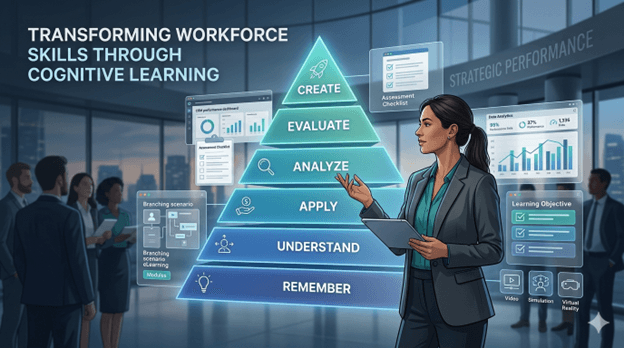
The two frameworks work together: Bloom’s Taxonomy guides where you want learners to end up. CLT guides how you sequence the journey to get there. If you are already working with Bloom’s and want to strengthen your learning objective writing, our guide to Bloom’s Taxonomy at TrainerCentric.in covers the practical integration in detail.
Common Misconceptions About Cognitive Load Theory
Misconception 1: Less Information Always Means Better Learning
The theory does not say give learners less information. It says design instruction so working memory is not overwhelmed. A well-sequenced, well-scaffolded programme can successfully teach genuinely complex content. The issue is design, not quantity.
Misconception 2: CLT Only Applies to eLearning
CLT applies equally to instructor-led training, classroom learning, coaching, job aids, and performance support. Cognitive load is a function of the human brain, not the delivery medium.
Misconception 3: Experts and Beginners Learn the Same Way
The Expertise Reversal Effect demonstrates definitively that they do not. What helps novices hurts experts, and vice versa. One-size-fits-all training always underserves part of the audience.
Misconception 4: Cognitive Load Equals Difficulty
A poorly designed instruction can create high extraneous load for trivially simple content. An excellent instructional sequence can make genuinely complex content accessible. Difficulty is a property of content. Cognitive load is a property of the interaction between content, design, and learner.
Limitations and Criticisms of Cognitive Load Theory
CLT is one of the most extensively researched frameworks in educational psychology. It is also not without legitimate criticism. Intellectual rigour requires acknowledging both.
Measurement Is Still Difficult
For much of its history, CLT relied on subjective self-report measures and indirect performance proxies. While physiological measures (pupil dilation, fMRI) have been explored, they remain impractical in applied training contexts. A 2021 systematic review by Leppink and Pelzer noted ongoing measurement challenges as a priority for future research.
The Germane Load Debate
Sweller and colleagues substantially revised the theory in 2011, reconceptualising germane load as a consequence of managing intrinsic and extraneous loads rather than a separate category. This revision has both strengthened the theory’s coherence and generated ongoing debate about whether the three-type model remains the most useful framework for practitioners.
Individual Differences
CLT’s core model assumes relatively uniform cognitive architecture. In practice, working memory capacity varies across individuals — influenced by age, fatigue, stress, anxiety, and prior sleep. A programme optimised for average working memory parameters may underserve learners at the extremes of capacity.
The Motivation Gap
CLT focuses on cognitive mechanisms and has relatively little to say about motivation, emotion, and engagement — factors that significantly influence whether learning occurs at all. The ARCS Model of Motivational Design (Attention, Relevance, Confidence, Satisfaction) addresses dimensions of learning that CLT leaves largely unexamined. Effective training design needs both.
Research Context
Much CLT research has been conducted in controlled settings with students learning mathematics. While the principles have been extended to professional contexts successfully, some researchers urge caution in direct application to the full complexity of organisational learning environments. Recent meta-analyses (Ginns, 2005; Adesope and Nesbit, 2012) support the generalisability of core effects but note context moderates outcomes.
| TrainerCentric Insight: The appropriate response to CLT’s limitations is not to abandon it — it remains the most evidence-based framework available for instructional design. The appropriate response is to apply it thoughtfully, alongside complementary frameworks, and with careful attention to your specific learners and context. |
AI and Cognitive Load — How Artificial Intelligence Can Help or Harm Learning
It is 2026. AI tools are now embedded in how organisations create, deliver, and personalise training. That creates both new opportunities to reduce cognitive load and new risks of increasing it. Understanding both sides is essential for modern instructional designers.

How AI Can Increase Cognitive Load
AI-generated content without instructional design quality control often violates CLT principles at scale:
- AI-generated content overload: AI tools can generate large volumes of text quickly — but volume is not the same as good instructional design. AI-generated modules often lack sequencing logic, scaffolding, and chunking. The result is extraneous load at scale.
- Information density without structure: Generative AI tends to produce comprehensive summaries rather than sequenced instruction. Comprehensiveness and learnability are not the same thing. A 2,000-word AI-generated overview of a complex process can impose higher cognitive load than a well-designed 400-word introduction.
- Personalisation without pedagogical logic: AI tools that adapt content based on user responses can still produce cognitively overloading sequences if they are optimising for engagement metrics rather than working memory management.
- Chatbot tutors without worked examples: Conversational AI tutors can answer questions well but often miss the core CLT principle of worked examples before practice. Learners may receive correct answers without the schema-building structure those answers need.
How AI Can Reduce Cognitive Load
Used thoughtfully, AI is genuinely powerful for CLT-aligned design:
- AI summarisation and chunking: AI tools can rapidly reduce a 30-page policy document to a structured, chunked sequence of key concepts — saving designers time and producing better-chunked instructional content than unedited source material.
- Adaptive learning pathways: AI-driven learning management systems can identify a learner’s existing schema depth and adjust the level of scaffolding accordingly — moving toward solutions for the Expertise Reversal Effect at scale.
- AI-generated job aids: AI can quickly produce first drafts of decision trees, reference cards, and process guides — offloading cognitive demand from working memory to an external tool, exactly as CLT recommends.
- Automated CLT auditing: Emerging AI tools can analyse slide decks and eLearning modules for word count per slide, redundancy between audio and text, and lack of retrieval practice — surfacing extraneous load issues before publication.
- Spaced repetition engines: AI-powered spaced repetition platforms deliver retrieval practice questions at optimally spaced intervals, implementing one of CLT’s most evidence-supported strategies at scale with minimal designer overhead.
The Design Principle for AI-Assisted Learning
The same question applies whether content is human-designed or AI-generated: does this help learners process and understand, or does it just take up space in their brain?
| TrainerCentric Insight: AI makes it faster to create more content. CLT reminds you that more content is not better learning. The instructional designer’s role in an AI-enabled L&D environment is to be the cognitive quality filter — ensuring AI-generated material is sequenced, scaffolded, and stripped of extraneous load before it reaches learners. |
Bottom line: AI tools that reduce extraneous load (summarisation, job aid creation, spaced repetition) are genuinely CLT-compatible. AI tools that generate unstructured volume without pedagogical logic can impose cognitive overload at unprecedented scale. The framework is your quality standard — apply it to AI output as rigorously as you apply it to human-authored content.
The TrainerCentric CLT Checklist for Instructional Designers
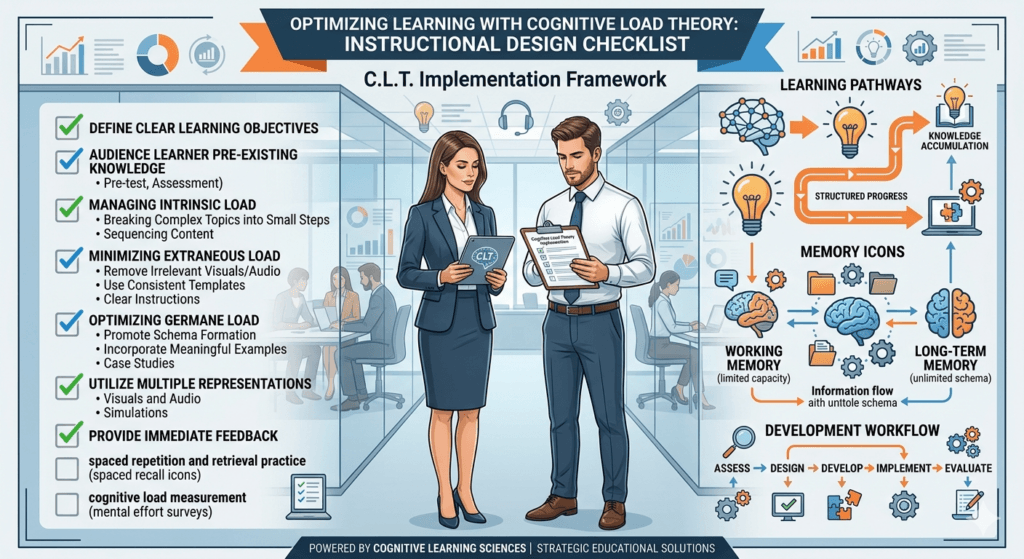
Print this. Share it with your team. Use it before every training programme goes live.
Run through all 28 checks before any training programme goes live. Any item marked ‘Needed’ is a cognitive load risk that should be addressed before publication. Share with SMEs and stakeholders to explain design decisions.
Download: The Cognitive Load Theory Toolkit
Everything you have read in this guide is actionable — but applying CLT consistently across a team or organisation requires practical tools, not just knowledge.
The TrainerCentric Cognitive Load Theory Toolkit includes three ready-to-use resources:
- C.L.E.A.R. Audit Template — the full five-phase audit in a fillable format you can run on any training programme before it goes live
- Cognitive Load Design Checklist — a condensed one-page reference card covering the 10 most critical CLT design decisions for your desk or screen
- Worked Example Worksheet — a structured template for building worked examples that match your learners’ experience level and scaffold toward independent practice
Conclusion: The Future of Training Is Cognitive Architecture Design
Every training programme you build is competing against a biological reality: working memory is limited, schema formation takes time, and the brain does not learn by being overwhelmed — it learns by being guided.
Great trainers do not win by cramming more information into a course. They win by making it easier for the brain to learn.
The shift from content delivery to cognitive architecture design is not a trend. It is the future of our profession. The organisations that understand this produce employees who can actually perform after training ends. The organisations that do not keep holding the same workshops and wondering why nothing changes.
John Sweller gave us the framework in 1988. Decades of research have refined and confirmed it. The tools are in your hands.
Use the C.L.E.A.R. Framework before you publish. Cut the extraneous load before the learner encounters it. Sequence for the brain you have, not the attention span you wish your learners had. Design for retention, not delivery.
Frequently Asked Questions
What is cognitive load theory in simple terms?
Your brain has a limited workspace for active thinking, called working memory. It can hold about 4–7 pieces of information at once. Cognitive Load Theory explains that when instruction places too many demands on that workspace simultaneously, learning breaks down. The theory gives you a framework for designing instruction that works within those limits.
What are the three types of cognitive load?
Intrinsic load (the inherent complexity of the content), extraneous load (unnecessary cognitive effort caused by poor instructional design), and germane load (the productive cognitive effort dedicated to schema construction and learning). Managing all three is the core practical application of CLT.
How can trainers reduce cognitive overload in employee training?
Key strategies: chunk content into manageable units, sequence from simple to complex, use worked examples before independent practice, eliminate redundant information (especially narration duplicating on-screen text), use audio narration alongside visuals, provide job aids for reference information, and distribute learning over time rather than massing it into single events.
What is the difference between intrinsic and extraneous load?
Intrinsic load comes from the content itself — understanding how GDPR interacts with marketing data across multiple jurisdictions is genuinely complex. Extraneous load comes from poor design — a narrator reading text that is already on screen, or cluttered slides that force the learner to search for the key point. The first cannot be eliminated; the second must be.
What is the Expertise Reversal Effect?
The finding that instructional approaches benefiting novice learners can actually impede more experienced learners. Scaffolding and worked examples reduce load for novices. For experts, the same guidance becomes redundant extraneous load. Training must be differentiated based on learners’ prior knowledge.
How does CLT connect to ADDIE?
ADDIE is a process model that tells you how to build training. CLT is a learning science framework that tells you how the brain learns. They operate at different levels and work together: ADDIE structures your design process; CLT informs the quality of your design decisions inside that process. A programme built on ADDIE that ignores CLT produces well-structured training that still overwhelms learners.
How does AI affect cognitive load in training?
AI can both reduce and increase cognitive load depending on how it is used. AI summarisation, job aid creation, and spaced repetition engines reduce extraneous load. AI-generated content without instructional design quality control can create cognitive overload at scale — producing high-volume, low-structure material that overwhelms working memory. Apply CLT as your quality filter for AI-generated content.
What is the C.L.E.A.R. Framework?
The TrainerCentric C.L.E.A.R. Framework is a practical pre-publication audit for instructional designers. C.L.E.A.R. stands for: Content Load, Learner Readiness, Extraneous Removal, Application Before Relying on Memory, and Retention Architecture. Run every training programme through the C.L.E.A.R. Audit before it goes live to identify and resolve cognitive load problems.
References
- Sweller, J. (1988). Cognitive load during problem solving: Effects on learning. Cognitive Science, 12(2), 257–285.
- Miller, G. A. (1956). The magical number seven, plus or minus two. Psychological Review, 63(2), 81–97.
- Cowan, N. (2001). The magical number 4 in short-term memory. Behavioral and Brain Sciences, 24(1), 87–114.
- Roediger, H. L., & Karpicke, J. D. (2006). Test-enhanced learning: Taking memory tests improves long-term retention. Psychological Science, 17(3), 249–255.
- Kirschner, P. A., Sweller, J., & Clark, R. E. (2006). Why minimal guidance during instruction does not work. Educational Psychologist, 41(2), 75–86.
- Mayer, R. E. (2009). Multimedia Learning (2nd ed.). Cambridge University Press.
Further Reading
- Bloom’s Taxonomy
- Instruction Designing Models
- ADDIE Model of Instructional Designing
- Successive Approximation Model (SAM): Complete Guide + 8 Free Templates
- Kolb’s Learning Cycle: Using Experiential Learning in the Workplace
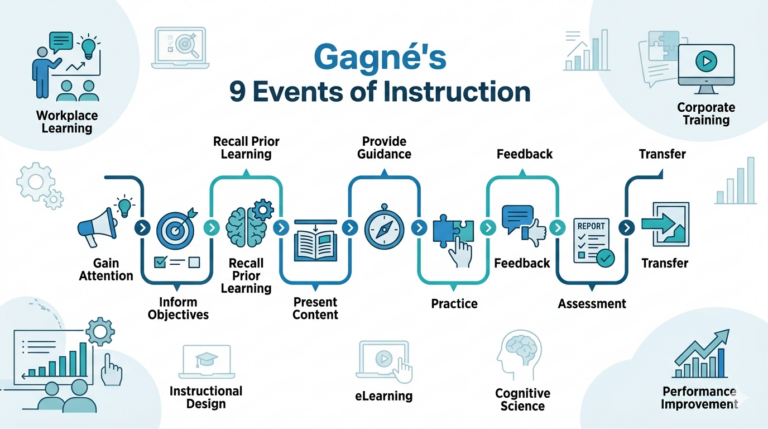
- Gagné’s 9 Events of Instruction: A Practical Guide for Trainers with Real Examples
- ADDIE vs SAM: Which Instructional Design Model Should You Use in 2026?
- ARCS Model of Motivation — The Complete Guide for Corporate Trainers [2026]
- Adult Learning Theory (Andragogy): Knowles’ 6 Principles Explained with Workplace Examples
- Kirkpatrick Model: How to Measure Training Effectiveness
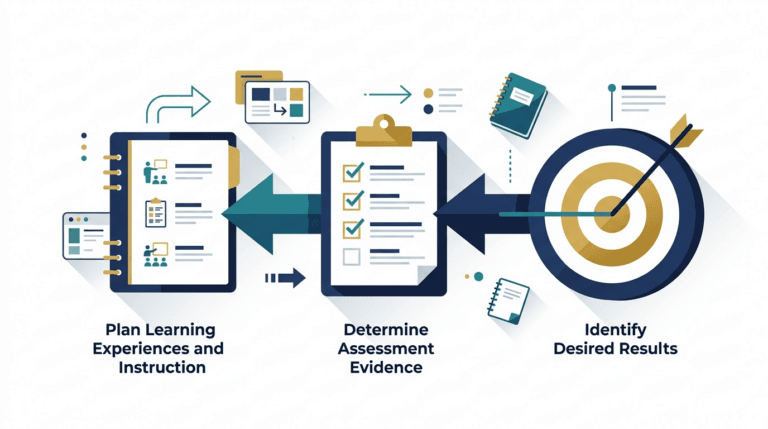
- Backward Design – The Complete Framework for Planning Learning
- Action Mapping: A Step-by-Step Guide with Examples
- Gamification vs Game-Based Learning: What’s the Difference
Author Details

Pankaj Nandi is a Technical Writer and Learning Content Specialist with experience creating complex technical and instructional content across software, technology, and enterprise environments. Having worked with organizations including Cisco, Rakuten India, and Newgen Software, he specializes in transforming complex concepts into clear, practical, and learner-friendly content. You can reach out to him at pankaj@trainercentric.in