Introduction – How to Handle Difficult Participants
Picture this. You are 45 minutes into a leadership session when one participant interrupts for the fourth time, publicly contradicts two of your points, and three others retreat into silence. The energy drops. You pivot to the next activity. It does not help.
Handling difficult participants in training is one of the most critical skills a corporate trainer can develop. Not because challenging participants in workshops are common — most people arrive with good intentions — but because when disruptive behaviour appears in training, it can derail an entire session within minutes. This guide gives every training facilitator working with difficult participants a proven framework, practical scripts, and activities to handle every type: classroom, virtual, hybrid, and corporate.

Quick Answer: How to Handle Difficult Participants in Training
Identify the root cause before you intervene
Difficult behaviour in training is almost always situational, not personal. Before acting, ask: is this resistance to the content, to the method, or to the training design itself? A facilitation problem and a participant problem require entirely different responses.
Address low-level disruption early and indirectly
A proximity move, a directed question, or a structured activity often resolves behaviour before it escalates. Waiting signals to the group that the behaviour is acceptable — and it will escalate.
Acknowledge the participant before redirecting
“That is a fair point — let me address it, then bring in a few other views.” Acknowledgement does not mean agreement. Participants who feel heard redirect. Participants who feel dismissed escalate.
Use private conversations for persistent patterns
Public correction rarely resolves recurring behaviour and frequently damages psychological safety for everyone watching. A 90-second conversation at a break achieves what ten in-the-moment interventions cannot.
Maintain psychological safety for the entire room
How you handle one person’s behaviour sends a message to every other participant. If you publicly embarrass someone, every other person in the room quietly decides to stop taking risks.
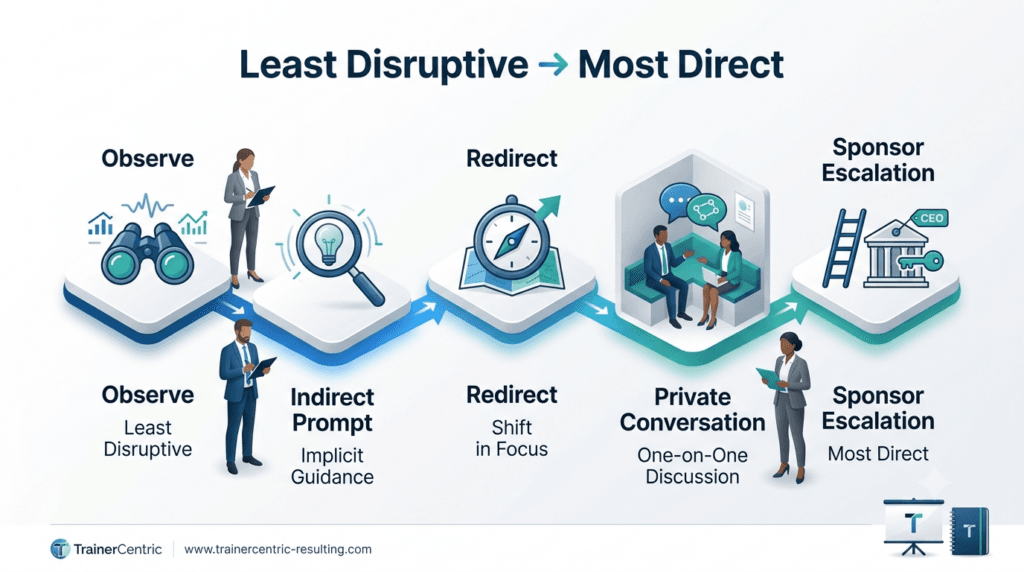
Escalate to the programme sponsor only as a last resort
Escalation belongs at the end of the response sequence — after root cause assessment, indirect intervention, and private conversation have all failed. It is not a reflexive first move.
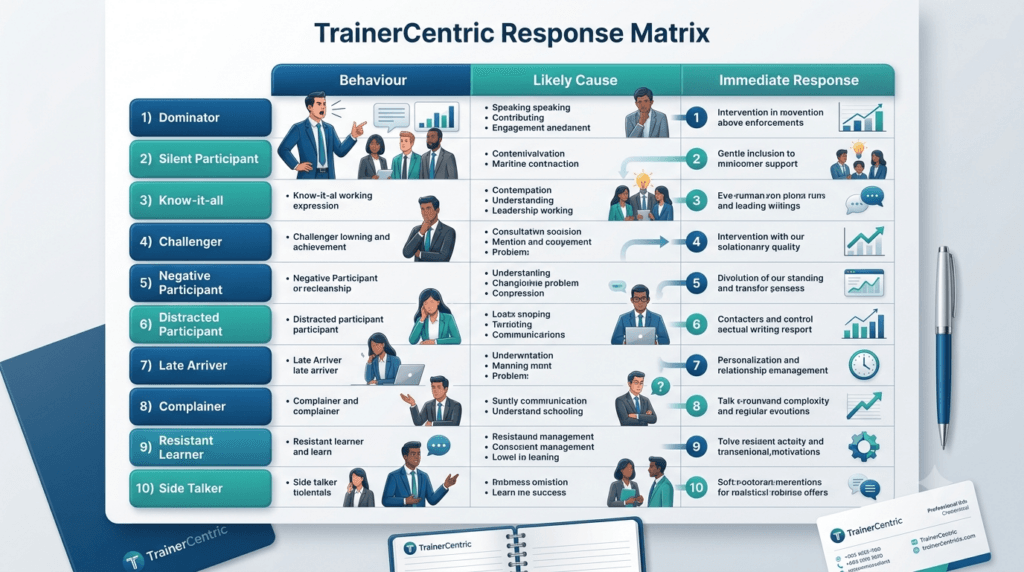
Use the RADAR Model and Response Matrix below for a structured approach to any participant type.
| 💡 Trainer Tip These six steps work in sequence. The most common cause of failed interventions is skipping step 1 — diagnosis. Treating every difficult participant the same way, regardless of cause, produces inconsistent results. Identify the root cause first. Every time. |
Difficult Participant Response Matrix
Use this matrix as your first reference when challenging behaviour appears. Detailed techniques and scripts for each participant type follow below.
| Participant Type | Behaviour | Recommended Response | What to Avoid |
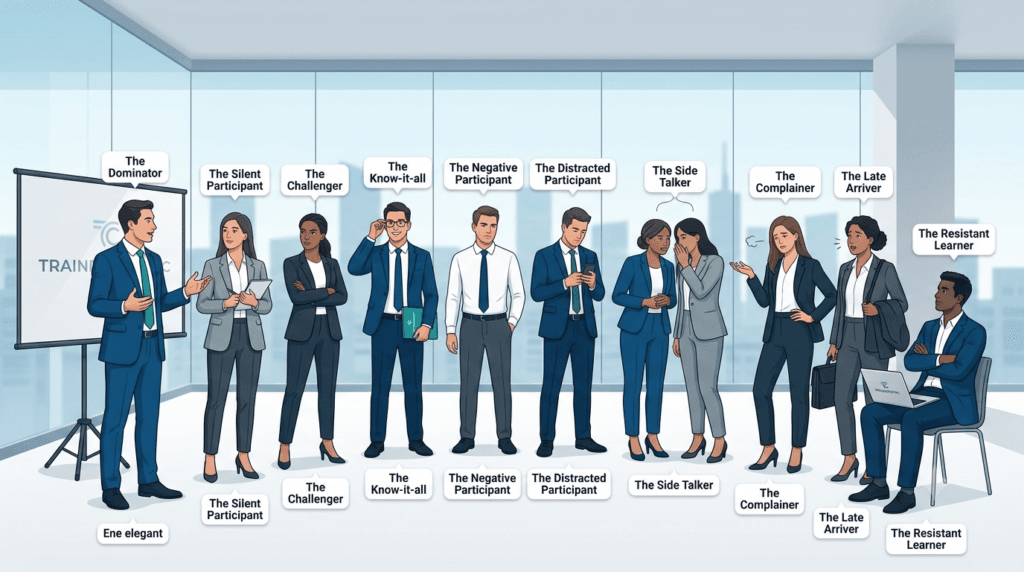
| The Dominator | Monopolises airtime, interrupts | Round-robin formats; acknowledge and redirect; give facilitation role | Shame or interrupt mid-sentence |
| The Silent Participant | No verbal response; minimal engagement | Think-pair-share; polls; private check-in; low-risk questions first | Cold-call without warning |
| The Know-It-All | Corrects trainer; grandstands expertise | Leverage their knowledge; appoint as group resource; probe inaccuracies | Debate publicly |
| The Challenger | Questions content, method, or trainer credibility | Validate; turn to group; agree to investigate; stay curious not defensive | Argue or become defensive |
| The Side-Talker | Whispers to neighbour mid-session | Move closer; directed question; restructure subgroups at break | Call out publicly |
| The Negative Participant | Sighs, eye-rolls, dismisses ideas | Private check-in; convert scepticism into group resource; reframe | Mirror negativity |
| The Distracted Participant | Phone/laptop; glazed expression | Activity every 10-12 min; use their name in examples; request focused slot | Embarrass publicly |
| The Late Arriver | Enters mid-session, disrupts flow | Entry protocol; buddy system; acknowledge briefly and continue | Restart content |
| The Complainer | Criticises logistics, timing, brief | Acknowledge; park; ask for solution not just problem | Over-explain or apologise |
| The Resistant Learner | Refuses activities; arms crossed | Find WIIFM; offer choice in how to engage; private dialogue | Force participation |
| 📊 Research Insight ATD data shows that programmes delivered by skilled facilitators who actively manage learner engagement produce measurably higher completion rates and post-training application scores compared to content-only delivery. The matrix above is a practitioner’s shortcut to that difference. |
Behaviour-Based Quick Reference
Find the behaviour you are observing and jump directly to the right response — regardless of which participant type you are dealing with. This table organises by what you can see, not by personality.
| Observed Behaviour | Likely Cause | First Response | What to Avoid |
| Repeated interruptions | Habit; high confidence; unaware of impact | Round-robin format; acknowledge and hold | Cutting off mid-sentence |
| Complete silence | Anxiety; low psychological safety; reflective style | Think-Pair-Share; closed questions; private check-in | Cold-calling without warm-up |
| Eye-rolls; audible sighs | Past training that failed to transfer | Private check-in at break; name scepticism as valid data | Mirroring negativity; dismissing |
| Side conversations | Low engagement; excess energy on topic | Proximity move; directed question; invite the pair to share | Public call-out in front of group |
| Phone or laptop use | Competing work demand; disengagement | Focused window request; assign a role | Embarrassing publicly |
| Public challenge to content | Scepticism; testing trainer credibility | Pause; validate; turn to group | Defending or arguing back |
| Arms crossed; refusal | WIIFM unanswered; mandatory attendance | Private dialogue; offer alternative engagement | Forcing participation |
| Arriving late | External pressures; low priority assigned | Buddy system; brief at break; do not restart | Restarting content for one person |
| Camera off (virtual) | Disengagement; personal context; trust gap | Redesign next activity; private nudge | Publicly mandating cameras |
| Repeated complaints | Evidence-based scepticism; past poor training | Acknowledge; park; ask for solution | Over-apologising; over-explaining |
| ◆ Decision Point Before any intervention, ask yourself: Is this behaviour disruptive (affecting others around them) or disengaged (affecting only this person)? The answer changes everything. Disruptive behaviour needs early, visible action to protect the group. Disengaged behaviour needs quiet, private curiosity. Using the wrong response makes both worse. |
The RADAR Model: TrainerCentric’s Framework for Managing Difficult Participants
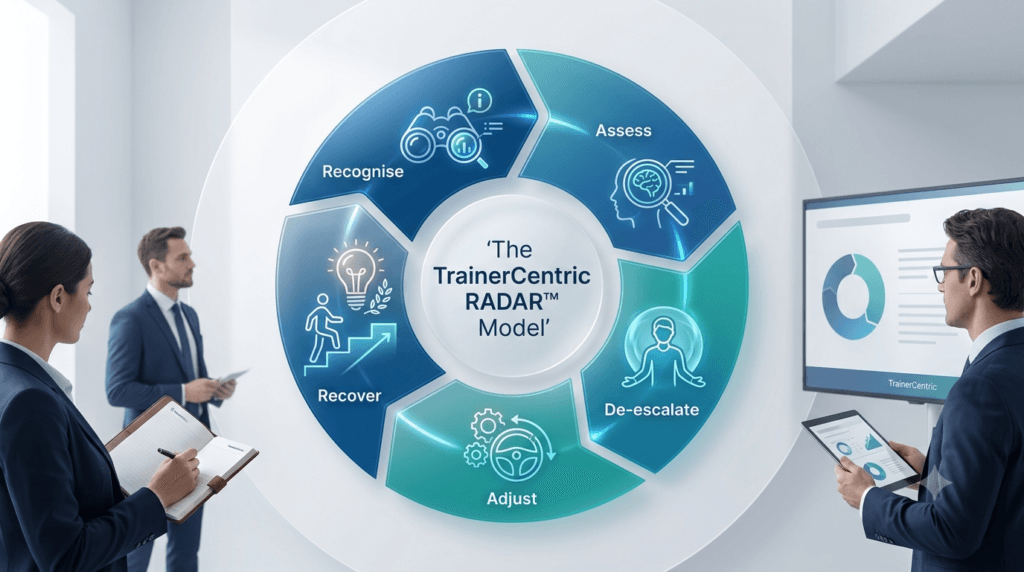
Most facilitation guides give you tactics. The RADAR Model gives you a sequence. Without a sequence, trainers either over-react — jumping straight to confrontation — or under-react, ignoring behaviour until it has already damaged the room.
The RADAR Model is TrainerCentric’s proprietary five-stage framework for managing challenging behaviour in corporate training environments. It provides a repeatable, professional approach that works across all participant types, session formats, and seniority levels.
| Step | Stage | What the Trainer Does | Example in Practice |
| R | Recognise | Identify the participant type and behaviour pattern as early as possible | “This is a Dominator pattern. I need to redirect, not suppress.” |
| A | Assess | Explore the root cause — resistance, relevance, experience, or design | Ask: Is this a behaviour problem or a training design problem? |
| D | De-escalate | Choose the least disruptive, most indirect intervention first | Move closer. Ask a directed question. Use the parking lot. |
| A | Adjust | Modify your facilitation approach in real time based on what you find | Slow down. Add a reflection. Change the activity. Acknowledge the tension. |
| R | Recover | Re-establish group energy and psychological safety after the intervention | Summarise what was heard. Validate contributions. Return to learning. |
Apply the model in proportion to the behaviour. For mild disruption, move through Recognise, Assess, and De-escalate in under 30 seconds. For persistent or escalating behaviour, work all five stages — including Adjust and Recover.
| Proprietary Framework The RADAR Model is an original framework developed by TrainerCentric. All rights reserved. Reference with attribution: RADAR Model, TrainerCentric.in. |
Decision Tree: What Should You Do in the Next 30 Seconds?
When difficult behaviour appears, you have approximately 30 seconds before it becomes the group’s new normal.
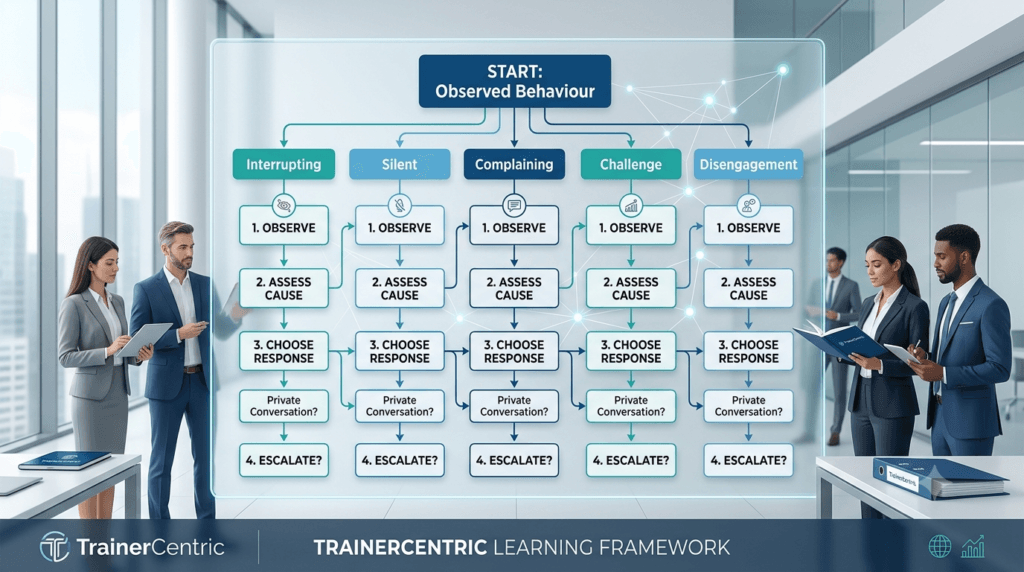
Use this to move from observation to action quickly.
| What You Observe | Likely Cause | First Response (next 30 seconds) |
| Single interruption | Habit or enthusiasm | Hold warmly: “Hold that thought — let me finish this thread and I will come back to you.” |
| Repeated interruptions | Dominator pattern | Round-robin: “I want to hear from each person in turn — starting here.” |
| Side conversation | Low engagement or excess energy | Move closer; ask a directed question to one of them |
| Arms crossed, total silence | Resistance or fear of exposure | Note it; intervene privately at the break — not in front of the room |
| Public challenge | Scepticism or credibility test | Pause; validate; turn to the group: “What do others think?” |
| Eye-rolls or audible sighs | Past negative training experience | Name it privately: “I notice you seem frustrated — what is on your mind?” |
| Persistent phone use | Competing demand or disengagement | Request a focused window; assign them a role in the next activity |
| Refusal to participate | WIIFM not answered | Private check-in; offer a different way to contribute |
| Camera off (virtual) | Disengagement or context concern | Address privately; redesign next activity to require visual presence |
| From My Experience In my own facilitation experience, I have found that the loudest participant in the room is rarely the hardest to manage. The quiet participant who mentally checks out in the first twenty minutes is often the greater risk — because the trainer may not notice until the session is over. Active resistance gives you something to work with. Quiet withdrawal does not. |
| 💡 Trainer Tip Post the Decision Tree as a private tab on your laptop during every session. The three-second glance it takes will save you a three-minute recovery. |
1. The Dominator
| ⚠ ⚠ High-Impact Participant Pattern Usually high-confidence individuals, unaware of their impact on others. The Dominator is not being malicious — they are being themselves in a context where that self takes up too much space. Behaviour is habitual, not hostile. That distinction shapes every response. |
- Round-robin formats: “I want to hear from each person in turn — let us start here.”
- Acknowledge and redirect: “Great point. Before we build on that, let us hear another perspective.”
- Give them a constructive role: timekeeper, devil’s advocate, or note-taker.
- If the pattern continues after two indirect redirections, address it privately at a break.
Avoid: Cutting them off mid-sentence without acknowledgement — this escalates resentment without changing behaviour.
🎯 Example from Practice: In one leadership programme, asking the Head of Operations to speak last on a key question transformed the discussion within minutes. Three of her direct reports contributed perspectives they had clearly held for months but never surfaced while waiting for the most influential voice in the room to go first.
| ▶ Sample Script Great insight, [Name]. Before we go deeper, I want to make sure we hear from a few others — then we can bring it all together. [Name on the other side], what is your take? |
2. The Silent Participant
Silence is rarely indifference. It is almost always self-protection — and the distinction matters enormously.
| ▼ Observe | ▼ Assess Why | ▼ Respond |
| No verbal contribution in group discussions. Monosyllabic when asked directly. Physically present but verbally withdrawn. | Anxiety. Introversion. Low psychological safety. Cultural context. Reflective learning style. Fear of being wrong in front of peers. | Think-Pair-Share. Anonymous polls. Closed, low-stakes questions first. Private check-in at break. Never cold-call. |
Silence often signals uncertainty rather than disengagement. Active listening skills for facilitators become especially important here — because what a quiet participant is not saying is usually more useful diagnostic information than what they are saying.
💡 Trainer Tip: Give thinking time before asking for verbal responses. Even ten seconds of deliberate wait time after posing a question doubles contribution from quieter participants. Most trainers fill the silence before the room has had a chance to respond.
| ▶ Sample Script Take 60 seconds and jot down one thought on this — then I will ask a few people to share. [Name], what did you write? |
3. The Know-It-All
Their need to have experience acknowledged is legitimate — Knowles’ andragogy treats this as a non-negotiable principle of adult learning. The intervention is not suppression. It is redirection.
| What You Observe | Why It Happens | Your Move |
| Corrects the trainer — sometimes accurately | Subject matter expertise seeking recognition | Leverage deliberately: “Can you give the group a specific example?” |
| Prefaces with “Actually…” or “In my experience…” | Bored with content they feel they already know | Appoint as group resource: “If anyone gets stuck, [Name] knows this well.” |
| Challenges accuracy — sometimes without evidence | Habit or professional status signal | Probe rather than contradict: “Walk us through your reasoning.” |
Avoid: Debating publicly. Even if you are correct, you appear defensive to the room.
| ▶ Sample Script [Name], you have worked extensively in this area. Where do you see people getting it wrong most often in practice? That would be genuinely useful for the group. |
4. The Challenger
A challenge is not an attack. In most cases it is intellectual engagement — or a rational test of whether this room is safe for honest thinking.
| If They Say… | You Respond… |
| “These models don’t work in practice.” | “What would need to be true for them to work in your context?” |
| “I have been doing this for twenty years.” | “Your experience is exactly what we need to stress-test this framework.” |
| “Where did that data come from?” | “Good question — let me confirm the source and come back to you by end of session.” |
| “This is too theoretical.” | “Fair challenge. Let me address it directly — then let us hear what the rest of the group thinks.” |
The ability to question rather than answer reflexively is one of the most important tools a trainer can develop. Questioning techniques for trainers covers the specific probe types that work best when turning a challenge back to the group.
◆ Decision Point: Before responding to a challenge: Is this a factual challenge I can answer with evidence? Or a relevance challenge that belongs to the group? If the former, answer briefly and move on. If the latter, turn it outward: “What do others think?” That question almost always produces a stronger answer than your rebuttal.
🎯 Example from Practice: The best challenge I have received in a training session came from a senior analyst who questioned a framework I had presented as settled practice. He was right to question it. Turning that challenge to the group produced the most useful discussion of the day — and increased my credibility far more than a polished defence would have.
| ▶ Sample Script That is a fair challenge and I do not want to brush past it. Here is my view — [answer]. But what has your experience been? Because if this does not hold in your context, that is worth exploring. |
5. The Side-Talker
Side conversations are usually a signal about engagement level — in the topic or in the room. The intervention should match that signal, not suppress it.
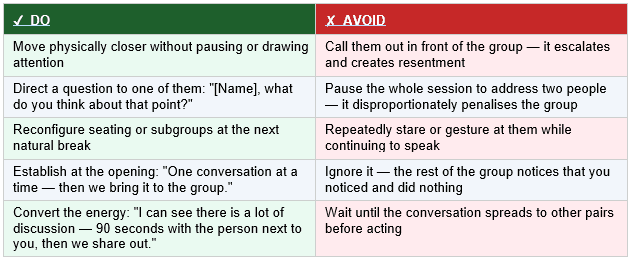
| ▶ Indirect Script I can see there are conversations at a few tables — which tells me we have energy on this topic. Let us make it official: 90 seconds to discuss with the person next to you, then we share out. |
6. The Negative Participant
| ⚠ Sceptic Pattern — Read This Before Responding Their scepticism is almost always evidence-based, not attitude-based. Many have been through training that did not transfer. The eye-roll is a data point, not a character flaw. Treating it as attitude rather than experience is the most common — and most costly — mistake with this participant type. |
- Privately at a break: “I notice you seem frustrated. I want to make sure today is useful. What is on your mind?”
- In session: “Some of you may be thinking — this sounds good in theory but will not survive our reality. What would need to be true for this to work here?”
- Convert their scepticism into a group resource: their experience of what has not worked is genuinely valuable data.
- Never mirror their energy or become visibly exasperated — the group reads this as the trainer losing control.
🎯 Example from Practice: After a compliance session where a senior manager spent the first hour with arms folded and audible sighs, I asked him privately what he wished the training had covered instead. His answer — a specific process failure his team had dealt with the previous quarter — became the case study for the afternoon. His engagement shifted completely, and the rest of the group benefited more from his real example than from anything I had prepared.
| ▶ Sample Script [Name], I can hear some real scepticism there — and that experience matters. Can you tell us more about what happened before? Understanding what did not work is as valuable as knowing what might. |
7. The Distracted Participant
Characteristics: On their phone. Laptop open but clearly not taking notes. Glazed expression. Checking their watch.
- Build in an activity or interaction point every 10-12 minutes maximum.
- Use their name in examples: “Imagine you are in [Name’s] situation and…”
- Request a focused window: “I need your full attention for the next 20 minutes — then we take a break for anything urgent.”
- Assign them a role in the next activity — accountability shifts attention.
Avoid: Embarrassing publicly — it increases resentment without changing behaviour.
📊 Research InsightCognitive load research shows that attention drops significantly after 10-15 minutes of passive input. The distracted participant is often not being difficult — they are responding normally to passive delivery. The intervention is activity design, not enforcement. If you are losing attention, the session design is the first thing to interrogate.
8. The Late Arriver
Characteristics: Enters the room after the session has started, sometimes repeatedly. Disrupts flow and sometimes asks questions already answered.
- Establish a late arrival protocol in your opening ground rules — before it happens.
- Assign a buddy — someone who shares notes and context quietly with any late arrival.
- Do not restart content or acknowledge the disruption mid-flow.
- Brief them privately at the break.
💡 Trainer Tip: The most effective late arrival protocol is co-created at the opening: “If anyone arrives after we have started, your buddy will catch you up at the break — please don’t interrupt the session to ask questions that have already been covered.” Participants enforce this norm on each other so you do not have to.
| ▶ Script (to the room) Welcome. Grab a seat and I will catch you up at the break. [Continue immediately.] |
9. The Complainer
Characteristics: Vocal about logistics, content, timing, or materials: “This should have been sent in advance.” “Why are we doing this on a Friday?”
- Acknowledge without agreeing: “I hear you — that is frustrating. Let me make sure the content is worth your time.”
- Park logistics complaints: “I have noted that — it will go to the right people. For now, let us focus on what we can use today.”
- Ask for solutions rather than problems: “Given where we are now, what would make today most useful for you?”
⚠ Common Mistake: Over-explaining or justifying your position in response to a complaint invites further complaints. Every word you spend defending the schedule, the venue, or the decision to run the session is an implicit acknowledgement that the complaint is worth debating. Acknowledge briefly. Park it cleanly. Move on.
| ▶ Sample Script That is valid feedback and I want it to reach the right people. I have noted it. For now: given where we are, what would make today most useful for you? |
10. The Resistant Learner
Characteristics: Refuses to engage in activities. Arms crossed. “I do not see how this applies to me.” Dealing with resistant employees during training almost always comes down to one thing: the WIIFM has not been answered.
- One-on-one at the break: “I can see today is not landing the way I hoped. What would make the rest of the afternoon more useful?”
- Offer choice in how to engage: “You do not have to do this role-play. You can observe and give feedback — which is a harder and more useful role.”
- Connect to their specific context: “In your role, the moment this comes up is probably [specific scenario]. Let us use that.”
◆ Decision Point: Before approaching a resistant participant, ask: Have I answered their WIIFM — the specific, personal reason this content should matter to them right now? If the answer is no, that is the first intervention — not enforcement. If the answer is yes and the resistance continues, then a private conversation is the next step
🎯 Example from Practice: During a communication skills programme for sales managers, one participant declined every activity for the first 90 minutes. At the break I asked: “What is the one conversation you keep avoiding in your team?” He gave a very specific answer. We spent the next activity on that exact scenario. He completed every subsequent exercise — and contributed the most useful discussion of the afternoon.
| ▶ Sample Script I want to check in. I can see this is not clicking yet — and I would rather understand why than push through. What is the one thing that, if we covered it well today, would make this worth your time? |
Real-Life Scenarios and Trainer Responses
Scenario 1: Participant Constantly Interrupts
You are mid-explanation when a participant cuts in for the third time in 20 minutes. The group is starting to look irritated.
▶ Trainer Response: [Name], I want to come back to your point — it is a good one. Let me just finish this thread and then I want to build on what you said. [Continue.] Okay — [Name], you were getting at something important. Go ahead.
Scenario 2: Participant Challenges Trainer Expertise
During a negotiation workshop, a senior sales director says: “With respect, I have been doing this for twenty years. I am not sure these models reflect how negotiation actually works.”
▶ Trainer Response: I appreciate you saying that directly. What I want to test today is whether there is anything in this framework that maps onto what you already do well — or that explains why certain approaches work better in some situations. Would you be willing to hold that challenge while we explore it? Your experience is exactly the stress-test this needs.
⚠ Common Mistake: The most common response to a public challenge is the instinct to defend your position comprehensively. Resist it. A brief, confident acknowledgement followed by “what do others think?” almost always lands better — because the group is watching how you handle the moment, not just what you say.
Scenario 3: Participant Refuses to Participate
A compliance delegate has arrived clearly unwillingly. They participate in nothing and have had their arms crossed for the first hour.
▶ Trainer Response[At the break:] I wanted to check in. I can see today is not what you were hoping for. Without putting you on the spot — what would make the rest of the afternoon more useful? I can adjust how we approach things if there is something specific that would help.
Scenario 4: Senior Leader Dominates the Room
The Head of Operations has answered every question before others can respond. Direct reports have stopped trying.
▶ Trainer Response: I am going to use a structure for the next discussion — I want to hear from different functions before we synthesise. [Head of Operations], I am going to ask you to go last on this one, so we get the full picture first — then your perspective can help us make sense of what we have heard.
| 💡 Trainer Tip When asking a senior leader to hold their response, frame it as giving their view the context it deserves, not as limiting their contribution. “I want the room’s full picture before your synthesis” lands far better than anything that could be heard as a restriction. |
Scenario 5: Virtual Participant Multitasks Throughout
In a virtual leadership programme, one participant’s camera is on but they are visibly reading something else and have not contributed in 40 minutes.
▶ Trainer ResponseWe are about to go into breakout rooms. [Name], I am putting you in the chair role — your job is to make sure everyone gets heard and you bring back the headline to the main room. Can you take that on?
From My Experience: When a senior leader challenges content publicly, the instinct is to defend your position. I have learned to resist that instinct almost entirely. Turning the challenge back to the group — “What do others think? Does this match your experience?” — achieves more than the most polished rebuttal. It shares the credibility burden across the room, and frequently produces answers more compelling than mine.
Activities That Help Manage Difficult Participants in Training
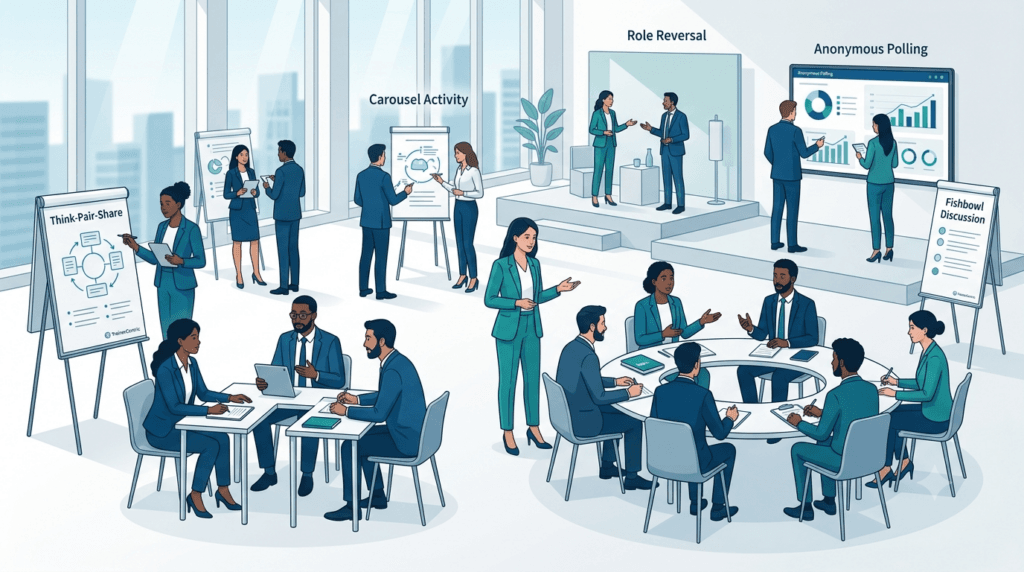
One of the most underused tools in managing difficult participants is activity design. The right activity can resolve a challenging situation before it surfaces — distributing voice, reducing performance risk, and increasing relevance without any direct intervention.
1. Think-Pair-Share
Best for: Silent participants, resistant learners, groups with low psychological safety.
Ask participants to spend 60-90 seconds writing a response before anyone shares verbally. They discuss briefly with a partner. By the time you invite whole-group sharing, most have committed a response to paper and are far less reluctant to speak.
💡 Trainer Tip: The writing step is not optional — it is what makes Think-Pair-Share work. Skipping it and asking people to “discuss with the person next to you” before they have processed the question produces shallow conversations. Write first. Every time.
2. Fishbowl Discussion
Best for: Dominators, senior leaders who crowd out junior voices, groups where hierarchy suppresses contribution.
Select 4-5 participants for an inner circle (or a focused video group in virtual). They discuss for 8-10 minutes while the rest of the group observes. Then rotate. This gives dominant participants a defined, time-bounded space and gives quieter participants the experience of observing discussion before being invited in.
3. Role Reversal Exercise
Best for: Challengers, resistant learners, negative participants, know-it-alls.
Ask the sceptical participant to argue the opposite position from the one they hold. Frame it: “Can you make the case for why this approach would work, even if you are not personally convinced?” This gives resistance a productive outlet and often surfaces the most useful insight of the session.
4. Anonymous Polling
Best for: Disengaged participants, groups with senior leaders who create a chilling effect.
Tools such as Mentimeter or Slido allow participants to respond without attribution. If eight of twelve participants indicate low relevance, that is an adjust signal — not an enforcement problem. The data tells you what private body language is also saying.
📊 Research Insight: Anonymous polling consistently surfaces divergent views that do not appear in facilitated discussion. In groups with visible hierarchy, the gap between public and anonymous responses is a direct measure of how much psychological safety has been lost. If the gap is large, the facilitation design — not the participants — needs to change.
5. Context-Anchored Case Study
Best for: Resistant learners, negative participants who cannot see relevance.
Replace generic case study material with a scenario drawn from the participants’ own industry, company, or role. If you do not have one prepared, create it live: “Let us use your situation as the case. Describe a recent moment when this came up for you.” This is the WIIFM principle in direct practice.
⚠ Common Mistake: Using a case study from a different industry to a room of specialists signals that the trainer does not know their audience. It is one of the fastest ways to lose a Challenger or a Know-It-All. Always adapt the case study. If you cannot, say so and build one from the room.
6. Carousel Debrief
Best for: Side-talkers, late arrivals, groups with mixed levels of prior knowledge.
Post 4-6 questions around the room (or on virtual breakout slides). Groups rotate to each question, building on what the previous group left. Side conversations become the intended format. Late arrivals join a rotation in progress. The blank-page problem disappears because groups build on prior contributions.
These activities are not tricks for managing difficult people. They are principled design choices that create the conditions under which adult learners engage naturally. Strong facilitation skills underpin all of them — particularly facilitation skills for corporate trainers who work regularly with resistant or senior-level groups.
Handling Difficult Participants in Virtual Training
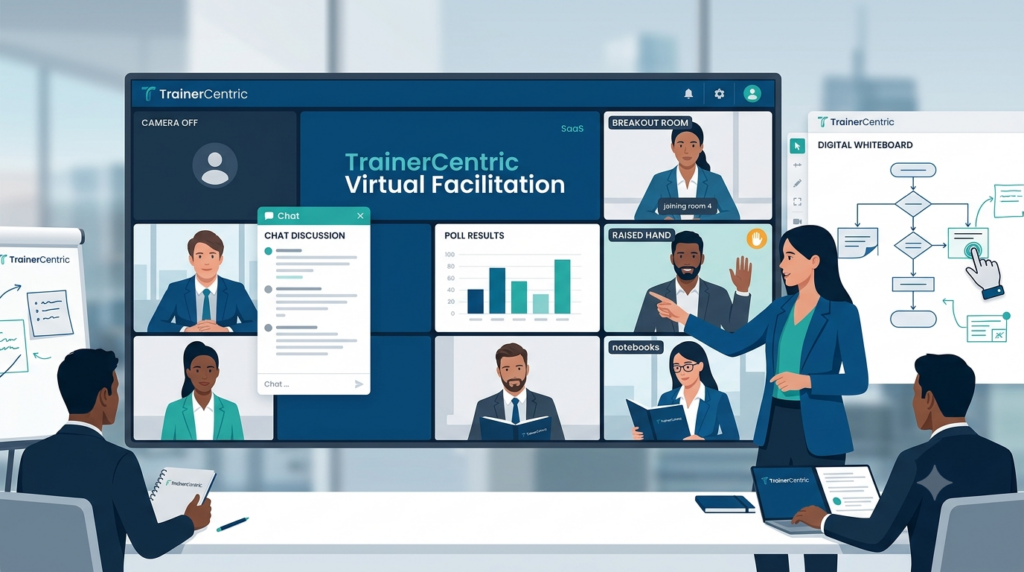
Virtual training environments amplify every facilitation challenge and introduce new ones. Physical cues are reduced, technical friction creates new distractions, and distance makes intervention harder. These corporate workshop challenges require adapted approaches — the same underlying principles apply, but the tools at each stage are different.
Camera-Off Participants
Do not mandate cameras — it creates resentment rather than engagement. Design activities where camera-on feels natural: breakout rooms, paired reflections, whiteboard collaboration. Address privately: “I find it easier to connect with you when I can see you — would you be willing to have your camera on for the next segment?”
Silent Breakout Rooms
Silence in a breakout room usually means the task is unclear or the group does not know who should go first. Pre-assign roles before sending groups: a facilitator, a note-taker, and a spokesperson. Provide a clear, time-bounded task. Pop in to observe in the first minute.
Multitasking Participants
Design for intermittent attention. Use polls every 15 minutes, call on participants by name, and create moments that require active participation. If someone consistently multitasks, assign them a role in the next breakout — accountability shifts behaviour far more reliably than requests.
Chat Distractions
Designate a co-host to monitor the chat. Use it as a facilitation tool — direct questions to specific names, run parallel discussions, and acknowledge chat contributions out loud. Potential distraction becomes engagement infrastructure.
📊 Research Insight: Virtual facilitation research consistently shows that the first 4 minutes of a virtual session are disproportionately important for engagement. Participants who contribute verbally in the first 4 minutes are significantly more likely to contribute throughout the session. Build your first interaction touchpoint before minute 4 — not at minute 10.
The deeper architecture of virtual session design — platform setup, breakout room structure, and engagement rhythms — is covered in Virtual Facilitation Skills, which provides the structural decisions that make virtual management easier before the session starts.
Preventing Difficult Behaviour Before It Starts
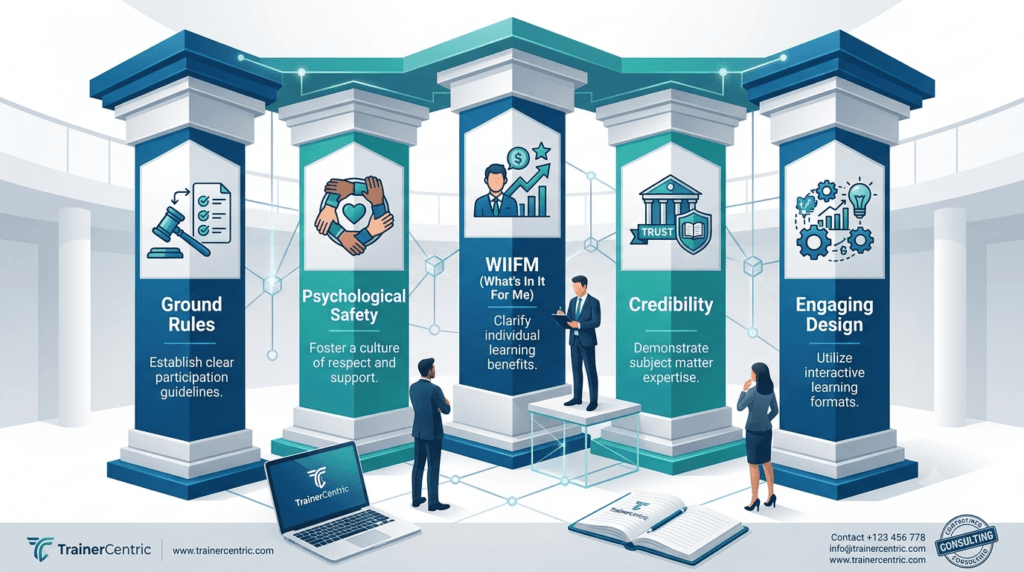
The most underrated facilitation skill is prevention. Many difficult participant situations are actually difficult design situations. Facilitation classroom management — and training classroom management generally — begins in the design phase, not the delivery phase. Managing disruptive behaviour in training is far easier when the conditions for engagement are built in from the start. Facilitation skills for corporate trainers provides the full design process for creating those conditions.
Co-Create Ground Rules at the Opening
Ask participants what they need from each other to make the session valuable. Not a lecture — a conversation. This creates ownership and makes it far easier to reference norms later without singling anyone out.
Answer the WIIFM Before Content Begins
In the first ten minutes, connect the training to something participants are actively working on or struggling with. When people understand why content matters to them specifically, the incidence of resistance drops markedly.
📊 Research Insight: Edmondson’s research shows that simply naming the risk — “Some of what we explore today may feel uncomfortable, and that is okay” — measurably reduces participant anxiety before they are asked to take that risk. Naming the conditions of the room is not soft. It is one of the most structurally important things a trainer can do in the first ten minutes.
Build Credibility Before You Need It
Know participants’ names, roles, and context before they arrive. Open with evidence that you understand their world: “I know most of you are in the middle of [relevant business context]. I want to make sure we connect today’s content to that reality.”
Set Expectations Clearly
Clarify scope, what participants will be expected to do, and what they will be able to do by the end. An expectation mismatch at the start creates compliance problems throughout.
Design Engaging Learning Experiences
Boring training creates difficult participants. Review your facilitation design through the lens of how adults actually learn: are participants getting the experience connection and reflection stages, or only the conceptual delivery? If the answer is “only conceptual,” the difficult behaviour you experience in the room is a design output, not a participant problem.
Common Mistakes Trainers Make When Managing Difficult Participants
- Arguing with a participant in front of the group. Even if you win the argument, you lose the room.
- Publicly embarrassing a learner. This shuts down every other participant.
- Ignoring disruptive behaviour and hoping it goes away. It does not — it escalates.
- Becoming defensive when challenged. This signals insecurity rather than authority.
- Making the same person a repeated example — even when the intention is positive.
- Not addressing side conversations. The group notices you noticed and did nothing.
- Treating all silence as disengagement. Silence is often reflective practice.
- Failing to follow up on commitments made during the session. Broken promises confirm the cynicism of resistant learners.
- Caving to pressure just to restore harmony in the moment.
- Using authority as a first resort rather than a last one.
- Not having a private conversation when needed. Some things cannot be resolved in public.
Quick Reference Cheat Sheet for Trainers
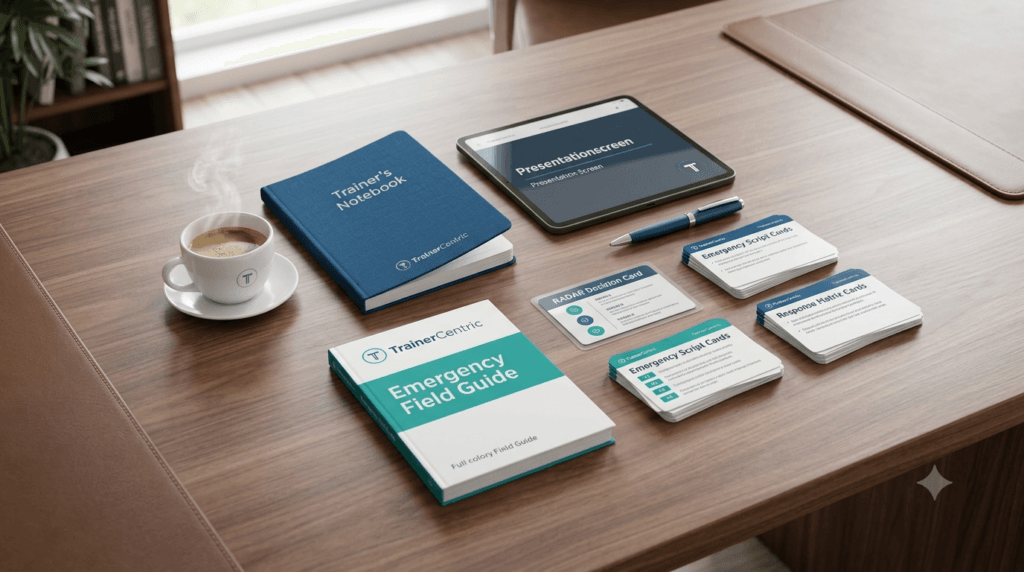
| TRAINER’S FIELD GUIDE: DIFFICULT PARTICIPANTS IN TRAINING | TrainerCentric.in | |
| THE RADAR MODEL R — Recognise the pattern early A — Assess the root cause D — De-escalate with the least disruptive response first A — Adjust your facilitation approach in real time R — Recover group energy and psychological safety BEFORE THE SESSION Co-create ground rules — not as a lecture, as a conversation Clarify scope and expectations before content begins Name psychological safety explicitly at the opening Build credibility by demonstrating knowledge of their context DURING THE SESSION Address low-level disruption early and indirectly Use the parking lot for off-topic but valid contributions Acknowledge before you redirect — always Move physically to dissolve side conversations Reserve private conversations for persistent patterns | EMERGENCY SCRIPTS Dominator: “Great point. Before we build on that, let us hear from a few others.” Challenger: “That is a fair challenge. Let me address it — and I want the group’s view too.” Negative: “That scepticism is useful. Where specifically do you see it breaking down?” Silent: “Take 60 seconds to write it first — then I will ask you to share.” Resistant: “What would make the rest of today worth your time?” Know-It-All: “Where do you see people getting this wrong in practice?” Complainer: “I have noted that. Given where we are — what would make today useful?” Late Arriver: “Welcome. Grab a seat and I will catch you up at the break.” |
From My Experience: What No Guide Tells You
After years of facilitating corporate training programmes — in leadership development, compliance, sales, and onboarding — these are the patterns I find no guide mentions clearly enough.
- The most resistant participant in a room is rarely the most dangerous one. The most dangerous participant is the one who has stopped trusting the process entirely but is too professional to show it. They comply. They complete the activities. They smile on the feedback form. And they leave without any intention of applying a single thing. Passive compliance without genuine engagement is invisible — and far more common than active resistance.
- The most important thing that happens in a difficult participant situation does not happen in the session. It happens in the 90 seconds before a break, when you walk over and quietly say: “I want to make sure today is useful for you. What would help?” That conversation resolves more situations than any in-the-moment intervention. It requires trainers to notice quietly, act decisively, and resist the temptation to wait until the situation forces their hand.
- I have learned to treat the first genuine challenge from a participant as the session’s most important moment — not its most difficult one. The room is watching to see if this is a space where honesty is rewarded or punished. If you reward it — with curiosity, not defensiveness — the psychological safety of the entire group rises noticeably in the following 20 minutes.
Download the Facilitation Guide Toolkit

| FREE FACILITATOR TOOLKIT Six downloadable resources for trainers managing difficult participants | |
| ✓ RADAR Decision Card Quick-reference laminate — all five stages with prompts | ✓ Emergency Script Cards One card per participant type, ready for your desk |
| ✓ Response Matrix Printable A4 desk guide — all 10 types at a glance | ✓ Session Preparation Checklist Pre-session setup guide: ground rules, expectations, safety |
| ✓ Difficult Participant Observation Sheet In-session tracking: behaviour, cause, response, outcome | ✓ Printable Desk Guide Complete intervention guide — all techniques in one sheet |
| Click on the Download Button Below | |
Frequently Asked Questions
How do you handle difficult participants in training?
Identify the root cause before intervening, address early and indirectly, acknowledge before redirecting, and escalate to management only when private conversation and design adjustments have both failed.
Identify the root cause — is it resistance, relevance, or something situational?
Address it early, using the least disruptive intervention first
Acknowledge the participant before redirecting
Use a private conversation for persistent behaviour
Escalate to the programme sponsor only when all other approaches have failed
The most common mistake is treating the symptom rather than the cause. A participant who appears aggressive is often afraid. A participant who appears disengaged is often overwhelmed.
How do you deal with someone who keeps interrupting?
Acknowledge and hold warmly, switch to a round-robin format to distribute speaking time structurally, and address it privately if it continues after two indirect redirections.
Acknowledge and hold: “Great point — let me finish this thread and come back to you.”
Switch to a round-robin format to distribute speaking time structurally
Give them a constructive role: timekeeper, devil’s advocate, or note-taker
If it continues after two indirect redirections, address it privately at a break
Repeated interrupting is almost always habitual rather than intentional. Name it neutrally before you name it directly.
How do you handle an angry participant in training?
Stay calm, acknowledge the emotion without agreeing with the framing, avoid debating publicly, and move the substance of the conversation to a private discussion at the earliest opportunity.
Stay calm and do not mirror their energy
Validate the feeling without agreeing with the framing: “I can hear this is frustrating — that matters.”
Do not try to resolve the substance of the anger in front of the group
Move it to a private conversation at the earliest natural pause
Escalate to the sponsor if the participant becomes abusive
Anger in training is almost always about something that predates the session. Your job is not to fix what caused it — it is to contain it and continue.
How do you manage senior leaders who are difficult in training?
Establish credibility before they can question yours, give them a role that channels their authority productively, and use structure — not confrontation — to balance their influence over the room.
Establish credibility in the first ten minutes — demonstrate you understand their context
Give them a visible but structured role: group expert, sponsor voice, or final synthesiser
Use round-robin or fishbowl structures to balance their authority without confronting it
Address privately if they are crowding out junior participants
Senior leaders do not become difficult because they are difficult people. They become difficult when the training design does not account for their position, experience, or investment.
How do you deal with toxic participants in workshops?
Distinguish between difficult and toxic — most participants who feel toxic are people with high expertise and low psychological safety, which responds to facilitation design rather than escalation.
Address the specific behaviour, not the person, in any private conversation
Make it clear what needs to change and what happens if it does not
Involve the programme sponsor if the behaviour is persistent or deliberately harmful
Document what happened and when
In practice, genuinely toxic behaviour is rare. What often feels toxic is someone with strong expertise and low safety — a facilitation problem, not a character problem.
What should I do if a participant refuses to participate?
Find the unanswered WIIFM — the specific, personal reason this content should matter to them — and offer a different way to contribute before assuming the refusal is permanent.
Privately at the break: “I can see today is not landing. What would make the rest of this more useful?”
Offer choice in engagement mode: observation with feedback is a legitimate alternative
Connect content to their specific context: “In your role, this comes up most when [scenario].”
Do not force participation — compliance without engagement produces nothing
Refusal to participate is almost always about relevance. Answer the WIIFM specifically and the resistance usually softens.
What if the difficult participant is my manager?
Use structure to create equity without confrontation, do not address their behaviour publicly, and raise anything genuinely problematic with the programme sponsor after the session.
Use round-robin and fishbowl structures to balance contributions without singling anyone out
Do not call out their behaviour in front of their team — the power dynamic makes this counterproductive
If they undermine you or the programme, raise it with the sponsor privately after the session
Document behaviour that is genuinely problematic
A manager who is difficult in training often feels their credibility is being tested in front of their team. Acknowledge their expertise visibly and early.
How do you engage silent participants in training?
Reduce the public risk of being wrong — use Think-Pair-Share, anonymous polls, and low-stakes questions before asking anyone to contribute verbally to the full group.
Use think-pair-share before asking for verbal responses
Run digital polls or anonymous chat submissions
Ask closed, low-stakes questions first
Give thinking time before asking for contributions
Check in privately at a break if silence continues
Silence is rarely indifference. It is more often self-protection. Never cold-call a participant who has shown no signals of readiness.
How do you manage difficult participants in virtual training?
Design an interaction touchpoint every 8-10 minutes, assign roles before sending groups into breakouts, and address camera-off and multitasking behaviour privately rather than publicly.
Design a participation touchpoint every 8-10 minutes
Use participant names frequently and deliberately
Assign roles before sending groups into breakout rooms
Use chat as a parallel engagement channel
Address camera-off and multitasking behaviour privately, not publicly
Virtual facilitation challenges are amplified facilitation design failures. Build a session where participation is the path of least resistance.
What activities help manage difficult participants in training?
Use structured activities that distribute voice, reduce the risk of being wrong in public, and increase perceived relevance — Think-Pair-Share, Fishbowl, Role Reversal, Anonymous Polling, and Context-Anchored Case Studies.
Think-pair-share — reduces the risk of being wrong in public
Fishbowl discussions — gives dominant participants a defined, bounded space
Role reversal exercises — builds understanding in resistant and sceptical learners
Anonymous polling — surfaces disengaged voices without pressure
Context-anchored case studies — resolves relevance objections
The Research Behind This Guide
The strategies in this guide are grounded in decades of research in adult learning, organisational psychology, and training effectiveness. Here is the evidence that matters most.
Adult Learning and the Roots of Resistance
Malcolm Knowles’ theory of andragogy identifies six principles that, when violated, produce the behaviours trainers experience as difficult. Adults need to know why they are learning something before they invest in it. They bring experience they expect to be acknowledged. They are problem-centred rather than subject-centred. When training ignores these principles — mandatory, unexplained, disconnected from real problems — resistance is a rational response, not a character flaw. (Knowles, Holton & Swanson, 2015)
| Research Insight Before attributing difficult behaviour to the participant, ask whether the training design is contributing to it. A participant who appears difficult may be a correctly functioning adult learner responding to poorly designed training. |
Psychological Safety and Group Dynamics
Amy Edmondson’s research at Harvard defines psychological safety as the shared belief that a team is safe for interpersonal risk-taking. In training contexts: when participants do not feel safe to ask questions, admit uncertainty, or challenge ideas, they either withdraw or comply without engaging. Both patterns produce the behaviours trainers label as difficult. Every Facilitation technique in this guide is designed to preserve or restore psychological safety — not just for the person being managed, but for the entire group watching. (Edmondson, 1999; 2018)
Learning Styles and Facilitation Design
David Kolb’s experiential learning model highlights that most corporate training is designed primarily around conceptual delivery, while neglecting the experience connection and reflection stages that make learning transfer. Participants who appear resistant are often people whose preferred learning approach is not being served. The response is design adjustment, not enforcement. (Kolb, 1984)
The Scale of the Problem
ATD and CIPD data consistently identifies learner engagement as one of the top challenges for L&D functions globally. Brinkerhoff’s research found that on average only 15% of training participants apply new skills consistently after training — meaning the majority of participants arrive in any room with personal evidence that training does not deliver results. Acknowledging this reality is one of the most credible moves a trainer can make. (Brinkerhoff, 2006)
The gap between training delivery and genuine learning transfer is the subject of Learning Transfer: Turning Training Into Performance — which covers the evidence-based approaches that close the gap Brinkerhoff identified.
The Kirkpatrick Broken Promise
The negative participant and the complainer are often people who have experienced Kirkpatrick’s model as a broken promise: they engaged in previous training, went back to work, and nothing changed. Acknowledging this reality — and connecting today’s content to something that will be different this time — is one of the most important credibility moves a trainer can make. (Kirkpatrick & Kirkpatrick, 2006)
Further Reading on TrainerCentric.in
- Facilitation Skills for Corporate Trainers
- How to Facilitate Training Without Being the SME
- Icebreakers That Actually Work in Corporate Training
- Virtual Facilitation Skills [Coming Soon]
- Learning Transfer: Turning Training Into Performance [Coming Soon]
- Training Needs Analysis: A Practical Guide
- Instructional Design Models: The Comprehensive Corporate L&D Guide
- Kirkpatrick Model: How to Measure Training Effectiveness
References
- Knowles, M.S., Holton, E.F., & Swanson, R.A. (2015). The Adult Learner (8th ed.). Routledge.
- Edmondson, A.C. (1999). Psychological Safety and Learning Behavior in Work Teams. Administrative Science Quarterly, 44(2), 350-383.
- Edmondson, A.C. (2018). The Fearless Organization. Wiley.
- Kirkpatrick, D.L., & Kirkpatrick, J.D. (2006). Evaluating Training Programs: The Four Levels (3rd ed.). Berrett-Koehler.
- Kolb, D.A. (1984). Experiential Learning. Prentice Hall.
- ATD (2023). State of the Industry Report. ATD Press.
- CIPD (2023). Learning and Skills at Work Survey. CIPD.
- Brinkerhoff, R.O. (2006). Telling Training’s Story. Berrett-Koehler.
Author Details

Pankaj Nandi is a Technical Writer and Learning Content Specialist with experience creating complex technical and instructional content across software, technology, and enterprise environments. Having worked with organizations including Cisco, Rakuten India, and Newgen Software, he specializes in transforming complex concepts into clear, practical, and learner-friendly content. You can reach out to him at pankaj@trainercentric.in