For Instructional Designers · HR Professionals · Trainers · Performance Consultants
| Quick Answer: What Is Job Task Analysis? Job Task Analysis (JTA) is the systematic process of identifying, documenting, and evaluating every task a person actually performs in a role — including the knowledge, skills, decisions, and consequences of error for each task. It is used in training design, competency mapping, performance management, and workforce planning to ensure interventions are built around real work, not assumptions. |
In 2018, I worked with a regional financial services firm — 34 account managers across four offices — that had just completed a two-day sales programme. The training was well designed. Six weeks later, the sales numbers had barely moved. When we went back and shadowed the team, we discovered that more than half of each account manager’s day was consumed by CRM admin, approval chains, and post-sale paperwork. They were not underperforming because they lacked sales skills. They were underperforming because their working day made selling nearly impossible. We had built training around assumptions. The missing piece was Job Task Analysis.
| 70% of employees say they lack the skills needed to do their jobs –McKinsey Global Survey, 2021 | 40% of employees who receive poor training leave within the first year – IBM Smarter Workforce Institute | 15–25% productivity gain when training targets real job tasks vs. generic content – ATD State of the Industry |
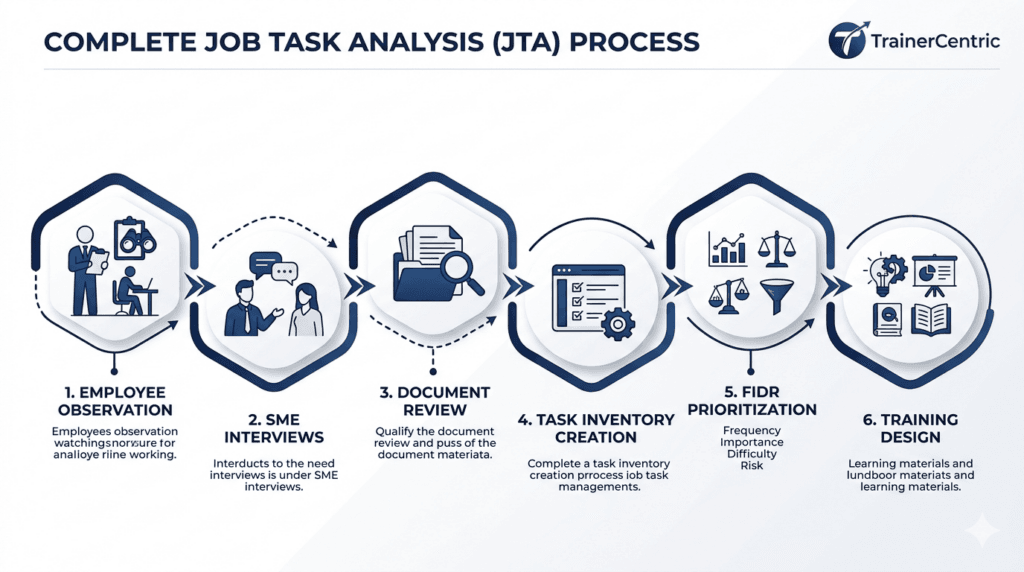
What Is Job Task Analysis?
Job Task Analysis is the structured process of breaking a job role into its component tasks, subtasks, and performance requirements — documenting what people must know, be able to do, and what happens when they do it wrong. It is used to design training, build competency frameworks, and set performance standards based on evidence, not assumption.
Most job descriptions answer none of these questions. A phrase like ‘manages customer accounts’ describes accountability. A job task analysis replaces that phrase with: reviews account activity every Monday, flags at-risk accounts in the CRM, initiates check-in calls within 24 hours, logs outcomes, and escalates unresolved issues within three business days. Those are observable, learnable, measurable behaviours that training can actually target.
JTA answers four foundational questions before any training is designed:
- What tasks does this role actually require?
- How often are those tasks performed, and how critical is each one?
- What knowledge and skill does each task require?
- What happens — to the customer, the business, or the employee — when tasks are performed incorrectly?
Where Is Job Task Analysis Used?
Job Task Analysis is used in: training design, employee onboarding, competency framework development, performance management, recruitment and selection, succession planning, and operational process improvement. While most common in L&D, its outputs are applied across HR, operations, and quality functions.
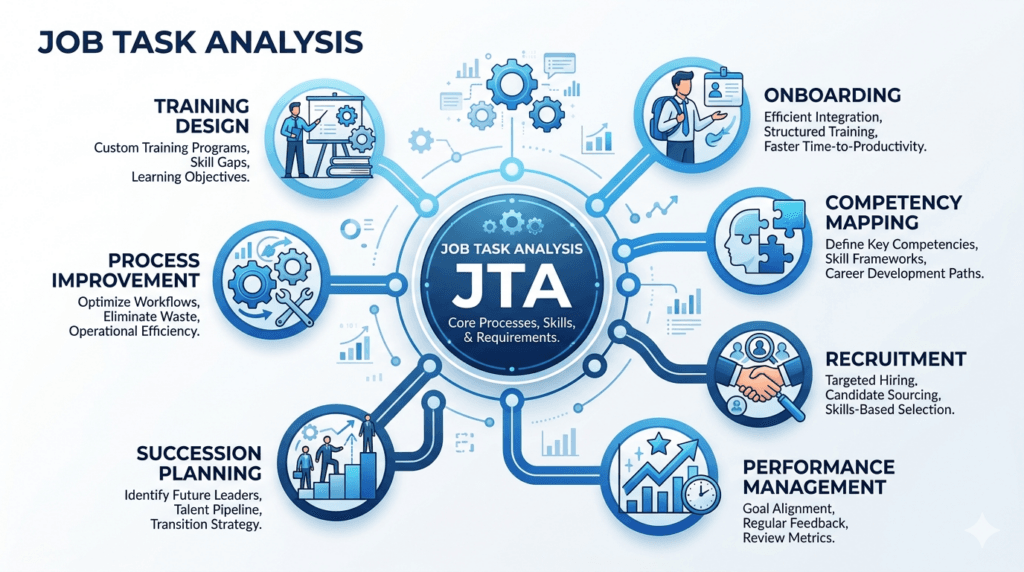
| Application | How JTA Is Used |
| Training Design | Maps real tasks to learning objectives, practice activities, and assessments |
| Onboarding | Ensures new hires are trained on actual day-one tasks, not a generic induction |
| Competency Mapping | Converts vague competency language into specific, observable behaviours |
| Performance Management | Creates task-based standards that managers can observe and measure |
| Recruitment | Designs interview questions and assessments that target critical job tasks |
| Succession Planning | Documents complex judgment calls so development programmes can build them deliberately |
| Process Improvement | Reveals informal workarounds, process gaps, and inefficiencies no SOP captures |
Job Task Analysis Examples Across Industries
JTA applies to every industry and function. The following brief task inventories show the kind of task-level specificity a good analysis produces. For a complete, scored example with FIDR calculations and training recommendations, see the CSR example section below and the downloadable worksheet.
Healthcare — Registered Nurse (Medication Administration)
| Task | Key Subtasks |
| Verify patient identity | Check two identifiers; confirm allergy status; match wristband to medication order |
| Review medication order | Confirm dose, route, timing; flag contraindications; verify prescriber authority |
| Prepare and administer | Correct preparation technique; administer via correct route; use aseptic procedure |
| Monitor and document | Observe for reactions; record time, dose, response in electronic health record |
Manufacturing — Machine Operator
| Task | Key Subtasks |
| Pre-shift inspection | Check equipment against safety checklist; log faults; escalate critical issues before starting |
| Machine configuration | Load production order specs; configure settings; run quality check on first batch |
| Fault diagnosis | Identify fault type from symptom pattern; apply documented fix sequence; escalate unresolved faults |
| Shutdown and handover | Complete end-of-shift checklist; document machine status; brief incoming operator |
Banking — Relationship Manager
| Task | Key Subtasks |
| Client portfolio review | Monthly health report; flag at-risk clients; update CRM with risk notes and action items |
| Structured client contact | Check-in calls with agenda; surface unstated needs; log commitments and next steps |
| Credit application | Gather documentation; complete credit memo; submit with recommendation and risk commentary |
| Compliance | Apply KYC at onboarding; complete annual reviews; file SAR when indicators are triggered |
BPO / Contact Centre — Customer Service Representative
See the full scored example below (8 representative subtasks with FIDR scores and training recommendations). The complete 26-row analysis is included in the downloadable JTA Master Worksheet.
Corporate Training — Instructional Designer
| Task | Key Subtasks |
| Needs analysis | Conduct JTA; identify performance gaps; recommend training vs. non-training interventions |
| Design | Write performance objectives; sequence content using ADDIE or SAM |
| Development | Build storyboards; develop eLearning modules or facilitator guides; create assessments |
| Evaluation | Apply Kirkpatrick Model Levels 1–4; report results to stakeholders |
Internal Resource: Read our detailed guide on Kirkpatrick Model: How to Measure Training Effectiveness
Job Task Analysis vs Similar Frameworks
The sections below compare JTA to closely related concepts. Each comparison is also covered in dedicated supporting articles — see the TrainerCentric Content Hub at the end of this guide for links.
Job Analysis vs Job Task Analysis
Job analysis provides a broad understanding of a role — responsibilities, qualifications, context — and is used for HR purposes like recruitment and compensation. Job task analysis breaks the role into specific tasks and subtasks, and is used for training design and performance improvement. Job analysis tells you the shape of the role; JTA tells you what is inside it.
| Job Analysis | Job Task Analysis | |
| Primary Focus | Broad role understanding | Detailed task and subtask breakdown |
| Typical Use | HR planning, recruitment, compensation | Training design, performance improvement |
| Level of Detail | Responsibilities and requirements | Tasks, subtasks, decisions, behaviours |
| Output | Job description, person spec | Task inventory with KSA and error analysis |
| Who Uses It | HR, recruitment, workforce planners | L&D, performance consultants, trainers |
Job Task Analysis vs Training Needs Analysis
A Training Needs Analysis (TNA) determines whether training is the right solution and identifies which areas need development. A Job Task Analysis determines what people actually need to do in a role, in enough task-level detail to design training content. TNA asks: should we train? JTA asks: what exactly do we train on?
| Training Needs Analysis | Job Task Analysis | |
| Primary Question | Is training the right solution? | What does the job actually require? |
| Focus | Organisation, role, and individual gaps | Specific tasks, subtasks, and behaviours |
| Output | Decision to train; learning priorities | Task inventory; KSA and error requirements |
| When Used | Before deciding on an intervention | Before designing training content |
| Risk if Skipped | Training designed for the wrong problem | Training designed around the wrong tasks |
A Training Needs Analysis tells you whether to train. A Job Task Analysis tells you what to train on. See also: The Three Levels of Training Needs Analysis.
Job Task Analysis vs Task Analysis
| Task Analysis | Job Task Analysis | |
| Scope | A single task or procedure | An entire job role across all task areas |
| Depth | Step-by-step task decomposition | Full task inventory with KSA and priority scoring |
| Common Use | Software training, procedure docs | Training programme design, role analysis |
| Output | Task flow, steps, decision points | Multi-task inventory with FIDR scores |
Job Task Analysis vs Competency Mapping
| Competency Mapping | Job Task Analysis | |
| Language | Behavioural competencies (‘customer focus’) | Specific tasks (‘resolve complaint within authority’) |
| Granularity | Broad behavioural clusters | Task- and subtask-level specificity |
| Best Use | Standards across a role family | Training design for a specific role |
| Relationship | JTA data feeds competency framework development | Competency map provides language; JTA provides evidence |
Task Analysis vs Performance Analysis
| Task Analysis | Performance Analysis | |
| Question | What does the task require? | Why is performance falling short? |
| Focus | Task steps, knowledge, skills | Root causes: training, process, environment, motivation |
| Output | Task documentation for training design | Diagnosis leading to the right intervention |
| Timing | Once a performance gap has been identified | Before deciding what intervention to use |
The Job Task Analysis Process: 6 Steps
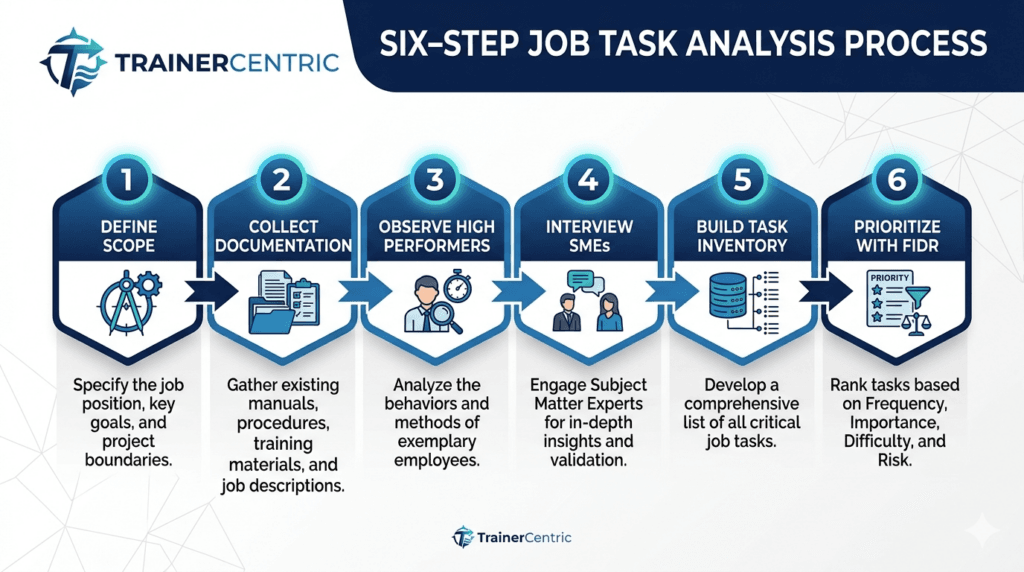
The 6 steps of a Job Task Analysis are: (1) Define role scope; (2) Collect existing documentation; (3) Observe high performers on the job; (4) Interview subject matter experts; (5) Build the task inventory by task area, task, and subtask; (6) Score and prioritise each subtask using the FIDR Model.
Step 1 — Define Role Scope
Identify the exact role, level (entry/senior), business unit, and geography before collecting any data. If the same job title covers different functions on different sites — which happens constantly — treat them as separate roles. Scope creep at this stage invalidates everything that follows.
Step 2 — Collect Existing Documentation
Gather SOPs, process maps, KPIs, job descriptions, quality rubrics, and prior training materials. This gives you a baseline task list to pressure-test during fieldwork. Treat documentation as the map, not the territory — it tells you the official story, not the real one.
Step 3 — Observe High Performers
Shadow two or three top performers. Watch the sequence, the shortcuts, the judgment calls, the informal checks that never appear in any SOP. Observation is the step most commonly skipped by L&D teams — and the step that produces the most valuable, non-replicable data.
Step 4 — Interview Subject Matter Experts
Run structured 1:1 interviews with high performers, supervisors, and quality specialists. Key questions: Walk me through a typical day. What do new starters get wrong? What decisions require judgment rather than following a process? Probe every summary answer — tacit knowledge is invisible until you dig for it.
Step 5 — Build the Task Inventory
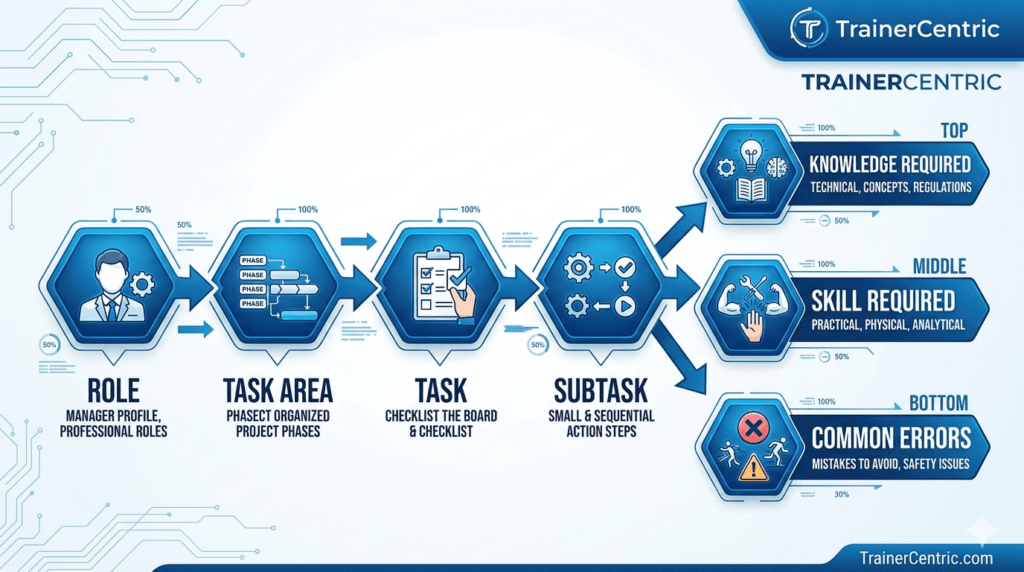
Organise findings into: Task Areas → Tasks → Subtasks. For each subtask, document: Knowledge Required · Skill Required · Common Errors. This is the core deliverable of the task analysis process — the table that every training design decision should trace back to.
Step 6 — Score and Prioritise with FIDR
Not every task needs formal training. Apply the FIDR Model (next section) to identify which subtasks are Priority 1 training targets, which are candidates for job aids, and which need only reference documentation.
The FIDR Model: Prioritising Tasks for Training
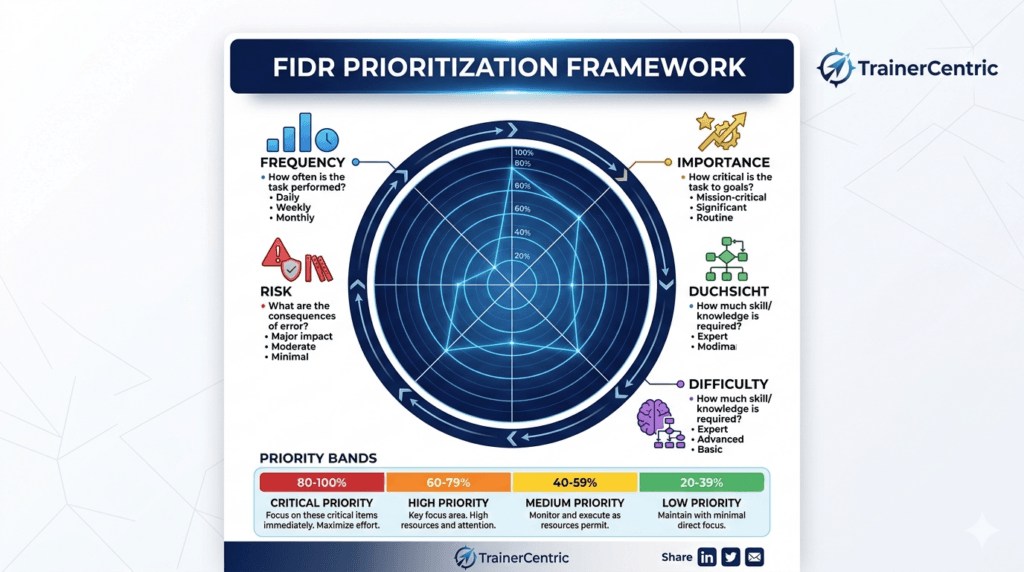
The FIDR Model evaluates each job task across four dimensions: Frequency (how often), Importance (how critical), Difficulty (how hard to learn), and Risk (consequence of errors). Each is scored 1–5 by SMEs. The weighted formula produces a priority score from 20–100. Tasks scoring 80+ are Critical and require mandatory formal training.
Over years of job task analysis projects, the same problem kept appearing: once you have a task inventory of 40 or 60 subtasks, how do you decide which ones justify formal training investment? I tried gut feel, weighted spreadsheets, and various priority matrices. Eventually I settled on a consistent framework I now use on every project — the FIDR Model.
| Dimension | What It Measures | Scoring Guide (1–5) |
| F — Frequency | How often is this subtask performed? | 1=Monthly or less · 3=Daily · 5=Constant (every interaction) |
| I — Importance | How critical is correct performance? | 1=Nice to have · 3=Important · 5=Mission critical |
| D — Difficulty | How hard is this to learn correctly? | 1=Simple (<1 day) · 3=Moderate (2–4 weeks) · 5=Expert (3+ months) |
| R — Risk | Consequence if done incorrectly? | 1=Minor rework · 3=Complaint/rework · 5=Legal/safety/financial exposure |
FIDR Weighted Formula FIDR Score = ((Frequency × 0.25) + (Importance × 0.35) + (Difficulty × 0.25) + (Risk × 0.15)) × 20 Importance carries the highest weight (35%) because task criticality is the primary driver of training priority. Score range: 20 (all 1s) to 100 (all 5s). The ×20 multiplier.
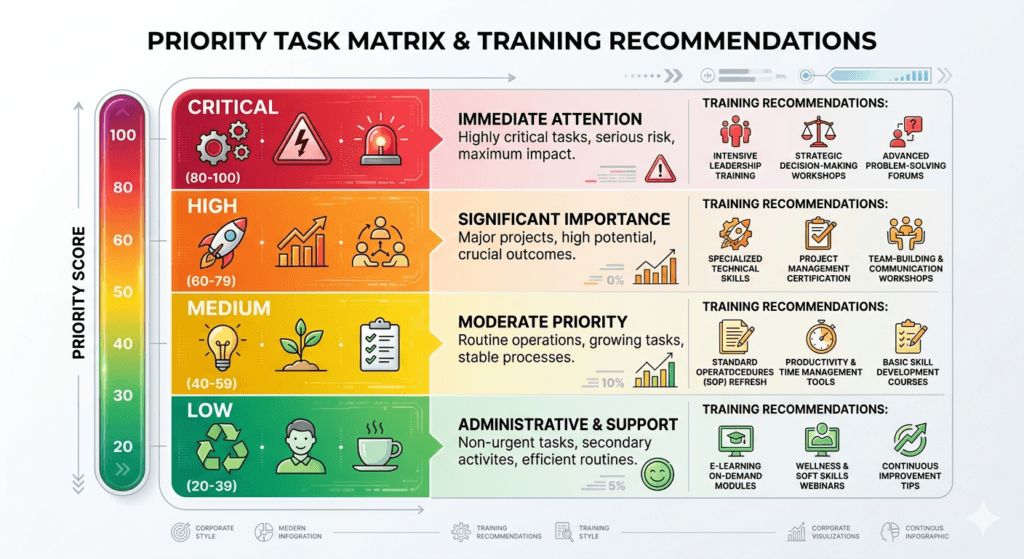
| FIDR Score | Priority | Training Response |
| 80 – 100 | 🔴 Critical | Mandatory training + certification required before solo work. Monitor performance closely. |
| 60 – 79 | 🟠 High | Formal training programme + structured practice + competency sign-off required. |
| 40 – 59 | 🟡 Medium | Structured eLearning or classroom + job aids + coaching plan. |
| 20 – 39 | 🟢 Low | Self-directed learning + reference materials + buddy system. |
Worked example: ‘Apply GDPR/CCPA data privacy procedures’ for a Customer Service Representative. Frequency 5 · Importance 5 · Difficulty 3 · Risk 5. FIDR = ((5×0.25)+(5×0.35)+(3×0.25)+(5×0.15))×20 = 90 — 🔴 Critical. Mandatory certification required before the agent handles live customer data.
→ For the full FIDR Model guide — including how to run SME scoring sessions, handle score disagreements, and build a FIDR-based training plan — see the dedicated FIDR Model article in the TrainerCentric hub.
Job Task Analysis Methods
The seven main Job Task Analysis methods are: (1) Observation — watching high performers work; (2) SME Interviews — structured conversations with subject matter experts; (3) Document Review — analysing SOPs, KPIs, and job descriptions; (4) Focus Groups — facilitated sessions with a team; (5) Surveys — large-scale task frequency and importance ratings; (6) Critical Incident Technique — analysis of specific high-stakes events; (7) Work Diaries — real-time activity logging.
| Method | Best Used When | Primary Strength |
| Observation | Always — non-negotiable for high performers | Reveals tacit knowledge, real time-usage, informal workarounds |
| SME Interviews | Always — for performers and managers | Surfaces the why; uncovers judgment calls and tacit expertise |
| Document Review | Always — as the starting baseline | Provides the official task list to validate and challenge |
| Focus Groups | Task performance varies across teams or sites | Surfaces disagreements about what ‘good’ actually looks like |
| Surveys | Analysing large populations (50+ people) | Validates and quantifies qualitative findings at scale |
| Critical Incident Technique | Surfacing high-stakes judgment calls | Reveals what separates high performers from average ones |
| Work Diaries | When time-on-task data is needed | Shows how time is actually distributed — usually surprising |
For most corporate training projects, observation + SME interviews + document review provides everything needed. Add surveys when the role population is large enough to require statistical validation of qualitative findings.
Free Download: JTA Master Worksheet
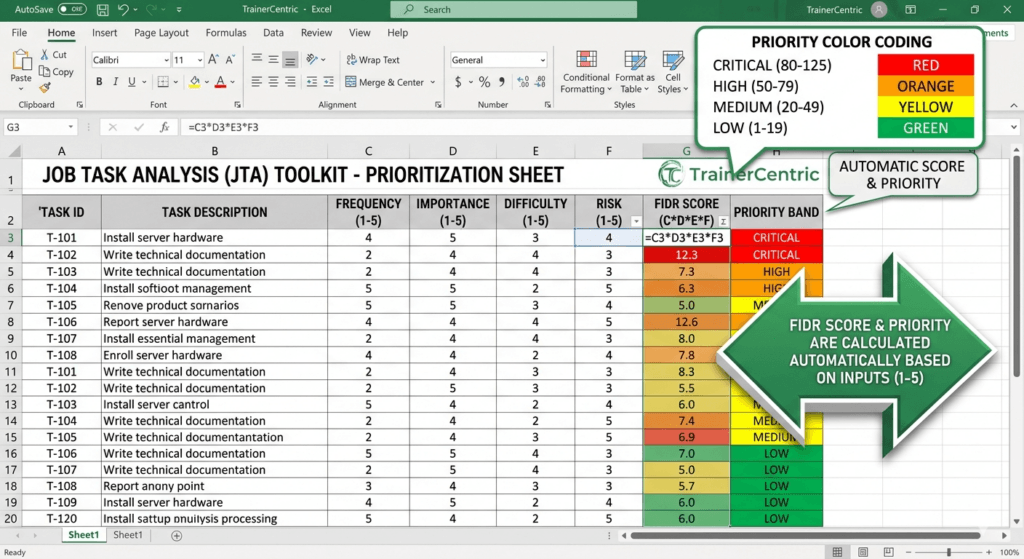
The TrainerCentric Job Task Analysis Master Worksheet is a complete Excel toolkit for conducting and documenting a JTA from start to finish. It includes four sheets.
| Sheet | Contents |
| 📋 Instructions | Full field guide for all 14 columns, FIDR formula explanation, and 10-step process guide |
| 📊 JTA Master Worksheet | Blank template — 50 rows with automatic FIDR calculation and priority colour-coding |
| ✅ CSR Completed Example | Fully populated 26-row example for a Customer Service Representative with SME-consensus scores |
| 🎯 Scoring Guide | Quick-reference calibration card for all four FIDR dimensions with score-level examples |
Completed JTA Example: Customer Service Representative
The table below shows 8 representative subtasks from the full 26-row CSR analysis — selected to illustrate a spread of priority levels and task areas. The complete scored example (all 26 subtasks, five task areas, full training recommendations) is included in the downloadable JTA Master Worksheet.
| Subtask | Task Area | F | I | D | R | FIDR | Priority | Training Required |
| Verify customer identity (dual authentication) | Call Handling | 5 | 5 | 3 | 5 | 90 | 🔴 Critical | Security & Compliance Cert (MANDATORY) |
| Document interaction notes in CRM in real time | Call Handling | 5 | 5 | 3 | 4 | 87 | 🔴 Critical | CRM Cert; Documentation Workshop |
| Apply active listening to understand root cause | Issue Resolution | 5 | 5 | 4 | 5 | 95 | 🔴 Critical | Active Listening Cert; Role-Play Programme |
| Apply correct compensation tier per policy | Issue Resolution | 4 | 5 | 4 | 5 | 90 | 🔴 Critical | Policy & Compensation Cert |
| Apply correct KB procedure step-by-step | Systems & Tools | 5 | 5 | 4 | 5 | 95 | 🔴 Critical | Procedure Workshop; 20-call supervised practice |
| De-escalate irate or hostile customers | Communication | 4 | 5 | 5 | 5 | 95 | 🔴 Critical | De-Escalation Cert; High-Conflict Simulations |
| Apply GDPR/CCPA data privacy procedures | Compliance | 5 | 5 | 3 | 5 | 90 | 🔴 Critical | Data Privacy Cert (MANDATORY — Annual Refresh) |
| Follow up on pending cases within SLA | Issue Resolution | 3 | 4 | 2 | 4 | 65 | 🟠 High | Case Management Training; Follow-Up Protocol |
In the full 26-subtask CSR analysis, 16 tasks score 🔴 Critical (FIDR 80+) and 10 score 🟠 High (60–79). There are zero low-priority tasks. The four subtasks with the highest FIDR score of 95 — Active Listening, Probing Questions, De-escalation, and Knowledge Base Application — should anchor the onboarding curriculum. Download the full worksheet to see all 26 rows with training recommendations.
How to Use AI to Accelerate Job Task Analysis
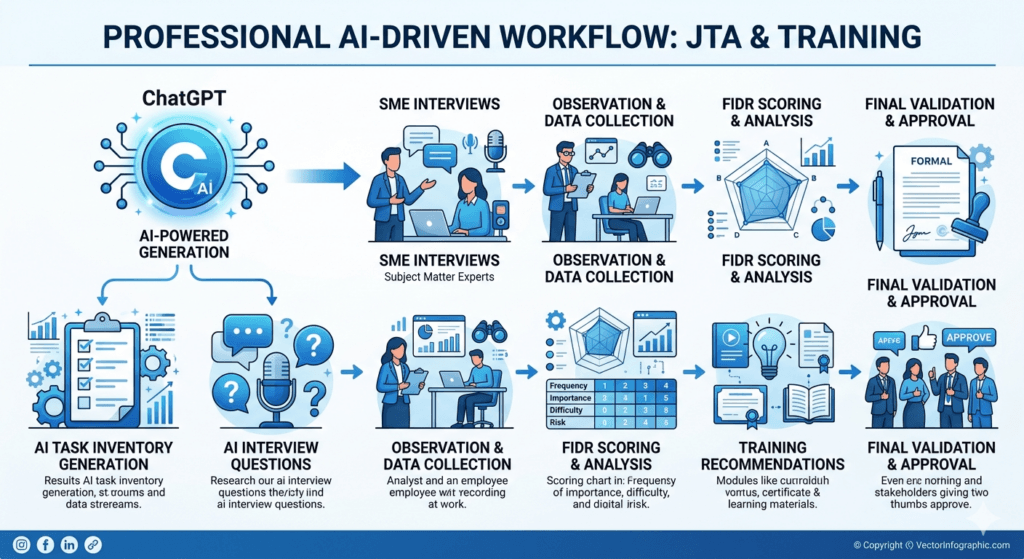
AI tools (ChatGPT, Claude, Gemini) can accelerate JTA preparation by generating starter task inventories, drafting SME interview questions, suggesting FIDR scores, and writing initial training recommendations. AI cannot observe job performance, replace SME judgment, or validate organisation-specific processes. AI-assisted JTA can reduce preparation time by 40–60% — but observation and SME input remain essential.
What AI Does Well
- Generate a starter task inventory. Prompt: ‘Generate tasks and subtasks for a [Role] in [Industry]. Organise by task area. Write each as: Action Verb + Object.’ Saves 2–3 hours of blank-page work.
- Draft SME interview questions. Prompt: ‘Write 15 JTA interview questions for a [Role]. Include questions that surface judgment calls, common errors, and tacit knowledge.’
- Suggest initial FIDR scores. AI can provide scored starting positions with rationale — reviewed and calibrated by SMEs in a facilitated session.
- Write training recommendations. Given a subtask, FIDR score, and common errors, AI drafts a recommendation with modality and duration.
What AI Cannot Do
- Observe the work. No AI can shadow an employee or capture tacit knowledge, workarounds, or informal behaviours that only appear on the floor.
- Replace SME judgment. FIDR scores reflect business context, risk tolerance, and operational realities only subject matter experts can assess accurately.
- Validate against your organisation. AI generates generic role descriptions. Every AI output needs SME review before use.
Recommended AI-Assisted Workflow
- Use AI to generate a draft task inventory (30 min)
- Use AI to draft SME interview questions (15 min)
- Conduct observation and SME interviews using the AI-generated guide (1–2 days)
- Refine the task inventory against observation and SME findings (2–3 hours)
- Use AI to suggest initial FIDR scores with rationale (45 min)
- Run a facilitated SME scoring session to calibrate and finalise scores (2–4 hours)
- Use AI to draft training recommendations per subtask (1 hour)
- Review and finalise recommendations with L&D team and stakeholders
AI-assisted JTA reduces preparation time by an estimated 40–60%. It does not replace fieldwork — it makes fieldwork more focused and documentation faster.
How Job Task Analysis Improves Learning Design
Every major design decision has an anchor in the task analysis output:
| Design Element | How JTA Informs It |
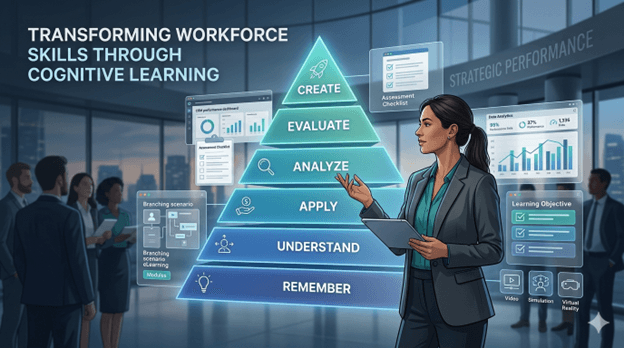
| Learning Objectives | Critical subtasks become performance objectives. ‘Understand complaint handling’ becomes ‘Apply the 4-step acknowledgment framework within 60 seconds.’ Bloom’s Taxonomy maps naturally to task difficulty levels. |
| Content Scope | The Knowledge Required column defines exactly what information learners need — nothing more, nothing less. Eliminates the ‘nice to know vs. need to know’ debate. |
| Assessments | The Common Errors column drives scenario design. If the error is ‘skipping identity verification,’ the assessment tests verification under realistic pressure. |
| Practice Activities | Difficulty scores identify where deliberate practice is needed. High-difficulty tasks get role-plays, simulations, or supervised OJT — not just eLearning. |
| Performance Support | Low-frequency, high-importance tasks are strong candidates for job aids over formal training. JTA data makes this decision evidenced, not intuitive. |
| Evaluation | FIDR Critical tasks become your Kirkpatrick Level 3 and 4 measures — because you documented exactly what matters. |
When using ADDIE or SAM, the JTA is the primary output of the Analysis phase. Adult learning principles — particularly relevance and problem-centredness — are built in automatically when learning is designed around real tasks.
When JTA Reveals Training Is Not the Solution
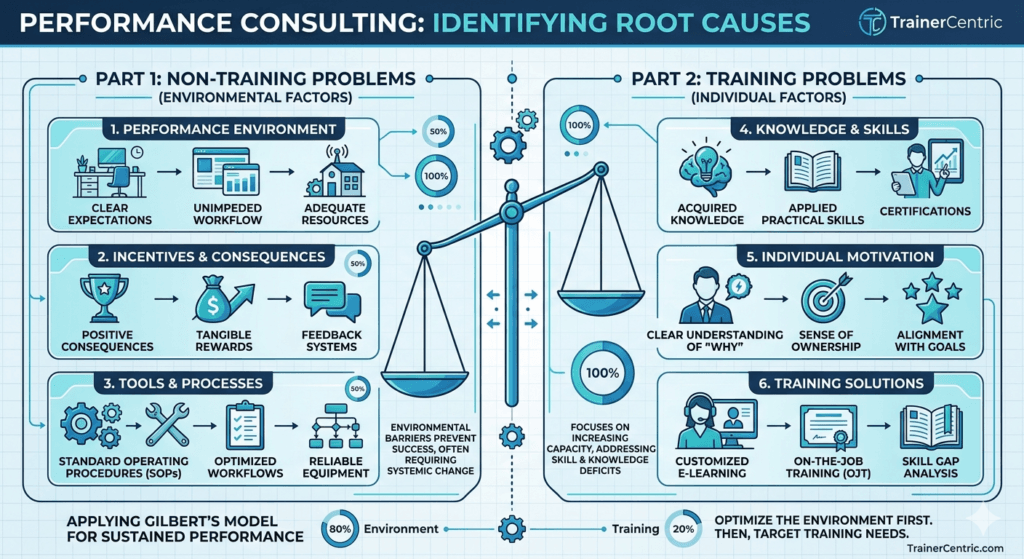
In 2019, I worked with a logistics operator — 80 warehouse staff across two sites — where picking error rates had been above target for six months. Management had already drafted a retraining programme. Three days of observation and interviews revealed:
- Picking labels were printed in a font genuinely difficult to read under warehouse lighting
- Scanner software generated so many false positives that pickers had learned to override alerts without reading them
- The KPI system rewarded speed over accuracy — so rushing was the rational choice
- Three experienced pickers had been moved to a different shift six months earlier — exactly when error rates began rising
None of those were training problems. The interventions were operational: label spec update, scanner recalibration, revised KPI weighting, and a rota change. Training would have done nothing.
Thomas Gilbert’s Behaviour Engineering Model argues that most performance problems are environmental, not individual. A solid JTA produces the evidence to make that case credibly to leadership. When training is not the answer, performance consulting is.
15 Common Job Task Analysis Mistakes
Mistakes in Setup (1–5)
| # | Mistake | Why It Matters |
| 1 | Relying on job descriptions as design input | Job descriptions describe accountability, not behaviour. Written for recruitment, not performance analysis. |
| 2 | Not defining role scope before data collection | If one title covers different functions on different sites, your task inventory blends two different jobs. |
| 3 | Treating JTA as a one-time project | Roles, systems, and processes change. A two-year-old task analysis may be dangerously out of date. |
| 4 | Skipping JTA because ‘we know this role well’ | Familiarity is the enemy of rigour. Proximity to a role increases the risk of blind spots, not decreases it. |
| 5 | Allowing scope to expand mid-project | Adding roles mid-analysis contaminates data and extends timelines without a corresponding plan or budget. |
Mistakes in Data Collection (6–10)
| # | Mistake | Why It Matters |
| 6 | Interviewing only managers | Managers know what they want the role to look like. They rarely know what it looks like on a Tuesday afternoon. |
| 7 | Ignoring top performers | High performers do things average performers don’t — often without realising it. Missing them means building training for average results. |
| 8 | Doing the analysis entirely from a desk | Documentation gives you the official story. Observation gives you the real one. Both are required. |
| 9 | Accepting the first answer SMEs give | SMEs give summaries. Your job is to get beneath the summary: ‘What specifically do you check? What does that look like?’ |
| 10 | Using surveys as the only data source | Surveys tell you what people think they do. Observation tells you what they actually do. |
Mistakes in Analysis and Design (11–15)
| # | Mistake | Why It Matters |
| 11 | Not documenting common errors per subtask | Common errors are the most valuable design input. Without them, training covers topics, not performance gaps. |
| 12 | Confusing knowledge with performance | Knowing what to do and doing it under real conditions are different. A JTA must capture both; training must develop both. |
| 13 | Prioritising by frequency alone | A monthly task with catastrophic consequences needs more training investment than a daily task with minor ones. |
| 14 | Building training for all tasks equally | Not every task needs formal training. Treating them equally wastes budget and learner attention. |
| 15 | Starting design before the analysis is complete | The design then shapes the analysis. This produces training that confirms assumptions rather than challenging them. |
Conclusion
The best training programmes rarely begin with content. They begin with curiosity — about what the job actually involves, about what high performers do differently, about where things go wrong and why.
Job task analysis is the discipline that turns that curiosity into design decisions you can defend. Before you build slides, write objectives, or choose a delivery method: spend time understanding the work.
When training is built around real tasks, real decisions, and real performance moments, it stops being an event people attend and starts being the thing that actually changes what happens on the job.
Frequently Asked Questions
What is Job Task Analysis?
Job Task Analysis is the systematic process of identifying, documenting, and evaluating every task a person performs in a specific role — including the knowledge, skills, frequency, importance, difficulty, risk, and common errors for each task. It is the foundation of evidence-based training design.
What are the components of a Job Task Analysis?
A complete JTA documents: Task Areas (functional groupings), Tasks (discrete observable work units), Subtasks (specific component actions), Knowledge Required, Skill Required, Common Errors, FIDR Priority Scores, and Training Recommendations including modality and duration.
What are the steps in a Job Task Analysis?
The six core steps are: (1) Define role scope; (2) Collect existing documentation; (3) Observe high performers; (4) Interview subject matter experts; (5) Build the task inventory; (6) Score and prioritise each subtask using the FIDR Model.
What tools are used in Job Task Analysis?
Common tools include: structured interview guides, observation checklists, SME scoring worksheets (such as the TrainerCentric JTA Master Worksheet), Critical Incident Technique forms, work diary templates, and survey instruments. A structured spreadsheet with FIDR auto-calculation is the most practical documentation format.
Who performs a Job Task Analysis?
JTA is conducted by instructional designers, L&D managers, performance consultants, or training managers — working in collaboration with subject matter experts, managers, and quality specialists. The analyst facilitates and documents; the SMEs provide the substance.
How long does a Job Task Analysis take?
A focused JTA for a single role typically takes 3–5 working days: one to two days of document review and interview preparation, one to two days of observation and SME interviews, and one day for analysis and documentation. Complex or enterprise-scale projects may take two to four weeks.
How often should a Job Task Analysis be updated?
At minimum annually, and immediately when: a significant process change occurs, a new system is implemented, compliance requirements change, or error rates shift notably. A JTA more than two years old without review should be treated as a starting draft, not a source of truth.
Why is Job Task Analysis important?
Without a JTA, training is built on assumptions. With one, every design decision — objectives, content, practice, assessments, support tools — can be traced to real performance requirements. JTA is also the tool most likely to reveal that a perceived training problem is actually a process, system, or incentive problem.
What data should be collected in a Job Task Analysis?
For each subtask: the specific action performed, Frequency (how often), Importance (how critical), Difficulty (how hard to learn), Risk (consequence of errors), Knowledge Required, Skill Required, Common Errors observed in practice, and the recommended training intervention with modality and duration.
Is task analysis part of ADDIE?
Yes. In the ADDIE model, job task analysis is the primary activity within the Analysis phase. The task inventory and FIDR scoring directly inform the Design phase — objectives, content sequencing, assessment design, and delivery format.
What is DACUM, and how does it differ from JTA?
DACUM (Developing A CurriculUM) is a structured group-based occupational analysis method in which a panel of 8–12 expert performers collaboratively develop a complete task profile in one to two facilitated days. JTA is typically conducted by an analyst through observation, interviews, and document review over a longer period. DACUM is faster for occupational standards work; JTA provides more depth for corporate performance improvement.
What is the difference between JTA and Competency Mapping?
Competency mapping defines behavioural competencies across a role family (e.g., ‘Customer Focus’ at multiple proficiency levels). JTA identifies the specific tasks a person must perform with the knowledge, skills, and error patterns for each. JTA data typically feeds into competency framework development as the behavioural evidence base.
What is the difference between Job Analysis and Job Task Analysis?
Job analysis provides a broad role understanding — responsibilities, required qualifications, working conditions — used for HR purposes like recruitment and compensation. Job task analysis provides a granular breakdown of specific tasks and subtasks, used for training design and performance improvement.
Can AI replace a Job Task Analysis?
No. AI can accelerate preparation and documentation — generating task inventories, drafting interview questions, suggesting FIDR scores. But AI cannot observe actual job performance, capture tacit knowledge, or replace SME judgment about organisational risk context. AI assists; practitioners and SMEs decide.
What are the most common mistakes in Job Task Analysis?
The five most impactful mistakes are: relying on job descriptions instead of observation, interviewing only managers rather than performers, skipping the observation phase entirely, confusing knowledge with performance, and beginning training design before the analysis is complete. See the full 15 Mistakes section above.
References
- Association for Talent Development (ATD). State of the Industry. Annual report series. atd.org
- Bersin, J. / Deloitte Insights. High-Impact Learning Organisation research series.
- Chartered Institute of Personnel and Development (CIPD). Learning and Skills at Work Survey. Annual. cipd.org
- Flanagan, J. C. (1954). The Critical Incident Technique. Psychological Bulletin, 51(4), 327–358.
- Gilbert, T. F. (1978). Human Competence: Engineering Worthy Performance. McGraw-Hill.
- IBM Smarter Workforce Institute. The Value of Training. IBM Corporation.
- McKinsey Global Institute. (2021). The Future of Work After COVID-19. McKinsey & Company.
- Rummler, G. A., & Brache, A. P. (1995). Improving Performance: How to Manage the White Space on the Organization Chart. Jossey-Bass.
- International Society for Performance Improvement (ISPI). Performance Improvement journal. ispi.org
Further Readings
- Ultimate Guide to Training Needs Analysis
- How to Conduct a Training Needs Analysis
- Performance Consulting Explained: When Training Is NOT the Answer
- Skills Gap Analysis vs Training Needs Analysis
- How to Present TNA Results to Senior Stakeholders
- The 3 Levels of Training Needs Analysis: Organisation, Task & Person Analysis
- ADDIE Model Explained
- Learning Objectives Guide
- Training Needs Analysis Template: 1 Free Download for L&D Teams
- Focus Groups and Interviews for Training Needs Assessment: A Practical Field Guide
- Training Needs Analysis Questionnaire: Complete Guide (75 Questions & Free Template)
Author Details

Pankaj Nandi is a Technical Writer and Learning Content Specialist with experience creating complex technical and instructional content across software, technology, and enterprise environments. Having worked with organizations including Cisco, Rakuten India, and Newgen Software, he specializes in transforming complex concepts into clear, practical, and learner-friendly content.
You can reach out to him at pankaj@trainercentric.in