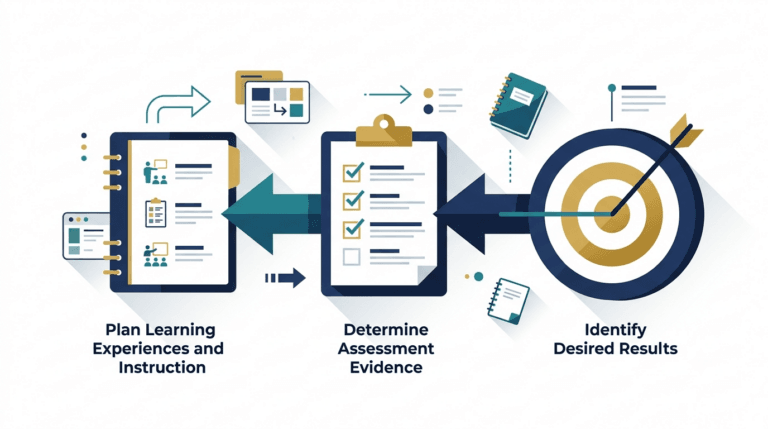
Picture a typical Monday morning rollout. Forty employees sit through a three-hour module on a new process, complete every knowledge check, and score well on the exit quiz. By Friday, most of them cannot describe what actually changed in their day-to-day work.
This is the gap Story-Based Learning Design closes. It’s an instructional approach that embeds a learning objective inside a narrative — a protagonist facing a work-relevant challenge, making a decision, and living with the consequence — instead of presenting that objective as a fact to memorise. Used well, it gives learners something a bullet-point list rarely does: a situation they recognise, and a decision they’ve already rehearsed.
This article gives you a working definition, the research behind why the approach works, when to use it (and when not to), the 5Cs Framework™ for designing one from scratch, a worked corporate example, the mistakes that waste a good story, and how to measure whether it actually changed behaviour on the job.
What Is Story-Based Learning Design?
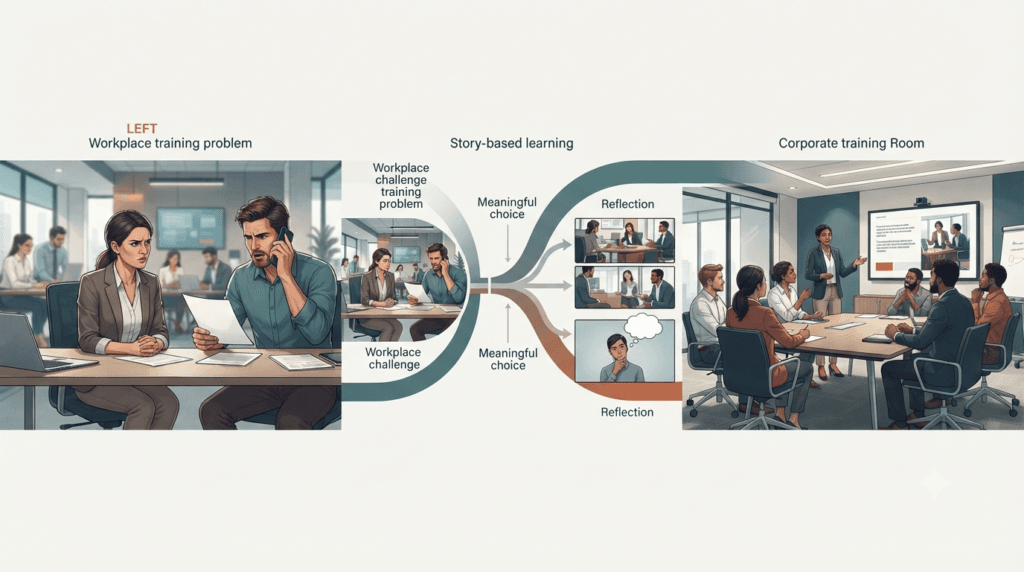
Story-Based Learning Design structures training content around a narrative: a protagonist facing a work-relevant challenge, making decisions, and living with the outcome of those decisions. The learning objective sits inside the plot rather than arriving as a summary slide at the end.
It’s easy to confuse this with other approaches that also feel more “real” than a straight content dump. Here’s how they differ in practice.
| Approach | What It Is | Learner’s Role |
| Traditional content delivery | Facts, processes, and rules presented directly, usually with examples | Passive recipient — reads or listens, then is tested |
| Story-Based Learning Design | A narrative arc with a protagonist, a challenge, decisions, and consequences | Follows the character, reflects on choices, extracts the lesson |
| Scenario-Based Learning | Branching decision points built around a specific task or situation | Makes the decisions directly, in the first person |
| Case Studies | A real or realistic account of what happened in a specific organisation, usually analysed after the fact | Analyst — studies what others did and why |
| Simulations | An interactive replica of a system, tool, or environment | Operator — practises a skill in a safe, repeatable environment |
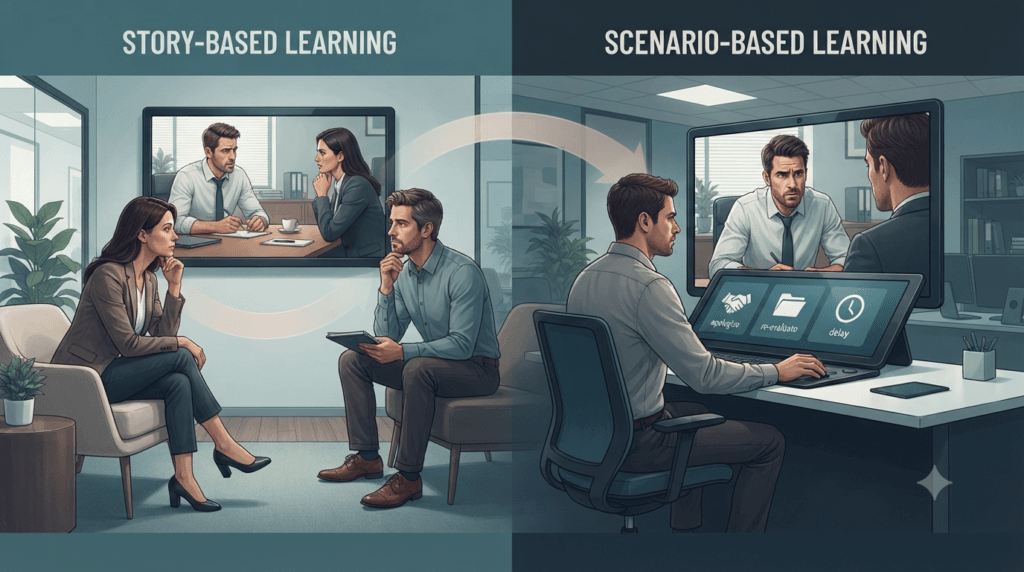
In short: a story is told about someone else, a scenario is lived by the learner directly, a case study is examined from the outside, and a simulation is practised hands-on. Story-Based Learning Design often sits at the front of a learning journey, setting up the emotional and contextual groundwork that a scenario or simulation can then build on.
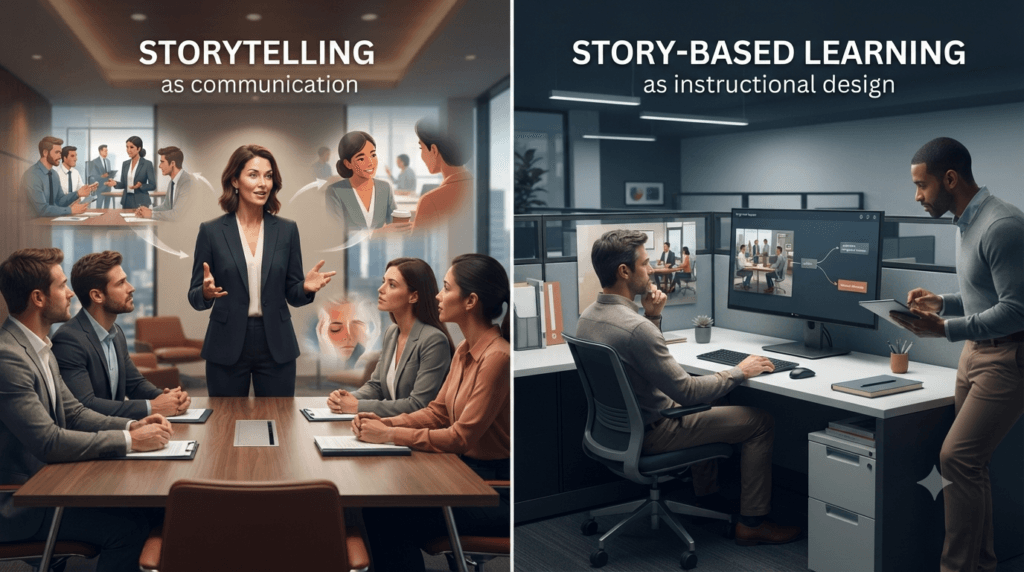
Storytelling vs Story-Based Learning
The two terms get used interchangeably, but they aren’t the same search intent or the same design discipline. Storytelling is a communication technique — it can inform, entertain, or persuade, with no fixed destination. Story-Based Learning Design is storytelling engineered around a specific, pre-defined learning objective, with a decision point and a reflection step built in on purpose. The narrative serves the objective; in general storytelling, it doesn’t have to.
Story-Based Learning vs Scenario-Based Learning
This is the comparison worth getting right, because it’s also where the two disciplines, story-based learning and Scenario based learning, connect into a working curriculum rather than two competing techniques. It plays one of the significantly important role in Instructional Designing models.
| Dimension | Story-Based Learning | Scenario-Based Learning |
| Learner’s role | Observes and reflects on someone else’s decision | Makes the decision directly, in the first person |
| Best used for | Building context, empathy, and motivation | Practising a specific skill or procedure |
| Structure | Usually linear, with one key decision point | Often branching, with multiple paths and outcomes |
| Typical placement | Early in a learning journey, to set up the “why” | Later, once learners are ready to apply the skill |
| Design effort | Lower — one strong narrative arc | Higher — every branch needs its own consequence |
In practice, the strongest corporate programmes often open with a short story to build motivation and context, move into a branching scenario once learners are ready to practise, and sometimes graduate from there into a full workplace simulation once the underlying judgment has been rehearsed enough to attempt under realistic conditions. This entire action mapping can be described as below:
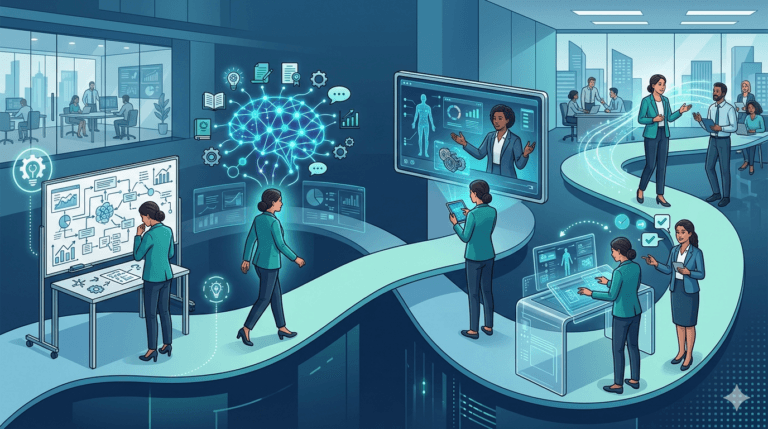
Learning Journey: Story → Discussion → Reflection → Practice → Transfer
Why Story-Based Learning Works
Trainers have used stories for years because they visibly work in the room. The research on why gives you a stronger case to make when a stakeholder pushes back on “why can’t we just send a PDF.”
It also helps to know how much is at stake. Replications of the classic Ebbinghaus forgetting curve confirm that unreinforced learning drops off sharply within the first day and continues to decay over the following weeks (Murre & Dros, 2015, PLOS ONE). The exact percentages you’ll see quoted online vary widely and are often overstated, but the direction isn’t in dispute: without something to anchor it, training content fades fast. A well-built story is one way to give it that anchor.
Emotional Engagement
Neuroeconomist Paul J. Zak’s research found that character-driven stories with emotional content trigger the release of oxytocin, a neurochemical linked to empathy and trust, and that this response predicts how closely an audience attends to and later recalls what was said (Harvard Business Review, 2014).
In practice, this is what can separate a compliance module that gets skimmed from one that gets remembered: a data-privacy course that opens with a case of a real customer harmed by a careless email attachment tends to create more engagement in the first ninety seconds than the policy document that follows it. The same mechanism is why a protagonist who struggles and eventually succeeds matters for confidence-heavy skills — difficult conversations, coaching, negotiation — where the technical content is often simpler than the courage required to use it.
Memory, Context, and Cognitive Load
A well-told story creates mental imagery, which tends to be easier to retrieve than a list of disconnected facts. ATD’s practitioner research describes how a compelling narrative can activate emotional and memory-related processing together, which may help explain why a story from three years ago is sometimes easier to recall than last month’s policy update (ATD, 2025).
Human memory also has two broad systems: semantic memory, which stores facts and definitions, and episodic memory, which stores events you experienced — complete with time, place, and feeling. A policy statement tends to be filed as semantic memory, competing with thousands of other disconnected facts; a story is filed closer to episodic memory, on a far less crowded shelf.
Context does similar work. A rule stated in isolation (“always verify identity before releasing account information”) is abstract. The same rule embedded in a story — a support agent under time pressure, a caller who sounds legitimate but isn’t — gives the learner a mental model for when and how the rule applies on the job, and a template it can attach itself to later. A story also reduces the working-memory burden of holding several unconnected facts in mind, since the facts arrive already organised by cause and effect — the same logic behind Cognitive Load Theory.
Decision-Making and Narrative Transportation
Stories that include a real choice point ask the learner to predict what they would do before revealing what happened. That act of prediction is what separates a story that entertains from one that trains — it forces the learner to commit to a position rather than passively watch events unfold, and it tends to generate a livelier debrief than a case study people simply read and summarise.
Psychologists Melanie Green and Timothy Brock coined the term narrative transportation to describe becoming cognitively and emotionally absorbed in a story. Their research found that the more transported someone is, the more their beliefs shift to match the story’s logic, and the less likely they are to argue with it (Green & Brock, 2000, Journal of Personality and Social Psychology). For trainers, this is why a story is a poor vehicle for a rule someone needs to interrogate closely, and a strong vehicle for a rule someone simply needs to accept and internalise.
Retrieval Cues
A well-built story hands the learner a mental hook for the lesson. Months later, a trainer doesn’t need to ask “what does the policy say” — they can ask “what would [the protagonist] have done here,” and the story becomes the retrieval cue that pulls the underlying rule back into working memory. That’s also a reason to reuse a handful of strong stories across a programme rather than writing a new one for every module.
| Storytelling Claims Trainers Should Be Careful With A few statistics and explanations circulate widely in training and marketing content without solid research behind them. Worth treating all of these with scepticism: “22 times more memorable” — the widely repeated claim that a fact “wrapped in a story” is 22 times more memorable, often attributed to Jerome Bruner, cannot be traced back to a specific study. “90% of communication is non-verbal” — a distorted extrapolation from narrow 1960s research on emotional tone, not a general finding about communication. “People only remember 10% of what they read” — the “learning pyramid” percentages have no traceable research source and don’t hold up under scrutiny. Simplistic “left brain / right brain” claims — real hemispheric specialisation exists, but the popular “left brain = logical, right brain = creative” framing oversimplifies it well past what the evidence supports. Mirror neurons as the reason audiences “feel what a character feels” — the concept is real and well established in motor cognition, but its extension to complex emotional and narrative experience is still debated among neuroscientists. The genuine, traceable evidence for narrative’s effect on memory and belief — Zak’s oxytocin studies and Green and Brock’s transportation research above — is strong enough on its own without borrowing an unverified statistic to make the case. |
When Should You Use Story-Based Learning?
Story-Based Learning Design earns its place when the training is really about judgment, behaviour, or attitude — not just information transfer. The table below shows where it consistently pays off in corporate programmes.
| Training Area | Why a Story Works Here |
| Leadership | Judgment calls under ambiguity are hard to teach as rules; a story shows the reasoning, not just the outcome |
| Sales | Buyer psychology and objection handling land better when learners see a real conversation unfold |
| Compliance | Turns an abstract policy into a recognisable situation, which improves both recall and application |
| Customer Service | Emotional regulation under pressure is best demonstrated, not described |
| Safety | A near-miss story creates the sense of consequence that a checklist alone cannot |
| Negotiation | Shows the back-and-forth and the trade-offs, not just a list of tactics |
| Coaching | Models the questions and the listening, which are difficult to convey outside of a scene |
| Change Management | Helps employees see themselves in someone else’s adjustment to change before living it themselves |
When Storytelling Is NOT the Best Choice
Stories aren’t free — they take longer to write, longer to deliver, and longer to sit through. Reach for a different format when the content itself doesn’t benefit from narrative treatment.
- Software demonstrations — learners need to see the exact click path, not a character clicking through it
- Regulatory updates — when the requirement is “know that this changed,” a direct summary is faster and more precise
- Reference material — content people will look up rather than memorise doesn’t need a narrative wrapper
- Technical procedures — step-by-step precision matters more than emotional context
- Short compliance announcements — a two-line policy reminder doesn’t justify a three-paragraph story
If you’re unsure, ask one question: does getting this right depend on judgment, or on following a fixed sequence correctly? Judgment favours a story. A fixed sequence favours a job aid.
The Story-Based Learning Design 5Cs Framework™
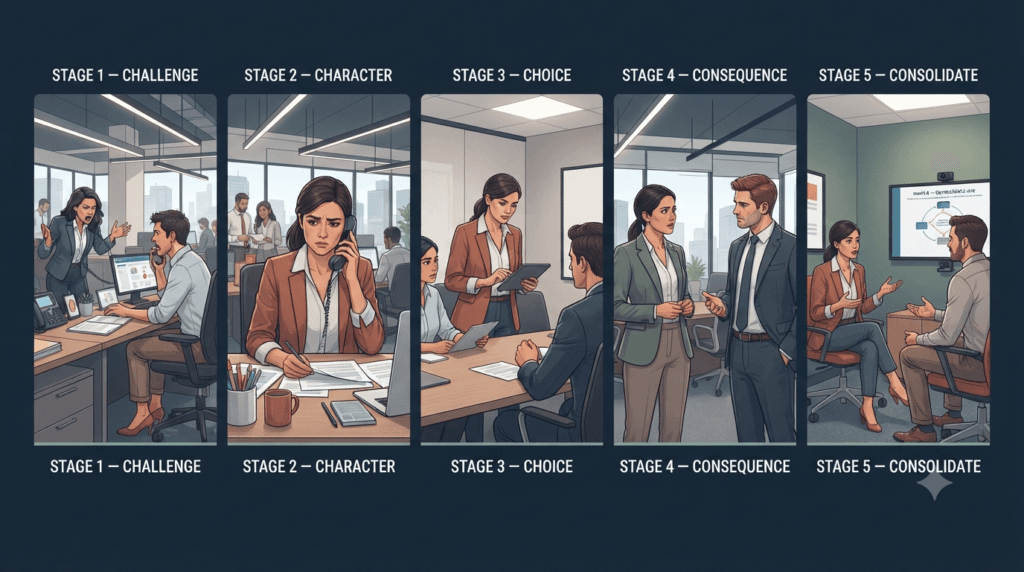
Most trainers who try Story-Based Learning Design for the first time either write something too thin (a scenario with no real tension) or too long (a short story that eats the entire session). The 5Cs Framework™ keeps the story tight and purposeful: Challenge, Character, Choice, Consequence, and Consolidate.
| Step | Purpose | Output |
| Challenge | Identify the learner’s real problem | A specific, recognisable workplace moment |
| Character | Build empathy and identification | A relatable protagonist |
| Choice | Create genuine engagement | A real decision point |
| Consequence | Demonstrate realistic outcomes | A believable behavioural insight |
| Consolidate | Reinforce and transfer the learning | A short, specific reflection and action |
Story Anatomy: Challenge → Character → Choice → Consequence → Reflection → Behaviour Change
A short word on AI, since it comes up in almost every design conversation now: AI can help generate dialogue, character variations, or alternative endings once you know what the story needs to do. It should support, not replace, the instructional designer’s understanding of the real workplace challenge — the Challenge, Choice, and Consequence still need to come from someone who has actually seen the mistake happen.
Step 1 — Challenge: Identify the Learner’s Challenge
Start with the exact moment your learners currently get it wrong on the job, not the topic on the course catalogue. “Handling objections” is a topic. “A buyer says the price is too high in front of their own boss” is a challenge.
Trainer tip: Pull this directly from real incidents — exit interviews, escalation logs, coaching notes, or a quick conversation with team leads. The best story challenges are barely disguised versions of something that actually happened.
Corporate example: A telecom contact centre kept seeing agents over-apologise and offer unauthorised discounts when a customer got angry. The challenge became: an agent must stay firm on policy while a visibly frustrated customer pushes back.
Common mistake: Starting with the learning objective and reverse-engineering a story to fit it, which usually produces a challenge nobody actually faces.
Quick checklist:
- The challenge is specific enough to picture, not a general topic
- It comes from a real pattern of mistakes, not a guess
- A learner could say “yes, that happens to me” within the first line
Step 2 — Character: Create a Believable Protagonist
The protagonist should look and sound like your actual audience — same seniority, same pressures, same vocabulary. A protagonist who is smarter or calmer than your real learners breaks the identification that makes the story work.
Trainer tip: Give the character one relatable flaw connected to the challenge — impatience, conflict-avoidance, over-confidence. Perfection is forgettable; a recognisable flaw is what makes learners lean in.
Corporate example: For a leadership programme on giving feedback, the protagonist was a newly promoted team lead who avoided difficult conversations because she still saw her reports as former peers — a situation almost every first-time manager recognises.
Common mistake: Making the protagonist a stand-in for management, which reads as preachy rather than authentic.
Quick checklist:
- The protagonist’s role, seniority, and pressures match the real audience
- One believable flaw is built in and connected to the challenge
- Dialogue sounds like how people actually talk at work, not like a script
Step 3 — Choice: Design Meaningful Decisions
This is the step most first-time story designs skip. Without at least one real decision point, you’ve written an anecdote, not a learning story. The decision should have at least two options that both seem reasonable in the moment — that tension is what forces genuine thinking rather than obvious guessing. See Action Mapping for detailed guidance.
Trainer tip: Pause the story right before the decision and ask learners what they would do — aloud in a live session, or via a poll in a virtual one — before revealing what the character chose.
Corporate example: In the contact centre story, the decision point was: does the agent offer a discount to de-escalate, or hold the line and offer a documented alternative instead? Both options feel plausible to someone in the room.
Common mistake: Writing a decision with one obviously correct answer and one absurd one, which removes any real thinking from the exercise.
Quick checklist:
- At least one decision point exists with genuine trade-offs
- Learners are asked to predict the choice before it’s revealed
- Neither option is a strawman
Step 4 — Consequence: Show Realistic Consequences
Whatever the character decides, show what actually happens next — including the version where the decision backfires. Real workplace consequences are rarely catastrophic or instantly obvious; they’re more often a slow build of trust, frustration, or credibility. Resist the pull toward a dramatic, movie-style outcome.
Trainer tip: Show both a short-term consequence (how the other person reacts in the moment) and a longer-term one (what happens to the relationship, the metric, or the reputation a few weeks later).
Corporate example: When the contact centre agent held the line and offered the documented alternative, the call ended tensely — but the customer called back a week later, calmer, having used the alternative solution successfully.
Common mistake: Making every wrong decision end in disaster, which teaches learners to fear the story rather than think it through.
Quick checklist:
- The consequence is proportionate and believable, not exaggerated
- Both an immediate and a longer-term outcome are shown
- The learner can see why the outcome happened, not just that it did
Step 5 — Consolidate: Reflect and Reinforce
A story without structured reflection is entertainment. This step converts the emotional experience into a transferable lesson learners can apply the next day.
Trainer tip: Ask three questions after the story closes — What did you notice? What would you have done differently? What is the one thing you’ll try this week? Keep the reflection short; a five-minute debrief usually outperforms a twenty-minute one.
Corporate example: The contact centre session closed with agents writing down one phrase they could use next time a customer pushed for an unauthorised discount, then sharing it with a partner.
Common mistake: Ending the session right after the story with no debrief, leaving the lesson implicit and easy to forget.
Quick checklist:
- A short, structured reflection follows every story
- Learners state one specific action they’ll take, not a general takeaway
- The reflection is captured somewhere — written, shared, or logged — so it isn’t lost by lunchtime
Real Corporate Example: Handling a Difficult Customer

Here’s how the same learning objective — staying composed and policy-compliant with an angry customer — plays out in both formats.
Traditional Training
A slide deck lists five steps for de-escalation, followed by a definition of “active listening” and a reminder of the discount approval policy. Learners complete a five-question quiz confirming they can recite the five steps.
Story-Based Version
Learners follow Priya, a two-year contact centre agent, through a call with a customer who is furious about a billing error and demanding an unauthorised refund while name-dropping her manager. Midway through, the story pauses and asks learners what Priya should do. It then shows what she actually did, how the customer reacted in the moment, and how the situation looked a week later when the customer called back to thank the team.
Comparing Outcomes
The traditional version confirms learners can recall a list. The story-based version puts learners inside the emotional pressure of the moment, asks them to commit to a decision, and shows them the trade-off between short-term relief and long-term credibility — the actual skill the training is meant to build.
Common Story-Based Learning Design Mistakes
| Mistake | Why It Hurts Learning |
| Stories too long | Attention drops and the core lesson gets buried in detail |
| No conflict | Without tension, there’s nothing for the learner to think through |
| No decisions | Turns the story into a passive anecdote instead of a learning exercise |
| Unrealistic dialogue | Breaks credibility and disengages learners who spot it immediately |
| No reflection | Leaves the lesson implicit, so it rarely transfers back to the job |
| Too much entertainment | Learners remember the joke or the drama, not the point behind it |
| Weak learning objective | A great story with a fuzzy objective still fails to change behaviour |
A pattern worth flagging: the first three mistakes on this list tend to show up together. A story that’s too long is usually avoiding the decision point, which is usually a sign the underlying learning objective was never pinned down in the first place.
| Weak Story | Strong Story |
| Generic | Workplace-specific |
| No tension | Real conflict |
| Obvious answer | Difficult decision |
| Happy ending | Realistic consequence |
| Entertainment | Learning |

Best Practices for Designing Learning Stories
- Write the learning objective first, then build the story around it — never the reverse
- Keep a single story under five minutes of read-aloud or watch time in most corporate settings
- Base characters and situations on real incidents, lightly disguised for privacy
- Build in exactly one clear decision point rather than several minor ones
- Test the story on a small group before rolling it out — if they miss the point, so will everyone else
- Pair every story with a short, specific reflection prompt, never a generic “what did you learn”. Check Facilitation Skills for Corporate Trainers for a detailed guide on how to present this to your class.
- Reuse strong stories across programmes instead of writing a new one for every session
- Log finished stories in a Story Bank Planner — most trainers end up rewriting one from scratch simply because the original was never logged anywhere searchable. Read Gamification vs. Game-Based Learning: What’s the Difference for more detailed guide.
How to Measure Story-Based Learning
Track application, not just reaction. A satisfaction score tells you whether learners enjoyed the story; it doesn’t tell you whether it changed anything. The four levels below, adapted from the Kirkpatrick Model, give a more complete picture of whether a learning story actually worked.
Level 1 — Engagement
Did learners engage with the story? This is the easiest signal to collect and the least conclusive on its own — completion rates, time-on-story, and whether learners actually reached the decision point rather than skipping to the end.
Level 2 — Decision Quality
Can learners make the right call in a similar situation? Pose a near-transfer scenario after the story — not the same story, a related one — and see whether the choice point actually built judgment or just familiarity with one specific plot.
Level 3 — Behaviour
Do they behave differently at work? This is where coaching observations, call-quality audits, or manager check-ins earn their keep — look for the specific behaviour the story’s decision point targeted, not a general improvement in “attitude.”
Level 4 — Business Outcome
Did the relevant metric move? Escalation rate, unauthorised-discount frequency, complaint resolution time, safety near-misses — whichever number the original challenge was pulled from in Step 1 is the one to watch after rollout.
In practice, most teams don’t need to instrument all four levels for every story. A quick Level 1 and 2 check after a pilot, followed by a Level 3 spot-check a few weeks later, is usually enough to tell you whether a story earns a place in the permanent programme. Here is an article that will guide you on How to Measure Training Effectiveness Using the Kirkpatrick Model.
Frequently Asked Questions
What is Story-Based Learning Design?
It’s an instructional approach that embeds a learning objective inside a narrative — a protagonist facing a work-relevant challenge, making a decision, and experiencing a realistic consequence — rather than presenting the objective as a standalone fact or rule.
Why does storytelling improve learning?
Stories tend to create stronger emotional engagement and more vivid mental imagery than a plain list of facts, both of which support memory formation. Research from Paul J. Zak at Claremont Graduate University links character-driven stories to better recall of key points weeks later.
Can storytelling be used in compliance training?
Yes, and it’s often one of the best uses of it. A story turns an abstract rule into a recognisable situation, which improves both recall and real-world application. It works best for judgment-based compliance topics, less well for short factual updates.
What is the difference between stories and scenarios?
In a story, the learner watches a character make a decision and reflects on it afterward. In a scenario, the learner makes the decision themselves, usually through branching choices. Many programmes use a story to build context, then a scenario to build the skill.
How long should a learning story be?
Most corporate learning stories work best under five minutes of read-aloud or watch time. Longer stories tend to bury the lesson in detail and lose learner attention before the decision point arrives.
Can AI help create learning stories?
AI tools can help draft dialogue, generate character variations, and speed up first drafts, but the challenge, the decision point, and the reflection prompt still need to come from a trainer who understands the real workplace pattern being addressed.
Do learning stories need professional voice actors or video production?
No. A well-written text-based story, read aloud by a facilitator or presented as narrated slides, works in most corporate settings. Production value matters far less than a genuine decision point and a focused reflection.
How do I measure whether a learning story worked?
Track engagement, decision quality, on-the-job behaviour, and the relevant business metric — see the four-level measurement framework above — rather than relying on a satisfaction score alone.
What makes a good learning story?
A specific, recognisable challenge; a protagonist who resembles the real audience; at least one genuine decision point; a proportionate consequence; and a short, structured reflection. Remove any one of these and the story stops functioning as training.
Can Story-Based Learning be used in eLearning?
Yes. Text-based branching narratives, narrated slide stories, and short animated or live-action video scenarios are all common ways to bring Story-Based Learning Design into a self-paced eLearning module or even Microlearning.
Conclusion
Story-Based Learning Design isn’t about turning every training session into a piece of fiction. It’s about recognising that judgment, behaviour change, and attitude are rarely built by a list of facts — they’re built by living through a decision, even a fictional one, and reflecting on what it cost or gained.
Employees rarely remember every slide they sat through. What tends to stay with them is the decision they were asked to make, the tension they felt in that moment, and the consequences they watched play out. That’s the real argument for Story-Based Learning Design — not that it’s more entertaining, but that it’s more memorable in exactly the places where memory changes behaviour.
Start small. Take one module where learners consistently forget or misapply the content, and rewrite just the opening five minutes as a story using the 5Cs — Challenge, Character, Choice, Consequence, Consolidate. Test it with a small group before rolling it into the full programme, and let the results tell you where else the approach is worth the extra design time.
Further Reading
- Scenario-Based Learning: How to Write Branching Scenarios for Corporate Training
- Instructional Design Model Playbook
- Action Mapping (Cathy Moore)
- Adult Learning Theory (Andragogy)
- Bloom’s Taxonomy: How to Write Learning Objectives That Actually Work
- How to Measure Training Effectiveness Using the Kirkpatrick Model
- Facilitation Skills for Corporate Trainers
- Gamification vs. Game-Based Learning: What’s the Difference?
- Rapid eLearning Development: Tools, Tips, and Best Practices
- Microlearning: What It Is, When to Use It, and How to Design It
- How to Sequence Learning: Building a Program That Flows
References
- Zak, P. J. (2014). Why Your Brain Loves Good Storytelling. Harvard Business Review. hbr.org/2014/10/why-your-brain-loves-good-storytelling
- ATD. (2025). The Stories We Tell: How Storytelling Can Shape Workplace Learning. td.org/content/atd-blog/the-stories-we-tell-how-storytelling-can-shape-workplace-learning
- Green, M. C., & Brock, T. C. (2000). The Role of Transportation in the Persuasiveness of Public Narratives. Journal of Personality and Social Psychology, 79(5), 701–721. pubmed.ncbi.nlm.nih.gov/11079236
- Murre, J. M. J., & Dros, J. (2015). Replication and Analysis of Ebbinghaus’ Forgetting Curve. PLOS ONE, 10(7). journals.plos.org/plosone/article?id=10.1371/journal.pone.0120644
Author Details

Pankaj Nandi is a Technical Writer and Learning Content Specialist with experience creating complex technical and instructional content across software, technology, and enterprise environments. Having worked with organizations including Cisco, Rakuten India, and Newgen Software, he specializes in transforming complex concepts into clear, practical, and learner-friendly content. You can reach out to him at pankaj@trainercentric.in