If you’re trying to figure out the difference between curriculum design and instructional design, you’re not alone — the two terms get used interchangeably constantly, but they solve different problems in learning design.
Both terms describe how learning gets built. But they operate at different altitudes. Curriculum design vs instructional design isn’t a rivalry — it’s a relationship, and understanding where one ends and the other begins will change how you plan, brief, and staff your next learning program.
Here’s the short version: curriculum design sets the roadmap. Instructional design builds the journey. One decides what gets learned and in what order. The other decides how each piece gets taught so it actually sticks.
Let’s unpack both, see where they overlap, and figure out when you need one, the other, or both.
What is the difference between curriculum design and instructional design?
Curriculum design structures the overall learning journey — deciding what gets taught and in what order across an entire program. Instructional design focuses on how each individual piece of that journey is delivered so learning actually happens. In short: curriculum design builds the roadmap; instructional design builds the experience travelers have along it.
| Quick Answer Curriculum design = program structure — what gets taught, and in what order Instructional design = learning experience — how each piece gets delivered so it sticks |
What is Curriculum Design?
Curriculum design is the big-picture architecture of learning. It’s the discipline of deciding what a learner needs to know and be able to do by the end of a program — and then structuring the path to get them there.
Think of it as city planning. A curriculum designer isn’t laying bricks; they’re deciding where the roads go, which neighborhoods connect to which, and how someone moves from one part of the city to the next without getting lost.
At its core, curriculum design focuses on:
- Structure — how a program is broken into courses, modules, or units
- Sequencing — the logical order topics should be taught in, so each one builds on the last
- Outcomes — the overarching goals the entire curriculum is meant to achieve
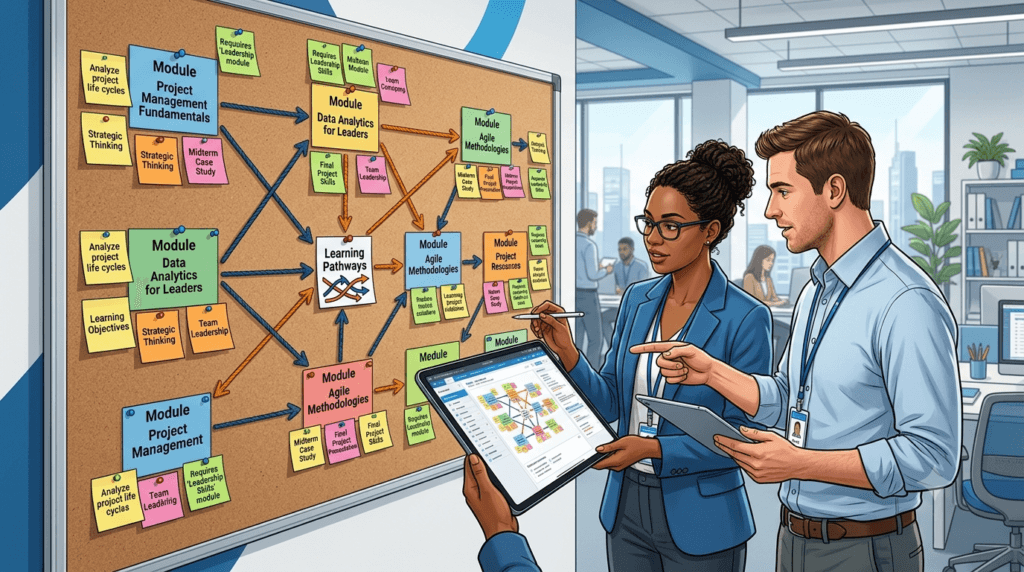
Curriculum Mapping
Curriculum mapping is the practical tool curriculum designers use to visualize this structure. It lays out what’s taught, when it’s taught, and how each unit connects to the next — making gaps, redundancies, and misalignments visible before a single lesson is built.
Backward Design (Understanding by Design)
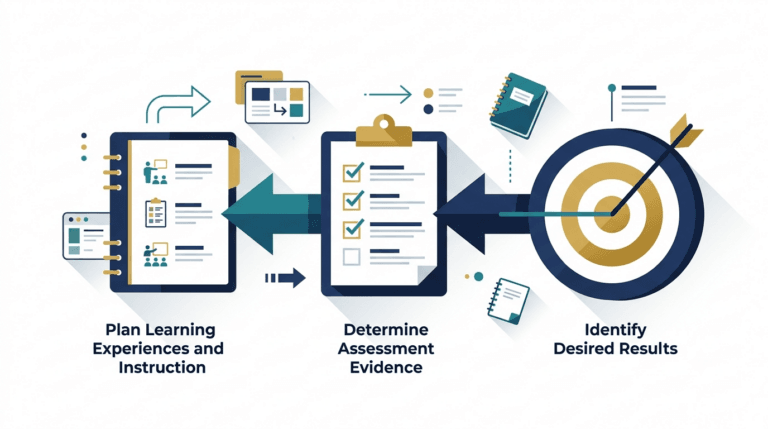
Much of modern curriculum design borrows from backward design, popularized through the Understanding by Design (UbD) framework developed by Grant Wiggins and Jay McTighe. Instead of starting with content or activities, backward design starts with the end goal: what should learners understand and be able to do, and what evidence would prove they got there? Only then does the designer plan the learning experiences that lead up to it.
Alignment
Alignment is the quality check that holds curriculum design together. It means every unit, assessment, and learning outcome ladders up to the same overarching goal — nothing is taught in isolation, and nothing is assessed that wasn’t actually taught.
In short, curriculum design answers: what should the entire learning journey look like, and why?
Curriculum Development vs Instructional Design
You’ll also see the term “curriculum development” used alongside curriculum design — and while they overlap heavily, they’re not identical. Curriculum design is the planning and structuring phase: deciding what to teach and in what sequence. Curriculum development is the broader umbrella that also includes writing the actual content, piloting it, and evaluating and revising it over time.
Instructional design, by contrast, stays focused at the delivery-experience level throughout — it doesn’t own the program’s ongoing evaluation cycle the way curriculum development does. In practice, most L&D teams don’t draw this line sharply, but it’s worth knowing if you’re scoping a role or a vendor contract.
What is Instructional Design?
Instructional design zooms in. Where curriculum design draws the map, instructional design builds the actual experience a learner has inside each stop along that map — the lesson, the module, the eLearning course, the workshop.
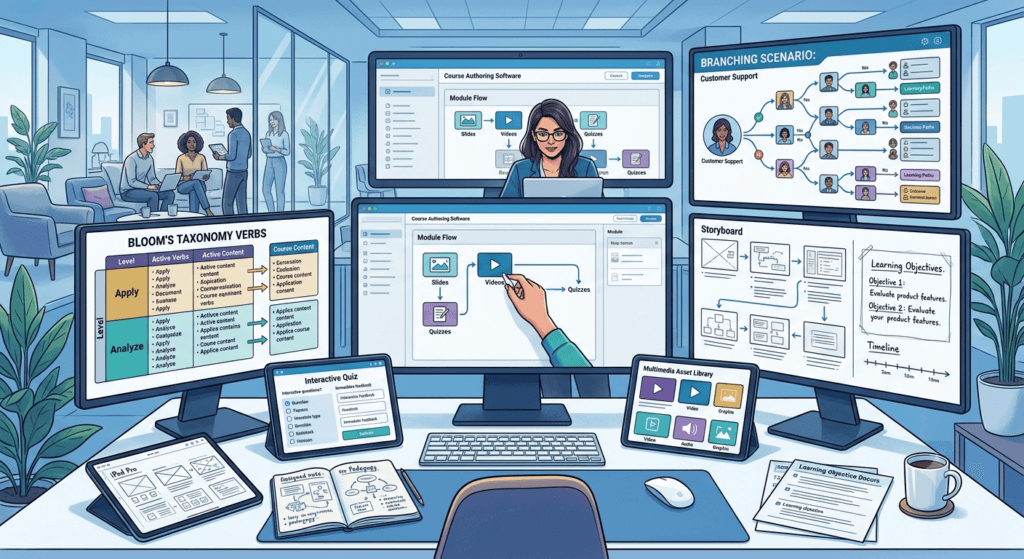
Instructional design is concerned with:
- Delivery — how content is presented (facilitator-led, eLearning, blended, self-paced)
- Engagement — how learners stay motivated and involved
- Effectiveness — whether the learning experience actually produces the intended behavior change or skill
Instructional design is sometimes called instructional systems design (ISD) — a nod to how methodically it treats each learning asset as a system with inputs, a process, and a measurable output.
The ADDIE Model
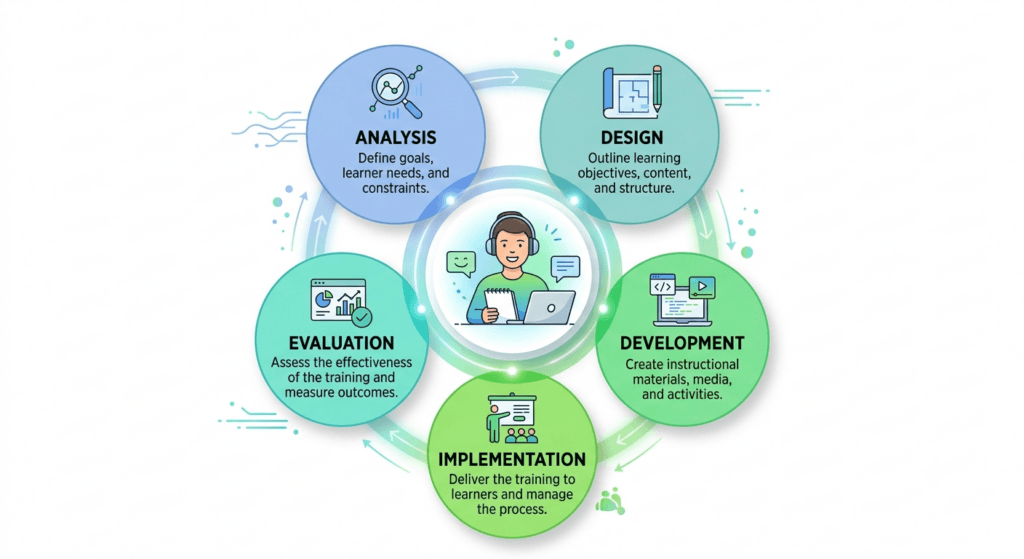
The most widely referenced framework here is ADDIE — Analysis, Design, Development, Implementation, and Evaluation. It’s less a rigid sequence and more a dynamic checklist instructional designers use to move from “we need training on X” to a finished, tested learning asset. ADDIE is the generic process that most other instructional design models are built on or adapted from.
Bloom’s Taxonomy
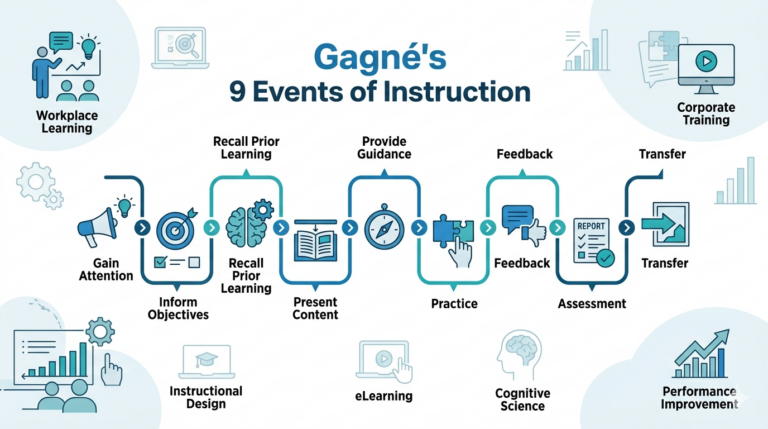
Instructional designers also lean heavily on Bloom’s Taxonomy to write learning objectives with the right level of cognitive demand — deciding whether a learner simply needs to recall information, or whether they need to apply, analyze, or evaluate it. This shapes everything from the verbs used in an objective to the type of practice activity designed around it.
Learning Experience Design
More recently, the field has folded in learning experience design (LXD) — a user-experience lens applied to learning. LXD asks not just “does this teach the right content?” but “does this feel intuitive, engaging, and worth the learner’s time?”
In short, instructional design answers: how do we teach this specific piece of content so people actually learn it?
Learning Design vs Instructional Design
You’ll increasingly see “learning design” used as an umbrella term that stretches beyond instructional design’s traditional scope. Where instructional design typically focuses on structured courses and formal training assets, learning design also considers informal and social learning — mentoring, peer coaching, learning in the flow of work, and the surrounding environment a learner sits in.
In corporate L&D, the two terms are used almost interchangeably day to day, but “learning design” signals a broader, more ecosystem-level view of how people actually develop skills, not just how a single course is built.
Curriculum Design vs Instructional Design: Core Differences
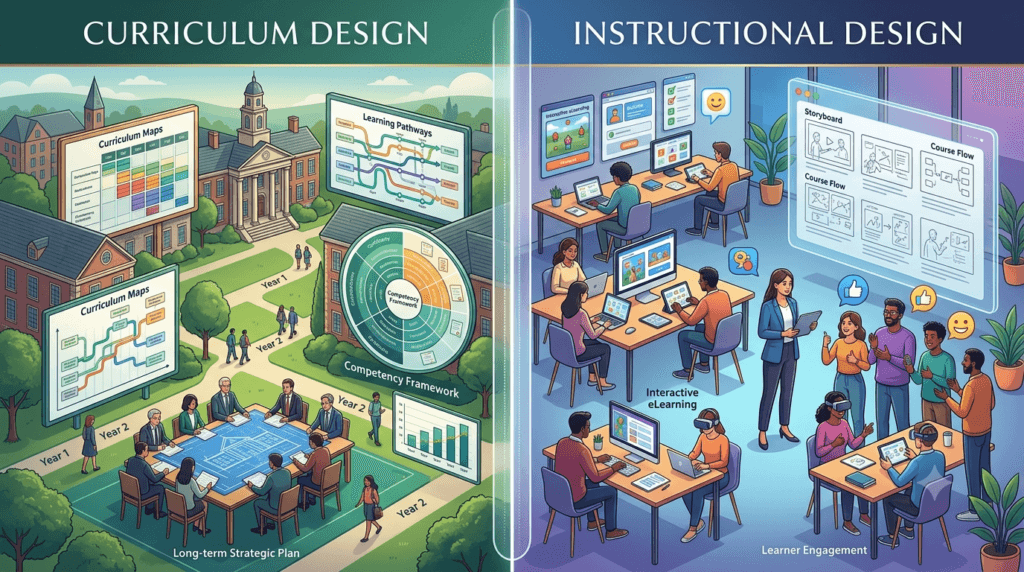
Here’s where the two disciplines split most clearly.
| Aspect | Curriculum Design | Instructional Design |
| Scope | Entire program or learning pathway | Individual course, module, or lesson |
| Focus | What to teach and in what order | How to teach it effectively |
| Timeline | Long-term (months to years) | Short-to-mid-term (weeks to months per asset) |
| Output | Program roadmap, syllabus, learning pathway | eLearning module, workshop, facilitator guide, job aid |
| Stakeholders | Program owners, academic leads, L&D directors | Instructional designers, facilitators, SMEs |
| Tools | Curriculum maps, program frameworks, competency models | Storyboards, ADDIE, authoring tools, learning objectives |
Notice the pattern: curriculum design is the what and why at the program level. Instructional design is the how at the content level. One without the other leaves a gap — a curriculum with no instructional design is just a table of contents nobody can teach from, and instructional design with no curriculum is a collection of well-built lessons that don’t add up to anything coherent.
How They Work Together
This is the part that matters most in practice: curriculum design and instructional design aren’t competing disciplines — they’re sequential dependencies.
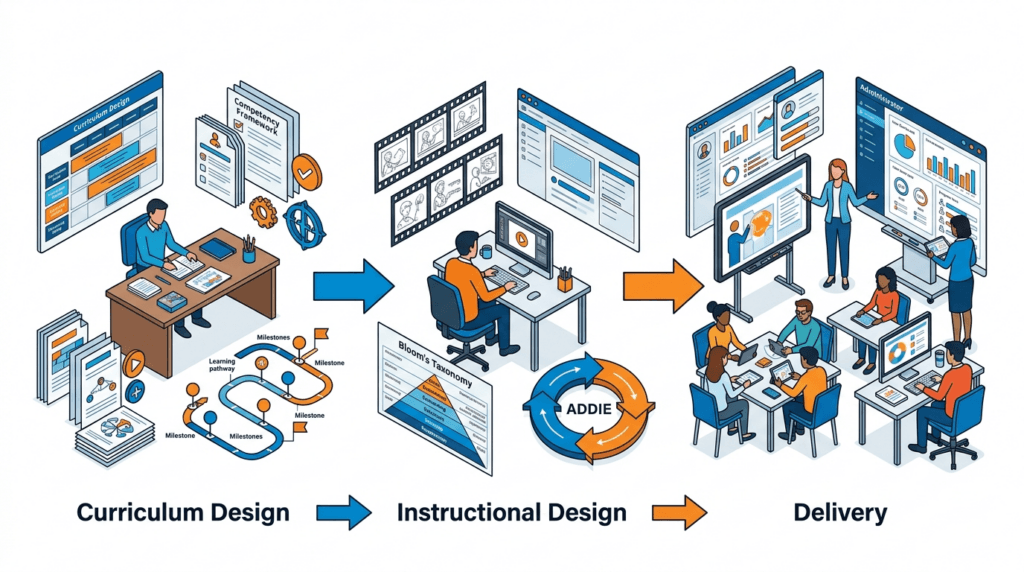
The flow typically looks like this:
Curriculum Design → Instructional Design → Delivery
Curriculum design happens first. It defines the program’s overarching goals, breaks them into logical units, and sequences those units into a coherent path. Only once that roadmap exists does instructional design step in to build out each unit — writing objectives, designing activities, choosing delivery formats, and producing the actual learning assets.
A corporate L&D example:
Say a company is rolling out a new People Manager Excellence Program. A curriculum designer (or an L&D lead wearing that hat) first maps the full learning journey:
- Module 1 — Foundations of Coaching
- Module 2 — Giving Feedback
- Module 3 — Managing Performance
- Module 4 — Leading Through Change
They decide the sequence, the prerequisites, and how each module ladders up to the goal of “confident, capable first-time managers” — the kind of structural thinking that also underpins a broader L&D strategy.
Once that structure is locked, instructional designers take each module and build it out. For Module 2 — Giving Feedback — an instructional designer applies ADDIE: analyzing what managers currently struggle with, designing objectives using Bloom’s verbs (“practice,” “critique,” “apply”), developing role-play scenarios and a short eLearning primer, and building in a manager-led practice session.
The curriculum gave the program its skeleton. Instructional design gave it muscle. Delivery — facilitators running the workshop, or learners completing the eLearning — is where it all comes to life.
When to Use Curriculum Design vs Instructional Design
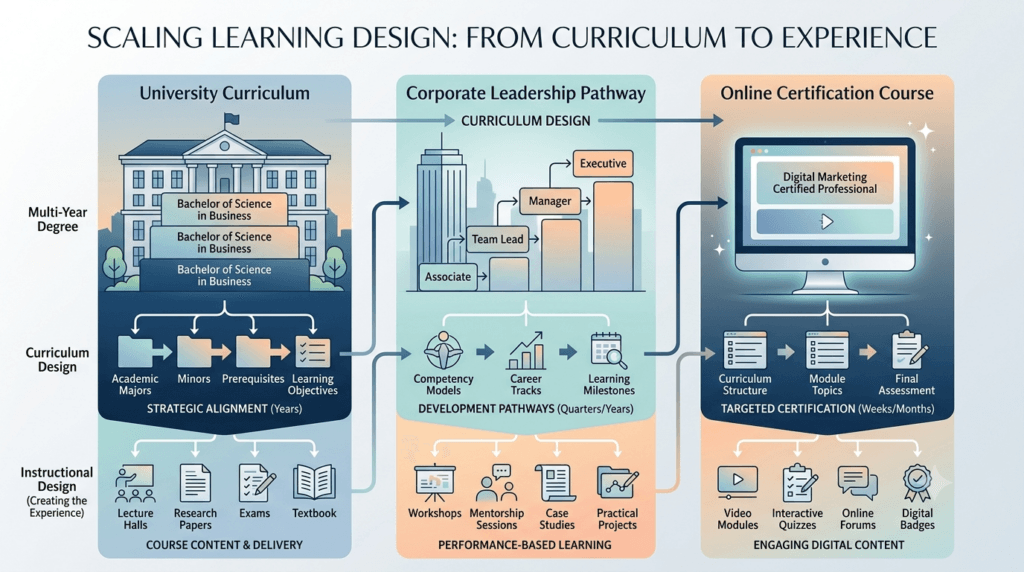
Academic Programs
In universities and schools, curriculum design dominates the early planning: degree requirements, course sequencing across semesters, prerequisite chains. Instructional design then takes over at the course level — how a specific professor structures a semester’s lectures, readings, and assessments.
Corporate Training
In corporate L&D, curriculum design shows up as learning pathways or competency frameworks — for example, a full onboarding journey or a leadership development track spanning 6–12 months. Instructional design builds each individual training asset within that track: the workshops, the eLearning modules, the facilitator-led sessions, the job aids.
eLearning Courses
For a single eLearning course, you may not need formal curriculum design at all — instructional design alone might suffice. But if that course is one of ten in a certification or digital learning pathway, curriculum design needs to happen first to make sure all ten modules connect logically and don’t duplicate or contradict each other.
| Rule of thumb: if you’re planning a program, start with curriculum design. If you’re building a single learning asset within an already-defined program, you’re in instructional design territory. |
Tools Used in Curriculum Design vs Instructional Design
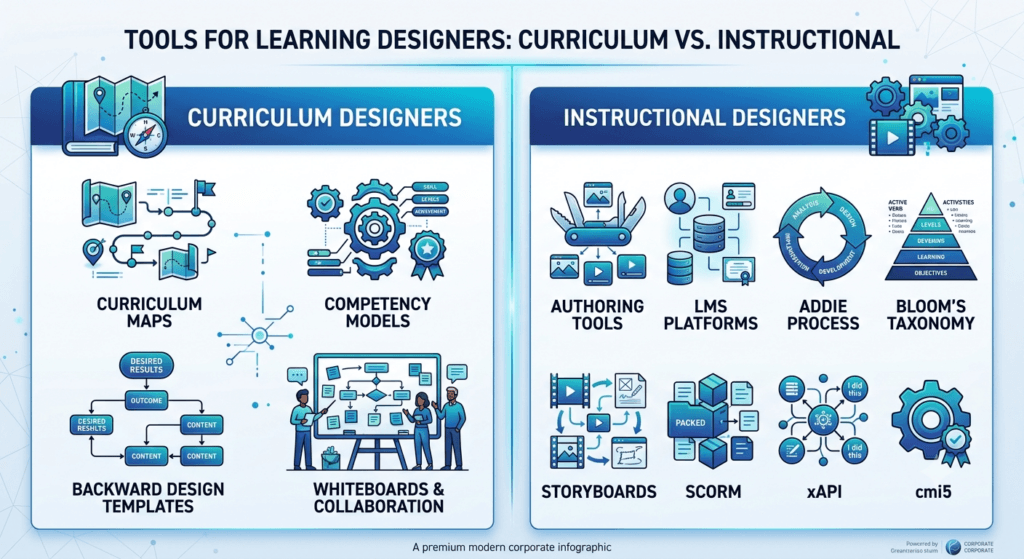
The two disciplines lean on different toolkits, which is often the fastest way to tell which hat someone is wearing on a project.
Curriculum design tools tend to be structural: curriculum maps, program frameworks, competency matrices, and backward-design templates. These live in spreadsheets, whiteboards, or dedicated curriculum-mapping software — the output is a plan, not a finished asset.
Instructional design tools are production-oriented:
- Authoring tools like Articulate Storyline, Rise, or iSpring, used to build the actual eLearning module
- LMS platforms that host and track the finished course
- SCORM, xAPI, and cmi5 — the technical standards that let a course report completion and performance data back to the LMS
If you’re evaluating a candidate or a vendor and they can only speak to one side of this list, that’s a useful signal of where their actual expertise sits.
Common Mistakes Professionals Make
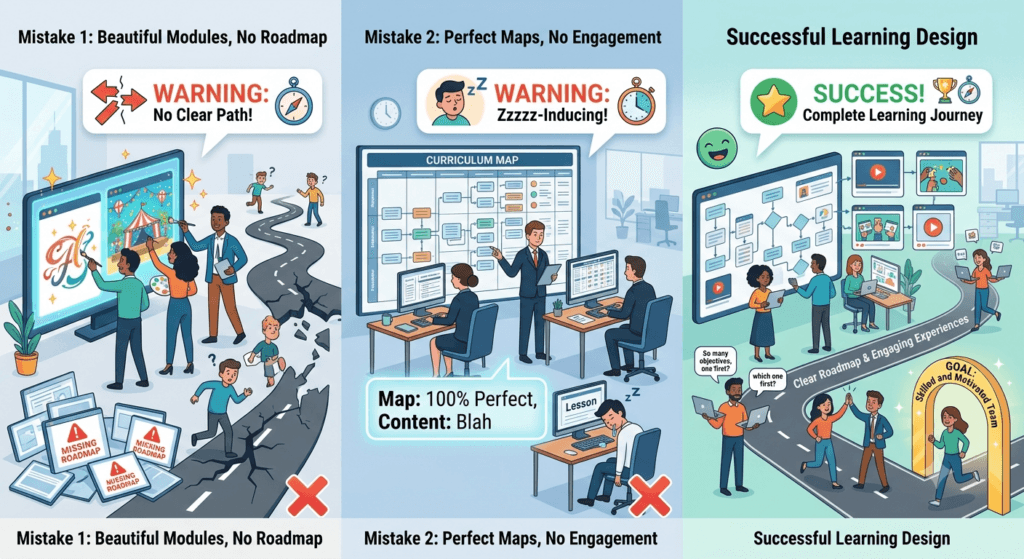
Confusing the two roles. Job titles blur this constantly — “Instructional Designer” postings sometimes expect curriculum-level program design, and vice versa. Knowing the distinction helps you scope a role, a project, or a deliverable correctly before work begins.
Skipping curriculum alignment. Teams often jump straight into building individual courses without first mapping how those courses connect. The result: modules that overlap, contradict each other, or leave gaps in the learner’s overall progression.
Over-focusing on tools. It’s easy to get pulled into authoring software, templates, and slick eLearning builds before the underlying structure is sound. A beautifully designed module built on a poorly sequenced curriculum still fails the learner — because the what was never solved before the how took over.
Quick Summary
- Curriculum design = the roadmap. Program-level structure, sequencing, and outcomes.
- Instructional design = the journey. Course-level delivery, engagement, and effectiveness.
- Curriculum design typically comes first and informs instructional design.
- Curriculum design uses tools like curriculum mapping and backward design (UbD); instructional design uses frameworks like ADDIE and Bloom’s Taxonomy.
- Academic programs lean heavily on curriculum design; single eLearning courses can often start straight at instructional design.
- The two disciplines work best as a sequence, not a substitute for one another.
Conclusion
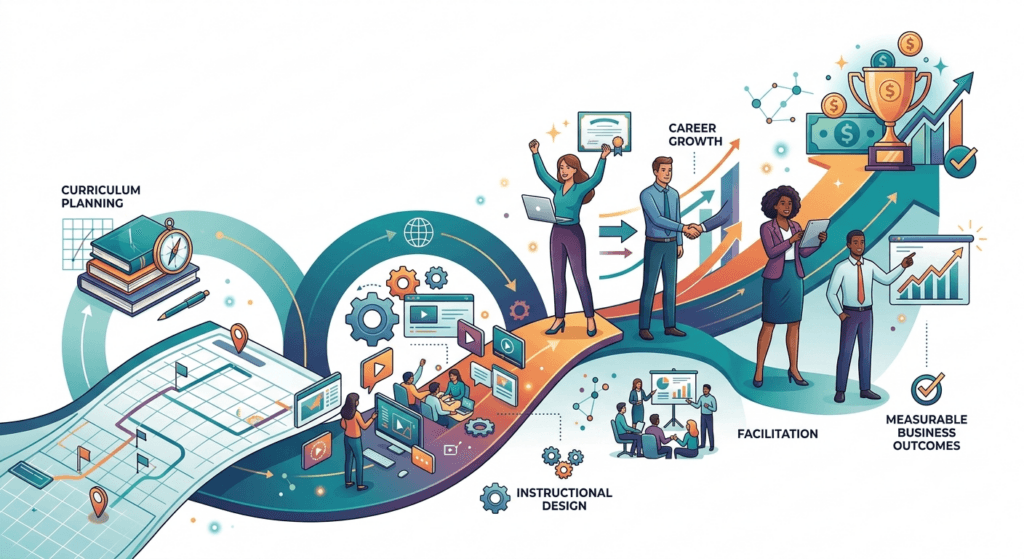
Curriculum design and instructional design aren’t two names for the same job — they’re two different altitudes of the same craft. Curriculum design gives a learning program its shape and direction. Instructional design gives each piece inside that program the substance to actually teach something.
Once you can tell the two apart, planning gets easier: you know when to zoom out and map the whole journey, and when to zoom in and build the experience for a single step along the way. To understand how instructional design fits into the broader picture, explore our complete instructional design models playbook, where frameworks like ADDIE and Bloom’s Taxonomy are covered in depth.
Frequently Asked Questions
Is curriculum design part of instructional design?
Not quite the reverse of what most people assume — curriculum design is the broader, program-level discipline, and instructional design typically operates within the structure a curriculum defines. They’re closely related and often performed by the same person in smaller teams, but curriculum design is not a subset of instructional design; if anything, instructional design work is scoped by curriculum decisions made earlier.
Which comes first – curriculum design or instructional design?
Curriculum design comes first. It establishes the overall goals, structure, and sequence of a learning program. Instructional design follows, building out the specific courses, modules, and materials that live inside that structure.
Is curriculum design higher level than instructional design?
Yes, in scope terms. Curriculum design operates at the program level — the full learning pathway. Instructional design operates one level down, at the course or module level, inside the structure curriculum design has already set.
Can one person do both curriculum design and instructional design?
Often, yes — especially in smaller L&D teams, where a single L&D lead or senior instructional designer will map the curriculum and then build out the individual modules themselves. In larger organizations or academic institutions, the two are more likely to be separate, specialized roles.
Which is better: curriculum design or instructional design?
Neither — they’re not competing for the same job. Curriculum design without instructional design produces a plan nobody can actually teach from. Instructional design without curriculum design produces well-built lessons that don’t add up to a coherent program. The two need each other to produce learning that both makes sense and works.
Is curriculum design the same as instructional design?
No. They’re closely related and often overlap in practice, but they operate at different levels — curriculum design shapes the overall program, while instructional design shapes how each individual piece of that program is taught. Treating them as interchangeable is exactly the confusion this article set out to clear up.
Further Reading
- Instructional Design Models Playbook (Pillar)
- How to Apply the ADDIE Model Step by Step
- Bloom’s Taxonomy: How to Write Learning Objectives That Actually Work
- How to Design a Learning Programme From Scratch
- What Is xAPI? A Practical Free Guide to the Experience API for L&D
References
- Understanding by Design (Expanded 2nd Edition) || 2nd Edition || Grant Wiggins & Jay McTighe || ASCD || 2005
- The Systematic Design of Instruction || 8th Edition || Walter Dick, Lou Carey, James O. Carey || Pearson || 2014
- Design for How People Learn || 2nd Edition || Julie Dirksen || New Riders || 2015
- Curriculum: Foundations, Principles, and Issues || 7th Edition || Allan C. Ornstein & Francis P. Hunkins || Pearson || 2017
- Instructional Design: The ADDIE Approach || 1st Edition || Robert Maribe Branch || Springer || 2009
- Understanding by Design: A Framework for Effecting Curricular Development and Assessment || 1st Edition || Jay McTighe & Grant Wiggins || ASCD || 2012
Author Details

Tulip Ghosh is a Learning and Development professional who designs impactful, learner-centric experiences rooted in behavioral insight and real-world application. She is passionate about improving learner engagement and translating complex ideas into practical training solutions. A thoughtful writer at heart and with experience of a decade in Learning and Development domain, she brings a simple, grounded perspective to the evolving world of workplace learning. Reach out to her on her Linkedin Profile from here.