Introduction
Let me paint you a picture.
It is Monday morning. Your manager has just walked into your office — or pinged you on Teams, because it is 2025 and that is where managers live now — and told you that the sales team’s conversion rates have dropped for the third consecutive quarter. Leadership wants a training solution. They want it ready in six weeks. They want it to work.
You open your laptop. You stare at a blank slide deck. And somewhere in the back of your mind, a voice says: where do I even start? This is the moment the ADDIE model was built for.
If you have been in L&D for more than five minutes, you have been in this exact moment. The pressure is real. The expectations are high. And the temptation — the very human, very understandable temptation — is to skip straight to building content, because building content feels like progress.
This is where most training programmes quietly go wrong. And this is exactly why the ADDIE model exists.
In this article, we are going to walk through every phase of the ADDIE model the way it actually works in a corporate training context. Not in theory. In practice. With a real example running through every single step, so you can see exactly what each phase looks like when you are sitting at your desk with a brief in your hand and a timeline breathing down your neck.
By the end, you will not just understand ADDIE. You will know how to apply the ADDIE model step by step . As a bonus, you can also download the 5 templates of each phases of ADDIE for free.
First — What Is the ADDIE Model and Why Does It Still Matter?
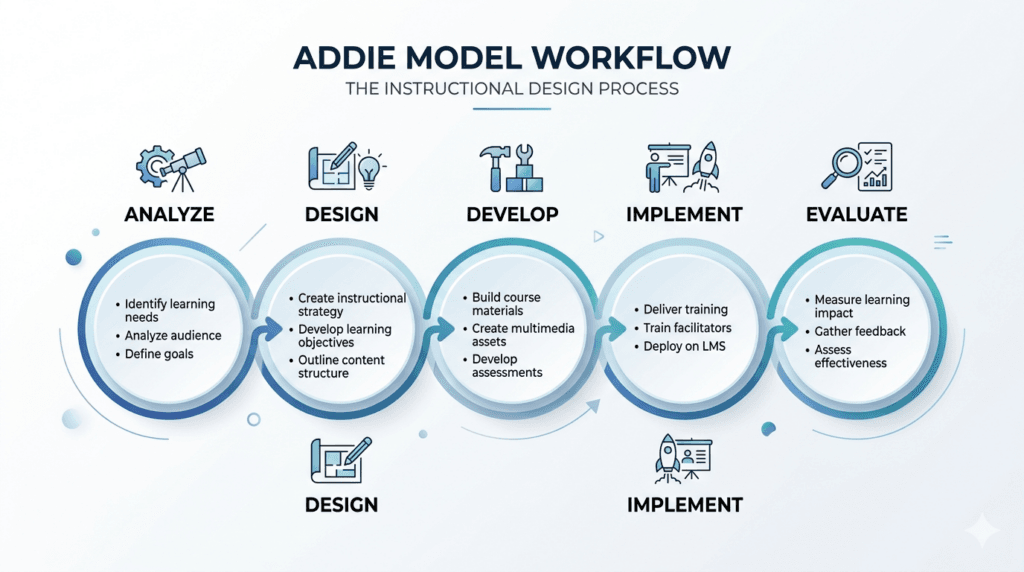
ADDIE stands for Analysis, Design, Development, Implementation, and Evaluation. It was originally developed in the 1970s at Florida State University for the US military — which tells you two things. First, it was built for high-stakes training where getting it wrong had serious consequences. Second, it has been tested across more training contexts, industries, and learner groups than almost any other framework in existence.
That is why, fifty years later, it is still the most widely used instructional design model in corporate L&D.
But here is the honest version that most articles skip over: ADDIE is not magic. It does not guarantee a great training programme. What it does is give you a disciplined sequence for making decisions — and in corporate training, undisciplined decision-making is the single biggest cause of programmes that fail quietly and expensively.
The five phases work like this:
- Analysis — Understand the actual problem before you design anything.
- Design — Build the blueprint before you build the content.
- Development — Create the materials the blueprint calls for.
- Implementation — Deliver the training with intention and preparation.
- Evaluation — Measure what changed, not just what happened.
Simple in principle. Harder in practice. Let us go through each one properly.
The Real Example We Will Use Throughout This Article
To make this concrete, we are going to follow one training project through all five phases. Here is the scenario:
Organisation: A mid-sized financial services company — let us call them Meridian Financial.
The problem: The customer services team’s first-call resolution rate has dropped from 74% to 61% over the past two quarters. Customers are calling back. Complaints are up. The Head of Customer Operations has requested a training intervention.
The brief to you: Design and deliver a training programme for 45 customer service representatives within eight weeks. The goal is to bring first-call resolution back above 70%.
This is real. This is the kind of brief that lands in L&D inboxes every week. Let us work through it using ADDIE.
Phase 1 — Analysis: Understand the Problem Before You Touch a Slide
What it is
The Analysis phase is about diagnosing before prescribing. It sounds obvious. It is surprisingly rare in practice.
Most training requests arrive as solutions. “We need a communication skills workshop.” “We need a module on our new CRM system.” “We need something on resilience.” These are not problems — they are assumptions about solutions. Your job in the Analysis phase is to go back behind the assumption and find the actual problem.
What you actually do
There are three levels of analysis that every corporate trainer should run, even in a condensed form.
Organisational analysis — What is the business context? What is the goal, and how does this training connect to it? Who are the stakeholders, and what does success look like to them?
Task analysis — What are the specific tasks, behaviours, or decisions that need to change? What does good performance look like in this role, and where is the current performance falling short?
Learner analysis — Who are the people you are designing for? What do they already know? What is their attitude toward training? What constraints — time, technology, language, shift patterns — will shape how you design?
At Meridian Financial
You do not just accept the brief. You dig in.
You spend two days running a proper analysis. You interview the Head of Customer Operations, three team leaders, and six customer service representatives across different performance levels. You listen to recordings of five resolved calls and five unresolved ones. You pull the complaints data and look for patterns.
What you find surprises you.
The drop in first-call resolution is not primarily a communication skills problem. It is a product knowledge problem. Six months ago, Meridian launched three new product variants with different terms and conditions. The training on those products was a one-hour briefing session. The customer service representatives are handling calls about products they only partially understand — and when a customer asks something they cannot confidently answer, they promise to call back rather than risk giving wrong information.
This matters enormously. If you had skipped the Analysis phase and built a communication skills programme — which is what the original brief implied — you would have delivered six weeks of training that did not address the actual problem. First-call resolution would still be at 61%. You would have wasted everyone’s time and budget, and you would have been the one explaining why the numbers did not move.
Analysis saves you from building the right solution to the wrong problem.
Output of the Analysis phase: A written summary — even a one-page document — covering the identified performance gap, the root cause, the target audience, the business goal, any constraints, and a clear statement of what success looks like. This becomes the foundation for everything that follows.
Phase 2 — Design: Build the Blueprint Before You Build the Content
What it is
The Design phase is where you plan the learning experience. Not build it — plan it. The analogy I always come back to is architecture. An architect designs the building before the builders lay a single brick. The design phase is your architectural drawing.
This is the phase that most time-pressured trainers skip or rush — and it is the phase that, when done properly, makes everything that comes after it faster, easier, and better.
What you actually do
Write your learning objectives first. Not topics. Objectives. There is a significant difference. “Understanding product features” is a topic. “Accurately explain the key differences between Product A, B, and C to a customer within two minutes” is a learning objective. Objectives describe what a learner will be able to do after training. They drive everything — content, activities, and assessment.
Choose your delivery method. Will this be instructor-led? eLearning? Blended? On-the-job? The answer depends on your learner analysis — their schedule, their location, their learning preferences, and the nature of what they need to learn.
Design your assessment strategy. How will you know that learning happened? Decide this during the design phase, not at the end of development when you realise you need a quiz and bolt one on in twenty minutes.
Map your content structure. What are the modules? What is the sequence? How does each section connect to the learning objectives? What activities will you use, and why?
Create a design document. This does not need to be forty pages. It can be a structured one-pager. But it needs to exist, because it is what you show stakeholders before you spend weeks building content they will then ask you to completely change.
At Meridian Financial
Based on your analysis, here is what you design:
Learning objectives: By the end of this programme, customer service representatives will be able to accurately explain the key features and terms of all three new product variants, identify which product a customer holds based on their account details, confidently answer the twelve most common customer questions about the new products, and handle call escalation decisions with greater certainty — reducing the need for callbacks.
Delivery method: A blended approach. Two half-day instructor-led sessions covering product knowledge and call handling scenarios, supported by a digital reference guide accessible during live calls. You also design a two-week post-training reinforcement plan using brief daily retrieval practice quizzes via the company’s existing LMS.
Assessment strategy: A pre-training knowledge check to establish baseline product knowledge. Formative quizzes during both sessions. A practical call simulation at the end of session two. A post-training knowledge check at four weeks to measure retention.
Content structure: Module 1 — Understanding the three new products: features, terms, and differences. Module 2 — Reading the customer account: identifying which product they hold. Module 3 — The twelve most common questions: confident answers and when to escalate. Module 4 — Call simulation practice with structured feedback.
Output of the Design phase: A design document that your stakeholder signs off on before you build a single piece of content. This sign-off is not bureaucracy — it is protection. It means that when content is delivered, everyone agreed on what was being built.
Phase 3 — Development: Build What the Blueprint Calls For
What it is
This is the phase most trainers secretly enjoy most — because it is where things get made. Slides, activities, facilitator guides, videos, job aids, assessment tools. Development is where the design comes to life.
The key discipline in this phase is building exactly what the design document specified, and resisting the temptation to add, expand, or elaborate beyond what the learning objectives require. Scope creep in the development phase is one of the most common causes of overlong, overloaded training programmes that lose learners by lunchtime.
What you actually do
Build content modularly. Develop one module at a time, complete with its activities and assessments, before moving to the next. This makes review and revision far more manageable.
Pilot before you finalise. Before the full delivery, test your materials with a small group — ideally two or three people from your actual learner group. Ask them to tell you what is unclear, what is missing, and what feels unnecessary. You will be amazed what a twenty-minute pilot review catches that you completely missed after staring at the same content for two weeks.
Build your facilitator guide at the same time as your content. Not afterwards. If you are delivering this yourself, the facilitator guide keeps you honest — it forces you to think about timing, transitions, and what you will do when a learner asks a question your content does not cover.
Apply cognitive load principles throughout. One idea per slide. Chunked content. Visuals that support the message rather than decorate the slide. Summaries at the end of each section. If it looks impressive, it is probably overloaded.
At Meridian Financial
You build four modules over three weeks. You create a clean digital reference card — one page, laminated — that reps can keep at their desk during calls while their confidence builds. You develop twelve scenario cards for the call simulation, each based on a real customer question from the complaints data you gathered during Analysis.
You run a thirty-minute pilot with two customer service representatives who were not part of your original interviews. One of them points out that Module 2 assumes familiarity with the account management system that newer reps do not have. You go back and add a two-minute orientation to that module. Without the pilot, this would have surfaced on day one of delivery — in front of forty-five people.
Output of the Development phase: Finalised, reviewed, and approved training materials — session decks, facilitator guide, reference card, scenario cards, pre and post assessments, and the LMS reinforcement quizzes — ready for delivery.
Phase 4 — Implementation: Deliver With Intention
What it is
Implementation is the delivery phase — and while it might seem like the point where instructional design hands over to facilitation, the two are far more connected than that. How a training programme is implemented — how participants are prepared, how the environment is set up, how the facilitator shows up — is as important to learning outcomes as the quality of the content itself.
A brilliant programme, poorly implemented, fails. A solid programme, well implemented, works. Implementation is not a formality. It is a craft.
What you actually do
Prepare your participants before the session. Send a pre-communication that explains why this training is happening, what it will cover, and — critically — what is expected of them afterwards. Adults learn better when they know why they are in the room. Do not leave this to their line manager to communicate on your behalf.
Prepare your facilitators. If you are not delivering this yourself, run a facilitator briefing session. Walk through the design intent, the tricky moments, the questions likely to come up. A facilitator who understands why each activity exists will deliver it better than one who is just following a slide deck.
Set up the environment intentionally. Whether this is a physical room or a virtual classroom, the environment shapes the learning experience. Arrive early. Test the technology. Arrange the room to support the kind of interaction your design requires. If you designed discussion and collaboration, rows of seats facing a projector will undermine you before you have said a word.
Be present to what is actually happening in the room. Your facilitator guide is a plan, not a script. The best trainers read the room continuously — adjusting pace, adding examples, calling out energy when it drops, responding to what learners are actually bringing rather than rigidly delivering what was written. Implementation is where human judgement becomes the most important tool in your kit.
At Meridian Financial
You run two cohorts — morning and afternoon — across two days, covering all 45 representatives. You send a pre-session email to every participant three days before, explaining what the drop in first-call resolution means for the team and why this programme was designed specifically around the product knowledge gap identified in the analysis.
This framing matters. When participants arrive, they already understand the why. There is no eye-rolling about “another training day.” They know this was built for them, around a problem they recognise from their own calls.
The call simulation in session two generates the most energy. Representatives are working in pairs, using the actual scenario cards drawn from real customer complaints. The room is noisy, competitive, and engaged. Two team leaders who attended the session — which you specifically requested — are participating alongside their teams. After the session, both ask you for a copy of the scenario cards to use in their team huddles going forward.
That is implementation done well.
Output of the Implementation phase: Training delivered. Attendance recorded. Participant reactions captured. Facilitator observations documented. The conversation with the two team leaders noted as a transfer support opportunity.
Phase 5 — Evaluation: Measure What Changed, Not Just What Happened
What it is
Evaluation is the most important phase in ADDIE and the most consistently shortchanged. In most corporate training programmes, evaluation means a smile sheet — a five-question survey at the end of the session asking whether participants enjoyed themselves. This is not evaluation. It is satisfaction data. And satisfaction data, while not useless, tells you almost nothing about whether the training worked.
Real evaluation asks a harder question: did anything change because of this training?
Most L&D professionals are familiar with the Kirkpatrick model’s four levels — reaction, learning, behaviour, and results. ADDIE’s Evaluation phase is where those levels are applied. And the crucial point is this: you cannot evaluate at Level 3 or Level 4 if you have not designed for it from the Analysis phase. Evaluation is not something you add at the end. It is something you build in from the beginning.
What you actually do
Level 1 — Reaction: How did participants respond to the training? Was it relevant, well-paced, and engaging? Useful for identifying facilitation and content issues, but not a measure of learning effectiveness.
Level 2 — Learning: Did participants actually acquire the knowledge or skills the programme was designed to deliver? This is where your pre and post knowledge checks are essential. Compare the scores. Look for patterns. Identify which areas showed the smallest gains — those are the parts of your programme that need redesigning.
Level 3 — Behaviour: Are participants applying what they learned back on the job? This is the hardest level to measure and the most important one. It requires follow-up — observations, manager feedback, performance data — at thirty, sixty, or ninety days post-training.
Level 4 — Results: Did the training move the business metric it was designed to move? This is where you return to the original business goal from your Analysis phase and ask: did we achieve it?
At Meridian Financial
At the end of both sessions, you collect Level 1 reaction data. Overall satisfaction is high — 4.3 out of 5. Participants specifically cite the scenario cards as the most useful part. You note this for the next iteration.
Your pre and post knowledge checks tell a more interesting story. Average product knowledge scores rose from 54% pre-training to 81% post-training across both cohorts. Module 2 — account identification — showed the smallest gain, confirming that the section you revised after the pilot still needs further work.
At four weeks, you run the LMS reinforcement quizzes. Average retention is 76% — a drop from 81%, but within an acceptable range given the complexity of the product information.
At eight weeks, you pull the first-call resolution data with the Head of Customer Operations.
First-call resolution has risen from 61% to 73%.
The business goal was 70%. You exceeded it.
That is Level 4 evaluation. And it is the only number that ultimately matters in the conversation with leadership.
Output of the Evaluation phase: A brief evaluation report — two pages is enough — showing results at all four Kirkpatrick levels, identifying what worked, what needs improvement, and what you recommend for the next iteration of the programme.
ADDIE in Practice — The Honest Bit
Here is what the articles that wrap up with “and that is how ADDIE works — follow these five steps and your training will be effective!” tend to leave out.
ADDIE is not linear in real life. The model is often drawn as a clean sequence — Analysis flows into Design flows into Development and so on. In practice, you loop. You are three weeks into Development and you discover something your Analysis missed. You go back. You are delivering Implementation and a pattern emerges in the room that suggests your Design underestimated a key knowledge gap. You note it, you adjust, and you build it into the next iteration.
ADDIE is not always done in full. For a six-week programme building to a business-critical metric, full ADDIE rigour is appropriate and worth the investment. For a ninety-minute workshop on a topic your team knows well, a condensed version — a fast Analysis, a brief Design document, rapid Development, clean Implementation, and at least Level 1 and Level 2 Evaluation — is entirely legitimate. The model scales.
ADDIE does not replace your judgement. The model gives you a structure. It does not tell you what to put inside that structure. Your experience, your knowledge of your learners, your relationships with stakeholders, and your ability to read what is happening in the room — those are what make the structure work. ADDIE in the hands of a thoughtful, experienced trainer produces great training. ADDIE in the hands of someone following it mechanically, without genuine engagement at each phase, produces mediocre training that happens to be well-documented.
Use it as a thinking framework, not a compliance checklist.
Quick Reference: ADDIE at a Glance
| Phase | Core Question | Key Output |
| Analysis | What is the actual problem? | Needs analysis document |
| Design | What will the solution look like? | Design document and sign-off |
| Development | Does the content do what the design intended? | Finalised, piloted materials |
| Implementation | Is the training being delivered as designed? | Delivery records and observations |
| Evaluation | Did anything change? | Evaluation report against business goal |
Common ADDIE Mistakes — and How to Avoid Them
Skipping or rushing Analysis. The most expensive mistake in training design. Every hour you invest in Analysis saves you multiple hours in redesign later.
Designing by content rather than by objective. If your Design phase produces a topic list rather than a set of learning objectives, you are building a presentation, not a training programme.
Piloting only in your head. A mental walkthrough of your content is not a pilot. Test it with real people from your actual learner group before you finalise anything.
Treating Implementation as just delivery. Participant preparation, environment setup, and facilitator readiness are all part of Implementation. Neglect them and your content will underperform regardless of its quality.
Evaluating only at Level 1. Reaction data is a starting point. If it is the only data you collect, you have no idea whether your training worked. Always design for at least Level 2 evaluation, and push for Level 4 whenever the business goal makes it possible.
Conclusion
The ADDIE model will not make training design effortless. Nothing does. What it does is give you a principled sequence for making better decisions — about what problem you are actually solving, what the solution should look like, how to build it without wasting time, how to deliver it in a way that respects your learners, and how to know whether it worked.
At Meridian Financial, first-call resolution went from 61% to 73% in eight weeks. That did not happen because the training was beautifully designed or cleverly delivered — though both of those things matter. It happened because the Analysis phase revealed the real problem. Everything that followed was built on that foundation.
That is what ADDIE is for.
The next time your manager pings you on Teams with a training request and a tight deadline, do not open a blank slide deck. Open a new document and write one question at the top of it: what is the actual problem?
Start there. The rest of the model will follow.
Frequently Asked Questions
Is ADDIE still relevant in 2025?
Yes — and more so than ever for high-stakes training. While faster, more agile models like SAM have grown in popularity for rapid development contexts, ADDIE remains the most reliable framework when a training programme needs to be rigorous, documented, and demonstrably tied to a business outcome.
How long does the ADDIE process take?
It depends entirely on the scale and complexity of the programme. A large corporate programme might take twelve to sixteen weeks from Analysis to full Evaluation. A focused workshop might move through all five phases in two to three weeks. The model scales — what matters is that you do not skip phases, even under time pressure.
Can I use ADDIE and SAM together?
Yes — and many experienced L&D teams do. A common approach is to use ADDIE for the overall project structure, and to apply SAM’s iterative rapid prototyping approach within the Development phase. You get the discipline of ADDIE and the agility of SAM in the places where speed matters most.
What is the most important phase of ADDIE?
Analysis. Without exception. Every other phase depends on the quality of the Analysis. A weak Analysis produces a solution built on assumptions. A strong Analysis produces a solution built on evidence.
Do I need to complete every phase in order?
In practice, experienced instructional designers loop back between phases as new information emerges. However, you should complete Analysis before Design, and Design before Development. These sequences exist for good reasons — each phase depends on the outputs of the one before it.
Author Introduction

Tulip Ghosh is a Learning and Development professional who designs impactful, learner-centric experiences rooted in behavioral insight and real-world application. She is passionate about improving learner engagement and translating complex ideas into practical training solutions. A thoughtful writer at heart and with experience of a decade in Learning and Development domain, she brings a simple, grounded perspective to the evolving world of workplace learning.
Reach out to her on her Linkedin Profile from here.
External Links:
- Research and Creative Activity – Florida State University
- The Kirkpatrick Model
- The Successive Approximations Model
Further Reads:
- Bloom’s Taxonomy
- Instruction Designing Models
- Successive Approximation Model
- Merrill’s Principles of Instruction: Designing Skill-Based Training
- Kirkpatrick Model: How to Measure Training Effectiveness
- Kolb’s Learning Cycle: Using Experiential Learning in the Workplace
- Gagne’s 9 Events of Instructions
- ADDIE vs SAM: Which Instructional Design Model Should You Use in 2026?
- ARCS Model of Motivation — The Complete Guide for Corporate Trainers [2026]
- Adult Learning Theory (Andragogy): Knowles’ 6 Principles Explained with Workplace Examples
- Cognitive Load Theory Explained: A Practical Guide for Trainers & Instructional Designers
- How to Handle Difficult Participants in Training -A Practical Guide for Corporate Trainers
- Backward Design – The Complete Framework for Planning Learning
- Gamification vs Game-Based Learning: What’s the Difference