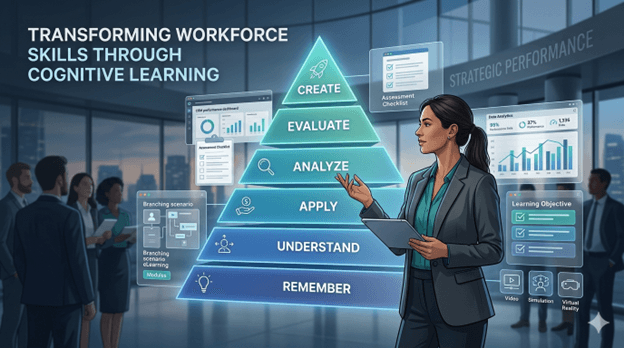
A practical guide for corporate trainers and instructional designers on applying Kolb’s experiential learning theory to create training that drives real behaviour change.
Why Most Corporate Training Fails (And How Kolb’s Model Fixes It)
It is Friday at Meridian Software. The training team runs a new customer service workshop. The trainer presents best practices, learners take notes, questions are asked, and the session ends on a high note.
By Monday morning, most of it is gone. Learners are back to their old habits.
The problem is not the trainer. The problem is that the training was designed to deliver information, not to create learning. Those are two very different things — and Kolb’s experiential learning cycle is built to close exactly that gap.
The most effective training programs are rarely the ones with the best slides. They are the ones that create experience, reflection, understanding, and practice in sequence.
Developed by psychologist David Kolb in his 1984 book Experiential Learning: Experience as the Source of Learning and Development, the Kolb learning cycle transforms training from a one-way information transfer into a four-stage loop that engages learners, embeds knowledge in memory, and produces measurable behaviour change.
In our experience working with L&D teams across sectors, most corporate training does not fail because learners are disengaged or because the content is wrong. It fails because reflection and experimentation are compressed or removed entirely — leaving learners with a memory of information rather than a habit of application. Kolb’s cycle is the clearest practical framework we know for diagnosing and fixing that gap.
What Is Kolb’s Experiential Learning Theory & Learning Cycle?
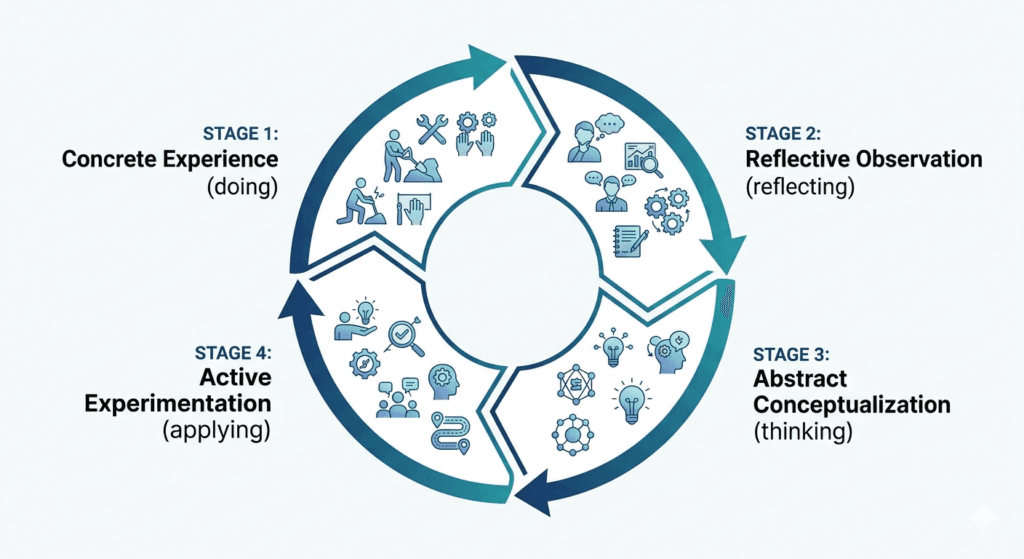
Kolb’s experiential learning theory is a model of how people learn from doing rather than from being told. At its core is a four-stage cycle: learners have a concrete experience, reflect on it, extract a general principle, and then apply that principle in a new situation. Then the cycle repeats.
Unlike Bloom’s Taxonomy — which describes cognitive levels from recall to creation — or the ADDIE model — which is a design process framework — Kolb’s cycle describes the learning journey itself. It is prescriptive about sequence, not just about depth or structure.
The experiential learning model is grounded in three intellectual traditions that Kolb drew together: Dewey’s pragmatism (learning through experience), Lewin’s action research (the role of reflection in changing behaviour), and Piaget’s constructivism (learners build understanding rather than passively receive it). These foundations are what give the model its durability.
The 4 Stages of Kolb’s Learning Cycle
Imagine a continuous loop. Each rotation deepens understanding and sharpens application.
| Stage | Label | What Happens | Example Activity |
| 1 | Concrete Experience | Learner does something real or simulated | Role-play, simulation, on-the-job task |
| 2 | Reflective Observation | Learner examines what just happened | Guided discussion, journaling, peer debrief |
| 3 | Abstract Conceptualization | Learner connects experience to principles | Framework intro, case analysis, lecture |
| 4 | Active Experimentation | Learner applies concept in a new context | Second scenario, real work task, action plan |
Stage 1: Concrete Experience — “What Happened?”
The learner participates in a real or realistic experience. They do something. This is not watching a video or reading a handout — it is direct engagement with a task, scenario, or problem. Role-plays, simulations, on-the-job tasks, and live experiments all qualify.
At Meridian, this meant putting customer service reps into a role-play with an angry customer before any training on de-escalation had been delivered. Real interaction. Real emotional stakes, even in a simulation.
Without this stage, training starts with theory — and loses Accommodators and Divergers before the first slide is done.
Stage 2: Reflective Observation — “So What?”
The learner steps back and examines the experience. What happened? What went well? What was surprising? What would they do differently? This is the most frequently skipped stage in corporate training, and the most consequential omission.
Meridian’s trainer paused after the role-play and asked: “What happened in that conversation? How did the customer respond? What could you have done differently?” That 10-minute discussion is not a luxury. It is where insight is formed.
Without reflection, learners have a memory of an activity but not a lesson from it. Experience without reflection is just an event.
Stage 3: Abstract Conceptualization — “Now What?”
The learner connects their reflection to a broader principle or framework. This is where individual experience becomes transferable knowledge. The concept lands differently when it is anchored to something the learner just lived through.
Meridian’s trainer introduced the five de-escalation techniques and noted: “Notice how in your role-play, you naturally used three of these. This framework explains what you already did.” That sequencing — experience first, theory second — is what makes the conceptualization stick.
Stage 4: Active Experimentation — “Let’s Try It”
The learner applies the new concept in a different situation — a second scenario, a real work task, or a structured action plan. This is where behaviour change occurs. It is also the start of the next loop: this new application becomes a new concrete experience.
At Meridian, learners completed a second role-play with a different customer type and then applied the techniques in live calls. The cycle continued on the job.
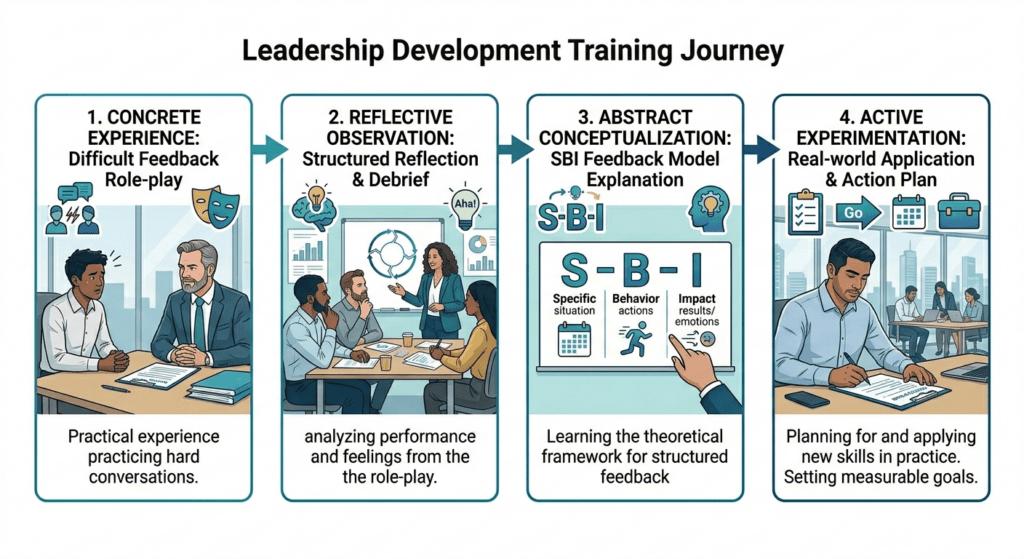
Full Example: Applying Kolb’s Learning Cycle to Leadership Training at Meridian Software
Seeing Kolb’s cycle described stage by stage is useful. Seeing it run end-to-end in a real workplace programme is where the design logic becomes clear. Here is how Meridian Software applied the full cycle to develop its first-line managers in giving constructive feedback.
The Challenge
Meridian’s HR team identified a recurring issue in 360° reviews: managers were either avoiding difficult performance conversations entirely, or giving feedback that was so vague it produced no change. A training module had been delivered six months earlier. It had not moved the needle.
The previous module opened with slides on communication theory, covered the SBI feedback model (Situation-Behaviour-Impact), and closed with a quiz. Managers could recite the framework on request. They were not using it.
Stage 1: Concrete Experience — The Difficult Scenario
The redesigned programme opened with a 10-minute role-play. Each manager received a written brief: a direct report who had missed three consecutive deadlines and had become defensive when approached informally. The manager’s task was to have the conversation — right now, with a trained actor playing the employee.
No frameworks had been introduced. No model had been explained. Managers walked in cold.
The result was predictable: conversations drifted, feedback was softened into irrelevance, managers apologised for raising the issue, and one participant avoided the core behaviour entirely. It was uncomfortable. It was also exactly the data the reflection stage needed.
Stage 2: Reflective Observation — The Debrief
Immediately after the role-play, the facilitator ran a structured 15-minute debrief using three questions:
- What did you try to say, and what actually came out?
- At what point did the conversation lose direction, and what caused that?
- What did the employee’s response tell you about how your feedback landed?
This was not a coaching session or a performance review of the role-play. It was an honest inventory. Managers surfaced patterns they had not noticed before: the tendency to pad criticism with praise until it disappeared, the habit of describing feelings instead of behaviours, the discomfort with silence that led them to fill it with reassurance.
Critically, these observations came from the managers themselves. The facilitator’s job was to ask questions that sharpened the observation, not to deliver conclusions.
Stage 3: Abstract Conceptualization — The SBI Model
Only after the debrief did the facilitator introduce the SBI feedback model:
- Situation: describe the specific context
- Behaviour: describe the observable action, not the personality trait or assumption
- Impact: describe the measurable or observable effect on the team, customer, or project
The introduction was anchored directly to what managers had just done: “In your role-plays, most feedback got stuck between S and B — you described the situation clearly, then jumped to what you thought the employee intended, instead of what they actually did. That gap is where feedback stops working. SBI closes it.”
Because managers had just experienced the failure mode that SBI is designed to prevent, the model did not feel like abstract guidance. It felt like a solution to a problem they had personally encountered 20 minutes earlier.
Stage 4: Active Experimentation — The Second Scenario
Managers returned to the actor for a second role-play: a different scenario, a different employee type, a different performance issue — but the same SBI framework to apply.
The difference was measurable. Conversations were more direct. Behaviour descriptions replaced personality judgements. Impact statements were specific and factual. One manager, who had spent the first role-play apologising for raising the issue at all, opened the second with a clean situation statement and did not retreat from it.
The session closed with each manager writing a one-paragraph action plan: a real conversation they needed to have in the next two weeks, structured using SBI. This plan was shared with their HR business partner as a light accountability mechanism.
The Outcomes
Six weeks after the session, Meridian’s HR team followed up with both managers and their direct reports. The findings:
- Most managers reported having conducted at least one structured feedback conversation using SBI within the two-week window — a marked contrast to the near-zero transfer rate observed after the original slide-based module.
- Direct reports described receiving feedback that was clearer and more focused on observable behaviour, rather than general impressions or personality assessments.
- HR reported a reduction in performance-related escalations from this cohort in the following quarter compared with the period before the programme.
The earlier training module had covered the same framework. It had not produced the same results. The difference was not the content. It was the sequence.
Real-World Examples of Kolb’s Learning Cycle in Corporate Training
The power of experiential learning in the workplace becomes clearest when you see the four-stage structure applied across different training contexts.
| Stage | Sales Training | Leadership Dev. | Safety Training | Software Training |
| 1. Experience | Cold-call simulation with objection-heavy prospect | 360° feedback session on real leadership behaviour | Near-miss incident walkthrough | Complete a real task with no guidance |
| 2. Reflect | What objections caught you off guard? | Where did your team’s feedback surprise you? | Where did you hesitate? What nearly went wrong? | Where did you get stuck? |
| 3. Conceptualize | SPIN selling and objection-handling principles | Situational leadership and delegation theory | Hierarchy of controls and risk frameworks | System architecture and workflow logic |
| 4. Apply | Live discovery call with coached prospect | Apply model to a current team challenge | Conduct a real risk assessment on own work area | Complete job-relevant task in the live system |
Notice what these experiential learning examples for employees share: the experience comes first in every case, and the conceptual framework is introduced only after learners have something concrete to hang it on. That sequencing is the key design principle.
Free Kolb’s Learning Cycle Template for Trainers
Use this template to design or audit any training session. For each stage, ask the planning questions and select (or create) an activity that fits your learning objectives and audience.
| Stage | Design Questions to Ask | Activity Examples |
| 1. Concrete Experience | What should learners do or encounter first? What experience will create the emotional or cognitive hook the rest of the session hangs from? Does it mirror the real work context closely enough to feel relevant? | Role-play, live simulation, case walk-through, real task with no upfront guidance, incident review, 360° feedback session, problem scenario |
| 2. Reflective Observation | What happened? What surprised learners? What would they do differently? What patterns emerged across the group? How can you make this feel honest rather than performative? | Facilitated debrief, paired reflection, journaling prompt, group discussion, structured observation form, hot-seat question round |
| 3. Abstract Conceptualization | What principle or framework explains what learners just experienced? How do you anchor the concept to the specific things that happened in Stage 1? What is the minimum theory needed? | Framework introduction, model explanation, case analysis, expert input, annotated example, comparative analysis |
| 4. Active Experimentation | How will learners apply this in a new context? What is different enough to require genuine application, not just repetition? What accountability mechanism will extend the cycle into the workplace? | Second scenario, real work task, action plan, peer coaching pair, implementation commitment, post-training challenge assignment |
Download the editable version of this template to use directly in your session design.
Kolb’s 4 Learning Styles Explained
Kolb observed that people have preferred stages in the cycle. Some are natural reflectors; others want to jump straight to doing. These preferences form four distinct learning styles, each defined by which adjacent stages a person gravitates toward.
| Style | Preferred Stages | Common Roles | Best Training Approach |
| Diverger | CE + RO | HR, customer service, trainers | Stories, case studies, reflective discussions |
| Assimilator | AC + RO | Analysts, researchers, finance | Frameworks, models, structured content |
| Converger | AC + AE | IT, engineering, project managers | Challenges, simulations, problem-based tasks |
| Accommodator | CE + AE | Sales, management, marketing | Jump-in activities, trial-and-error, action plans |
CE = Concrete Experience RO = Reflective Observation AC = Abstract Conceptualization AE = Active Experimentation
A note on learning styles as fixed traits: the research on Kolb’s Learning Style Inventory has faced legitimate psychometric criticism. Learning style preferences are better understood as context-dependent tendencies than fixed personality categories. The same person may behave like an Assimilator in technical training and an Accommodator in leadership development. Use these styles as design heuristics, not as labels.
The practical implication for design: a full Kolb cycle gives every learning style at least one stage where they feel at home. That is the strongest argument for completing all four stages, not just the ones your audience appears to prefer.
Benefits of Kolb’s Learning Cycle in Employee Training
Experiential learning approaches that complete the full Kolb cycle consistently outperform lecture-based training across several measures (Kolb & Kolb, 2005; Fenwick, 2000). Here is what that means in practice, not in abstract:
- Learners participate rather than observe, reducing passive attendance and increasing the ratio of practice to content delivery. Engagement is behavioural, not just attitudinal.
- Knowledge anchored to a specific, lived experience is encoded with richer contextual cues. Retrieval in the workplace is easier because the memory carries the context of application, not just the content of a slide.
- Because the application stage mirrors the real-world context learners will face, transfer from training to job is higher. Learners are not translating an abstract principle — they are repeating a version of something they already did.
- Completing all four stages gives every learning style preference at least one stage where they are in their natural mode. No single group is consistently disadvantaged by the design.
- Frameworks introduced after experience are understood rather than merely memorised. Learners have a mental model to hang the concept on because they have already encountered the problem it solves.
A note on retention statistics: You may have seen claims that lecture produces 5% retention while experiential learning produces 75%. These figures are not supported by robust empirical research — they appear to originate from the so-called “Learning Pyramid,” which has been credibly debunked by researchers including Subramony et al. (2014). What the evidence does consistently show is that active and experiential learning approaches produce meaningfully stronger retention and transfer than passive lecture formats. The exact magnitude varies by context, content type, and learner.
Common Criticisms of Kolb’s Learning Theory
No model should be applied uncritically. Knowing the limitations makes you a more credible and effective designer.
- Cultural bias: the model was developed in Western, individualist contexts. Learning style preferences and the value placed on reflective practices vary across cultures (Yamazaki, 2005).
- Psychometric concerns: the Learning Style Inventory (LSI) has faced criticism for test-retest reliability and construct validity. Treat style scores as indicative, not definitive.
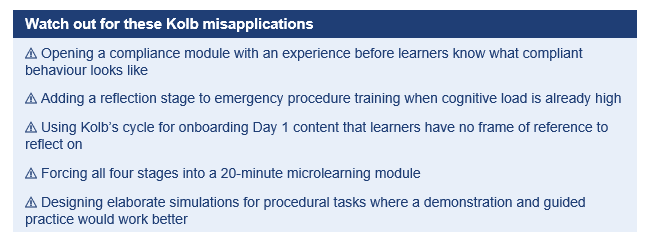
- Overemphasis on fixed stages: not all learning requires all four stages, and forcing the sequence onto every training scenario can feel contrived.
- Reflection is hard to facilitate well: poorly facilitated reflection can feel like therapy, interrogation, or wasted time. It requires skill and design investment.
- Experience alone is not sufficient: the model is sometimes misread as “just let them do it.” Experience without structured reflection and conceptualization produces inconsistent results.
Where Trainers Go Wrong with Kolb’s Model
Forcing Artificial Reflection
Asking learners to fill in a reflection journal about a five-minute activity feels hollow and patronising. Reflection needs to be proportionate to the depth of the experience. For a short simulation, a brief group debrief works. For a multi-day programme, structured written reflection is appropriate. Match the depth of reflection to the weight of the experience.
Confusing Activity with Experience
A game or icebreaker is not automatically a concrete experience in the Kolb sense. What matters is whether the activity produces something real for the learner to reflect on — a decision made under pressure, a skill stretched, a consequence encountered. Activity for its own sake does not trigger the cycle.
Using Simulations Without Debrief Design
Many designers invest heavily in building a simulation and almost nothing in designing the debrief. The debrief — the reflection and conceptualization stages — is where the simulation pays off. A simulation that ends without a structured debrief is an event, not a learning cycle.
This is, in our view, the single most common implementation failure when organisations adopt Kolb’s model. Budget and creative effort flow toward building the experience. The debrief gets 10 minutes at the end of a packed schedule. The ratio should usually be closer to equal — and for complex behavioural topics, we would argue the debrief deserves more design investment than the simulation itself.
Assuming Equal Time in Each Stage
The four stages do not need equal time. Some topics benefit from a long experiential phase and a brief conceptualization. Others — particularly technical or compliance training — need more time on abstract conceptualization and less on open reflection. Design each stage to appropriate depth, not to a formula.
Overusing Role-Play as the Default Experience
Role-play is powerful, but it is actively aversive to some learners — particularly introverts and those who struggle with performance anxiety. Vary your experiential activities: case analysis, real task completion, think-aloud problem-solving, and observed practice are all valid alternatives that engage the cycle without requiring performance in front of peers.
When NOT to Use Kolb’s Learning Cycle
Kolb’s cycle is a powerful framework, but it is not universally appropriate. Applying it indiscriminately — particularly in contexts where learners need clarity, speed, or procedural precision — can actively harm learning outcomes.
| Training Context | Why Kolb’s Full Cycle Doesn’t Fit | Better Approach |
| Compliance microlearning | No time for reflection; content is prescribed, not discovered | Direct instruction + spaced repetition + scenario testing |
| Emergency procedures | Cognitive overload risk; learners need clarity, not exploration | Procedural drill + worked examples + checklist reinforcement |
| Ultra-tight onboarding (Day 1–2) | Learners lack context to reflect meaningfully on early experiences | Structured orientation + job aids + full cycle introduced later |
| Highly procedural software training | Sequential steps don’t benefit from open reflection; they need practice | Demonstration + guided practice + error correction |
| Cognitive overload scenarios | Adding reflection and conceptualization increases load when bandwidth is already full | Reduce content scope; use worked examples before experiential activities |
The underlying principle: Kolb’s cycle works best when the learning goal involves understanding and transfer, not just accurate execution of a defined sequence. If the goal is “follow these steps correctly every time,” direct instruction with deliberate practice and feedback is more appropriate than an experiential cycle.
How to Apply Kolb’s Learning Cycle in Instructional Design
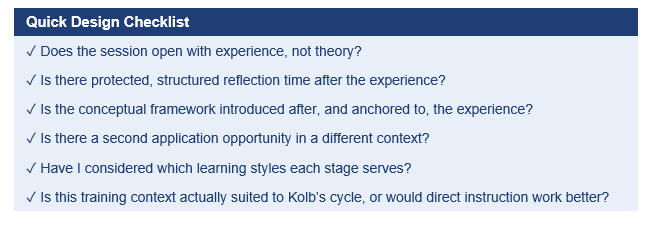
Step 1: Start with a Real or Realistic Experience
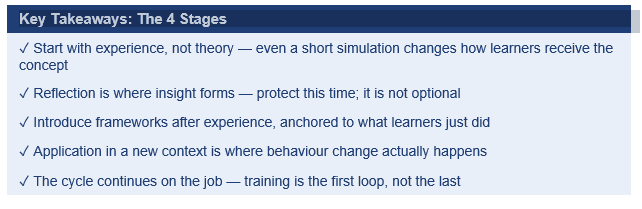
Do not open with objectives and theory. Open with doing. A case study, a role-play, a real task, or a challenging scenario. The experience primes the brain for learning and creates an emotional anchor that the rest of the session hangs from.
Step 2: Build in Structured Reflection
After the experience, pause deliberately. Use open questions: “What happened? What surprised you? What would you do differently?” Discussions, journaling, and structured peer sharing all work. Protect this time. This is where experience becomes insight.
One observation we return to repeatedly when reviewing training designs: the reflection question is where most trainers underinvest their effort. A question like “What did you learn?” invites the answer the trainer wants to hear. A question like “What did you notice?” invites genuine observation. The difference sounds small. In the room, it is the difference between a scripted debrief and an honest one. We consistently recommend specificity over generality: anchor the reflection question to something that actually happened in the experience, not to the learning objective the trainer has in mind.
Step 3: Introduce the Concept or Framework
Now bring in the theory — anchored to what just happened. “Here are the five principles behind what you just tried. Notice that you used three of them naturally.” The framework lands differently when learners have already lived the experience it describes.
Step 4: Apply in a New Context
Give learners a second scenario, a real task, or a structured action plan that requires them to use the concept somewhere new. This is where behaviour change happens. It is also the start of the next cycle, which continues after training ends.
Kolb’s Learning Cycle vs Bloom’s Taxonomy vs ADDIE
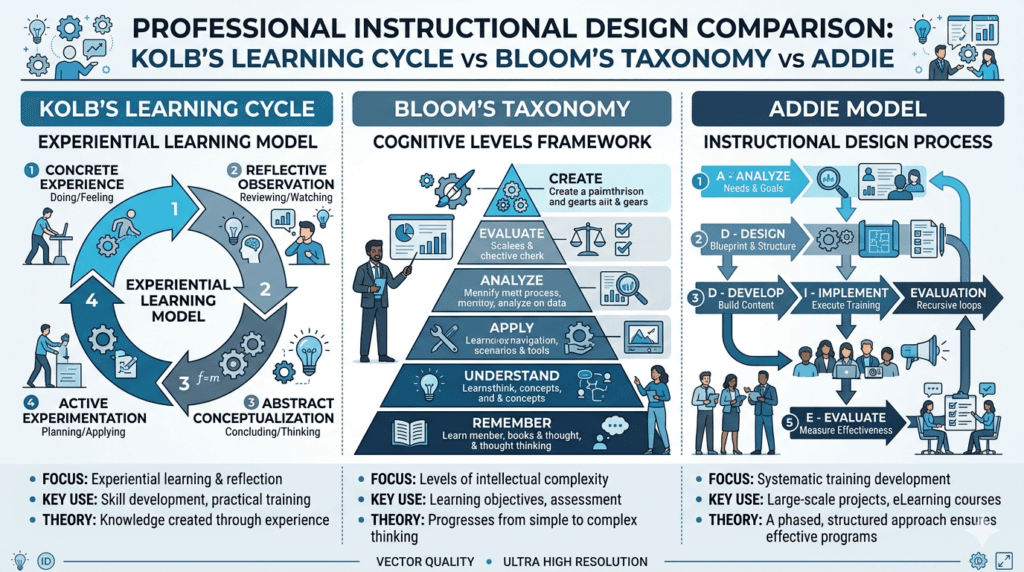
These three frameworks are often used together in instructional design. They are not competing models — they answer different questions.
A practical way to think about this: ADDIE tells you how to run the project. Bloom’s Taxonomy tells you what level of thinking to aim for in each objective. Kolb’s cycle tells you how to sequence the learning experience so that knowledge actually sticks.
| Framework | The Question It Answers | Primary Use in Design | Works Best When… |
| Kolb’s Learning Cycle | How should I sequence the learning experience? | Structuring activities, choosing what comes before what, designing the flow from experience to application | The goal is behaviour change, skills transfer, or applying knowledge in varied real-world contexts |
| Bloom’s Taxonomy | What cognitive level should learners reach? | Writing learning objectives, aligning assessments to the right depth, deciding whether to aim for recall, comprehension, or application | You need to specify what “good” looks like at the objective level and align your assessments accordingly |
| ADDIE | How should I manage this training project from start to finish? | Scoping the project, coordinating analysis, design, development, implementation and evaluation phases, managing stakeholders | You need a repeatable process for managing the full design and development lifecycle, particularly on larger programmes |
Used together: ADDIE structures the project, Bloom’s Taxonomy calibrates the objectives, and Kolb’s cycle sequences the learning activities. A training programme designed this way addresses the question of what to build, how complex to make it, and in what order to put it in front of learners.
The Bottom Line: Complete Cycles Produce Lasting Behaviour Change
Meridian’s customer service training worked because it moved learners through all four stages: they experienced a difficult customer, reflected on what happened, learned the principles behind de-escalation, and applied those principles in new scenarios and live calls. Customer satisfaction scores improved. Help desk escalations fell.
Meridian’s leadership programme worked because managers did not learn about SBI — they experienced the failure mode that SBI prevents, then received the model, then immediately applied it. The sequence made the content inevitable rather than academic.
If your training is not producing the results you want, audit the cycle. Which stages are you completing? Which are you skipping? The gap is almost always there. Fill it, and the training becomes something learners carry with them.
And if the full cycle genuinely does not fit your training context — audit that too. Knowing when not to use a framework is as important as knowing how to use it.
What to Do Next
- Download the Kolb’s Learning Cycle Trainer Template — the four-stage planning and audit tool from this article, in an editable format.
- Download the Learning Styles Assessment & Accommodation Guide — identify which styles are in your audience and how to design for each.
- Explore Related Articles — Kolb’s cycle works best alongside Bloom’s Taxonomy, Merrill’s Principles, SAM, and ADDIE.
- Subscribe to the Trainercentric Digest — monthly practical strategies, case studies, and downloadable templates for corporate trainers.
Key References
- Kolb, D. A. (1984). Experiential Learning: Experience as the Source of Learning and Development. Prentice Hall.
- Kolb, A. Y., & Kolb, D. A. (2005). Learning styles and learning spaces: Enhancing experiential learning in higher education. Academy of Management Learning & Education, 4(2), 193–212.
- Fenwick, T. J. (2000). Expanding conceptions of experiential learning. Adult Education Quarterly, 50(4), 243–272.
- Subramony, D. P., Molenda, M., Betrus, A., & Thalheimer, W. (2014). The mythical retention chart and the corruption of Dale’s Cone of Experience. Educational Technology, 54(6), 6–16.
- Yamazaki, Y. (2005). Learning styles and typologies of cultural differences: A theoretical and empirical comparison. International Journal of Intercultural Relations, 29(5), 521–548.
Frequently Asked Questions about Kolb’s Learning Cycle
What is Kolb’s Learning Cycle?
Kolb’s Learning Cycle is a four-stage model of experiential learning developed by educational theorist David Kolb in 1984. The four stages are: Concrete Experience (doing), Reflective Observation (reflecting), Abstract Conceptualization (thinking), and Active Experimentation (applying). The model holds that effective learning — particularly in workplace and corporate training contexts — requires moving through all four stages in sequence.
What are the 4 stages of Kolb’s experiential learning cycle?
The four stages are: (1) Concrete Experience — the learner engages in a real or simulated activity; (2) Reflective Observation — the learner examines what happened; (3) Abstract Conceptualization — the learner connects the experience to a broader principle; and (4) Active Experimentation — the learner applies the principle in a new context.
What are some Kolb learning cycle examples in employee training?
A customer service team practices handling an angry customer through role-play (Concrete Experience), discusses what happened (Reflective Observation), learns the five principles of de-escalation (Abstract Conceptualization), then completes a second role-play with a different scenario (Active Experimentation). The full Meridian Software leadership training case study above shows an end-to-end example with outcomes. The cross-context table shows how the same structure applies to sales, leadership, safety, and software training.
How is Kolb’s model used in instructional design?
Instructional designers use Kolb’s cycle to sequence training: open with an experiential activity, follow with structured reflection, introduce the conceptual framework, and close with application. The model is also used to audit existing training — diagnosing which stages are missing and why learning is not transferring to the job. The trainer template in this article provides a practical design and audit tool.
When should you NOT use Kolb’s Learning Cycle?
Kolb’s cycle is not well-suited to compliance microlearning, emergency procedure training, ultra-tight onboarding, highly procedural software training, or any context where cognitive load is already high. In these cases, direct instruction with deliberate practice and feedback typically produces better outcomes. See the dedicated section above for the full breakdown and decision framework.
What are the criticisms of Kolb’s model?
The main criticisms are: cultural bias toward Western learning norms; limited psychometric validity of the Learning Style Inventory; the risk of applying the cycle too rigidly; and the difficulty of facilitating genuine reflection in time-pressured training environments. The model is best treated as a design heuristic rather than a scientific law.
Further Readings
- Bloom’s Taxonomy
- Instruction Designing Models
- ADDIE Model of Instructional Designing
- Merrill’s Principles of Instruction: Designing Skill-Based Training
- Successive Approximation Model (SAM): Complete Guide + 8 Free Templates
- Gagné’s 9 Events of Instruction: A Practical Guide for Trainers with Real Examples
- ADDIE vs SAM: Which Instructional Design Model Should You Use in 2026?
- ARCS Model of Motivation — The Complete Guide for Corporate Trainers [2026]
- Adult Learning Theory (Andragogy): Knowles’ 6 Principles Explained with Workplace Examples
- Cognitive Load Theory Explained: A Practical Guide for Trainers & Instructional Designers
- Backward Design – The Complete Framework for Planning Learning
- Action Mapping: A Step-by-Step Guide with Examples
- Story-Based Learning Design: A Practical 5-Step Framework
Author Introduction

Tulip Ghosh is a Learning and Development professional who designs impactful, learner-centric experiences rooted in behavioral insight and real-world application. She is passionate about improving learner engagement and translating complex ideas into practical training solutions. A thoughtful writer at heart and with experience of a decade in Learning and Development domain, she brings a simple, grounded perspective to the evolving world of workplace learning. Reach out to her on her Linkedin Profile from here.