Introduction
Every training request sounds urgent. Most don’t actually need training.
The problem is that by the time a request reaches L&D, people are already thinking about courses — not causes. A stakeholder describes a symptom, and somewhere between that conversation and the kickoff meeting, the diagnosis gets skipped entirely.
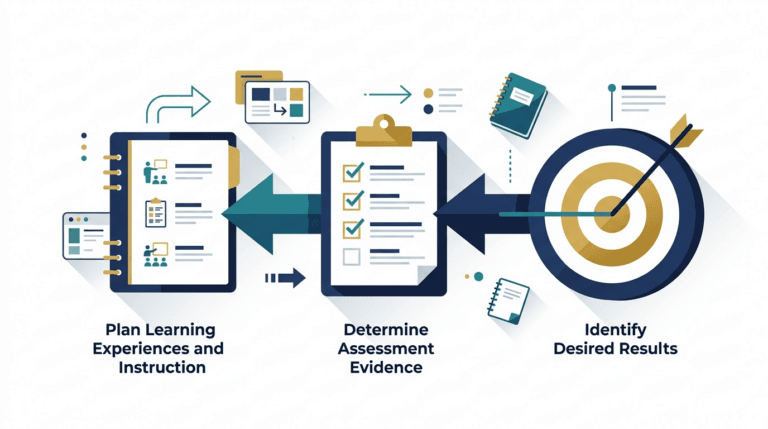
This checklist exists to catch that mistake before design begins, not after it’s already expensive. It won’t replace the deeper diagnostic thinking in our complete guide to Training Needs Analysis — including the TrainerCentric DVPD Framework™ (Diagnose → Validate → Prioritise → Design). What it gives you is the tick-box version of that process: something you can run against any request, print, and hand to a project file.
Below: a one-page printable version you can use immediately, followed by the full 10-step breakdown with the actions, questions, and common mistakes behind each item.
Training Needs Analysis Checklist (10 Steps)
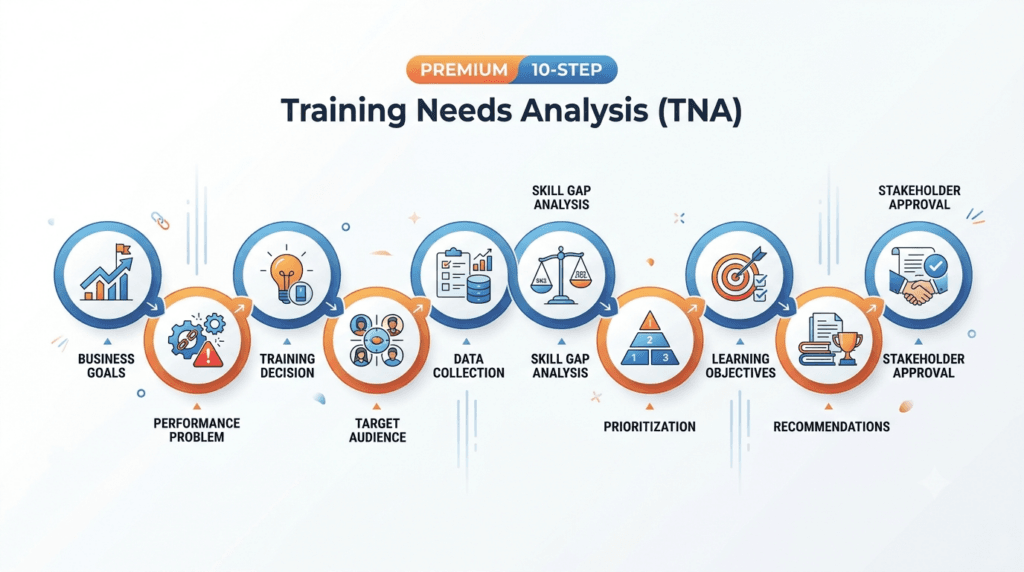
- Clarify business goals
- Identify the performance problem
- Determine whether training is the right solution
- Define the target audience
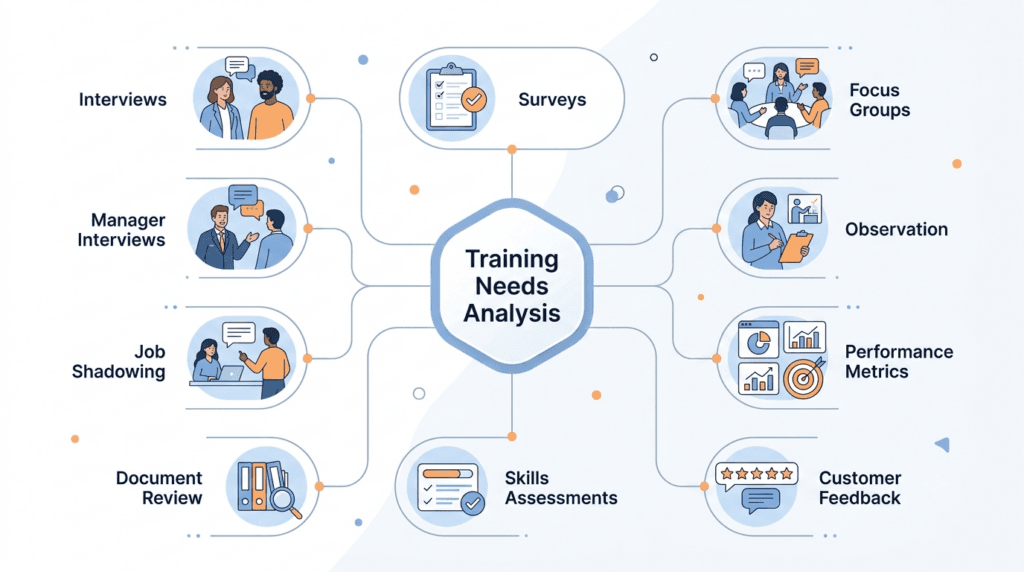
- Gather data from multiple sources
- Identify knowledge and skill gaps
- Prioritise learning needs
- Develop learning objectives
- Recommend appropriate solutions
- Document findings and gain stakeholder approval
PRINTABLE Training Needs Analysis CHECKLIST
| ✓ | Checklist Item |
| ☐ | 1. Business goal identified — linked to a specific KPI or strategic priority, confirmed with the sponsor |
| ☐ | 2. Performance gap defined — written as a measurable gap, not a training topic |
| ☐ | 3. Root cause validated — confirmed as a knowledge/skill issue, not process, tool, or motivation |
| ☐ | 4. Target audience named — specific roles or individuals identified; already-competent staff excluded |
| ☐ | 5. Data triangulated — at least two data collection methods used and cross-checked |
| ☐ | 6. Skill/knowledge gap sized — current performance compared against a defined standard |
| ☐ | 7. Needs prioritised — ranked against consistent criteria (impact, urgency, feasibility) |
| ☐ | 8. Learning objectives written — observable behaviours with a measurable standard |
| ☐ | 9. Solutions recommended — training and non-training interventions identified, with owners |
| ☐ | 10. Findings documented and signed off — written specification approved before design begins |
Want this as a fillable, formatted PDF? Get the printable one-pager above as a print-ready PDF, plus the fillable version, inside the TrainerCentric Strategic Training Needs Analysis Toolkit™.
What Is a Training Needs Analysis Checklist?
A Training Needs Analysis checklist is the operational layer beneath a TNA framework — it converts the why of a methodology like DVPD into the concrete what-to-do-next of a live project, so nothing gets skipped under deadline pressure.
It’s worth a quick distinction, since the terms get used interchangeably:
| Term | Core Question | Typical Output |
| Training Needs Analysis | Is training the right fix, and for whom? | Learning needs specification |
| Skills Gap Analysis | What skills do we have vs. need? | Skills gap map |
| Performance Analysis | Why is performance below target, of any cause? | Root cause map |
A solid TNA checklist borrows from both of the latter — see our full comparison in Skills Gap Analysis vs Training Needs Analysis for the underlying theory.
TrainerCentric Tip: The biggest mistake we see isn’t skipped interviews — it’s skipped prioritisation. Teams routinely identify 15–20 training needs during a single analysis and then treat all of them as equally important. The result is a broad, shallow programme that improves nothing significantly. Rank ruthlessly before you design anything.
The Complete Checklist, Step by Step
This checklist is based on the TrainerCentric DVPD Framework™ and refined through our work building TNA toolkits and learning needs documentation for L&D teams.
The 80/20 Rule of TNA: In our experience, the first three checklist items — business goal, performance gap, and root cause — determine roughly 80% of the quality of the eventual learning solution. Get those three right and the rest of the process is refinement. Get them wrong, and everything downstream becomes expensive rework you’ll redo anyway.
Step 1: Clarify Business Goals
Quick check: ☐ Business goal identified ☐ KPI or metric documented ☐ Sponsor/owner confirmed ☐ Cost of inaction understood
Why it matters: Training that isn’t tied to a business goal is the easiest line item to cut, and the hardest to defend when questioned.
Key actions: Identify which strategic objective or KPI the request connects to. Confirm who owns that outcome. Note any related initiatives already underway.
Questions to ask: What business result are we trying to move? How is it currently measured? What happens if this gap runs another six months?
Common mistake: Accepting “we need training on X” as the goal itself, rather than digging one level deeper.
Tip: If a sponsor can’t state the business goal in one sentence, the request needs more scoping before you proceed.
Step 2: Identify the Performance Problem
Quick check: ☐ Gap described in measurable terms ☐ Evidence cited ☐ Affected population scoped ☐ Statement contains no training language
Why it matters: Vague requests produce vague programmes. Specific gaps produce targeted ones.
Key actions: Ask the sponsor what people are doing that they shouldn’t, or not doing that they should. Quantify the gap. Identify who’s affected and by how much.
Questions to ask: What specifically is happening? How do you know? Is the gap consistent across the population or concentrated?
Common mistake: Writing the problem as a training topic (“needs conflict resolution training”) instead of a performance gap (“12% of escalations mishandled at first contact”).
Tip: If your problem statement contains the word “training,” rewrite it.
Step 3: Determine Whether Training Is the Right Solution
Quick check: ☐ Root cause investigated, not assumed ☐ Knowledge/skill gap separated from environment/motivation ☐ Non-training causes flagged to an owner
Why it matters: Training only fixes gaps caused by a lack of knowledge or skill. Broken processes, poor tools, or missing incentives won’t respond to it.
Key actions: Investigate root cause through interviews, observation, or data — not assumption. Separate genuine capability gaps from environmental barriers. Flag non-training causes to the right owner (IT, operations, HR).
Questions to ask: Do people know how and simply aren’t doing it, or do they genuinely not know? Would the gap disappear if we fixed a process or system instead?
Common mistake: Assuming training is always at least part of the answer, because that’s the request that arrived.
Tip: Telling a sponsor training won’t solve their problem is uncomfortable — but it builds more credibility than delivering a course that was never going to work.
→ Need help distinguishing training issues from performance issues? See our guide to Performance Consulting.
Step 4: Define the Target Audience
Quick check: ☐ Roles/individuals named ☐ Already-competent staff excluded ☐ Subgroup differences checked
Why it matters: Training aimed at “everyone in the department” is usually too generic to close a specific gap, and wastes the time of people who don’t need it.
Key actions: Segment by role, tenure, location, or performance level. Identify anyone already at standard for exclusion. Check for subgroups needing different depth or format.
Questions to ask: Who exactly has this gap? Who’s already meeting the standard? Do segments need different content, or the same content at a different pace?
Common mistake: Applying a blanket population without checking who’s already performing well.
Tip: Ask line managers to name their top and bottom performers before finalising the audience.
Step 5: Gather Data from Multiple Sources
Quick check: ☐ Two-plus methods used ☐ Multiple levels represented (frontline, manager, sponsor) ☐ Data recorded systematically
Why it matters: Every data source has blind spots. Triangulating methods produces findings that hold up under scrutiny.
Key actions: Combine interviews, observation, surveys, performance data, or document review. Include frontline and management perspectives. Record data for later reference.
Questions to ask: Does the qualitative data support or contradict the quantitative? Have I spoken to people doing the job, not just managing it?
Common mistake: Relying solely on stakeholder interviews, which tend to surface solutions people already have in mind.
Tip: Interview the people doing the job before their managers — it reduces filtering through a management lens.
Step 6: Identify Knowledge and Skill Gaps
Quick check: ☐ Current performance benchmarked against a defined standard ☐ Knowledge vs. skill gap distinguished ☐ Gap size/consistency noted
Why it matters: This converts your data into the precise capability gap that every learning objective downstream depends on.
Key actions: Compare current performance to a defined standard — a competency framework, role profile, or top-performer behaviour. Distinguish “doesn’t know” from “knows but can’t execute under pressure.”
Questions to ask: What does a top performer do differently? Is this knowledge, skill, or confidence from lack of practice?
Common mistake: Skipping task analysis and guessing at what “good” looks like.
Tip: Observe a genuine top performer — it’s often the fastest way to define the real standard.
→ Need a deeper methodology for this step? See Skills Gap Analysis vs Training Needs Analysis.
Step 7: Prioritise Learning Needs
Quick check: ☐ Needs scored against consistent criteria ☐ Stakeholders involved in ranking ☐ “Now” separated from “later”
Why it matters: A thorough TNA almost always surfaces more needs than one programme can address. Without ranking, everything competes and nothing gets resourced properly.
Key actions: Score each need on business impact, urgency, reach, and feasibility. Involve stakeholders in agreeing the ranking.
Questions to ask: What’s the cost of leaving this unaddressed another quarter? Is this feasible given current budget and time?
Common mistake: Treating every need as equally urgent, spreading resources too thin. (This is the mistake behind the TrainerCentric Tip above — it’s the single most common failure point we see.)
Tip: A simple impact-vs-feasibility matrix, reviewed with your sponsor, is usually enough.
Step 8: Develop Learning Objectives
Quick check: ☐ Written as observable behaviours ☐ Condition and standard stated ☐ Traces back to a Step 6 gap
Why it matters: Objectives written as topics give designers nothing to design against. Objectives written as behaviours give them a target.
Key actions: Write each objective as an observable behaviour with an action verb. State the condition and standard where relevant.
Questions to ask: Could someone independently observe whether this was met? Does it describe a behaviour or still a topic?
Common mistake: Writing objectives that describe course content rather than learner capability.
→ For the full method, see our guide to Learning Objectives.
Step 9: Recommend Appropriate Solutions
Quick check: ☐ Each need matched to the right intervention ☐ Non-training recommendations documented with an owner ☐ Blended approach considered where needed
Why it matters: Not every gap needs a formal course — some need a job aid, coaching, or a process fix with nothing to do with L&D.
Key actions: Match each need to training, coaching, job aids, e-learning, or a non-training fix. Document non-training recommendations with a named owner.
Questions to ask: Is a full programme necessary, or would a lighter intervention close the gap? Who owns any non-training recommendation?
Common mistake: Defaulting to a workshop or e-learning module because it’s the familiar format.
→ Ready to move into design? See the ADDIE Model for how this handoff works.
Step 10: Document Findings and Gain Stakeholder Approval
Quick check: ☐ Written specification produced ☐ Findings presented in a stakeholder-appropriate format ☐ Sign-off captured ☐ Baseline data collected
Why it matters: A TNA that lives only in your notes has no accountability and no traceability if challenged later.
Key actions: Produce a learning needs specification: problem, root cause, audience, objectives, solution, constraints, evaluation approach. Present to stakeholders in the right format for them. Capture sign-off before design begins.
Questions to ask: Does the sponsor agree with the problem statement and approach? Is a baseline in place to measure success?
Common mistake: Treating documentation as optional rather than a deliverable in its own right.
→ Set your evaluation approach before design starts: see How to Design a Training Evaluation Plan Before the Programme Starts.
Download the Training Needs Analysis Toolkit
The checklist above is complete and ready to use as-is. In practice, most L&D teams find it faster to work from templates than to build documentation from scratch each time — which is what the TrainerCentric Strategic Training Needs Analysis Toolkit™ is for.
It includes a fillable version of this checklist, a stakeholder interview guide, a data collection planner, a prioritisation matrix, a learning needs specification template, and a presentation template for reporting to senior stakeholders.
Example: Applying the Checklist in a Realistic Scenario
Scenario: Everly Health Group | A mid-sized private healthcare provider, 40 patient-facing administrative staff across six clinics, rolling out a new patient scheduling system.
An Operations Director requests “customer service training” after a rise in patient complaints. Here’s how the checklist plays out:
| Checklist Item | Completed? | Finding |
| 1. Business goal identified | ✓ | Linked to the annual patient satisfaction target |
| 2. Performance gap defined | ✓ | Scheduling-related complaints up 22% in 4 months |
| 3. Root cause validated | ✓ | Partly a knowledge gap on the rebooking workflow; partly a system timeout issue (escalated to IT) |
| 4. Target audience named | ✓ | 24 of 40 staff, at the 3 most recently transitioned clinics |
| 5. Data triangulated | ✓ | Call observation + 2-question survey + system error logs |
| 6. Skill gap sized | ✓ | 70% of the affected group struggle specifically with rebooking/cancellation, not standard booking |
| 7. Needs prioritised | ✓ | Ranked high — active, worsening complaint trend |
| 8. Learning objectives written | ✓ | “Complete a rebooking/cancellation without escalation on 95% of attempts within 3 weeks” |
| 9. Solutions recommended | ✓ | 90-minute practical workshop + one-page job aid (not a full customer service course) |
| 10. Documented and signed off | ✓ | Specification approved; error-rate baseline captured pre-training |
What this shows: A generic “customer service training” request became a targeted, 90-minute intervention on one specific workflow — once the checklist surfaced that most of the original complaint volume was a technical issue, not a training issue at all.
Common Mistakes to Avoid
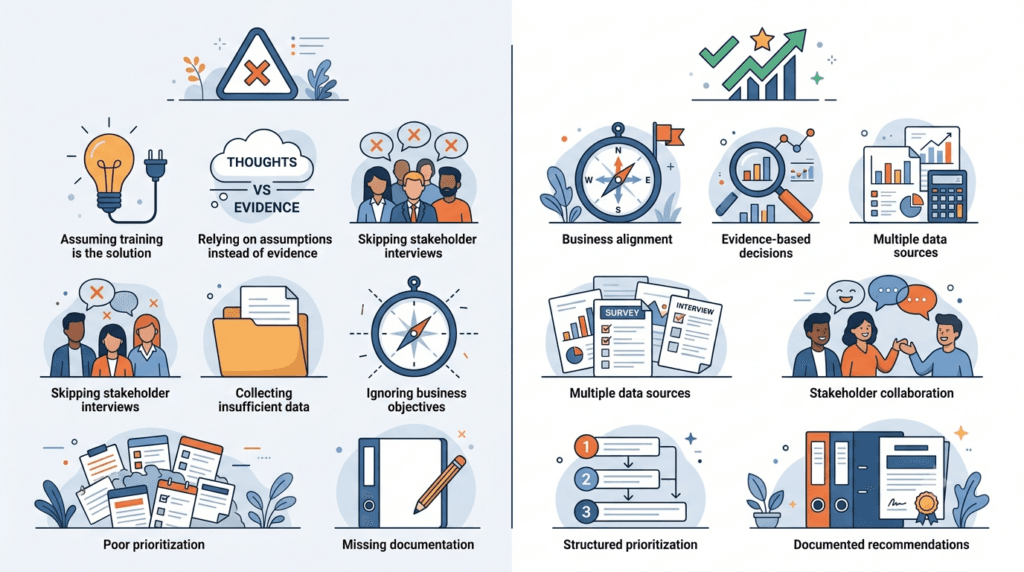
| Mistake | Recommended Action |
| Assuming training is always the solution | Investigate root cause before recommending an intervention |
| Relying on a single data source | Combine at least two or three methods |
| Skipping stakeholder interviews | Build in sponsor and manager conversations early, even for small requests |
| Ignoring organisational goals | Anchor every request to a specific business objective before scoping |
| Poor documentation | Produce a written specification for every project, regardless of size |
| Weak prioritisation | Score needs against consistent criteria, not by whoever asked loudest |
| Failing to define measurable outcomes | Write objectives as observable behaviours with a clear standard |
Conclusion
Effective training starts with effective diagnosis — and a checklist is what keeps that diagnosis rigorous under real deadline pressure. Print the one-page version above, work through the ten steps in order, and use the detailed breakdown whenever you need the reasoning behind a step.
Remember the 80/20 rule: get the first three items right — business goal, performance gap, root cause — and everything downstream gets easier. Get them wrong, and no amount of good instructional design will fix it.
If you’re running Training Needs Analyses regularly enough that recreating templates each time is slowing you down, the TrainerCentric Strategic Training Needs Analysis Toolkit™ takes that friction away — so more of your time goes into the analysis, and less into the paperwork around it.
Frequently Asked Questions
Should every training programme begin with a Training Needs Analysis?
In principle, yes — but the depth should match the stakes. A high-investment or strategically important programme needs the full checklist. A routine compliance refresh may only need a light-touch version of Steps 1–3.
Can small training requests skip TNA?
Not entirely — but they can move through it faster. Even a five-minute version of Steps 1–3 (goal, gap, root cause) catches most of the wasted-training-spend risk. What you shouldn’t skip is confirming training is actually the right fix.
What comes after a Training Needs Analysis?
The learning needs specification from Step 10 becomes the brief for instructional design — informing modality, content sequence, and evaluation approach. See the ADDIE Model for how that handoff typically works.
How many interviews should a Training Needs Analysis include?
There’s no fixed number — it depends on population size and how consistent early findings are. As a rule of thumb, keep interviewing until new conversations stop surfacing new information, and always combine interviews with at least one other data source.
What evidence is enough to confirm a training need?
Enough to answer three questions with confidence: what the gap is, why it exists, and who it affects. If you can’t answer all three from your current evidence, keep gathering data before moving to design.
Can ChatGPT or AI tools perform a Training Needs Analysis?
AI tools can help draft interview questions, summarise qualitative data, or structure a report — but they can’t observe your workplace, interview your stakeholders, or judge organisational context. Treat AI as a drafting aid inside this checklist, not a replacement for the analysis itself.
Is a checklist enough on its own?
No. It ensures consistency and completeness, but doesn’t replace the analytical skill of diagnosing root causes and interpreting data.
How long does a Training Needs Analysis take?
A targeted TNA for a single team typically takes a few days of effort; a full organisational assessment can take several weeks.
What tools can support the process?
Interview guides, data collection templates, prioritisation matrices, and reporting templates. The TrainerCentric Strategic Training Needs Analysis Toolkit™ provides editable versions of each.
References
- Training Needs Assessment: Methods, Tools, and Techniques || 1st Edition || Jean A. Barbazette || Pfeiffer, 2006
- Performance Consulting: A Practical Guide for HR and Learning Professionals || 3rd Edition || Dana Gaines Robinson & James C. Robinson || Berrett-Koehler Publishers, 2015
- Telling Ain’t Training: Updated, Expanded, and Enhanced || 2nd Edition || Harold D. Stolovitch & Erica J. Keeps || Association for Talent Development (ATD), 2011
- Map It: The Hands-On Guide to Strategic Training Design || 1st Edition || Cathy Moore || Association for Talent Development (ATD), 2017
- The Six Disciplines of Breakthrough Learning: How to Turn Training and Development into Business Results || 3rd Edition || Roy V. H. Pollock, Andrew McK. Jefferson & Calhoun W. Wick || John Wiley & Sons, 2015
- Evaluating Training Programs: The Four Levels || 3rd Edition || Donald L. Kirkpatrick & James D. Kirkpatrick || Berrett-Koehler Publishers, 2006
Further Readings
- Ultimate Guide to Training Needs Analysis
- How to Conduct a Training Needs Analysis
- Skills Gap Analysis vs Training Needs Analysis
- Job Task Analysis
- How to Present TNA Results to Senior Stakeholders
- The 3 Levels of Training Needs Analysis: Organisation, Task & Person Analysis
- ADDIE Model Explained
- Learning Objectives Guide
- Training Needs Analysis Template
- Focus Groups and Interviews
- Kirkpatrick Model: How to Measure Training Effectiveness
- 12 Facilitation Skills for Corporate Trainers: The Complete Guide
- Training Needs Analysis Questionnaire: Complete Guide (75 Questions & Free Template)
Author Details

Pankaj Nandi is a Technical Writer and Learning Content Specialist with experience creating complex technical and instructional content across software, technology, and enterprise environments. Having worked with organizations including Cisco, Rakuten India, and Newgen Software, he specializes in transforming complex concepts into clear, practical, and learner-friendly content. you can reach out to him at pankaj@trainercentric.in