If you’ve ever approved a “gamified” training project and still saw zero behaviour change afterward, you’re not alone — and it’s not because gamification doesn’t work. It’s because it was solving a problem you didn’t actually have.
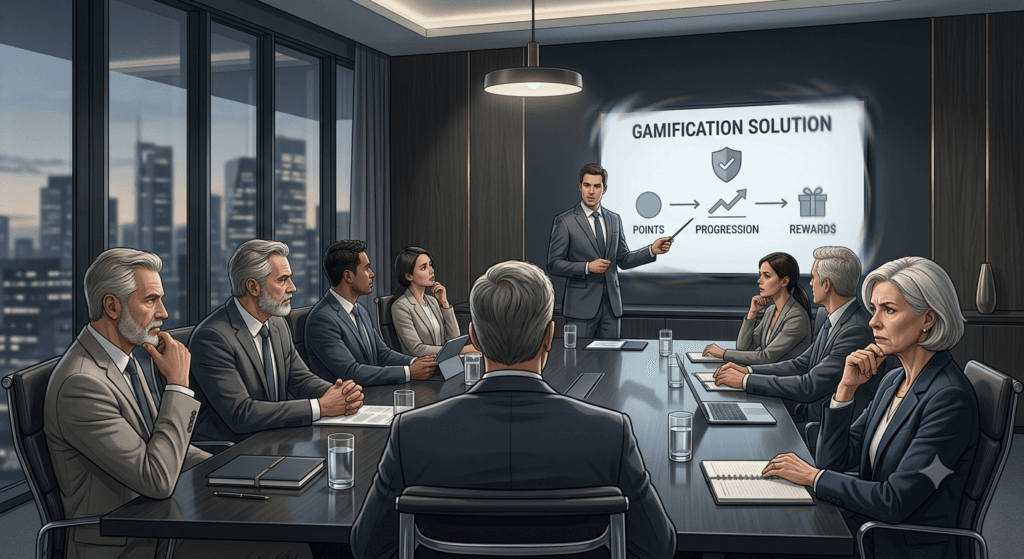
If you have ever sat in a vendor pitch and heard “gamification” and “game-based learning” used as if they were the same thing, that is not an accident. Most vendors benefit from the confusion — the vaguer the term, the easier it is to sell you a platform that does neither well.
Here is the part that should bother you more: companies routinely burn lakhs on the wrong approach because nobody in the room could draw the line between the two. A leadership team asks for “something gamified” and ends up green-lighting a six-figure simulation build. Or they ask for “engaging” compliance training and get a leaderboard bolted onto the same tired module. Both mistakes come from the same root cause — not understanding gamification vs game-based learning well enough to push back in the room.
This article exists to fix that, permanently. Not with a textbook definition, but with a distinction you can actually apply the next time someone on your team says “let’s gamify it.”
If you have not already, it is worth anchoring this against the broader instructional design models that guide these decisions — gamification and game-based learning are both design choices that sit downstream of your instructional strategy, not replacements for it.
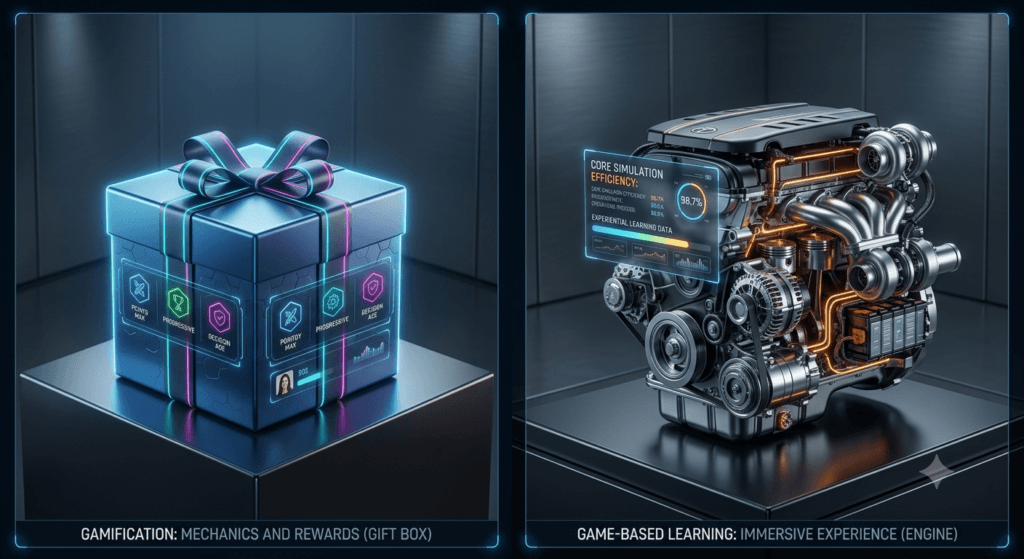
Gamification vs Game-Based Learning, In One Sentence Each
| –Gamification is the practice of adding game elements — points, badges, leaderboards — on top of existing training content to motivate learners to complete it. –Game-based learning is the practice of using an actual game, simulation, or scenario as the learning experience itself, so the content and the gameplay are the same thing. One sentence further: gamification changes the wrapper; game-based learning changes the vehicle. |
Why Vendors Blur This Line (And Why You Shouldn’t Let Them)
Here is what most articles on this topic won’t tell you: the confusion between gamification and game-based learning is not just a training-industry accident. It’s commercially convenient.
A vendor selling a “gamified learning platform” wants the term to stretch as far as possible — because the wider the definition, the more of your budget it can plausibly claim. If “gamification” can mean anything from a badge on a dashboard to a full branching simulation, then a vendor never has to tell you which one you’re actually buying, or whether it’s the right one for the behaviour you’re trying to change.
The fix isn’t distrust — it’s specificity. Once you can name which of the two you need and why, a vendor conversation changes shape entirely. You stop asking “can you gamify this?” and start asking “is this a motivation problem or a practice problem?” That single reframe is worth more than any feature comparison.
What Is Gamification?
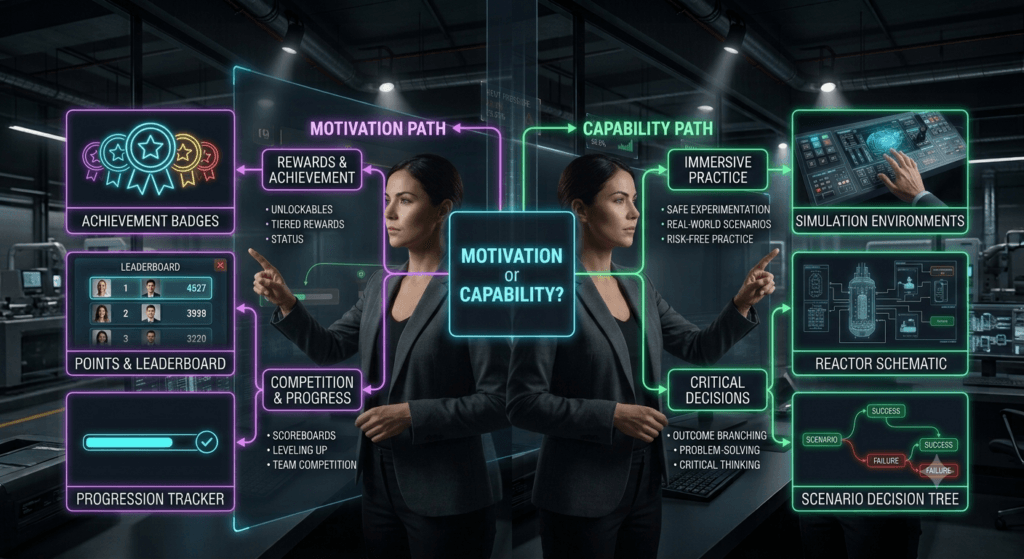
Gamification does not ask “how do we turn this into a game?” It asks “how do we make people want to finish this?” The course, the assessment, the compliance module — all of it stays exactly the same. What changes is the motivational layer wrapped around it.
Key characteristics:
- Adds a motivational layer on top of unchanged content
- Relies primarily on extrinsic motivation — rewards, recognition, competition
- Fast and cheap to implement, usually through an LMS
- Does not require rebuilding the learning content itself
Corporate examples of gamification:
- A sales enablement LMS awarding badges for completing product modules
- A compliance dashboard with a progress bar and completion streaks
- A quarterly leaderboard ranking teams by course completion or quiz scores
- Peer recognition points redeemable for rewards
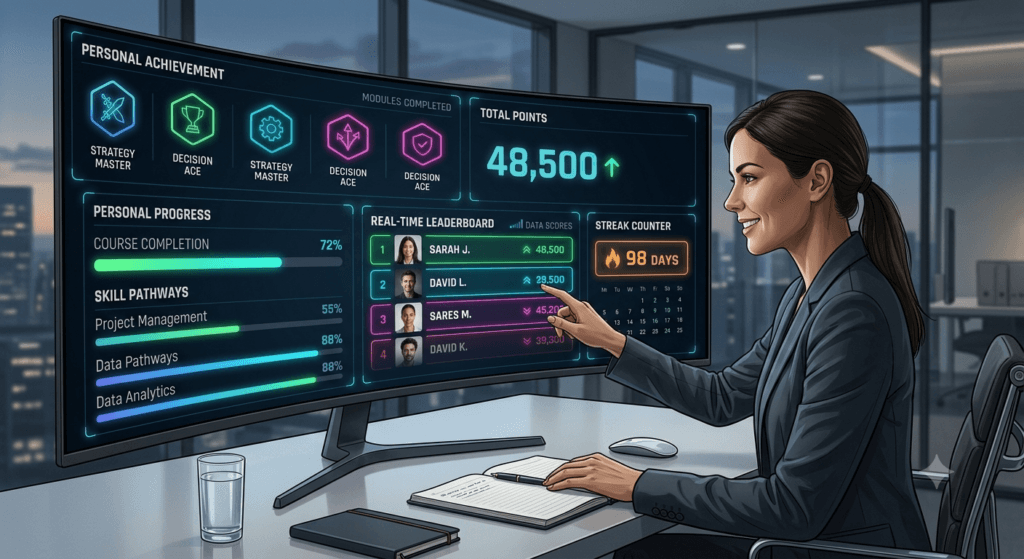
Gamification works best where the content itself is necessary but not naturally engaging — onboarding checklists, compliance renewals, product knowledge refreshers. Most modern platforms make this easy to bolt on; our guide to choosing the right LMS covers what to look for in built-in gamification features.
Gamification does not fix bad content. It gives learners a reason to show up. What they find when they arrive is still on you. This is exactly where most gamification projects go wrong: they add rewards without first asking why the learner should care in the first place. If you skip that question, you’ll build a leaderboard nobody sustains interest in past week two — which is why it’s worth running your content through the ARCS Model of Motivation before you add a single badge, not after.
What Is Game-Based Learning?
Game-based learning (GBL) uses an actual game as the learning experience itself. The game is not decoration — it is the delivery mechanism. Learners hit the learning objective by playing, not by completing a course dressed up to look playful.
Key characteristics:
- The game and the content are inseparable — there is no “underneath”
- Relies primarily on intrinsic motivation — curiosity, challenge, mastery
- Built around goals, rules, feedback loops, and visible consequences
- Higher cost and build time — this is design work, not a plugin
Engagement is not learning. A learner can be fully engaged in a badge system and learn nothing from it. GBL closes that gap by making the decision itself the lesson — which is also why GBL is unforgiving of weak design. Skip the underlying learning theory and you’ll build an expensive game that’s fun but doesn’t transfer. Two models are worth understanding before you brief a GBL build: Kolb’s experiential learning cycle explains why practicing a decision beats reading about one, and Merrill’s Principles of Instruction explains how to structure that practice around a real task instead of a trivia loop — the single most common way GBL projects quietly become expensive quizzes.
Real examples of game-based learning:
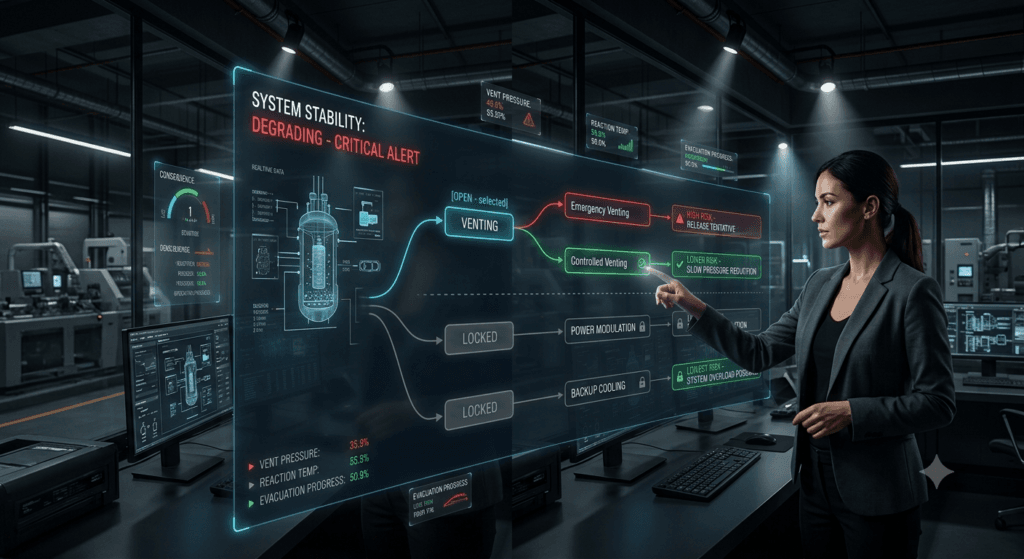
- Branching negotiation simulations where a sales rep sees the consequences of each choice in real time
- Role-play simulations for managers practicing a redundancy conversation, with different endings based on decisions made
- Serious games where new hires run a virtual factory floor or store, balancing safety, output, and cost
- Scenario-based compliance training where a wrong decision triggers a realistic consequence — an audit flag, a customer complaint, a safety incident
If you are designing this kind of content, our guide to writing branching scenarios for scenario-based learning walks through the exact structure GBL depends on.
Gamification vs Game-Based Learning: Core Differences
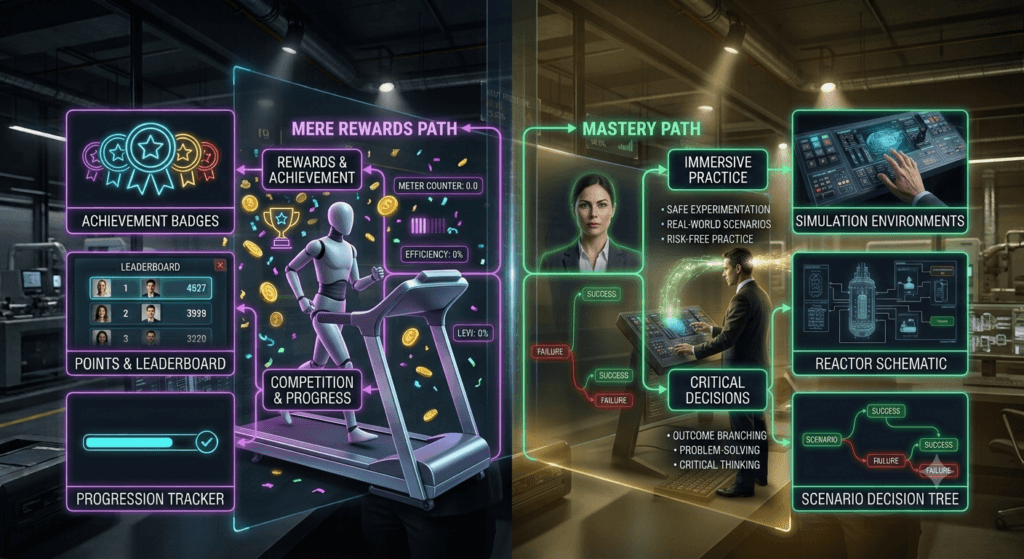
If you only remember one thing from this article, make it this. Gamification tracks completion. Game-based learning builds capability. Confusing the two is the single most expensive mistake on this list.
| Factor | Gamification | Game-Based Learning | What This Means |
| Objective | Increase engagement with existing content | Deliver the learning experience through gameplay | Ask “motivate or teach?” before you scope anything |
| Design Approach | Add mechanics on top of unchanged content | Build a game where content and challenge are inseparable | You can’t “gamify” a bad course into a good one |
| Immersion | Low to moderate | High | Immersion is what you’re paying for in GBL |
| Motivation Type | Extrinsic (rewards, competition) | Intrinsic (curiosity, mastery, narrative) | Extrinsic motivation fades when the reward stops |
| Tools Used | LMS gamification plugins, badge and leaderboard widgets | Simulation authoring tools, branching scenario builders | Tooling cost is a proxy for build complexity |
| Learning Outcomes | Completion rates, short-term engagement | Decision-making practice, retention, behaviour transfer | Pick the metric before you pick the format |
| Cost & Time | Low to moderate, fast to deploy | Higher — scenario design and often development resources | Budget conversations should start here |
| Best Fit | Compliance, onboarding, product refreshers | Sales negotiation, leadership decisions, safety-critical judgment | Match the format to the stakes, not the trend |
Points are cheap. Behaviour change is not. That single line is why the “Best Fit” and “Learning Outcomes” rows matter more than any other row in this table.
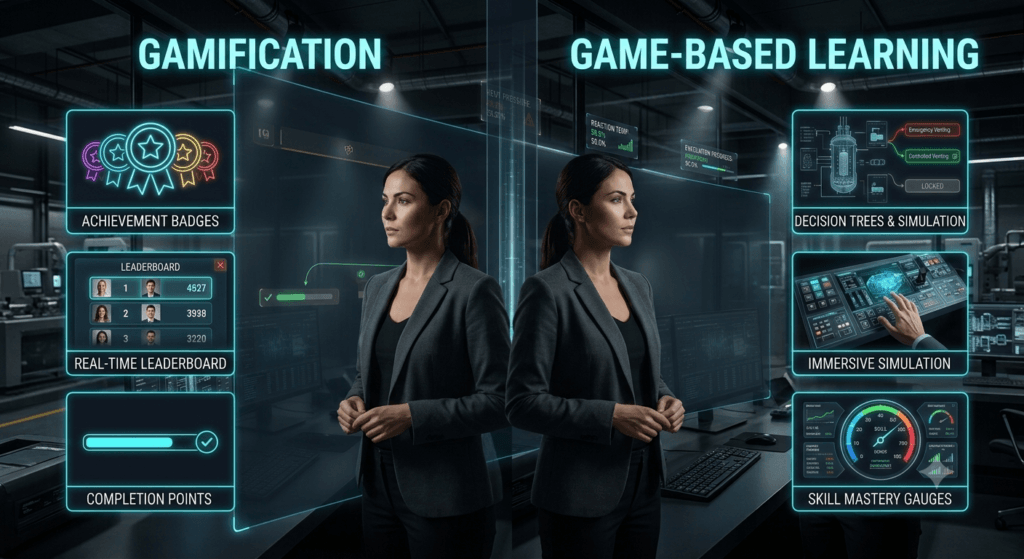
| The Naming Framework Gamification = Motivation Layer. Game-Based Learning = Learning Environment. That distinction alone resolves most “should we gamify this?” arguments before they start. |
This isn’t just a framing device — it holds up against the research. A meta-analysis by Sailer and colleagues found that gamification’s measurable benefit shows up almost entirely in motivational outcomes, with far weaker evidence for actual knowledge retention. In plain terms: the data backs the “motivation layer” label, not a “learning method” label. If your goal is retention or behaviour change rather than completion, that finding alone should redirect your budget toward game-based learning instead.
The Engagement Depth Model (TrainerCentric Framework)
Think of the two approaches as sitting on a spectrum rather than as a binary choice — call it the Engagement Depth Model:
Light engagement (points, badges, streaks) → Moderate engagement (challenges, team competitions) → Deep engagement (branching scenarios, simulations, serious games)
Gamification lives on the light-to-moderate end. Game-based learning lives on the deep end. Most training doesn’t need to sit at the deep end — but when the stakes justify it, nothing on the light end will substitute for it.
How to use it: run every project through this model before a single screen gets designed. Place the desired behaviour change on the spectrum first, then let the scope follow the placement — not the other way round. If the honest answer is “light,” stop your team from scoping a simulation. If it’s “deep,” don’t let a badge system substitute for the practice your learners actually need.
Real-World Examples
Gamification in corporate training:
- Onboarding checklist with progress tracking — new hires unlock badges as they complete HR forms and policy reads. The content is unchanged; the wrapper drives completion.
- Sales team leaderboard — reps earn points for product certifications, with monthly recognition for top scorers.
- Compliance streaks — employees maintain a “streak” for on-time completion of monthly micro-refreshers.
- BFSI regulatory refreshers — banks and insurers use points and completion badges to push annual AML and KYC refresher modules across large distributed workforces.
- Retail onboarding badges — new store associates unlock badges for completing product knowledge and POS training ahead of their first shift.
Game-based learning in corporate training:
- Sales negotiation simulation — a rep works through a multi-round client negotiation where price, tone, and timing decisions change the deal outcome.
- Manager decision simulation — a first-time manager navigates a simulated underperformance conversation that branches based on the approach taken.
- Safety scenario game — a warehouse employee makes a sequence of decisions where an unsafe shortcut leads to a visible, consequence-driven outcome.
- Manufacturing floor safety simulation — a plant operator practices a lockout-tagout procedure in a simulated environment, with a near-miss consequence triggered by any skipped step.
- BFSI fraud-detection scenario — a bank teller works through a branching scenario where the “correct” answer depends on reading behavioural red flags, not memorising a policy list.
The pattern holds: gamification suits high-volume, lower-stakes content. Game-based learning earns its higher cost when the behaviour being trained has real consequences if practiced wrong in real life.
What Most Articles on This Topic Get Wrong
A few widely repeated claims about this topic don’t hold up under scrutiny:
“Gamification increases engagement.” Not quite. It increases completion. Those aren’t the same thing, and treating them as interchangeable is how compliance training ends up dressed in badges while nobody remembers the content a month later.
“Game-based learning is always the better format.” Also not true. GBL is frequently the overengineered choice — a simulation built for content that a clear deadline and a badge would have handled at a tenth of the cost. Depth is only valuable when the stakes justify the build.
“Engagement equals learning.” This is the most repeated mistake in the industry, and it deserves to be said plainly rather than buried in a bullet list: a learner can be maximally engaged and learn nothing. Engagement is a precondition for attention, not a proxy for retention. Every decision in this article — which format, which budget, which metric — should be filtered through that one sentence.
Why Most Gamification Efforts Fail
Nobody sets out to build a bad gamification layer. It fails quietly, for three repeatable reasons:
Points are not a strategy. A badge system bolted onto a weak course does not fix the course — it just decorates the same problem.
- Gamification amplifies whatever is underneath.
- Good content becomes engaging.
- Bad content becomes louder.
The content is still boring. No leaderboard survives contact with content nobody wanted to sit through in the first place. Motivation mechanics buy you a few extra completions, not a rescue.
Design gets skipped. Points and badges get added as an afterthought in week four of a project, instead of being designed alongside the learning objectives from week one. That’s the difference between a mechanic that reinforces behaviour and one that just sits on top of a screen. None of this means gamification doesn’t work. It means gamification only works on content that was already worth completing.
The most expensive version of this mistake: using gamification where practice was actually required. It creates the illusion of learning — completion certificates, high scores, a busy leaderboard — without the reality of it, because none of those signals measure whether the learner could actually perform the behaviour under pressure. That gap is invisible until the moment it matters most.
Other common mistakes worth flagging:
- Overcomplicating learning with unnecessary games. Building a full branching simulation for a five-minute policy update wastes budget and learner time.
- Ignoring cognitive load. This is exactly where cognitive load theory becomes critical — poorly designed game mechanics add extraneous load that competes directly with the content for the learner’s attention, so a “fun” mechanic can quietly make comprehension worse, not better.
- Confusing engagement with retention. A leaderboard spikes short-term participation without necessarily improving recall or behaviour change — and if you’re only tracking completion, you won’t notice the gap until a manager asks whether the training actually changed anything. That’s the exact question our guide to measuring training effectiveness with the Kirkpatrick Model is built to answer, and it’s worth reading before you present results upward, not after.
When to Use What: The Decision Shortcut
Use gamification when:
- ✔ Time is limited
- ✔ Budget is limited
- ✔ The content already exists and is already correct
- ✔ The problem is engagement, not skill
Use game-based learning when:
- ✔ Behaviour change is the actual goal
- ✔ Learners need to practice a decision, not just absorb information
- ✔ Getting it wrong in real life carries real cost — safety, compliance, customer relationships
- ✔ You have the budget and timeline for scenario or simulation design
Still unsure? Map the topic against adult learning theory (andragogy) first — if learners need relevance and hands-on practice, lean GBL. If they need a nudge to engage with content they already understand, lean gamification. If you’re currently comparing platforms to support either decision, our guide to choosing the right LMS is worth reading before you sign anything.
Practical Tips for Implementation
- Audit your content before choosing a format. If the course itself is weak, fix that first — neither approach rescues poor instructional design.
- Start small with gamification. Pilot a badge or leaderboard system in one LMS module before rolling it out organisation-wide. Most modern platforms, including the tools covered in our rapid eLearning development guide, have gamification features built in.
- Reserve GBL budgets for the 20% that matters. Save simulation spend for the content where decision-making practice genuinely changes outcomes.
- Keep gamified content bite-sized. Pairing gamification with microlearning formats sustains engagement better than gamifying a long, unchanged course.
- Design consequences, not just choices, in GBL. A branching scenario without meaningful, visible consequences is a quiz with extra steps. This is where an action mapping approach earns its keep — it forces every scenario branch back to a real on-the-job action rather than a trivia question.
- Measure the right outcome. Track completion and participation for gamification; track decision quality and behaviour transfer for game-based learning.
Conclusion
Gamification and game-based learning both borrow the language of play, but they solve different problems. Gamification motivates learners to get through content that already exists. Game-based learning is the content — the game and the learning objective are the same thing.
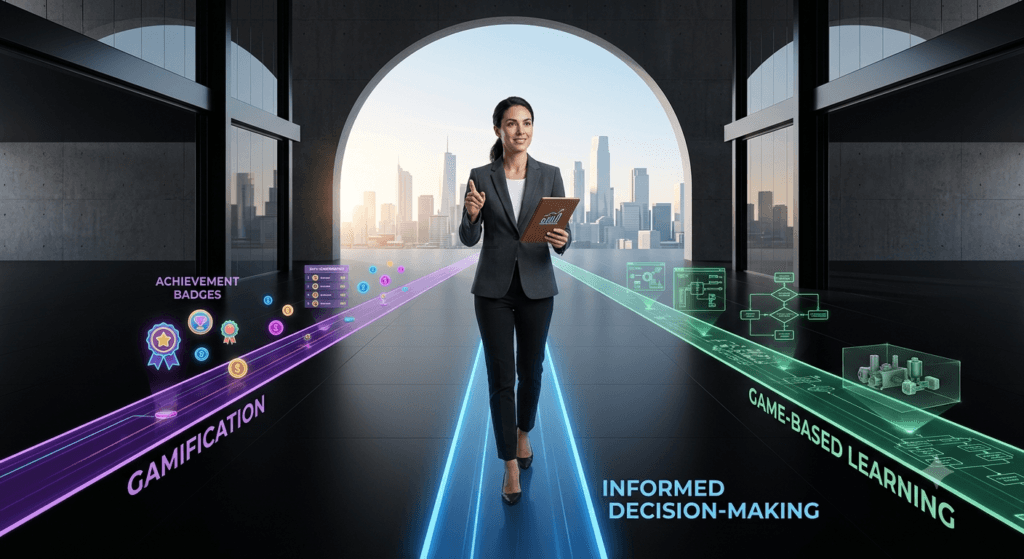
Choose based on what the learner needs to walk away with, not on what sounds innovative in a stakeholder meeting.
If you’re adding points to a course nobody wanted to take in the first place, you are not gamifying learning — you’re decorating a problem you haven’t actually solved. And if you’re building a full simulation where a badge and a clear deadline would have done the job, you’re not being thorough — you’re overengineering a problem that didn’t need it.
The format was never the strategy. It’s the consequence of one — and if you’re choosing between gamification and game-based learning before you’ve defined the behaviour change you actually need, you’ve already lost the design. Points are easy to add. Practice is hard to design. One changes behaviour. The other just tracks it.
Frequently Asked Questions
Is gamification the same as game-based learning?
No. Gamification adds game elements to existing content; game-based learning uses a game as the content itself. They share vocabulary, not mechanics.
Which is better for corporate training: gamification or game-based learning?
Neither is universally better — the right choice depends on whether the goal is motivating completion or practicing a decision. See the Decision Shortcut above for a quick way to tell which one you need.
Is gamification actually effective, or is it a fad?
It’s effective at what it’s designed for — completion and short-term engagement — and ineffective as a substitute for good content. Treat it as a motivation layer, not a fix, and it holds up well over time.
Is game-based learning worth the extra cost?
Only for content where a wrong decision has real consequences. For low-stakes, high-volume content, GBL is usually over-investment; gamification or well-designed microlearning does the job for less.
Can you combine gamification and game-based learning in one program?
Yes, and it’s common. A typical pattern: use a simulation for the core skill practice, then layer gamification — badges, completion tracking — around the surrounding compliance or knowledge-check content in the same program.
Further Reading
- Scenario-Based Learning: How to Write Branching Scenarios for Corporate Training
- Kolb’s Learning Cycle: Using Experiential Learning in the Workplace
- Cognitive Load Theory for Instructional Designers
- How to Choose the Right LMS for Your Organisation
- Microlearning: What It Is, When to Use It, and How to Design It
- How to Measure Training Effectiveness Using the Kirkpatrick Model
- Keller’s ARCS Model of Motivation, Explained
- Action Mapping: A Practical Guide for Instructional Designers
- Merrill’s Principles of Instruction: Designing Skill-Based Training
- Story-Based Learning Design: A Practical 5-Step Framework
References
- The Gamification of Learning and Instruction: Game-Based Methods and Strategies for Training and Education || 1st Edition || Karl M. Kapp || Pfeiffer || 2012
- Design for How People Learn || 2nd Edition || Julie Dirksen || New Riders || 2015
- Map It: The Hands-On Guide to Strategic Training Design || 1st Edition || Cathy Moore || Books to Read LLC || 2017
- The Adult Learner: The Definitive Classic in Adult Education and Human Resource Development || 8th Edition || Malcolm S. Knowles, Elwood F. Holton III, Richard A. Swanson || Routledge || 2015
- Actionable Gamification: Beyond Points, Badges, and Leaderboards || 1st Edition || Yu-kai Chou || Octalysis Media || 2015
Author Details

Anupama Mitra is a learning experience designer, writer and facilitator with a deep interest in how people learn, adapt and grow at work. With over a decade of experience in corporate learning and development, she specializes in simplifying complex ideas into practical, actionable insights. Her work focuses on leadership development, behavioral changes, making workplace learning more human and engaging. You can reach out to her at anupama@trainercentric.com