Introduction
Sarah got the email on a Tuesday: she’d be facilitating a company-wide cybersecurity workshop in three weeks. She runs L&D at a mid-sized logistics company, and she’s built dozens of successful training sessions — but she’s never configured a firewall or investigated a phishing incident in her life. Her first instinct was panic. Her second was to Google “how to facilitate training when you are not an expert” at 11 p.m. We’ll come back to how her session actually went.
If that’s how you found this article, you’re in good company. This scenario plays out constantly in corporate learning — a trainer gets handed a compliance module, a software rollout, or a technical topic they didn’t major in. It’s one of the most common sources of anxiety in the profession, and in our experience facilitating and reviewing corporate training programs across industries, the real challenge is rarely a lack of technical knowledge. It’s uncertainty about handling the unexpected question.
Here’s the reassurance up front: you don’t need to become the subject matter expert to run a great session. You need a different skill set, and this article shows you exactly how to use it — without losing credibility in the room. This guide specifically talks about how to facilitate training without being an expert. Let’s jump in.
Can You Facilitate Training Without Being a Subject Matter Expert?
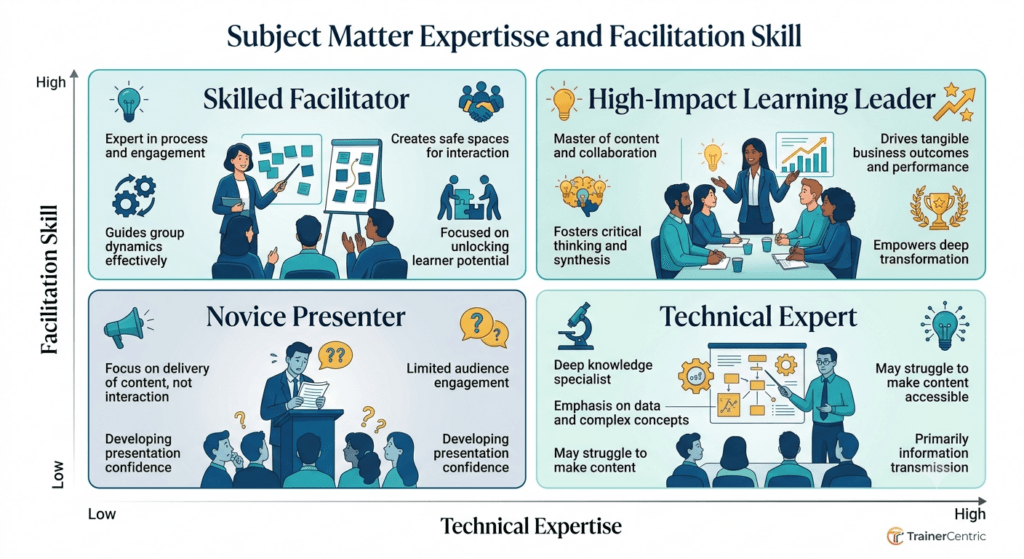
Yes. A facilitator’s job is to guide the learning process — managing discussion, keeping participants engaged, and helping the group reach the session’s objectives. Subject matter expertise adds value, but it’s not the same job. Many corporate training programs deliberately pair a facilitator with an SME so that strong facilitation and deep technical knowledge work together, rather than expecting one person to deliver both.
It helps to understand why organizations split these roles in the first place, rather than just accepting it as a workaround. In large organizations, expecting one person to be both an expert practitioner and an expert facilitator usually isn’t realistic. Technical experts spend years building domain knowledge; facilitators spend years building skill in adult learning, group dynamics, and instructional delivery. Separating the roles lets each professional focus on what they’re actually best at — which, more often than not, produces a more effective learning experience than asking one person to stretch across both.
That distinction — facilitating learning versus delivering technical expertise — is the foundation for everything else in this article, so it’s worth sitting with for a second.
A subject matter expert knows the content inside and out. They can answer the edge-case question or explain why a regulation exists. That depth matters, but it doesn’t automatically make someone skilled at helping a room of adults actually absorb and apply information. Many L&D teams intentionally separate facilitation from technical expertise, precisely because the two require different muscles: one is about content mastery, the other is about guiding people through a learning experience.
A facilitator’s role is to structure the session, manage time, draw out participation, and make sure the room walks away able to do something with what they learned. You’re not the encyclopedia. You’re the guide. This is exactly the model behind well-designed Instructional Design Models— content ownership and facilitation ownership are treated as separate disciplines, because doing both well at once is genuinely hard, even for people who are experts.
Facilitator vs Subject Matter Expert
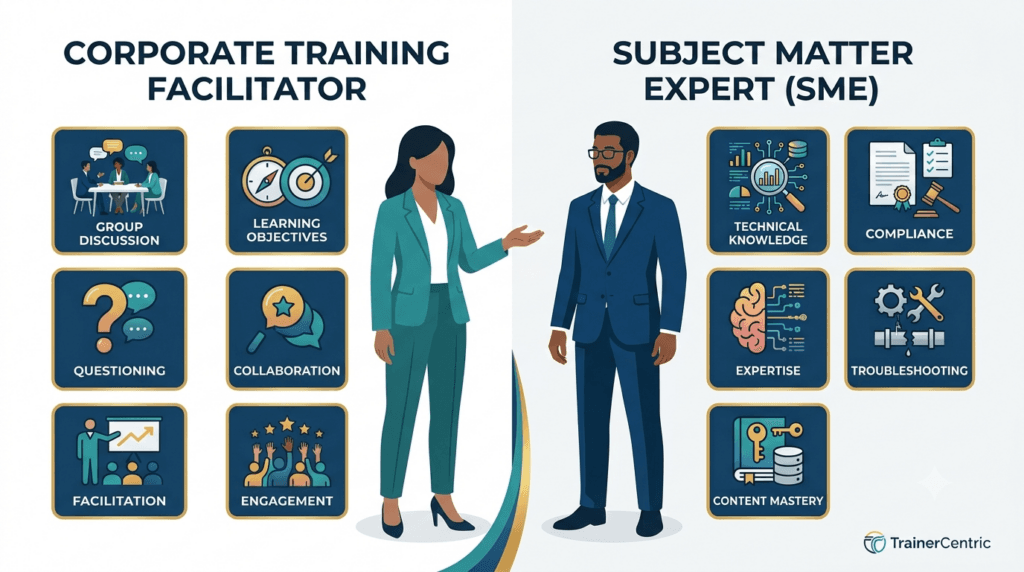
| Facilitator | Subject Matter Expert | |
| Purpose | Guide the learning experience | Provide accurate, deep content knowledge |
| Core responsibility | Structure, pacing, engagement, group dynamics | Technical accuracy, edge cases, real-world application |
| Expertise required | Adult learning principles, questioning technique, facilitation skills | Deep, current knowledge of the subject |
| Focus during session | Is the group understanding, participating, and progressing? | Is the information correct and complete? |
| Success measure | Learners engage, apply, and retain the material | Content is technically sound and defensible |
Neither role outranks the other. A brilliant SME who reads slides in a monotone will produce a worse outcome than a strong facilitator working from well-built content, and vice versa. That’s why investing in a solid Training Needs Analysis before you build the session matters — it tells you upfront how much each role needs to carry.
The TrainerCentric 3C Facilitation Model
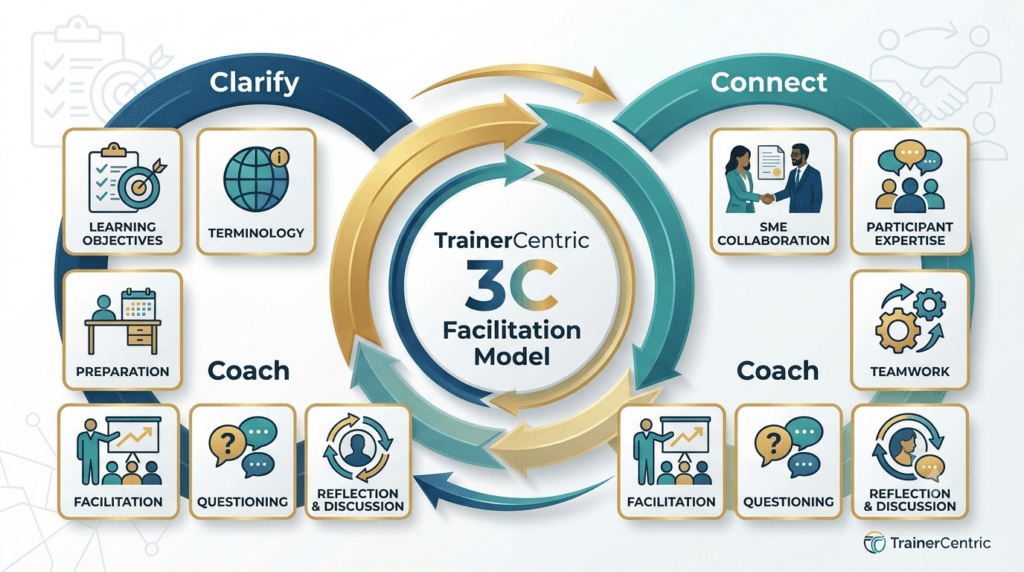
Most advice on this topic boils down to a loose list of tips — “prepare,” “meet the SME,” “ask good questions.” Useful, but hard to remember under pressure. Over the years, we’ve found that facilitators who succeed without deep technical expertise consistently do three things well: they clarify expectations, connect with experts, and coach learning instead of performing expertise. That’s why we teach the TrainerCentric 3C Facilitation Model to every non-SME facilitator we train.
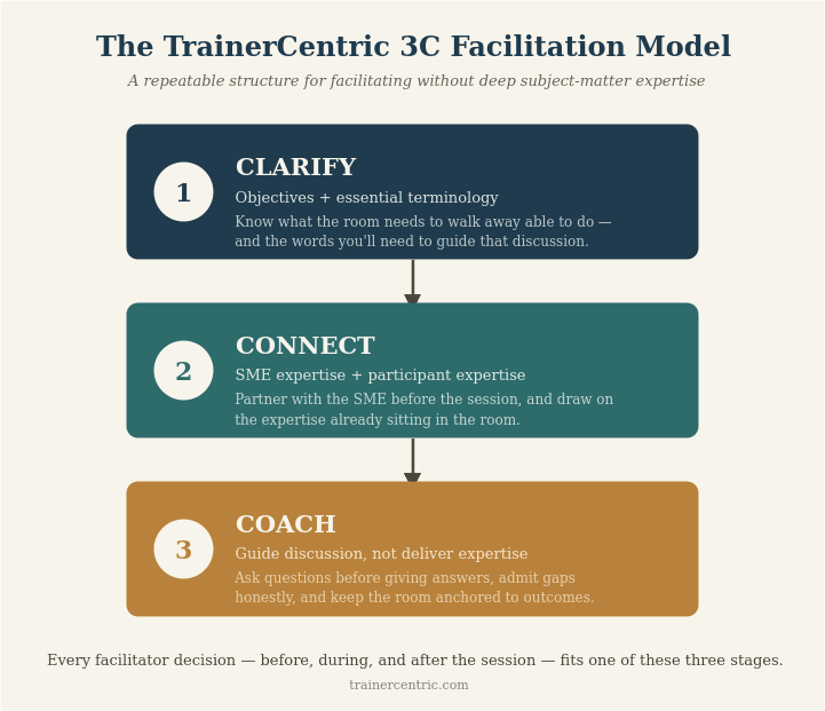
- Clarify — Understand the learning objectives and the essential terminology before you build anything else.
- Connect — Partner with the SME and draw on the expertise already sitting in the room with your participants.
- Coach — Guide discussion, encourage reflection, and reinforce application instead of trying to be the technical authority.
Every facilitator decision, during preparation and during delivery, fits into one of these three stages. When a session goes sideways, it’s almost always because one of the three got skipped — usually Clarify, because it’s the least visible of the three and the easiest to rush past under deadline pressure.
One mistake we see repeatedly: facilitators spend hours trying to become mini-experts before the session instead of investing that same time in designing better discussions. Ironically, participants rarely remember the facilitator’s technical knowledge — they remember whether the session helped them solve a real problem. Time spent clarifying objectives and building good questions almost always pays off more than time spent cramming content.
Sarah, from the opening of this article, didn’t become a cybersecurity expert overnight. She clarified the objectives with her manager, connected with her IT lead twice before the session, and coached discussion instead of trying to lecture on attack vectors she didn’t fully understand. Without realizing it, she’d already started applying the 3C Model.
Each phase carries a couple of specific, practical moves. Here’s how it plays out.
Clarify: know the objectives and the language
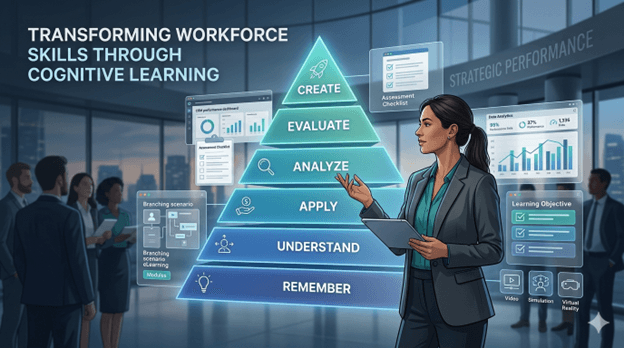
Get precise on the learning objectives. Before touching slides or terminology, nail down exactly what participants need to be able to do by the end of the session — not “understand cybersecurity,” but “identify a phishing email and report it correctly.” Once Sarah reframed her workshop that way, the scope of what she actually needed to know shrank dramatically. Objectives frameworks like Bloom’s Taxonomy are useful here for turning a vague topic into a measurable outcome.
Learn the key terminology, not the whole discipline. You need conversational fluency, not a certification. A facilitator running a data privacy compliance session doesn’t need the full regulatory framework — she needs to comfortably use terms like “data subject” and “breach notification window” so she can follow and steer the conversation. Build a one-page glossary of 15–20 terms before any unfamiliar session and review it the morning of.
Connect: lean on the SME and the room
Meet with the SME beforehand — and come prepared. Don’t ask for a full brain dump. Bring your objectives and ask which 20% of the content matters most, plus the questions participants are most likely to ask. A trainer preparing an ERP rollout got 80% of what she needed from a single 45-minute conversation with the implementation lead about the five workflows employees would use daily.
Encourage participant discussion and peer expertise. In most rooms, someone already knows more than you do about part of the topic — that’s a resource, not a threat. During a product training session, a facilitator invited a veteran support rep to walk the group through a real customer scenario, which built more credibility than anything she could have said herself. Designing this kind of moment in deliberately, rather than hoping it happens, is part of what Scenario-Based Learning does well.
Coach: guide the room, don’t perform the content
Ask powerful questions instead of supplying answers. This is arguably the single most valuable skill here, and it works especially well when you’re not the expert. Instead of answering a technical question yourself, turn it back: “Has anyone run into this before?” or “What’s your best guess, and why?” In a leadership workshop, a participant asked how to handle a specific underperforming employee — rather than prescribing an answer, the facilitator asked, “What outcome are you trying to protect here?” and let the group work through it.
Admit when you don’t know — clearly and confidently. This is the move new facilitators resist most, and the one that matters most. Bluffing a technical answer is the fastest way to lose a room’s trust; saying “I don’t know, but I’ll find out” builds it. Practice saying it out loud before your session so it sounds calm, not apologetic.
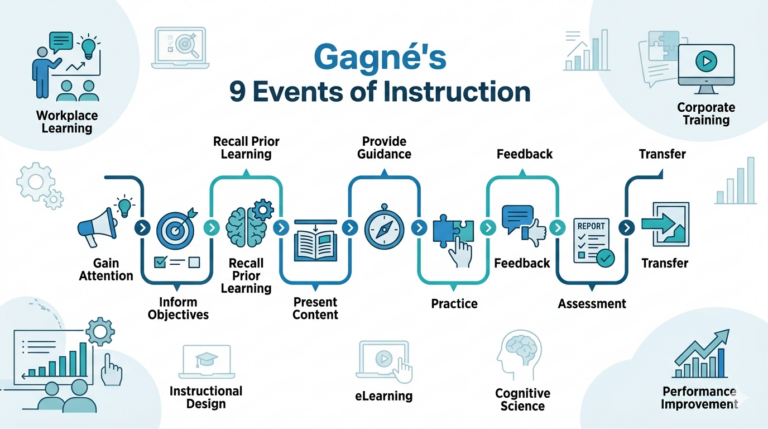
Keep the conversation anchored to the objectives. Without deep content knowledge, it’s easy for a tangent to pull you somewhere you can’t navigate. Notice when a discussion has drifted past what’s useful, and redirect it — more on exactly how in the next section. This is where a well-sequenced session design, like the one behind Gagné’s Nine Events of Instruction, pays off: it gives you natural checkpoints to pull the group back to.
As one facilitation principle puts it: a good facilitator doesn’t need to be the smartest person in the room — they need to make sure the smartest ideas in the room get shared.
How to Handle Questions You Cannot Answer
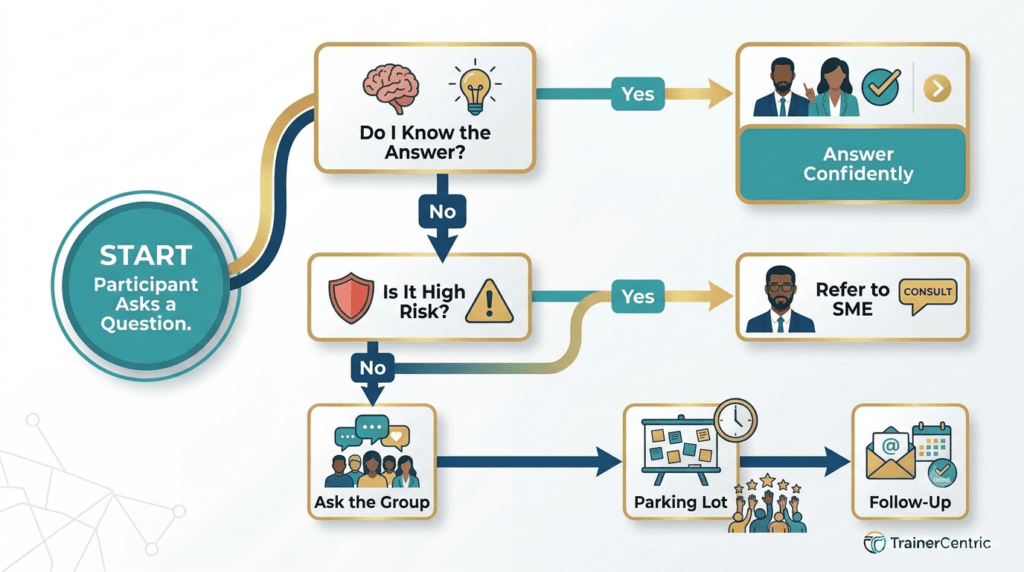
This is the moment most new facilitators dread, so have language ready before you need it:
- “That’s a great question. Rather than speculate, I’ll confirm the answer with our SME and follow up with everyone by [specific date].”
- “I want to give you an accurate answer rather than a guess — let’s park that and I’ll circle back before we finish today.”
- “I don’t have the technical depth to answer that precisely, but here’s who on the team would know — let’s connect you after the session.”
- “Good catch. Does anyone in the room have experience with this?”
None of these scripts pretend, panic, or guess — and all of them commit to a next step. That commitment is what protects your credibility. Participants don’t expect facilitators to know everything; they expect facilitators to handle not knowing something professionally.
This matters even more in regulated or high-risk contexts — compliance, safety, legal, or clinical training — where a guessed answer can create real liability. In those settings, defer to the SME every time and build a formal escalation process before the session starts, not on the fly.
Keep a visible “parking lot” for questions you table — a whiteboard section, a shared doc, whatever’s visible to the room. Closing the loop on parked questions afterward is what separates a facilitator participants trust from one they stop asking hard questions of.
What Happens Before, During, and After the Session
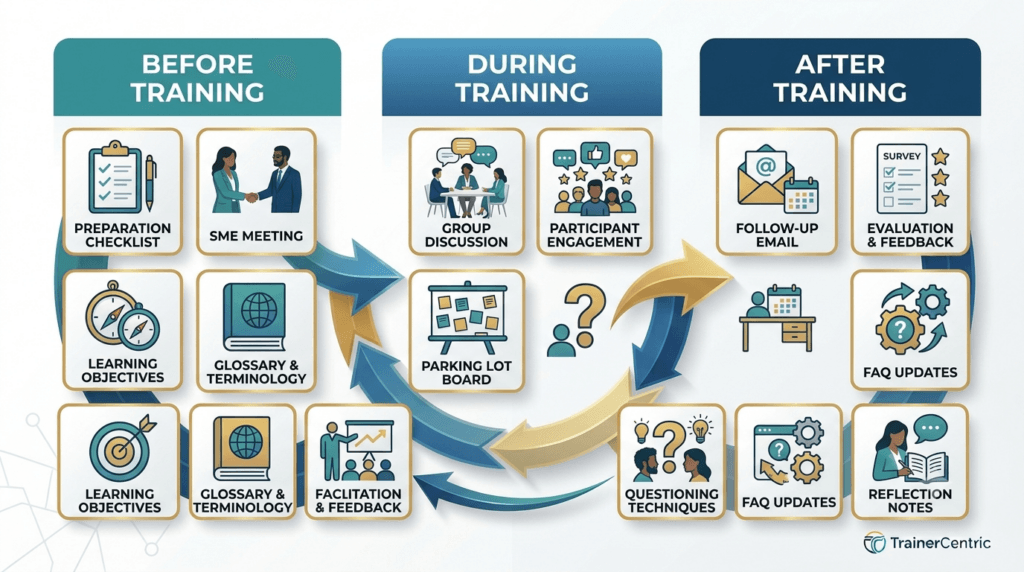
Isolated tips are useful, but it helps to see the whole workflow in sequence.
Before
- Meet the SME and confirm objectives
- Build your terminology glossary
- Draft an FAQ from the SME conversation
- Set up a parking lot and confirm the escalation process
During
- Ask open-ended questions before offering answers
- Facilitate discussion and invite peer expertise
- Capture unanswered questions in the parking lot
- Manage time against the objectives, not the slide deck
After
- Send follow-up answers to parked questions
- Debrief briefly with the SME on what came up
- Reflect on participant feedback and update your FAQ for next time
That last step compounds over time — each session makes the next one easier, because your FAQ and glossary get sharper with every round.
Common Mistakes First-Time Facilitators Make
- Pretending to know everything. Participants can usually tell, and it erodes trust faster than an honest gap ever would.
- Reading slides word-for-word. This signals you’re leaning on the deck because you don’t trust yourself with the content.
- Arguing with experienced participants. If someone with deep tenure challenges a point, explore it or park it — don’t try to win it.
- Letting discussions drift. Interesting tangents feel productive in the moment but eat into time meant for the actual objectives.
- Skipping SME prep. Walking in without a pre-session conversation is the single biggest predictor of getting caught flat-footed.
Quick Preparation Checklist
- Review and write down specific learning objectives
- Meet with the SME and ask what participants usually get wrong
- Build a one-page glossary of key terminology
- Prepare an FAQ list from the SME meeting
- Set up a parking lot for questions you can’t answer live
- Confirm the escalation process — who answers parked questions, and by when
- Prepare 3–5 open-ended questions to redirect discussion back to the group
- Identify participants who may bring relevant peer expertise into the room
When the Facilitator Should Lead vs. When the SME Should Lead
Not every part of a session belongs to you. Knowing where the boundary sits removes a lot of the guesswork.
| Session Moment | Facilitator Leads | SME Leads |
| Icebreakers and openers | ✓ | |
| Group activities and exercises | ✓ | |
| Technical demonstrations | ✓ | |
| Compliance or regulatory interpretation | ✓ | |
| Reflection and discussion | ✓ | |
| Action planning | ✓ | |
| Edge-case or “what if” technical questions | ✓ |
If a moment falls in the SME column and no SME is in the room, that’s exactly what your parking lot and escalation process are for — not a cue to guess.
Why Participants Care More About Confidence Than Expertise
Here’s something that surprises new facilitators: post-session feedback almost never mentions how much the facilitator personally knew. It mentions whether the room felt organized, whether questions got real answers (even if delayed), and whether the session helped people do their jobs better afterward.
That tracks with a simple reality of how adults experience a room. Confidence reads as competence — but confidence doesn’t come from knowing every answer. It comes from having a clear process for what happens when you don’t: a calm script, a parking lot, a follow-up date. Participants forgive a facilitator who says “I don’t know, but I’ll find out.” They don’t forgive one who guesses and gets it wrong, or one who visibly panics.
This is also why the decision tree below is worth having ready before your next session, not improvising in the moment.
Key Takeaways
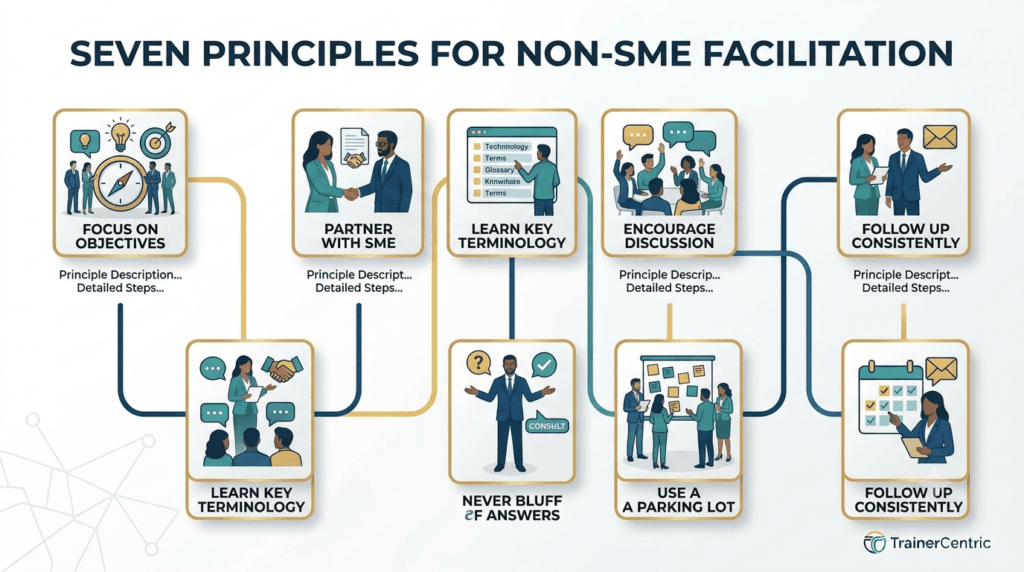
- You don’t need to be the SME to facilitate effectively.
- Learn the objectives, not the entire subject.
- Partner with SMEs before the session, not during it.
- Use participant expertise already in the room.
- Never bluff an answer.
- Follow up on parked questions — every time.
- Focus on learning outcomes, not on performing expertise.
Conclusion
Sarah ran her cybersecurity workshop three weeks later. She still couldn’t explain a zero-day exploit off the top of her head — and she didn’t need to. She’d clarified her objectives, connected with her SME twice, and coached the room through the material using questions, parked items, and peer expertise instead of guesswork. It went well, not because she’d become a security expert, but because she facilitated one.
Great facilitators don’t earn credibility by knowing every answer. They earn it by creating an environment where the right answers emerge, the right conversations happen, and every learner leaves better equipped to perform — and that’s a skill you can build starting with your very next session.
Frequently Asked Questions
Q: Do I need subject matter expertise to be a good corporate trainer?
A: No. Facilitation and subject matter expertise are different skill sets. A facilitator guides the learning process — structuring the session, managing engagement, and keeping discussion focused on outcomes — while an SME provides technical depth. Many programs deliberately pair the two roles.
Q: Is a facilitator the same as a trainer?
A: Not exactly. “Trainer” is often used loosely to mean anyone delivering learning content, while “facilitator” specifically describes someone guiding a group through a learning process — asking questions, managing discussion, and drawing out participation rather than simply presenting information.
Q: Can an SME be a poor facilitator?
A: Yes, and it happens often. Deep technical knowledge doesn’t automatically translate into strong group facilitation skills — engaging a room, managing time, and drawing out discussion are separate competencies from content mastery. That’s exactly why many organizations pair an SME with a dedicated facilitator.
Q: How much subject knowledge is enough to facilitate a topic well?
A: Enough conversational fluency to follow the discussion, use correct terminology, and know when to redirect a question to the SME — not full mastery. A one-page glossary and an FAQ built with your SME beforehand usually covers what you need.
Q: Should facilitators answer every question?
A: No. Facilitators should answer what they confidently know, redirect technical or high-risk questions to the SME or a follow-up process, and use participant expertise where it exists in the room. Trying to answer everything yourself is one of the fastest ways to lose credibility if you get something wrong.
Q: What should I say when a participant asks a question I can’t answer?
A: Acknowledge it honestly, avoid guessing, and commit to a specific follow-up — for example, “I’ll confirm that with our SME and follow up by Friday.” You can also redirect the question to the group first to see if a participant has relevant experience.
Q: When should I defer to a subject matter expert instead of answering myself?
A: Defer whenever accuracy carries real consequences — compliance, legal, safety, or technical troubleshooting questions. In these high-risk or regulated contexts, a guessed answer can create liability, so it’s worth setting up a clear SME escalation process before the session starts.
References
- The Skilled Facilitator: A Comprehensive Resource for Consultants, Facilitators, Managers, Trainers, and Coaches || 3rd Edition || Roger Schwarz || Jossey-Bass || 2016
- Training from the Back of the Room!: 65 Ways to Step Aside and Let Them Learn || 2nd Edition || Sharon L. Bowman || Pfeiffer || 2014
- Design for How People Learn || 2nd Edition || Julie Dirksen || New Riders || 2015
- Telling Ain’t Training || 2nd Edition || Harold D. Stolovitch & Erica J. Keeps || Association for Talent Development (ATD) Press || 2011
- The Adult Learner: The Definitive Classic in Adult Education and Human Resource Development || 9th Edition || Malcolm S. Knowles, Elwood F. Holton III & Richard A. Swanson || Routledge || 2020
- The Art and Science of Training || 1st Edition || Elaine Biech || Association for Talent Development (ATD) Press || 2015
Further Reading
- Training Needs Analysis — understand what participants actually need before you design anything
- Job Task Analysis — build facilitation content grounded in real job performance
- The ADDIE Model — the systematic design framework that contextualises facilitation
- Writing Learning Objectives — align your facilitation choices to measurable outcomes
- The Kirkpatrick Model — measure whether your facilitation is driving business results
- Adult Learning Theory — the research base that underpins every facilitation decision
- When Training Is NOT the Answer — the performance consulting lens every facilitator needs
- How to Handle Difficult Participants in Training -A Practical Guide for Corporate Trainers with 10 Examples
- 8 Icebreakers That Actually Work in Corporate Training
- 12 Facilitation Skills for Corporate Trainers: The Complete Guide + Free Template
- 25 Facilitation Techniques for Corporate Trainers (2026 Guide)
Author Details

Ankita Roy is an accomplished HR leader with over 9 years of experience driving people strategy across the telecom, logistics, and retail sectors. As Head of Human Resources at AGWANI FASHIONS, she specializes in talent management, organizational development, performance management, employee engagement, and HR transformation. Ankita has successfully led workforce planning, career framework design, succession planning, and culture-building initiatives for high-growth organizations. You can reach out to her via her linkedin Profile: https://www.linkedin.com/in/ankita-roy-398708105/