A few months ago, I sat in on a vendor call where an L&D director asked her authoring tool provider a simple question: “Should we publish this course in SCORM or xAPI?” The vendor rep paused, then gave an answer that was technically correct and practically useless: “It depends.” Twenty minutes later, the director was no closer to a decision — and her project timeline had just lost an afternoon.
This scene repeats itself in L&D teams every week. SCORM vs xAPI vs cmi5 is one of those questions that sounds like a technical footnote but actually shapes how your organization tracks learning, reports to stakeholders, and scales training over the next five to ten years. Get it wrong, and you either lock yourself into rigid, LMS-bound reporting or drown your team in raw data nobody knows how to use.
The confusion is understandable. All three are learning standards that sit at the heart of your organization’s digital learning infrastructure. All three move data between content and a system. But they were built to solve different problems, in different decades, for different kinds of learning — and mixing them up leads to real budget and vendor-selection mistakes.
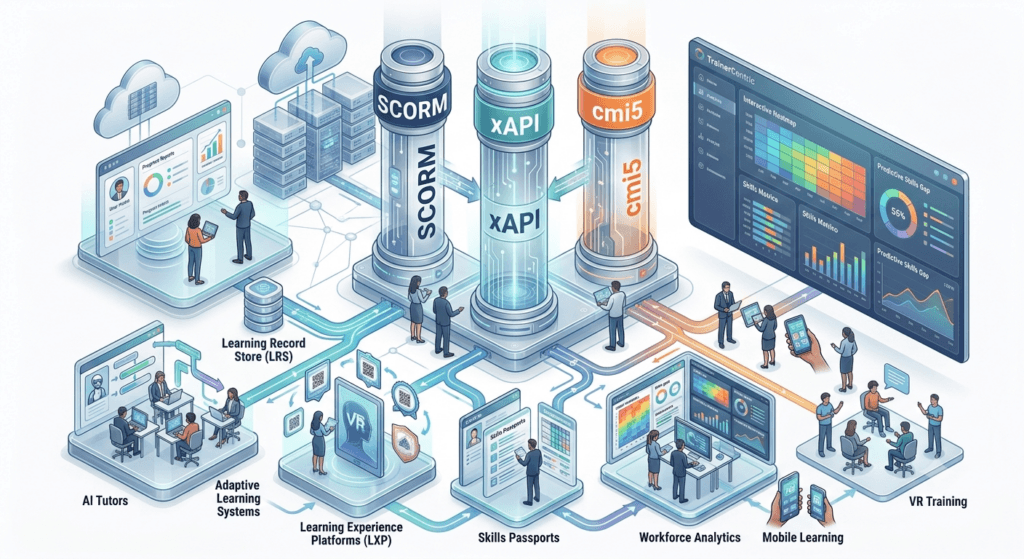
This article breaks down what SCORM, xAPI, and cmi5 actually are, compares them side by side across the parameters that matter to a corporate L&D team, and gives you a practical framework for deciding which one (or which combination) fits your organization in 2026 — a year when AI-powered LMSs, learning experience platforms (LXPs), and skills-based workforces are quietly changing what “good tracking” even means.
| Quick Answer: SCORM is best for traditional LMS-based course tracking. xAPI tracks learning anywhere — inside or outside an LMS. cmi5 combines SCORM’s structured course launches with xAPI’s richer tracking. If you need only completion data, choose SCORM. For learning analytics, choose xAPI or cmi5. |
Executive Summary
- Choose SCORM if your only requirement is completion and score tracking inside a single LMS.
- Choose xAPI if learning happens outside the LMS — mobile, offline, simulations, on-the-job practice.
- Choose cmi5 if you want LMS-style structure and launch control, plus xAPI-level data richness.
- Avoid switching standards just because one sounds more modern — match the standard to your reporting needs, not the marketing.
- Best long-term strategy: keep stable SCORM content as-is, build new courses in cmi5 where your LMS supports it, and use xAPI for anything that lives outside a traditional course structure.
What Are eLearning Standards?
Suppose your organization switches from Moodle to Cornerstone next year. Without learning standards, hundreds of courses might need to be rebuilt from scratch, tested, and re-approved — a project that can quietly eat months of an L&D team’s calendar. That’s exactly the problem SCORM was created to solve, and it’s why learning standards matter far beyond the IT team’s checklist.
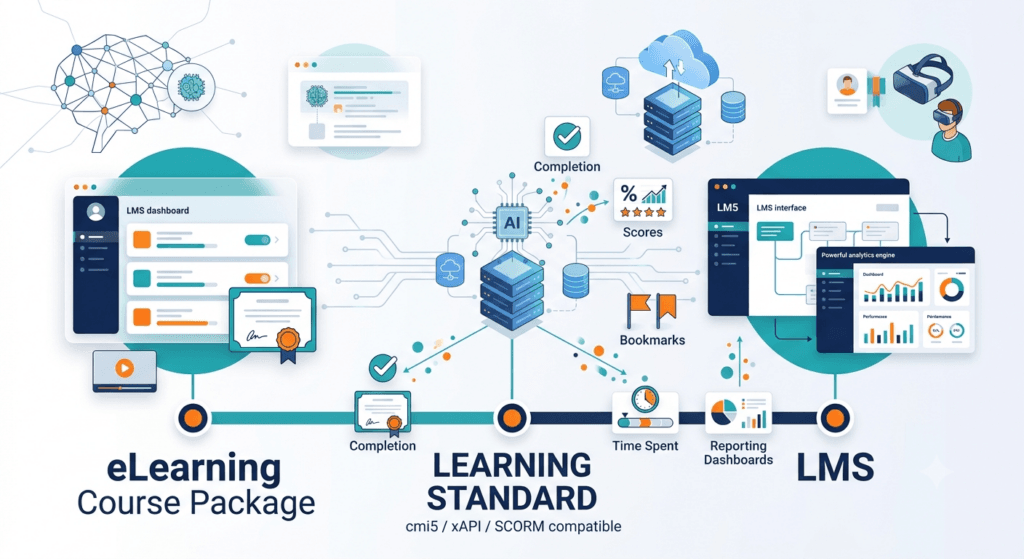
In the 1990s, every LMS vendor and every authoring tool built its own way of tracking learner data. A course built in one system often couldn’t run — or couldn’t report progress correctly — in another. If your organization changed LMS vendors, you frequently had to rebuild your entire course library from scratch.
Learning standards solve this by acting as a shared language between content and the system that hosts it. They define:
- How a course package should be structured
- What data gets tracked (completion, score, time spent, pass/fail, and more)
- How that data is sent, received, and stored
- How a course launches and resumes
Think of a learning standard the way you’d think of a plug socket standard. It doesn’t matter which country made your laptop charger — if it matches the socket, it works. SCORM, xAPI, and cmi5 are three different “socket standards” for your learning technology stack, each designed in a different era, for a different shape of learning experience.
| Did You Know? Before SCORM, the Aviation Industry CBT Committee (AICC) had already built an early interoperability standard in the 1990s for training aircraft technicians. Its DNA still shows up in cmi5 today — the two standards share more history than most people realize. |
How We Got Here: A Quick Timeline
- 1999–2000 → SCORM emerges to solve LMS compatibility. Courses become portable across systems for the first time.
- 2013 → xAPI (born from the “Tin Can API” research project) solves the bigger problem: tracking learning that happens outside the LMS.
- 2016 → cmi5 solves the gap xAPI left open — a standardized way to launch structured courses from an LMS while still using xAPI’s richer data model.
Three standards, three problems, one continuous story of learning technology catching up with how people actually learn.
What Is SCORM?
SCORM (Sharable Content Object Reference Model) is the standard most L&D professionals learned on. It was developed by the U.S. Department of Defense’s Advanced Distributed Learning (ADL) Initiative, with work beginning in the late 1990s and the first version released in January 2000 (ADL Initiative). SCORM 1.2, released in 2001, became the version most of today’s LMSs still support, and SCORM 2004 followed with more advanced sequencing and navigation rules.
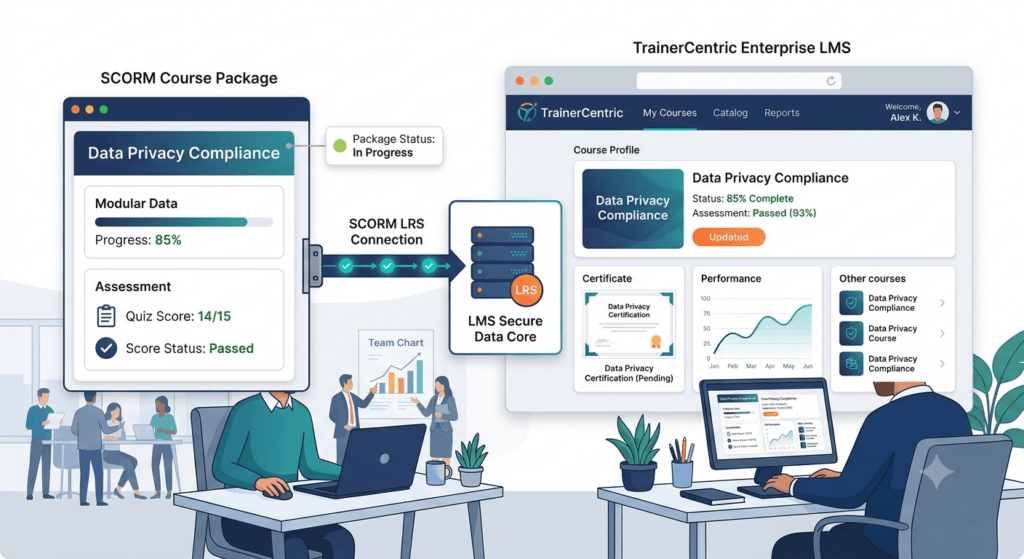
How it works: A SCORM course is packaged as a .zip file containing an imsmanifest.xml file that tells the LMS how the content is structured. The course communicates with the LMS through a JavaScript API while the learner is inside it. Now if you are wondering which LMS to choose, here is our guide on How to Choose the Right LMS for Your Organisation.
What it tracks: Completion status, pass/fail, score, session time, and bookmarking — enough to answer “did they finish, and how did they do?”
Benefits:
- Supported by virtually every LMS on the market today
- Simple to implement and widely understood by vendors
- Well suited for structured, self-paced courses with a clear start and end point
Limitations:
- Only tracks learning that happens inside the LMS
- Struggles with offline learning, mobile apps, and simulations
- Data is limited to a fixed set of fields — no room for rich, custom learning activity data
- No longer actively maintained by ADL; the last official release was 2011
Best use cases: Compliance training, structured onboarding modules, and any self-paced course where “completed / not completed” and “pass / fail” are the only outcomes stakeholders care about.
Corporate example: A manufacturing company rolling out an annual safety compliance module across 40 plants typically still reaches for SCORM — every LMS in their RFP shortlist supports it out of the box, and the audit trail (completed, scored, dated) is exactly what regulators expect.
| If you’re an L&D manager: choose SCORM when your biggest success metric is “did they complete it, and did they pass” — nothing more. It’s the low-risk, low-cost default for straightforward compliance reporting. |
| TrainerCentric Tip: Don’t assume “SCORM” means one thing. Confirm whether your LMS supports SCORM 1.2, SCORM 2004 (and which edition), since sequencing behavior differs between versions and can quietly break navigation in more complex courses. |
What Is xAPI?
xAPI (Experience API), informally known by its research codename Tin Can API, was developed from 2011 onward by ADL and Rustici Software specifically to fix SCORM’s biggest weakness: it could only see learning that happened inside an LMS. xAPI 1.0 was released in April 2013, and the specification is maintained and published openly at xapi.com.
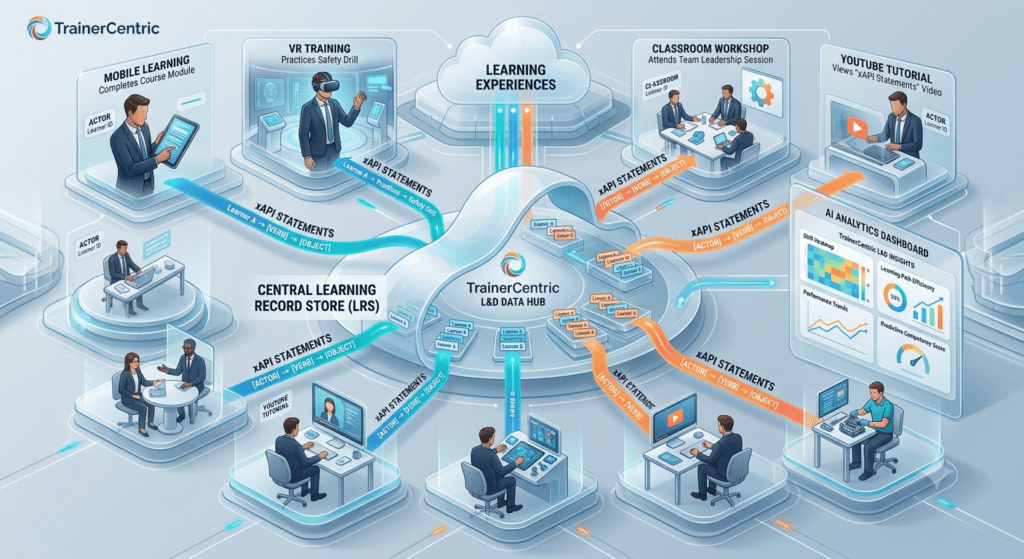
Instead of a rigid set of tracked fields, xAPI records learning activity as simple statements in an “Actor–Verb–Object” format — for example, “Priya completed Module 3” or “Rahul practiced Negotiation Simulation.” These statements are sent to a Learning Record Store (LRS), a database built specifically to receive, store, and surface xAPI data.
Consider what happens when an employee completes half a course on a mobile phone during a commute, loses signal, and finishes the rest later on a laptop at the office. SCORM has no good way to stitch that together into one learning record. xAPI was built precisely for moments like this.
This statement-based approach unlocks tracking for learning experiences SCORM was never built to see:
- Offline learning — statements queue locally and sync once a connection returns
- Mobile learning — native apps can send statements without a browser
- VR and simulations — a VR headset can log “Trainee attempted Emergency Shutdown Procedure — Failed”
- Learning outside the LMS — reading an article, attending a workshop, watching a video tutorial, or completing an on-the-job task can all be logged
Practical example: A retail chain training store staff on new POS software could log statements every time an employee practices a transaction on the actual till — not just when they finish an eLearning module about it. That gives L&D visibility into real behavior across the whole learning technology stack, not just course completion.
The trade-off: xAPI is a data specification, not a launch or packaging specification. It doesn’t define how a course should structure content, how it launches from an LMS, or when a course is officially “complete.” Without additional rules, two vendors implementing xAPI can send wildly inconsistent statements — which is exactly the gap cmi5 was built to close.
| If you’re an L&D manager: choose xAPI when your biggest success metric is learning behavior, not just course completion — practice frequency, real-world application, or engagement with content that lives outside your LMS. |
Common Myth: “Tin Can API and xAPI are two different standards.” They’re not — Tin Can API was the working project name during development; xAPI is the same specification under its official name. For a detailed information on what is xAPI, read our detailed guide on what is xAPI?
What Is cmi5?
cmi5 began life as an AICC project in 2010, aimed at replacing SCORM with something built on more modern web technology. When the AICC dissolved in 2014, the project was formally transferred to ADL, which continued developing it in partnership with the community. cmi5 was released for production use in 2016, and its governance now sits with ADL alongside the xAPI specification itself (Rustici Software).
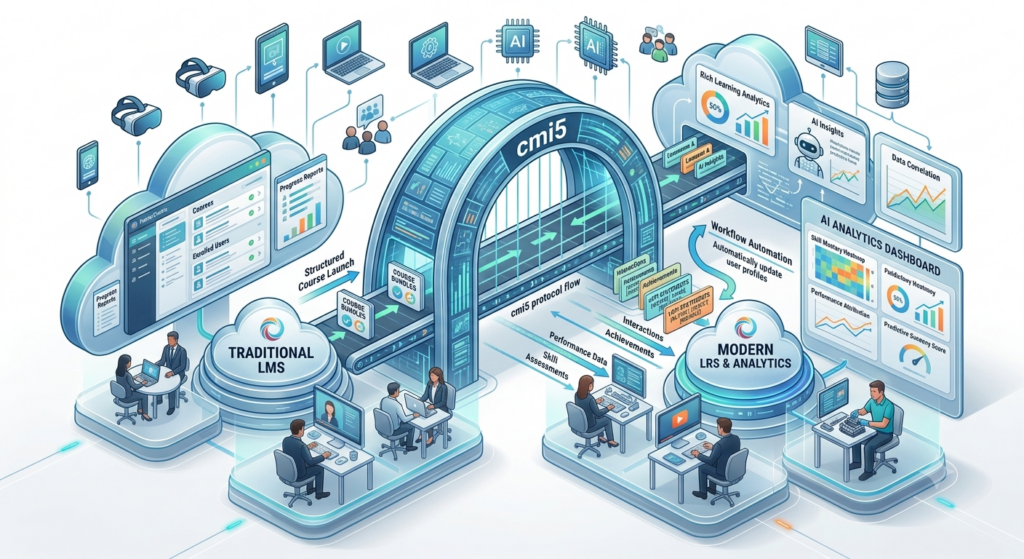
Here’s the simplest way to think about cmi5: xAPI tells you what data to send; cmi5 tells you exactly how, when, and in what structure to send it — specifically for the “launch content from an LMS” use case.
cmi5 is an xAPI profile, meaning it’s a rulebook layered on top of xAPI that adds the pieces SCORM had but plain xAPI doesn’t:
- A defined course structure and package format
- A standard launch mechanism from the LMS
- Consistent completion and mastery-score rules
- Governance so different vendors produce interoperable results, rather than each interpreting xAPI differently
In effect, cmi5 gives you the structural discipline of SCORM — predictable packaging, a defined launch sequence, and clear completion rules — combined with the rich, flexible data model of xAPI.
Corporate example: A bank replacing its aging SCORM-based compliance catalogue with cmi5 gets the same clean “assigned → launched → completed” reporting its compliance team relies on, but now the LRS underneath can also capture which specific policy sections a learner revisited, or how long they spent on a risk-scenario question — data SCORM simply can’t produce.
| If you’re an L&D manager: choose cmi5 when you need the predictability of an LMS-launched course and your leadership team is asking for deeper learning analytics than “completed / not completed.” |
Quick Decision: Already have an LMS with native cmi5 support and a growing appetite for analytics? cmi5 is very likely your long-term migration path — not SCORM, and not plain xAPI on its own.
The Three Levels of Learning Tracking
If you remember nothing else from this article, remember this one framework — it’s the simplest way to explain the difference to a stakeholder who doesn’t have five minutes for a technical deep-dive.
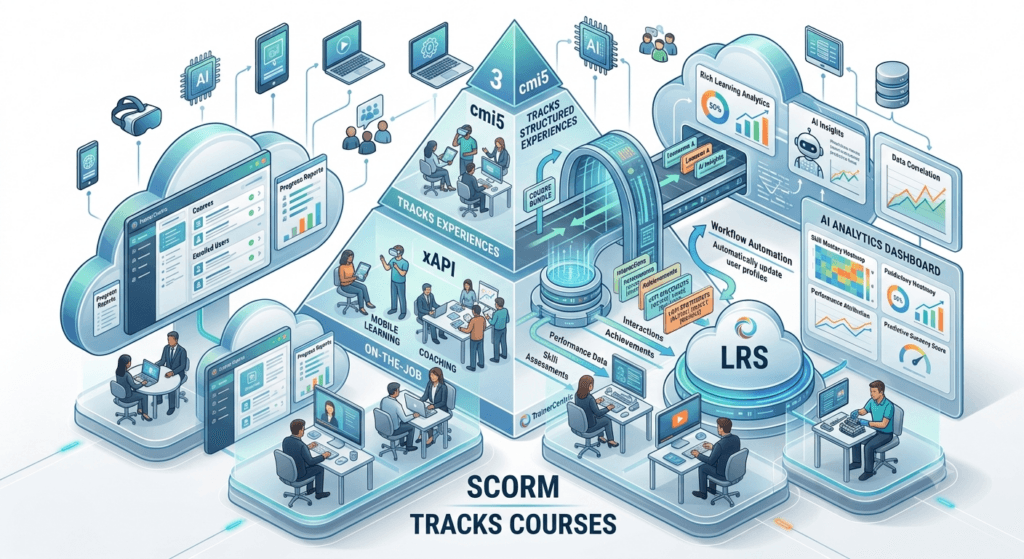
- Level 1 — SCORM tracks courses. It answers: did the learner open this course, and did they finish it?
- Level 2 — xAPI tracks experiences. It answers: what did the learner actually do, wherever they did it?
- Level 3 — cmi5 tracks structured experiences. It answers both — with the predictability of an LMS-launched course.
Three standards. Three levels of visibility into how learning actually happens.
SCORM vs xAPI vs cmi5: Comprehensive Comparison
| Parameter | SCORM | xAPI | cmi5 |
| Release year | 2000 (SCORM 1.0) | 2013 (v1.0) | 2016 (v1.0) |
| Standard owner | ADL Initiative | ADL Initiative | ADL Initiative (with AICC origins) |
| LMS compatibility | Near-universal | Requires LRS-aware system | Growing; supported by modern LMSs |
| LRS requirement | Not required | Required | Required |
| Completion tracking | Yes, fixed fields | Yes, but flexible/custom | Yes, standardized rules |
| Quiz tracking | Basic (score, pass/fail) | Fully customizable | Standardized + customizable |
| Offline support | No | Yes | Yes |
| Mobile learning | Limited | Strong | Strong |
| VR/AR support | No | Yes | Yes |
| Simulation tracking | Limited | Strong | Strong |
| External learning (outside LMS) | No | Yes | Partial (via LRS integration) |
| Reporting capability | Basic, standardized | Rich, but needs LRS/dashboard tooling | Rich + standardized launch reporting |
| Ease of implementation | Easy (mature tooling) | Moderate to complex | Moderate |
| Learning curve | Low | Medium | Medium |
| Security | Browser-based, dated | Token-based, modern | Token-based, modern |
| Data flexibility | Low | Very high | High, within defined rules |
| Corporate adoption | Very high | Growing steadily | Growing, especially in defense/gov and large enterprise |
| Future readiness | Declining (unmaintained since 2011) | High | High |
| Ideal use cases | Compliance, self-paced courses | Blended, mobile, VR, informal learning | LMS-launched courses needing rich data |
| Scalability | Good within LMS silo | Excellent across systems | Excellent, with LMS structure intact |
| Compliance suitability | Strong (audit-friendly) | Requires custom reporting build | Strong (audit-friendly + richer data) |
| Watch Out: Don’t treat this table as “cmi5 always wins.” cmi5 requires an LRS and modern LMS support — if your current LMS doesn’t support it yet, forcing the migration can cost more than the analytics gain is worth this year |
Which Standard Fits Your Organization’s Size?
| Organization Type | Recommended Standard |
| Small business | SCORM |
| Mid-size company | SCORM + xAPI |
| Large enterprise | cmi5 + xAPI |
| Regulated industries | cmi5 |
| Global / extended enterprise | cmi5 + xAPI |
This is a starting point, not a rule — a heavily regulated small business (say, a boutique pharmacovigilance firm) may still need cmi5-level rigor despite its size.
Which Standard Should You Choose?
There’s no universally “best” standard — only the standard that fits your learning scenario and where your organization sits on the path to a skills-based, AI-augmented digital learning infrastructure.
| Scenario | Recommended Standard | Why |
| Compliance training | SCORM or cmi5 | Auditors want clean completion and score records; cmi5 gives the same plus richer data |
| Employee onboarding | SCORM (simple) or cmi5 (multi-module journeys) | Structured, sequenced content with clear completion milestones |
| Product training | xAPI | Often spans videos, simulations, and job-aids outside the LMS |
| Sales enablement | xAPI | Needs to track practice, role-plays, and real deal activity, not just course views |
| Leadership development | xAPI or cmi5 | Blended programs mixing coaching, workshops, and self-paced modules |
| Healthcare training | cmi5 | Regulatory rigor of SCORM-style completion, with richer clinical-simulation data |
| Manufacturing | SCORM (safety modules) + xAPI (on-floor simulations) | Mixed formal and hands-on tracking needs |
| Retail | xAPI | Store-floor practice, mobile-first delivery, high frequency of micro-interactions |
| Banking (BFSI) | cmi5 | Strong compliance needs plus growing appetite for learning analytics |
| Blended learning | xAPI | Only xAPI can unify classroom, digital, and on-the-job data in one LRS |
| Mobile-first learning | xAPI | Native mobile app support without a browser dependency |
| Extended enterprise learning | cmi5 or xAPI | Content often lives outside the core LMS, across partners and vendors |
The pattern to notice: SCORM answers “did they finish it,” xAPI answers “what did they actually do,” and cmi5 answers both — with the LMS structure intact.
Picture a global onboarding program rolling out across 20 countries, mixing self-paced compliance modules, live virtual sessions, and on-the-job checklists completed on a supervisor’s phone. No single standard covers that whole journey cleanly — which is exactly why most large organizations end up running more than one standard at once, not choosing just one forever.
Should You Migrate Existing SCORM Courses?
This is one of the highest-intent questions behind “SCORM vs xAPI vs cmi5” searches — and the honest answer is: not all at once, and not by default.
- Don’t rebuild everything. A large SCORM library that’s working fine doesn’t need an urgent rebuild just because newer standards exist.
- Keep stable compliance courses in SCORM. If a course only needs completion and score tracking and isn’t changing, migrating it rarely pays for itself.
- Develop new courses in cmi5 where your LMS supports it. New development is the natural point to shift standards — you’re not paying a migration cost, only a design decision.
- Use xAPI for experiential and off-LMS learning — simulations, mobile practice, on-the-job checklists — rather than trying to force that content into a SCORM package.
- Plan a phased migration, prioritizing high-volume or high-visibility courses first, and let your legacy SCORM catalogue wind down naturally as content is refreshed.
| TrainerCentric Tip: Treat migration as a content-refresh strategy, not a one-time IT project. Most organizations that succeed here migrate opportunistically — whenever a course is due for an update anyway — rather than running a disruptive big-bang rebuild. |
Questions to Ask Before Choosing a Learning Standard
Here’s the truth: readers aren’t just comparing three acronyms. They’re trying to avoid a costly, hard-to-reverse mistake. Before you commit to a standard, work through these questions with your team:
- What data do you actually need — completion and score, or behavioral and performance data?
- Where does learning actually happen — entirely inside the LMS, or across apps, on the floor, and in the field?
- Will learners primarily use mobile devices, especially in low-connectivity environments?
- Are you planning simulations, VR, Microlearning or scenario-based practice in the next 12–24 months?
- Will you migrate LMS platforms in the next 3–5 years? (xAPI and cmi5 data is far more portable than SCORM data.)
- Do you already have a large SCORM content library? If so, a full rebuild rarely makes sense — a phased migration usually does.
| TrainerCentric Tip: Answer these six questions as a team before you touch a vendor RFP. Most “SCORM vs xAPI vs cmi5” debates are really disguised disagreements about what the business wants to measure. |
SCORM vs xAPI vs cmi5 Decision Framework
Use this simple flow to narrow down your choice. It’s written so it can be converted directly into a flowchart for your team or client deck.
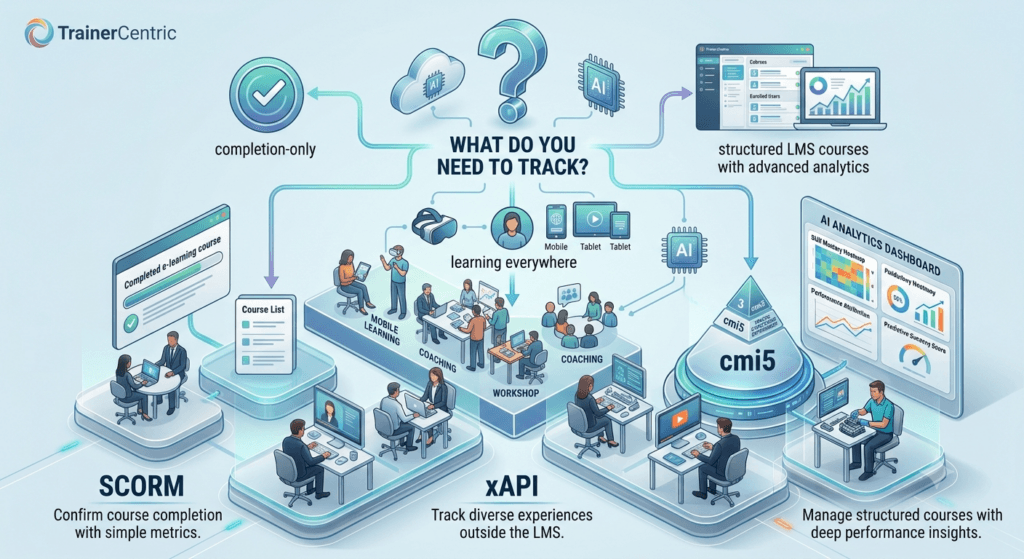
Step 1 — Do you only need to know if a learner completed a course and their score?
→ Yes: SCORM is likely sufficient.
→ No: Continue.
Step 2 — Does the content live entirely outside an LMS (mobile app, VR headset, simulation, on-the-job task, external platform)?
→ Yes: xAPI with a Learning Record Store.
→ No: Continue.
Step 3 — Do you need LMS-style structure (assignments, sequencing, standardized launch) *and* richer analytics than SCORM allows?
→ Yes: cmi5.
→ No: Reassess your reporting requirements before choosing a standard.
Step 4 — Are you running a mixed ecosystem (some legacy SCORM content, some modern learning experiences)?
→ Most organizations land here. The realistic answer is often SCORM for existing catalogues + cmi5 or xAPI for new development, feeding into a shared LRS where possible.
Read our definitive guide if you need to know How to Convert Classroom Training to eLearning Without Losing Impact.
Before You Ask Your LMS Vendor…
Before you sign anything, get straight answers to these five questions — every serious LMS or content vendor should be able to answer them without hesitation:
- Do you support cmi5 natively, or is it a partial/roadmap feature?
- Is a Learning Record Store included, or will we need a separate LRS product and integration?
- How is xAPI data actually visualized — dashboards, exports, or a third-party analytics layer?
- Can our existing SCORM content migrate, or run alongside newer cmi5/xAPI content without a rebuild?
- Are there additional licensing costs tied to xAPI/cmi5 support, LRS storage, or analytics add-ons?
| Watch Out: “We support xAPI” is not the same as “we support cmi5.” Vendors sometimes use these interchangeably in sales conversations — always ask the five questions above explicitly. |
What We’ve Seen in Real LMS Projects
In many LMS implementation projects, organizations initially request xAPI because it sounds more advanced. After reviewing their actual reporting requirements, they often discover SCORM already meets their needs — or that cmi5 offers a more balanced migration path than a full xAPI build. The lesson holds up project after project: learning objectives and reporting needs should drive the technology choice, not the popularity of the standard.
The organizations that struggle most are the ones that pick a standard first and figure out their measurement strategy afterward. The ones that succeed start with a training needs analysis, define what “success” looks like for the program, and only then choose the standard that can actually deliver that data.
Common Mistakes Organizations Make
After sitting through dozens of LMS and authoring-tool selection projects, the same mistakes come up again and again:
- Choosing the newest standard simply because it’s newer. cmi5 and xAPI are not automatically “better” than SCORM for every use case. A simple compliance course doesn’t need xAPI’s flexibility — it needs reliability.
- Ignoring LMS compatibility. Not every LMS supports cmi5 well yet, and even fewer come with a built-in LRS. Confirm support before committing content strategy to a standard.
- Overlooking reporting requirements. xAPI’s flexibility is a double-edged sword — without a clear statement design and a dashboard to interpret it, “rich data” quickly becomes “unusable data.”
- Not considering future scalability. A standard that works for 5 courses may not hold up at 500, especially if multiple content vendors are involved and each interprets the specification slightly differently.
- Confusing xAPI with cmi5. These are not competing standards — cmi5 is built on top of xAPI. Treating them as alternatives (rather than layers) leads to flawed vendor conversations.
- Selecting technology before defining learning objectives. The standard should follow from what you need to measure, not the other way around — which is exactly why a proper training needs analysis should happen before any platform conversation.
If you are not sure which LMS fits your organizational requirement, check out our guide on how to choose the right LMS for your organization.
Future of Learning Standards
A few credible trends are actively shaping where learning standards go next in 2026 and beyond:
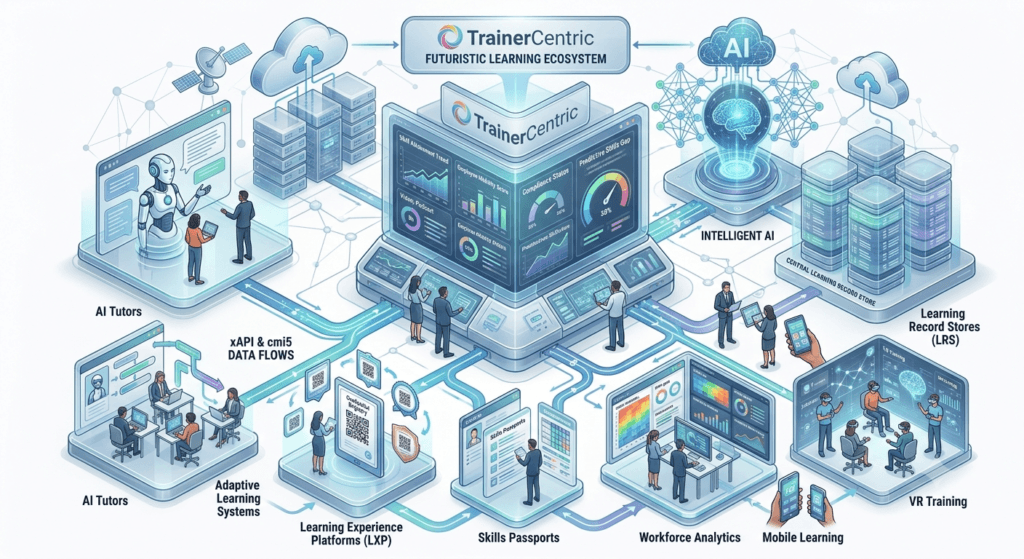
- AI-powered learning analytics increasingly depend on the granular, statement-level data xAPI provides — SCORM’s fixed fields simply don’t offer enough signal for predictive or adaptive models. As AI tutors and coaching bots become part of everyday training, they generate their own xAPI statements (“Learner asked AI tutor for clarification on Module 4”), adding a new, richer layer of behavioral data.
- Adaptive learning engines need real-time behavioral data — what a learner struggled with, retried, or skipped — another area where xAPI-based tracking outperforms SCORM.
- Learning Experience Platforms (LXPs) are largely built around aggregating content and activity from multiple sources, which naturally favors xAPI and cmi5 over SCORM’s LMS-bound model.
- Skills-based learning and skills intelligence platforms require tracking that spans formal courses, informal resources, and on-the-job application — again, the domain xAPI was purpose-built for. Expect more organizations to connect their LRS directly into workforce analytics and skills-passport systems.
- Digital credentials and verifiable credentials are increasingly tied to verified learning activity data, which pairs naturally with LRS-based ecosystems — a learner’s credential can now be traced back to the actual xAPI statements that earned it.
- Learning inside everyday tools — Microsoft Teams, Slack, and other workflow platforms — is becoming more common as “learning in the flow of work” gains traction. This kind of embedded learning is difficult to track in SCORM but a natural fit for xAPI.
- AI assistants becoming part of workplace learning. As AI assistants become more integrated into day-to-day work, organizations are beginning to explore how those interactions can be recorded as learning events using xAPI — extending the learning record well beyond formal courses.
None of this means SCORM disappears overnight. Its installed base is enormous, and for straightforward compliance reporting, it remains a perfectly reasonable choice. But new investment in learning technology — modern learning platforms, LXPs, and skills-based workforce strategies alike — is steadily shifting toward xAPI and cmi5, and any 2026 LMS or authoring tool shortlist should confirm support for both. The common thread isn’t replacing SCORM overnight — it’s expanding the amount of learning organizations can understand and improve.
Final Thoughts
SCORM, xAPI, and cmi5 aren’t rivals fighting for the same job — they’re three tools built for three overlapping but distinct problems. SCORM proved that learning content could be portable and trackable across LMSs, and it still does that job well for simple, structured, compliance-style training. xAPI opened the door to tracking learning wherever it actually happens — on a phone, in a simulator, on the job. cmi5 brought the discipline of SCORM back to that richer data model, giving organizations a modern, standardized way to launch and track structured courses.
In 2026, this decision matters more than ever. Next-generation learning platforms, LXPs, and skills-based organizations are all built on top of learning data — and the standard you choose today determines how usable, portable, and future-ready that data will be five years from now.
The organizations that get the most value out of this decision aren’t the ones chasing the newest acronym. They’re the ones who start with a clear question — what do we actually need to measure, and where does the learning happen? — and let that answer point them to the right standard, or the right combination of standards.
Before your next LMS renewal, authoring tool purchase, or content migration, take the time to map your learning architecture against this framework. It’s a far cheaper conversation to have upfront than to have after a six-figure platform decision is already locked in.
Frequently Asked Questions
Is SCORM still relevant in 2026?
Yes. SCORM remains the most widely supported eLearning standard and is still the preferred choice for compliance training, certifications, onboarding, and other structured courses that only require completion, score, and pass/fail tracking. While newer standards offer richer analytics, SCORM continues to meet the needs of many organizations.
What is the main difference between SCORM, xAPI, and cmi5?
The biggest difference lies in what they track. SCORM tracks learning inside an LMS. xAPI tracks learning anywhere, including mobile apps, simulations, VR, and on-the-job activities. cmi5 combines SCORM’s structured LMS launch process with xAPI’s flexible and detailed tracking capabilities.
Does xAPI replace SCORM?
Not entirely. xAPI was created to overcome SCORM’s limitations, particularly its inability to track learning outside an LMS. However, many organizations continue using SCORM for existing content while adopting xAPI for newer learning experiences. In practice, both standards often coexist.
Do I need a Learning Record Store (LRS) for xAPI?
Yes. An LRS is required to collect, store, and retrieve xAPI statements. Unlike SCORM, which communicates directly with an LMS, xAPI sends learning records to an LRS, allowing organizations to capture learning data from multiple systems and devices.
What is cmi5, and how is it different from xAPI?
cmi5 is an xAPI profile that adds standardized rules for launching, completing, and tracking LMS-based courses. While xAPI defines how learning activities are recorded, cmi5 specifies how structured courses should behave, ensuring consistent implementation across different LMSs and authoring tools.
Which learning standard is best for compliance training?
SCORM and cmi5 are both excellent choices for compliance training because they provide standardized completion tracking and audit-friendly reporting. If your organization also wants deeper learning analytics, cmi5 offers additional insights without sacrificing structured reporting.
Can SCORM track mobile and offline learning?
Not effectively. SCORM relies on a browser-based connection to an LMS, making offline tracking difficult. xAPI and cmi5 support mobile and offline learning by allowing learning statements to be stored locally and synchronized when an internet connection becomes available.
Should I convert my existing SCORM courses to xAPI or cmi5?
Usually not. If your SCORM courses are performing well and only require basic completion reporting, there is little business value in rebuilding them. Most organizations migrate gradually, updating courses to cmi5 or adding xAPI tracking as content is refreshed or new learning initiatives are launched.
Which LMSs support cmi5?
Support for cmi5 is growing, particularly among modern enterprise LMSs and learning platforms. However, implementation varies by vendor. Before selecting an LMS, confirm whether it provides native cmi5 support, includes an LRS, and offers reporting features that fully utilize cmi5 data.
Which learning standard is the most future-proof?
For organizations investing in learning analytics, AI-powered personalization, adaptive learning, and skills-based workforce development, xAPI and cmi5 are generally the most future-ready standards. They provide richer learning data while supporting modern learning experiences that extend beyond traditional LMS-based courses. SCORM, however, remains a practical and reliable option for many structured learning programs.
Further Readings
- How to Choose the Right LMS for Your Organisation
- Corporate eLearning Playbook: The Complete Guide to Designing, Delivering, and Scaling Digital Learning
- AI in L&D: What Corporate Trainers Need to Know Right Now
- How to Measure Training Effectiveness Using the Kirkpatrick Model
- How to Calculate Training ROI and Present It to the Business
- Rapid eLearning Development: Tools, Tips, and Best Practices
- Training Needs Analysis
- What Is a Learning Experience Platform (LXP) and Do You Need One
- How to Convert Classroom Training to eLearning Without Losing Impact
- Learning Analytics for L&D Professionals
- What Is xAPI? A Practical Free Guide to the Experience API for L&D
- What Is a Learning Record Store (LRS)? A Practical Guide for L&D
References
- Design for How People Learn || 2nd Edition || Julie Dirksen || New Riders || 2015
- Telling Ain’t Training || 2nd Edition || Harold D. Stolovitch and Erica J. Keeps || ATD Press || 2011
- Map It: The Hands-On Guide to Strategic Training Design || 1st Edition || Cathy Moore || Montesa Press || 2017
- e-Learning and the Science of Instruction || 4th Edition || Ruth C. Clark and Richard E. Mayer || Wiley || 2016
- Data & Analytics for Instructional Designers || 1st Edition || Megan Torrance || ATD Press || 2022
Author Details

Pankaj Nandi is a Technical Writer and Learning Content Specialist with experience creating complex technical and instructional content across software, technology, and enterprise environments. Having worked with organizations including Cisco, Rakuten India, and Newgen Software, he specializes in transforming complex concepts into clear, practical, and learner-friendly content. You can reach out to him at pankaj@trainercentric.in