A practical, research-backed guide to engineering learner motivation into every training programme you design
You have built training that checks every box: clear objectives, solid content, well-structured modules. Yet learners zone out by Module 2. Completion rates crawl. Managers shrug and say the team just is not motivated.
Here is the uncomfortable truth: motivation is not the learner’s problem to solve. It is yours.
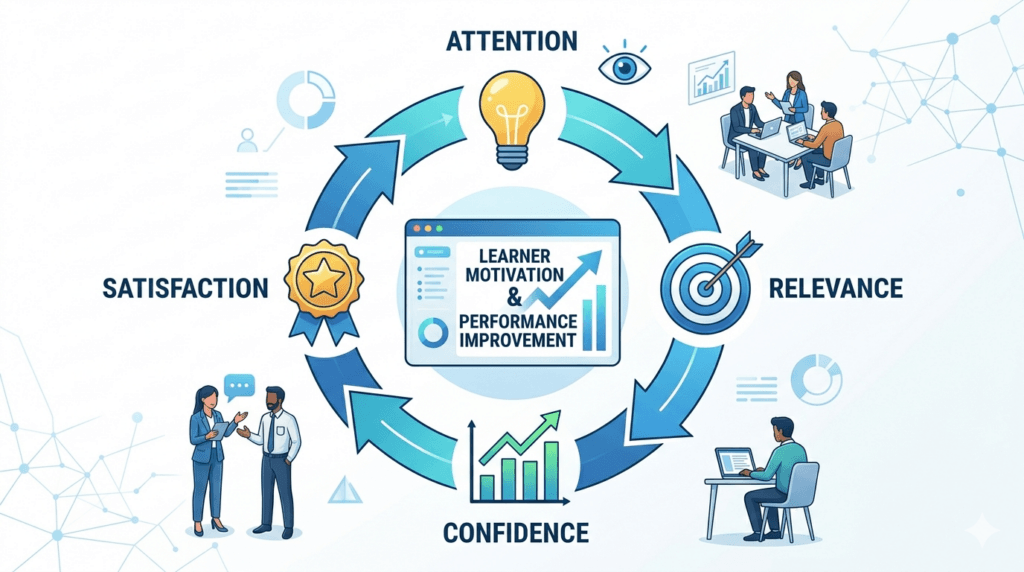
The ARCS Model of motivation gives you a systematic, evidence-based framework to engineer motivation directly into your training. Developed by educational psychologist John Keller in 1987, the Keller ARCS model breaks learner motivation into four manageable components — Attention, Relevance, Confidence, and Satisfaction — and gives you practical strategies to address each one.
This guide covers everything you need to know: what the ARCS motivational model is, how each component works, how to apply it in corporate training, a worked example, what research says, when to use it, a comparison with ADDIE, common mistakes, and free downloadable templates.
| 📋 In This Guide • What the ARCS model is and where it came from • A deep dive into all four ARCS components with corporate examples • ARCS model example: sales negotiation training (worked end-to-end) • What research says about the ARCS motivational model • When to use the ARCS model — and when not to • Step-by-step instructions for applying ARCS in your next training • ARCS model vs ADDIE — when to use which • Keller’s ARCS model in e-learning and blended contexts • Mistakes to avoid • 3 free downloadable templates |
What Is the ARCS Model of Motivation?
The ARCS model is a motivational design framework created by Dr. John M. Keller, Professor Emeritus at Florida State University. Published in his 1987 paper Development and use of the ARCS model of instructional design, the framework was built on a simple premise: no matter how well-designed your content is, learners who are not motivated will not learn.
What Are the Four Components of the ARCS Model?
The ARCS model consists of four motivational components:
- Attention – capture and sustain learner interest throughout the training.
- Relevance – connect learning to the learner’s personal goals and real work.
- Confidence – help learners believe they can succeed, and design experiences where they do.
- Satisfaction – reinforce accomplishment and the value of what was learned.
The ARCS acronym stands for Attention, Relevance, Confidence, and Satisfaction — four conditions that must all be present for sustained learner motivation.
| Component | Core Question It Answers |
| A — Attention | How do I grab and hold the learner’s interest? |
| R — Relevance | Why does this matter to the learner personally? |
| C — Confidence | How do I help the learner believe they can succeed? |
| S — Satisfaction | How do I make the learner feel good about what they’ve accomplished? |
Unlike most instructional design models that focus primarily on content structure, the ARCS motivational model focuses on the learner’s psychological experience. It is built on expectancy-value theory — learners are motivated when they expect to succeed and when they value the outcome.
Keller later extended the model into the ARCS-V model (adding Volition) and developed the Motivational Design Process (MDP) as a structured method for applying ARCS in real instructional projects. For most corporate training contexts, the original four-component ARCS model remains the most practical and widely used version.
The Four Components of the ARCS Model — A Deep Dive
Let us go deeper into each component. For every one, you will find what it means, the psychology behind it, and concrete examples from a corporate training context.
1. Attention — Capturing and Sustaining Interest
Attention is the first and most fundamental component. If learners are not paying attention, nothing else matters. But attention is not just about a flashy opening — it is about sustaining curiosity and engagement throughout the entire training.
Keller identifies three attention sub-strategies:
| Sub-Strategy | What It Means | Corporate Example | Watch Out For |
| Perceptual Arousal | Surprise or novelty that triggers a response | Opening a compliance module with a real fraud case from your industry instead of a definition | Gimmicks that don’t connect to content |
| Inquiry Arousal | Stimulating curiosity through questions or problems | ‘What would you do if a client asked you to backdate a document?’ before teaching ethics | Questions so hard they cause anxiety |
| Variability | Changing the format and pace to prevent habituation | Alternating video, scenario, quiz, and reflection within a single module | Variety for variety’s sake with no through-line |
| 💡 Corporate Attention Example: New Manager Onboarding Instead of opening with ‘Welcome to the New Manager Programme,’ start with a short video clip of a real (anonymised) situation where a new manager handled a difficult conversation poorly. Then ask: What would you have done differently? You have just triggered perceptual arousal and inquiry arousal simultaneously — before you have taught a single concept. |
🔗 Related: Gagné’s Nine Events of Instruction — see how ‘Gain Attention’ aligns directly with ARCS.
2. Relevance — Connecting to the Learner’s World
Attention without relevance is entertainment. Learners need to see a direct connection between the training and their goals, roles, and real work. Relevance answers the learner’s silent question: What’s in it for me?
Keller’s three relevance sub-strategies:
| Sub-Strategy | How to Apply It |
| Goal Orientation | Explicitly link training outcomes to learners’ career goals or day-to-day job tasks. ‘This module will help you run performance reviews with less awkwardness and better outcomes for your team.’ |
| Motive Matching | Align training to intrinsic motives: achievement, affiliation, or autonomy. High-autonomy learners respond well to choice; high-achievement learners like stretch challenges. |
| Familiarity | Use examples, language, case studies, and analogies drawn from the learner’s own work context — not generic stock-photo scenarios. |
| ⚠️ Common Mistake: Generic Relevance Saying ‘This training is important for your role’ is not relevance. Relevance means specificity: ‘As an account manager, you will use these negotiation techniques in every quarterly review call with clients.’ The more precisely you connect training to the learner’s actual tasks, the stronger the motivational effect. |
3. Confidence — Building the Belief That Success Is Possible
Even when learners are paying attention and see the relevance of the training, they will not engage fully if they do not believe they can succeed. Confidence in Keller’s model is not about cheerleading — it is about designing the learning experience so that success feels achievable, and is actually achieved.
| Sub-Strategy | Design Tactic |
| Learning Requirements | Make expectations crystal clear from the start. Tell learners exactly what they will be able to do and what success looks like. Ambiguity breeds anxiety. |
| Success Opportunities | Design for early wins. Begin with accessible content or low-stakes practice before raising difficulty. Each small success builds the learner’s belief in their ability. |
| Personal Control | Give learners a sense of agency. Allow them to choose paths, set a learning pace, or apply concepts in their own context. When learners feel in control, their confidence and accountability grows. |
| ✅ Confidence in Practice: Sales Skills Training A well-designed sales training module opens with a clear ‘By the end of this module, you will be able to handle three of the most common objections using a simple four-step framework.’ Then it starts with the easiest objection, walks through a worked example, lets learners practise with low stakes, and gradually increases complexity. Confidence builds through doing, not through being told ‘You’ve got this!’ |
🔗 Related: Bloom’s Taxonomy — use Bloom’s levels to scaffold your confidence-building sequence from Remember to Apply:.
4. Satisfaction — Reinforcing the Value of What Was Learned
Satisfaction is the payoff. It ensures learners leave with a positive feeling about what they have accomplished, which drives future engagement and application on the job. Without satisfaction, even good training can leave learners feeling flat — or worse, cynical.
| Sub-Strategy | Application |
| Natural Consequences | Give learners opportunities to apply new skills in realistic situations during training — not just at the end. The most powerful reinforcement is using knowledge to solve a real problem. |
| Positive Reinforcement | Acknowledge effort and success through meaningful feedback, not just score popups. ‘You correctly identified the compliance risk in that scenario — here’s why that approach works’ is far more satisfying than ‘Correct!’ |
| Equity | Ensure the effort required matches the reward. If learners feel the training was too long for the value delivered, or that the standards were unfair, satisfaction collapses. |
| 💡 The Satisfaction Trap Many trainers confuse satisfaction with enjoyment. A learner can enjoy a game-based module but leave with zero satisfaction if they do not feel they have genuinely learned something useful. Design for the feeling of real accomplishment — the sense that they are better at their job because of this training. |
ARCS Model Example: Designing a Sales Negotiation Training Program
This is the section many instructional designers need most: a complete, end-to-end example of how the ARCS model works in a real corporate context. Use this as a template for your own design work.
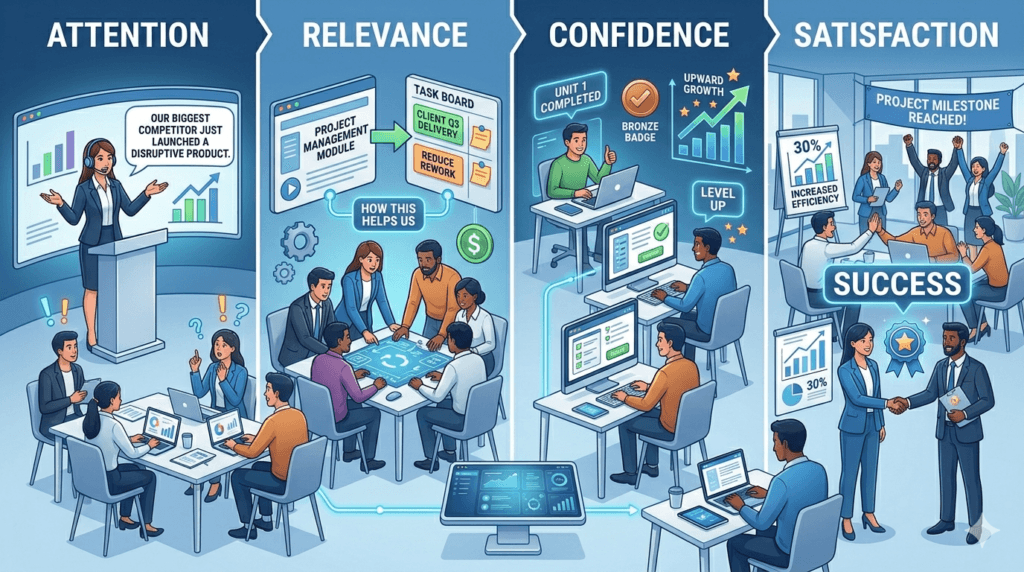
Scenario: A regional sales team has completed product knowledge training but conversion rates on high-value deals remain flat. Post-training interviews reveal learners found the content ‘a bit dry’ and ‘not really about how we sell.’ Motivation — not knowledge — is the problem. This is a textbook ARCS situation.
| ARCS Element | Design Choice | Why It Works |
| Attention | Open with a recorded (anonymised) difficult customer call where the salesperson lost control of the negotiation. Ask: what went wrong? | Perceptual arousal through a real, high-stakes scenario. Learners immediately recognise the situation. |
| Relevance | All practice scenarios are drawn from actual sales calls submitted by the team. Job titles, deal values, and objection types match real accounts. | Familiarity and goal orientation. Learners see exactly how this applies to their pipeline. |
| Confidence | Module 1 covers one objection type — the easiest and most common. Each subsequent module adds complexity. No formal assessment until Module 3. | Scaffolded success opportunities. Early wins build the belief that the framework is learnable. |
| Satisfaction | After completing the training, manager and learner review a real call together using the framework. Manager provides structured feedback on specific techniques used. | Natural consequences. The skill is applied in a real context, and the feedback creates genuine accomplishment. |
Walking through the design process:
- Motivational audience analysis revealed that the team’s primary frustration was: ‘We’ve done loads of training but the scenarios are never how it actually works here.’
- Motivational objective for Relevance: ‘Within the first 10 minutes, learners will be able to identify at least two situations from their current pipeline where this framework applies.’
- Confidence strategy: The programme designer mapped Bloom’s levels (Recall → Understand → Apply) to the objection-handling framework, ensuring each module built on the last.
- Satisfaction measure: Post-programme, learners were asked one question — “Did you use anything from this training on a real call this week?” The majority reported applying a specific technique within their first week back. This single question is a more meaningful satisfaction signal than any completion certificate.
| 🔑 Key Takeaway The power of ARCS is that it forces you to ask motivational questions before design questions. Not ‘what should I teach?’ but ‘why will they care?’ and ‘how will they know they’ve succeeded?’ Get those answers first, and content design becomes much easier. |

What Does Research Say About the ARCS Model?
One reason the ARCS motivational model has endured for nearly four decades is that it is grounded in established psychological theory and has been tested extensively in real educational and training environments. Here is what the research tells us.
Motivational Design and Online Learning
Multiple reviews and empirical studies of ARCS-based instructional interventions have found consistent positive effects on learner motivation, engagement, and satisfaction across online and blended learning environments. The Relevance and Confidence components appear to produce the strongest effects on learning outcomes, with Relevance being the component most frequently underimplemented in training design. (Cheng, Y. M., & Yeh, H. T. (2009). From concepts of motivation to its application in instructional design: Reconsidering motivation from an instructional design perspective. British Journal of Educational Technology, 40(4), 597–605.)
ARCS and Learner Self-Regulation
Song and Keller (2001) conducted a controlled study comparing ARCS-designed online instruction with conventionally designed instruction and found that learners in the ARCS condition reported significantly higher motivation, spent more time on task, and demonstrated stronger performance on transfer assessments. Crucially, the effect was strongest for learners who initially had low motivation toward the subject — precisely the population that most corporate compliance and mandatory training programmes struggle with. (Song, S. H., & Keller, J. M. (2001). Effectiveness of motivationally adaptive computer-assisted instruction on the dynamic aspects of motivation. Educational Technology Research and Development, 49(2), 5–22.)
Motivation vs. Instructional Quality
Keller’s own development and validation work on the Instructional Materials Motivation Survey (IMMS) — a 36-item instrument aligned to the four ARCS components — has been replicated and validated across hundreds of studies in corporate and academic settings. A meta-analysis by Naime-Diefenbach (1991) found that motivational quality of instruction, as measured by ARCS dimensions, was a significant independent predictor of learner outcomes even after controlling for content quality and instructional design rigour. In practical terms: a motivationally engaging training programme that is instructionally average will frequently outperform an instructionally excellent programme that is motivationally flat. (Keller, J. M. (2010). Motivational Design for Learning and Performance: The ARCS Model Approach. Springer.)
| 🔬 Trainercentric Insight In our experience reviewing corporate training programmes at TrainerCentric, the biggest ARCS failure is nearly always Relevance. Most learners do not disengage because content is boring — they disengage because they cannot see how it helps them perform better at work. Fixing relevance is often the single highest-return intervention an instructional designer can make to a struggling programme. |
When Should You Use the ARCS Model?
The ARCS model is a powerful tool — but it is not the right tool for every training situation. Here is how to decide when to apply it.
| Use ARCS When… | Consider Another Approach When… |
| Engagement is low and learners resist or ignore training | Motivation is not the problem — content accuracy or skill gaps are |
| Completion rates for e-learning are poor | You need a complete development model — ARCS does not cover sequencing, assessment design, or content structure |
| Learners say training is ‘not relevant to my job’ | The training audience is already highly motivated and the design challenge is cognitive, not motivational |
| You are redesigning existing content that learners find dry | You have very limited design time — ARCS requires upfront motivational audience analysis |
| Your audience is resistant, sceptical, or has had bad training experiences | Content accuracy and compliance requirements are the only concern |
ARCS works best as a layer inside a complete instructional design process — not as a standalone model. See the ARCS vs ADDIE section below for how to combine them effectively.
🔗 Related: ADDIE Model — the complete development framework that pairs most naturally with ARCS.
How to Apply the ARCS Model in Corporate Training: Step-by-Step
The ARCS model is not just a checklist of motivational techniques. Keller designed a full Motivational Design Process (MDP) to integrate ARCS into your instructional design workflow systematically. Here is how to apply it in a corporate training context.
Phase 1 — Audience Analysis (Motivational)
Before you design anything, analyse your learners specifically through a motivational lens. This is separate from your standard needs analysis. You want to know:
- What is the current motivational condition of this audience? Are they resistant, indifferent, or enthusiastic?
- What are their goals and how does this training connect to them?
- What are their existing confidence levels with this topic?
- What past training experiences have they had? Were they positive or negative?
- What are the most common objections or frustrations about this type of training?
| 💡 Trainercentric Tip Run a short survey or a 15-minute focus group with a sample of your target audience before you start designing. Ask: ‘What would make this training actually useful for you?’ and ‘What’s your biggest worry about this topic?’ The answers will directly inform your ARCS strategies. |
Phase 2 — Motivational Goals and Analysis
Based on your audience analysis, define specific motivational objectives for each ARCS component. These are not learning objectives — they are motivational outcomes.
| ARCS Component | Sample Motivational Objective |
| Attention | Learners will actively engage with scenario-based challenges rather than passively watching demonstrations. |
| Relevance | Learners will be able to articulate at least two ways the content applies to their specific role within the first 10 minutes. |
| Confidence | Learners will successfully complete a practice activity at 80% accuracy before attempting the formal assessment. |
| Satisfaction | Learners will express that the training was worth their time and relevant to their real work, measured by post-training survey. |
Phase 3 — Design ARCS Strategies
This is where you translate motivational goals into specific design decisions. For each component, choose strategies that match your audience’s motivational profile and your training context.
| 📋 Template Prompt Use the ARCS Strategy Planning Matrix (Template 1, available for download below) to map your design decisions systematically. For each module or section, note which ARCS strategies you are using and why. |
Phase 4 — Integrate Motivation into the Instructional Design
ARCS strategies should not be an add-on layer. They should be built into your storyboard, script, and interaction design from the start. Here is how each ARCS component maps to standard design elements:
| ARCS Component | Opening | Middle Sections | Assessment and Close |
| Attention | Case study, provocative statistic, surprise element, problem to solve | Format variety, unexpected examples, thought-provoking questions | Challenge scenario, gamified element |
| Relevance | Clear ‘What’s in it for you’ statement, role-specific context | Job-alike scenarios, real workplace examples, learner-relevant language | Transfer activity, application plan |
| Confidence | Clear learning objectives, overview of what to expect | Scaffolded practice, worked examples, low-stakes early activities | Competency-building assessment with feedback |
| Satisfaction | Preview of outcomes learners will achieve | Progress indicators, meaningful micro-feedback | Celebration of completion, application commitment |
Phase 5 — Evaluate Motivational Outcomes
Use the ARCS Motivation Survey (Keller’s IMMS — Instructional Materials Motivation Survey) or a custom version adapted for your organisation. Measure:
- Attention score: Did learners find the content interesting and engaging?
- Relevance score: Did learners feel the content connected to their real work?
- Confidence score: Did learners feel capable and supported throughout?
- Satisfaction score: Did learners feel the time and effort were worthwhile?
Use these scores to iterate and improve — not just to report. The goal of ARCS evaluation is to make the next version of training more motivating than the last.
ARCS Model Examples in Corporate Training
Theory becomes clearest through examples. Here are three real corporate training scenarios showing how the ARCS model is applied in practice.
Example 1: Cybersecurity Awareness Training
This is perhaps the most universally dreaded corporate training — low motivation, high resistance, and a subject that most employees see as irrelevant to their actual jobs.
| ARCS Component | How It Was Applied |
| Attention | Opened with an anonymised case study of a real phishing attack on a company in the same industry. Not a statistic — an actual story with consequences. Followed by ‘Could this happen to us?’ discussion. |
| Relevance | Every scenario used role-specific examples: finance team saw finance phishing scams, HR saw payroll fraud attempts, operations saw vendor impersonation. No generic ‘Dear Employee’ emails. |
| Confidence | Started with easy, obvious examples (‘Spot the phishing email’) before moving to sophisticated, ambiguous scenarios. Learners built competence and confidence through graduated difficulty. |
| Satisfaction | Used a team leaderboard showing the organisation’s phishing detection rate improving across the training cohort. Learners saw real, collective impact — not just a completion certificate. |
Example 2: Leadership Development Programme
| ARCS Component | How It Was Applied |
| Attention | Each module opened with a short ‘leadership dilemma’ — a real situation (anonymised) submitted by senior leaders in the organisation. Learners voted on what they would do before the discussion. |
| Relevance | The programme was preceded by a 360-degree feedback exercise. Learners arrived knowing their specific development areas. Every module connected explicitly to those individual gaps. |
| Confidence | Coaching triads allowed learners to practise skills in a low-stakes peer environment before applying them in real situations. Structured feedback frameworks reduced the fear of getting it wrong. |
| Satisfaction | Participants created a personal leadership action plan and presented it to their direct manager. The act of presenting — and being heard — was deeply satisfying and created immediate accountability. |
Example 3: Onboarding for Customer-Facing Roles
| ARCS Component | How It Was Applied |
| Attention | The first module used real, unscripted customer calls (with permission) — both excellent and poor examples. Hearing actual customer voices immediately created authenticity and engagement. |
| Relevance | The onboarding was structured around the first 30 days on the job — the exact sequence of situations a new joiner would face. Content was organised by experience, not by topic. |
| Confidence | Simulated customer interactions with branching scenarios allowed new joiners to practise responses safely. Mistakes had no real consequences and came with immediate coaching feedback. |
| Satisfaction | A ‘first win’ celebration after the first week on the job — where managers specifically referenced skills from the training — created a powerful connection between learning and doing. |
ARCS Model vs ADDIE: What’s the Difference and When Should You Use Each?
One of the most common questions in the instructional design community is how the ARCS model relates to ADDIE — and which one to use. The answer is that they are fundamentally different types of frameworks, not alternatives to each other.
| Dimension | ADDIE | ARCS Model |
| Primary Focus | Systematic content and course structure | Learner motivation throughout training |
| Type of Framework | Process model (phases of development) | Design model (motivational strategies) |
| Core Question | What should learners learn and how? | How do we keep learners engaged and motivated? |
| Strengths | Rigorous, comprehensive, widely understood by stakeholders | Deep learner-centricity, reduces dropout and disengagement |
| Weaknesses | Can overlook motivation if used mechanically | Not a full development framework on its own |
| Best Used When | Building structured curricula, compliance programmes, full course development | Diagnosing motivation gaps, redesigning disengaging content, any complex or resistant audience |
| Relationship | ARCS can be integrated within ADDIE | ARCS informs the ‘how engaging is this?’ question inside ADDIE phases |
Using ARCS Inside ADDIE
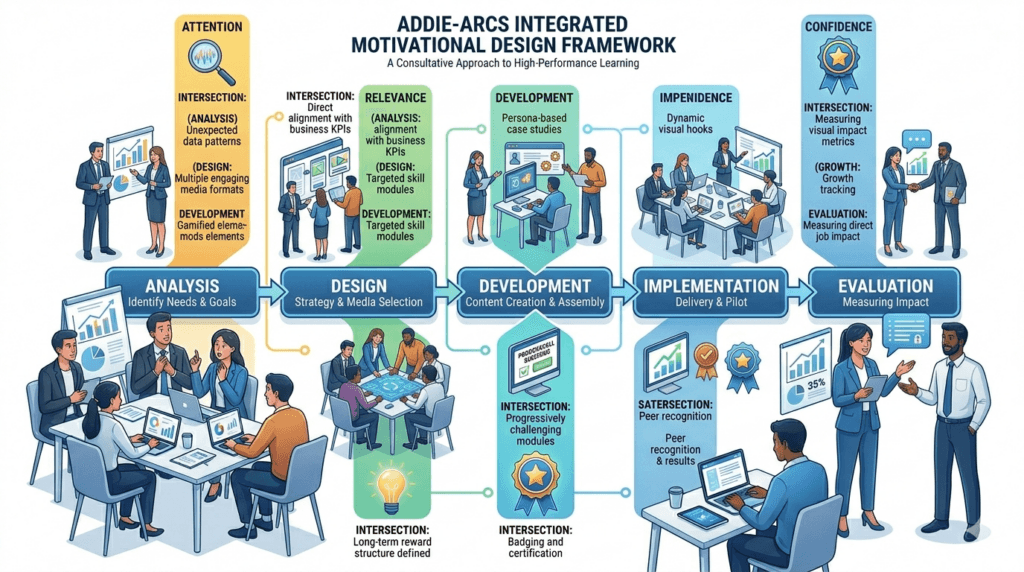
The most effective approach for most corporate training projects is to use ADDIE as the overarching process model and embed ARCS strategies within it:
| ADDIE Phase | Where ARCS Lives |
| Analysis | Add a motivational audience analysis alongside your learning needs analysis. Ask ARCS-specific questions: What will challenge attention? What are the relevance drivers? What creates confidence gaps? |
| Design | Define motivational objectives for each ARCS component alongside your learning objectives. Build your ARCS Strategy Matrix here. |
| Development | Every piece of content, every interaction, every piece of feedback is reviewed against ARCS criteria. Does this element sustain attention? Is this scenario relevant enough? |
| Implementation | Facilitate in a way that models ARCS: use energising openers, connect regularly to learners’ real context, celebrate progress, and invite application. |
| Evaluation | Include the IMMS or your custom motivation survey alongside Kirkpatrick Level 1-2 data. Separate motivational findings from learning findings. |
Keller’s ARCS Model in E-Learning and Blended Training
The ARCS motivational model is perhaps even more critical in e-learning than in instructor-led training. When there is no facilitator to read the room, adjust the energy, or respond to a confused face, the design itself must carry the full motivational load.
Attention in E-Learning
- Replace static text walls with scenario-based interactions from the first screen
- Use curiosity gaps: reveal information progressively rather than front-loading everything
- Short video segments (under 3 minutes) with a hook in the first 15 seconds
- Interactive elements every 3–5 minutes to break passive consumption
Relevance in E-Learning
- Personalisation paths: let learners choose their role or experience level at the start, then serve role-specific content
- Job aids embedded in the course that learners can download and use on the job
- Scenarios that mirror real situations learners encounter in their specific role
- Avoid stock photography — use illustrations, real workplace screenshots, or custom visuals that reflect your organisation
Confidence in E-Learning
- Progress bars and module completion indicators give learners a sense of advancement
- Low-stakes practice with immediate, specific feedback before any formal assessment
- Clear instructions and navigation — uncertainty about how to proceed destroys confidence
- Worked examples (‘Here is how an expert would approach this’) before asking learners to practise
Satisfaction in E-Learning
- Meaningful completion acknowledgment — not just a generic ‘Course Complete’ banner
- Summary of what was learned and how it connects to the learner’s role
- Commitment or application activity: ‘What is one thing you will do differently this week?’
- Share functionality for social learning or team discussions
| 🔀 ARCS in Blended Learning In blended programmes, ARCS components can be distributed across modalities. Attention and Relevance are strongest in facilitated sessions where a trainer can respond dynamically. Confidence is often best built through practice activities in e-learning modules at the learner’s own pace. Satisfaction is most powerful when achieved in a live session — being observed using a skill and receiving real feedback from a peer or coach. |
The ARCS-V Model: Adding Volition
Keller later extended the original ARCS model by adding a fifth component: Volition. This gives us the ARCS-V model.
Volition refers to the learner’s self-regulatory effort — their ability to maintain focus and commitment in the face of distractions, competing priorities, and the inevitable tedium of longer or more complex training programmes.
| Volition Strategy | How to Apply It |
| Volitional Control Strategies | Teach learners how to manage their own learning: time-blocking, distraction management, self-monitoring against goals |
| Self-Regulation Reminders | Build in prompts within the course: ‘You’re halfway through — how are you feeling? What do you want to focus on in the second half?’ |
| Goal Commitment Devices | Have learners state a specific commitment publicly (to their manager, peer, or coach) — social accountability is a powerful volition booster |
| Re-engagement Triggers | For multi-module programmes, create ‘returnability’ — re-entry points that remind learners why they started and what they have already accomplished |
| 💡 When to Use ARCS-V vs ARCS Use the standard ARCS model for shorter training interventions (single modules, workshops, one-day courses). Add Volition strategies for extended programmes: multi-week e-learning, leadership academies, certification journeys, or any programme where learner drop-off is a known risk. |
ARCS Model vs Other Instructional Design Models
Beyond ADDIE, it is worth understanding how the ARCS motivational model relates to other frameworks you may already be using.
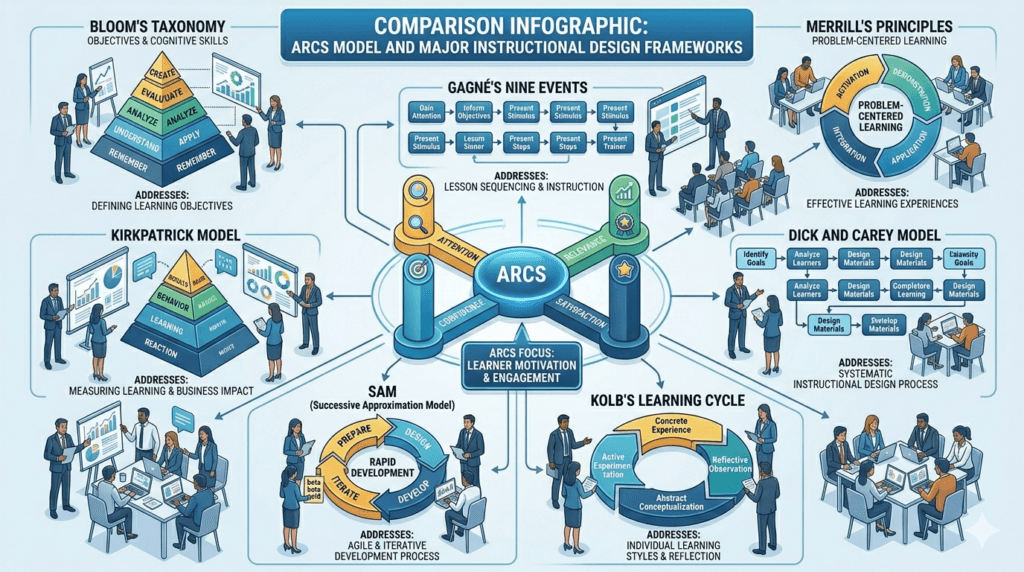
| Model | How It Compares to ARCS |
| Bloom’s Taxonomy | Bloom’s classifies what learners should do cognitively. ARCS addresses whether they will want to do it. Use Bloom’s to write objectives; use ARCS to make those objectives engaging. |
| Gagné’s Nine Events | Gagné’s events include motivational steps (gaining attention, informing objectives) that naturally align with ARCS. ARCS provides a richer motivational lens for each event. |
| Merrill’s Principles | Merrill focuses on authentic problem-centred learning. ARCS complements Merrill by addressing the motivational conditions needed for learners to engage with complex problems. |
| SAM / Agile Design | ARCS integrates naturally into rapid iterative design: use early prototypes to test motivational impact, gather feedback on ARCS dimensions, and iterate quickly. |
| Kirkpatrick Model | Kirkpatrick evaluates training impact at four levels. ARCS provides the motivational conditions that make Levels 1 (reaction) and 3 (behaviour transfer) more likely to be positive. |
| Dick and Carey Model | Dick and Carey is a highly systematic design model. ARCS adds the motivational layer that Dick and Carey does not address explicitly, making it a natural complement. |
| 🔗 Related: Merrill’s Principles of Instruction — see how problem-centred design pairs with ARCS motivation strategies. |
| 🔗 Related: Kolb’s Learning Cycle — how experiential learning and ARCS satisfaction strategies reinforce each other. |
| 🔗 Related: Dick and Carey Model — how to use ARCS to fill Dick and Carey’s motivational gap. |
ARCS vs Bloom’s Taxonomy
Bloom’s Taxonomy and the ARCS model solve different problems and work best when used together. Bloom’s answers the question: what cognitive level should this learning outcome target? ARCS answers the question: how do we ensure learners are motivated enough to engage with it? In practice, use Bloom’s to define the level of thinking required (remember, understand, apply, analyse, evaluate, create) and use ARCS to design the motivational conditions that make learners willing to do that thinking. A learning objective written at the Apply level with no ARCS design behind it will still produce passive, disengaged learners. The two frameworks are complementary, not competing — and together they cover both the cognitive and motivational dimensions of effective training design.
ARCS vs Gagné’s Nine Events of Instruction
Gagné’s Nine Events of Instruction and the ARCS model share important common ground — both take seriously the idea that learning has psychological preconditions. Gagné’s first event, Gain Attention, maps directly to ARCS’s A component. His second event, Inform Learners of Objectives, supports ARCS Confidence by making success criteria transparent. The key difference is scope: Gagné’s Nine Events is a sequencing model that tells you what to do in what order across an instructional event. ARCS is a motivational lens that tells you what psychological conditions need to be maintained throughout. For complex corporate training, using Gagné to structure your sequence and ARCS to check motivational quality at each step is a particularly powerful combination.
7 Common Mistakes When Applying the ARCS Model
The ARCS model is straightforward in theory but easy to misapply in practice. Here are the most common errors to avoid.
1. Treating ARCS as a checklist, not a design lens
ARCS is not ‘add one attention activity, one relevance statement, one confidence builder, one satisfaction moment.’ Motivational strategies must be woven throughout the entire learning experience, not bolted on at specific checkpoints.
2. Confusing entertainment with attention
A highly polished, gamified module can grab attention without sustaining it. If the novelty wears off by Module 2, you have an entertainment problem, not an attention strategy. Attention must be continuously refreshed.
3. Writing generic relevance statements
‘This is important for your role’ is not relevance. Role-specific language, examples from the learner’s actual work context, and connections to their real goals — that is relevance.
4. Building confidence through praise, not through competence
Telling learners ‘You can do this!’ does not build confidence. Designing experiences where they actually succeed at progressively harder tasks does. Confidence comes from demonstrated competence.
5. Equating satisfaction with a happy face on the feedback form
Learners can enjoy training and still leave unsatisfied. Satisfaction means they feel genuinely more capable and that the time was worth it. It must be earned through real accomplishment.
6. Skipping the motivational audience analysis
Applying ARCS strategies without understanding your specific audience’s motivational condition is guesswork. Take the time to analyse motivation specifically before you design.
7. Using ARCS in isolation instead of as part of a complete design process
ARCS addresses motivation but not learning objectives, sequencing, assessment, or content depth. Use it inside a complete design framework like ADDIE, not instead of one.
ARCS Model Quick Reference: Strategies at a Glance
Use this as a rapid-reference guide when reviewing your training design or preparing for a facilitation session.
| Component | Sub-strategy 1 | Sub-strategy 2 | Sub-strategy 3 |
| Attention | Perceptual Arousal: Surprise, novelty, dramatic openings | Inquiry Arousal: Problems, questions, mysteries | Variability: Format changes, pace shifts, unexpected elements |
| Relevance | Goal Orientation: Connect to career and job goals | Motive Matching: Align to achievement, affiliation, autonomy | Familiarity: Role-specific language, context, examples |
| Confidence | Learning Requirements: Clear expectations and success criteria | Success Opportunities: Scaffolded difficulty, early wins | Personal Control: Choice, autonomy, pacing control |
| Satisfaction | Natural Consequences: Apply skills in realistic situations | Positive Reinforcement: Meaningful, specific feedback | Equity: Fair standards, effort-reward balance |
Conclusion
If your training is technically correct but learners disengage, the problem may not be content quality — it may be motivation. The ARCS Model gives instructional designers a practical framework for diagnosing and fixing motivation problems by systematically addressing Attention, Relevance, Confidence, and Satisfaction.
The four components — Attention, Relevance, Confidence, and Satisfaction — are not abstract psychological categories. They are concrete design levers. Pull them deliberately and your training will engage learners who previously zoned out, connect with audiences who previously did not see the point, and leave participants feeling genuinely more capable and motivated to apply what they have learned.
Whether you are building a cybersecurity awareness module, a leadership development programme, or a full onboarding curriculum, applying Keller’s ARCS model will make every piece of training you design more engaging, more effective, and more worth the time you invest in building it — and the time your learners invest in taking it.
The best place to start is not a new training build — it is an existing one. Audit a single training programme using the four ARCS dimensions. Most instructional designers discover that their biggest opportunity is not content quality but motivational design. The free templates below will help you do exactly that.
Frequently Asked Questions About the ARCS Model
Who created the ARCS model?
The ARCS model was created by Dr. John M. Keller, a professor of instructional systems and educational psychology. He published the model in 1987 and has continued to refine it over subsequent decades, including the development of the ARCS-V model and the full Motivational Design Process.
Is the ARCS model evidence-based?
Yes. The Keller ARCS model is grounded in established psychological theory, including expectancy-value theory (why people choose to engage), attribution theory (how people explain success and failure), and cognitive evaluation theory (intrinsic vs. extrinsic motivation). Decades of research and application in both academic and corporate contexts have validated its core components.
Is the ARCS model suitable for corporate training?
Absolutely. The ARCS motivational model was developed in an educational context but translates directly to corporate training. In fact, the conditions where ARCS is most powerful — resistant learners, low-relevance content perception, compliance programmes, self-paced e-learning — are more common in corporate L&D than in formal education. Many of the model’s most effective applications are in corporate settings.
What are the four components of the ARCS model?
The four components are Attention (capturing and sustaining learner interest), Relevance (connecting training to learners’ goals and real work), Confidence (designing experiences so learners believe they can succeed and then do succeed), and Satisfaction (ensuring learners leave feeling genuinely more capable and that their time was well spent). Together, Attention Relevance Confidence Satisfaction form a complete motivational design framework.
What is the difference between ARCS and ADDIE?
ADDIE is a process model — it guides how you develop training through Analysis, Design, Development, Implementation, and Evaluation phases. ARCS is a motivational design model — it provides strategies for ensuring learners stay engaged throughout. ARCS does not replace ADDIE; it works best when embedded within ADDIE as the motivational layer. See the ARCS vs ADDIE section above for a detailed comparison.
How does ARCS improve learner engagement?
The ARCS model improves engagement by systematically addressing the four conditions that research shows drive sustained motivation: capturing interest (Attention), making content personally meaningful (Relevance), ensuring learners feel capable of succeeding (Confidence), and creating a genuine sense of accomplishment (Satisfaction). When all four are present, learners engage not because they have to but because they want to.
Can ARCS be used in eLearning?
Yes — and it is arguably more important in e-learning than in instructor-led training. In elearning, there is no facilitator to dynamically adjust engagement, so the design must carry the full motivational load. The ARCS model provides concrete, actionable strategies for each component that translate directly to e-learning interactions, scenario design, feedback mechanisms, and completion experiences. See the dedicated e-learning section above for specific tactics.
Can the ARCS model be used for instructor-led training, not just e-learning?
Absolutely. ARCS is equally applicable — arguably more so — in instructor-led, virtual, and blended contexts. In live training, facilitators have even more tools for creating attention, demonstrating relevance, and generating satisfaction in real time. Many of the most powerful ARCS strategies (live dilemmas, group discussions, real-time coaching feedback) are only available in instructor-led settings.
What is the difference between ARCS and ARCS-V?
ARCS-V adds Volition as a fifth component — addressing learners’ ability to maintain sustained effort and self-regulation over the course of a longer programme. Use standard ARCS for shorter interventions; add Volition strategies for multi-week or self-paced programmes where drop-off is a risk.
Where can I find Keller’s IMMS survey?
Keller’s Instructional Materials Motivation Survey (IMMS) is a 36-item validated instrument available through academic publications and John Keller’s official resources at arcsmodel.com. You can also create a shorter, adapted version for corporate use based on the four ARCS dimensions.
References
- Keller, J. M. (1987). Development and use of the ARCS model of instructional design. Journal of Instructional Development, 10(3), 2–10.
- Keller, J. M. (2010). Motivational Design for Learning and Performance: The ARCS Model Approach. New York, NY: Springer.
- Keller, J. M. (2008). First principles of motivation to learn and e-learning. Distance Education, 29(2), 175–185.
Further Readings
- Bloom’s Taxonomy
- Instruction Designing Models
- ADDIE Model of Instructional Designing
- Successive Approximation Model (SAM): Complete Guide + 8 Free Templates
- Kolb’s Learning Cycle: Using Experiential Learning in the Workplace
- Gagné’s 9 Events of Instruction: A Practical Guide for Trainers with Real Examples
- ADDIE vs SAM: Which Instructional Design Model Should You Use in 2026?
- Adult Learning Theory (Andragogy): Knowles’ 6 Principles Explained with Workplace Examples
- Cognitive Load Theory Explained: A Practical Guide for Trainers & Instructional Designers
- Kirkpatrick Model: How to Measure Training Effectiveness
- Backward Design – The Complete Framework for Planning Learning
- Action Mapping: A Step-by-Step Guide with Examples
- Gamification vs Game-Based Learning: What’s the Difference
Author Details

Tulip Ghosh is a Learning and Development professional who designs impactful, learner-centric experiences rooted in behavioral insight and real-world application. She is passionate about improving learner engagement and translating complex ideas into practical training solutions. A thoughtful writer at heart and with experience of a decade in Learning and Development domain, she brings a simple, grounded perspective to the evolving world of workplace learning. Reach out to her on her Linkedin Profile from here.