| Quick Answer The three levels of training needs analysis are: (1) Organisational Analysis — identifying capability gaps at the business or department level in relation to strategic goals; (2) Task Analysis — defining the tasks, KSAs, and performance standards for each critical role; and (3) Person Analysis (Individual TNA) — identifying which specific employees have gaps against those standards. Each level informs the next. |
Every year, organisations across India and the globe pour significant budget into training programmes that do not move the needle. Courses are designed, calendars are filled, participants sit through sessions — and yet performance gaps stubbornly persist. The root cause, more often than not, is not a failure of instructional design or delivery. It is a fundamental misidentification of the type of need being addressed.
When an L&D team skips straight to employee surveys and course catalogues without first establishing whether the gap is a business capability issue, a role standards problem, or an individual skill deficiency, they are answering the wrong question — expensively. Understanding the three levels of training needs analysis is the difference between building learning that drives business outcomes and building learning that simply fills a schedule.
This article unpacks all three levels in depth: what they are, how they differ, when to use each, and — critically — how to integrate them into a cohesive corporate learning strategy that earns the confidence of senior stakeholders.
What Is Training Needs Analysis?
Training Needs Analysis (TNA) is the systematic process of identifying the gap between current performance and desired performance, and determining whether training is the appropriate solution to close that gap. It is the investigative foundation upon which every effective learning intervention should be built.
A well-executed TNA answers three core questions: What capability does the organisation or individual need? What capability currently exists? And what should be done to bridge the difference?
Crucially, TNA is not a single, one-size-fits-all exercise. The foundational model — established by McGehee and Thayer in 1961 and still recognised by CIPD and ATD — defines three distinct levels of training needs analysis. Each level serves a different diagnostic purpose, draws on different data sources, and produces different outputs.
📌 Internal Resource: For a step-by-step walkthrough, see How to Conduct a Training Needs Analysis in 5 Steps on TrainerCentric.in.
Why Training Needs Analysis Matters: The Evidence
Before diving into the three levels, it is worth anchoring this discussion in evidence. The consequences of skipping or shortcutting TNA are not theoretical — they show up directly in wasted budget, unmoved performance metrics, and disengaged learners.
70% of employees say they lack the skills needed to do their jobs effectively — yet organisations continue to commission training without first diagnosing which specific skills are missing and at what level.
49% of L&D professionals say their biggest challenge is getting employees to engage with learning. Research consistently shows that engagement rises sharply when training is visibly relevant to actual job performance — which only happens when TNA is done first.
Source: LinkedIn Workplace Learning Report (2024)
Only 12% of employees report applying new skills from training back to their jobs. A primary contributor is the absence of proper needs analysis — training is designed without a clear understanding of the specific performance gap it is meant to close.
Source: ATD Research, ‘Bridging the Skills Gap’ (2023)
These statistics are not arguments for more training. They are arguments for better diagnosis. The three-level TNA framework is the diagnostic tool that makes the difference.
The Three Levels of Training Needs Analysis
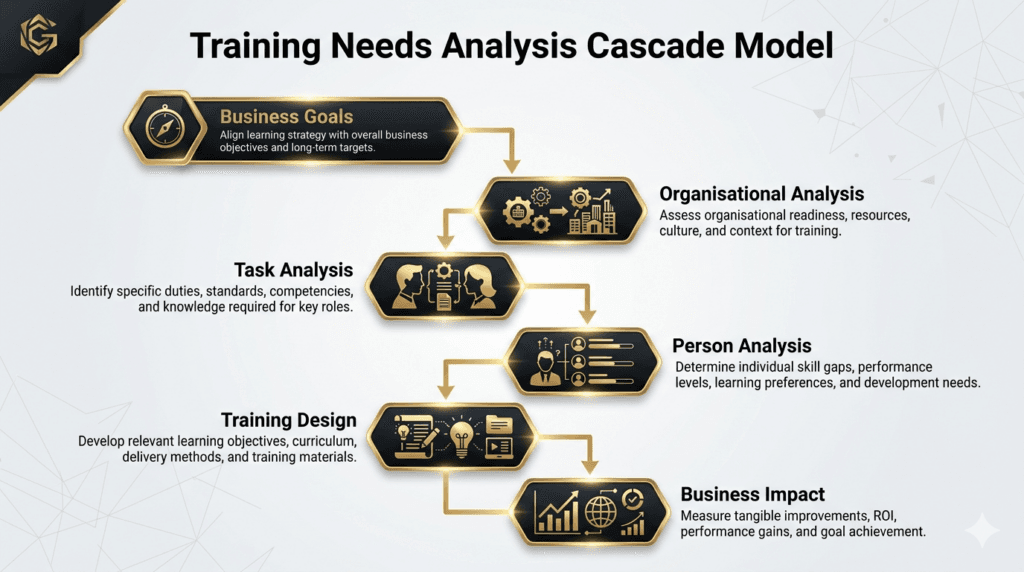
The McGehee–Thayer three-level model remains the most widely used framework for structuring TNA in corporate L&D. The diagram below illustrates how the three levels relate to each other and what each one produces:
Level 1: Organisational Analysis
Organisational analysis in training needs assessment asks the macro-level question: Is training the right response, and if so, where should the organisation focus its learning investment? It examines strategic goals, business performance, and the external environment to determine whether workforce capability gaps are preventing the business from achieving its objectives.
This is the level most closely associated with what practitioners call Organisational TNA or corporate training needs assessment. It produces the L&D strategy, annual learning roadmap, and budget allocation that govern all subsequent learning activity.
Level 2: Task Analysis
Task analysis (also called operational analysis or job analysis) examines what a person must be able to do to perform a specific role effectively. It breaks a role down into its constituent tasks and for each task defines the knowledge, skills, and abilities (KSAs) required to perform it to the required standard.
This level of TNA is frequently skipped — and it is a critical error. Without a clear task analysis, individual assessments have no validated benchmark to measure against. You cannot determine whether someone has a skill gap if you have not first defined what the skill standard is.
| ⚠️ Common Mistake: Many L&D teams move directly from Organisational TNA to individual surveys, skipping Task Analysis entirely. Without first defining role standards and KSAs, individual assessments produce subjective, inconsistent gap data that is difficult to act on. |
Level 3: Person Analysis (Individual TNA)
Person analysis in training needs assessment — what most practitioners call Individual TNA — uses the standards established in task analysis to assess specific individuals. It identifies which employees have gaps, how significant those gaps are, and what types of learning intervention are most likely to close them effectively.
This is the level of TNA most familiar to line managers and HR Business Partners. It feeds directly into Individual Development Plans (IDPs), personalised learning pathways, coaching programmes, and targeted upskilling.
| ✅ Key Takeaway: The three levels must work in sequence: organisational analysis sets the strategic context → task analysis defines the performance standard → person analysis identifies who is below it. Skipping any level weakens the entire process. |
What Is Organisational Training Needs Analysis?
Definition and Purpose
Organisational Training Needs Analysis is a macro-level assessment that examines capability gaps across an entire organisation, business unit, or department in the context of strategic goals. It connects learning priorities to where the business is headed — not just where it currently struggles.
The purpose is to ensure that the collective capabilities of the workforce are sufficient to execute the company’s strategy, and to inform decisions about where to invest training budgets and which skills to prioritise at scale.
Typical Questions Answered
- What strategic objectives does the organisation need its workforce to achieve over the next 12–24 months?
- Which functional or departmental teams face the most critical capability gaps relative to those objectives?
- Are there emerging industry trends, regulatory changes, or technology shifts requiring new competencies across the business?
- Where is performance consistently below benchmark across teams, roles, or locations?
- What does workforce data reveal about systemic learning gaps?
Common Data Sources
- Business strategy documents and annual operating plans
- HR workforce analytics and performance dashboards
- Employee engagement and exit interview data
- Industry benchmarking reports and regulatory requirements
- Leadership interviews with department heads, COOs, and HR Directors
Organisational Training Needs Examples
- A BFSI firm’s entire client-facing workforce lacks digital literacy as the company pivots to mobile-first banking.
- A manufacturing company’s supervisors lack coaching skills needed for a new continuous improvement culture.
- A retail chain’s 800-strong store manager population needs compliance training ahead of new consumer protection regulations.
- A technology company’s salesforce lacks solution-selling skills as the product shifts from transactional to consultative.
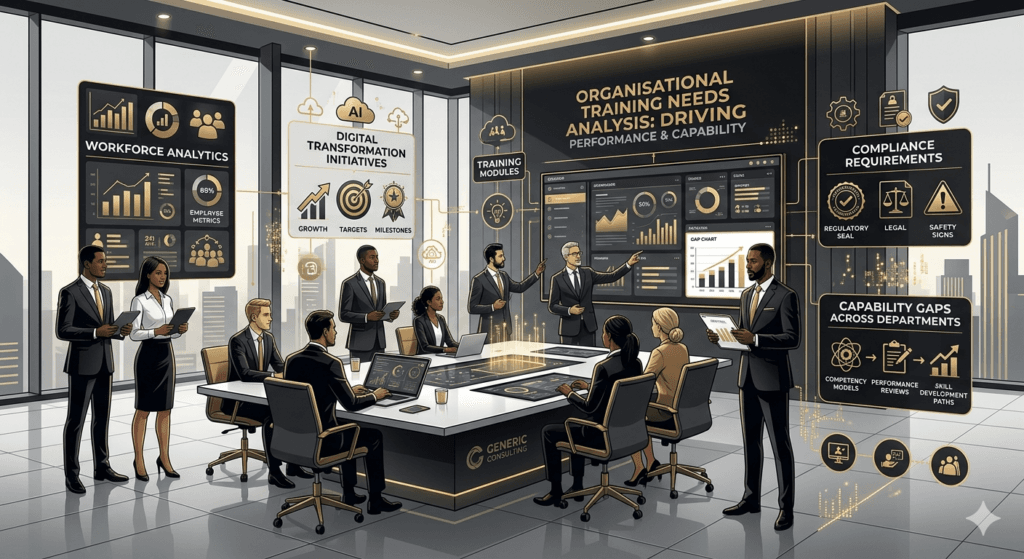
| 💡 Real Example: A mid-sized Indian BFSI firm announces a strategic pivot toward digital banking. The L&D Head conducts an Organisational TNA by reviewing the three-year business plan, interviewing the CTO and branch heads, and analysing HR performance data. Output: a critical gap in digital literacy, data fluency, and customer experience skills across 70% of client-facing roles — informing a 12-month enterprise learning roadmap. |
What Is Individual Training Needs Analysis? (Person Analysis)
Definition and Purpose
Individual Training Needs Analysis — also known as Person Analysis in the McGehee–Thayer model — is a micro-level assessment that examines the specific knowledge, skill, and behavioural gaps of a single employee relative to the requirements of their current role or a planned future role. It is personal, contextual, and performance-driven.
Its purpose is to diagnose precisely what a particular person needs to learn in order to perform effectively and grow professionally, forming the evidence base for Individual Development Plans, personalised learning pathways, and targeted coaching interventions.
Typical Questions Answered
- What are the defined competencies and performance expectations for this role? (Established in Task Analysis)
- Where does this person’s current performance fall short of those expectations?
- Are the gaps caused by a lack of knowledge/skill, or by motivation, process, or environmental factors?
- What learning interventions — formal, informal, or experiential — are most appropriate?
Common Data Sources
- Annual and mid-year performance appraisal data
- 360-degree feedback from peers, direct reports, and managers
- Skills self-assessment questionnaires
- Line manager observations and one-to-one meeting notes
- Role competency frameworks (from Task Analysis)
Individual Training Needs Examples
- A new Product Manager has strong analytical skills but a clear deficit in stakeholder influencing and executive communication.
- A senior sales representative consistently wins new business but struggles with CRM data discipline and pipeline reporting.
- A recently promoted team leader has deep technical expertise but no experience conducting performance conversations.
- A finance analyst is proficient in Excel but unfamiliar with the organisation’s ERP and internal reporting standards.
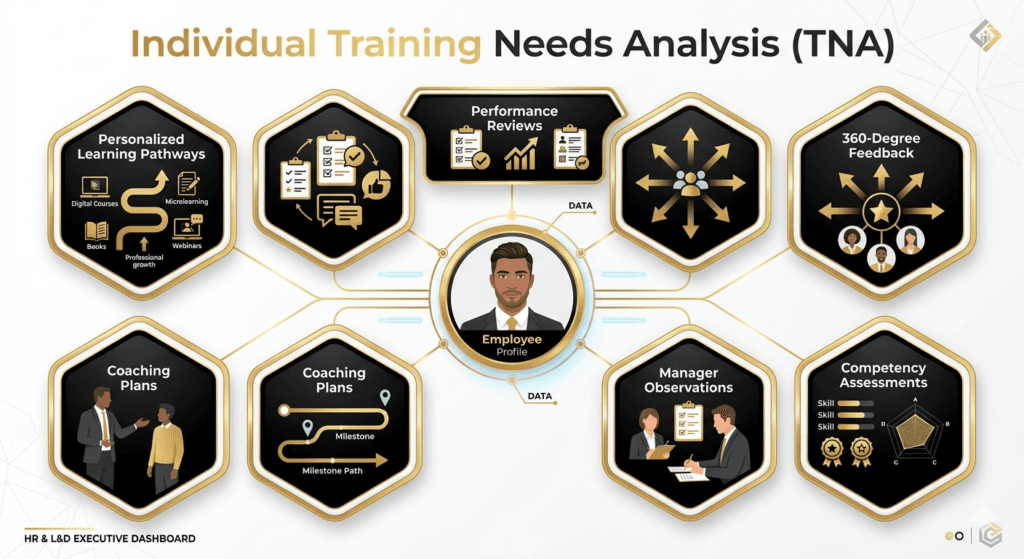
| 💡 Real Example: A new Product Manager at a technology startup struggles to influence stakeholders. After reviewing two performance appraisals and 360° feedback, the L&D Business Partner identifies a deficit in executive communication and influencing without authority. Output: a targeted IDP including a communication skills workshop, executive shadowing, and eight weeks of structured coaching. |
Organisational TNA vs Individual TNA: Key Differences
While both types of TNA are essential, they operate at different levels and serve different purposes. The comparison table below captures the most important distinctions:
| Dimension | Organisational TNA | Individual TNA (Person Analysis) |
| Focus | Business-level performance gaps and workforce capability trends | Specific knowledge, skills, and behaviour gaps of a single employee |
| Scope | Entire organisation, business unit, or function | One individual — often within a team or role cluster |
| Objective | Align workforce capabilities with strategic goals | Improve individual performance and support personal development |
| Data Sources | Business plans, KPIs, exit interviews, performance dashboards, workforce analytics | Performance appraisals, 360° feedback, line manager input, skills self-assessments |
| Stakeholders | C-suite, HR Director, L&D Head, Finance | Employee, line manager, HRBP, L&D team |
| Time Horizon | Medium to long term (6–18 months) | Short to medium term (immediate – 6 months) |
| Typical Outputs | L&D strategy, capability framework, budget plan, learning roadmap | Individual Development Plan (IDP), targeted learning pathway, coaching plan |
| Business Impact | Enterprise-wide — affects hiring, succession, and competitiveness | Individual — influences performance ratings, retention, and career growth |
| ✅ Key Takeaway: Organisational TNA and Individual TNA (Person Analysis) are not alternatives — they are sequential levels within the same diagnostic process. Using one without the other is the most common source of misaligned training investment. |
How to Choose the Right Level of TNA
Not sure which level of analysis to conduct? The decision tree below walks through the key diagnostic questions:
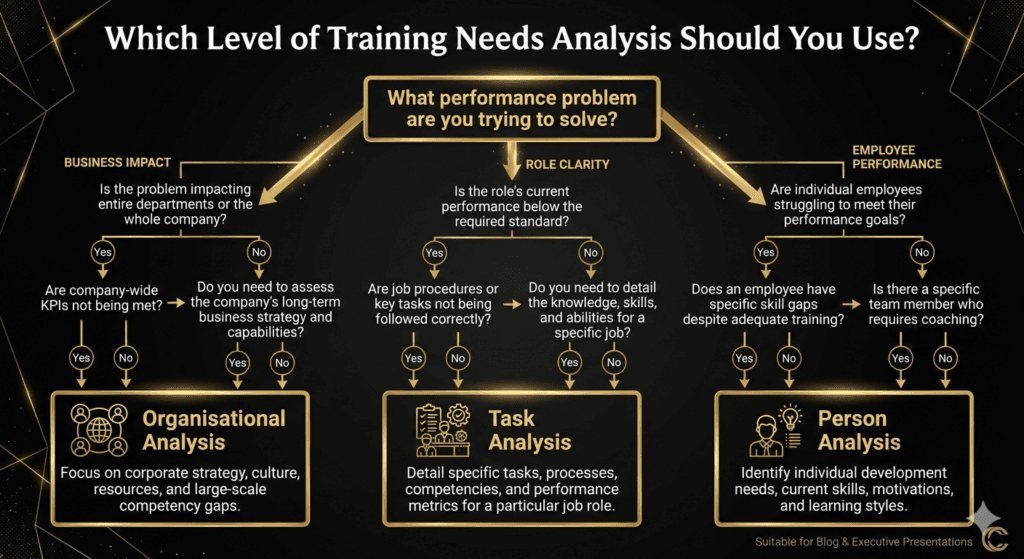
As the decision tree illustrates, many performance gaps require more than one level of TNA. A new technology rollout, for example, typically requires Organisational Analysis to scope the business case, Task Analysis to define the required CRM tasks and standards, and Person Analysis to identify which individuals need which type of support.
When Should You Conduct Each Level of TNA?
Conduct Organisational TNA When:
- The organisation is undergoing strategic transformation — a merger, market expansion, or digital overhaul.
- New legislation or regulatory changes require capability upgrades across an entire function.
- Multiple teams are underperforming against the same KPIs, suggesting a systemic gap.
- A major technology platform is being deployed enterprise-wide.
- Annual L&D budget planning requires evidence-based prioritisation.
Conduct Task Analysis When:
- A new role is being created and no competency framework or job standard currently exists.
- An existing role has changed significantly due to technology, process, or market shifts.
- Performance benchmarks are unclear or inconsistently applied across teams.
- You are designing a new training programme and need validated learning objectives.
Conduct Individual TNA (Person Analysis) When:
- An employee is on a formal Performance Improvement Plan (PIP).
- A high-potential employee is being prepared for a senior or specialist role.
- An employee has recently been promoted or transferred to a new function.
- A manager or L&D Business Partner is designing a targeted coaching engagement.
How All Three Levels of TNA Work Together
The most effective corporate learning strategies layer all three levels within a structured, cascading framework that flows from business strategy to individual development. Here is the five-stage model:
| Stage | Activity |
| 1 Business Goals | Review strategic plans, annual targets, and key performance indicators with senior leadership. |
| 2 Organisational Analysis | Identify workforce capability gaps at the function or department level using HR analytics and performance data. |
| 3 Task Analysis | Map the tasks, KSAs, and performance standards for each critical role — forming the benchmark for individual assessment. |
| 4 Person Analysis | Conduct one-to-one assessments, review appraisal data, and gather 360° feedback to identify individual gaps against role standards. |
| 5 Training Design | Synthesise all findings into a structured learning strategy — blended, role-specific, and aligned to measurable outcomes. |
This sequence ensures that individual development plans are always grounded in validated role standards, which are in turn aligned to the business priorities identified at the organisational level. The result is a learning strategy that is coherent from the boardroom to the individual contributor.
| ✅ Key Takeaway: The biggest mistake L&D teams make is treating Organisational TNA and Individual TNA as either/or choices. They are sequential steps in the same diagnostic process — all three levels must be applied for TNA to be complete. |
Common Mistakes L&D Teams Make with TNA
1. Jumping Directly to Employee Surveys
Sending out a training needs survey before defining business goals is the single most common error in corporate L&D. Surveys capture what employees perceive they need — not what the business requires. Without Organisational TNA as the anchor, survey responses produce a wish list of course topics rather than a strategically aligned learning roadmap.
| ⚠️ Common Mistake: Leading with a training needs survey before Organisational TNA produces wish lists, not strategic priorities. Always establish the business context first. |
2. Skipping Task Analysis
Moving directly from Organisational TNA to Individual surveys without Task Analysis is a critical gap. Without defined role standards, individual assessments have nothing validated to measure against — producing subjective, inconsistent gap data.
3. Ignoring Business Goals
TNA conducted in isolation from the business strategy addresses yesterday’s problems, not tomorrow’s opportunities. Effective TNA always starts with a conversation about where the organisation is going, not just where it currently struggles.
4. Treating Every Performance Issue as a Training Issue
Not all performance gaps are caused by a lack of knowledge or skill. Sometimes the issue is motivation, unclear expectations, broken processes, inadequate tools, or poor management. Commissioning training as the default response — without proper diagnosis — wastes budget and erodes L&D credibility.
📌 Internal Resource: Read When Training Is NOT the Answer: A Guide to Performance Consulting on TrainerCentric.in for a deeper exploration of this critical issue.
5. Using Only One Data Source
Relying on a manager’s opinion, a survey, or a performance metric alone produces a partial and often misleading picture. Robust TNA triangulates at least three data sources to reduce bias and increase the validity of findings.
Real Example: Launching a New CRM Across a Sales Team
To illustrate how all three levels of TNA work in practice, consider the following scenario:
A B2B technology company is rolling out Salesforce CRM to its 60-person sales team as part of a strategic initiative to improve pipeline visibility and revenue forecasting accuracy. The VP of Sales wants 90% adoption within three months.
Level 1 — Organisational Analysis Findings
- The business case links CRM adoption to a 20% revenue growth target for the fiscal year.
- Workforce analytics show 40% of sales representatives have never used a CRM professionally.
- Manager interviews reveal the team relies heavily on spreadsheets — a significant mindset shift is required.
- The highest-performing reps are the most tenured — and the most resistant to technology change.
Level 2 — Task Analysis Findings
- Four critical CRM tasks identified: pipeline entry, activity logging, opportunity stage management, and revenue reporting.
- Each task mapped to required KSAs, frequency of performance, and consequence of error.
- Role-specific standards defined for Sales Representatives, Team Leads, and Regional Managers.
Level 3 — Person Analysis (Individual TNA) Findings
- Senior reps (8+ years): strong pipeline skills, low digital tool confidence, high change resistance. Gap: CRM navigation and data discipline.
- Mid-level reps (3–7 years): mixed confidence; gap varies between CRM usage and sales methodology.
- Junior reps (0–2 years): high digital confidence but gaps in sales process fundamentals the CRM supports.
Resulting Training Strategy:
| TNA Level | Key Finding | Training Response |
| Level 1 — Organisational Analysis | CRM adoption critical for 20% revenue growth target; 40% of reps lack digital tool confidence | Company-wide CRM awareness campaign + mandatory onboarding module |
| Level 2 — Task Analysis | Four critical CRM tasks identified: pipeline entry, activity logging, opportunity staging, and revenue reporting. Role-specific standards defined. | Task-specific job aids and process guides embedded in the CRM platform |
| Level 3 — Person Analysis (Individual TNA) | Senior reps: strong pipeline skills, weak CRM data discipline. Junior reps: high tool confidence, gaps in sales process fundamentals. | Differentiated pathways: seniors receive tool-focused micro-learning; juniors receive blended sales skills programme |
The differentiated approach — made possible by conducting all three levels of TNA — resulted in significantly faster adoption and fewer post-launch support requests than a one-size-fits-all rollout would have produced. Each group received training precisely calibrated to their actual gaps.
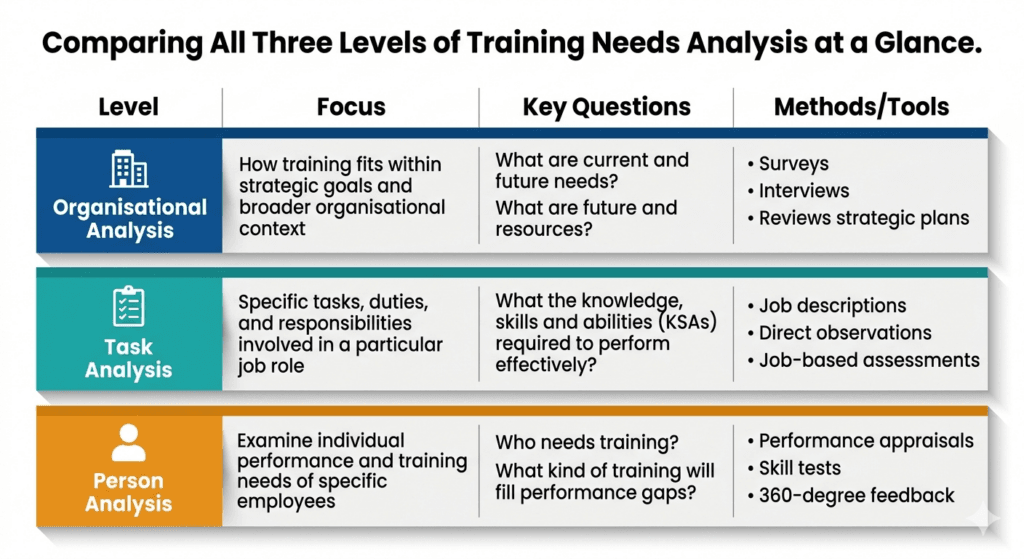
Comparing All Three Levels at a Glance
The following comparison matrix summarises the key attributes of all three TNA levels side by side:
Best Practices for Conducting TNA Across All Three Levels
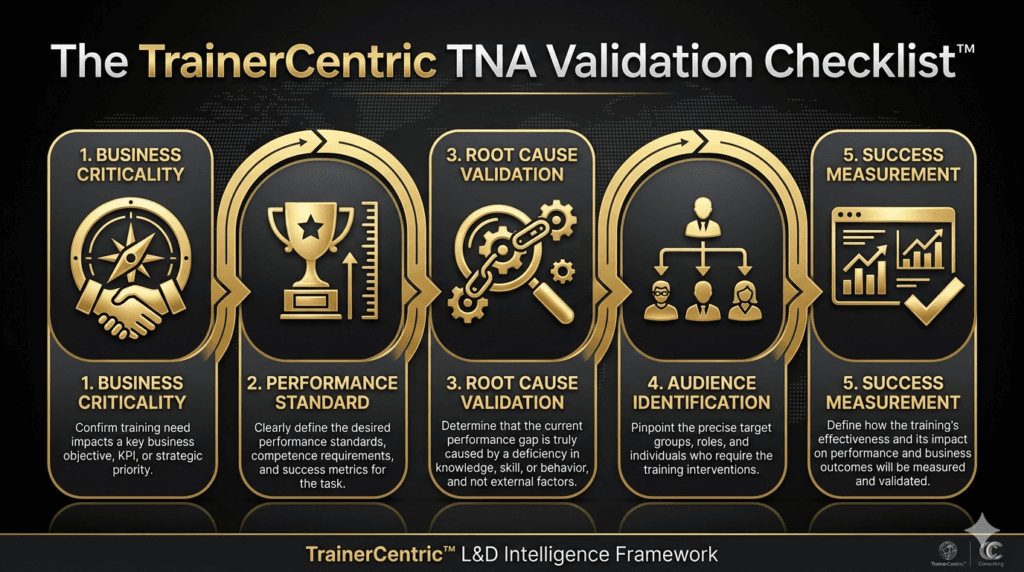
The checklist below summarises the most impactful practices for conducting effective TNA:
| ✓ | Best Practice |
| ✓ | Always anchor TNA in business strategy — review OKRs and the annual plan before any stakeholder conversation. |
| ✓ | Follow the correct sequence: Organisational Analysis → Task Analysis → Person Analysis. |
| ✓ | Triangulate data — use at least three sources to reduce bias and increase validity. |
| ✓ | Involve the right stakeholders at each level: C-suite for Org TNA; line managers and employees for Individual TNA. |
| ✓ | Distinguish a training need from a performance problem — test whether a skill deficit is the root cause. |
| ✓ | Document your methodology to build L&D credibility and create an investment audit trail. |
| ✓ | Revisit TNA annually and whenever a significant change occurs (merger, technology rollout, regulation update). |
| ✓ | Use structured templates to maintain consistency and comparability across analyses over time. |
📌 Internal Resource: Download our Training Needs Analysis Template and Training Needs Analysis Checklist: Free Download for L&D Teams on TrainerCentric.in to streamline your next TNA exercise.
Quick Answers: People Also Ask
The following short answers address the most frequently searched questions on this topic:
| People Also Ask | Short Answer |
| Is organisational TNA the same as a skills gap analysis? | No. A skills gap analysis identifies the delta between current and required skills. Organisational TNA is broader — it determines whether training is the right solution, sets strategic priorities, and produces a full learning roadmap. |
| Can individual TNA be conducted without organisational TNA? | Yes — for standalone cases like PIPs or promotions. But without the strategic context that Organisational TNA provides, Individual TNA risks addressing personal gaps that are not business-critical. |
| Which level of TNA should be conducted first? | Organisational Analysis always comes first, followed by Task Analysis, then Person Analysis (Individual TNA). This sequence ensures individual assessments measure against validated role standards. |
| What is person analysis in training needs assessment? | Person analysis is Level 3 of TNA. It identifies which specific employees have gaps against role standards defined in task analysis, and which learning interventions will close them. |
Conclusion
The three levels of training needs analysis — Organisational Analysis, Task Analysis, and Person Analysis — are not academic abstractions. They are the practical diagnostic tools that separate L&D teams who drive business results from those who simply fill training calendars.
Organisational TNA connects the workforce to strategy. Task Analysis defines the performance standard every role must meet. Individual TNA (Person Analysis) identifies exactly who needs help and what they need. Used together, in the right sequence, they create the evidence base for learning investments that are strategically justified, precisely targeted, and measurably effective.
For L&D leaders building a training needs analysis process for the first time, or refining one that is not delivering the expected returns, the answer almost always lies in one of the three levels being missing, abbreviated, or conducted in the wrong order.
Frequently Asked Questions
What are the three levels of training needs analysis?
The three levels are: (1) Organisational Analysis — examines workforce capability gaps in the context of business strategy; (2) Task Analysis — defines the tasks, KSAs, and standards required for each critical role; and (3) Person Analysis (Individual TNA) — identifies which specific employees have gaps against those standards. Established by McGehee and Thayer (1961), this framework is still used by CIPD and ATD as the foundation of effective TNA.
What is the difference between organisational and individual TNA?
Organisational TNA examines workforce capability gaps at a business or department level, aligned to strategic goals. Individual TNA (Person Analysis) examines the specific knowledge, skill, and behaviour gaps of a single employee relative to their role requirements. They differ in scope, stakeholders, data sources, and outputs — but both are essential levels within a complete training needs analysis.
What is person analysis in TNA?
Person analysis is Level 3 of training needs analysis (also called Individual TNA). It identifies which specific employees have performance gaps against the role standards defined in task analysis, how significant those gaps are, and which learning interventions are most appropriate. It draws on performance appraisals, 360° feedback, skills assessments, and manager input.
What is organisational analysis in HRD?
In Human Resource Development (HRD), organisational analysis is the macro-level examination of an organisation’s strategic goals, current performance, and environment to determine whether training is an appropriate solution and where learning investment should be focused. It answers: does the business context support a training intervention, and if so, where should it be targeted?
What are examples of organisational training needs?
Examples include: a company’s entire salesforce lacks digital selling skills following a market shift; a manufacturing firm’s supervisors need coaching skills to embed a continuous improvement culture; an NBFC’s (Non-Banking Financial Company) operations team needs AML/KYC compliance training; or a technology company’s workforce needs AI literacy upskilling as part of a digital transformation strategy.
What are examples of individual training needs?
Examples include: a newly promoted team leader lacks experience in conflict resolution and performance conversations; a senior account manager is strong on relationships but weak on data analysis and CRM reporting; a financial analyst joining from a competitor is proficient in Excel but unfamiliar with the company’s internal ERP; or a product manager has strong technical knowledge but struggles to communicate to non-technical stakeholders.
Why is organisational analysis conducted before person analysis?
Organisational analysis must come first because it establishes the strategic frame that makes all subsequent analysis meaningful. Without knowing which capabilities the business needs most urgently, there is no way to prioritise which individual gaps to address. Conducting person analysis first risks investing in personal development that is not business-critical, leading to training spend with no measurable organisational return.
Which level of TNA should be conducted first?
Organisational Analysis always comes first, followed by Task Analysis, then Person Analysis (Individual TNA). This sequence ensures individual assessments are conducted against role standards that have been validated against business priorities. Reversing the order is one of the most common and costly errors in corporate L&D.
Can you conduct multiple levels of TNA at the same time?
In practice, many organisations run Organisational TNA and Task Analysis concurrently, particularly during strategic planning cycles. However, Person Analysis should always follow Task Analysis — individual assessments are only meaningful once role standards have been defined. Even when activities overlap, the logic must remain sequential.
Who is responsible for conducting TNA?
Responsibility depends on the level. Organisational TNA is typically led by the L&D Head or HR Director in partnership with senior business leaders. Task Analysis is led by L&D in collaboration with subject-matter experts and line managers. Individual TNA (Person Analysis) is facilitated by the L&D Business Partner or HRBP in collaboration with the line manager and the employee.
Is a skills gap analysis the same as Training Needs Analysis?
Not exactly. A skills gap analysis is a component of TNA — it maps the difference between current skills and required skills at Level 3 (Person Analysis). TNA is broader: it determines the root cause of performance gaps across all three levels, evaluates whether training is the right solution, and produces a multi-level learning strategy.
How often should Training Needs Analysis be conducted?
Organisational TNA should be reviewed annually, aligned to the business planning cycle, and triggered again whenever significant change occurs. Task Analysis should be reviewed when roles change substantially due to technology, process, or market shifts. Individual TNA is typically conducted annually through the appraisal cycle, with additional reviews triggered by role transitions, PIPs, or development plan milestones.
📌 Internal Resource: Read Skills Gap Analysis vs Training Needs Analysis on TrainerCentric.in for a detailed comparison of these two related but distinct processes.
Why Effective TNA Is the Foundation of Strategic L&D
At TrainerCentric.in, we work with L&D leaders across India’s corporate sector — from BFSI and manufacturing to technology and retail — and the organisations that achieve the greatest ROI from their training spend share one common practice: they conduct rigorous Training Needs Analysis across all three levels before a single piece of content is designed or a single vendor is briefed.
TNA is not a bureaucratic step in a process. It is the act of aligning learning to impact. When L&D teams understand and apply the three-level TNA model with discipline, they transform the perception of the L&D function from a cost centre into a genuine strategic partner.
References:
- Training Needs Assessment | Allison Rossett | Educational Technology Publications, 1987
- First Things Fast: A Handbook for Performance Analysis | Allison Rossett | Pfeiffer, 2009 (2nd ed.)
- Needs Assessment for Organizational Success | Roger Kaufman & Ingrid Guerra-López | ATD Press, 2013
- Analyzing Performance Problems | Robert F. Mager & Peter Pipe | CEP Press, 1997 (3rd ed.)
- Map It: The Right Way to Use Action Mapping to Design Innovative Business Training | Cathy Moore | Montesa Press, 2017
- Telling Ain’t Training | Harold D. Stolovitch & Erica J. Keeps | ATD Press, 2011 (2nd ed.)
Further Readings:
- Training Needs Analysis: The Complete Guide for L&D Professionals
- How to Conduct a Training Needs Analysis in 5 Steps
- Instructional Design Models: The Comprehensive Corporate L&D Guide
- Skills Gap Analysis vs Training Needs Analysis:Understanding the Difference
- Performance Consulting Explained: When Training Is NOT the Answer
- The 3 Levels of Training Needs Analysis: Organisation, Task & Person Analysis
- Job Task Analysis
- How to Present Training Needs Analysis Results to Senior Stakeholders
- Training Needs Analysis Template: 1 Free Download for L&D Teams
- Focus Groups and Interviews for Training Needs Assessment: A Practical Field Guide
- 12 Facilitation Skills for Corporate Trainers: The Complete Guide
- Training Needs Analysis Questionnaire: Complete Guide (75 Questions & Free Template)
- Examples of Training Needs Analysis Reports: Real Samples, Formats, and Best Practices [2026]
Author Details

Soumyadeep Sen is a Learning & Development professional with over 14 years of experience across training, coaching, quality, and performance improvement. Currently serving as Assistant Manager – Training at 24/7.ai, he specializes in designing practical learning solutions that drive employee performance and support business objectives. Reach out to him via Linkedin.