Including the TrainerCentric Facilitation Skills Framework™ — Foundation → Group Leadership → Learning Design → Advanced (For corporate trainers, L&D professionals, training managers, and instructional designers)
Introduction
Facilitation skills for corporate trainers are the deciding factor between training that changes behaviour and training that fills time. Over the course of facilitating more than 200 workshops across manufacturing, financial services, FMCG, and technology organisations, one pattern has emerged with remarkable consistency: the quality of the content is rarely what determines learning outcomes. The quality of the facilitation almost always does.
This is not a comfortable truth for L&D professionals who invest heavily in instructional design. But it is the one that drives results. A well-designed programme in the hands of a weak facilitator will produce average outcomes. A well-facilitated session with reasonably good design will consistently outperform it.
What makes this article different from the dozens of generic facilitation guides already online is this: it is built from what actually happens in corporate training rooms, not from textbook definitions of what should happen. The examples are real. The mistakes are ones I have made myself or watched skilled trainers make. The frameworks are drawn from repeated observation of what separates good facilitators from exceptional ones.
| What You Will Find Here 1. The TrainerCentric Facilitation Skills Framework™ — a proprietary four-tier model organising all 12 core skills 2. 15+ field examples from real corporate training sessions 3. Practical scripts for managing difficult participants 4. A 30-day development plan and self-assessment checklist 5. Facilitation interview questions (for hiring and self-review) 6. Guidance on assessment, certification, and building a verifiable track record |
One note on scope: this guide is written specifically for corporate training environments. It is not a guide to community facilitation, design thinking workshops, or Agile retrospectives. The principles overlap, but the pressures are different. In corporate L&D, you are usually working against time pressure, mandatory attendance, mixed motivation levels, and senior stakeholders watching outcomes. That context shapes everything.
What Are Facilitation Skills?
Facilitation skills are the competencies that enable a trainer to guide a group through a learning process in a way that maximises participant thinking, collaboration, and insight — rather than simply transmitting information at them.
The word ‘facilitate’ comes from the Latin facilitas, meaning to make easy. A skilled facilitator makes it easy for participants to learn, to engage, and to construct meaning from their own experience. They do not do the thinking for the room. They create the conditions in which the room does the thinking itself.
Presenting vs Teaching vs Training vs Facilitating
These four terms are used interchangeably in corporate L&D, but they describe different roles with different relationships to the learner:
| Role | Primary Goal | Information Flow | Participant Role | Best Used For |
| Presenter | Communicate ideas | One-way | Passive audience | Keynotes, announcements, pitches |
| Teacher | Transfer subject knowledge | Largely one-way | Student receiving instruction | Technical skills, academic content |
| Trainer | Develop specific behaviours | Mixed | Learner practising skills | Compliance, onboarding, process training |
| Facilitator | Generate group insight | Multi-directional | Active co-creator of learning | Leadership, soft skills, culture work |
Most corporate trainers move between all four modes within a single session. You might present a framework, teach a tool, let participants practise it, then facilitate a debrief. Facilitation skills are what allow you to shift between these modes smoothly, and to read when each one serves the learning.
| Facilitation skills are the competencies that allow a trainer to guide group discussions, manage participation, create psychological safety, and structure activities so that participants actively construct their own learning rather than passively receiving information. |
Why Facilitation Skills Matter More Than Ever
Corporate learning has changed dramatically, and the demands on facilitators have intensified. Understanding these shifts helps explain why facilitation skills are now more critical than ever.
Only 12% of employees apply what they learn in training back to their jobs. –Training Industry / Robert Brinkerhoff, The Success Case Method
That statistic is uncomfortable for anyone in L&D. But the reason is almost never the content. It is almost always the learning experience — how the training was designed and, more importantly, how it was delivered and facilitated.
Shorter Attention Spans and the Competition for Focus
Research on cognitive load consistently shows that adult learners in passive receiving mode begin disengaging after 10 to 20 minutes. In corporate settings, where participants are often mentally managing email inboxes, post-meeting stress, and open deliverables, the effective attention window is even shorter. Active facilitation — through questions, activities, and structured participation — is the primary mechanism for resetting and reclaiming attention.
The average corporate learner has just 24 minutes a week available for formal learning.LinkedIn Learning, Workplace Learning Report
Hybrid and Virtual Learning
The hybrid classroom — part of the room physically present, part on screens — is now a standard delivery context, not an exceptional one. Managing engagement across both physical and digital spaces simultaneously requires an entirely different facilitation skill set from any that existed before 2020. Trainers who have not actively developed virtual facilitation skills are working with a significant gap.
Learner Diversity and Inclusion
Modern corporate training rooms are diverse across experience levels, cultural backgrounds, personality types, and learning preferences. Without deliberate facilitation, these sessions default to serving the loudest or most confident participants. Skilled facilitation is what ensures every voice in the room contributes and benefits.
85% of L&D leaders say engagement is the top challenge in virtual training delivery.CIPD, Learning at Work Survey
The Learning Transfer Imperative
The Kirkpatrick Model positions behaviour change (Level 3) and business results (Level 4) as the true measures of training effectiveness. Both depend heavily on how a session is facilitated. Facilitation creates the psychological safety for real practice, the quality of feedback during activities, and the reflective space where application planning happens. Great content delivered without facilitation skill rarely transfers. Our guide to the Kirkpatrick Model for Measuring Training Effectiveness explores this in detail.
Adult Learning Principles
Malcolm Knowles’ andragogy principles remind us that adult learners need to know why they are learning something, bring their own experience to the table, and see immediate relevance to their work. Facilitation — not presentation — is the mode that honours these principles. For a full treatment, see our guide on Andragogy and Adult Learning Principles.
The TrainerCentric Facilitation Skills Framework™
Most facilitation skills lists are flat. They give you twelve or fifteen skills in no particular order, which makes it difficult to know where to start, what to prioritise, or how to think about progression.
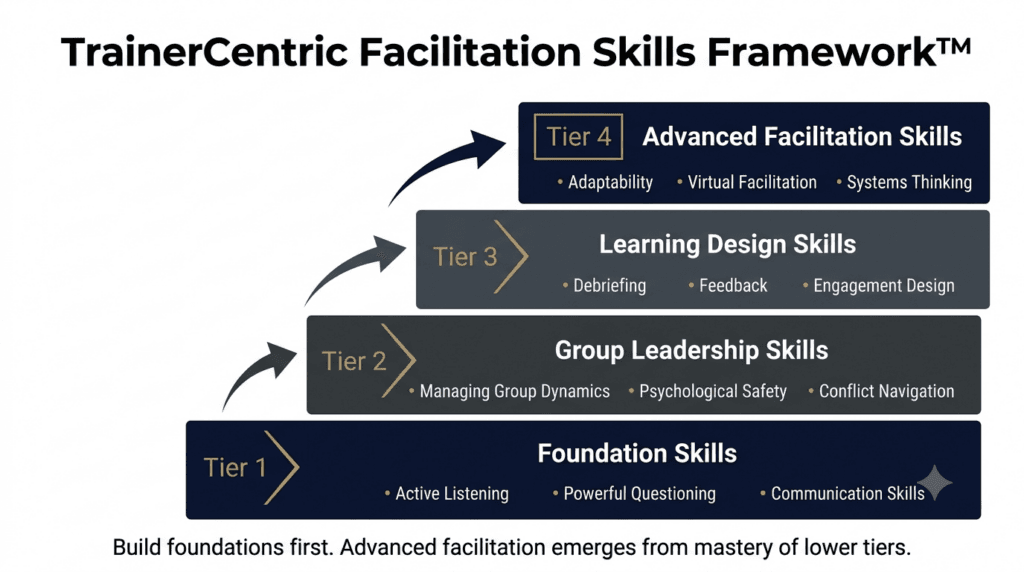
After working with hundreds of trainers across facilitation development programmes, a pattern became clear: facilitation skills are not equally foundational. Some must be in place before others can be developed meaningfully. And they cluster into four distinct functional areas that map to different aspects of the training role.
The TrainerCentric Facilitation Skills Framework™ organises the twelve core facilitation competencies into four tiers:
| Foundation Skills | Group Leadership Skills | Learning Design Skills | Advanced Skills |
| Active Listening Powerful Questioning Communication Skills | Managing Group Dynamics Psychological Safety Conflict Navigation | Debriefing Feedback Engagement Design | Virtual Facilitation Adaptability Systems Thinking |
| Must be solid before anything else | Controls who speaks and how safely | Determines whether learning lands | Separates good from exceptional |
The logic of the framework: you cannot lead a group effectively if you are not listening (Tier 1). You cannot create psychological safety if you haven’t established the foundations of communication (Tier 1 into Tier 2). You cannot design learning activities that work if you haven’t learned how to read a room (Tier 2 into Tier 3). And you cannot facilitate virtually or adapt under pressure if you haven’t consolidated the earlier tiers (Tier 3 into Tier 4).
This sequencing is also how the development plan below is structured. Now let us look at each skill in detail.
Tier 1: Foundation Skills
1.1 Active Listening
Active listening is the non-negotiable foundation of everything else in the framework. When participants feel genuinely heard, they engage more, share more honestly, and trust the facilitator enough to take learning risks. When they feel processed — responded to but not really heard — they disengage and the session becomes a performance on both sides.
| From the Training Room In a conflict resolution workshop for a logistics company, a participant said: ‘Management never actually listens to us.’ A trainer who was half-listening would have validated and moved on. I stopped the session: ‘That’s a strong word — never. Is that the experience of others in the room?’ Four hands went up. That moment became the most productive hour of the three-day programme. It was available the whole time. I just had to hear it. |
Why it matters: Without real listening, facilitation becomes a series of prompts and responses with no genuine connection. The learning becomes transactional rather than transformative.
Common mistakes: Listening to respond rather than to understand; summarising before the participant has finished; missing the emotional content behind factual statements; over-nodding as a social performance rather than genuine signal.
Development tip: Record one session per month with participant consent. Watch it back on mute. What does your non-verbal behaviour communicate about your listening quality?
1.2 Powerful Questioning
Questions are the facilitator’s primary tool. The quality of your questions determines the quality of the thinking that happens in the room. Weak questions generate surface answers. Strong questions surface assumptions, challenge thinking, and connect learning to real application.
| Question Type | Purpose | Example |
| Open | Generate discussion | “What has been your experience with this in practice?” |
| Probing | Deepen thinking | “Can you say more about what you mean by that?” |
| Hypothetical | Challenge assumptions | “What would happen if the opposite were true?” |
| Reflective | Connect to experience | “Where have you seen this play out in your team?” |
| Scaling | Measure commitment | “On a scale of 1–10, how confident are you in applying this?” |
| Devil’s advocate | Test robustness | “What would a sceptic say about this approach?” |
| From the Training Room The most common questioning mistake I see in new trainers is answering their own questions. They ask, wait about two seconds, feel the silence, and then immediately provide the answer they were hoping someone else would give. The silence after a good question is not dead air. It is thinking time. Three seconds of silence is not uncomfortable — it is productive. I now count to five after every key question before considering an intervention. |
Development tip: Prepare eight to ten questions before every session. Categorise them: which open the discussion, which deepen it, which close it. Then be willing to discard the plan when a better question emerges from the room.
1.3 Communication Skills
Communication in facilitation is not primarily about what you say. It is about how you say it, when you say it, and what your body is saying simultaneously. Tone, pace, posture, and word choice all signal whether this is a space of genuine inquiry or a performance the group is expected to play along with.
Why it matters: Facilitators who speak faster and louder when they feel the session slipping communicate anxiety — and anxiety is contagious. Facilitators who slow down and lower their volume in charged moments communicate control, safety, and confidence. The room follows the trainer’s emotional lead.
Common mistakes: Using jargon that excludes participants; relying on filler words (‘basically’, ‘kind of’, ‘you know’) that erode credibility; failing to modulate energy across a long session; mismatched verbal and non-verbal communication.
Tier 2: Group Leadership Skills
2.1 Managing Group Dynamics
Every group has a social ecosystem: roles, alliances, status hierarchies, and unspoken tensions. Skilled facilitators read this ecosystem from the moment they enter the room and make conscious decisions about when to intervene and when to let the group process run.
| From the Training Room I was facilitating a leadership development programme for a FMCG organisation where two directors had clearly been in disagreement before the session started. Within the first twenty minutes, every comment from one was being subtly undermined by the other — too politely for participants to name, but strongly enough to chill the discussion. I called a break, spoke to each privately, and reframed the session opening when we reconvened. That off-agenda fifteen minutes saved the rest of the day. |
Development tip: Before any session with a new group, do five minutes of social mapping: who knows each other, who has authority over whom, where might the fault lines be? This is not paranoia — it is preparation.
2.2 Psychological Safety
Amy Edmondson’s research on psychological safety established what skilled facilitators have known from experience: people do not speak up, take risks, or admit uncertainty in environments where they feel it is not safe to do so. In corporate training, psychological safety is not given. It is built — usually in the first fifteen minutes of a session.
How to build it quickly: Ground rules established by the group rather than imposed by the facilitator; a deliberate opening activity where every participant speaks early (so the first contribution is not costly); the facilitator modelling vulnerability (‘I’ve made this mistake myself’); and consistent non-judgmental responses to every contribution, especially the risky ones.
Teams with high psychological safety are 1.9x as likely to report feeling motivated to tackle difficult problems. –Google Project Aristotle Research
2.3 Conflict Navigation
Conflict in a training room is not a problem to be eliminated. It is usually the most productive content available, if it is handled well. The facilitator’s job is not to suppress disagreement but to hold it productively — to prevent it from becoming personal while allowing it to be genuinely exploratory.
The distinction that matters: Task conflict (disagreement about ideas, approaches, or conclusions) is healthy and generative. Relationship conflict (personalised, status-driven, or hostile) is corrosive and needs to be named and interrupted. Most facilitator interventions should be distinguishing between the two and actively managing the boundary.
| From the Training Room During a change management programme, two managers got into what started as a healthy debate about implementation approaches. Within five minutes it had shifted from task conflict to something more personal — the tone changed, the audience went quiet, and contributions from others stopped. I interrupted: ‘There’s clearly real energy here, and I want to use it productively. Let’s capture both perspectives on the board and test them against the criteria the group set earlier.’ That pivot saved the session and actually produced the best output of the day. |
Tier 3: Learning Design Skills
3.1 Debriefing
This is the most undervalued and most commonly mishandled facilitation skill. The debrief is where learning happens. The activity is the stimulus. The debrief is the learning. Trainers who rush the debrief — or skip it entirely in the name of time — are throwing away the most valuable part of the session.
A structured debrief follows the What / So What / Now What model:
- What happened? (Descriptive — what did participants observe and experience?)
- So what does that mean? (Analytical — what principles, patterns, or insights does it surface?)
- Now what will you do differently? (Application — what specific change or commitment does it generate?)
| From the Training Room The most common pattern I see in new trainers: they run a well-designed role play activity, spend 45 minutes on it, then have five minutes left for the debrief. They rush through two questions and move on. The participants had a learning experience. They just did not have time to learn from it. I protect debrief time as if it is the content — because it is. |
3.2 Giving and Generating Feedback
In skills-based training, feedback is the primary accelerant of development. Feedback that is vague, generic, or overly softened fails the learner. Feedback that is specific, timely, and grounded in observable behaviour drives genuine growth. As a facilitator, your job is both to give high-quality feedback and to create conditions in which peer feedback is equally honest and useful.
The SBI model: Situation (the specific context), Behaviour (what was observable and specific), Impact (what effect did it have). Not: ‘Good job.’ But: ‘In that stakeholder scenario, when you paused before answering the difficult question, it changed the energy in the room — the person playing the stakeholder visibly relaxed.’
3.3 Engagement Design
Facilitation is not a performance skill alone. A significant part of it is design: how you structure the session to ensure that participation is built in rather than hoped for. Trainers who rely on voluntary contribution will always end up with 20% of the room doing 80% of the contributing.
Design principles: Alternate activity types every 10 to 15 minutes; alternate group sizes (individual → paired → small group → full room); build in multiple contribution channels (verbal, written, digital); design activities before slides. If you cannot articulate what participants will be doing at every point in the session, you have a presentation, not a facilitated learning event.
Tier 4: Advanced Skills
4.1 Virtual Facilitation
Virtual facilitation is a discipline in its own right — not face-to-face facilitation conducted through a screen. See Section 9 for a full treatment. The core principle: every technique must be rebuilt from scratch for the virtual environment, not simply translated.
4.2 Adaptability
No session plan survives first contact with participants intact. A technical failure, a piece of unexpected news, a participant who surfaces a pressing real-world problem that reframes the learning agenda — skilled facilitators adapt their plan to serve the learning, not the other way around.
| From the Training Room I was mid-way through a leadership programme when a participant mentioned that their CEO had resigned two hours before the session. The room was distracted, understandably. I stopped the planned agenda entirely: ‘What you’re actually navigating right now is a real leadership challenge. Let’s use today to think about how you lead through uncertainty — which is what this programme was about anyway.’ We never opened the slide deck. The feedback was the strongest of the programme. |
4.3 Systems Thinking
This is the skill that separates the most sophisticated facilitators from those who are simply skilled practitioners. Systems thinking in facilitation means reading the organisational context behind the training need, understanding how group dynamics connect to broader cultural patterns, and recognising when a training session is surfacing a systemic problem that requires an intervention beyond the room.
This connects directly to performance consulting — the discipline of identifying whether a business problem is actually a training problem at all. Our article on When Training Is NOT the Answer explores this in depth and is essential reading for any facilitator operating at a strategic level.
Facilitation Skills vs Presentation Skills
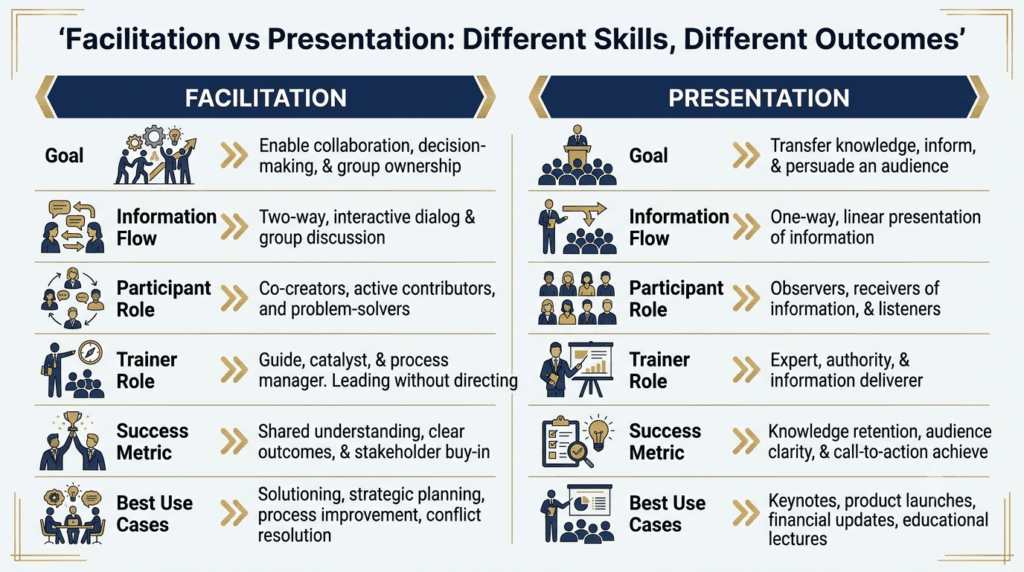
One of the most persistent confusions in corporate L&D is treating facilitation and presentation as the same skill set. They share some surface features but diverge fundamentally in orientation, technique, and outcome.
| Dimension | Facilitation | Presentation |
| Primary goal | Generate learning and insight from the group | Communicate information to an audience |
| Information flow | Multi-directional | Largely one-directional |
| Participant role | Active thinker and contributor | Passive receiver |
| Facilitator/Presenter role | Guide and process manager | Expert and communicator |
| Success metric | Quality of participant thinking and behaviour change | Clarity and persuasiveness of message |
| Best used for | Behaviour change, soft skills, culture work | Information sharing, awareness-raising |
| Preparation focus | Questions, activities, process | Content, narrative, slides |
| Risk if it goes wrong | Lose control of group dynamics | Bore or confuse the audience |
The most effective corporate trainers are fully bilingual — fluent in both modes, and clear about which one serves the learning objective. An important note: senior or experienced audiences often resist being ‘facilitated’ if the facilitation feels performative. A highly credible subject matter expert presenting a well-constructed case can sometimes be more effective than a facilitated session that feels like it is avoiding direct answers.
Facilitation Skills Examples in Real Training Sessions
Abstract descriptions of facilitation skills are useful. Concrete examples from real sessions are more useful. The following scenarios illustrate what specific facilitation skills look like when applied under pressure.
Example 1: Active Listening Unlocks the Real Issue
Setting: A two-day resilience training programme for a financial services operations team. The designed agenda focused on individual coping strategies, stress management, and boundary-setting.
What happened: In the first ninety minutes, participant engagement was low. Responses to questions were polite but shallow. Forty minutes in, one participant made a passing comment: ‘This is useful, but our main problem is that we’re three people down and nobody upstairs seems to care.’
The facilitation response: Rather than acknowledging and moving on, the facilitator stopped: ‘That sounds like it might be more relevant than anything in the slide deck. Is resourcing the context everyone’s working against right now?’ Every head nodded.
The outcome: The facilitator restructured the afternoon around ‘how do you protect your own functioning in environments you cannot fully control?’ Engagement transformed immediately. The content became relevant because the facilitator had listened well enough to hear what the group actually needed.
Example 2: Questioning That Shifts the Learning Depth
Setting: A leadership programme exploring delegation for middle managers.
The weak version: Facilitator asks, ‘Why is delegation important?’ Group gives textbook answers about efficiency and development. Facilitator summarises the answers and moves on.
The facilitated version: Facilitator asks, ‘What does it actually cost you personally when you don’t delegate?’ Pause. Then: ‘Not cost the team. Cost you.’ The discussion that followed revealed that delegation anxiety in this group was almost entirely about identity and control, not about trust or process. That insight could not have been designed in advance — it emerged through the question.
Example 3: Managing Dynamics in a Hierarchical Room
Setting: A cross-functional collaboration workshop. A divisional director was in the room alongside eight of their direct and indirect reports.
The dynamic: Every contribution was being, consciously or not, oriented toward the director. Participants were checking for approval after statements. The director, to their credit, was trying not to dominate — but their presence was shaping everything.
The facilitation response: The facilitator restructured the afternoon into breakout groups that deliberately mixed functions and levels, and used individual written reflection before any group sharing. When the director spoke in full-group debrief, the facilitator thanked them and immediately broadened: ‘What did others observe from a different vantage point?’
The outcome: The breakout session produced significantly better outputs than the morning session because status had been temporarily suspended by structure.
Example 4: Recovering a Session That Is Losing the Room
Setting: A virtual compliance training session for a technology company. Ninety minutes in, cameras were starting to go off, chat had gone quiet, and one participant had been clearly typing elsewhere for twenty minutes.
The facilitation response: Stop the content. ‘I want to do a quick check-in before we go further. In the chat, give me a number from one to ten for how relevant this feels to what you actually do. You don’t need to explain the number — just give me a number.’ Results ranged from 3 to 7.
The outcome: That moment of transparency broke the session open. The facilitator asked the person who typed ‘3’ to say more. Their response reframed the remaining forty-five minutes around the scenarios that were most relevant to the team’s actual work. It was not the planned session. It was a better one.
Facilitation Techniques and Activities
The following techniques and facilitation activities form the practical toolkit of any skilled corporate trainer. Each is described with its optimal use case, typical pitfalls, and a note on where it tends to fail.
1. Think-Pair-Share
What it is: Participants think individually (1–2 min), discuss with a partner (2–3 min), then share with the full group.
Best for: Opening discussions where voluntary contribution would produce only the most confident voices. Exploring complex questions that benefit from individual processing time before debate.
Where it fails: When the question is too simple (pair discussion ends in 30 seconds and feels forced) or when participants are not given clear enough instructions about what to discuss.
2. Case Studies
What it is: Participants analyse a realistic business scenario and apply course concepts to diagnose problems or recommend solutions.
Best for: Senior audiences, complex concepts, situations where direct practice would be premature. Works best when cases are drawn from the participants’ own industry or, better still, from a lightly disguised version of their own organisation.
| From the Training Room The single most effective case study I have ever used was a scenario I wrote during the lunch break on day one, based on something a participant had mentioned that morning. It was rough, unpolished, and immediately recognisable. The group worked on it with an intensity I have rarely seen in a pre-written case. |
3. Simulations
What it is: Participants role-play or work through a realistic work scenario in real time, with structured facilitator observation and debrief.
Best for: High-stakes skills — difficult conversations, sales negotiations, crisis management, stakeholder engagement. Simulations create the conditions for emotional learning that case study analysis cannot replicate.
Critical success factor: The quality of the debrief. A simulation without a structured debrief is theatre, not training.
4. Role Play
Best for: Communication skills, coaching conversations, feedback delivery, negotiation. Structure matters: always brief participants on the scenario, run the role play, then debrief with self-assessment before peer or facilitator feedback.
Common mistake: Asking participants to ‘just do a role play’ without sufficient context, character briefs, or clear observation criteria. Vague role plays produce vague learning.
5. Reflection Activities
What it is: Structured time for individual processing: journaling, sentence completions (‘The most important thing I’ve realised today is…’), or written self-assessment.
Best for: Consolidating learning at module end; building self-awareness; supporting transfer planning. Introvert-friendly and consistently underused in fast-paced corporate programmes.
6. Live Polling
Tools: Mentimeter, Slido, Microsoft Forms, Poll Everywhere.
Best for: Opening discussions, checking understanding, surfacing group data that can itself become the content of a discussion. Polling data is a facilitation gift: it gives the group something to respond to rather than to a blank question.
7. Breakout Groups
Critical success factors: Clear task, clear time boundary, clear output. Breakout groups without a specific deliverable tend to become social conversations. Always debrief breakouts in full group, and resist the urge to add your own analysis after every group report-back.
8. Fishbowl Discussion
What it is: A small group (4–5) discusses a topic in the centre of the room while the larger group observes, then reflects on both the content and the group process.
Best for: Exploring genuinely contested topics where multiple perspectives need airtime; leadership programmes where the group dynamics are themselves a learning object.
8. World Café
What it is: Participants rotate between tables or conversation stations, building on each other’s thinking across multiple rounds.
Best for: Generating multiple perspectives on complex problems with larger groups (20+). Works well in strategy workshops and stakeholder engagement sessions.
| Technique | Group Size | Session Type | Energy Level | Prep Required |
| Think-Pair-Share | Any | Any | Medium | Low |
| Case Study | 4–20 | F2F or Virtual | Medium-High | High |
| Simulation | Any | F2F preferred | Very High | High |
| Role Play | 2–6 | Any | High | Medium |
| Reflection | Any | Any | Low-Medium | Low |
| Live Polling | 10+ | Any | High | Low |
| Breakout Groups | 8+ | Any | High | Medium |
| Fishbowl | 10–30 | F2F preferred | High | Medium |
| World Café | 20+ | F2F preferred | High | Medium |
How to Handle Difficult Participants During Training
Difficult participants are not obstacles to learning. They are information. Every disruptive behaviour is communicating something about the emotional contract of the session, the relevance of the content, or the interpersonal dynamics of the group. The goal is never to shut them down. It is to understand the need behind the behaviour and respond to that.
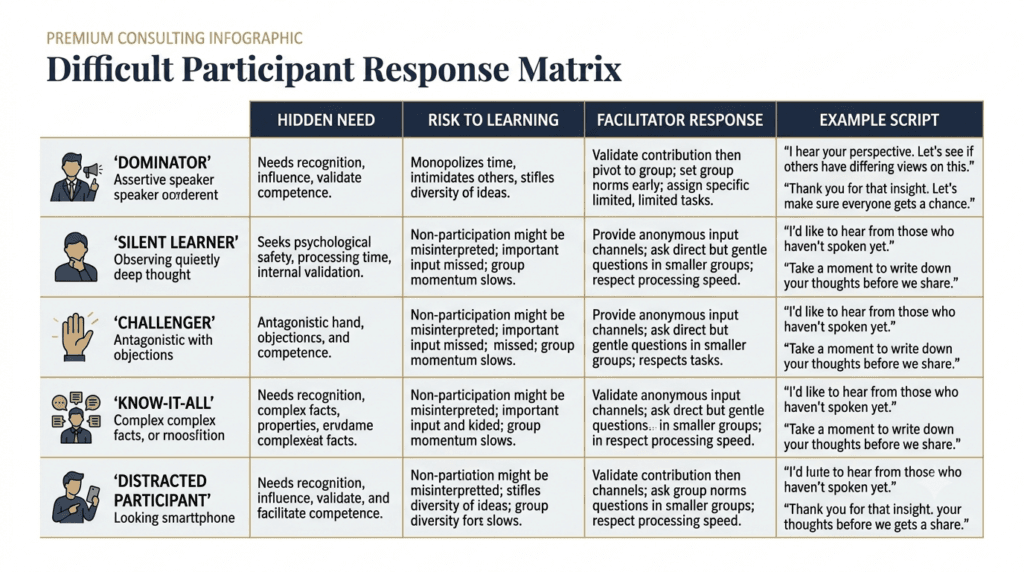
1. The Dominator
What they need: Significance and acknowledgement.
Script: “That’s a really important perspective, [name]. I want to make sure we’re drawing on the full range of experience in the room. Let’s hear from someone who hasn’t spoken yet.”
Prevention: Use Think-Pair-Share and round-robin structures that prevent any single voice from controlling the conversation. Call on the dominator early and gratefully — it satisfies the need before it becomes a pattern.
2. The Silent Learner
What they need: Psychological safety and a lower-stakes entry point.
Script: “We haven’t heard from everyone yet. [Name], what’s your instinct on this?” (Note: ask for instinct, not answer. Instinct has no wrong answer.)
Prevention: Use paired activities, written reflections, and anonymous polls to create multiple pathways to contribution. Ensure the first participation request of any session is very low-stakes.
| From the Training Room I have consistently found that silent participants in a room are not disengaged — they are often doing the deepest thinking. The worst thing you can do is put them on the spot in a way that makes the silence public and judgeable. The best approach is a private, low-pressure invitation. ‘I’d love to hear your perspective when you’re ready’ often works better than any direct question. |
3. Side Conversations
What they need: Either stimulation (they are bored) or permission to address something more pressing.
Script: “[Names], it looks like you might be onto something. Would you be willing to share it with the group?”
4. The Challenger
What they need: Their critical thinking to be respected, not deflected.
Script: “That’s a genuinely important challenge and I don’t want to brush past it. Let’s test this — does the model hold up under that scrutiny?”
Key distinction: Challengers are often the most intellectually engaged person in the room. Treating their challenge as disruption is a facilitation mistake. Treating it as a gift — even when it is inconvenient — is a facilitation skill.
5. The Know-It-All
What they need: Their expertise acknowledged and leveraged rather than competed with.
Script: “You clearly have deep experience here, [name]. I’d love to use you as a resource for the group. When we get to the practice activity, could you act as a sounding board for the team?”
6. The Distracted Participant
What they need: Either a reason to be here or permission to leave.
Script (privately, at a break): “I notice there seems to be a lot pulling at you today. Is there something making it hard to be in the room? If this isn’t the right time for this programme, I want us to find a solution that works for you.”
Internal Resource: Read our complete guide on How to Handle Difficult Participants in Training: A Practical Guide for Corporate Trainers
Facilitation Skills for Virtual Training
Virtual facilitation is a discipline in its own right. Trainers who apply face-to-face facilitation techniques to virtual environments and are then confused by poor outcomes are treating a fundamentally different medium as though it were the same one.
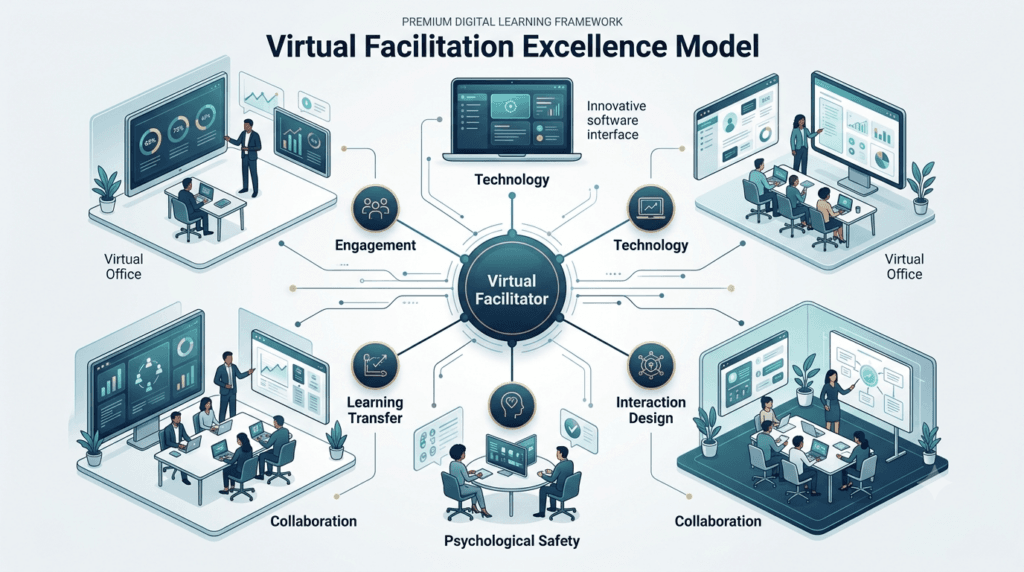
Only 17% of L&D professionals say they feel confident facilitating virtual training to the same standard as face-to-face. -Training Industry, Virtual Instructor-Led Training Report
Why Virtual Is Different
- Reduced social cues: you cannot read the room in the same way. The person who is processing thoughtfully and the person who has mentally checked out look identical through a small thumbnail.
- Camera fatigue: sustained video attention is cognitively expensive. Sessions longer than 90 minutes without deliberate breaks produce meaningfully worse engagement.
- The domestic environment: participants are surrounded by the cognitive cues of home, family, and open email. Their attention competes with all of it.
- Technology mediation: every technical glitch interrupts the learning process. Plan for it.
Virtual Facilitation Best Practices
| Challenge | Best Practice | Tool / Technique |
| Camera fatigue | Maximum 90-min blocks; 10 min break per hour | Session design |
| Low participation | Rotate speaking; use chat as contribution channel | Chat waterfall, name cards |
| Engagement drops | Activity every 7–10 minutes | Polls, whiteboards, breakouts |
| Assessing understanding | Anonymous polls; individual message to facilitator | Mentimeter, Slido, Forms |
| Collaborative work | Shared digital canvases | Miro, Mural, Jam |
| Building connection | Paired breakouts before full-group activities | Platform breakout rooms |
| Technical failures | Co-facilitator or producer as dedicated role | Shared run sheet, backup dial-in |
| Hybrid rooms | Satellite camera for remote participants; breakouts equalise groups | Room layout, deliberate pairing |
The Chat as a Facilitation Tool
Most facilitators use the chat as a side channel. Skilled virtual facilitators use it as a primary engagement mechanism. The ‘chat waterfall’ technique — asking participants to type their answer but not press send until told to — creates simultaneous contribution that sidesteps the social pressure of who speaks first. When everyone sends at once, you get the room’s actual thinking, not the thinking of whoever was fastest or least inhibited.
Common Facilitation Mistakes
| Mistake | Why It Happens | How to Avoid It |
| Filling every silence | Discomfort with pause; interpreting silence as failure | Silence is thinking time. Count to five before intervening. |
| Lecturing instead of facilitating | Over-reliance on content expertise | Design activities first, slides second. If you’ve spoken for 15+ minutes, stop. |
| Ignoring the emotional climate | Exclusive focus on content delivery | Check in at the start of each module: ‘How is the energy in the room right now?’ |
| Over-scripting the session | Seeking certainty; fear of improvisation | Know your outcomes, not your exact words. Prepare frameworks, not scripts. |
| Calling on the same people | Responding unconsciously to social cues | Track who has spoken. Use structures that require broader participation. |
| Avoiding conflict | Desire to keep things positive | Name tensions without blaming: ‘There seem to be some genuinely different views here. Let’s explore them.’ |
| Rushing the debrief | Time pressure; treating activity as the learning | Protect debrief time as if it is the content. Shorten the activity, not the debrief. |
| Reading from slides | Over-reliance on slides as safety net | Slides are for participants. Know your content well enough to facilitate without them. |
| Skipping the group contract | Assuming shared norms; wanting to get to content | Spend 10 minutes establishing ground rules at the start. It pays back tenfold. |
| Confusing activity with learning | Busy feels like learning | Every activity needs a learning objective and a debrief question. Busy is not learning. |
| Dismissing resistant participants | Taking resistance personally | Resistance is information. Explore it: ‘Tell me more about your hesitation.’ |
| Failing to adapt mid-session | Commitment to the plan regardless of room response | Read the room every 20 minutes. If it isn’t working, change the approach. |
Facilitation Skills Interview Questions
Whether you are hiring a corporate trainer, being interviewed for a facilitation role, or conducting a self-review of your own capability, the following questions surface what actually matters in facilitation competence. They are organised by the four tiers of the TrainerCentric Facilitation Skills Framework™.
Foundation Skills
- Tell me about a time when you noticed a participant was struggling but not saying anything. What did you do?
- Describe a session where the group gave you an unexpected or difficult answer to one of your questions. How did you handle it?
- How do you know when a group has genuinely understood something versus when they are just going through the motions?
Group Leadership Skills
- Tell me about the most difficult group dynamic you have ever had to manage in a training session. What happened and what did you do?
- How do you establish psychological safety with a group you have never met, within the first fifteen minutes of a session?
- Describe a time when conflict emerged between participants during a session. How did you respond?
Learning Design Skills
- Walk me through how you design a debrief. What questions do you use and in what sequence?
- What is your approach to giving feedback to participants during role plays or practice activities?
- Tell me about a session where the planned activity clearly was not working. What did you do?
Advanced Skills
- How do you keep a group of thirty participants genuinely engaged in a two-hour virtual session?
- Tell me about a session where you completely abandoned the agenda. What drove that decision and what was the outcome?
- A senior executive in the room is clearly trying to steer the discussion toward a predetermined conclusion. How do you handle it?
| For Hiring Managers When evaluating responses to these questions, look for: specific examples (not theoretical answers); evidence of real-time decision-making under pressure; the facilitator’s awareness of group dynamics (not just content delivery); and, critically, what they learned from situations that did not go well. A facilitator who has never had a difficult session has not facilitated enough. |
Facilitation Skills Assessment and Certification
How to Assess Facilitation Skills
Self-assessment is a starting point but has significant limitations. Research on Dunning-Kruger effects in skills assessment suggests that people with moderate competence tend to overestimate their ability, while genuine experts tend to be more circumspect about their limitations. The most accurate facilitation assessment combines:
- Observed performance with structured feedback from an experienced observer
- Participant feedback gathered immediately after sessions (not just end-of-programme satisfaction scores)
- Video review against a behavioural framework (the self-assessment checklist in Section 13 is a starting point)
- Peer comparison through co-facilitation and structured debrief
Recognised Facilitation Certifications
The following certifications are recognised within the L&D profession and can provide external validation of facilitation competence:
| Certification | Provider | Best For | Level |
| Certified Professional Facilitator (CPF) | International Association of Facilitators (IAF) | Facilitators seeking global professional recognition | Professional |
| Certified Master Facilitator (CMF) | IAF | Experienced facilitators with extensive track record | Advanced |
| CPTD (Certified Professional in Talent Development) | ATD | L&D professionals seeking broader development credential | Professional |
| Certificate in Training Practice | CIPD | Trainers in UK/European corporate environments | Foundation-Professional |
| Facilitation Skills Certificate | Various corporate training providers | Entry-level facilitation skill development | Foundation |
A note on certification: credentials signal credibility to clients and employers, but they do not replace the evidence that comes from a documented track record of facilitated sessions with measurable outcomes. If you are building a facilitation practice or career, prioritise collecting and articulating evidence of impact alongside any formal qualifications.
Facilitation Skills Self-Assessment Checklist
| How to Use This Checklist Rate yourself honestly on each item: 1 = Not yet consistent, 2 = Developing, 3 = Consistently strong. Items rated 1 or 2 are your development priorities. Return to this checklist after each facilitated session and after completing the 30-day development plan. |
Facilitation Skills Development Plan: 30 Days
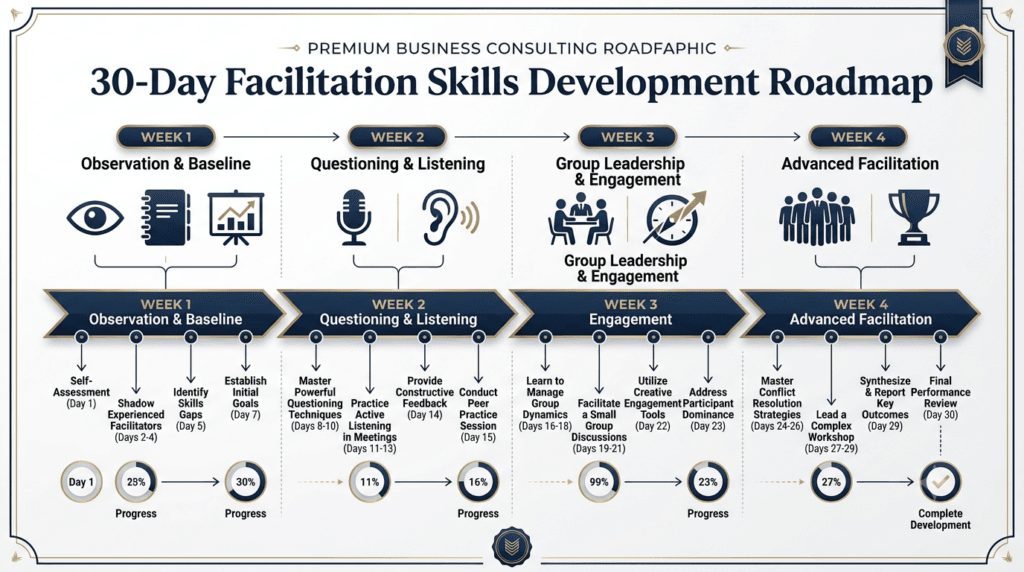
Week 1 — Observation and Baseline
| Week 1 Focus Before improving your facilitation, you need accurate data about your current practice. This week is about honest observation without intervention. |
- Day 1: Review your last three session evaluations. What patterns emerge?
- Day 2: Record a session with consent. Review it with the Tier 1 section of the checklist.
- Day 3: Observe a colleague facilitate. Note three specific things they do that you do not currently do.
- Day 4: Interview three recent participants about what supported and what hindered their learning.
- Day 5: Write a one-page honest self-assessment against all four tiers of the Framework.
Weekend: Identify your top two development priorities based on the week’s evidence.
Week 2 — Foundation: Questioning and Listening
| Week 2 Focus Powerful questioning and active listening are the single highest-leverage facilitation skills. One week of deliberate practice transforms the quality of room conversation. |
- Day 8: Write ten open questions for your next session. Categorise them by purpose.
- Day 9: Practise the five-second wait after questions in a low-stakes meeting.
- Day 10: Facilitate a 30-minute session using only questions. No statements or mini-lectures.
- Day 11: Debrief one activity using only probing questions: ‘What else?’, ‘Can you say more?’, ‘What was behind that?’
- Day 12: Practise reframing closed questions as open ones. Write ten examples.
- Weekend: Reflect on how your questioning changed the quality of participant contributions this week.
Week 3 — Group Leadership and Engagement Design
| Week 3 Focus This week, experiment with facilitation techniques and engagement designs you have never used or rarely use. The goal is to expand your toolkit. |
- Day 15: Run a Think-Pair-Share in a session you would normally have run as open group discussion.
- Day 16: Use a live poll as the opening activity of a session.
- Day 17: Design and run a peer learning activity. Resist adding your own commentary at the end.
- Day 18: Run a structured silent reflection activity before a group discussion.
- Day 19: Identify the two participants who contribute least in your sessions. Design a specific strategy for each.
- Weekend: Which technique generated the richest thinking? Why?
Week 4 — Advanced Facilitation
| Week 4 Focus Integration and challenge. This week you will practise managing difficult dynamics, adapting under pressure, and facilitating without your usual safety structures. |
- Day 22: Deliberately create productive conflict using a devil’s advocate question. Practise managing it to insight.
- Day 23: Facilitate a session without any slides. Questions, activities, and conversation only.
- Day 24: Practise named facilitation moves: redirect a dominator, invite a silent participant, name a tension.
- Day 25: Co-facilitate with a colleague. Debrief each other’s facilitation choices explicitly.
- Day 26: Facilitate in virtual mode using three digital engagement tools you haven’t used before.
- Weekend: Repeat the self-assessment checklist. What has changed?
Conclusion
Great content does not create great learning. Facilitation does.
You can have the most meticulously designed programme in your portfolio — built on solid TNA data, mapped to Kirkpatrick Level 4, with learning objectives that would make Bloom proud — and weak facilitation will hollow it out. The reverse is equally true: a skilled facilitator can take reasonably good material and produce genuinely transformative learning experiences. The room responds to the person holding the space, not the slide deck behind them.
A few things worth carrying forward from this guide:
- The debrief is the learning. Every time you cut it short, you cut the learning short.
- Difficult participants are your best diagnosticians. Listen to what they are signalling before you manage the behaviour.
- Experience only compounds if you review it. Record your sessions. Watch them back. Use the self-assessment checklist in Section 13 after every programme you deliver.
- And remember: facilitation is a craft, not a personality type. What separates exceptional facilitators from average ones is not charisma or extroversion — it is staying genuinely curious about the people in the room, and consistently more interested in their thinking than in demonstrating your own.
That curiosity is the thing no framework can give you. But if you have it, every skill in this guide is learnable.
The next step is yours: open the 30-day plan, run the self-assessment, and take one deliberate action in your next session that you would not have taken before reading this.
Download: The TrainerCentric™ Facilitation Skills Toolkit
Everything in this guide — the Framework, the scripts, the checklists, the development plan — only gets you so far on a page.
The TrainerCentric™ Facilitation Skills Toolkit is the practitioner’s companion: a set of five premium resources designed for corporate trainers who want to move from reading about facilitation to applying it under pressure.
Frequently Asked Questions
What are facilitation skills?
Facilitation skills are the competencies that enable a trainer or group leader to guide participants through a learning or problem-solving process in a way that maximises their active engagement, thinking, and insight. Core facilitation skills include active listening, powerful questioning, managing group dynamics, creating psychological safety, designing effective debriefs, and adapting in real time.
What is the difference between facilitation and presentation?
Presentation is primarily about transmitting information from an expert to an audience. Facilitation is about creating conditions in which participants actively construct their own learning through discussion, reflection, practice, and collaboration. A skilled corporate trainer knows when to present and when to facilitate, and can move between the two within a single session.
How do corporate trainers improve facilitation skills?
The most effective route is structured practice with honest feedback: recording and reviewing your own sessions, observing skilled facilitators, seeking genuine post-session input from participants, and working through a deliberate development plan. The 30-day programme in Section 14 provides a structured starting point.
What are examples of facilitation techniques?
Common techniques include Think-Pair-Share, case study analysis, live polling, fishbowl discussions, World Café rotations, structured role plays, peer learning activities, breakout groups, and What-So What-Now What debriefs. The choice of technique should always be driven by the learning objective and the group’s profile.
What is the most important facilitation skill?
Active listening is the foundation of everything else. Without genuine listening, questioning becomes interrogation, group dynamics management becomes control, and emotional intelligence becomes performance. Trainers who invest in developing their listening first tend to see the fastest overall improvement in facilitation quality.
How do you handle difficult participants in training?
The most effective approach is to respond to the need behind the behaviour, not just the behaviour itself. Dominant participants typically need acknowledgement. Silent participants need safety. Challengers need to feel their critical thinking is respected. Practical scripts for each participant type are covered above.
What facilitation skills are needed for virtual training?
Virtual facilitation requires redesigning every technique from the ground up for the medium. Key skills include managing camera engagement, using digital participation tools (polls, whiteboards, breakout rooms, chat waterfall), designing for reduced attention spans (maximum 90-minute blocks with activity every 7–10 minutes), and building psychological safety in an environment with fewer social cues.
What are facilitation interview questions?
Strong facilitation interview questions explore real situations rather than theoretical knowledge. Examples: ‘Tell me about the most difficult group dynamic you have ever managed in a training session,’ ‘Describe a session where you completely abandoned the agenda,’ ‘How do you establish psychological safety with a new group in fifteen minutes?’
What certifications exist for facilitation skills?
The most recognised global certification is the Certified Professional Facilitator (CPF) from the International Association of Facilitators (IAF). The ATD’s CPTD is relevant for broader L&D credentialing. CIPD qualifications are standard in UK and European corporate environments.
Can facilitation skills be learned?
Yes. While natural aptitude in areas like communication or emotional intelligence helps, every component of the facilitation skill set is learnable through deliberate practice, honest feedback, and structured reflection. The TrainerCentric Facilitation Skills Framework™ provides a sequenced learning path that prevents the common mistake of trying to develop advanced skills before the foundations are solid.
Key Takeaways
| Key Lesson | Practical Implication |
| Facilitation is not the same as presenting | Design sessions around participant thinking, not content delivery |
| The TrainerCentric Framework gives you a sequence | Build Tier 1 before Tier 2, Tier 2 before Tier 3. Don’t try to run before the foundations are solid. |
| Active listening is the foundation | Invest here first. Everything else builds on it. |
| Debriefing is where learning happens | Protect it fiercely. An activity without a debrief is entertainment, not training. |
| Difficult participants are communicating a need | Respond to the need, not the behaviour. Scripts exist for every type. |
| Virtual facilitation is a distinct skill set | Redesign every technique for the medium. Don’t translate face-to-face approaches. |
| Facilitation drives learning transfer | Kirkpatrick Levels 3 and 4 are directly linked to facilitation quality, not just content quality. |
| Adaptability is a professional discipline | Have a Plan B for every module. Know your outcomes better than your plan. |
| Interview questions reveal real competence | Test for real situations, not theoretical knowledge. See Section 11. |
| 30 days of deliberate practice will move you forward | Use the development plan in Section 14. Track progress with the checklist in Section 13. |
Build Your Complete L&D Toolkit
- Training Needs Analysis
- Job Task Analysis
- The ADDIE Model
- Writing Learning Objectives
- The Kirkpatrick Model
- Adult Learning Theory
- When Training Is NOT the Answer
- How to Handle Difficult Participants in Training
- 8 Icebreakers That Actually Work in Corporate Training
- How to Facilitate Training Without Being An Expert
- How to Design a Learning Programme From Scratch: A Step-by-Step Guide
References
- The Skilled Facilitator || Roger Schwarz
- Facilitator’s Guide to Participatory Decision-Making || Sam Kaner
- The Surprising Science of Meetings || Steven Rogelberg
- Make It Stick: The Science of Successful Learning || Peter C. Brown, Henry L. Roediger III, and Mark A. McDaniel
- Training from the BACK of the Room! || Sharon Bowman
- The Fearless Organization || Amy Edmondson
Author Details

Tulip Ghosh is a Learning and Development professional who designs impactful, learner-centric experiences rooted in behavioral insight and real-world application. She is passionate about improving learner engagement and translating complex ideas into practical training solutions. A thoughtful writer at heart and with experience of a decade in Learning and Development domain, she brings a simple, grounded perspective to the evolving world of workplace learning. Reach out to her on her Linkedin Profile from here.