Introducing the TrainerCentric A-GCAP Framework™
Learning how to conduct a training needs analysis means knowing exactly where to focus your L&D investment before a single slide is built or a course is bought. Done well, a TNA ensures every training programme solves a real business problem — and links directly to measurable organisational outcomes. Done poorly — or skipped entirely — you end up with training that people sit through but never apply.
Here is the uncomfortable truth: most training fails not because of poor delivery, but because the diagnosis came last. Organisations jump straight to solutions — a new e-learning module, a leadership workshop, a coaching programme — without stopping to ask whether training is even the right answer.
This article gives you a practical training needs analysis framework for beginners and experienced L&D professionals alike, structured around our proprietary TrainerCentric A-GCAP Framework™. You will learn how to conduct a training needs analysis step by step, using a real example woven through each stage. By the end, you will have everything you need to run your own TNA with confidence.
The TrainerCentric A-GCAP Framework™
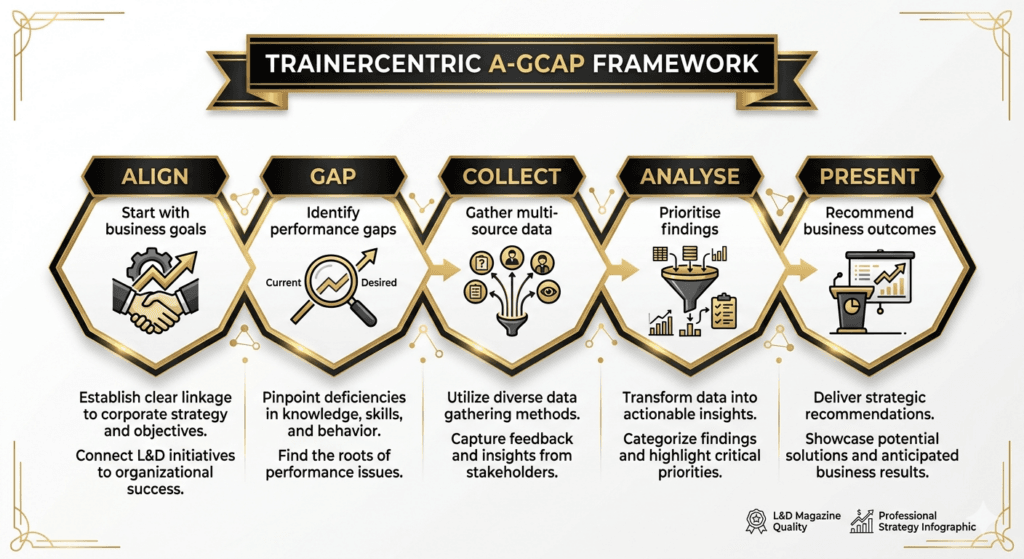
We created the A-GCAP Framework™ after noticing that most TNA models focus heavily on data collection but fail to maintain business alignment throughout the process. The result is L&D teams who gather excellent data and then drift into training solutions that were never properly connected to a business outcome. A-GCAP is designed to close that gap — giving you a repeatable, evidence-based structure that keeps every decision anchored to organisational impact.
| A | G | C | A | P |
| Align | Gap | Collect | Analyse | Present |
| Start with the business goal | Find the performance gap | Gather multi-source data | Prioritise findings | Frame as business outcomes |
Each stage feeds into the next with clear evidence. Align → Gap → Collect → Analyse → Present. Skip a stage and the entire chain weakens.
What Is a Training Needs Analysis?
A Training Needs Analysis (TNA) is a structured process for identifying the gap between current performance and desired performance, and determining whether training is the right intervention to close it. It sits at the heart of any evidence-based L&D strategy and connects directly to concepts such as competency mapping, performance analysis, and organisational development.
TNA is distinct from, though closely related to, skills gap analysis, job analysis, root cause analysis, and learning objectives design. Together, these form the diagnostic toolkit of any effective L&D function. For a deeper dive into the concept and its relationship to ADDIE and the Kirkpatrick Model, read our complete guide to TNA — this article focuses specifically on the five-step A-GCAP process.
In many organisations, competency frameworks provide the benchmark against which performance gaps are measured during a TNA. A competency framework defines the skills, knowledge, and behaviours required for effective performance in a given role or function. When used as a reference point during the Gap stage (Step 2), it allows L&D professionals to move from vague impressions of underperformance to a structured, measurable comparison between what is required and what is currently demonstrated. If your organisation already has competency frameworks in place, they should be one of your first inputs.
Step 1 — Align: Start With Business Goals
Every TNA must start with a business problem, not a training request. Before you conduct a training needs analysis, you need to ask: what specific outcome does the organisation need to improve? Skip this step and you risk spending your entire budget on training that has zero measurable impact.
Start by meeting with senior stakeholders to identify the business challenge. Use clear, measurable language. ‘We want better communication’ is not a business problem. ‘Sales conversion has dropped 15% in two consecutive quarters’ is.
Once you have the business problem, you can ask a far more useful question: is this a performance problem, and is training the right solution? Often the root cause is a broken process, unclear expectations, or a lack of resources — none of which training can fix. This is where a basic root cause analysis mindset is essential before moving forward.
Example: A regional sales manager reports that conversion rates have dropped by 15% over the past two quarters. Before deciding on a sales training programme, your job is to find out whether the team lacks the skills (a training issue), lacks the motivation (a management issue), or is working with an outdated CRM system (a process issue). Align with business goals first, and every subsequent step becomes sharper.
| ✅ Key Takeaway: Always start with the business problem, not the training solution. Alignment at Step 1 prevents wasted investment at every step that follows. |
Step 2 — Gap: Identify Performance Gaps
Once you know the business goal, you need to identify the gap between where people are now and where they need to be. This is the heart of the training needs analysis process — and it is where most TNA efforts go wrong.
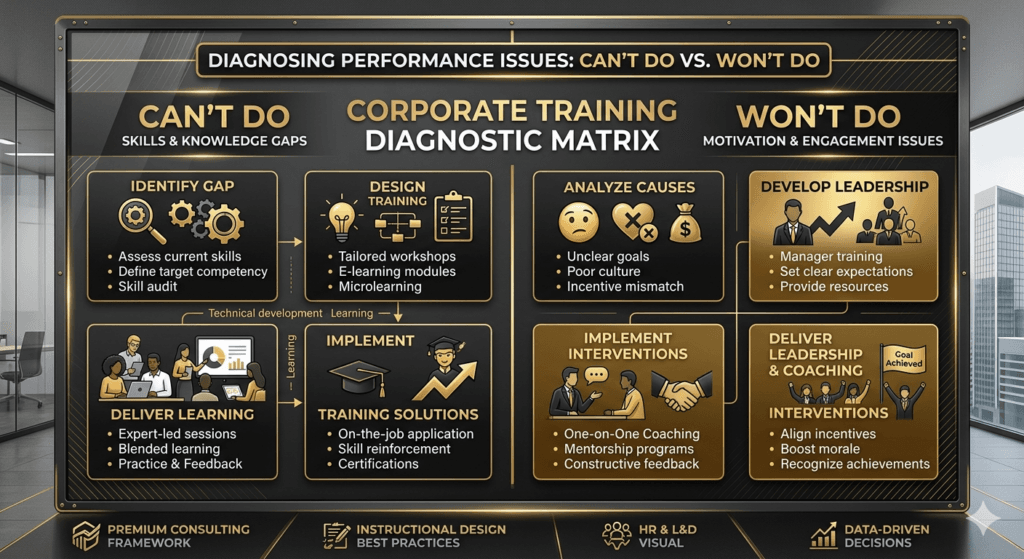
The critical distinction here is between ‘can’t do’ and ‘won’t do’. A skills gap (can’t do) calls for training. A motivation or attitude gap (won’t do) calls for a different intervention entirely — better management, clearer incentives, or a culture change. Confusing the two is one of the most expensive mistakes in L&D.
When thinking about how to do training needs analysis for employees, you must gather perspectives from multiple levels — not just managers. Talk to the employees themselves. Ask what gets in the way of doing their job well. Competency mapping at this stage can help you articulate the difference between what the role requires and what individuals currently demonstrate. If your organisation uses a competency framework, cross-reference it here to validate what you are hearing in the data.
| ✅ Key Takeaway: Distinguish between ‘can’t do’ (skill gap) and ‘won’t do’ (motivation/management gap) before recommending any training solution. |
Step 3 — Collect: Choose Your Data Collection Methods
The training needs analysis methodology you choose will shape the quality and credibility of your findings. No single method gives you the full picture — triangulate across at least two or three sources to build a robust evidence base. According to CIPD’s Learning at Work research, multi-source data collection is a defining hallmark of effective needs analysis practice.
Performance Data Analysis
Before you design a survey or book a single interview, check what the data is already telling you. Existing performance metrics — KPI dashboards, quality scores, call recordings, sales reports, error logs, customer satisfaction data, and LMS assessment results — are often the richest and most underused source of evidence in a TNA. Many L&D teams skip this step and go straight to active data collection, then discover three weeks later that the answer was sitting in a report the business already owned.
The key advantage of performance data is that it is collected without observer effect. People are behaving exactly as they would in normal working conditions, and the numbers reflect real outcomes rather than recalled impressions. A sustained dip in CSAT scores, a pattern in conversion data, or a spike in errors at a particular stage of a process will often surface your gap hypothesis faster than any active data collection method.
Use performance data early — ideally as your first Collect activity — to sharpen your hypothesis before you design your surveys or interview guides. If call recordings already reveal that agents consistently struggle at a specific moment in a customer interaction, you can build your subsequent questions around that specific behaviour rather than starting from a blank canvas.
If your organisation has recently completed a competency mapping exercise, that data belongs here too. Competency assessments give you a structured, role-level benchmark against which current performance can be compared — and they feed directly into the gap identification you began in Step 2.
Useful sources to review: call monitoring reports, sales conversion dashboards, quality assurance scores, customer satisfaction data, LMS completion and assessment records, 360-degree appraisal outputs, and any existing competency framework assessments.
Surveys
Surveys are efficient for gathering data from large groups quickly. They work best when you already have a hypothesis about the gap and want to test it at scale. Keep them short — 10 questions maximum — and use a mix of rating scales and open-text fields.
Interviews and Focus Groups
One-to-one interviews and focus groups give you depth that surveys cannot. They surface the ‘why’ behind the data and often reveal systemic issues no one has put on record. See our detailed guide to running focus groups and interviews for TNA for question frameworks and facilitation tips.
Observation
Watching people do their jobs in context is one of the most underused TNA methods. Sit with a salesperson on a call. Shadow a team leader in a morning briefing. You will see things that no survey will ever surface. This is particularly valuable for roles with specific technical requirements, where job analysis helps map exactly what competencies the role demands.
Job Task Analysis
For roles with specific technical requirements, a job task analysis helps you map exactly what competencies the role demands versus what the individual currently demonstrates. ATD research consistently shows that observation combined with job task analysis produces more accurate skills gap identification than self-report alone.
Example: For the sales team, after reviewing six months of conversion data and three recorded calls, you run a short survey (15 respondents), two 30-minute interviews with top and bottom performers, and observe three client calls. All three methods point to the same gap: handling price objections confidently.
| ✅ Key Takeaway: Use at least two data collection methods. Surveys alone rarely tell the full story — combine them with interviews or observation for reliable findings. |
Step 4 — Analyse: Prioritise Needs
Data gathered, you now need to make sense of it. Most TNAs surface more needs than you can realistically address in one programme — prioritisation is not optional, it is essential.
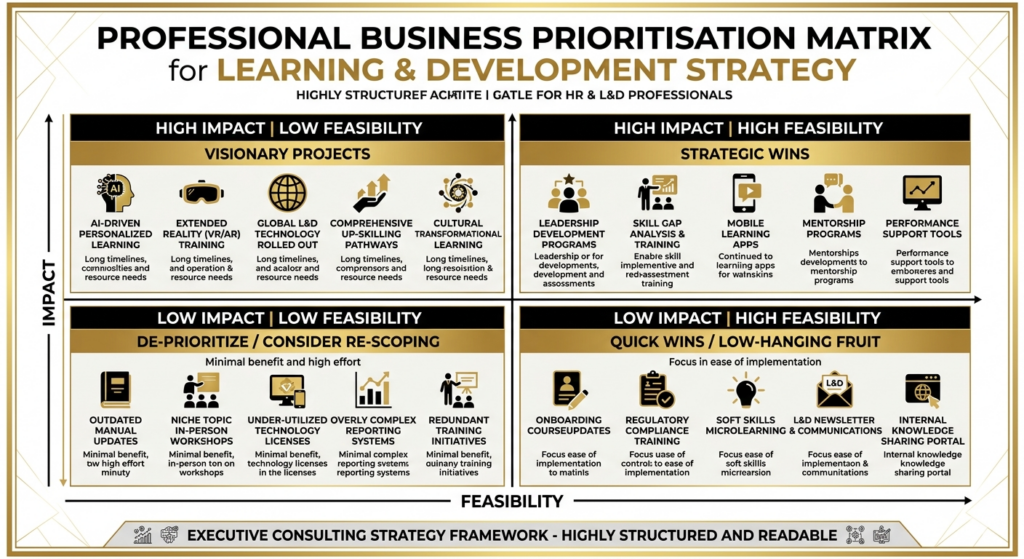
The most practical tool here is a simple 2×2 matrix. Plot each identified need on two axes: business impact (high to low) and feasibility (easy to difficult to address). Needs that fall in the high-impact, high-feasibility quadrant are your immediate priorities. Needs that are high-impact but difficult to address belong in your medium-term plan.
This step also requires you to be honest about what is actually a training issue versus a systemic one. If a need keeps appearing across different data sources but is rooted in a process failure, flag it as an organisational recommendation — not a training deliverable. SHRM’s research on performance improvement consistently supports separating training interventions from structural or management-level fixes.
When defining learning objectives at this stage, use precise, observable language. Vague objectives produce vague outcomes. ‘Participants will be able to handle price objections using a three-step framework’ is measurable. ‘Participants will improve communication’ is not.
Example: Your analysis identifies three needs: objection-handling skills, CRM system proficiency, and team confidence with pricing strategy. The first two score high on both impact and feasibility. The third surfaces as a management communication issue — it belongs in a separate recommendation, not a training programme.
| ✅ Key Takeaway: Use an impact vs. feasibility matrix to prioritise needs. Not every finding belongs in a training programme — some require systemic or management-level solutions. |
Step 5 — Present: Present Findings and Recommendations
The final step is where many L&D professionals lose momentum. They produce a thorough report, send it to stakeholders, and wonder why nothing happens. The mistake is presenting training activities instead of business outcomes.
Senior stakeholders do not care about the number of learning hours or the delivery format. They care about what will change as a result of the investment — reduced errors, faster onboarding, improved conversion rates, lower attrition. Frame every recommendation in those terms.
Structure your findings around three things: the business problem you set out to solve, the evidence you gathered, and the specific recommendations (with expected outcomes and costs). If you are referencing the Kirkpatrick Model, frame your measurement plan across all four levels — reaction, learning, behaviour, and results — to give your recommendations credibility and rigour.
Example: Your recommendation states: ‘A targeted objection-handling programme for the sales team (6 hours, blended delivery) is projected to recover 8–10% of conversion rate within two quarters, based on benchmarks from comparable interventions.’ That is a business case, not a training brief.
| ✅ Key Takeaway: Lead with business outcomes, not training activities. Stakeholders approve budgets when they see ROI, not learning hours. |
For a detailed guide and templates, see: How to Present the TNA results to the Senior Stakeholders.
When You Should NOT Conduct a Full TNA
Most TNA guides tell you when and how to run one. Fewer explain when a full TNA would be disproportionate — or simply wrong for the situation. Knowing when to skip a full process is as important as knowing how to run one.
There are specific circumstances where committing to a comprehensive A-GCAP process would consume more time and resource than the situation warrants:
| ⚠️ A full TNA is designed for diagnosing genuine performance gaps where the cause is unclear. In the scenarios below, the cause is already known — and speed matters more than diagnosis. |
- Urgent compliance changes. If a regulator has mandated a specific training intervention by a fixed date, the business problem is defined, the solution is prescribed, and there is no diagnostic stage to run. Deploy, document, and measure completion.
- Mandatory regulatory updates. When legislation changes (data protection, health and safety, financial regulation), the gap is legal non-compliance. The training need is obvious. A full TNA would delay delivery without adding analytical value.
- Obvious skill deficiencies with a clear cause. If a team has just adopted new software and cannot use it, the gap is unambiguous and the solution is a product training programme. Observation and stakeholder interviews are unnecessary — go straight to design.
- One-off induction or onboarding programmes. New starters need structured onboarding regardless of performance data. The need is structural, not diagnostic. A TNA adds process overhead without altering the answer.
In each of these situations, the right move is a proportionate needs check — not a full five-stage TNA. Confirm the scope, confirm the audience, and proceed. Save the rigorous diagnostic process for situations where the cause of underperformance is genuinely unclear and a wrong diagnosis would be costly.
TNA Template Preview
One of the most requested tools from L&D professionals using the A-GCAP Framework™ is a working template they can adapt immediately. Below is a partial preview of the TrainerCentric TNA Template. Each row maps a business goal through to a specific recommendation.
| Business Goal | Performance Gap | Data Source | Root Cause | Recommendation |
| Improve sales conversion by 15% | Objection handling in final stage | Call observation + interviews | Skill gap (can’t do) | Targeted objection-handling workshop |
| Reduce customer complaints by 20% | De-escalation during charged calls | Call recordings + focus groups | Skill + confidence gap | Blended de-escalation programme |
| Cut onboarding time by 30% | Product knowledge gaps at 90 days | Performance scores + surveys | Knowledge gap | Structured onboarding pathway |
This structure keeps every recommendation anchored to a business goal and a verified data source — making it far easier to defend your recommendations to senior stakeholders. Download the full TNA template for the complete version including a prioritisation matrix and stakeholder sign-off section. If you need just the TNA template , please scroll down.
Training Needs Analysis Example — A Complete Walkthrough
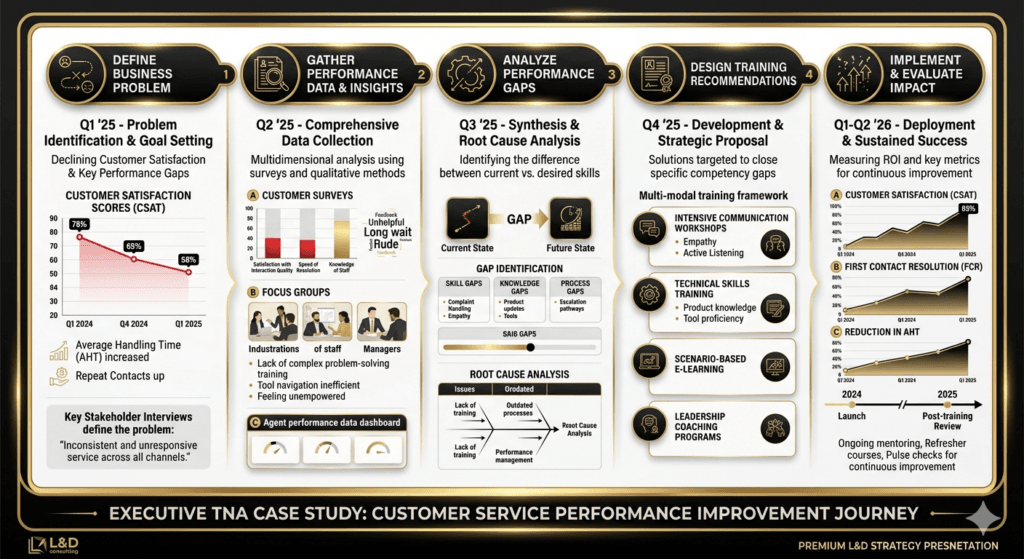
Here is a training needs analysis example using a mid-sized company with a 40-person customer service team. Customer satisfaction (CSAT) scores have dropped from 82% to 71% over six months. The Head of Operations has submitted a request for customer service training. Here is how the A-GCAP Framework™ unfolds:
- Align: The business goal is to return CSAT to 80%+ within two quarters. The TNA begins by defining what ‘good’ looks like and what KPIs will measure success.
- Gap: Call monitoring data reveals that agents consistently struggle with de-escalation during emotionally charged interactions. Surveys show agents feel under-prepared, not under-motivated — a clear ‘can’t do’ gap.
- Collect: Three focus groups (agents), one-to-one interviews with six team leaders, and analysis of 50 recorded calls across high and low performers.
- Analyse: Two priority gaps emerge — de-escalation language and empathy-led responses. A third gap (product knowledge) is low-impact relative to the CSAT issue and is deferred to the next cycle.
- Present: The L&D recommendation includes a four-hour blended workshop on de-escalation and empathy skills, with a projected CSAT recovery of 8–12 percentage points within 60 days, supported by a 90-day manager coaching cadence.
That is the complete training needs analysis process in action — from business problem to actionable recommendation.
Common TNA Findings From the Field
A recurring pattern emerges consistently across TNA work in corporate environments. The following observations are shared not as universal rules, but as field findings that may help you frame your own diagnostic process more sharply.
1. The training request rarely matches the actual need. In the majority of TNAs, the initial request from a business stakeholder points to a training solution that turns out to be either the wrong format, the wrong scope, or the wrong intervention entirely. The request for ‘leadership development’ frequently reveals a management communication problem at team level. The request for ‘sales training’ often uncovers a CRM or process issue. The TNA exists to surface this gap between the stated request and the actual need.
2. The motivation gap is almost always misread as a skills gap. Another common finding: when managers interpret low performance as a skill deficit, the real barrier is often unclear expectations, inconsistent feedback, or low psychological safety. Training cannot fix those things. A well-structured TNA surfaces this distinction before any budget is committed.
3. Data collection is treated as the end, not the beginning. In practice, many L&D teams conduct surveys, compile results, and present findings without a structured analysis stage. The data collection is thorough; the sense-making is rushed. The prioritisation matrix in Step 4 of the A-GCAP Framework™ exists specifically to address this.
Training Needs Analysis vs Skills Gap Analysis
These two terms are frequently used interchangeably, but they serve different purposes. Understanding the distinction will help you select the right approach for the right situation — and make a more credible case to stakeholders for the methodology you choose.
| Training Needs Analysis (TNA) | Skills Gap Analysis | |
| Focus | Business goals → performance gaps → training decisions | Current competencies vs. required competencies |
| Scope | Specific performance problem or L&D programme | Entire workforce or job family |
| Output | Targeted training recommendation with business case | Competency map with development priorities |
| Trigger | Business problem, performance drop, new initiative | Strategic workforce planning, role redesign |
| Best used when | You need to diagnose a specific performance issue | You need a broader picture of organisational capability |
In practice, a TNA often begins with a skills gap analysis as one of its inputs — particularly during Step 2 (Gap) of the A-GCAP Framework™. But the two are not substitutes. A skills gap analysis tells you what is missing; a TNA tells you what to do about it.
For a more detailed breakdown of how these two tools interact, read our article: Skills Gap Analysis vs Training Needs Analysis.
Training Needs Analysis Best Practices
Whether you are running your first TNA or your fiftieth, these training needs analysis best practices will keep your process on track:
- Involve stakeholders from the start — do not present findings to people who were never part of the conversation. Buy-in begins at Step 1, not at the presentation.
- Triangulate your data — never rely on a single source. One survey or one manager’s opinion is not evidence; three converging sources are.
- Never skip Step 1 — business alignment is not optional. Without it, you have no way to measure whether the training worked.
- Separate the problem from the solution — your job at this stage is diagnosis, not prescription. Avoid pre-deciding on a solution before the evidence is gathered.
- Include the learner’s voice — employees often know exactly what is getting in the way of their performance. Ask them.
- Keep it proportionate — a TNA for a team of 20 does not need to take three months. Scale your methodology to the complexity and risk of the decision.
- Document your process — a well-documented TNA makes it easier to defend your recommendations, repeat the process next year, and demonstrate the value of the L&D function.
Common Mistakes to Avoid
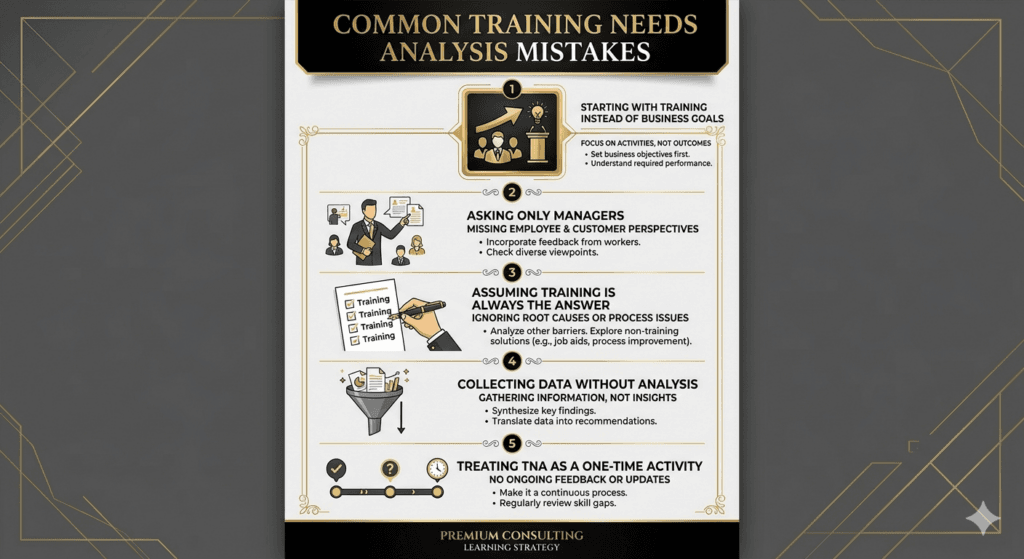
- Skipping Step 1 — starting with a training solution rather than a business problem is the single most common and most costly TNA mistake.
- Asking only managers — managers provide valuable perspective, but they also have blind spots. Missing the voice of frontline employees often means missing the real barriers to performance.
- Assuming training is always the answer — sometimes the issue is a broken process, a lack of resources, or unclear expectations. Read our article on when training is NOT the answer
- Treating TNA as a one-off activity — performance gaps evolve. Build a rhythm of continuous needs analysis into your L&D calendar rather than running a TNA only when something goes wrong.
- Collecting data but not analysing it — gathering surveys and interviews is worthless without a structured approach to sense-making. Reserve time to do the analysis properly.
| 📋 Free TNA Template & Checklist: Ready to run your own TNA? Download our free TNA template to document each step of the A-GCAP Framework™, and use our TNA checklist to make sure nothing gets missed. Both tools are designed to be practical and printable — not just pretty documents. |
Conclusion
A rigorous training needs analysis is not a bureaucratic hurdle — it is the difference between training that makes a measurable difference and training that gets forgotten the moment the session ends.
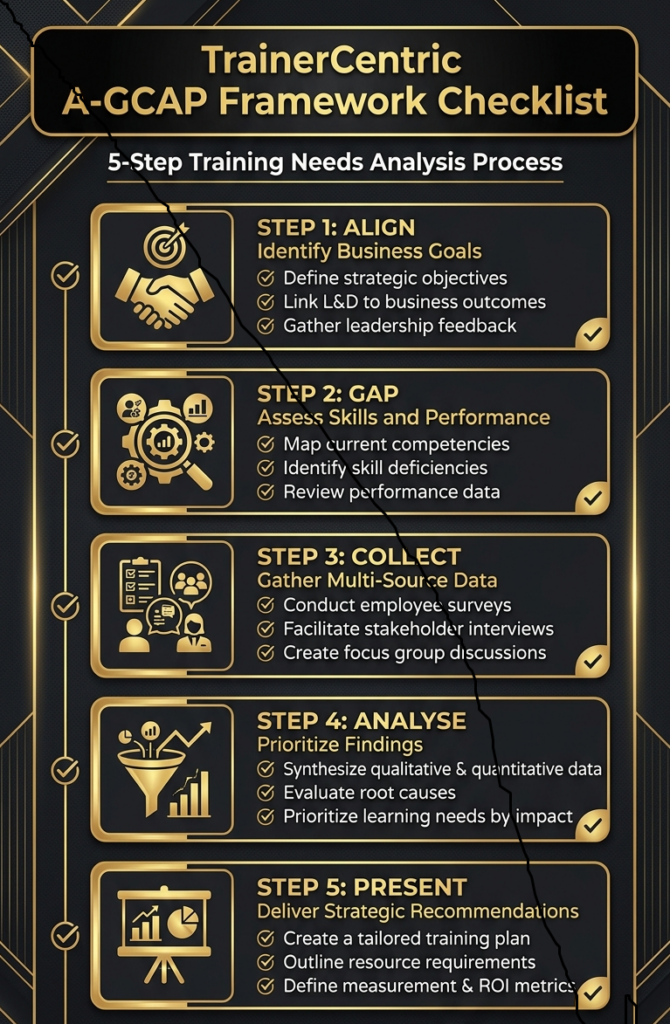
To recap the TrainerCentric A-GCAP Framework™: Align with business goals, identify performance Gaps, Collect data from multiple sources, Analyse and prioritise using an impact matrix, and Present findings tied to business outcomes. That is the complete training needs analysis process — simple in structure, powerful in practice.
Now that you know how to conduct a training needs analysis step by step, the next move is to put it into action. Start with the business problem on your desk right now. Then follow the five steps. If you want to go deeper, read The Ultimate Guide to Training Needs Analysis — or download the free template and checklist to get started today.
Frequently Asked Questions
What are the 5 steps of a training needs analysis?
The five steps of a training needs analysis, as structured by the TrainerCentric A-GCAP Framework™, are: (1) Align — connect to a specific business goal; (2) Gap — identify the performance gap and distinguish between skill and motivation issues; (3) Collect — gather data from multiple sources including surveys, interviews, and observation; (4) Analyse — prioritise findings using an impact vs. feasibility matrix; and (5) Present — frame recommendations in terms of business outcomes, not training activities.
What methods are used in training needs analysis?
The most common TNA data collection methods include surveys, one-to-one interviews, focus groups, observation, performance data analysis, job task analysis, and competency mapping. The most effective TNAs use at least two or three methods in combination. ATD research confirms that multi-source data collection produces more accurate and defensible findings than any single method alone.
What is the difference between skills gap analysis and training needs analysis?
A skills gap analysis identifies the difference between the competencies a role requires and what an individual or team currently demonstrates. A training needs analysis is broader: it starts with a business problem, uses skills gap analysis as one of its inputs, and produces a specific recommendation for whether — and how — training should be used to close the gap. See our comparison table above for a detailed breakdown.
Who should conduct a TNA?
A TNA is typically conducted by an L&D professional, HR business partner, or external consultant. For larger organisations, a dedicated L&D team will lead the process in collaboration with line managers and senior stakeholders. For smaller businesses, a single HR professional or even an informed line manager can run a proportionate TNA using the five-step framework. The key is ensuring that whoever leads the process has no vested interest in a particular training solution before the data is gathered.
How long does a TNA take?
This depends on the scope and complexity of the performance issue. A focused TNA for a single team addressing one specific problem can be completed in one to two weeks. A broader TNA covering an entire department or business function may take four to eight weeks. Organisation-wide TNAs linked to strategic workforce planning can take several months. The principle is proportionality: the depth of the process should match the risk and investment associated with the decision.
Is training needs analysis part of ADDIE?
Yes — TNA is closely aligned with the first phase of the ADDIE instructional design framework. ADDIE stands for Analysis, Design, Development, Implementation, and Evaluation. The Analysis phase of ADDIE encompasses much of what a TNA does — identifying the performance problem, understanding the audience, and defining the learning objectives before any content is built. The A-GCAP Framework™ operates at this Analysis stage but goes further by explicitly maintaining business alignment throughout, rather than treating analysis as a preliminary box to tick. For a full breakdown of how TNA and ADDIE relate, read our guide to the ADDIE Instructional Design Framework.
Related Reading
- Training Needs Analysis: The Complete Guide for L&D Professionals
- The 3 Levels of Training Needs Analysis: Organisation, Task & Person Analysis
- Skills Gap Analysis vs Training Needs Analysis
- Job Task Analysis: A Step-by-Step Guide
- How to Present TNA Results to Senior Stakeholders
- ADDIE Instructional Design Framework
- Training Needs Analysis Template: 1 Free Download for L&D Teams
- Focus Groups and Interviews for Training Needs Assessment: A Practical Field Guide
- Training Needs Analysis Questionnaire: Complete Guide (75 Questions & Free Template)
References
- The Six Disciplines of Breakthrough Learning || Calhoun Wick, Roy Pollock & Andrew Jefferson
- Telling Ain’t Training || Harold Stolovitch & Erica Keeps
- Performance Consulting || Dana Gaines Robinson & James C. Robinson
- Evaluating Training Programs: The Four Levels || Donald Kirkpatrick & James Kirkpatrick
- Design for How People Learn || Julie Dirksen
Author Details

Anupama Mitra is a learning experience designer, writer and facilitator with a deep interest in how people learn, adapt and grow at work. With over a decade of experience in corporate learning and development, she specializes in simplifying complex ideas into practical, actionable insights.
Her work focuses on leadership development, behavioral changes, making workplace learning more human and engaging. You can reach out to her at anupama@trainercentric.com