A practitioner’s guide to what an LXP actually does, how it differs from an LMS, and how to decide if your organisation needs one.
Your employees already live with AI-powered recommendations every day. Netflix knows what they’ll watch next. Spotify builds their playlists. Amazon predicts what they’ll buy before they’ve searched for it. Then they log into the company LMS and are greeted by a static tile called “Mandatory Leadership Module v4,” last updated two years ago, assigned to everyone in their band regardless of what they already know.
That contrast is the entire reason the Learning Experience Platform category exists. Consumer software trained employees to expect content to find them. Most corporate learning systems still work the other way around: someone assigns a course, and the employee is expected to want it.
The gap this creates is not a minor UX complaint. Employers now expect roughly two out of every five core skills their workforce holds to change by 2030, and a majority already named skills gaps as the single biggest barrier to executing their business strategy.
A Learning Experience Platform is one response to that pressure. It is not a replacement for governance, and it is not a shortcut around building a real learning strategy. It’s a layer that changes how content is discovered, recommended, and consumed. Whether that layer is worth the investment depends entirely on your organisation’s maturity, content library, and what problem you’re actually trying to solve — which is the question this article is built to help you answer, not a reason to buy software.
What Is a Learning Experience Platform (LXP)?
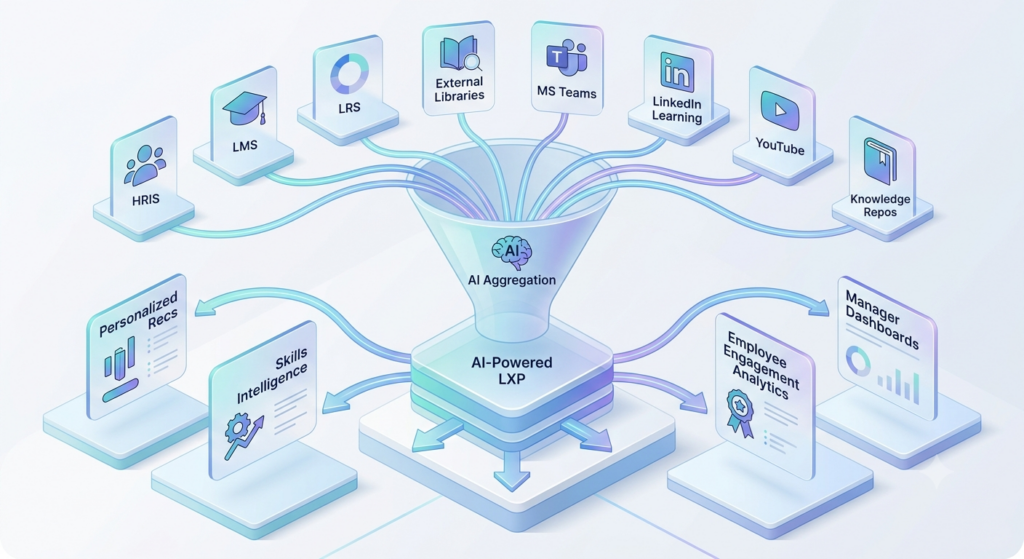
A Learning Experience Platform is learner-facing software that aggregates content from multiple sources — internal courses, videos, articles, podcasts, and external libraries — and uses data about a person’s role, skills, and behaviour to recommend what to learn next. Instead of assigning a fixed curriculum, it presents a personalized feed, closer in spirit to a streaming service than a training catalogue. In practice, it functions as an employee learning platform built around discovery rather than administration.
The category grew out of a genuine limitation in traditional LMS design. Learning management systems were built to administer training: assign courses, track completion, generate compliance records, and manage certifications. That’s an essential job, but it’s an administrative one. An LXP was built to solve a different job: getting people to actually engage with learning content by making it relevant, discoverable, and social.
It’s worth being precise here, because vendors have blurred the line deliberately. An LXP is not simply an LMS with a nicer interface, and it’s not just a content aggregator with a search bar. The defining characteristic is that recommendations are personalized and dynamic — the system changes what it surfaces based on what a learner does, not just what an administrator assigns.
Is “LXP” Still the Right Term?
Worth knowing before you shop: Fosway Group’s 2026 analysis of the learning systems market argues the LXP has effectively stopped existing as its own standalone category. Personalized recommendations and a clean learner interface, once genuine differentiators, are now baseline expectations built into most modern LMS and “learning system” suites. In practice, this means the more useful question in 2026 often isn’t “do we need an LXP,” but “does our current platform already do this, and are we simply not using that layer.”
In many organisations, that question surfaces something uncomfortable: the LMS already purchased has recommendation and content-aggregation features nobody switched on, because the initial rollout focused entirely on compliance. Before treating “buy an LXP” as the answer, it’s worth auditing what your existing stack can already do.
How Does an LXP Work?
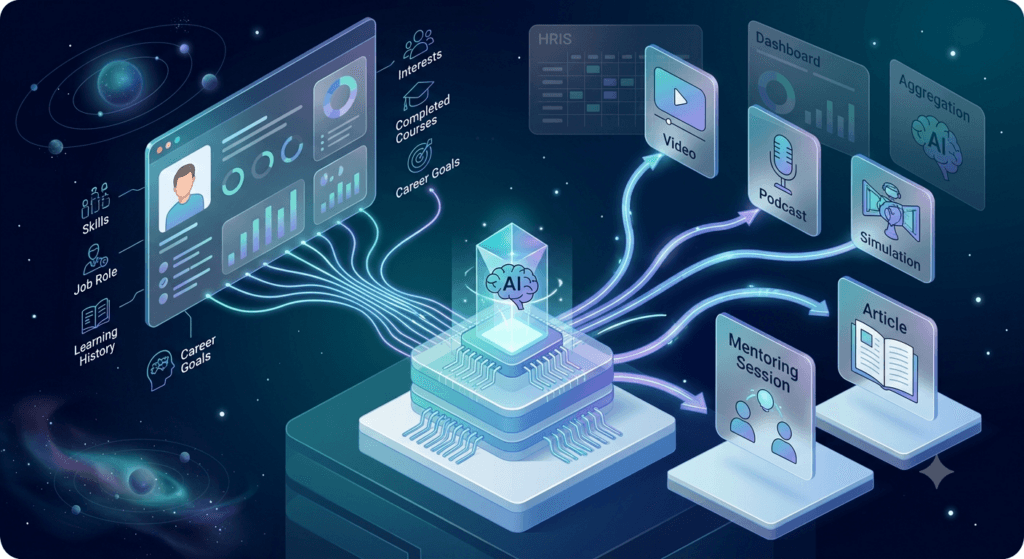
Underneath the polished interface, an Learning Experience Platform is running a handful of distinct mechanisms at once. Understanding them individually makes it much easier to evaluate whether a specific platform actually delivers on the category’s promise, or is just repackaging an LMS content catalogue.
AI Recommendations
The platform builds a profile from a learner’s role, stated interests, skills data, and consumption history, then recommends content the way a streaming service recommends shows.
| In Practice A newly promoted sales manager logs in for the first time. The system already knows she completed a coaching fundamentals course during onboarding. Without anyone assigning anything, it surfaces a short module on difficult conversations, a podcast episode on negotiation tactics, an article on delegation for first-time managers, and a checklist another regional manager built and shared last quarter. She didn’t search for any of it. That’s the moment an LXP earns its place — the recommendation engine noticed a role change and a completed prerequisite, and acted on both. |
One mistake I repeatedly see in early rollouts is treating this feature as “set it and forget it.” Recommendation quality depends entirely on the richness of the content tagged in the system. A platform with a thin, poorly tagged library will produce generic, forgettable suggestions no matter how sophisticated its underlying AI is. For a broader look at how AI is showing up across L&D beyond just recommendation engines, see: AI in L&D: What Corporate Trainers Need to Know Right Now.
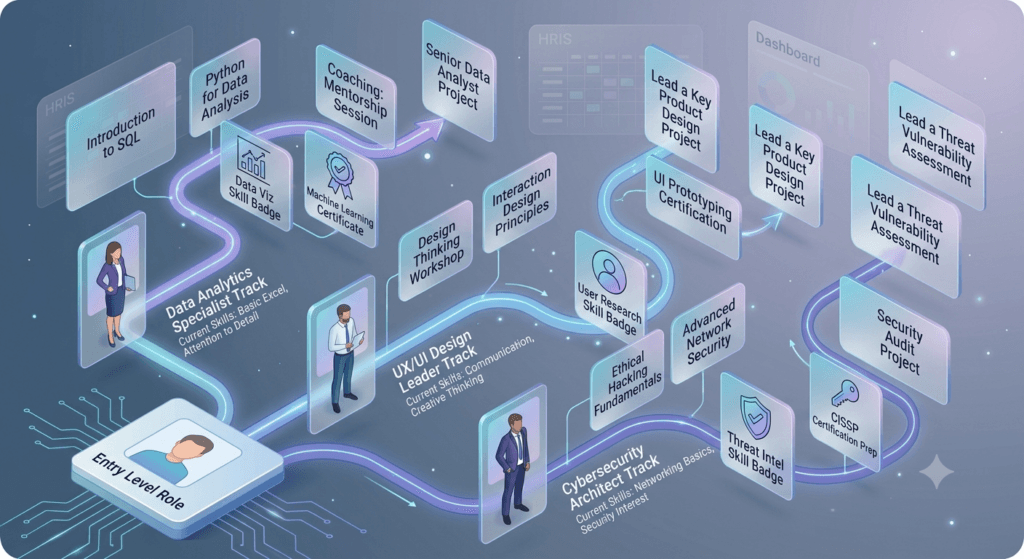
Personalized Learning Pathways
Rather than one curriculum for every job title, pathways adapt to a person’s existing skill level and career goals. Two people in the same role can see meaningfully different sequences of content based on what they’ve already demonstrated competence in.
User-Generated Content
Employees can upload their own videos, write short articles, or curate playlists of external resources for colleagues. A senior engineer’s fifteen-minute walkthrough of a tricky deployment process often gets more engagement than a polished, professionally produced module on the same topic.
Social Learning
Comments, ratings, discussion threads, and the ability to follow colleagues turn learning into something visible rather than solitary. People find content because a peer shared it, not because a training calendar told them to look.
Content Aggregation
One search bar pulls results from your internal LMS, a subscription library such as LinkedIn Learning, YouTube, internal documents, and podcasts. The learner isn’t expected to know which system holds which piece of content. Aggregation is only as good as the source material feeding it, which is why the tools used to author that content in the first place matter more than most buyers assume — see: How to Choose eLearning Authoring Tools: A Framework for L&D Teams.
Skills-Based Learning
Content is tagged against a skills taxonomy rather than just a course catalogue structure, so the system can answer “what should I learn to close this specific skill gap” instead of just “what course is next in the module sequence.” This is the layer most large organisations now care about more than the recommendation feed itself — it’s what turns an LXP from an engagement tool into a workforce-planning input. Building that taxonomy in the first place usually starts with the same groundwork used for a skills gap analysis: Competency Mapping vs Skills Gap Analysis
Standards Underneath an LXP: xAPI, LRS, and Skills Ontology
Worth knowing even at a glance, since vendors assume familiarity: xAPI (Experience API) is the data standard that lets an LXP record granular learning activity — not just “completed a course,” but actions like watched a video, practiced a scenario, or read an article — from many different tools. That data is typically stored in a Learning Record Store (LRS), a backend repository built specifically to collect xAPI statements from an LMS, an LXP, simulations, and other systems in one place.
A skills ontology is the underlying structure that defines how skills relate to each other and to roles, so that a system can reason about proximity between skills, not just list them. None of this needs to be mastered to evaluate an LXP, but knowing the terms helps you ask sharper questions in a vendor demo — particularly whether a platform’s “skills intelligence” is built on a real ontology or is just keyword tagging with better marketing.
Why Traditional LMS Platforms Fall Short
None of this means the LMS is obsolete. It means the LMS was built to answer a narrower question than most L&D teams now need answered, and stretching it to do the job of engagement and personalization usually produces a frustrating half-measure.
- Compliance vs learning: an LMS is optimised to prove that mandatory training happened. It has no real mechanism for surfacing content nobody was told to take.
- Push vs pull: courses are assigned to people rather than discovered by them, which works for mandatory training and works poorly for everything else.
- Static catalogues: content sits in folders organised by department or course code, not by the skill or problem a learner is trying to solve.
- Poor learner engagement: completion rates for voluntary, non-mandatory LMS content are notoriously low across most organisations, and the interface itself is rarely the reason people come back.
None of this is a knock on the people who built or administer these systems. An LMS built primarily for compliance tracking and audit trails is doing its job well. The problem only appears when an organisation tries to use the same system to drive voluntary skill development and wonders why engagement stays flat. For a deeper look at picking the right foundational system in the first place, see: How to Choose the Right LMS for Your Organisation
LXP vs LMS
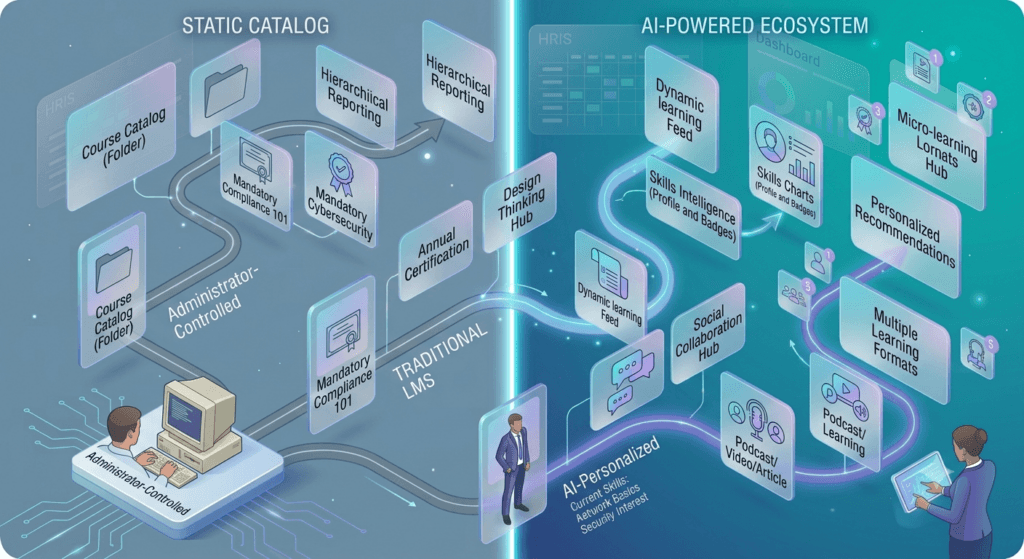
The two categories are complementary far more often than they are competing. Most mature organisations run both, with the LMS handling compliance and formal certification, and the LXP handling discovery, engagement, and informal skill development. The table below breaks down where each system is genuinely built to lead.
| Dimension | LMS | LXP |
| Purpose | Administer, assign, and track mandatory training and compliance | Drive discovery, engagement, and self-directed skill development |
| User experience | Administrator-first; learner interface is often a course list | Learner-first; feed-based, similar to a streaming app |
| AI | Limited; mostly rules-based assignment logic | Central; drives recommendations and content surfacing |
| Content | Primarily internally authored, formal courses | Aggregated from internal and external sources, multiple formats |
| Personalization | Minimal; same catalogue for a given role or group | High; adapts to individual behaviour and stated interests |
| Administration | Strong; built for enrolment rules and certification tracking | Lighter; not designed to manage compliance workflows |
| Reporting | Detailed compliance and completion reporting for audit purposes | Engagement and consumption analytics; weaker on formal compliance |
| Social learning | Rare or bolted on | Core feature; comments, ratings, sharing, following |
| Best use cases | Regulatory training, certification, onboarding compliance | Skill development, culture of learning, informal upskilling |
If you need a single takeaway from this table: an LMS proves that learning happened. An LXP tries to make learning happen in the first place. Very few organisations should choose one over the other outright; the real decision is usually sequencing and budget, not either-or.
Three Myths About LXPs
The category’s marketing has produced some assumptions worth challenging directly before you build a business case around them.
Myth 1: AI will solve poor learning engagement
Reality: AI cannot recommend content people don’t care about. A recommendation engine can only surface what already exists in the library, tagged well enough to be matched to a learner’s context. If the underlying content is thin, outdated, or irrelevant to real job problems, the AI will simply recommend mediocre content faster and more confidently.
Myth 2: Buying an LXP creates a learning culture
Reality: it exposes whether one already exists. Organisations with managers who actively encourage development, leaders who model curiosity, and a content library people trust tend to see strong adoption fast. Organisations without those foundations often see a spike in logins during launch week, followed by a steady decline back toward pre-launch engagement levels.
Myth 3: More content equals more learning
Reality: better curation beats larger libraries. Aggregating five content subscriptions into one search bar doesn’t help a learner if the top results are outdated, off-topic, or duplicative. A smaller, well-curated, actively maintained library consistently outperforms a sprawling one in engagement and completion data.
Key Features of an LXP
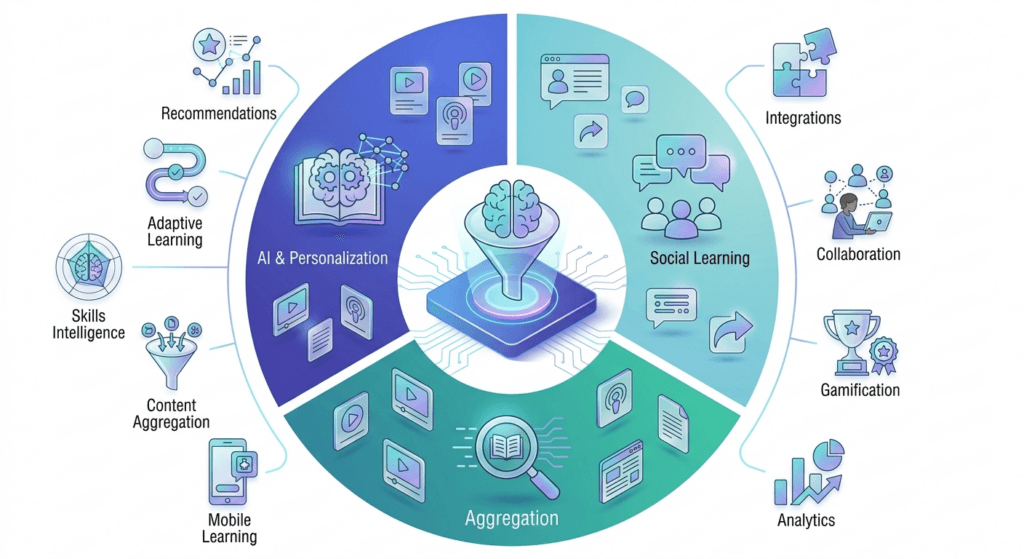
Vendor feature lists tend to blur together after the fifth demo. Here’s what actually differentiates a platform that delivers on the category, versus one that’s an LMS with a recommendation widget bolted on.
- AI-powered recommendations that visibly improve as the platform learns more about a user, not a static “recommended for you” list that never changes
- Skills intelligence that maps content against a living skills taxonomy and can identify organisational skill gaps, not just individual course completions — functionally, this is what makes an LXP double as a skills platform, not just a content feed
- Adaptive learning pathways that adjust sequencing based on demonstrated competence rather than a fixed course order
- Content aggregation across internal libraries, subscription services, and open web content, searchable from one interface
- Learning in the flow of work — surfacing short, relevant content inside tools like Slack, Teams, or a CRM rather than requiring a separate login
- Mobile-first design, since a meaningful share of engagement on well-adopted platforms happens outside a desk
- Analytics that go beyond completion percentages to show engagement patterns, content effectiveness, and skill trends
- Social and collaborative learning features: comments, peer recommendations, following colleagues, and community-curated playlists
- Native support for microlearning formats — short videos, bite-sized reading, quick assessments — rather than forcing everything into long-form courses
- Integrations with HRIS, single sign-on, and existing content libraries so the platform doesn’t become another data silo
- Gamification elements such as badges and recognition, used to reinforce engagement rather than as the primary motivator
For a closer look at the microlearning formats most LXPs are built to surface, see: Microlearning: What It Is, When to Use It, and How to Design It
Benefits of Using an LXP
The genuine benefits of an LXP show up less in vanity metrics like logins, and more in a handful of practical shifts that L&D teams notice within the first two or three quarters of a well-run rollout.
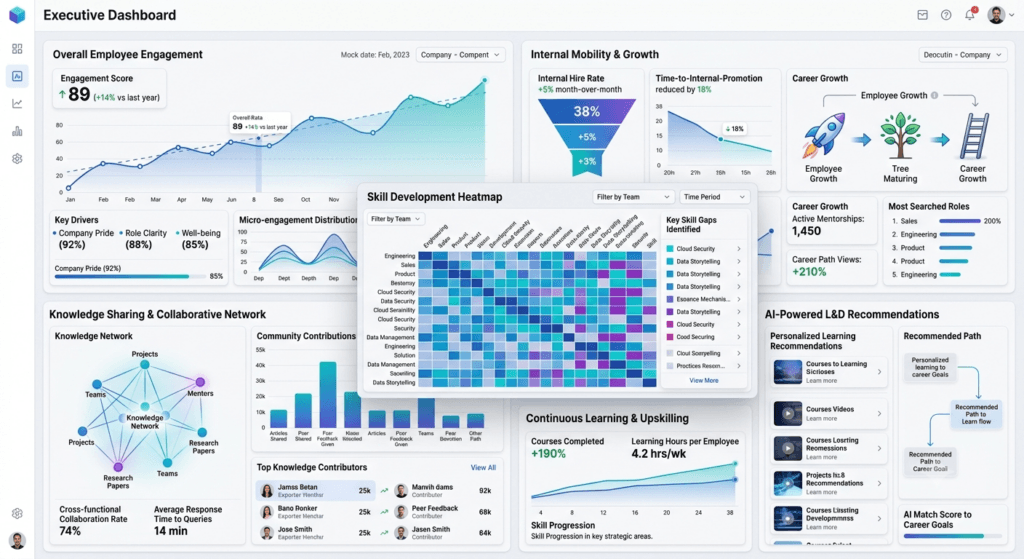
- Higher voluntary engagement with non-mandatory content, since recommendations replace a static catalogue nobody was browsing
- Faster surfacing of internal expertise, because employees can publish and share what they know instead of waiting for a formal course to be built
- Better visibility into actual skill gaps at a team or organisational level, since content consumption is tagged against a skills taxonomy
- Reduced duplication of effort, as teams stop rebuilding content that already exists somewhere in a subscription library or another department
- A stronger case for continuous learning as a norm, since the experience of finding relevant content becomes closer to effortless
This matters more than it might seem on paper: most organisations now name providing learning as their single most important retention lever, yet only around a third currently qualify as having a mature, well-resourced career development program. That gap is exactly where a well-curated LXP can move the needle fastest.
None of these benefits materialise automatically. They depend on decent content variety, a credible content curation effort in the first ninety days, and managers who actively point their teams toward the platform rather than treating it as an L&D side project.
Challenges and Limitations of a Learning Experience Platform
Vendor case studies rarely mention this section, which is exactly why it matters. Go into an LXP evaluation with clear eyes about what tends to go wrong.
- Cost: licensing is usually priced per active user and stacks on top of existing LMS and content subscription costs, which makes the total cost of ownership higher than the sticker price suggests
- Adoption: an LXP only works if people actually use it voluntarily; without a deliberate change management effort, usage often plateaus after an initial curiosity spike
- Content quality: aggregation surfaces whatever content exists, including outdated or low-quality material, unless someone actively curates and retires content
- Governance: with employees able to upload and tag their own content, maintaining quality standards and avoiding misinformation requires ongoing moderation
- Integration: connecting an LXP cleanly to an existing LMS, HRIS, and content libraries is more technically involved than most vendor sales conversations suggest
- Measuring ROI: engagement metrics are easy to produce and hard to tie convincingly back to business outcomes, which makes budget renewal conversations harder than expected
| Trainercentric Note The single most common reason LXP rollouts underdeliver isn’t the software. It’s treating the launch as an IT project instead of a change management project. Budget for curation and internal promotion, not just the licence. |
Five Mistakes Organizations Make When Buying an LXP
After watching several of these rollouts unfold from the inside and from the sidelines, the same five failure patterns show up again and again, almost regardless of company size or industry.
1. Buying before content exists
An LXP has nothing to recommend if the content library is thin. Organisations that sign a contract before auditing what they actually have to aggregate end up with an expensive, empty-feeling feed for the first six months.
2. Ignoring governance
Opening up user-generated content without a lightweight review or tagging process invites quality problems fast. The fix isn’t heavy gatekeeping; it’s a clear, simple standard applied consistently from day one.
3. Not involving IT early
Single sign-on, HRIS data feeds, and security review are frequently treated as an afterthought by L&D-led buying committees, which pushes the go-live date back by months and damages internal credibility before launch.
4. Ignoring integrations
A platform that can’t cleanly pull content and completion data from your existing LMS creates two disconnected systems of record instead of one improved experience, and employees notice immediately when the two don’t agree.
5. Treating it like an LMS replacement
This is the most expensive mistake on the list. Organisations that decommission or neglect their LMS in favour of the new LXP typically discover, at the next audit cycle, that compliance tracking and certification management were never features the LXP was built to handle well.
Do You Actually Need an LXP?
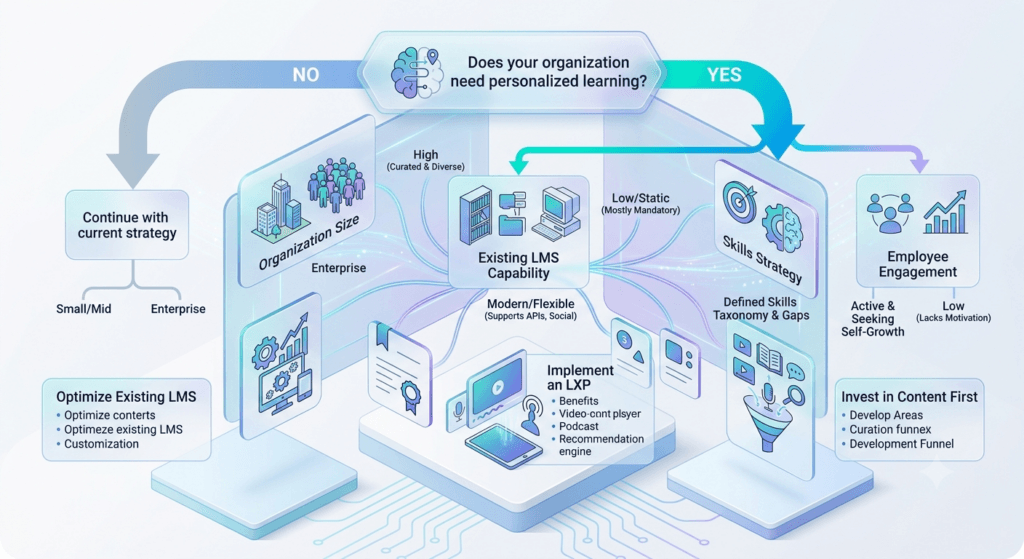
This is the question most vendor content is structurally incapable of answering honestly, because the honest answer is often no — at least not yet. Use the scenarios below as a starting point, not a final verdict.
| Organisation Profile | Recommendation |
| Small organisation (under 500 employees), limited content library, LMS mainly used for compliance | Skip it for now. Focus on building a stronger content library and a clearer skills framework first; an LXP has little to aggregate or personalise. |
| Mid-size organisation with a growing content library across multiple subscriptions and internal sources, but low voluntary engagement | Strong candidate. This is the exact gap an LXP is built to close — fragmented content and weak discovery. |
| Large enterprise with mature compliance processes, a large existing content footprint, and a stated strategic goal around skills-based talent management | Strong candidate, and likely worth budgeting for skills-intelligence features specifically, not just content discovery. |
| Organisation currently mid-way through an LMS migration or major HRIS change | Wait. Layering a new platform on top of unstable core systems tends to multiply integration problems rather than solve engagement problems. |
| Organisation where the core problem is content quality and quantity, not discovery | Invest in content first. An LXP makes it easier to find content — it does not create content that doesn’t exist. |
A Sample 90-Day LXP Rollout Roadmap
For organisations that have concluded they’re a genuine candidate, this is a realistic sequencing model rather than a vendor’s optimistic launch timeline.
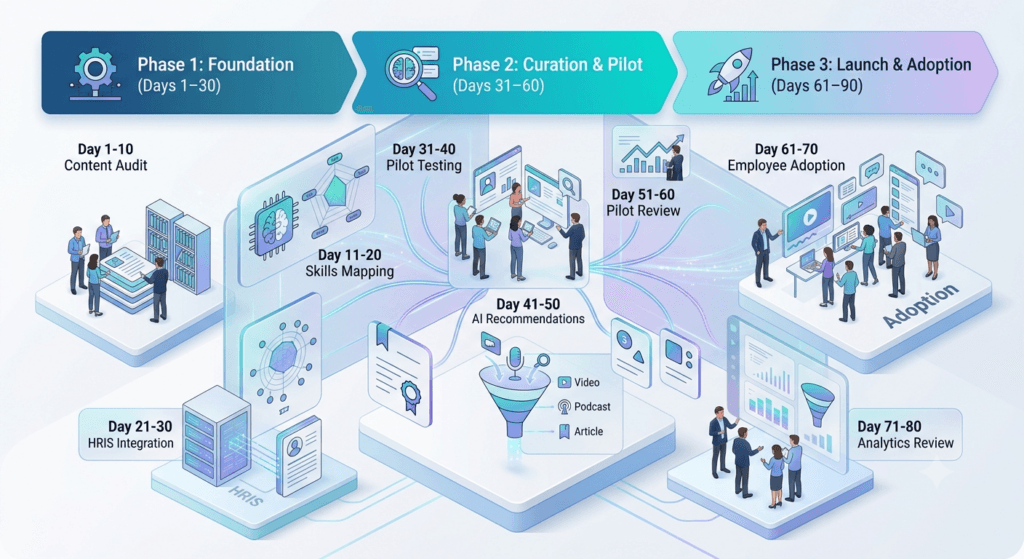
Days 1–30: Foundation
Audit existing content across the LMS, subscriptions, and informal sources. Map a skills taxonomy against actual roles, not a generic industry template. Confirm HRIS and SSO integration requirements with IT before any content work begins.
Days 31–60: Curation and Pilot
Tag and curate a focused starting library rather than dumping every available asset in at once. Launch with a single business unit or region as a pilot group, and recruit a small number of respected employees to seed user-generated content before the wider rollout.
Days 61–90: Launch and Adoption
Roll out organisation-wide with direct manager involvement, not just an email announcement. Set a 90-day engagement review checkpoint with clear metrics agreed in advance, and budget time explicitly for ongoing content curation after launch — this is the step most rollouts quietly drop.
Leading Learning Experience Platforms to Evaluate
The vendor landscape changes often enough that any specific feature comparison ages quickly, so this table is deliberately limited to naming platforms commonly evaluated in this category, without ranking or endorsing any of them. Do your own current evaluation before shortlisting a best LXP for corporate training, an AI-powered learning platform, or a broader enterprise learning platform in your specific context.
| Vendor | Best For | Strength |
| Degreed | Skills-led organisations | Skills intelligence and career pathing tied to content |
| Docebo | Teams wanting one platform for both jobs | Combined LMS and LXP functionality |
| Cornerstone (incl. EdCast-derived LXP) | Large enterprises already on Cornerstone | Deep integration with existing Cornerstone HR/talent systems |
| 360Learning | Organisations built on peer expertise | Collaborative, peer-authored content creation |
| LinkedIn Learning | Standalone use or as a content source | Large, continuously updated content library |
| SAP SuccessFactors | Organisations standardised on SAP | Native fit with existing SAP HR and talent stack |
| Adobe Learning Manager | Teams already in the Adobe ecosystem | Tight integration with Adobe content-authoring tools |
Treat this table as a starting point for a shortlist, not a recommendation. The right platform depends heavily on your existing HR tech stack, content licences, and the specific problem identified in the decision matrix above.
How to Evaluate an Learning Experience Platform
A practical buyer’s checklist, built from the questions that separate a genuinely useful platform from an impressive demo.
- Does the recommendation engine visibly improve with more usage data, or does it show the same generic list to every user in a role?
- Can the platform ingest content from your specific existing sources — your LMS, subscription libraries, internal documents — without heavy custom development?
- What does the skills taxonomy look like out of the box, and how much configuration is needed to map it to your organisation’s actual roles?
- How does the platform handle governance for user-generated content — approval workflows, tagging standards, retirement of outdated material?
- What does the analytics dashboard show beyond completion and login counts — can it connect engagement to identified skill gaps?
- How does pricing scale as active users grow, and what happens to the licence cost if adoption is lower than projected?
- What is the actual implementation timeline, including data migration and integration with HRIS and single sign-on?
- Does the vendor have credible reference customers of a similar size and industry, and can you speak to them directly rather than reading a case study?
- What specific AI capabilities does the platform ship with in its current release, versus what’s on a roadmap slide — ask for a live demo of each, not a mockup?
The Future of LXPs
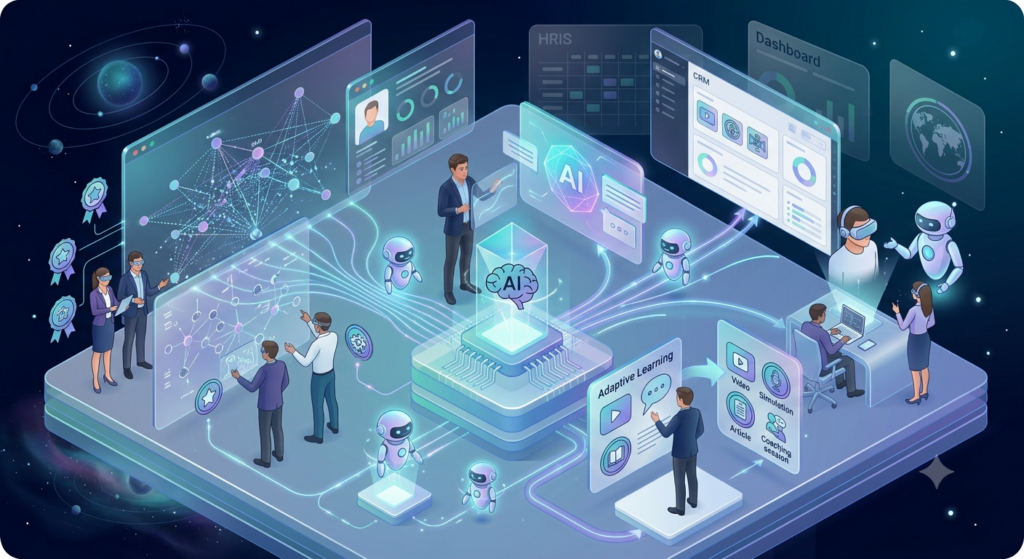
A few shifts are worth watching over the next few years, since they’ll change what “good” looks like in an evaluation faster than most procurement cycles move.
- AI copilots: expect conversational interfaces layered on top of the recommendation feed, letting a learner ask “what should I know before this client meeting” instead of browsing a search bar.
- Deeper skills intelligence: platforms are moving from tagging content against skills to actively inferring skill proficiency from behaviour and performance signals, not just self-reported ratings.
- Agentic AI: early movement toward systems that don’t just recommend content but can take action — assembling a short custom learning path on demand, or automatically flagging a manager when a team member’s skill gap widens.
- Adaptive learning at the content level: not just recommending which course to take, but dynamically adjusting difficulty and pacing within a single piece of content based on how a learner is performing in real time.
- Deeper embedding into Microsoft Teams and similar hubs: learning surfaced natively inside the tools people already spend their day in, continuing the shift away from a separate destination app.
None of this changes the fundamentals in this article. A skills-based learning platform with weak content and no governance will still underperform, no matter how advanced its AI layer becomes. Evaluate the fundamentals first, and treat the roadmap features as a tiebreaker, not the main event.
Conclusion
A Learning Experience Platform solves a real problem: static catalogues and push-based assignment don’t build a genuine culture of learning. But it solves that problem only when the underlying content, skills framework, and change management effort are already reasonably solid. Bought before that groundwork exists, an LXP becomes an expensive feed with nothing compelling to recommend.
It’s also worth remembering that the market itself is shifting under this decision. Analysts now describe personalization and recommendation features as baseline expectations across modern learning systems generally, not a distinct product category to shop for in isolation. Meanwhile, seven in ten business leaders say adapting quickly is now their primary competitive strategy, and embedding continuous, personalised learning into daily work is named as one of the immediate priorities that follows from that.
The decision worth making isn’t “LXP or no LXP” in the abstract. It’s a specific, evidence-based judgement about your current content maturity, your engagement data, and what problem you are actually trying to solve. Use the decision matrix, the buying-mistakes list, and the evaluation checklist in this article as a starting point for that conversation internally, before a single vendor demo happens.
Frequently Asked Questions
Is an LXP the same as an LMS?
No. An LMS is built primarily to administer, assign, and track mandatory training and compliance records. An LXP is built to personalise content discovery and drive voluntary engagement. Most mature organisations run both, rather than replacing one with the other.
Can an LXP replace our LMS?
For most organisations, no. If you have regulatory training, certifications, or audit requirements, you still need the administrative and compliance capabilities an LMS provides. An LXP typically sits alongside an LMS rather than replacing it.
How much does an LXP cost?
Pricing is usually per active user per year, and varies significantly by vendor and organisation size. Beyond the licence, budget for content curation, integration work, and change management, which are frequently underestimated in the total cost of ownership.
Do small companies need an LXP?
Usually not yet. Smaller organisations often lack the content volume and role diversity that make personalised recommendations valuable. Building a stronger content library and skills framework typically delivers more value first.
What is skills intelligence in an LXP?
It refers to the platform’s ability to tag content against a skills taxonomy and use that data to identify organisational skill gaps, rather than simply tracking which courses were completed.
Does an LXP use artificial intelligence?
Yes, most current platforms use AI or machine learning models to power content recommendations, skills matching, and increasingly, content summarisation or generation features.
What AI features should an LXP have in 2026?
At minimum, a recommendation engine that measurably improves with usage data, skills-matching against real content rather than keyword tags, and some form of AI-assisted content summarisation. Ask vendors to demonstrate each live rather than describe it, since roadmap slides are not shipped features.
How long does it take to implement an LXP?
Implementation timelines vary widely depending on integration complexity and content migration, but a realistic range for a mid-size organisation is several months from contract signature to a well-curated launch.
What is learning in the flow of work?
It describes surfacing short, relevant learning content inside the tools employees already use — such as a CRM, Slack, or Microsoft Teams — instead of requiring a separate login to a dedicated learning portal.
Can an LXP integrate with Microsoft Teams?
Most enterprise LXPs offer some level of Teams integration, ranging from simple notification bots to fully embedded learning widgets inside a Teams tab. Integration depth varies significantly by vendor, so confirm exactly what’s supported natively versus what requires custom development.
How is an LXP different from a Learning Record Store?
A Learning Record Store (LRS) is backend infrastructure that collects and stores learning activity data, typically via xAPI, from multiple systems. An LXP is a front-end, learner-facing experience. Some LXPs include LRS-like data collection, but the two solve different problems and are not interchangeable.
Is user-generated content risky in an LXP?
It carries quality and accuracy risks if left unmoderated. Most successful implementations pair open contribution with a lightweight review or tagging process rather than either heavy gatekeeping or no oversight at all.
Does an LXP improve employee retention?
Indirectly, and only when paired with genuine content quality and manager support. Continuous learning access is consistently cited as a top retention factor in workforce research, but a poorly adopted LXP with a thin library will not move retention numbers on its own.
How do you measure LXP ROI?
Engagement metrics such as active usage and content consumption are straightforward to capture. Connecting those metrics to business outcomes such as retention, internal mobility, or performance requires deliberate measurement design from the outset, not an afterthought.
Further Reading
- Corporate eLearning Playbook: The Complete Guide to Designing, Delivering, and Scaling Digital Learning (2026)
- How to Choose the Right LMS for Your Organisation
- Rapid eLearning Development: Tools, Tips, and Best Practices
- Microlearning: What It Is, When to Use It, and How to Design It
- AI in L&D: What Corporate Trainers Need to Know Right Now
- How to Choose eLearning Authoring Tools: A Framework for L&D Teams
- Skills Gap Analysis vs Training Needs Analysis: Understanding the Difference
- Competency Mapping vs Skills Gap Analysis
- How to Measure Training Effectiveness Using the Kirkpatrick Model
- How to Calculate Training ROI and Present It to the Business
- How to Design a Learning Programme From Scratch
- How to Write a Learning and Development Strategy
- How to Convert Classroom Training to eLearning Without Losing Impact
References
- e-Learning and the Science of Instruction: Proven Guidelines for Consumers and Designers of Multimedia Learning || 4th Edition || Ruth Colvin Clark and Richard E. Mayer || Wiley || 2016
- Design for How People Learn || 2nd Edition || Julie Dirksen || New Riders || 2015
- Telling Ain’t Training || 2nd Edition || Harold D. Stolovitch and Erica J. Keeps || ATD Press || 2011
- Map It: The Hands-On Guide to Strategic Training Design || 1st Edition || Cathy Moore || Montesa Press || 2017
- The Fifth Discipline: The Art and Practice of the Learning Organization || Revised Edition || Peter M. Senge || Currency || 2006
Author Details

Anupama Mitra is a learning experience designer, writer and facilitator with a deep interest in how people learn, adapt and grow at work. With over a decade of experience in corporate learning and development, she specializes in simplifying complex ideas into practical, actionable insights. Her work focuses on leadership development, behavioral changes, making workplace learning more human and engaging. You can reach out to her at anupama@trainercentric.com