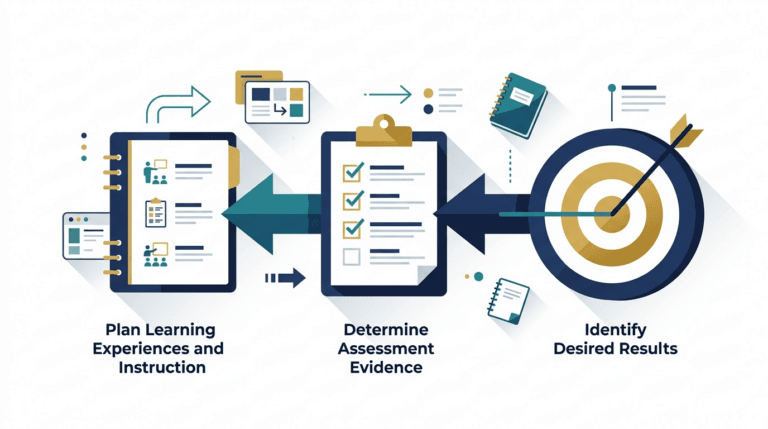
A practical guide to measurable learning objectives, assessment alignment, and instructional design that drives real performance change.
What Is Bloom’s Taxonomy? (And Why It Still Matters)
Bloom’s Taxonomy is a hierarchical classification system for learning objectives that organizes cognitive skills from simple recall to complex creation. Developed by educational psychologist Benjamin Bloom and colleagues in 1956, and revised by Anderson and Krathwohl in 2001, it remains the most widely used framework in instructional design, corporate training, and eLearning development.
If you write training, design courses, or build onboarding programs, you already use Bloom’s Taxonomy—whether you know it or not. The question is whether you are using it well.
Here is the problem most training programs share: a new CRM course gets built at Meridian Software. Weeks of development. Engaging videos. Practice exercises. And objectives that look like this:
- Understand the new CRM interface
- Learn the key features of the platform
- Know how to navigate the dashboard
Training launches. Support tickets flood in anyway. The post-training quiz scores looked fine—but users still cannot do the job. This is not a content problem. It is an objective problem. And Bloom’s Taxonomy is the fix.
This guide covers everything: the six levels, the verb chart, assessment alignment, industry examples, and the step-by-step guide to write learning objectives.
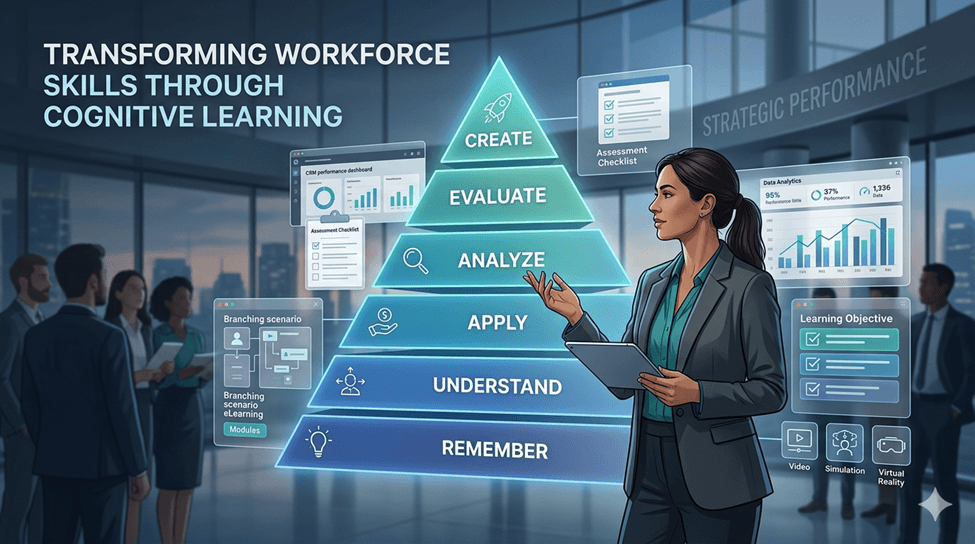
The Three Domains of Bloom’s Taxonomy: Cognitive, Affective, and Psychomotor
Most people only know the cognitive pyramid. Bloom’s original framework described three domains:
| Domain | Focus | Corporate Training Example | When to Use |
| Cognitive (Thinking) | Knowledge, reasoning, analysis | Sales rep analyzes why a deal stalled in the CRM | Most eLearning and ILT |
| Affective (Feeling) | Attitudes, values, empathy | Customer service rep demonstrates empathy during a complaint | Culture, DEI, leadership, soft skills |
| Psychomotor (Doing) | Physical skills, procedural execution | Nurse administers medication using a new delivery device | Safety, healthcare, manufacturing |
Corporate training lives mostly in the cognitive domain—but the most effective programs blend all three. A compliance course that teaches rules without addressing why they matter (affective) tends to produce box-checkers rather than ethical employees. That distinction is worth the design effort.
The Revised Bloom’s Taxonomy: 1956 vs. 2001
The revision by Anderson and Krathwohl (2001) made two meaningful changes:
| Aspect | Original 1956 | Revised 2001 |
| Level Names | Nouns: Knowledge, Comprehension, Application, Analysis, Synthesis, Evaluation | Verbs: Remember, Understand, Apply, Analyze, Evaluate, Create |
| Philosophy | Learning is a STATE—what you know | Learning is an ACTION—what you can do |
| Top Level | Synthesis | Create (moved above Evaluate) |
The shift from nouns to verbs is not cosmetic. It reframes the entire purpose of a learning objective: from ‘what information was covered’ to ‘what the learner can now do.’ In corporate training, that distinction drives everything from content selection to assessment design.
Note: Unless otherwise noted, ‘Bloom’s Taxonomy’ in this article refers to the 2001 revised version.
The Six Levels of Bloom’s Taxonomy (With Corporate Examples)
Each level builds on the one before it. You cannot reliably analyze something you have never applied. Using Meridian’s CRM training as the example throughout:
Level 1: Remember — Recall Facts and Basic Concepts
Action verbs: Define, list, name, label, identify, recall, state, match, outline
Example: List the five main tabs in the CRM dashboard.
Assessment: Multiple-choice quiz, matching exercise, flashcards
The foundation—and also the ceiling of most compliance training. Necessary, but not sufficient for behavior change.
Level 2: Understand — Explain Ideas and Concepts
Action verbs: Explain, describe, summarize, classify, interpret, compare, distinguish, infer
Example: Explain how pipeline stage affects forecast accuracy.
Assessment: Short-answer question, concept mapping, summary exercise
Level 3: Apply — Use Knowledge in New Situations
Action verbs: Demonstrate, solve, use, implement, operate, execute, calculate, illustrate
Example: Demonstrate how to create a new customer record and assign it to the correct sales rep.
Assessment: Simulation, Watch-Try-Do exercise, live task execution
This is the minimum bar for performance-based learning. If your training objective cannot reach Apply, ask whether training is the right solution at all.
Level 4: Analyze — Break Down Information and Make Connections
Action verbs: Analyze, compare, contrast, categorize, differentiate, examine, question, test
Example: Analyze a stalled deal and identify which CRM fields indicate why the sale is stuck.
Assessment: Case study, diagnostic scenario, troubleshooting exercise
Level 5: Evaluate — Make Judgments Based on Criteria
Action verbs: Evaluate, judge, assess, critique, defend, justify, prioritize, appraise
Example: Evaluate the current CRM workflow and recommend two specific improvements.
Assessment: Written recommendation, peer review, decision-making scenario
Level 6: Create — Produce Something New
Action verbs: Design, build, develop, generate, compose, construct, invent, formulate, plan
Example: Design a customized CRM dashboard that optimizes the team’s unique sales process.
Assessment: Project, prototype, process redesign proposal
Most corporate programs never reach this level. That is sometimes appropriate—and sometimes a significant missed opportunity for leadership and senior individual contributor development.
Bloom’s Taxonomy Verb Chart: Action Verbs by Level
Use this verb chart every time you write a learning objective. If the verb you chose is not on this list, it is almost certainly too vague to be measurable.
| Remember | Understand | Apply | Analyze | Evaluate | Create |
| Define | Explain | Demonstrate | Analyze | Evaluate | Design |
| List | Describe | Solve | Compare | Judge | Build |
| Recall | Summarize | Use | Contrast | Assess | Develop |
| Name | Classify | Apply | Differentiate | Critique | Create |
| Identify | Interpret | Implement | Examine | Defend | Produce |
| Label | Compare | Execute | Categorize | Justify | Construct |
| Match | Distinguish | Calculate | Question | Prioritize | Invent |
| State | Infer | Illustrate | Test | Rate | Formulate |
| Outline | Discuss | Operate | Distinguish | Appraise | Plan |
Steal the exact worksheet instructional designers use to rewrite vague objectives
Download this free Bloom’s Taxonomy Learning Objectives Worksheet and start writing clearer, measurable, and more effective learning objectives for your training programs. Perfect for instructional designers, trainers, teachers, and L&D professionals.
Why ‘Understand’ Is a Weak Learning Objective Verb
‘Understand’ is not observable. You cannot watch someone understand something. You can watch them explain it, apply it, or demonstrate it—which is exactly why those verbs appear in the chart and ‘understand’ does not.
In practice, SMEs often insist on ‘understand’ because it feels inclusive—it seems to cover everything without committing to anything. That is precisely the problem. Rewriting ‘learners will understand the new policy’ to ‘learners will be able to identify which of three scenarios requires escalation’ is not just better instructional design. It is often a negotiation. Expect pushback. The conversation is worth having.

Download this free Bloom’s Taxonomy Action Verb Reference Sheet Used by Corporate L&D Teams
This template help you to quickly choose the right verbs for writing measurable learning objectives. A practical tool for instructional designers, educators, trainers, and L&D professionals creating outcome-driven training programs.
Learning Objectives vs. Learning Outcomes: A Practical Distinction
These terms are used interchangeably in most organizations, which causes quiet problems in program evaluation.
| Learning Objective | Learning Outcome | |
| Describes | What the designer intends to teach | What the learner can do back on the job |
| Perspective | Designer-focused | Learner- and business-focused |
| Measured when? | During or immediately after training | Weeks or months post-training |
| Example | Demonstrate how to log a support ticket in the CRM | Accurately log 95% of support tickets within two weeks of hire |
Objectives drive design. Outcomes drive evaluation. Bloom’s Taxonomy helps you write objectives specific enough to eventually produce verifiable outcomes. Most programs skip the connection entirely—then wonder why ROI is hard to demonstrate.
Bloom’s Taxonomy vs. SMART Learning Objectives: Complementary, Not Competing

SMART objectives (Specific, Measurable, Achievable, Relevant, Time-bound) and Bloom’s Taxonomy solve different problems. Bloom’s tells you the cognitive level. SMART tells you the conditions and standards. You need both.
A SMART objective without Bloom’s can be measurable but pitched at the wrong cognitive level—testing recall when the job demands analysis.
A Bloom’s-aligned objective without SMART can target the right level but remain vague about conditions, standards, and timing.
Combined example: “By the end of week two (Time-bound), all new sales reps (Specific) will demonstrate (Bloom’s: Apply) how to qualify a new opportunity using the company’s five-stage framework (Relevant) with 90% accuracy on a simulated scenario (Measurable, Achievable).”
Bloom’s Taxonomy and Assessment Alignment: The Most Common Training Design Failure
Write an Apply-level objective. Assess it with a multiple-choice quiz. This is the most pervasive design failure in corporate training—and Bloom’s Taxonomy gives you a direct prescription to fix it.
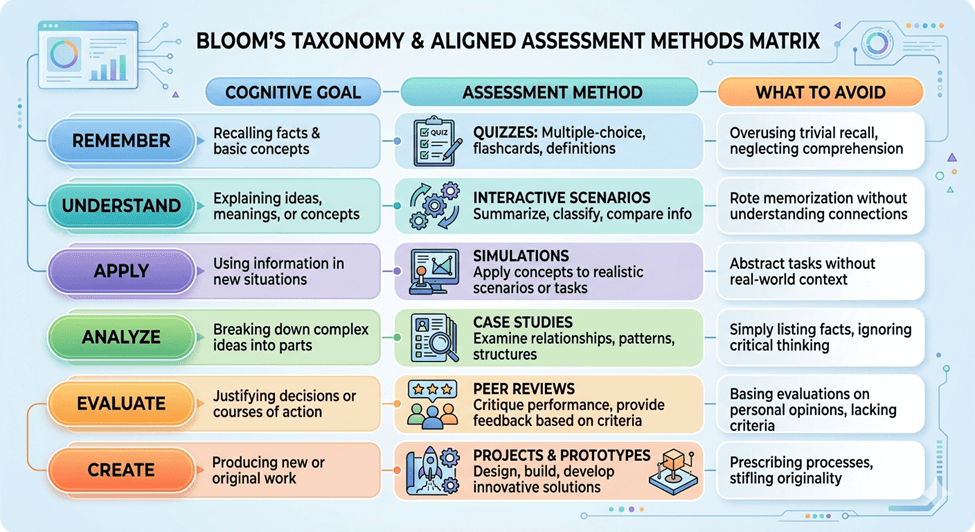
This alignment principle is the foundation of backward design (Wiggins & McTighe): start with the performance you want, identify how you’ll measure it, then design instruction to bridge the gap. When designers start with content instead of outcomes, misalignment is almost guaranteed.
Source: Anderson, L.W. & Krathwohl, D.R. (2001). A Taxonomy for Learning, Teaching, and Assessing. Longman. | Wiggins, G. & McTighe, J. (2005). Understanding by Design. ASCD.
Assessment Alignment Checklist Free Download
Make sure your assessments actually measure what your learners are expected to achieve. Download this free Assessment Alignment Checklist to match learning objectives with the right evaluation methods using Bloom’s Taxonomy. Ideal for instructional designers, trainers, educators, and L&D professionals building effective, outcome-driven learning experiences.
Why Most Corporate Training Stops at ‘Understand’ (And the Real Cost)
Here is the honest pattern across most corporate programs:
| Level | Typical Usage | Actual Result | What Most Roles Need |
| Remember | 10% | Trivia retention | Lean foundation; don’t over-invest |
| Understand | 50% | Familiarity, not capability | Reduce; always pair with Apply |
| Apply | 30% | Practical skill | Increase to 40–50% for most operational roles |
| Analyze | 5% | Diagnostic thinking | Increase for any problem-solving role |
| Evaluate | 3% | Critical judgment | Increase for supervisors and managers |
| Create | 2% | Innovation | Add for senior individual contributors and leaders |
This distribution is backwards for most performance goals. The L&D field has long recognized that organizations over-invest in knowledge transfer and under-invest in practice and application—a gap that researcher Will Thalheimer has documented extensively in work on performance-focused learning design.
The result: learners pass the quiz. They cannot do the job. The training team gets blamed for something that was a design problem from the start.
Reference: Thalheimer, W. (2017). Performance-Focused Smile Sheets. Work-Learning Research.
The Honest Limitations of Bloom’s Taxonomy (What Most Articles Won’t Tell You)
Bloom’s Taxonomy has critics—and some of their arguments are worth taking seriously before you treat the framework as gospel.
The hierarchy is not always linear.
Bloom’s implies that lower levels must precede higher ones. In practice, this is often true—but not always. Expert practitioners frequently operate at Analyze and Create levels while still having gaps at Remember. A senior developer might architect complex systems (Create) while occasionally forgetting specific syntax (Remember). Real cognition is messier than any pyramid suggests.
Higher-order objectives can be a vanity metric in compliance contexts.
Not every training program should aim for Analyze or Create. A fire evacuation procedure needs Apply—reliably, every time, under stress. Adding Evaluate-level objectives to safety training does not make it better. It makes it longer. The goal is always job-appropriate cognitive demand, not impressively high Bloom’s levels.
Bloom’s does not tell you whether training is the right solution.
This is probably the most important limitation. Bloom’s Taxonomy assumes you have already correctly diagnosed a training need. If the performance problem is actually caused by unclear processes, missing tools, or misaligned incentives—no amount of Bloom’s-aligned objective writing will fix it. Use Bloom’s inside a proper needs analysis, not as a substitute for one.
The framework says nothing about transfer.
A learner can achieve Create-level performance in a simulation and still fail to transfer that skill to the job. Bloom’s measures cognitive demand in a learning context, not transfer to a performance context. For transfer, you need spaced practice, retrieval, and on-the-job application—none of which Bloom’s addresses directly. It is a taxonomy, not a learning theory.
The Bloom’s Alignment Triangle: A Framework for Training That Works
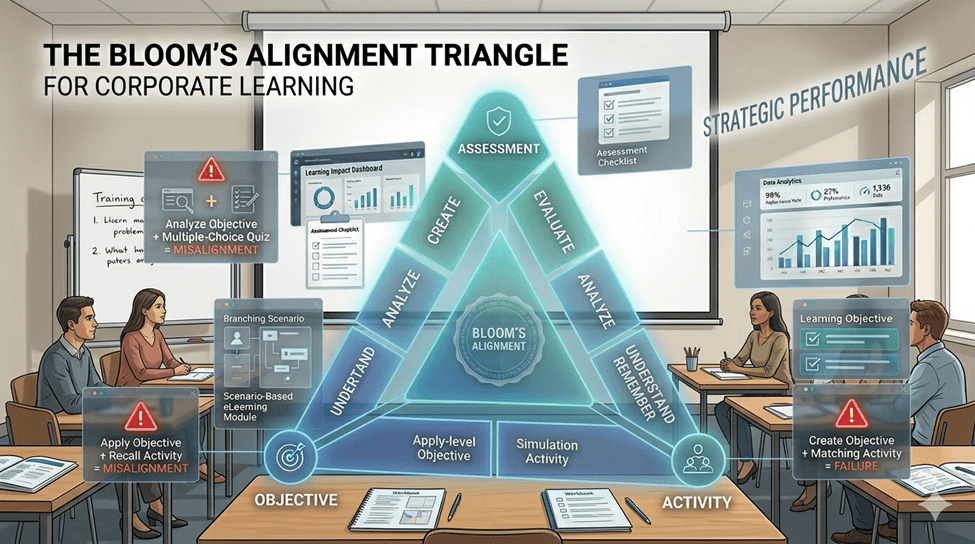
One pattern separates training programs that drive performance from those that produce quiz scores. All three design elements must operate at the same Bloom’s level:
THE BLOOM’S ALIGNMENT TRIANGLE
Objective → Activity → Assessment
| Misalignment | What It Looks Like | What Happens |
| Objective above activity | Apply objective, content only explains | Learners understand; cannot perform |
| Activity above assessment | Apply practice, quiz tests recall | Learners perform; cannot pass the test |
| Objective above assessment | Analyze objective, multiple-choice test | Learners pass; cannot reason through real problems |
The 3-Level Corporate Training Rule (practical shorthand):
- Remember + Understand: onboarding facts, compliance foundations, policy awareness
- Apply: operational procedures, tool proficiency, standard task execution
- Analyze + Evaluate: management, coaching, problem-solving, leadership development
This is a starting point, not a formula. Let job task analysis determine the level—not the seniority of the audience or the ambitions of the training brief.
How to Write Measurable Learning Objectives Using Bloom’s Taxonomy
Four steps. In order. No skipping.
Step 1: Start with the job task, not the content.
What must the person actually do on the job? Not ‘understand the CRM’—but ‘create a customer record’ or ‘qualify a new opportunity.’ The job task is the objective’s anchor. If you cannot name the task, you cannot write the objective.
Step 2: Identify the cognitive level the task requires.
Does the job require recall, execution, diagnosis, or judgment? The answer determines the Bloom’s level. A call center rep following a script needs Apply. A claims adjuster weighing competing evidence needs Evaluate. Let the job demand drive the level—not the training department’s ambitions.
Step 3: Choose a verb from the Bloom’s verb chart.
Replace ‘understand,’ ‘know,’ ‘learn,’ and ‘appreciate’ with a verb that is observable and assessable. If you cannot imagine watching someone do the thing the verb describes, the verb is wrong.
Step 4: Align the assessment to the same level.
Apply-level objective? You need a simulation or live task, not a quiz. Analyze-level objective? You need a case study, not a matching exercise. This step is where most programs fail—and where Bloom’s delivers the most practical ROI.
Bloom’s Taxonomy in eLearning: Matching Levels to Design Patterns
Every authoring tool decision reflects a Bloom’s level, whether the designer intended it or not.
| Level | eLearning Strategy | Authoring Tool Pattern |
| Remember | Microlearning, spaced repetition, flashcards | Knowledge check slides, matching interactions |
| Understand | Explainer videos, annotated diagrams | Click-to-reveal, tab interactions, labeled graphics |
| Apply | Scenario-based learning, software simulations | Storyline/Rise branching, screen capture simulations |
| Analyze | Case studies, diagnostic exercises | Complex branching decision trees, drag-and-drop sorting |
| Evaluate | Reflective practice, peer critique | Video response, discussion boards, journaling prompts |
| Create | Capstone projects, design challenges | Portfolio submissions, collaborative tools |
The most common eLearning mistake: defaulting to click-to-reveal interactions for Apply-level objectives. Click-to-reveal is an Understand-level interaction. It exposes content; it does not build skill. Scenario-based learning and simulation are the only eLearning formats that reliably achieve Apply-level performance outcomes in a digital environment. That is not an opinion—it is the direct implication of what Apply means.
Bloom’s Taxonomy Examples by Industry
Healthcare and Clinical Training
- Remember: List the five steps of the pre-procedure safety checklist.
- Apply: Demonstrate correct hand hygiene technique before patient contact.
- Analyze: Analyze patient vital sign trends to identify early deterioration indicators.
Sales Training and Onboarding
- Understand: Explain how the company’s value proposition differs from the top three competitors.
- Apply: Demonstrate the five-step discovery conversation using the company’s qualification framework.
- Evaluate: Evaluate a recorded discovery call and identify two specific coachable moments.
Customer Service
- Apply: Demonstrate how to de-escalate an angry customer using the LATTE framework.
- Analyze: Analyze a complaint log and identify the three most common root causes of repeat contacts.
- Create: Design a personal service recovery script for the three most frequent complaint types in your queue.
Compliance and Regulatory Training
- Remember: Identify the five behaviors that constitute a reportable conflict of interest.
- Understand: Explain why data privacy regulations apply to verbal disclosures, not just written ones.
- Evaluate: Evaluate three simulated scenarios and determine which require a formal compliance report.
New Employee Onboarding
- Remember: Name the five core company values.
- Apply: Complete a simulated new-hire workflow including benefits enrollment and IT setup.
- Analyze: Compare two internal escalation paths and determine which applies to your role.
Common Mistakes When Using Bloom’s Taxonomy
Mistake 1: Treating Bloom’s as a verb library.
The verb matters only because it signals the cognitive level. A designer who writes ‘learners will analyze the dashboard’ but assesses it with a multiple-choice quiz has used the right verb and completely missed the point. The level—not the word—determines the design.
Mistake 2: Equating higher levels with better design.
Create and Evaluate are not superior to Remember and Apply. They are appropriate for different job demands. A warehouse picker who follows a standard pick-and-pack procedure needs Apply-level precision, not Evaluate-level judgment. Stretching objectives beyond what the job requires inflates development cost and training time without improving performance.
Mistake 3: Writing compound objectives.
‘Learners will understand and apply the CRM’ is two objectives pretending to be one. Write one objective per cognitive demand. If you need both, write both. Compound objectives are unassessable—you cannot know which part the learner got right.
Mistake 4: Using Bloom’s as a substitute for needs analysis.
Bloom’s does not tell you whether training is the right intervention. A performance gap caused by a broken process or unclear expectations will not be solved by better objective writing. Bloom’s is a design tool, not a diagnostic one.
The Bottom Line
Meridian rewrote their objectives. Support tickets dropped. User confidence improved. Training ROI became reportable.
Bloom’s Taxonomy is a quality control system—not a creativity constraint. Before you write another learning objective, answer three questions: What is the observable action? What is the cognitive level? Does the assessment match? Answer those honestly, and your training will be measurable, focused, and defensible.
The framework is 70 years old. It persists because the problem it solves—vague objectives that produce no behavior change—is just as common today as it was in 1956.
Put Bloom’s to Work on Your Next Program
If you have read this far, you have a specific training challenge in mind. Here’s what to do with it:
- If your objectives use vague verbs like ‘understand’ or ‘know’: Download the Bloom’s Taxonomy Learning Objectives Worksheet. Rewrite three objectives today using the verb chart.
- If your assessments feel disconnected from your training: Download the Bloom’s Assessment Alignment Checklist. Audit each objective-assessment pair in your current program.
- If you are designing a full course from scratch: Read our companion articles on ADDIE, SAM, Kolb’s Learning Cycle, Gagne’s 9 events of Instructions, Merrill’s Principles and backward design. Bloom’s Taxonomy works best as part of a complete design methodology, not in isolation.
- If you want monthly tools and case studies: Subscribe to the Trainercentric Digest. 10K+ corporate trainers. Practical, not theoretical. Also, as a added bonus, you will get premium members-only downloadable tools that we do not publish anywhere else on our website.
A Final Note
I have reviewed training programs across healthcare, financial services, technology, and retail. The verb problem is everywhere. But the deeper issue—the one that takes longer to fix—is the assumption that good content automatically produces good performance. It does not. The cognitive level of the objective determines what learners can do after training. Everything else is scaffolding.
Bloom’s Taxonomy does not guarantee great training. It guarantees that the cognitive demand you design for is the one you actually get. That is a more modest promise than most L&D frameworks make. It is also one that holds up.
Frequently Asked Questions About Bloom’s Taxonomy
What are the 6 levels of Bloom’s Taxonomy?
The six levels of the revised Bloom’s Taxonomy (2001) are: Remember, Understand, Apply, Analyze, Evaluate, and Create. Each represents an increasingly complex cognitive demand, from simple recall to original production.
What is the difference between Bloom’s Taxonomy and learning objectives?
Bloom’s Taxonomy is the framework. Learning objectives are the output. You use the taxonomy to determine the right cognitive level and verb for each objective—and to ensure your assessment matches that level.
Why is ‘understand’ a weak learning objective verb?
‘Understand’ is not observable or measurable. You cannot assess it directly. Replace it with a verb that describes a visible performance: explain, demonstrate, apply, analyze. Those can be assessed. ‘Understand’ cannot.
How do instructional designers use Bloom’s Taxonomy?
Instructional designers use Bloom’s at every stage: to write objectives, select content and activities at the right cognitive level, choose aligned assessment methods, and evaluate whether a program is designed for the job performance it is supposed to support.
What are measurable learning objectives?
Measurable learning objectives describe a specific, observable performance using an action verb from Bloom’s Taxonomy. They answer: ‘How will we know the learner can do this?’ If you cannot design an assessment for the objective, the objective is not measurable.
What assessments align with each Bloom’s level?
Remember: quizzes, matching. Understand: short-answer, concept mapping. Apply: simulations, live practice. Analyze: case studies, diagnostic scenarios. Evaluate: written recommendations, decision scenarios. Create: projects, prototypes, proposals. The cognitive demand of the assessment must match the objective.
Is Bloom’s Taxonomy still relevant today?
Yes—and the argument for it gets stronger as automation handles more routine tasks. When Remember-level work can be automated, the organizational premium shifts to Analyze, Evaluate, and Create. Bloom’s Taxonomy provides the design language for building those capabilities. The pyramid has not changed; the urgency of climbing it has.
What is the revised Bloom’s Taxonomy?
The revision by Anderson and Krathwohl (2001) made two key changes to the original 1956 framework: it renamed the six levels using action verbs (shifting from ‘Knowledge’ to ‘Remember,’ etc.) and reordered the top two levels, placing Create above Evaluate. The revision reflects a performance-focused view of learning: not what you know, but what you can do.
Further Readings
- Instruction Designing Models
- ADDIE Model of Instructional Designing
- Successive Approximation Model (SAM): Complete Guide + 8 Free Templates
- Kolb’s Learning Cycle: Using Experiential Learning in the Workplace
- Gagné’s 9 Events of Instruction: A Practical Guide for Trainers with Real Examples
- ADDIE vs SAM: Which Instructional Design Model Should You Use in 2026?
- ARCS Model of Motivation — The Complete Guide for Corporate Trainers [2026]
- Adult Learning Theory (Andragogy): Knowles’ 6 Principles Explained with Workplace Examples
- Cognitive Load Theory Explained: A Practical Guide for Trainers & Instructional Designers
- Kirkpatrick Model: How to Measure Training Effectiveness
- 12 Facilitation Skills for Corporate Trainers: The Complete Guide
- Action Mapping: A Step-by-Step Guide with Examples
- Story-Based Learning Design: A Practical 5-Step Framework
References
- Bloom, B. S. (Ed.), Engelhart, M. D., Furst, E. J., Hill, W. H., & Krathwohl, D. R. (1956). Taxonomy of Educational Objectives: The Classification of Educational Goals. Handbook I: Cognitive Domain. David McKay Company.
- Clark, R. C., & Mayer, R. E. (2023). e-Learning and the Science of Instruction: Proven Guidelines for Consumers and Designers of Multimedia Learning (5th ed.).
- Dirksen, J. (2015). Design for How People Learn (2nd ed.). New Riders.
- Mager, R. F. (1997). Preparing Instructional Objectives (3rd ed.). Center for Effective Performance.
- Merrill, M. D. (2002). “First Principles of Instruction.” Educational Technology Research and Development, 50(3), 43–59.
- Thalheimer, W. (2017). Performance-Focused Smile Sheets: A Radical Rethinking of a Dangerous Art Form. Work-Learning Research.
- Wiggins, G., & McTighe, J. (2005). Understanding by Design (Expanded 2nd ed.). ASCD.
- Brown, P. C., Roediger III, H. L., & McDaniel, M. A. (2014). Make It Stick: The Science of Successful Learning. Belknap Press.
- Ambrose, S. A., Bridges, M. W., DiPietro, M., Lovett, M. C., & Norman, M. K. (2010). How Learning Works: Seven Research-Based Principles for Smart Teaching. Jossey-Bass.
About the Author

Arindam is a learning and development entrepreneur and the founder of TrainerCentric, a platform focused on instructional design, workplace learning, and modern training solutions. With 15 years of experience in Learning and Development, he specializes in creating engaging educational content, SEO-driven learning resources, and human-centered training experiences. Reach out to him at arindam@trainercentric.in or via his Linkedin Profile: Linkedin