Most training programmes fail for the same reason: they dump information on learners and call it learning. Merrill’s Principles of Instruction exist to fix exactly that.
Developed by educational psychologist M. David Merrill and published in 2002, Merrill’s Principles of Instruction identify five conditions that must be present in any effective instructional experience. They are:
- Task-Centred — Learning is organised around real-world tasks or problems.
- Activation — Prior knowledge or experience is activated before new content is introduced.
- Demonstration — New knowledge is shown, not just told.
- Application — Learners practise and get feedback.
- Integration — Learners are helped to transfer new skills into their real world.

| What is Merrill’s Principles of Instruction? Merrill’s Principles of Instruction is an instructional design framework developed by M. David Merrill that outlines five essential conditions for effective learning: task-centred learning, activation, demonstration, application, and integration. Unlike process models such as ADDIE, Merrill’s framework is a content quality standard — it defines what every effective instructional experience must contain, regardless of format or delivery method. |
What makes Merrill’s Principles of Instructional Design stand out is their universality. They work for classroom training, virtual instructor-led sessions, and self-paced eLearning alike — no adaptation required at the framework level.
This guide is deliberately practical. You will find real-world corporate training examples for each principle, a step-by-step design process, eLearning-specific tactics, and a free lesson plan template. No abstract theory — just a framework you can act on tomorrow.
Who Was M. David Merrill?
M. David Merrill is an American educational psychologist and instructional design theorist widely regarded as one of the field’s most influential figures. He spent much of his academic career at Utah State University, where he developed and refined several major instructional theories, including Component Display Theory (CDT) in the 1980s — an early attempt to classify the relationships between content types and instructional strategies.
In 2002, Merrill published “First Principles of Instruction” in the journal Educational Technology Research and Development, synthesising decades of research across multiple instructional design models into five core conditions present in every effective learning experience. The framework was deliberately cross-model: rather than competing with ADDIE, Gagné, or other approaches, Merrill’s Principles were intended as a distillation of what all effective instructional theories had in common.
His later work expanded the framework into a fuller instructional design theory, described in his 2013 book Pebble-in-the-Pond, which outlines a design process that starts with a real-world problem and builds outward — fully consistent with the Task-Centred principle at the heart of his 2002 framework.
For L&D professionals, Merrill’s significance lies not in academic novelty but in practical utility: his principles translate directly into design decisions that improve the quality of workplace training.
Merrill’s 5 Principles of Instruction Explained (With Corporate Examples)

Merrill’s Principles of Instruction examples appear throughout corporate L&D, often without trainers even realising it. Below is each principle explained and grounded in a recognisable workplace scenario.
1. Task-Centred Learning
What it means: Every lesson should be built around a whole, meaningful task — not isolated facts or skills. Learners need to see why they are learning something before they encounter what they are learning.
Why it matters: When training is disconnected from real work, learners file it under “interesting but irrelevant.” A task-centred approach anchors content in a problem they will actually face.
Corporate example — Sales Training: Instead of opening a sales training course with slides on “the psychology of objection handling,” start with a scenario: “You are on a call with a prospect who says, ‘We already have a solution for that.’ What do you do?” Every skill taught thereafter — listening, reframing, questioning — connects directly to resolving that scenario.
Quick test: Can a learner answer “why does this matter to my job” within the first five minutes of your training? If not, you haven’t applied this principle yet.
2. Activation
What it means: Before presenting new information, activate what learners already know or have experienced. This creates mental “hooks” for the new content to attach to.
Why it matters: Cognitive load research — including the foundational work of John Sweller and later synthesised by Clark and Mayer in Evidence-Based Training Methods — shows that new knowledge sticks better when it connects to existing schema. Activation reduces the cognitive effort required to process new material by giving it somewhere to attach.
Corporate example — Compliance Training: Before launching into GDPR regulations, ask learners: “Think of a time you gave your personal data to a company. How did that feel? Did you trust them with it?” A brief two-minute reflection or poll does more for engagement and retention than any introductory slide. You are not wasting time — you are building the scaffolding the new content will hang on.
Practical activation techniques:
- A quick pre-quiz (not graded — just activating memory)
- A reflective prompt (“Tell me about a time you had to…”)
- A short video case study before any instruction begins
- Asking learners to share a relevant past experience in the chat (virtual) or with a partner (in person)
3. Demonstration
What it means: Show learners what mastery looks like. Do not just explain — demonstrate. This goes beyond showing a PowerPoint slide; it means showing the skill in action in a realistic context.
Why it matters: Humans learn by observation. Telling someone to “handle difficult customers professionally” means nothing without showing them what that actually looks and sounds like.
Corporate example — Software Onboarding: When training employees on a new CRM system, do not list features in a slide deck. Instead, show a screen recording of a sales rep moving a deal through the pipeline — narrating their thinking as they go. Then show a second example with a different deal type. Two well-chosen demonstrations are worth more than ten slides of feature lists.
Demonstration formats that work:
- Worked examples (show the process, not just the outcome)
- Expert walkthroughs with narrated reasoning (“I’m doing this because…”)
- Contrasting cases — show a strong example and a weak example side by side
- Video role-plays for interpersonal skills (customer service, leadership conversations)
4. Application
What it means: Learners must do something with the new skill — not just watch or read. Crucially, they must receive timely, specific feedback on what they did.
Why it matters: Without practice and feedback, there is no learning — only exposure. Application is where behaviour change actually begins.
Corporate example — Leadership Development: After demonstrating how to give constructive feedback using a structured model (e.g., SBI — Situation, Behaviour, Impact), have each manager write a draft feedback statement for a provided scenario. Then give them a rubric to self-assess, followed by peer or facilitator feedback. The act of constructing the statement, checking it, and revising it cements the skill far more than any explanation.
Application design principles:
- Practice should match the difficulty and context of the real task
- Feedback must be specific and immediate (or near-immediate)
- Start with guided practice, then move to independent practice
- Include enough repetitions — one attempt is rarely enough
- Avoid “click next to continue” as practice — that is not application
5. Integration
What it means: Help learners take what they have learned back into their real world. Create conditions for reflection, public demonstration, or on-the-job application.
Why it matters: The transfer problem is real. Research consistently shows that most training does not transfer to the job without deliberate support. Integration is the principle that bridges the training room and the workplace.
Corporate example — Customer Service Training: At the end of a service skills programme, ask each agent to identify one specific thing they will do differently in their next customer interaction. Have them share it with their manager (or post it in a team Slack channel). Schedule a brief follow-up check-in two weeks later. This is not complex — but it closes the loop between learning and performance.
Integration tactics:
- Personal action planning at the end of every module
- “Teach it back” exercises (learners explain a concept to a colleague)
- Manager briefing cards so line managers can reinforce training on the job
- Short follow-up nudges (email, app, or SMS) at 1, 7, and 21 days post-training
- On-the-job observation or coaching sessions tied to the training content
What Research Supports Merrill’s Principles of Instruction?
Merrill’s Principles are not a personal opinion — they are a synthesis of converging evidence from multiple research traditions. Here is the scholarly grounding behind each condition.
The Original 2002 Paper
Merrill’s framework is drawn directly from his peer-reviewed paper “First Principles of Instruction,” published in Educational Technology Research and Development (Vol. 50, No. 3, 2002). In it, Merrill reviewed five major instructional design theories — including his own Component Display Theory, Gagné’s Conditions of Learning, and the Four-Component Instructional Design model — and identified the conditions they all shared. The five principles are that synthesis.
Problem-Centred Instruction
The Task-Centred principle has strong empirical backing in the literature on problem-based learning. Research consistently shows that learners who encounter a problem before receiving instruction perform better on transfer tasks than those who receive instruction first — a finding replicated across medical education, engineering, and business training contexts. Merrill’s insistence on leading with the whole task reflects this evidence directly.
Cognitive Load Theory and the Activation Principle
The Activation and Demonstration principles are grounded in Cognitive Load Theory (Sweller, 1988) and its instructional applications. Clark and Mayer’s Evidence-Based Training Methods synthesises this research for workplace learning, demonstrating that worked examples — a core form of demonstration — consistently outperform equivalent amounts of practice time when learners are novices. Activating prior knowledge reduces extraneous cognitive load, making room for the new information to be processed and encoded.
Further reading: Cognitive Load Theory Explained: A Practical Guide for Trainers & Instructional Designers
Retrieval Practice and the Application Principle
The Application principle is supported by one of the most replicated findings in cognitive psychology: the testing effect (also called retrieval practice). Roediger and Karpicke (2006) demonstrated that retrieving information from memory produces stronger long-term retention than an equivalent period of re-study — even when the initial retrieval attempt fails. This is why application with feedback is not just pedagogically preferable; it is measurably more effective than additional exposure to content.
Transfer of Learning and the Integration Principle
The Integration principle addresses the transfer problem — the well-documented gap between what learners demonstrate in training and what they do back on the job. Research by Blume, Ford, Baldwin, and Huang (2010) meta-analysed 89 studies of training transfer and found that work environment factors — particularly supervisor support and opportunity to use new skills — were among the strongest predictors of whether training transferred. This is precisely why Integration requires a mechanism, not just an intention.
For L&D professionals, the practical implication is clear: each of Merrill’s five principles is not a design preference but a condition with a body of evidence behind it. Omitting any one of them does not just make training less elegant — it measurably reduces its effectiveness.
When to Use Merrill’s Principles of Instruction (and When NOT to)
Merrill’s Principles of Instruction are powerful — but like any framework, they are not the right fit for every situation. Understanding where they add the most value (and where they do not) is part of applying them with real professional judgement.
When Merrill’s Principles Work Best
- Performance-critical training — where incorrect on-the-job behaviour has real consequences (safety, compliance, customer experience)
- Skill-based learning — any training where learners must be able to do something, not just know something
- Multi-format programmes — the principles apply equally to classroom, virtual ILT, and self-paced eLearning
- New-to-role onboarding — where learners are building foundational capability from scratch
- Behaviour change initiatives — where the gap is not knowledge but practice
When Merrill’s Principles Are Less Appropriate
- Quick reference or job aids — a one-page checklist or resource document does not need a task-centred narrative or activation moment
- Pure awareness communications — if the goal is to inform rather than change behaviour, a full Merrill-structured experience is over-engineered
- Very short microlearning assets (under 3 minutes) — not all five principles can be meaningfully embedded without padding the content artificially
- Content that is already embedded in a live coaching conversation — where activation and feedback happen naturally through dialogue
The honest test: ask “will learners need to do something differently after this?” If yes, use Merrill. If the answer is “they just need to know something,” a simpler approach may serve better.
Common Mistakes When Applying Merrill’s Principles of Instruction
Even experienced instructional designers misapply Merrill’s framework. Here are the most frequent errors — and how to avoid them.
Mistake 1: Treating it like a checklist. The principles work together — they are not modular add-ons. A course that technically includes an activation moment and a practice activity but does not integrate them around a real task has missed the point.
Mistake 2: Skipping activation. Activation feels like a warm-up, so it is usually the first thing cut when time is tight. Without it, new content has nothing to attach to cognitively — and retention drops significantly.
Mistake 3: Using passive demonstration. Showing a slide listing steps is not demonstration. Demonstration means showing the skill in action, in a realistic context, with the thinking made visible.
Mistake 4: Confusing assessment with application. A multiple-choice quiz is recall testing, not application. True application means practising the skill in a context that mirrors the real task, with feedback that helps learners improve.
Mistake 5: No real integration plan. An action planning slide is not integration. Real integration requires a mechanism — a follow-up prompt, a manager conversation, or a 21-day nudge sequence. Without a mechanism, plans are forgotten within 48 hours.
Mistake 6: Applying the principles as a fixed sequence. The principles are conditions, not steps. Activation can recur throughout a session. Demonstration and application can interleave. Flexibility is the point.
How to Apply Merrill’s Principles of Instruction in Your Training — A Worked Example
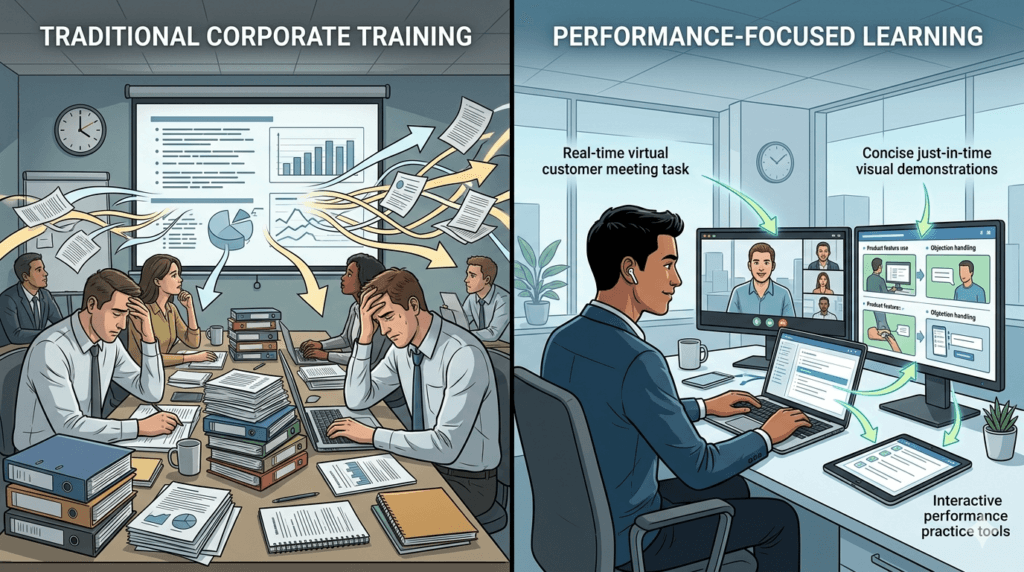
Knowing the principles is one thing. Seeing them assembled into an actual course design is another. What follows is a complete worked example using Meridian Software — a fictional B2B SaaS company — as the context. The training challenge: onboarding new account managers onto Meridian’s sales methodology and CRM workflow before their first client call.
Follow each step as a design decision, not a template. The principle in brackets is the condition being applied.
| 📋 The Meridian Software scenario Meridian Software has just doubled its sales headcount. New account managers are being hired with strong general sales experience but no familiarity with Meridian’s consultative sales methodology or its CRM system. The L&D team has four weeks before the first cohort takes a live client call. The business goal: reps who can qualify a deal and move it through the pipeline correctly from day one. |
Step 1: Define the Real-World Task First (Task-Centred Principle)
Before writing a single slide or learning objective, the Meridian L&D team identifies the task learners must actually perform:
| 🎯 Meridian’s task statement “Correctly qualify an inbound lead using Meridian’s MEDDIC criteria and move it to the ‘Proposal’ stage in Salesforce within the first client discovery call.” |
This is not a topic. It is a task with a measurable outcome, a real tool, and a defined context. Every design decision that follows will be tested against it: does this content help a new account manager complete that task? If not, it gets cut.
Notice what this rules out immediately: a module on ‘Meridian’s history and values,’ a slide deck on CRM best practices in general, and a 40-minute product overview. None of those help a rep qualify a deal on a live call. They get moved to a reference library — or dropped entirely.
Step 2: Design the Activation Opening (Activation Principle)
The Meridian course does not open with a welcome screen or a list of objectives. It opens with this:
| 💬 Meridian’s activation prompt “Think about the last deal you worked where you felt like you were chasing the prospect more than they were engaging with you. What information did you not have early enough? What would have changed if you had it on the first call?” |
New account managers — all of whom have prior sales experience — immediately have something real to attach to. They are not starting from zero. They are connecting the new methodology to a problem they have already lived.
In a virtual ILT setting, this runs as a two-minute paired discussion before any instruction begins. In the eLearning version, it is a reflective free-text prompt. Either way, it takes five minutes and eliminates the cognitive cold start that kills retention.
Step 3: Build Demonstrations Before Writing Content (Demonstration Principle)
Most instructional designers would now write the MEDDIC framework content and build slides explaining each letter. The Meridian team does the opposite — they build the demonstrations first.
They record two Salesforce screen walkthroughs with a senior account manager narrating their thinking in real time:
- A rep works through a genuine discovery call recording, pausing to show how each MEDDIC criterion is captured in Salesforce fields — narrating why each piece of information changes the qualification decision.
- The same rep walks through a deal that stalled at proposal stage. They identify the three MEDDIC fields left blank after the discovery call and explain what the rep should have asked to fill them.
The explanatory content — what MEDDIC stands for, what each criterion means — is written afterwards, to support the demonstrations. Learners encounter mastery before they encounter theory. This is the sequence that produces retention.
What Meridian avoids: a slide deck that lists the six MEDDIC criteria with bullet-point definitions. That is explanation, not demonstration. It tells learners what to do without ever showing them what doing it well actually looks like.
Step 4: Design Practice with Feedback Loops (Application Principle)
After each demonstration, learners practise — in a context that matches the real task as closely as possible.
Guided practice (after Demo 1):
- Learners are given a written transcript of a discovery call with a fictional Meridian prospect.
- They complete a Salesforce sandbox entry, filling in each MEDDIC field based on what the prospect said.
- They receive a model answer showing what a senior rep would have entered — with annotations explaining each decision.
Independent practice (after Demo 2):
- Learners watch a new, unnarrated discovery call recording — different industry, different deal size.
- They complete the full qualification without scaffolding.
- A manager or facilitator reviews the Salesforce entry and provides written feedback within 24 hours, using a structured rubric tied to the MEDDIC criteria.
The feedback must be specific: “Economic Buyer field is blank — you had the information on line 7 of the transcript. Budget authority was confirmed but not recorded. This would have caused a stage-two problem.” That is application. A percentage score on a knowledge quiz is not.
Step 5: Close with an Integration Commitment (Integration Principle)
The Meridian onboarding programme does not end with a completion screen. It ends with a structured commitment — and a mechanism to follow through on it.
| 📌 Meridian’s integration close “Before your first live discovery call, identify one MEDDIC criterion you historically under-qualify. Write down the two questions you will ask to fill it. Share this with your manager before the call. After the call, log whether you got the information and what you would ask differently next time.” |
The manager receives a briefing card before the new rep’s first call. It contains three things: what the rep committed to practising, one question to ask in the post-call debrief, and the Salesforce fields to review together.
At day 7, an automated nudge is sent to both the rep and manager: “How did your first three discovery calls go? Are your MEDDIC fields complete before moving to Proposal stage?” At day 21, the manager conducts a structured call review using the same rubric from the practice stage.
The result: the training does not end when the module closes. The learning environment extends into the first real calls — which is where behaviour change either happens or it does not.
| ✅ Meridian’s design at a glance Task-Centred: Qualify a lead using MEDDIC and move it to Proposal stage in Salesforce on the first discovery call. Activation: Reps reflect on a past deal where they lacked early qualification data. Demonstration: Two narrated Salesforce walkthroughs — one strong example, one failure case — before any theory is introduced. Application: Guided Salesforce sandbox entry with model answer, followed by independent practice with personalised manager feedback. Integration: Pre-call commitment, manager briefing card, day-7 nudge, and day-21 structured call review. |
Notice that nothing in the Meridian design is novel or expensive. No game mechanics, no immersive VR, no AI-powered personalisation. Just five principles applied with discipline to a real performance problem — and a follow-up mechanism that makes transfer the default, not the exception.
How to Use Merrill’s Principles of Instruction in eLearning
Merrill’s Principles of Instruction in eLearning are just as applicable as in the classroom — but the tactics need to adapt for a self-paced, screen-based environment.
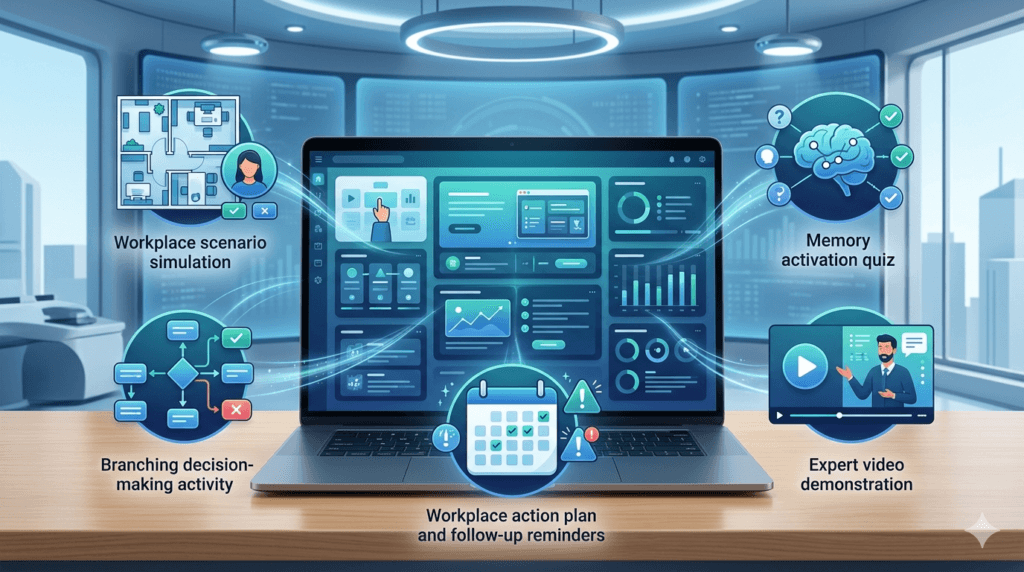
Here is how each of the five principles translates into specific eLearning design decisions.
Task-Centred in eLearning: Lead with a Scenario
Open every module with a realistic workplace scenario rather than a menu screen or learning objectives slide. Use a character-based narrative: “You are Alex, a regional manager. You have just received a complaint from a long-standing client…” The learner is now emotionally and cognitively invested. Every piece of content that follows is framed as helping Alex resolve the situation.
Tools and formats: Storyline branching scenarios, Rise 360 scenario blocks, custom HTML5 scenarios.
Activation in eLearning: Pre-Assessments and Reflective Prompts
Use a short pre-quiz (ungraded) at the start of a module to activate prior knowledge. Alternatively, show a brief video of a common workplace situation and ask a reflective question before any instruction begins.
Some platforms allow free-text entry for reflection — even if no one reads the responses, the act of writing activates memory and primes learners for new content.
Demonstration in eLearning: Video Walkthroughs and Annotated Examples
Short, narrated screen recordings (for software skills) or video role-plays (for interpersonal skills) are the eLearning equivalent of a live demonstration. Keep them under three minutes.
Show the thinking, not just the action — expert narration (“I’m pausing here because…”) is what separates a useful demo from a passive video. For knowledge-based content, use annotated worked examples: walk learners through a solved problem before asking them to solve one independently.
Tools: Camtasia, Loom, Articulate’s built-in video, or embedded YouTube (with caution for security and distraction).
Application in eLearning: Branching Scenarios and Simulations
Branching scenarios are the gold standard of eLearning application. Present learners with a realistic decision point, let them choose, show them the consequences, and give specific feedback.
Multiple branches allow learners to experience both effective and ineffective approaches in a safe environment. For software training, click-through simulations provide authentic practice without risk to live data.
Avoid the “three-distractors-and-one-correct-answer” multiple choice question as your primary application strategy. It tests recall, not performance.
Integration in eLearning: Action Planning and Manager Emails
Most LMS platforms allow you to add a free-text response question at the end of a course. Use it as an action planning prompt. Go further by triggering an automated email to the learner’s manager (if your platform supports it) summarising what they completed and asking the manager to have a brief follow-up conversation.
If your LMS cannot do this, a post-course PDF action plan template (downloadable) is a simple and effective alternative.
Merrill’s Principles of Instruction vs Other Instructional Design Models

Merrill’s Principles of Instructional Design sit within a broader ecosystem of instructional design frameworks. Here is how they compare with the three models L&D professionals encounter most often.
Merrill vs ADDIE
ADDIE (Analyse, Design, Develop, Implement, Evaluate) is a process model — it tells you the steps to follow to build a training programme. Merrill’s Principles are a content model — they tell you what effective instruction must contain.
They are not in competition. You can follow the ADDIE process while ensuring every module you design embeds Merrill’s five principles. Think of ADDIE as the project management framework and Merrill as the quality checklist.
Further Reading: ADDIE Model Explained Step by Step with a Real Corporate Example
Merrill vs SAM
The Successive Approximation Model (SAM) is an agile, iterative alternative to ADDIE. Like ADDIE, it is a process model focused on how to build training quickly through rapid prototyping and stakeholder feedback cycles.
Merrill’s Principles can be applied within SAM just as easily as ADDIE. In fact, Merrill’s Task-Centred principle aligns well with SAM’s emphasis on starting with a real performance problem rather than a content outline.
Further Reading: SAM Model: How to Build Training Faster Without Sacrificing Quality
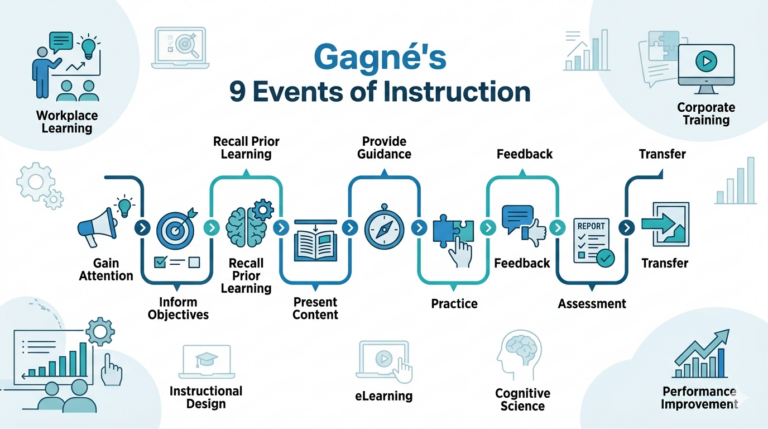
Merrill’s Principles vs Gagné’s Nine Events of Instruction
Gagné’s Nine Events are perhaps the closest cousin to Merrill’s Principles. Both are prescriptive models focused on the conditions of learning. The key differences:
- Gagné’s model is more granular (nine steps versus five principles) and maps closely to the cognitive processes involved in each event.
- Merrill’s model is less sequential and more principled — the five conditions can be applied flexibly rather than as a rigid sequence.
- Gagné works particularly well for systematic instructional design in formal settings. Merrill is arguably more flexible and transferable to a range of formats, including modern eLearning and performance support.
Many experienced instructional designers draw on both, using Gagné’s events as a micro-level checklist and Merrill’s principles as a macro-level quality test.
Further reading: A complete and comprehensive guide on Gagné’s 9 events of Instructions.
Merrill vs Bloom’s Taxonomy
Bloom’s Taxonomy (1956, revised by Anderson and Krathwohl in 2001) classifies learning objectives by cognitive complexity — from Remember and Understand at the lower end, through Apply and Analyse, to Evaluate and Create at the highest levels.
The relationship with Merrill’s Principles is complementary rather than competitive. Bloom’s Taxonomy tells you what level of thinking you are targeting; Merrill’s Principles tell you how to design instruction that achieves it. In practice, this means:
- If Bloom’s analysis tells you the learning objective is at the Apply or higher level, all five of Merrill’s Principles are likely needed — especially authentic Application and Integration.
- If the objective is at the Remember or Understand level (factual recall, awareness), Merrill’s full framework may be more than is required.
- Bloom’s also helps you write the Task-Centred scenario: a task that targets Analyse-level thinking needs a more complex problem structure than one targeting basic Recall.
Many experienced instructional designers use Bloom’s Taxonomy to set the level of a learning objective and Merrill’s Principles to design the instruction that develops it. The two tools answer different questions — and together they provide a more complete design foundation than either alone. Read our comprehensive guide on Bloom’s Taxonomy and get access to 8 premium templates for free.
A Quick Comparison at a Glance
| Model | Type | Best Used For | Sequence Required? |
| Merrill’s Principles | Content quality framework | Any training format — ILT, VILT, eLearning | No — principles, not steps |
| ADDIE | Process / project model | Formal course development projects | Yes — five sequential phases |
| SAM | Agile process model | Rapid development, iterative prototyping | Iterative, not strictly sequential |
| Gagné’s Nine Events | Instructional sequence model | Systematic lesson design, formal instruction | Yes — nine sequential events |
| Bloom’s Taxonomy | Learning objective classifier | Setting cognitive level of objectives | No — a classification system |
For a deeper look at experiential learning theory and how it connects to Merrill’s Integration principle, see also: Kolb’s Experiential Learning.
Merrill’s Principles of Instruction: Quick Audit Checklist
Use this checklist to audit any training you are designing — or to review existing courses for quality gaps. For each principle, ask whether the condition is genuinely met (not just technically present).
| ✓ | Audit Question | Principle |
| ☐ | Is the course built around a whole, real-world task — not isolated topics? | Task-Centred |
| ☐ | Does the first 5–10 minutes activate what learners already know or have experienced? | Activation |
| ☐ | Are there at least two demonstrations showing mastery in context (not just explained)? | Demonstration |
| ☐ | Is there a narrated worked example, not just a list of steps? | Demonstration |
| ☐ | Do learners actually practise the skill — not just recall facts? | Application |
| ☐ | Is feedback specific, timely, and tied to the actual task? | Application |
| ☐ | Does practice start guided and progress to independent? | Application |
| ☐ | Is there a structured integration moment (action plan, commitment, or on-the-job task)? | Integration |
| ☐ | Is there a follow-up mechanism at day 7 or day 21 to reinforce transfer? | Integration |
| ☐ | Can a learner answer “why does this matter to my job” within the first five minutes? | Task-Centred |
If you cannot tick every box, that is your design brief. Each unchecked item is a specific, actionable gap — not a vague quality problem.
Criticisms and Limitations of Merrill’s Principles of Instruction
Any framework applied uncritically becomes a liability. Merrill’s Principles are well-evidenced and widely applicable — but they have real limitations that experienced practitioners should understand.
1. No guidance on project workflow. Merrill’s Principles tell you what effective instruction must contain, but they say nothing about how to manage the process of building it. There is no advice on scoping, stakeholder management, revision cycles, or timelines. In practice, most instructional designers need to combine Merrill’s Principles with a process model — ADDIE or SAM — to have a complete design methodology.
2. Does not address stakeholder and organisational constraints. Real training projects rarely fail on instructional quality alone. Budget constraints, subject matter expert availability, legal sign-off, and political priorities all shape what actually gets built. Merrill’s framework operates in an ideal design space that does not account for these realities. A training manager using Merrill’s Principles still needs separate tools for stakeholder management.
3. Less useful for awareness-only learning. Not all organisational communication is training. Newsletters, policy updates, awareness campaigns, and information briefings are legitimate interventions — but they do not require task-centred design, demonstrations, or integration mechanisms. Applying Merrill’s Principles to these content types produces over-engineered solutions to simple communication problems.
4. Can be resource-intensive to implement fully. A properly task-centred course with two demonstrations, guided and independent practice, and a 21-day follow-up mechanism takes significantly more time and budget to build than a slide deck. For organisations with limited L&D resource, the full application of Merrill’s Principles may not be feasible for every training need — requiring prioritisation.
5. Requires strong subject matter expertise. Merrill’s Demonstration principle, in particular, depends on access to credible, observable examples of mastery. If the subject matter expert cannot articulate what good performance looks and sounds like — or is unavailable to support development — the demonstration stage breaks down. The framework assumes SME access that not all teams have.
6. Limited guidance on learning objectives. Merrill’s framework does not include a system for classifying the type or level of learning being targeted. Practitioners often need to combine it with Bloom’s Taxonomy or Gagné’s conditions to determine whether they are designing for knowledge recall, procedural skill, or complex problem-solving — distinctions that significantly affect design decisions.
None of these limitations invalidate the framework. They do, however, confirm that Merrill’s Principles are best understood as one essential tool in a broader toolkit — not a complete instructional design methodology on their own.
Conclusion
A principle-based approach to instructional design does not make training more complicated — it makes it more honest. Merrill’s Principles of Instruction strip away the illusion that covering content equals teaching, and replace it with a clear standard: effective training is built around real tasks, activates what learners already know, shows mastery before asking for it, creates genuine practice with feedback, and helps learners carry new skills back to the job.
If you take nothing else from this guide, take this: design the task first, the demonstration second, and the explanation third. Most training programmes do the opposite — and most training programmes are forgotten within a week.
Ready to put this into practice?
Download the lesson plan template from the resource section above and apply it to your next training project. Or drop a comment below and share an example of how you have used one of Merrill’s principles in your own work — we would love to hear how it is playing out in real corporate training environments.
The Course Redesign Roadmap gives you a step-by-step plan to retrofit Merrill’s five principles into an existing programme — without rebuilding from scratch. Work through the audit, identify exactly which principles are missing, and follow a phased plan to close the gaps.
Found this guide useful? Share it with a fellow L&D professional or bookmark it for your next course build.
Frequently Asked Questions About Merrill’s Principles of Instruction
What are Merrill’s Principles of Instruction?
Merrill’s Principles of Instruction are five conditions that must be present in any effective instructional experience: task-centred learning, activation, demonstration, application, and integration. Developed by M. David Merrill in 2002, they define what good instruction must contain — regardless of format or delivery method.
What are the 5 principles of Merrill’s instructional design model?
The five principles are: (1) Task-Centred — learning is built around a real-world task; (2) Activation — prior knowledge is surfaced before new content is introduced; (3) Demonstration — new skills are shown in context, not just explained; (4) Application — learners practise with specific feedback; and (5) Integration — learners are supported to transfer skills back to the job.
How is Merrill’s Principles of Instruction different from ADDIE?
ADDIE is a process model that tells you how to build training. Merrill’s Principles are a content model that defines what effective instruction must contain. They are complementary — use ADDIE as your project framework and Merrill’s Principles as your quality checklist.
Can Merrill’s Principles of Instruction be used in eLearning?
Yes. All five principles apply directly to eLearning: scenarios replace live tasks, pre-quizzes replace verbal activation, narrated screen recordings replace live demos, branching scenarios replace role plays, and action planning prompts replace in-room integration activities.
What is a real example of Merrill’s Principles of Instruction in training?
A sales onboarding course opens with a live objection scenario (Task-Centred), asks reps to reflect on past difficult calls (Activation), shows a recorded call with narrated reasoning (Demonstration), has reps draft and refine their own responses with peer feedback (Application), and closes with a three-call commitment reviewed by a manager at day 14 (Integration).
Is Merrill’s instructional design model suitable for all training?
Merrill’s Principles work best for skill-based, performance-critical training where learners must do something differently. They are less suited to quick reference materials, awareness communications, or microlearning under three minutes where embedding all five principles would pad the content artificially.
What are the most common mistakes when applying Merrill’s Principles?
The most common mistakes are: treating the principles as a checklist rather than an integrated framework; skipping activation; using passive slides as demonstration; mistaking a knowledge quiz for application; and failing to build a real integration mechanism beyond a single action planning slide.
References
- Merrill, M.D. (2002). First Principles of Instruction.
- Merrill, M.D. (2013). Pebble-in-the-Pond Instructional Design.
- Sweller, J. (1988). Cognitive Load During Problem Solving.
- Clark, R. & Mayer, R. Evidence-Based Training Methods.
- Roediger, H. & Karpicke, J. Test-Enhanced Learning.
- Blume, B. et al. Transfer of Training Meta-Analysis.
Further Reads
- Bloom’s Taxonomy
- Instruction Designing Models
- ADDIE Model of Instructional Designing
- Successive Approximation Model (SAM): Complete Guide + 8 Free Templates
- Kolb’s Learning Cycle: Using Experiential Learning in the Workplace
- Gagné’s 9 Events of Instruction: A Practical Guide for Trainers with Real Examples
- ADDIE vs SAM: Which Instructional Design Model Should You Use in 2026?
- ARCS Model of Motivation — The Complete Guide for Corporate Trainers [2026]
- Adult Learning Theory (Andragogy): Knowles’ 6 Principles Explained with Workplace Examples
- Cognitive Load Theory Explained: A Practical Guide for Trainers & Instructional Designers
- Kirkpatrick Model: How to Measure Training Effectiveness
- Backward Design – The Complete Framework for Planning Learning
- Action Mapping: A Step-by-Step Guide with Examples
Author Details

Arindam is a learning and development entrepreneur. He has designed and delivered learning solutions across leadership development, sales enablement, customer experience and digital learning initiatives over the past 15 years. Reach out to him at arindam@trainercentric.in or via his Linkedin Profile: Linkedin